
Ensuring a Smooth Pathway
The Growing Demand for Early Childhood Educators with BAs
Early childhood educators have a unique opportunity to foster the development of cognitive, behavioral, and social skills. But the work is not easy. Effective educators need both a deep understanding of child development and mastery of a complex set of skills to meet the learning needs of young children. Accordingly, there is a growing demand across the country for early childhood educators with a bachelor’s degree education. For example, 35 state pre-K programs now require lead teachers to possess a bachelor’s degree, up from 26 programs with such a degree requirement 10 years ago.1 And the 2007 reauthorization of Head Start required half of all lead teachers to hold bachelor’s degrees with training in early education. Currently about 74 percent of Head Start leaders hold a bachelor’s or advanced degree in early childhood or a related field.2
The momentum towards a demand for early educators with at least a bachelor’s degree has only grown in the last several years. In 2015, the National Academies of Science, Engineering, and Medicine released Transforming the Workforce for Children Birth Through Age 8,3 a report that explores the science of child development and its implications for professionals who work with young children. The most significant recommendation in the report was the call for a transition to a minimum bachelor’s degree qualification requirement for all lead teachers working with children from birth through age eight.
35 state pre-K programs now require lead teachers to possess a bachelor’s degree, up from 26 programs with such a degree requirement 10 years ago.
In order to unpack the complexities of this recommendation and its implications for teachers of three- and four-year-olds, New America and Bellwether Education Partners engaged the nation’s leading experts on early childhood teacher preparation in a discussion of what preparation for current and future early educators should look like and the potential of new, more accessible, and higher-quality models for degree programs. New America and Bellwether convened a day-long meeting in Washington, D.C. on September 26, 2017 and conducted follow-up interviews throughout the fall with selected attendees and other experts. In February 2018, we released a paper synthesizing our findings and elevating issues that need to be addressed to ensure that all pre-K teachers have the core knowledge and competencies needed to effectively teach three- and four-year-olds.4 This brief on articulation agreements is the first in a series that will explore strategies to help address some of those issues.
The Importance of Articulation Agreements for Improving Access and Completion
Community colleges are well-positioned to help meet the growing demand for early educators with bachelor’s degrees. The majority of early childhood degree programs are already located in these two-year institutions, including programs designed for educators pursuing a Child Development (CDA) credential, associate degree, or coursework in order to ultimately obtain a bachelor’s degree.5 As of 2009, more than 700 higher education institutions offered associate degree programs in early childhood education (ECE), with the majority of these degrees offered at community colleges.6
Community colleges are an appealing option for many early educators for several reasons. Beginning one’s studies at a two-year institution is generally less expensive than doing so at a four-year university, for example. Community colleges are also more likely to offer flexible options for students, such as part-time schedules, online courses, and classes on nights and weekends to accommodate those who attend school while simultaneously working or taking care of their children.7
But for students who want to eventually receive a bachelor’s degree and become a lead early childhood teacher, the time and money they invest in their community college studies is only beneficial if they can smoothly transition into a four-year institution without loss of credit. Articulation agreements help ensure that smoother pathway, minimizing the waste of time and money that current and future early educators risk when they cannot transfer credits and need to take duplicative courses.
These agreements enable students to earn an associate degree and then enter a four-year institution with junior standing and 52 to 60 credit hours to apply to required program credits in their field of study.8 Ideally, these credits would include coursework specific to early education that helps educators already in the classroom immediately improve their teaching practice as well as general education courses that prepare them for bachelor’s-level coursework. As the National Association for the Education of Young Children (NAEYC) states in a 2009 position statement, the focus should be on designing coursework that “simultaneously enhance[s] one’s current practice while still maintaining transfer options from associate to baccalaureate to graduate degree programs.”9 It is only through strong articulation agreements formed between two- and four-year institutions that this vision can be made into reality.
Box 1
Articulation between a CDA and Associate Degree
The Child Development Associate (CDA) is considered the entry-level credential for individuals interesting in pursuing a career in ECE. Currently, some associate degree programs offer credit for students who possess a CDA or state-issued equivalent credential, but policies vary by state and institution. Florida, for example, guarantees articulation of nine credit hours toward a postsecondary degree in ECE for students who have earned a CDA (or state-issued equivalent) and received training in emergent literacy.10 New Mexico has attempted to ease transfer by creating a state-issued equivalent credential to the CDA, the New Mexico Child Development Certificate. Advantages of obtaining the state credential include the fact that all of the coursework can be applied towards an associate degree, the credential does not expire, and the application costs associated with the credential are less than for the CDA.11
| Type of Agreement | Description | Factors to Consider |
|---|---|---|
| Faculty-to-Faculty | · Created when early childhood faculty members at various institutions negotiate individual transfer agreements between their programs | · Dependent upon trust between leaders at different institutions; can end with faculty turnover |
| Course-to-Course | · Created when specific courses are matched between two institutions · Two- and four-year institutions work together to create matching numbers, titles, and syllabi to ensure a smooth transfer of credit between institutions | · Remain stable when faculty change, but can be threatened if significant course changes take place · Courses are locked into place once the agreement is reached, possibly limiting innovation · Agreements notoriously onerous and time-consuming to implement |
| Program-to-Program | · Agreement in which the entire associate degree program transfers to a four-year institution once the degree is completed | · Successful student performance can be shown through an outcomes-based measure, such as a capstone portfolio · Student performance can be measured against national professional standards; program quality can be verified through national accreditation |
There are several advantages to program-to-program agreements over other types of agreements. Under this model, there is no need to do the time-consuming and difficult work of establishing course-to-course correspondence between institutions. Rather than a focus on matching course numbers and titles, the focus is on ensuring that students meet specific competencies and are adequately prepared to continue their education and obtain a bachelor’s degree.
The advantages of program-to-program agreements are multiplied when these agreements are implemented statewide. Statewide agreements offer benefits to both institutions and students in comparison to individual program-to-program agreements that can be difficult to manage. Under a statewide program-to-program agreement, community colleges are able to offer a smooth transfer pathway that attracts new students while four-year institutions gain students who already have a track record of success in undergraduate coursework. Students gain an easy-to-understand transfer pathway that is more stable than an agreement based on course-to-course correspondence or faculty trust. Furthermore, they no longer need to decide on a transfer institution at the moment they enter community college because they are assured that their entire degree will transfer to any public institution within the state.13
Why Agreements Are Difficult to Establish and Maintain
Forming and maintaining articulation agreements that guarantee a smooth pathway from a community college to a bachelor’s degree program is no easy task. Enabling successful degree completion and credit transfer for prospective educators while simultaneously increasing the amount of early childhood-specific content taught at each degree level has been an elusive goal for decades.
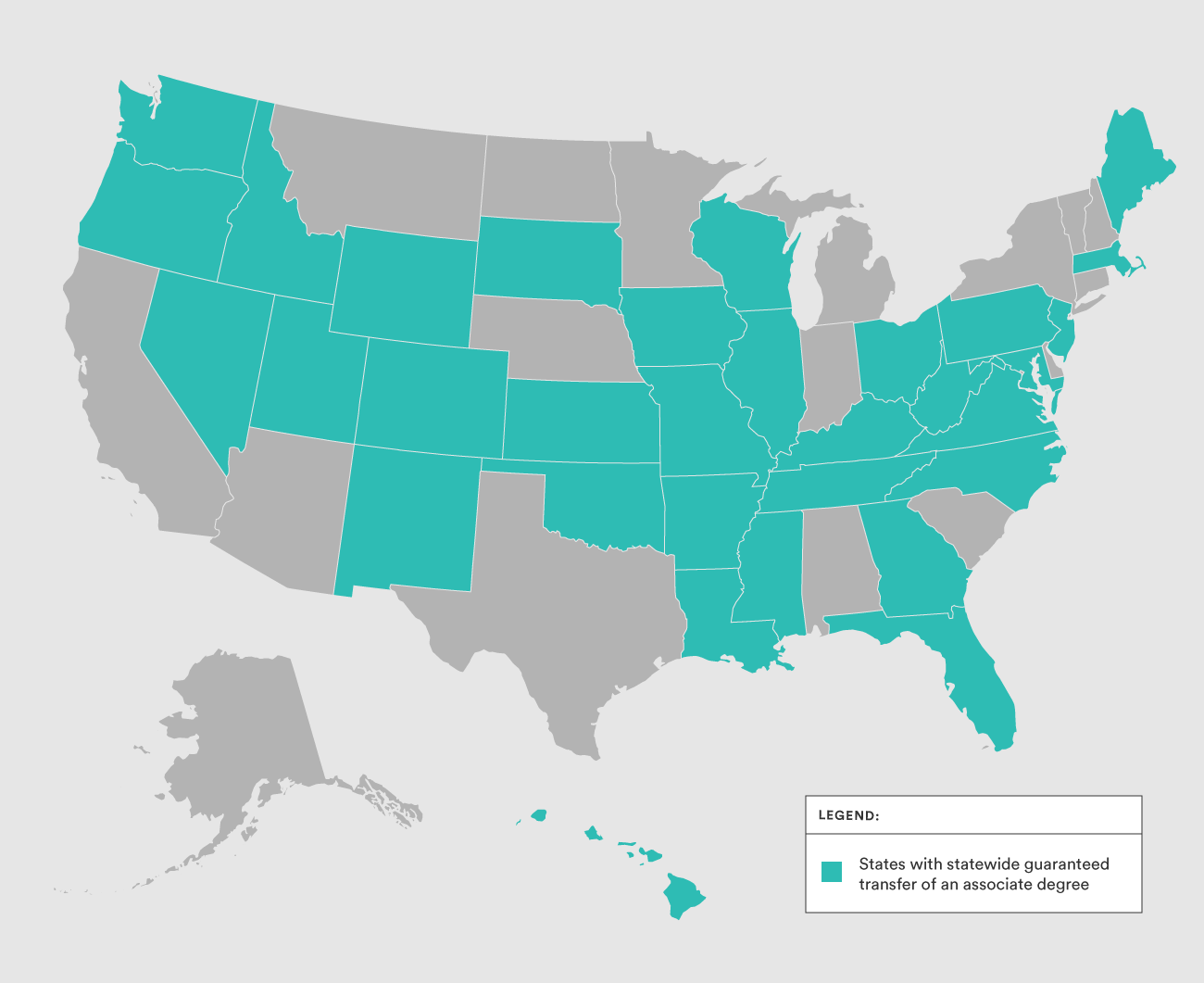
The majority of states have policies guaranteeing that students with an associate degree can transfer all of their credits to a public four-year institution in that state and enter with junior standing. In these states, students who transfer with an associate degree generally are not required to complete additional general education courses (see map below).14 But a policy of statewide guaranteed transfer of an associate degree, while helpful to many students, does not help future early educators who have taken early childhood-specific courses at community college in addition to general education courses. If only general education courses are guaranteed to transfer to a four-year institution, then aspiring early educators will likely have to complete duplicative early childhood-specific courses at their four-year school even if they have successfully completed similar courses in community college.
If only general education courses are guaranteed to transfer to a four-year institution, then aspiring early educators will likely have to complete duplicative early childhood-specific courses at their four-year school even if they have successfully completed similar courses in community college.
Much of the difficulty of establishing articulation agreements specific to ECE lies in the fact that many associate degree programs in ECE were originally established as terminal degrees, marking the end of an educational pathway rather than the first step towards a bachelor’s degree. Many of these programs were designed to prepare students for a specific role in the classroom, such as classroom aide or assistant teacher. These programs were not generally designed by university administrators concerned about the possibility and ease of transfer. These terminal degree programs are generally more focused on courses that teach skills and content relevant to working in early childhood programs and include fewer of the general education courses likely to easily transfer into a bachelor’s degree program.15
Articulation agreements specific to ECE are notoriously difficult and time-consuming to create and implement. For example, thanks to funding from the W. K. Kellogg Foundation, the T.E.A.C.H. Early Childhood National Center recently assisted 10 states with efforts to achieve statewide articulation agreements over a two-year period.16 The difficulty and complexity of the work involved, however, forced most state teams to revise their original goal because they quickly realized such an agreement could not be reached within two years.17
Another challenge is that four-year institutions are increasingly judged on whether their graduates can attain jobs that pay well. Unless an early childhood educator is hired as a public school teacher, it is unlikely that educator will be paid well. Data from the Center for the Study of Child Care Employment show, for example, that even with a bachelor’s degree, teachers of young children in private settings are paid approximately $29,000 per year compared to $43,000 for pre-K teachers in public schools.18 This can cause four-year institutions to fail to prioritize the improvement of credit transfer for future early educators. Some colleges actually bar students enrolled in ECE programs from obtaining certain types of loans due to fears that they will struggle to pay back the loans on time.19
Pennsylvania and Indiana: The Advantages of a Statewide Program-to-Program Model
Pennsylvania and Indiana are states that implemented statewide program-to-program articulation agreements that aim to provide a smooth, predictable pathway for future early educators from an associate degree to a bachelor’s degree.
In 2009, the Pennsylvania legislature passed a law that required the state’s four-year public institutions to accept the entire Associate of Arts or Associate of Science degree toward the graduation requirements of a bachelor’s degree program. This legislation included language stressing the importance of ensuring articulation between two- and four-year institutions for students pursuing ECE degrees.20
Pennsylvania’s statewide articulation system for ECE is one that focuses on major competencies and learning outcomes rather than course-matching between institutions. In order to ensure program quality, two-year institutions are required to use NAEYC standards and outcomes to guide program development. Program accreditation from NAEYC is strongly encouraged, but not mandatory. A capstone portfolio compiled of assessments aligned with NAEYC’s Professional Preparation Standards serves as the main exit criterion for students graduating from an associate degree program, in addition to at least 40 hours of field experience. The two-year institution assesses the capstone portfolio according to a statewide rubric and certifies that the graduate has met all required learning outcomes. Successful graduates of the associate degree program are then guaranteed entrance to a four-year institution with full junior standing and 60 transfer credits: 30 credits in general education and 30 credits in ECE-specific courses.21
In 2013, the Indiana legislature passed a bill that required state educational institutions to create a single articulation pathway for programmatic areas in which large numbers of students first obtain an associate degree with the intent of eventually obtaining a bachelor’s degree.22 The bill led to the creation of Transfer Single Articulation Pathways (TSAPs), competency-based tracks meant to promote seamless transfer from two-year to four-year degree programs at public institutions in 13 program areas, including ECE. Students enrolled in the ECE TSAP complete a general education core of 30 credit hours as well as 30 credit hours in ECE-specific courses that are aligned with NAEYC standards. Upon successful completion of the TSAP, students can transfer all 60 credits into a bachelor’s degree program at a four-year public institution and enter with junior status.23
According to Russ Baker, vice president of Academic Affairs at Ivy Tech Community College, prior to the implementation of TSAP the college had separate articulation agreements in place with each four-year public institution in the state, leading to “an impossibly complex situation where students have a different path depending on what four-year institution they ultimately want to transfer to.” Ken Sauer, senior associate commissioner and chief academic officer for the Indiana Commission for Higher Education, notes that TSAP has led to “a system that really is functioning” by easing transfer difficulties for students and saving money for both students and the state. The ECE TSAP officially launched in 2015 and 24 students recently graduated with an associate degree from the program with plans to pursue a bachelor’s degree at a four-year institution; 15 to 20 more students are expected to graduate the program at the conclusion of the spring 2018 semester.24
Conclusion
Articulation agreements can be an important tool for helping current and future early educators attain a bachelor’s degree. When implemented well, they can ease the burden that students have too often faced when moving from a two-year to a four-year institution, reducing the extra time and money spent on courses that do not transfer.
As states consider ways to help more early educators attain a four-year degree, leaders should look to articulation agreements as one potential tool. The multiple benefits of achieving a statewide program-to-program articulation agreement should be considered and weighed against course-to-course agreements that require the matching of course numbers, titles, and syllabi. Pennsylvania and Indiana have both implemented statewide agreements; the long-term results of the agreements are worthy of further study.
Box 2
Useful Resources for Further Reading
- Alison Lutton, “Supporting Successful Degree Completion by Early Childhood Professionals”
- Marnie Kaplan, “It Takes A Community: Leveraging Community College Capacity to Transform the Early Childhood Workforce”
- T.E.A.C.H. Early Childhood National Center, “Early Childhood Articulation Project Compendium”
Acknowledgments
This paper benefited from the insights of many. I am especially grateful for the help of Alison Lutton, Marnie Kaplan, and Sue Russell in sharing their expertise. Thanks to officials from Indiana for speaking to me about their state’s efforts to ease articulation difficulties. Thanks to New America colleagues Lisa Guernsey, Laura Bornfreund, and Sabrina Detlef for their expert and editorial insight and to Anisha Ford for her support. Maria Elkin and Riker Pasterkiewicz provided layout and communication support. This work would not have been possible without the generous support of the Joyce Foundation and the Alliance for Early Success. The views expressed in this paper are those of the author alone.
Downloads
Citations
- W. Steven Barnett, Allison H. Friedman-Krauss, G. G. Weisenfeld, Michelle Horowitz, Richard Kasmin, and James H. Squires, The State of Preschool 2016: State Preschool Yearbook (New Brunswick, NJ: National Institute for Early Education Research, 2017), source.
- Marnie Kaplan and Sara Mead, The Best Teachers for Our Littlest Learners? Lessons from Head Start’s Last Decade (Washington DC: Bellwether Education Partners, February 2017), source.
- LaRue Allen and Bridget B. Kelly, eds., Transforming the Workforce for Children Birth Through Age 8: A Unifying Foundation (Washington, DC: National Academies Press, 2015), source.
- Emily Workman, Lisa Guernsey, and Sara Mead, Pre-K Teachers and Bachelor’s Degrees: Envisioning Equitable Access to High-Quality Preparation Programs (Washington, DC: New America, February 2018), source.
- Marnie Kaplan, It Takes a Community: Leveraging Community College Capacity to Transform the Early Childhood Workforce (Washington, DC: Bellwether Education Partners, January 2018), source.
- NAEYC Standards for Early Childhood Professional Preparation (Washington, DC: National Association for the Education of Young Children, July 2009), source.
- Briana Boyington, “4 Reasons for High School Graduates to Turn to Community College,” U.S. News & World Report, April 16, 2015, source.
- Early Childhood Articulation Project Compendium (Chapel Hill, NC: T.E.A.C.H. Early Childhood National Center, August 2015), source.
- NAEYC Standards for Early Childhood Professional Preparation (Washington, DC: National Association for the Education of Young Children, July 2009), source.
- Florida Department of Education, “Notice of Statewide Articulation: Child Care Credentials to AS Degree Program,” source.
- Central New Mexico Community College (website), “Child Development Certificate,” source.
- Alison Lutton, “Advancing the Early Childhood Profession: Supporting Successful Degree Completion by Early Childhood Professionals,” YC Young Children 68, no. 5 (November 2013): 51–53, source.
- Alison Lutton memorandum, August 2017, “Program-to-Program Articulation.”
- Education Commission of the States (website), 50-State Comparison, “Transfer and Articulation: Statewide Guaranteed Transfer of an Associate Degree,” April 2016, source.
- Marnie Kaplan, It Takes a Community: Leveraging Community College Capacity to Transform the Early Childhood Workforce (Washington, DC: Bellwether Education Partners, January 2018), source.
- The states are Alabama, Arizona, Florida, Indiana, Iowa, Michigan, North Carolina, Ohio, West Virginia, and Wisconsin.
- Early Childhood Articulation Project Compendium (Chapel Hill, NC: T.E.A.C.H. Early Childhood National Center, August 2015), 3-4, source.
- Marcy Whitebook, Caitlin McLean, and Lea J. E. Austin, Early Childhood Workforce Index: 2016 (Berkeley, CA: Center for the Study of Child Care Employment, 2016), source.
- Ben Barrett and Amy Laitinen, Off Limits: More to Learn Before Congress Allows Colleges to Restrict Student Borrowing (Washington, DC: New America, May 2017), source.
- Pennsylvania General Assembly (website), “2009 Act 50,” source.
- Pennsylvania Department of Education, “Pennsylvania Statewide Program-to-Program ArticulationAgreement for Degrees Leading to PK–4 Teacher Certification,” April 11, 2012, source.
- State of Indiana, “Senate Enrolled Act No.182,” 2013 source.
- Transfer Single Articulation Pathways (TSAP) (Indianapolis: Indiana Commission for Higher Education May 21, 2015), source.
- Russ Baker (vice president of academic affairs, Ivy Tech Community College), Rebecca Carothers (early childhood education program chair, Ivy Tech Community College), Ken Sauer (senior associate commissioner and chief academic officer, Indiana Commission for Higher Education), and Dawn Clark (assistant director of academic affairs, Indiana Commission for Higher Education), phone interview with author, May 2018.
More About the Authors

Aaron Loewenberg
Senior Policy Analyst, Early & Elementary Education
Issues
Programs/Projects/Initiatives
Related