
Earning While Learning with Early Educator Apprenticeship Programs
The Growing Demand for Early Childhood Educators with BAs
Early childhood educators have a unique opportunity to foster the development of cognitive, behavioral, and social skills. But the work is not easy. Effective educators need to master a complex set of skills, which requires high-quality educational and training programs rooted in child development and practicums in early childhood classrooms led by highly qualified teachers.
Finding highly qualified teachers can be challenging, however. Historically, the work has been considered low-skilled, employing people with limited education and training, and offering low wages to match. At present, most early childhood professionals earn a wage that falls below the poverty line for a family of four, at an average of just $13.74 per hour.1
Yet while compensation remains low, over the past two decades, policymakers have gradually increased credentialing requirements for teachers. In 2007, the reauthorization of the Federal Head Start Act set a requirement that 50 percent of its teachers hold a bachelor’s degree within five years. At present, 35 state-funded pre-K programs require that lead teachers have a bachelor’s degree and 17 programs require degree specializations in a field related to early childhood education or child development.
In the influential 2015 report published by the Institute of Medicine and the National Research Council, Transforming the Workforce for Children Birth Through Age 8: A Unifying Foundation, a committee of experts recommended that states and other organizations build a system that requires and enables all lead educators in early childhood settings to hold a minimum of a bachelor’s degree with specialized knowledge and competencies in early childhood education.
In order to unpack the complexities of this recommendation and its implications for teachers of three- and four-year-olds, New America and Bellwether Education Partners engaged the nation’s leading experts on early childhood teacher preparation in a discussion of what preparation for current and future early educators should look like and the potential of new, more accessible, and higher-quality models for degree programs. In February 2018, we released a report elevating issues that need to be addressed to ensure that all pre-K teachers have the core knowledge and competencies needed to effectively teach three- and four-year-olds. In May 2018, we released a brief explaining the importance of articulation agreements for improving college access and completion for current and future early educators. In January 2019, we released a brief highlighting local and state strategies for assisting early educators in financing college degrees. This brief on Registered Apprenticeship models is the third in a series that explores strategies to help address some of those issues.
The Early Childhood Workforce
Today’s typical early childhood worker is a woman from a low-income family, the first in her family to go to college, with a family at home to support. Meeting increasing education requirements requires a significant time commitment, when maintaining full-time work is critical and child care is difficult to access; it requires money, when current wages are at or below the poverty line, and academic preparedness for college-level courses, proficiency in English, and so much more.
“While apprenticeships are sometimes promoted as an alternative to college education, they can also be promoted as another format for college education.” – Alison Lutton, Lutton Consulting
A concern in increasing educational requirements for pre-K teachers is that it will negatively impact the diversity in the current workforce. At present, the early childhood workforce is significantly more diverse than the K–12 teacher workforce, and this diversity is one of its strengths. We know from extensive research that students tend to do better in school when they are taught by someone that looks like them—from the same racial, ethnic, or linguistic background.2 Today, 44 percent of children aged zero to five in the U.S. are identified as non-white. The early childhood workforce closely mirrors those demographics, with nearly 40 percent of early childhood educators identifying as non-white. In comparison, only 18 percent of the K–12 teaching workforce identifies as non-white. The number of children who speak a language other than English at home is also increasing, currently standing at 23 percent.3
Registered Apprenticeship Could Improve Access and Completion
Registered Apprenticeships, an age-old model in many industries, particularly outside of the United States, offer students on-the-job learning and coursework aligned with the knowledge and competencies required to be fully proficient employees. Through Registered Apprenticeships, participants are employees receiving paid, specialized on-the-job training with ongoing mentorship as well as classroom-based, related technical instruction that can result in college credit. All Registered Apprenticeship programs culminate in a nationally recognized credential, while in degree apprenticeship4 models participants also receive an associate degree, or in some cases, a bachelor’s degree following completion. Apprentices are given time off to attend classes with contextualized coursework that applies directly to the job. Wage increases are provided as participants meet benchmarks for skill attainment and, upon completion, they receive a certificate of completion from the U.S Department of Labor’s Office of Apprenticeship. Most Registered Apprenticeships last two to three years and include about 2,000 hours of on-the-job training and a minimum of 144 hours of classroom-based instruction each year.
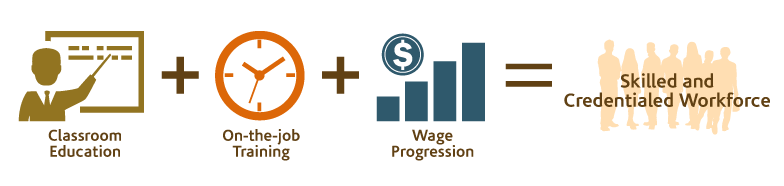
At least eight states currently offer an early childhood Registered Apprenticeship program,5 some of which are degree apprenticeships. Each program varies in its administration and offerings to and expectations of apprentices. Some programs, for example, include two semesters of college-level coursework while others award a CDA or associate degree following completion. The program goals are much the same, however. In response to a growing acknowledgement that early educators require advanced training, state and local districts have begun looking to Registered Apprenticeships as an effective way to break down some of the barriers believed to be preventing them from accessing higher education and setting them on a pathway to earning a bachelor’s degree.
Pre-Apprenticeship Programs
Pre-apprenticeships can be an effective tool for recruiting the next generation of early childhood educators and are designed to prepare students to enter into and succeed in a registered apprenticeship program. Students can gain specialized instruction and on-the-job training in early childhood education while pursuing a high school diploma or GED. Pre-apprenticeships are involved in a formal partnership with a registered apprenticeship program, allowing apprentices to receive credit towards the completion of the registered apprenticeship following graduation.
Industries best known for utilizing Registered Apprenticeships typically have an integrated set of supports and infrastructure to help them succeed, something largely absent in the early education field.
A large manufacturing plant, for example, likely has a human resources department responsible for finding and developing talent, a dedicated staff member to manage the Registered Apprenticeship and build key relationships within the community, adequate funding for program implementation and wage increases, qualified mentors on staff, and in-house training and professional development.6
Early childhood centers, on the other hand, are typically small, independently run organizations. To implement a Registered Apprenticeship, responsibility for managing administrative processes and paperwork, supporting each apprentice and mentor, and securing funding for the program would likely be borne almost entirely by the director of the center.
Forming Partnerships
In its Apprenticeship Toolkit, the Department of Labor urges states and localities interested in developing a Registered Apprenticeship to partner with businesses, workforce intermediaries (such as industry associations or labor organizations), educational institutions, the public workforce system, and other community organizations. Partnerships are important during the development of a Registered Apprenticeship program including program design and sustainability, resource identification, and employer and employee recruitment.
“Successful apprenticeships are born from collaboration among partners.” – U.S. Department of Labor
For example, in a nationally recognized early childhood Registered Apprenticeship program in Pennsylvania, participating employers receive significant financial and administrative support from the program intermediary, the District 1199C Training & Upgrading Fund, a Philadelphia-based labor/management workforce development partnership. The training fund has taken the lead on program design, ensuring compliance with state and federal regulations, providing preparation and advising services, and leveraging related private and public workforce development funding and other supports. Having a partner like this has relieved participating early childhood centers of much of the financial burden that may have otherwise inhibited their ability to offer the Registered Apprenticeship program to their teachers.
Coordinating with Education Institutions
Technical and community colleges are the primary education institutions serving apprentices, with technical high schools complementing that instruction in the case of youth apprenticeship programs.7 In areas where strong articulation agreements exist between two- and four-year institutions, students may have the option to complete an associate degree and seamlessly transition into bachelor’s degree programs.
Collaboration between businesses and education partners can help ensure that curricula are aligned with the competencies needed to succeed in the workplace. Many relationships between higher education institutions and the early childhood field, however, are still in their infancy, as only in recent years has it become more widely recognized that child care and preschool teaching is highly skill-based and technical in nature. In the absence of close partnerships with higher education institutions, Registered Apprenticeship programs run the risk of misaligning classroom instruction with job responsibilities and on-the-job training, which would weaken a program by poorly equipping apprentices and undermining return on investment for employers. And by failing to engage in Registered Apprenticeship programs, higher education institutions miss opportunities to offer early childhood workers accessible opportunities to earn degrees they need, as well as opportunities for students to gain extensive, related work experience while pursuing an ECE degree.
The college credit, certificate, or degree an apprentice can earn varies from state to state. In Kansas, apprentices are required to obtain a total of 20 hours of course credits, the first 10 of which culminate in a Child Development Associate (CDA). In Pennsylvania, apprentices, required to obtain a CDA prior to enrolling in the Registered Apprenticeship program, complete the program with an associate degree designed to articulate into an early childhood bachelor’s degree.8 A Los Angeles-based program led by the SEIU National Training Center offers three educational pathways culminating in the teacher assistant with associate degree permit, associate degree in child development, or the bachelor’s degree in early childhood studies, depending on whether the apprentice enters the program with prior higher education coursework.9 A West Virginia program links its Registered Apprenticeship program with a pre-apprenticeship program operating in high schools where much of the course credit can be earned prior to graduation.10 To ensure students are prepared for college-level coursework, the Pennsylvania program offers a remedial or contextualized bridge course followed by a college placement preparation course. Throughout the program, apprentices are provided academic advising, tutoring, and study groups.
Managing High Costs
The costs associated with Registered Apprenticeship programs are significant and typically the responsibility of the sponsoring employer. When strong partnerships are in place, providers often get much relief from the financial burden. In almost every state program, apprentice tuition is covered through scholarship programs. Administrative costs may be covered by an intermediary. In Pennsylvania, for example, the managing organization covers much of the administrative cost, as well as expenses related to professional development curricula and training. In Kansas, the St. Louis Agency on Training and Employment (SLATE) covers half of each apprentice's pay for the duration of the two-year program, as well as fees for credentialing exams.11 To incentivize businesses to sponsor apprentices, some states have also established tax breaks for businesses offering Registered Apprenticeships.12
Using Federal Support to Expand Registered Apprenticeships
With research to support the effectiveness of Registered Apprenticeships to advance the economy, the federal government has renewed its support for the workforce strategy in recent years. In 2016, $90 million was appropriated to expand Registered Apprenticeships across the country and in 2018, funding levels for Registered Apprenticeships were increased by 53 percent above the Fiscal Year 2017 funding level. President Trump also released an executive order to expand apprenticeships, including the development of a task force to identify strategies to promote apprenticeships, “especially in sectors where apprenticeship programs are insufficient.”13
One Example: Virginia’s Experience
Recognizing the importance of creating a high-quality early childhood workforce and the inadequacy of the current education and training programs available, Virginia created an early childhood Registered Apprenticeship program in 2016.14 Much of the program administration falls upon program directors, although substantial financial supports are available to cover the full cost of tuition for community college coursework. Several courses offered at community colleges across the state have been pre-approved to meet Registered Apprenticeship training requirements. Each course is a part of the Career Studies Certificate in Early Childhood, courses that can seamlessly articulate toward the early childhood certificate, an associate degree and, in cases where program-to-program articulation agreements have been established, towards a bachelor’s degree in early childhood. Virginia has struggled, however, to grow its program and it is not for lack of interest. A component notably missing is a partnership with an intermediary able to provide administrative oversight and funding support. Kathy Glazer, president of the Virginia Early Childhood Foundation, explains that several providers expressed interest in the program but were not able to shoulder the responsibilities on their own.15
As the state continues to seek out new ways to support individual providers, it can look to a successful program—the Child Development Center (CDC)—about 13 miles from the White House. The CDC has overcome many of the challenges associated with the statewide program. What sets CDC apart is how it’s parent organization, the Annandale Christian Community for Action (ACCA), serves as a local intermediary. The CDC is one program of ACCA, a coalition of churches that provides early childhood care and education, food, rental assistance, furniture, and other services to low-income families. The success of CDC is an example of how state and local leaders may be able to help employers find success by building relationships with local organizations when a statewide intermediary does not exist.
Since Maria-Isabel Ballivian came on as CDC executive director in 2010, she says she has made developing her teachers her first priority. Ballivian has been fortunate to receive funding through ACCA to offer in-house trainings for everything from computing to test preparation for the CDA. She has the means to offer meals during training time, child care, and costs for exams. Ballivian says the team approach to learning she had already fostered among the teachers has served the center well throughout the Registered Apprenticeship program. She calls her staff a “community of learners.”
CDC apprentices have professional development plans that are created annually, and they are mentored by a fellow teacher who holds a bachelor’s degree. In-house trainings tend to take place every Wednesday at lunchtime (meals provided), during nap time, and on some late days and Saturdays. Each teacher receives 120 hours of trainings per year. Classroom instruction is delivered by community colleges, but Ballivian has arranged for some classes to be taught at Hopkins House, a community-based learning center, where apprentices do not have to navigate a large campus. Wage increases are given throughout the program, but the first bump in pay comes earlier than the formal program recommends, in order to offset additional costs that participation in the program might incur. Thus far, eight staff members have graduated from the Registered Apprenticeship program, with 24 more currently enrolled. Some graduated from the program with a CDA and others with an associate degree. Many current and past apprentices have indicated that they intend to take advantage of the articulation agreements already in place at many institutions to pursue a bachelor's degree. Ballivian reports increases in teacher evaluation scores and positive feedback from families as testaments to a successful initiative.
Conclusion
Registered Apprenticeship programs can be a useful strategy for helping current and future early educators pursue higher education and training. With the right support, independent schools and centers can offer current and future staff members an opportunity to “earn while they learn." This can build a more qualified workforce for the industry, yield better teaching and learning for students, and offer meaningful career advancement opportunities for staff. As states consider ways to help more early educators attain two- and four-year degrees, leaders should look to Registered Apprenticeships as a way to kick-start college-level coursework for a population that often faces significant barriers to accessing higher education. Critical to program success is strong community partnerships that alleviate the administrative and financial burdens on center directors and a strong leader who is prepared to wholly invest in his or her staff.
Early education teacher quality matters. Yet, helping teachers access the education and training they need to be highly effective can be challenging. A earn-while-you-learn training model is ideal for the largely low-income, low-wage workforce. State and local leaders should consider the Registered Apprenticeship model as an effective tool for teacher development.
For Further Reading
- New America report: Mary Alice McCarthy, Iris Palmer, and Michael Prebil, Eight Recommendations for Connecting Apprenticeship and Higher Education (Washington, DC: New America, December 2017), https://www.newamerica.org/education-policy/policy-papers/eight-recommendations-connecting-apprenticeship-and-higher-ed/
- Mary Alice McCarthy, “The Crisis Facing America’s Preschool Teachers,” The Atlantic, October 26, 2017, https://www.theatlantic.com/education/archive/2017/10/the-crisis-facing-americas-preschool-teachers/544002
- White paper: Alison Lutton, Apprenticeship as a Degree Attainment Strategy for the Early Childhood Workforce (Philadelphia, PA: District 1199C Training & Upgrading Fund, September 2018), https://www.1199ctraining.org/docs/allisonlutton_apprenticeshipwhitepaper_formatted090418.pdf
- Definition: U.S. Department of Labor (website), “What is Registered Apprenticeship?” https://www.doleta.gov/OA/apprenticeship.cfm; see also “Apprentices” at the same site, https://www.doleta.gov/oa/apprentices.cfm
- Data on registered apprentices: U.S. Department of Labor (website), “Registered Apprenticeship National Results: Fiscal Year (FY) 2017 (10/01/2016 to 9/30/2017),” https://doleta.gov/oa/data_statistics.cfm
- Trump’s executive order: https://www.whitehouse.gov/presidential-actions/3245/
- Interview on corporate benefits of apprenticeship: SC Technical College System (website), “Sonoco Shapes Its Future with Apprenticeship.” https://www.sctechsystem.edu/edge/plastics-and-synthetics/sonoco-shapes-its-future-with-apprenticeship.html
- A number of federal funding streams may be applied toward the costs of na apprenticeship. See Ben Olinsky and Sarah Ayers, Training for Success A Policy to Expand Apprenticeships in the United States (Washington, DC: Center for American Progress, December 2013), https://cdn.americanprogress.org/wp-content/uploads/2013/11/apprenticeship_report.pdf.
- Study: Debbie Reed, Albert Yung-Hsu Liu, Rebecca Kleinman, Annalisa Mastri, Davin Reed, Samina Sattar, and Jessica Ziegler, An Effectiveness Assessment and Cost-Benefit Analysis of Registered Apprenticeship in 10 States (Washington, DC: Mathematica Policy Research, July 25, 2012), https://www.mathematica-mpr.com/our-publications-and-findings/publications/an-effectiveness-assessment-and-costbenefit-analysis-of-registered-apprenticeship-in-10-states.
Acknowledgments
This paper benefited from the insights of many. Thanks to Kathy Glazer for providing insights into Virginia’s system and to Maria-Isabel Ballivian for sharing her program’s successes. Thanks to Laura Bornfreund, Cara Sklar, and Sabrina Detlef for editing and to Maria Elkin, Riker Pasterkiewicz, and Julie Brosnan for layout and communication support. This work would not have been possible without the generous support of the Joyce Foundation, W. Clement & Jessie V. Stone Foundation, and the Bill and Melinda Gates Foundation. The views expressed in this paper are those of the author alone.
Downloads
Citations
- Marcy Whitebook, Caitlin McLean, and Lea J. E. Austin, Early Childhood Workforce Index 2016 (Berkeley, CA: Center for the Study of Child Care Employment, 2016), 10, source.
- Anna J.Egalitea, Brian Kisidab, and Marcus A. Winters, “Representation in the Classroom: The Effect of Own Race Teachers on Student Achievement,” Economics of Education Review 45 (April 2015): 44–52; and Chrys Limardo, Sara Hill, Jessie Stadd, and Tim Zimmer, Accessing Career Pathways to Education and Training for Early Care and Education (ECE) Professionals (Bethesda, MD: Manhattan Strategy Group, October 2016), source.
- Population Reference Bureau, analysis of data from the U.S. Census Bureau, Census 2000 Supplementary Survey, 2001 Supplementary Survey, 2002 through 2017 American Community Survey. source.
- “Degree apprenticeship may be defined as ‘an apprenticeship program that meets the standards established in the National Apprenticeship Act 29 CFR Part 29 and the requirements of a postsecondary degree program as established by the relevant state education agency in the state where the program is delivered,’” Mary Alice McCarthy, Iris Palmer, and Michael Prebil, Eight Recommendations for Connecting Apprenticeship and Higher Education (Washington, DC: New America, December 2017), source)
- Alison Lutton, Apprenticeship as a Degree Attainment Strategy for the Early Childhood Workforce (Philadelphia, PA: District 1199C Training & Upgrading Fund, September 2018), source
- Martha Ross and Kimberly Hauge, “States Equip Employers to Drive Apprenticeship,” The Avenue (blog), Brookings, April 23, 2018, source.
- U.S. Department of Labor, Apprenticeship Toolkit FAQ, “What are the basic program components of Apprenticeship?” source
- Lutton, Apprenticeship; and Amy Friedlander, “Philadelphia Early Childhood Education Apprenticeship Program: Support for the ECE Workforce and the Children They Teach,” The Early Childhood Action Collective, source.
- State of California, Department of Industrial Relations, Division of Apprenticeship Standards, letter to Alexa Frankenberg, deputy director, SEIU Early Care & Education Head Start Apprenticeship Program, June 18, 2018, on approval of apprenticeship program, source
- National Center on Child Care Professional Development Systems and Workforce Initiatives, “Strategies to Strengthen the Early Childhood and School-Age Workforce: West Virginia,” source.
- Durrie Bouscaren, “Apprenticeship Pilot Program to Train Child Care Workers in St. Louis,” St. Louis Public Radio, April 27, 2016, source.
- U.S. Department of Labor (website), “Learn About Tax Credits,” source.
- U.S. Department of Labor (website), “Task Force on Apprenticeship Expansion,” source.
- Virginia Early Childhood Foundation, “Frequently Asked Questions: Early Childhood Workforce – Registered Apprenticeship,” source.
- Kathy Glazer, phone interview with author, November 8, 2018.
More About the Authors

Emily Workman
Issues
Programs/Projects/Initiatives
Related