The Cost of Connectivity in the Navajo Nation
Introduction
Tribes are some of the least connected communities in the United States. The lack of broadband availability is especially acute on tribal lands, where the American Indian Policy Institute found that only 49 percent of residents have fixed home internet service. Recent testimony by the president of the Navajo Nation confirms that this figure is even worse in the Navajo Nation, where over half of Navajo chapters lack any broadband access.
Our analysis of internet service plans in 109 Navajo chapters shows that not only is federal data on internet service in the Navajo Nation inaccurate, but the market is characterized by slow, outdated, and expensive service plans. The Federal Communications Commission’s (FCC) data on service in the Navajo Nation overstates the number of providers and speeds of services advertised in the relevant areas. Only four Navajo chapters advertised service meeting the FCC’s standards for broadband, with satellite internet being the sole option available across all chapters. Additionally, internet service in the Navajo Nation is on average $21.70 to $44.01 more expensive than elsewhere in the country, making it unaffordable for many living on Navajo land whose incomes are at or under the poverty level.
The ongoing COVID-19 pandemic exposes the deeply unjust policies behind stark inequities in certain communities. In the case of tribal nations, the federal government’s lack of support during the pandemic is another chapter in a brutal history of injustice that leaves tribes particularly vulnerable to this disease. Generations of federal policies undermining Indigenous wealth, power, and sovereignty have left many Native people without access to basic infrastructure, including food, running water, safe and adequate housing, telecommunications service, and healthcare. By repressing tribes for so long, the U.S. government diminished tribes’ ability to meet the needs of their communities and forced them to advocate for additional support from the federal government. At the same time, the federal government has failed to adequately support and fund tribes, despite its responsibility for many of the problems that ail tribes today. This includes the issue of lack of access to telecommunications services. Those without internet access do not have adequate access to information about the health crisis and to the resources they need. They also lack access to telehealth, making it more difficult for public health officials to reach them for contact tracing. Native students without internet access are left behind by distance learning, while those who have lost employment are unable to apply online for government benefits and services. Altogether, the federal government’s failure to connect people on tribal lands deprives entire tribes of opportunities for employment, healthcare, education, and economic growth in both the short and long-term.
OTI began reviewing the Navajo Nation’s internet access as part of our research for our Cost of Connectivity 2020 report, which we released in July. We published previous versions of this report in 2012, 2013, and 2014 to describe the disparity between what consumers pay for broadband service in the United States versus consumers in peer cities abroad, as measured by retail prices advertised by internet service providers. Earlier this year, we published our first set of findings detailing the benefits of a municipally-run fiber optic network in Ammon, Idaho, and rural connectivity challenges in West Virginia.
Our Methodology
We collected data on all service options within all 109 Navajo chapters listed on the Navajo Nation Woven Integrated Data Project site. We relied on a variety of publicly available sources—including broadband maps from the relevant states and the FCC—to gather and verify data on all available standalone broadband plans that we could locate in each Navajo chapter from March to July 2020.1 To collect this information, we navigated to internet service providers’ websites and, if prompted, manually entered addresses and zip codes corresponding to real homes in the community. We selected these addresses by cross-checking the FCC’s Broadband Deployment Map with publicly available addresses in Google Maps.
Across all of the providers’ websites, we gathered data on download and upload speeds, monthly promotional and non-promotional pricing, contract termination fees, data caps, technology used, equipment costs and/or rental fees, activation fees, and installation fees, where applicable. Providers often list either a promotional price or non-promotional price on a monthly basis—where just one price is listed, we cite that number in our analysis. If providers list both a promotional and non-promotional price, we adopt the promotional price.
The data we compiled on broadband service in the Navajo Nation is a near-comprehensive effort to include all available broadband plans that were listed publicly on the internet service providers’ websites at the time of our data collection. Other internet plans may be available, but all analysis in this report is limited to the 450 plans included in our dataset and the information that was available at the time of data collection (see Appendix). Our dataset does not necessarily represent the available plans for each community as a whole, as certain plans may not be available in all locations. Because our methodology is limited to collecting data on only those providers that list the relevant information online, our dataset excludes at least two providers: Table Top Telephone Company and Skycasters, which service some of the Navajo chapters examined in this study according to the FCC's Broadband Deployment Map.2
To conduct our analysis, we also used data from the 2010 U.S. Census available on each Navajo chapter, also found on the Navajo Nation’s Woven Integrated Data Project.
Our Findings
Our research demonstrates that the people of the Navajo Nation suffer from a lack of reliable internet access, with a disproportionate lack of broadband infrastructure and slower, more expensive service where there actually are options.
Internet service in the Navajo Nation is significantly more expensive than service advertised in other areas of the United States, burdening many on tribal lands living at or below the poverty level. The average advertised monthly, non-promotional price for internet service across all Navajo chapters is $127.51, a steep $44.10 hike above the average non-promotional price found in our Cost of Connectivity 2020 dataset of internet service plans across the United States. Similarly the $105.11 average promotional price for internet service plans advertised in the Navajo Nation is $42.94 more expensive than the average promotional price for internet service we found for the greater United States dataset. Even when comparing monthly cost for plans advertised in the Navajo Nation with monthly cost for internet service in our West Virginia dataset, which included plans advertised in rural communities, plans advertised in the Navajo Nation are still $15.01 more expensive on median (looking at the median of non-promotional prices where promotional prices were unavailable). The cheapest plan in our study advertised to meet FCC standards of broadband service costs $39, and is only available in two chapters. Another separate study found that only 33 percent of 14.2 million residents in tribal zip codes across the country have access to a broadband plan at under $60 a month. This suggests that disparities in internet access on tribal lands are unique, and differ from hardships experienced in other rural areas. While the tribal digital divide is partly a product of many tribes’ rural settings, tribal rural areas lack access to high-speed broadband at higher rates than non-tribal rural areas.
These high prices are concerning given the significant body of research demonstrating that cost is one of the biggest barriers to internet service adoption. According to a recent study, over 3 million U.S. households with annual incomes under $25,000 didn’t have home internet because it was too expensive. Sixty-three of the chapters examined have a median household income of $25,000 or less. The poverty rate, or percentage of people under the poverty level, on the Navajo Nation Reservation is 38 percent. This is extraordinarily high when compared to the overall poverty rates for the states around Navajo land: almost twice as high as the poverty rate for New Mexico, more than twice as high as poverty rate for Arizona, and four times as high as the poverty rate for Utah. In a 2016 report, the Government Accountability Office (GAO) reported that many of the members they interviewed from 21 tribes across the country identified poverty and affordability as drivers of low subscribership to existing internet services, or as barriers to availability. Even internet providers cited high poverty rates as a reason for not providing service on tribal lands, as they assumed people could not pay for service even if available. For the significant percentage of people living on tribal lands living at or below the poverty level, these plans are a significant financial burden to bear.
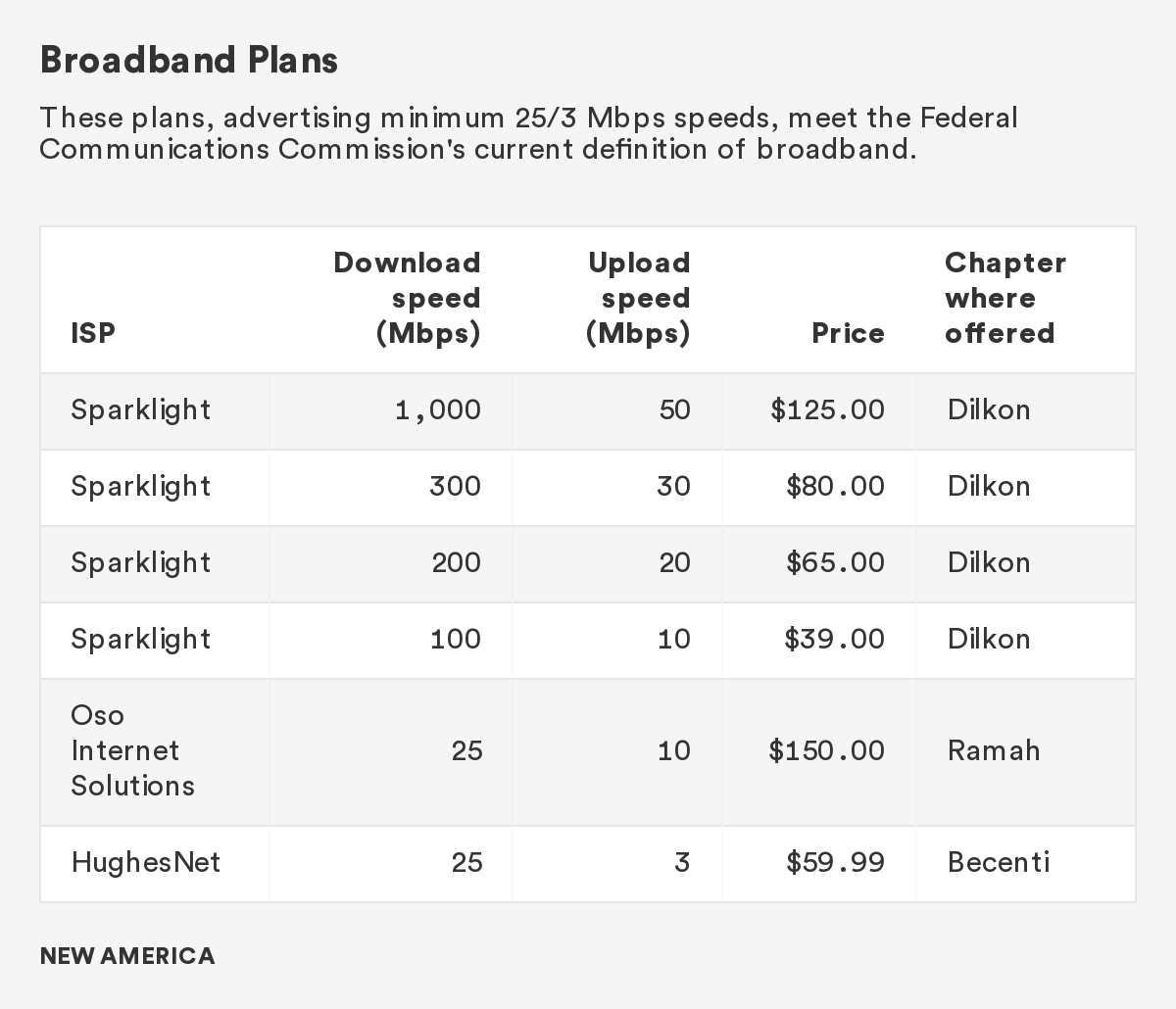
Only four chapters of the Navajo Nation have access to plans advertised to meet the FCC’s current definition of broadband service. Just one of these plans is advertised at below $50 per month for service.
None of the current FCC data is verified by publicly available sources. The Cost of Connectivity methodology confirmed none of the FCC data on internet access in these chapters and their surrounding areas. In every Navajo chapter, we were unable to confirm service from at least one provider that the FCC's broadband deployment map claims provides service in that area. In particular, internet service provider Viasat consistently reported offering 35/3 Mbps service in all Navajo chapters to the FCC, but we only found evidence that Viasat offered 12/3 Mbps service across all chapters, reflecting download speeds almost three times slower than those reported.
A 2019 report on the state of internet service in tribal lands summarizes a history of federal neglect concerning collection of accurate data on broadband access in tribal lands, not to mention more accurate demographic data overall on tribes. One reason for inaccurate data, cited in a 2018 report by the GAO and repeatedly raised by our own organization, is that the FCC considers broadband access primarily in terms of deployment, or the scope of an area where a company claims it could feasibly provide service, without assessing where companies actually do provide service, leading to overstatements of service for specific locations like tribal lands. Further, the FCC assesses broadband deployment and availability based on census blocks—which tend to be very large in rural areas—and allows providers to deem an entire census block as “served” if only one location in that block is or could be served. For rural areas, and particularly tribal lands, our research confirms that the FCC’s broadband mapping paints an inaccurate picture of broadband access. Adding to the inaccuracy of federal data on the state of tribal broadband is the lack of a formal process to obtain tribal input on the accuracy of provider-submitted broadband data. The FCC is now seeking comment to establish a challenge process for coverage data, which would allow consumers themselves to contest providers’ claims about where they provide service, and at what speeds, based on firsthand experience.
Internet infrastructure in the Navajo Nation is outdated, and the advertised service speeds themselves are slow. Overall, the speed of internet service advertised in the Navajo Nation falls far behind the rest of the United States. The average download and upload speeds for internet plans advertised in the Navajo Nation comes to 24.15/3.59 Mbps—by comparison, the U.S. average is 482.77/354.02 Mbps.
Additionally, the median download and upload speeds (12 Mbps and 3 Mbps respectively) of plans advertised in the Navajo Nation are lower than the averages (means) for these speeds, indicating that most Navajo consumers have slower advertised download speeds than the average might suggest, and certainly well below the FCC’s standard for broadband service. This is the same for our larger U.S. dataset of advertised speeds, where the median speeds are more representative of the majority of plans than the average. However, the median download speed of our larger U.S. dataset is 150 Mbps, more than 10 times faster than that in the Navajo Nation.
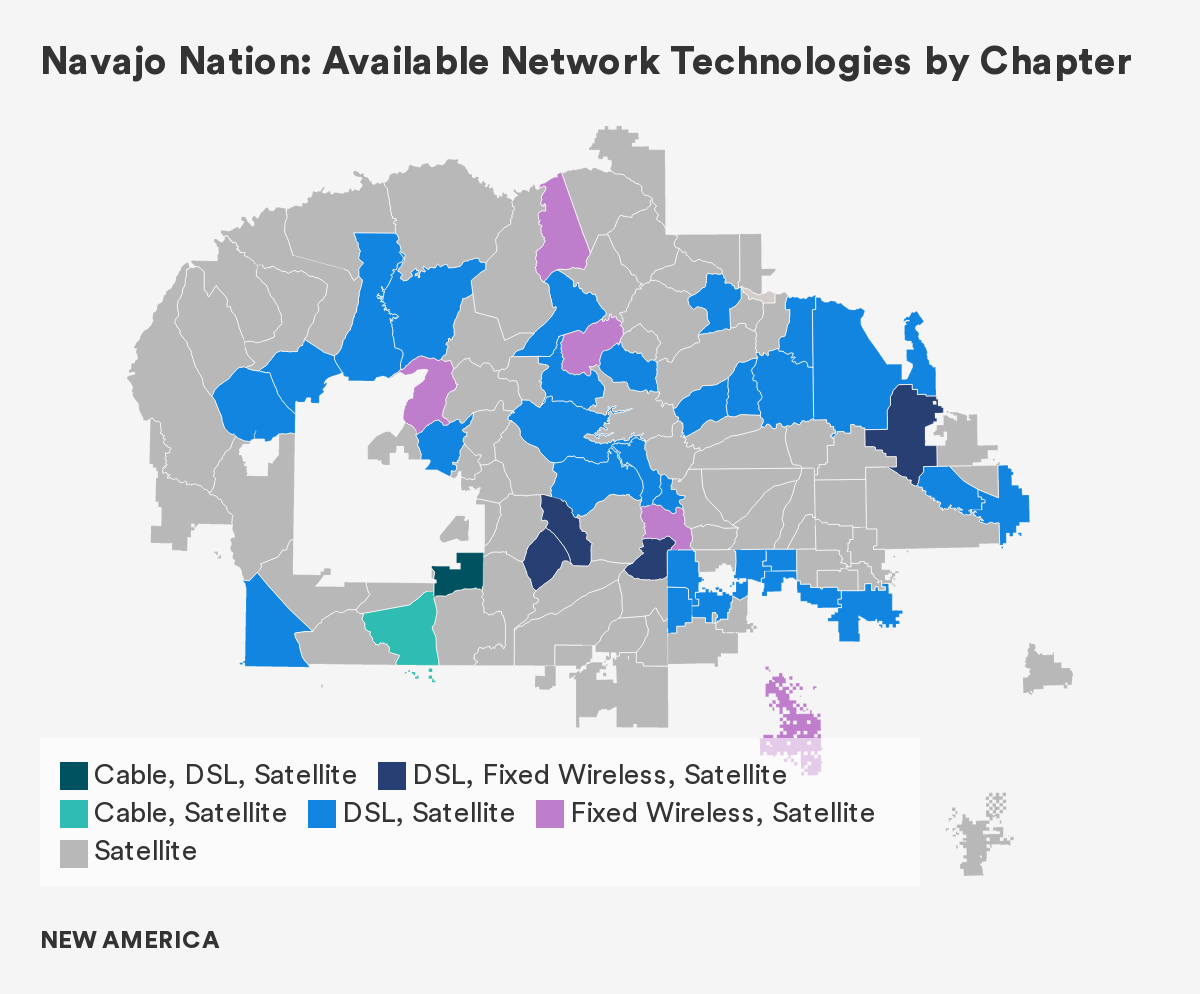
A major reason for the huge disparity in speed of internet service advertised in the Navajo Nation and service advertised throughout the rest of the United States is that the internet infrastructure available on Navajo land is outdated. Satellite internet service reaches all 109 Navajo chapters, but it is the only internet service option to do so; in 65 chapters, satellite is the only option available. Satellite broadband has historically been a last resort for internet access, even for rural communities, due to its slow speeds, high costs, and dependence on fair weather. The next most ubiquitous technology after satellite is DSL, found in 35 chapters. However, DSL is not much better than satellite internet—in 23 of these 35 chapters, DSL provider Frontier advertises a 6 Mbps download speed plan that does not even come close to meeting the FCC’s definition of broadband.
Policy Implications
Our research joins a large body of other reports, testimonies, surveys, and articles confirming the extent of the digital divide in Indian Country. The ongoing COVID-19 pandemic has exacerbated the consequences tribes face from a lack of internet and mobile service. We need meaningful action at the federal level to connect tribes.
The FCC needs to consistently collect accurate data on the state of internet service in tribal lands. As OTI and others have long argued, the FCC’s dependence on internet service providers’ self-reported speed offerings and deployment leads the agency to include significantly inflated numbers in its reporting. Current federal maps of broadband availability are especially flawed for tribal lands, where the lowest percentage of people have access. The FCC should also implement a formal process through which tribes can provide input and check data.
Additionally, there is a lack of data on related factors like affordability, service quality, and service denials that can affect the extent to which Americans living on tribal lands can access broadband services. This includes basic demographic data collected by the U.S. Census Bureau. Tribes have historically been undercounted in the census, especially because many people on tribal lands lack internet access or reliable mail services and must be counted in person. Unfortunately, the bureau will continue to undercount tribes if it moves forward with its decision to end field operations early in 2020. The resulting census undercount would mean that tribal members get a fraction of the federal money they are owed for the next 10 years. This would be particularly harmful given how the pandemic is taxing the already under-resourced Indian Health Service. Census data also affects funding for other infrastructure, including telecommunications.
Federal subsidies should incentivize adoption of newer, faster technologies and tribal solutions. Not only does the FCC need to collect accurate data on existing problems and needs on tribal lands, the FCC and Congress should also prioritize federal subsidies for ameliorating the profound lack of broadband access in Indian Country. Broadband deployment costs more on unserved tribal lands that are generally rural and may have rugged terrain, and such costs can discourage private providers from deploying in such areas. The FCC should therefore reexamine whether the reverse auction mechanisms that drive funds like the Rural Digital Opportunity Fund are appropriate for building fast, resilient networks. Reverse auction mechanisms prefer incumbent providers that can offer low-cost proposals that only involve slight upgrades to existing infrastructure. The reverse auction doesn’t incentivize adoption of newer and faster technologies. The FCC must consider what mechanism would prioritize investment in technologies, as well as in local internet service providers. Smaller local companies like Sacred Wind Communications and the Navajo Tribal Utility Authority (NTUA)’s Choice Wireless may provide cheaper, faster service to tribal communities, and local providers should take priority in federal funding. Additionally, a 2019 report from the American Indian Policy Institute and Arizona State University suggests that rather than subsidizing competitive providers, funding for internet solutions in tribal lands should be tailored to individual tribes so that they and their governments can operate community solutions to provide affordable and high-speed internet service. If federal subsidies are distributed predominantly to incumbent companies that use outdated, slow technology like satellite and dial-up, it may only serve to widen the digital divide.
The FCC should better prioritize tribal access to dormant spectrum. The FCC should grant tribes priority in spectrum auctions to aid tribe-owned telecommunications providers interested in providing wireless broadband services. In 2019, the FCC adopted the “2.5 GHz Rural Tribal Priority Window,” which allowed rural tribes to apply for free spectrum to use for wireless broadband service. Despite the promise of this opportunity, the COVID-19 crisis proved a significant hurdle to tribes finishing their applications on time. Although the FCC extended the window briefly, the extension came far too late and was far too short to be of use to the tribes involved. The FCC should further extend the Rural Tribal Window through the pandemic to ensure that all tribes that want to apply for the spectrum can do so.
This is only one of many bureaucratic obstacles tribes have faced during the pandemic, including life-threatening delays in receiving federal emergency funds that were immediately available to other counties and municipalities throughout the country. This faltering pandemic response and enduring digital divide compound and perpetuate the long history of injustices committed against tribes by the U.S. government since it first forced Native Americans from their homes. This analysis, in the larger context of our Cost of Connectivity report, confirms the disproportionate lack of connectivity for the Navajo Nation, which only deepens existing inequalities and precludes tribes from better healthcare, economic opportunities, education, and more. The federal government has an obligation to tribal nations to provide much-needed services and benefits, and to improve infrastructure on tribal lands. There is significant progress left for agencies like the FCC to meet these challenges and ensure tribes are connected.
Appendix
Acknowledgments
This report would not have been possible without the help of a talented and resourceful team. The author would like to thank Austin Adams, Lisa Johnson, Sarah Morris, Amir Nasr, and Joshua Stager for their thoughtful edits and valuable input on research design; Lukas Pietrzak for enthusiastic research support; Naomi Morduch Toubman for patient guidance and support in designing the data visualization; and Maria Elkin, Samantha Webster, and Joe Wilkes for creative communications support.
Downloads
Citations
- As with our West Virginia report, we included satellite plans in our Navajo Nation dataset as satellite technology is most readily available in rural communities. Some of these communities are not serviced by any providers when satellite plans are omitted.
- It was not possible to confirm areas served by Table Top Telephone Company, while Skycasters’ website directed us to call their customer service line or email them directly, and it was unclear if the company provided residential or business-only internet service.
More About the Authors