
U.S. Policy Recommendations
Our dataset indicates that, for many consumers, the cost of connectivity is simply too high—and too complicated. In this section, we offer recommendations for how U.S. policymakers can help consumers. While no single recommendation is a panacea, collectively they would make internet service more affordable and accessible in the United States.
The FCC Should Collect Better Data on the Cost and Availability of Internet Service
Policymakers and the public need better data on internet availability, access, and affordability. The FCC’s widely maligned maps of internet deployment are inaccurate and do not match up with reality. The maps’ flaws stem from the underlying dataset, which is self-reported from ISPs and prone to overcounting. Pricing data is even more opaque. ISPs do not publicly disclose any datasets about their prices. No government agency collects pricing data, either. All of this leaves consumers and lawmakers in the dark. The government must collect more accurate and granular data on actual deployment, available speeds, and pricing.1
On deployment, the government relies on self-reported data from the ISPs that is inherently flawed. All facilities-based providers are required to report deployment data to the FCC twice a year in a filing known as Form 477. ISPs must disclose where they can feasibly offer internet service at speeds exceeding 200 kilobits per second (kbps) in at least one direction (upload or download speed) and list the census blocks where “they can or do offer service to at least one location.”2 This method is imprecise and overcounts availability, especially in rural areas where census blocks tend to be larger.3 In addition, the FCC’s Form 477 instructions state that, “broadband connections are available in a census block if the provider does, or could, within a service interval that is typical for that type of connection—that is, without an extraordinary commitment of resources—provision two-way data transmission to and from the Internet with advertised speeds exceeding 200 kbps in at least one direction to end-user premises in the census block.”4 By asking ISPs to self-report the areas where they merely could feasibly provide high-speed broadband, Form 477 data risks overstating internet availability.5
With respect to speed data, the FCC similarly relies on ISP-reported data that does not always match the speeds users actually experience. Independent studies have found that many U.S. communities experience different speeds than the data that ISPs report to the FCC.6 For example, OTI’s United States of Broadband Map visualized the difference between download and upload speeds based on FCC data and the speeds actually experienced by users, as measured by M-Lab data.7 It’s important to note that there are various reasons these discrepancies could exist. Subscribers may have chosen a plan with a lower speed limit (and presumably lower price) than the service the ISP reported to the FCC. This consideration makes drawing conclusions about the data challenging—and underscores the need for clearer, more robust reporting and analysis from the expert agency tasked with this work.
The situation is worst of all for pricing data. Currently, no government agency collects data on internet prices. High prices have been identified as a key cause of the digital divide.8 Yet policymakers have no data on prices to guide their efforts to close the digital divide. The government also needs pricing data to create an evidentiary record that could inform future regulatory and antitrust enforcement. The FCC could also use pricing data to identify any pricing discrimination that may exist on the basis of income, race, or geography. The challenges in collecting pricing data described in our research methodology makes clear that, absent a clear government mandate, this data will remain uncollected at scale. In July 2020, the House of Representatives passed a bill that directs the FCC to collect pricing data from ISPs.9 Unfortunately, the Senate has not taken action on this bill.
Indeed, it is extremely burdensome for independent researchers to conduct the type of research included in this report. ISPs are not transparent about pricing terms, and it’s difficult to determine where service is even available. Comparative analysis of internet service plans is challenging, too, due to a lack of standardization across providers and the complex plan structure. Therefore, it is critical that the government collect and analyze accurate and granular internet deployment, availability, and access data that includes pricing data.
ISPs Should Clearly Disclose Price and Service Terms in a “Broadband Nutrition Label”
A clear takeaway from our research is that the cost of connectivity is difficult to find and often hidden in convoluted pricing schemes or obscure contract terms. Consumers cannot make informed decisions in this environment. Accordingly, the United States needs better truth-in-billing requirements for internet service.
As explained in this report, ISPs advertise prices that are not inclusive of all costs, instead relying on convoluted lists of itemized fees that can confuse consumers. The advertised price for monthly service often excludes ancillary fees for equipment, installation, and activation. Some costs, like contract termination fees, may be buried in lengthy terms of service. Other fees may not be disclosed at all.10 These hidden fees make it difficult for consumers to identify the total cost, often resulting in bills that are unexpectedly higher than what is disclosed on a provider’s website.11 This complexity also makes it difficult for consumers to comparison-shop.
People need to know what they are paying for. They need more transparency from ISPs. To this end, OTI has long advocated for a “broadband nutrition label,” a standardized format—similar to the Food and Drug Administration’s (FDA) familiar nutrition labels—that ISPs can use to disclose the prices, speeds, and terms of their various services.12 In 2016, the FCC created a broadband consumer label that largely adopted these concepts.13
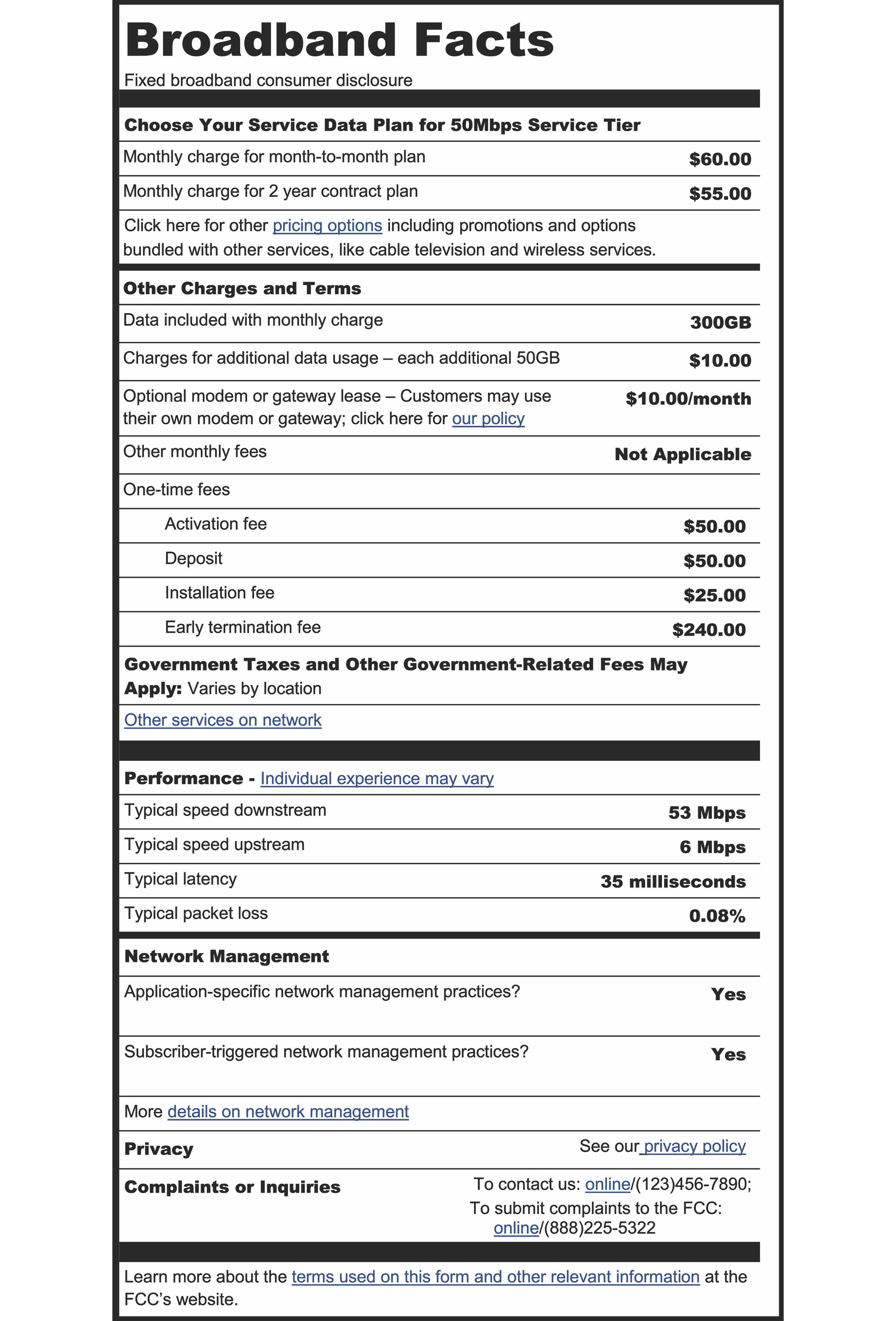
This label was unanimously endorsed by a diverse committee of ISPs, government officials, and consumer advocates.14 The label is voluntary for ISPs to use, but the FCC has done little to promote or encourage its adoption in recent years. The FCC should do more to revive the label so it becomes as familiar to consumers as the FDA’s nutrition labels. In July 2020, the House of Representatives passed a bill that requires the FCC to incentivize widespread adoption of the label. The bill also requires the FCC to hold public hearings to learn more about how consumers evaluate internet services and whether current disclosures are sufficient.15 Unfortunately, the Senate has not taken action on this bill. But the FCC should not wait for Congress; the agency can do these things now. Doing so would help give consumers the truth-in-billing clarity that has eluded them for so long in this market.
The Government Should Expand Lifeline and Other Low-income Internet Discounts
Lifeline is the only federal program that directly addresses the affordability of telecommunications services. Households with annual incomes at or below 135 percent of federal poverty guidelines, and/or individuals who participate in other federal assistance programs like Medicare or SNAP may qualify to receive $9.25 a month toward telecommunications services through the Lifeline program.
Our study underscores how the Lifeline subsidy is essential to helping people access employment opportunities, healthcare, government services, and other benefits that come with being connected. The majority of plans in our U.S. dataset cost over $50 a month, and only 64 of the 118 plans that fall under this benchmark meet the current FCC definition for broadband speeds at 25/3 Mbps—the excessively slow speeds of plans targeted toward low-income households, have been long recognized as a pervasive problem.16 Essentially no plans in our dataset meet the $10 price benchmark that Sallet recommends.17 As detailed earlier in our report, we find that six plans on Ammon’s open access network in our dataset meet this benchmark, but the monthly prices for these plans do not include the additional fees consumers pay for the open access network.18 After accounting for these true costs, the monthly price would exceed the $10 benchmark. Our findings provide additional evidence that internet access in the United States remains unaffordable and therefore inaccessible for many households, especially those that are considered low-income.
The FCC and Congress, which oversee the Lifeline program, should focus on expanding the program and connecting more low-income families. Lifeline has long suffered from underutilization and lack of public awareness. In 2018, only 25 percent of eligible households participated in the program; in Wyoming and Nebraska, the participation rate was just 3 percent.19 This participation rate has consistently declined in recent years, from 33 percent in 2016 to 28 percent in 2017.20 Unfortunately, the FCC has proposed new rules for Lifeline that have been described as “death by a thousand cuts” for the program.21 The FCC should abandon this misguided proposal and focus on efforts that will expand participation and increase the subsidy to cover a more meaningful portion of the cost of internet service.22
Moreover, Congress is currently considering multiple bills to help make internet service more affordable during the COVID-19 pandemic. One of the strongest proposals is the HEROES Act, which would establish a $50 monthly subsidy for qualifying low-income households and students to purchase internet service during the public health emergency. The bill passed the House in May and awaits consideration in the Senate.23
Congress Should Legalize Municipal Networks in Every State
Our research demonstrates that municipal networks deliver some of the most affordable and fastest internet service in the United States. However, municipal networks are not fully permitted under the laws of many states. At least 20 states restrict or outright prohibit these networks from existing. These laws must be repealed.
Municipal networks bring many benefits to communities. Our research on Ammon, Idaho shows how a municipal network can spark competition and significantly reduce prices.24 Wilson, N.C., offers another instructive example. When Wilson built out its municipal network called Greenlight, an incumbent cable company held rates flat even as it raised rates in nearby areas by up to 40 percent for comparable offerings.25 The competition introduced by the municipal network saved Wilson residents more than $1 million per year.26 One study found that, in 23 communities across the United States, municipally-owned fiber networks charged less than the incumbent private ISPs when averaged over four years, whereas private ISPs typically charged low initial rates that increased after 12 months.27
Unfortunately, large incumbent ISPs have lobbied at least 20 states to enact laws that effectively outlaw municipal networks—to protect the incumbents from having to compete against affordable, consumer-friendly services.28 The laws vary from state to state, with some explicitly prohibiting municipalities from selling telecommunications services, while other jurisdictions impose additional taxes on municipal networks or require that they get approval from a two-thirds supermajority of voters in costly and time-consuming ballot initiatives.29 In July 2020, the House of Representatives passed a bill that repeals these state laws and allow every community to invest in their own broadband infrastructure.30 Unfortunately, the Senate has not taken action on this bill. State legislatures could also repeal these laws without Congress’s help.
The Government Should Protect Consumers from Landlord-Tenant Scams and Digital Redlining
The internet services examined in our study are often not available to every resident in a city due to a variety of anti-consumer practices that limit consumer choice. The government should take steps to protect consumers from at least two of these practices: landlord exclusivity deals and digital redlining.
First, ISPs often broker special deals with landlords of apartment complexes and other multiple tenant environments (MTEs) that ensure only one ISP can serve the building’s tenants—even if multiple ISPs are equipped to serve the building.31 Because our research assesses internet services on a city-wide basis, we do not capture this dynamic in our report. However, this practice contributes to a longstanding inequity that harms many apartment dwellers and needlessly limits their options for internet service. These deals effectively give an ISP a monopoly on a building’s tenants, allowing the provider to raise prices or degrade service without fear of losing customers.32 The FCC tried to ban these exclusivity deals in the past, but ISPs found ways to circumvent the rules with new revenue-sharing schemes, bulk billing arrangements, and exclusive wiring deals. Congress should direct the FCC to close these loopholes once and for all.
Second, there is growing evidence that some ISPs purposefully neglect low-income neighborhoods. The National Digital Inclusion Alliance examined this practice, known as digital redlining, in a study that detailed AT&T’s “pattern of long-term, systematic failure to invest” in Cleveland, Ohio’s low-income neighborhoods.33 As AT&T upgraded service to more affluent neighbors, Cleveland’s poorest residents were left behind with antiquated networks that may not even meet the federal definition of broadband. This practice contributes to growing inequality and can deny people access to low-income discounts. For example, in April 2020, Verizon introduced a $20 discount for low-income consumers in response to the COVID-19 pandemic. The discount, which could bring the baseline price for internet service down to $19.99 per month, was only made available to customers of Verizon’s Fios service—which the company has not deployed in many low-income neighborhoods.34 Verizon has left many low-income areas with an antiquated DSL network that is ineligible for the discount.35 Congress and the FCC must address the willful neglect of low-income neighborhoods by prioritizing federal infrastructure funds for these areas and requiring that any ISP receiving subsidies must serve every household in a community, not just the most affluent.
The Government Should Strengthen Antitrust Enforcement in the Internet Services Market
Our research confirms that U.S. consumers pay more for internet access than consumers abroad. Economists like Thomas Philippon have attributed higher U.S. prices to a lack of competition and weak U.S. competition policy.36 As such, U.S. antitrust enforcers—namely the FCC and the Department of Justice (DOJ)—must do more to ensure a competitive marketplace and block harmful mergers that further undermine competition.
The U.S. market for internet service is dominated by just four companies: Comcast, AT&T, Verizon, and Charter. This lack of choice directly affects the cost and quality of internet service. Researchers have established that the number of providers in a given market correlates with competitive aspects, such as higher internet speeds.37 Research has also demonstrated that competition at the 1 Gbps speed level—the equivalent of 1,000 Mbps—leads to price reductions. For plans advertised between 25 Mbps and 1,000 Mbps download speed, the average price reduction is $13.28 to $29.08 per month. This research also found that each additional provider offering 1 Gbps service in a market reduces prices for comparable plans by $50 to $60 per month.38
Several recent antitrust investigations demonstrate the potential for anticompetitive harm in this sector. For example, when Comcast sought to acquire Time Warner Cable in 2014, the DOJ and the FCC found that the new company would be able to charge higher fees as a result of its increased size and would also prevent new entry into internet and video services markets.39 During the AT&T/DirecTV merger in 2015, the FCC concluded that the integrated company would have the incentive to engage in anticompetitive practices through data caps. The agency was concerned that the company might selectively target data caps to thwart competitors in the online video space.40
In such a consolidated market, there is potential for increasingly complex mergers involving ISPs. Future deals could challenge the government’s traditional lenses on vertical and horizontal mergers, but enforcers must be vigilant to scrutinize every transaction for innovative ways an ISP could use the merger to raise prices or otherwise adversely affect consumers.41
Antitrust enforcers have imposed merger conditions that create more affordable options, although these are imperfect solutions. For instance, Comcast agreed to offer high-speed internet access to 2.5 million low-income households for less than $10 per month as a condition of its acquisition of NBCUniversal in 2011.42 But many households did not qualify for the program, and the government struggled to monitor and enforce the condition. Moreover, Comcast openly boasted that the company had planned to offer the low-income service years earlier, but held back to entice the FCC to approve the NBCU transaction.43 This case study suggests that ISPs can offer low-income discounts without gaming the nation’s antitrust laws.
If enforcers ultimately permit a merger, conditions that create meaningful low-income discounts are better than no commitments at all. But there are long-term repercussions that come with consolidating private power: consumers are left with little to no choice once the commitments expire, and they become more susceptible to anticompetitive practices. It’s also difficult to hold companies accountable if they fail to meet the conditions or deliver the efficiencies they claimed when they sought regulatory approval.44 For instance, years after the Comcast/NBCU merger, the company is still criticized for failing to deliver on its commitments.45
Most recently, the T-Mobile/Sprint merger consolidated the market of wireless carriers from four to three—a critical tipping point in markets that often leads to price increases.46 Although we do not examine mobile wireless internet pricing in this report, it is important to note that mobile and fixed internet are not substitutes and exist in separate markets.
Ultimately, stronger enforcement of the nation’s antitrust laws could block anticompetitive ISP practices, prevent harmful mergers, or break up ISPs that have become too big. Better antitrust enforcement creates healthier markets, which leads to lower prices.
Citations
- Amir Nasr, “Why We Can’t Forget Cost When Discussing Broadband Mapping,” New America Weekly, June 20, 2019, source
- “Fixed Broadband Deployment Data from FCC Form 477,” Federal Communications Commission, updated March 12, 2020, source
- See, e.g., Max Garland, “WV Broadband Council Chairman Blasts FCC Report, Says Data Isn't Correct,” Charleston Gazette-Mail, February 8, 2018, source and Katy Rossiter, “What Are Census Blocks?” United States Census Bureau, July 11, 2011, source
- Federal Communications Commission, FCC Form 477 Local Telephone Competition and Broadband Reporting Instructions for Filings as of December 31, 2019 and Beyond, (Federal Communications Commission: May 21, 2020), source
- Amir Nasr, “Why We Can’t Forget Cost When Discussing Broadband Mapping,” New America Weekly, June 20, 2019, source ; “OTI to FCC: Broadband is Not Reaching All Americans,” New America’s Open Technology Institute (blog), September 19, 2018, source ; “OTI Submits Reply Comments Urging FCC To Strengthen Section 706 Review Process,” New America’s Open Technology Institute (blog), October 4, 2018, source
- See, e.g., H. Trostle, Christopher Barich, and Christopher Mitchell, Broadband Competition in the Rochester Region: Reality vs Federal Statistics, (Institute for Local Self-Reliance), August 2018, source ; “Manchin: FCC Broadband Report is Plain Wrong,” (press release), May 1, 2020, source ; April Simpson, “Can You Hear Me Now? In Quest for Federal Money, States Debunk Mobile Providers’ Coverage Claims,” Pew Charitable Trusts, January 23, 2019, source
- Ross Schulman, Georgia Bullen, Nick Thieme, “The United States of Broadband Map: Mapping the Gulf Between the Broadband Speeds That ISPs Report and Those Measured by Consumers,” New America’s Open Technology Institute, last updated on July 17th, 2019, source
- A survey published by the Pew Research Center in 2019 revealed that whereas 81 percent of households with incomes between $30,000 and $99,000 have home high-speed broadband service, 44 percent of adults with household incomes below $30,000 a year do not. Monica Anderson and Madhumitha Kumar, “Digital divide persists even as lower-income Americans make gains in tech adoption,” Pew Research Center, May 7, 2019, source
- Moving Forward Act, H.R. 2, 116th Congress (2020). source
- See, e.g., Jon Brodkin, “Lawsuit forces CenturyLink to stop charging ‘Internet Cost Recovery Fee’,” Ars Technica, December 11, 2019, source
- Jonathan Schwantes, How Cable Companies Use Hidden Fees to Raise Prices and Disguise the True Cost of Service, (Consumer Reports: October 2019), source
- Emily Hong, Laura Moy, and Isabelle Styslinger, Broadband Truth-in-Labeling: Empowering Consumer Choice Through Standardized Disclosure, (New America’s Open Technology Institute: July 2015), source ; See, also, Broadband Truth-in-Labeling, (New America’s Open Technology Institute: 2009), source
- Consumer and Governmental Affairs, Wireline Competition, and Wireless Telecommunications Bureaus Approve Open Internet Broadband Consumer Labels,” Public Notice, GN Docket No. 14-28, Federal Communications Commission, April 4, 2016, source
- Consumer and Governmental Affairs, Wireline Competition, and Wireless Telecommunications Bureaus Approve Open Internet Broadband Consumer Labels,” Public Notice, GN Docket No. 14-28, Federal Communications Commission, April 4, 2016, source
- Moving Forward Act, H.R. 2, 116th Congress (2020). source
- Cecilia Kang, “Comcast is Trying to Improve Its Image With a Program for Low-Income Consumers,” Washington Post, May 9, 2014, source
- Jonathan Sallet, Broadband For America’s Future: A Vision For the 2020s, (Evanston, IL: Benton Institute for Broadband & Society, October 2019, source
- Fybercom and QWK in Ammon, Idaho advertise service for a monthly price of $9.98 and $9.38 respectively, but these prices do not include the monthly utility, construction, and other fees subscribers pay. See Becky Chao and Lukas Pietrzak, The Cost of Connectivity in Ammon, Idaho, (Washington, D.C.: New America’s Open Technology Institute, January 22, 2020), source
- Universal Service Administrative Company, “Lifeline Participation,” Program Data, last accessed May 27, 2020, source ; Wyoming and Nebraska share the lowest participation rate among those eligible for Lifeline. The participation rate is estimated to have dropped even further since 2018 to 18 percent in 2019. See Comments of Free Press, WC Docket No. 17-287, WC Docket No. 11-42, WC Docket No. 09-197, Jan. 27, 2020, 11, source
- Universal Service Monitoring Report, CC Docket No. 96-45 WC Docket No. 02-6 WC Docket No. 02-60 WC Docket No. 06-122 WC Docket No. 10-90 WC Docket No. 11-42 WC Docket No. 13-184 WC Docket No. 14-58, 2018, 27, source
- “OTI Urges FCC to Abandon “Misguided and Cynical” Lifeline Proposal,” New America’s Open Technology Institute (press release), January 27, 2020, source
- “OTI Urges FCC to Strengthen Lifeline Safety Net Program During COVID-19 Pandemic,” New America’s Open Technology Institute (press release), March 23, 2020, source
- Health and Economic Recovery Omnibus Emergency Solutions Act (HEROES Act), H.R. 6800, 116th Congress, §2 (2020).
- Becky Chao and Lukas Pietrzak, The Cost of Connectivity in Ammon, Idaho, (Washington, D.C.: New America’s Open Technology Institute, January 22, 2020), source
- Jonathan Sallet, Broadband for America’s Future: A Vision for the 2020s, (Evanston, IL: Benton Institute for Broadband and Society, October 2019), 50, source
- Jonathan Sallet, Broadband for America’s Future: A Vision for the 2020s, 50.
- David Talbot, Kira Hessekiel, and Danielle Kehl, Community-OwnedFiber Networks: Value Leaders in America, (Cambridge, MA: Berkman Klein Center for Internet and Society, January 2018), source
- See, e.g., “State Restrictions on Community Broadband Services or Other Public Communications Initiatives,” Baller Stokes and Lide, July 1, 2019, source ; Kendra Chamberlain, “Municipal Broadband Is Roadblocked Or Outlawed In 22 States,” BroadbandNow, May 13, 2020, source
- “State Restrictions on Community Broadband Services or Other Public Communications Initiatives,” Baller Stokes and Lide, July 1, 2019, source
- Moving Forward Act, H.R. 2, 116th Congress (2020). source; see also Senator Cory Booker, “Community Broadband Act of 2017,” 115th Congress 1st Session, source
- See Charles Barr, Lisa Gonzalez, and Christopher Mitchell, “Transcript: Community Broadband Bits Episode 197,” Institute for Local Self-Reliance, April 21, 2016, source
- See Susan Crawford, “The New Payola: Deals Landlords Cut with Internet Providers,” Wired, June 27, 2016, source ; Broadband Now, The Broadband Report, “Apartment Landlords Are Holding Your Internet Hostage,” July 14, 2016, source
- Connect Your Community and the National Digital Inclusion Alliance, “AT&T’s Digital Redlining Of Cleveland,” (Mar. 10, 2017) (“Specifically, AT&T has chosen not to extend its “Fiber To the Node” VDSL infrastructure – which is now the standard for most Cuyahoga County suburbs and other urban AT&T markets throughout the U.S. – to the majority of Cleveland Census blocks, including the overwhelming majority of blocks with individual poverty rates above 35%”).
- Jon Brodkin, “Verizon refuses to give DSL users its low-income deals during pandemic,” Ars Technica, April 7, 2020, source
- Katie Kienbaum, “Monopoly ISPs Too Big to Make Good on Covid-19 Internet Offers,” Institute for Local Self-Reliance, April 10, 2020, source
- See, Thomas Phillipon, The Great Reversal (Cambridge, MA: Belknap Press, 2019).
- See, e.g, Scott Wallsten and Colleen Mallahan, “residential Broadband Competition in the United States,” March 2010, source ; this study uses FCC Census tract data, which may not accurately reflect experienced speeds or number of providers available in a given market.
- Jonathan Sallet, Broadband for America’s Future: A Vision for the 2020s, (Evanston, IL: Benton Institute for Broadband and Society, October 2019), 49, source
- Jonathan Sallet, Broadband for America’s Future: A Vision for the 2020s, (Evanston, IL: Benton Institute for Broadband and Society, October 2019), 49, source
- Nicholas Hill, Nancy L. Rose, and Tor Winston, “Economics at the Antitrust Division 2014–2015: Comcast/Time Warner Cable and Applied Materials/Tokyo Electron.”
- Charlotte Slaiman and Joshua Stager, Comments on the Draft Vertical Merger Guidelines to the Federal Trade Commission by Public Knowledge and New America’s Open Technology Institute, submitted February 26, 2020,source
- Federal Communications Commission, Comcast Corporation and NBC Universal, MB Docket 10-56, para 6, source
- Lisa Gonzelez, “Comcast Gamed FCC for Internet Essentials ‘Concession’ in NBC Merger,” Institute for Local Self-Reliance, December 3, 2012, source
- See, e.g., Charlotte Slaiman and Joshua Stager, Comments on the Draft Vertical Merger Guidelines to the Federal Trade Commission by Public Knowledge and New America’s Open Technology Institute, submitted February 26, 2020,source
- Emily Steel, “Comcast Critics Cast Doubt on Its Intentions,” New York Times, April 23, 2015, source
- See “T-Mobile Completes Merger with Sprint to Create the New T-Mobile,” T-Mobile, April 1, 2020, source ; Yosef Getachew, Jonathan Schwantes, Goergeo Slover, Joshua Stager, Amir Nasr, Becky Chao, Michael Calabrese, Philip Berenbroick, Dylan Gilbert, Laura Blum-Smith, Petition to Deny of Common Cause, Consumers Union, New America’s Open Technology Institute, Public Knowledge and Writers Guild of America, West, Inc., WT Docket No. 18-197, source