Table of Contents
Closing the Eviction and Foreclosure Data Gap
“‘What do we expect the data from our court systems to do?’ Is it to keep a very basic record of the things that transpire in their walls, or is it to [provide] critical information sharing that helps us solve problems in our public and private systems?”—Participant in the New America Spring 2023 eviction data focus groups
The eviction and foreclosure (EF) data knowledge gap stems in large part from the fact that EF data—which is primarily generated by local courts—is difficult to access and use. Courts typically do not process, store, and share this data in ways that make it useful for tracking evictions or that will provide actionable information for preventing evictions.1
Further, without a state or federal level mandate and few incentives (and associated funding) to collect and share EF data, local leaders lack the resources to systematically collect and analyze this data and use insights to drive down evictions and foreclosures. The variation in data access and quality—combined with the lack of a mandate—means that many municipalities across the United States do not have the data infrastructure in place to use data-driven insights from EF data in an ongoing and meaningful way.
When decision makers have reliable and current data on who loses their homes and why, they can more effectively target resources, pass policies to address specific vulnerabilities, and align housing investments with the scale of the housing assistance need. But building effective EF data infrastructure takes time and resources, and there is currently neither a federal mandate nor much funding for local leaders to undertake this effort. For this reason, it’s critical to simultaneously work at the federal level to make long-term investments in EF data, while also working locally, where possible, to equip municipal leaders with this data right now.2
Federal Action
Federal action—in the form of funding, programs, and policies—is critical to building a robust EF data infrastructure. New America has produced several reports and resources that identify the most salient deficiencies in data infrastructures and recommendations for improving them.3 Much of this work has been through an Eviction Data Coalition that New America stewards, comprised of more than 50 local and national housing leaders, technologists, policymakers, legal experts, court clerks, and public information officers.
In 2021, the Eviction Data Coalition released eight recommendations for creating national and local eviction data systems, which the U.S. Department of Housing and Urban Development (HUD) adopted in its report to Congress on the feasibility of a national eviction database.4
Three Years Later: Progress on Eviction Data Recommendations
Since the release of eight recommendations for creating national and local eviction data systems, New America and the Eviction Data Coalition have produced several resources to move the needle towards a more robust data infrastructure. To date, this has included:
- Court Eviction Data Standards to help generate high-quality court data. These data standards provide guidance to courts on which eviction-related information should be collected to allow for actionable analysis and tracking of evictions.
- Analytic tools and resources to help build local capacity for high-quality data analysis, including the Foreclosure and Eviction Analysis Tool and Understanding Evictions: A Guide to Using Local Court Data, which outlines 14 common questions that can be asked and addressed using court eviction data.
- Policy recommendations for federal government action to provide the funding and technical assistance needed to unlock access to court eviction data and build local capacity to use it. These recommendations build off insights from focus groups with users of local court eviction data.
Local Action
Improving national EF data infrastructure is a long-term effort with potentially transformative impact. All the while, Americans continue to face evictions and foreclosures at alarming rates, and local leaders need access to whatever data is available right now to intervene and keep families housed.
Working locally over the last five years, New America has collaborated with over two dozen cities and counties and three states to build their capacity to access and analyze eviction and foreclosure data. These insights have led to direct action on the ground.
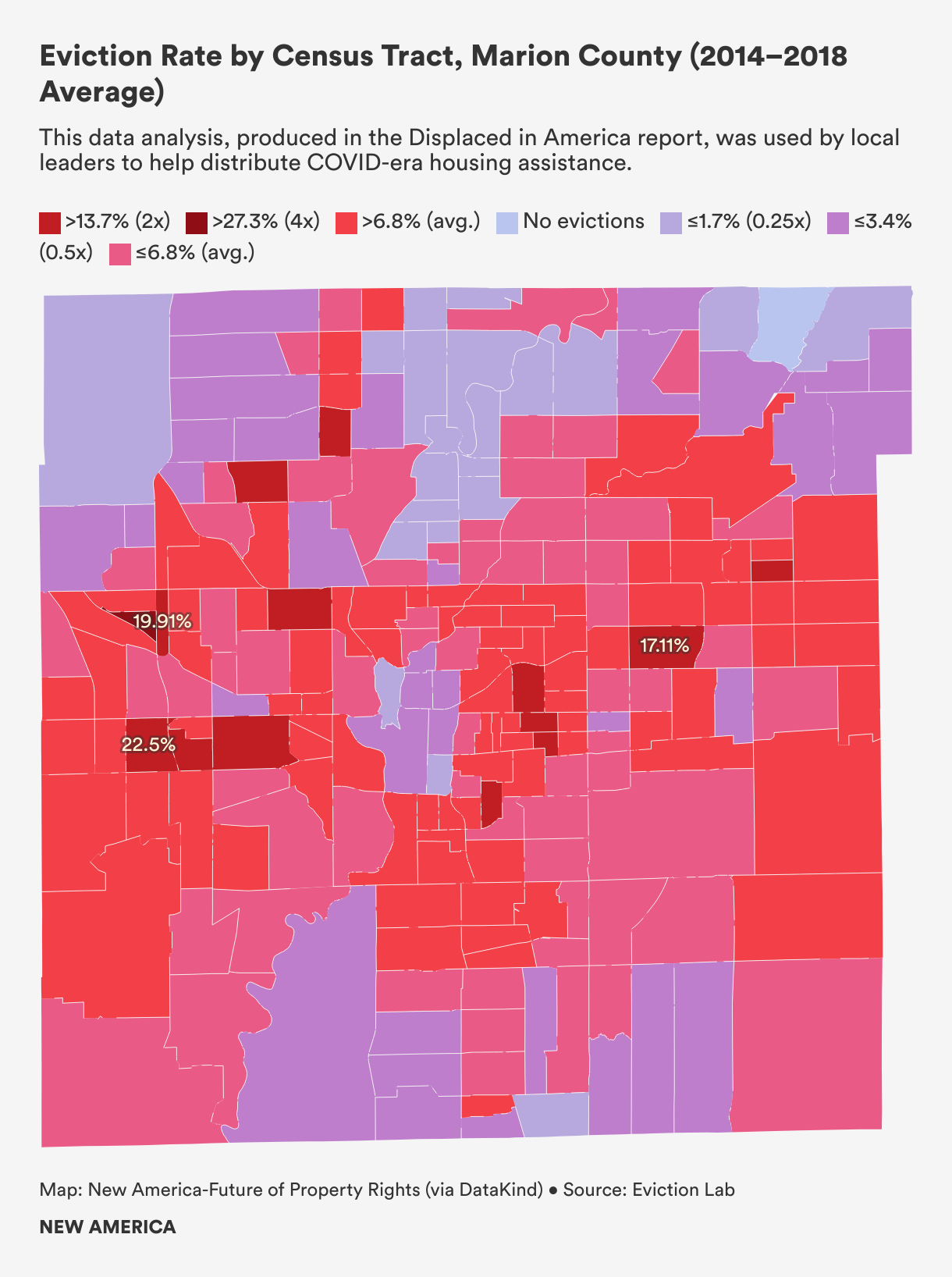
At the outset of the COVID-19 pandemic in March 2020, for example, the Deputy Mayor of Indianapolis had to distribute $15 million of Coronavirus Aid, Relief, and Economic Security (CARES) Act funding across the city to keep people stably housed. Using census-tract level heat maps of evictions and foreclosures from the five years prior to the pandemic (2014–2018), city leaders were able to see which neighborhoods had historically been hardest hit by housing loss as a way to determine how to allocate this federal housing aid.
In Tempe, Arizona, the City Council used our findings that non-citizens were being evicted at higher rates to propose standing up a Spanish language legal aid clinic. And in Winston-Salem, North Carolina, our findings about racial disparities in housing loss gave advocates the data to back what they were already seeing in their communities, forcing conversations about discriminatory housing practices.
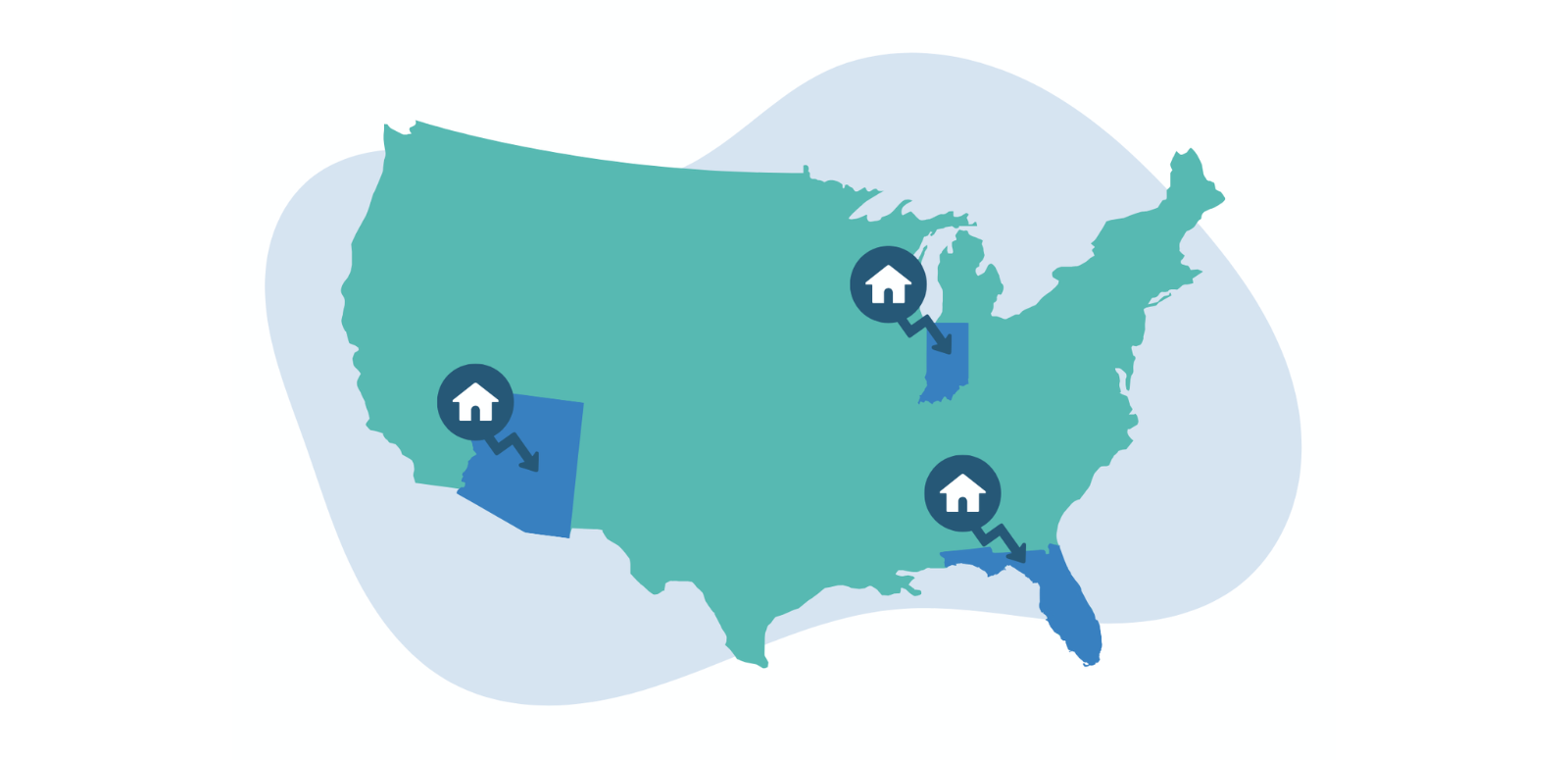
Watching local leaders strategically use eviction data in real-time to inform important housing decisions motivated the development of the Foreclosure and Eviction Analysis Tool (FEAT) and its piloting to unlock statewide analysis of EF data in Arizona, Florida, and Indiana. The remainder of this report details the development and piloting of FEAT and critical lessons learned from municipalities’ use of the tool to scale this analysis statewide.
Citations
- Sabiha Zainulbhai, “What Can Court Data Actually Tell Us About Evictions?” New America, April 20, 2023, source.
- New America’s policy work around improving housing loss data has to date focused on evictions, however the majority of the actions discussed here are equally applicable to foreclosure data.
- Yuliya Panfil, Sabiha Zainulbhai, and Tim Robustelli, Why is Eviction Data so Bad?Recommendations for Improving the Local and National Landscape (Washington, DC: New America, 2021), source.
- Office of Policy Development and Research, Report to Congress on the Feasibility of Creating a National Evictions Database (Washington, DC: U.S. Department of Housing and Urban Development, 2021), source.