
The Bermuda Triad
Abstract
This report examines the system of shared accountability that devolves into a game of hot potato, with no one member of the program integrity triad willing to take serious action against an institution of higher education that falls short of its standards until other members of the triad have stepped up. In its examination, the report asks the question: Who is supposed to be protecting students and taxpayers?
Acknowledgments
New America would like to thank Arnold Ventures for its generous support of this project, and the Bill & Melinda Gates Foundation for its generous support of our work. The views expressed in this report are those of its authors and do not necessarily represent the views of the supporters, their officers, or employees.
Downloads
Shifting and Rebalancing the Roles of the Program Integrity Triad
Introduction
The American higher education system is among the most vaunted in the world. It provides some of the greatest opportunity and access to postsecondary education and boasts some of the globe’s most prestigious universities.1
But the U.S. also hosts thousands of poor- and under-performing colleges, where millions of students are paying—and often borrowing—a lot. Unfortunately, most students do not know that schools are underperforming until it is too late. The higher education industry has coasted on the reputation of our nation’s most prestigious schools. And while students who find themselves in debt with no degree or a dead-end credential may blame themselves, the truth is that the current system is largely to blame.
Nationally, only about 42 percent of students complete a four-year degree in four years—with rates that are much lower for Black (22 percent) and Hispanic (33 percent) students—and fewer than one in three complete a certificate or associate degree within one-and-a-half times the length of time it should take them.2 At hundreds of colleges, alumni who attended school using federal aid leave with typical earnings of less than $25,000, with many well below the average earnings of a worker with only a high school diploma.3 And over a million borrowers each year fall behind and default on their loans for the first time.4 Students who enroll in college may actually leave school worse off than they were before they started, often with debt and no degree or with a low-value credential that carries little value in the labor market.5 And in recent years, tens of thousands of students have seen their colleges close in the blink of an eye, with no warning and few options.6
Given these mediocre outcomes for millions of postsecondary students each year, it is reasonable to ask: Who is supposed to be protecting students and taxpayers?
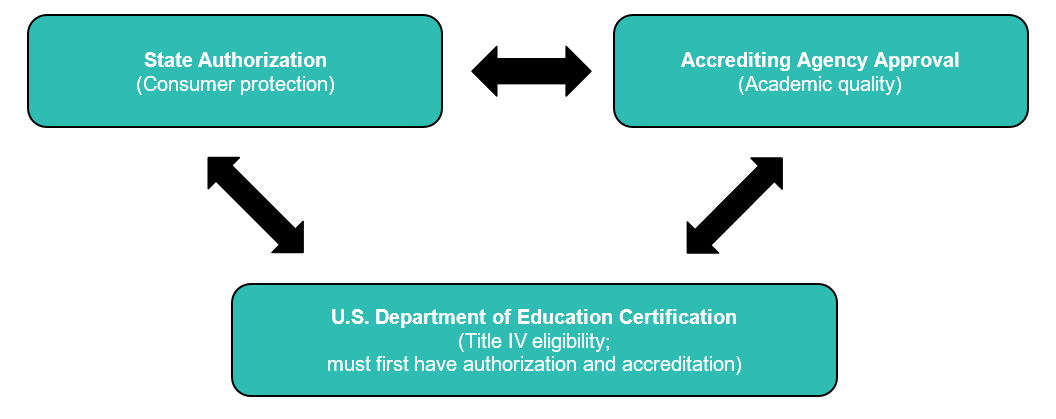
In such a diffuse, varied system, gatekeeping responsibilities are not simple. So Congress cobbled together a “program integrity triad” to share the responsibilities, pulling in existing entities—designed in a different time and for different purposes—to fill that role as it expanded federal dollars to more colleges (see Figure 1). In general, accrediting agencies are approved by the Education Department to bear responsibility for the academic quality of the colleges they accredit; the states are tasked with consumer protection; and the federal government, via the U.S. Department of Education, certifies institutions to be eligible for taxpayer-financed financial aid and oversees their administration of those funds. The Department also decides which accreditors meet federal standards. This system has scarcely evolved to address massive increases in the federal investment in higher education; huge increases in the number of Pell Grant recipients and student loan borrowers; and the development of new institutions, education providers, and delivery models entering the system.
Too often, the system of shared accountability devolves into a game of hot potato, with no one member of the triad willing to take serious action against an institution of higher education that falls short until other members of the triad have stepped up. With potentially severe consequences for a college—and its students—each member of the triad has a tendency to wait several beats too long before enforcing any severe action against a college, often no matter how poor the institution. And each piece of the triad is guilty of seeing institutions, not students and taxpayers, as the client. This imbues regulatory capture, in which regulators feel beholden to the interests of the industry they regulate, at every level of oversight.
Figure 1: Program Integrity Triad
This problem is not a recent development. In the culminating report of a series of hearings by Senator Sam Nunn (D-GA) ahead of the 1992 reauthorization of the Higher Education Act, the Subcommittee found that the triad “provides little or no assurance that schools are educating students efficiently and effectively.”7 The report also found that “the Department of Education had all but abdicated its responsibility to the students it is supposed to service and the taxpayers whose interests it is charged with protecting.”8 A later investigation led by Senator Tom Harkin (D-IA) confirmed the problems had continued, and even grown, especially in the for-profit sector, noting that “the ability of regulators to protect students, ensure academic quality, and safeguard State and Federal taxpayer dollars has been strained.”9
“Not It:” The Triad and Charlotte School of Law
An example helps to illustrate both the promise and the inherent tension of the program integrity triad. Charlotte School of Law (CSL) was founded in North Carolina in 2004, financed by a private equity firm and accredited by the American Bar Association in 2008. By 2016, the school enrolled some 700 students, offering high-priced law degrees that students could borrow for into the six figures from the U.S. Department of Education.10
But the degree was often not worth the cost for students. For graduates who took the bar exam for the first time in February 2016, barely one in three passed. At a faculty meeting, an assistant dean of the school said its bar pass rate would have been even worse if not for a scheme the school employed to pay students not to take the bar exam at all.11 Despite the accreditor taking note of declining student outcomes and other missed standards in January 2015 following a comprehensive review, the school remained accredited and continued to enroll students.
After two more years of non-compliance with accreditor standards and disturbingly bad outcomes for most students at the school, the Department finally took a rare action. In December 2016, the Education Department notified Charlotte School of Law it would not be recertified to participate in the federal student loan program based on its inability to meet the ABA’s standards.
The school asked that it be granted access to loans for at least another semester, setting up an institutional loan program to load students up with private loans in the interim. While the Department originally declined, the incoming Trump administration sent the school back some of the taxpayer-backed loan dollars after it had limped along on private loans for a few months. But despite modest sanctions from the accreditor and the Department’s complicated history with the school, it remained open.
Finally, in June 2017 (fully 18 months after the Department took action), the North Carolina state authorizer (the UNC Board of Governors) voted to place a long list of conditions on Charlotte School of Law’s license to operate in the state—requiring, among other things, approval from the accreditor (the ABA) and from the Education Department. The school missed the deadline for those approvals, rendering it automatically unauthorized to operate in North Carolina. Still, the school continued to tell students it would meet the requirements, and confusion reigned for nearly a week, before UNC clarified to the public that Charlotte School of Law had lost its authority to operate, effectively shutting it down.
The triad is supposed to ensure that multiple entities are keeping a close eye on colleges. But with Charlotte School of Law, this system became more of a “Bermuda triad,” with the mysterious disappearance of rigorous oversight of colleges that are known by all actors to be problems. While the entities in the triad should respect the decisions of other regulators in the system, in this case they saw a problematic institution and each pointed fingers, allowing other members of the triad to substitute for their own responsibilities. That Charlotte School of Law was able to continue teaching students for so long after problems were spotted and the institution failed to improve—and that it came so close to being permitted back into the federal financial aid system even after severe actions were taken—is deeply concerning.
Shifting and Rebalancing the Roles of the Triad
If Congress were designing a quality assurance system from scratch—one that recognized the huge and growing role that the federal government plays in higher education, the decreasing relative state investment, the changes in the types of students and the schools they go to, and the increased cost and risk of higher education when it is financed with student debt—it would undoubtedly be designed differently to avoid the kind of finger-pointing common among the triad.
"Oversight of colleges has fallen short, at the expense of millions of students."
But change is desperately needed. Oversight of colleges has fallen short, at the expense of millions of students. And the last 18 months have shown the U.S. Department of Education further back-tracking on what few protections do exist in the program integrity triad.12 Taken individually, any one of the Department’s current efforts to minimize responsibilities of states, accreditors, and the federal government might further weaken a leg of the program integrity triad. Taken together, the entire system will come crashing to the ground.
Summary of Recommendations
Accreditors
- Restore minimal oversight of accreditors through federal rules
- Hold accreditors accountable for fulfilling their responsibilities
- Set reasonable time frames for improvement and require accreditors to take action when they expire
- Give accreditors enhanced tools for accountability
- Make student outcomes central to what accreditors do and hold them to those standards
- Ensure accreditors are student-focused in their policies and actions
- Create more independence within accrediting bodies
- Increase transparency of accreditation documents
- Promote risk-based reviews of institutions and of accreditors
States
- Require states to do more than rubber stamp colleges
- Shift some responsibilities from accreditors to states
- Strengthen states’ roles in protecting consumers of higher education
- Collect and refer complaints as appropriate
- Subject online colleges to rigorous oversight
- Help states to triage the challenges in their states
- Provide data feedback reports to states on the outcomes of their institutions
- Provide coordinating grants to states to align oversight across federal programs
U.S. Department of Education
- Reform the structure of Federal Student Aid to promote heightened oversight
- Increase risk-based reviews of colleges
- Improve financial monitoring of private colleges
- Prevent colleges from dragging out closure at taxpayers’ expense
- Strengthen outcomes-based accountability
- Establish—and use—interim sanctions short of total loss of taxpayer financing
- Protect students from abusive recruiting practices
- Strengthen interactions among the members of the triad
Citations
- Education at a Glance: United States (Paris, France: Organisation for Economic Co-operation and Development, 2018), source
- Institute of Education Sciences, National Center for Education Statistics (website), “Digest of Education Statistics,” Table 326.10, 2018, source ; Institute of Education Sciences, National Center for Education Statistics (website), “Digest of Education Statistics,” Table 326.20, 2018, source These graduation rates Include only first-time, full-time students.
- Authors’ analysis of data from the College Scorecard, available at collegescorecard.ed.gov/data
- Federal Student Aid (website), “Default Rates,” source
- Arne Duncan, “Toward a New Focus on Outcomes in Higher Education” (remarks at the University of Maryland–Baltimore County, Baltimore, MD, July 27, 2015), source ; and authors’ analysis of “Debt to Earnings Rate Data,” Federal Student Aid (website), 2017, source
- See, for example, Corinthian Colleges, ITT Tech, Education Corporation of America, Dream Center Education Holdings, and others.
- Permanent Subcommittee on Investigations of the Committee on Governmental Affairs United States Senate, Abuses in Federal Student Aid Programs (Washington, DC: U.S. Congress, 1991), source
- Ibid.
- Majority Committee of the Senate Health, Education, Labor, and Pensions Committee, For-Profit Higher Education: The Failure to Safeguard the Federal Investment and Ensure Student Success (Washington, DC: U.S. Congress, 2012), source
- This section is adapted from two EdCentral New America blog posts: Clare McCann, “A Play-by-Play of Charlotte School of Law’s Closure,” August 23, 2017, source ; and Clare McCann, “Lessons for Higher Ed in Charlotte School of Law Closure,” August 23, 2017, source
- Lisa Worf, “Recordings Shed Light on Charlotte School of Law’s Methods to Boost Bar Passage,” Charlotte Observer, January 25, 2017, source
- Amy Laitinen and Clare McCann, “Comments on Proposed Accreditation and State Authorization Rules,” New America, July 12, 2019, source ; and Clare McCann, “Comments on Proposed Gainful Employment Rule,” New America, September 13, 2018, source
Accreditors
While all members of the triad have seen their roles and scope change dramatically since their inception, accreditors may have claim to the most substantial shift. What started in the 1800s as a voluntary system of institutional peer review became a high-stakes role as the gatekeeper to significant federal dollars. Despite putting federal money on the line, beginning in the 1950s with the second GI Bill, the federal government did not want primary responsibility for the gatekeeping function, and instead deferred to accreditors.1 In 1965, the scope and stakes of accreditors’ roles changed tremendously with the advent and growth of programs under the Higher Education Act. Today, accreditors are gatekeepers to more than $120 billion in federal dollars annually, most of which is borrowed by—and must be repaid by—students.
This is a tremendous responsibility for a largely volunteer labor force that is interested in institutional improvement and inclined against institutional sanctioning, particularly since the agencies’ revenue and board membership come from the very institutions they accredit. And yet, the accreditors’ stamp of approval provides the public, and even policymakers, with the (sometimes false) perception that the institution is a quality one. Their stamp also opens the spigot to allow billions and billions of federal dollars to flow, including to schools that have failed students badly and sometimes at tremendous scale.
These problems with accreditors and our cobbled-together quality assurance system are well documented. The Organisation for Economic Co-operation and Development (OECD) published a book in 2013 that identified the lack of quality as one of the top issues plaguing the American postsecondary education system. The usually restrained OECD rang alarm bells, warning that the current system linking federal financial aid eligibility to the existing quality assurance system was “unsustainable.”2 The OECD continued, “the postsecondary quality assurance system is weak and inconsistent, [and] places too great reliance on institutional accreditation arrangements…. The blend of this system with increasing tuition fees, constrained public budgets and broader economic distress creates a dangerous mix with financial risks both for individuals and lending bodies, including the federal government.”3
"The usually restrained OECD rang alarm bells, warning that the current system linking federal financial aid eligibility to the existing quality assurance system was “unsustainable.”
In short, accreditation is not working as it needs to—not for students who borrow to attend accredited schools they believe will serve them well, and not for taxpayers, whose dollars are used to prop up schools that are not working.
The Spellings Commission
This realization is nothing new. The most significant recent iteration of attempting to name and solve the problems with accreditation began back in 2005, when Secretary Margaret Spellings announced the formation of the Commission on the Future of Higher Education. This group was not just ambitious in name, but also in the scope of issues it sought to tackle: access, affordability, quality, accountability, and innovation. Not surprisingly, given their gatekeeping role to billions of dollars, accreditors found themselves in the crosshairs.
The commission’s final report stated that accreditation had "significant shortcomings" and needed a "transformation."4 The commission’s report found, among other things, that accreditors focused too much on inputs and not enough on outcomes; that they did not have standards that allowed for comparison across colleges; that they did not report measurable progress; and that their processes were not open or transparent. And the commission did not just identify the problems; it called for action to resolve them. With Secretary Spellings in a position to do just that, she began the process of initiating a rulemaking to help make the commission’s vision a reality.
But nothing upsets the higher education sector more than the federal government looking at issues of quality and asking for accountability. The reaction from accreditors and schools was swift and strong. The dreaded “slippery slope” and the horrors to which it could lead were invoked. Judith Eaton, the president of the country’s largest institutional higher education membership organization, the Council for Higher Education Accreditation (CHEA), warned that "we could end up with national standards and federally set levels of expectations.”5 She warned that ”those efforts would convert the accreditation process "from a collegial activity to a regulatory one,” highlighting the fact that—despite being legally tasked as the gatekeepers to federal money—accreditors do not see themselves as regulators.6 Accreditors and schools started pounding the pavement in the marbled halls of Congress to stop the regulations, and Congress obliged.
Senator Lamar Alexander, then-ranking member of the Senate education committee, warned Secretary Spellings in a 2007 floor speech that, if she were to move forward with her plan to publish a final rule on accreditation before Congress acted, he would author an amendment prohibiting her from doing so.7 Shortly after, a bipartisan group of 18 of the 21 education committee members wrote a letter asking her to refrain from regulating until after Congress passed the Higher Education Act reauthorization.8 The House got in on the action, too, by putting language in its draft spending bill to prevent the Secretary from using any of those funds to enact the regulations.9
Secretary Spellings got the message, and did not finalize the regulations. But when Congress finally did pass the legislation, in the form of the Higher Education and Opportunity Act of 2008, it did little to strengthen requirements for accreditors, or for the standards they apply to the institutions they approve. Instead, it took a fairly dramatic step to weaken federal oversight of accreditors by banning the Education Department from specifying how accreditors look at student achievement in their standards.10
Accreditors and Student Outcomes Today
Since 2008, the situation has deteriorated. In 2014, Corinthian Colleges collapsed despite being in good standing with the Accrediting Council for Independent Colleges and Schools (ACICS). A few years after that, ITT Tech followed suit, and then Education Corporation of America and its 70 campuses.11 Both ECA and ITT Tech were also accredited by ACICS, an accreditor that had become notorious for approving bottom-of-the-barrel schools, willing to extend its approval easily and to look the other way when schools fell short.12 In the case of these three schools alone, around 75,000 students were affected by the immediate closures.
In 2016, the Education Department conducted a regular review of ACICS, and career staff turned up dozens of areas of noncompliance, including evidence from those failed colleges. Based largely on those findings, NACIQI, an independent advisory body to the Department, recommended the Department withdraw the agency’s recognition. Remarkably, it did. The agency appealed the decision to the secretary in the waning days of the Obama administration, but the secretary reaffirmed the decision to withdraw recognition. This would have been a death knell to the poor-performing accreditor, so it bought time with a court fight, which paid off when President Trump came into office shortly after. Political appointees at the Department, citing the lawsuit, reversed the original decision.13 ACICS is back in full status as a gatekeeper today, albeit a shell of its former self, having lost dozens of colleges to other accreditors or to the catastrophic closures it failed to anticipate.14
But while ACICS had an unusual concentration of poor-quality institutions under its purview, the problems extend beyond ACICS. A chain of schools that included the Art Institutes and Argosy University, among other brands—accredited by agencies that included ACICS, the Higher Learning Commission (HLC), the Southern Association of Colleges and Schools Commission on Colleges (SACSCOC), and the Western Association of Schools and Colleges (WSCUC)—nearly closed before being sold to a religious nonprofit called the Dream Center that had no experience or expertise in education. After sinking money into the schools for around two years, Dream Center executives ultimately filed for receivership and most campuses are now closed. But not before millions in federal aid went missing and students reported experiencing eviction and homelessness after the school apparently stole their federal aid dollars.
The circumstances around ACICS, as well as a burgeoning public debate on college closures and the efficacy of accreditors, reopened concerns about the failures of accreditors. In 2017, the Government Accountability Office stated that the majority of its round-table experts, including accreditors and other stakeholders, agreed that “inadequate accreditors’ standards are a challenge for overseeing academic quality and that accreditors lack effective oversight practices for academic quality.”15 The same year, the Department’s own inspector general found that the Department “does not have adequate controls” over the decision to recognize accreditors, and that the Department’s oversight of accreditors once they’re recognized “is not adequate to ensure agencies consistently and effectively carry out their responsibilities.”16
And it is about to get worse. Despite catastrophic and public failures that cost students years of their lives and billions of federal dollars, and repeated external findings that the accreditation leg of the triad is incredibly weak, U.S. Secretary of Education Betsy DeVos has recently sought to weaken, rather than strengthen, accreditation. A new rule, currently in the works, will vastly reduce the already-low expectations the Department has for its accreditors and its own oversight, and ensure that poor-quality colleges can continue to advertise themselves as accredited—and receive federal dollars—for years longer than they can today. The rules represent an even more significant back-tracking in accountability for accrediting agencies than the ban added during the Higher Education Act reauthorization in 2008 did, and all without Congressional input.
Recommendations for Strengthening Accreditation
Despite widespread agreement that accreditation is not functioning as an effective gatekeeper to billions of dollars, there is less agreement about how to fix it. Senator Lamar Alexander (R-TN), chair of the powerful Senate HELP Committee, said at his 2015 accreditation hearing, “it’s important to find a way to make accreditation work better. I have had a hard time thinking of another way to do this….If the accreditors don’t do it, I can assure you the Congress can’t. And the Department of Education I don’t believe has the capacity or the know-how.” The game of hot potato continues.
Without change, accreditors will continue to fall short of our expectations and pay no consequence. The following recommendations, while not a full-scale re-envisioning, would help prevent future failures, ensure that accreditors are a strong part of the triad, and protect millions of students.
- Restore minimal oversight of accreditors through federal rules. Admittedly, requirements on accreditors have long been fairly lax. But a regulatory effort launched by the Trump administration in 2018 greatly weakened the requirements accreditors must place on the colleges they approve, as well as the Department’s own expectations for accreditors. Taken individually, the proposed changes will result in less oversight and provide a license for poor-quality colleges to flourish. Cumulatively, the changes are much more severe—likely to mean accreditors have neither the ability nor the inclination to ensure the quality of the institutions they approve, and that the Department has virtually no ability to police which accreditors are permitted to serve as gatekeepers to billions in federal dollars.17 Policymakers—at the Department and in Congress—must strengthen accreditation requirements by restoring strong federal rules before the triad collapses entirely.
- Hold accreditors accountable for fulfilling their responsibilities. Accreditors have been designated by policy experts and media as “watchdogs that rarely bite.”18 The Government Accountability Office found that agencies sanctioned only about 8 percent of schools, and withdrew accreditation for only about 1 percent of accredited schools, despite there being more than 1,500 accredited colleges with graduation rates below 40 percent.19 Yet with millions of students dropping out of college every year, often indebted despite not holding a degree; a million borrowers defaulting for the first time on their loans each year; and little progress made to improve students’ outcomes over the years, it is clear that accreditors have fallen short of their responsibilities.20 Some institutions are even able to obtain accreditation by shopping for the agency with the lowest standards; nowhere was this more obvious than with the Accrediting Council for Independent Colleges and Schools (ACICS). When ACICS-approved schools had to seek alternative accreditation after the agency (temporarily) lost its gatekeeper status, 111 schools were able to receive accreditation from another agency within 18 months, but fully 85 could not, and another 61 closed completely prior to the deadline.21 If standards for accreditors are not raised, very poor-quality institutions will persist.
- Set reasonable time frames for improvement and require accreditors to take action when they expire. One straightforward improvement would be to require action when an institution has dragged the process out too long. Currently, federal rules require accreditors to pull their approval after an action for non-compliance (like probation) within a maximum of two years for a four-year college. In the 2018–19 rulemaking, the Department doubled that time frame. Combined with other changes that will allow accreditors to drag out the process of taking even an intermediate action in the first place, schools failing to meet accreditors’ standards could easily go a decade before they lose accreditation.22 The Department needs to restore and enforce those limits for accreditors, so that students know they can trust accreditors to pull approvals where warranted.
- Give accreditors enhanced tools for accountability. The loss of accreditation leaves most colleges unable to survive, given that it carries with it the loss of eligibility for federal financial aid. Accreditors are reluctant to use that bludgeon: they took around four times as many negative actions not to pull accreditation as they did to withdraw accreditation last year.23 Encouraging accreditors to make use of limitations—ensuring colleges that fall short of the agency’s requirements cannot continue to expand their operations or enrollment, for instance, or mandating changes to increase spending on instruction—could help to protect students when agencies are unwilling to go as far as to remove approval. Accreditors also need legal protection from the institutions they accredit, so that when they take an action, they are not outgunned by lawyer fees and court battles.
- Make student outcomes central to what accreditors do and hold them to those standards. Accreditors—and particularly the regional accreditors that typically accredit public and nonprofit colleges—have a poor track record when it comes to ensuring student outcomes are prioritized at their colleges. Agencies often rely on vague, amorphous standards around student achievement and let colleges select their own metrics and set their own goals. Every agency has its own definition and data source.24 And rarely, if ever, does a regional accreditor take severe action against a college on the basis of failing student achievement measures. The head of one such agency, when asked whether a college with a 10 percent graduation rate could do a good job, stated that “it can be a good school for those 10 percent who graduate.”25 Congress should require that accreditors serving as gatekeepers to federal dollars set minimum requirements for their colleges in a variety of areas (such as graduation/retention rates and labor market outcomes); mandate that the Education Department provide applicable data to accreditors annually, so the data are comparable and reliable; and direct the Department to ensure agencies’ thresholds are reasonably effective.
- Ensure accreditors are student-focused in their policies and actions. Accreditors often boast of their “rigorous process of peer review,” in which they send hundreds of volunteer college faculty and administrators across the country to review the quality of other colleges. But while the peer review process may be a long-standing and valued one to promote “continuous improvement,” the high stakes of placing federal financial aid on the line carry the significant risk that peers don’t look too hard, or ask too much.
- Create more independence within accrediting bodies. Accrediting agencies are currently required to have policies to prevent conflicts of interest. But those policies are not always sufficient to guard against such conflicts or affiliations. The Center for American Progress has found that, of 69 commission members designated to represent the “public,” nearly a third have backgrounds at colleges, mostly as retired faculty or administrators.26 And in many agencies, most commissioners—those responsible for making decisions about accrediting actions—are employed at institutions approved by that same accreditor.27 It is no wonder, then, that accreditors are often reluctant to hold institutions accountable. Peer review will not be an effective model if there is no degree of independence, particularly given the financial interests accreditors have in not withdrawing approval from an agency. Lawmakers should improve protections so they go beyond formal conflicts of interest and also prevent accreditors from stacking their commissions with current and former officials at the schools they review.
- Increase transparency of accreditation documents. Much of the accreditation process happens in a black box, with reports and other materials usually kept private and students kept in the dark about the process that resulted in an institution earning and keeping its approval. During the 2008 debates, accreditors claimed opening up the process would “undermine their effectiveness,” making small and private colleges “reluctant to talk about their problems.”28 And yet, one agency, the Western Association of Schools and Colleges headquartered in California, has decided to increase transparency, without apparent ramifications. The WSCUC website includes all final accreditation materials—like reports and decision letters—easily accessible to members of the public.29 Policymakers should mandate that level of transparency across all accrediting agencies, as well as continued timely reporting to the Education Department (and the public) of key information and decision letters for negative actions taken by the agency.30
- Promote risk-based reviews of institutions and of accreditors. The accreditation process is often (rightly) critiqued as overly focused on compliance, and not focused enough on the types of issues that present the most severe problems. With a lengthy list of boxes to check, accreditors often spend too much time conducting regular reviews of quality institutions—and too little on the schools that underperform. Accreditors should be encouraged to focus on the colleges with the worst outcomes and the greatest risk for students. Similarly, the Department should invest more of its time in the accrediting agencies that fail students and taxpayers the most, or that leave taxpayers most at risk. More reviews of those agencies, and more focused reviews of all agencies when problems arise, would bring the greatest return on investment to the accreditation process.
Citations
- Antoinette Flores, “Hooked on Accreditation: A Historical Perspective,” Center for American Progress, December 14, 2015, source
- Malgorzata Kuczera and Simon Field, A Skills Beyond School Review of the United States (Paris, France: Organisation for Economic Co-operation and Development, July 10, 2013), source
- Ibid.
- The Secretary of Education’s Commission on the Future of Higher Education, A Test of Leadership: Charting the Future of U.S. Higher Education (Washington, DC: U.S. Department of Education, September 2006), source
- Burton Bollag, “Spellings Wants to Use Accreditation as a Cudgel,” Chronicle of Higher Education, November 24, 2006, source
- Paul Basken, “Bush Administration Spars with Accreditors,” Chronicle of Higher Education, September 24, 2007, source
- Lamar Alexander, “Accountability in Higher Education” (remarks in the U.S. Senate, Washington, DC, May 25, 2007), source
- Edward M. Kennedy, Sr., Michael B. Enzi, Christopher Dodd, Judd Gregg, Tom Harkin, Lamar Alexander, Barbara A. Mikulski, Richard Burr, Jeff Bingaman, Johnny Isakson, Patricia Murray, Lisa Murkowski, Jack Reed, Pat Roberts, Hillary Rodham Clinton, Barack Obama, Bernard Sanders, and Sherrod Brown, “Wait Until the Higher Education Act is Reauthorized” (letter to Margaret Spellings, Washington, DC, June 15, 2007), source
- Doug Lederman, “Senate and Spellings: Showdown Looms,” Inside Higher Ed, June 18, 2007, source
- 20 U.S.C. 1099b(g). The Higher Education Opportunity Act (P.L. 110-315) added this language: “Nothing in this section shall be construed to permit the Secretary to establish any criteria that specifies, defines, or prescribes the standards that accrediting agencies or associations shall use to assess any institution’s success with respect to student achievement.” Document available at source
- Andrew Kreighbaum, “Collapse of For-Profit Chain Long in the Making,” Inside Higher Ed, December 6, 2018, source
- Ben Miller, ACICS Must Go (Washington, DC: Center for American Progress, June 6, 2016), source
- Ben Miller and Antoinette Flores, ACICS Should Not Regain Its Ability to Grant Access to Federal Financial Aid (Washington, DC: Center for American Progress, March 9, 2018), source
- Antoinette Flores, “The 85 Colleges That Only ACICS Would Accredit” (Washington, DC: Center for American Progress, July 3, 2018), source
- Melissa Emrey-Arras, Higher Education: Expert Views of U.S. Accreditation (Washington, DC: Government Accountability Office, December 22, 2017), source
- U.S. Department of Education’s Recognition and Oversight of Accrediting Agencies (Washington, DC: Office of Inspector General at U.S. Department of Education, June 27, 2018), source
- Amy Laitinen and Clare McCann, “Comments on Proposed Accreditation and State Authorization Rules,” New America, July 12, 2019, source
- Andrea Fuller and Douglas Belkin, “The Watchdogs of College Education Rarely Bite,” Wall Street Journal, June 17, 2015, source
- Higher Education: Education Should Strengthen Oversight of Schools and Accreditors (Washington, DC: Government Accountability Office, December 2014), source ; and National Advisory Committee on Institutional Quality and Integrity, Recognized Institutional Accreditors: Federal Postsecondary Education and Student Aid Data (Washington, DC: U.S. Department of Education, February 5, 2019), source
- Antoinette Flores, The Unwatched Watchdogs (Washington, DC: Center for American Progress, September 19, 2019), source
- Antoinette Flores, “The 85 Colleges That Only ACICS Would Accredit,” Center for American Progress, July 3, 2018, source
- Amy Laitinen and Clare McCann, “Comments on Proposed Accreditation and State Authorization Rules,” New America, July 12, 2019, source
- Council for Higher Education Accreditation (website),“CHEA Almanac Online: Summary of Accreditation Actions for January 1–December 31, 2018,” source
- Antoinette Flores, How College Accreditors Miss the Mark on Student Outcomes (Washington, DC: Center for American Progress, April 25, 2018), source
- Andrea Fuller and Douglas Belkin, “The Watchdogs of College Education Rarely Bite,” Wall Street Journal, June 17, 2015, source
- Ben Miller, Bolstering the Public Voice in Accreditation (Washington, DC: Center for American Progress, June 6, 2019), source
- Preston Cooper, “Many Accreditors Have Conflicts of Interest,” Forbes, November 18, 2016, source
- Burton Bollag, “Spellings Wants to Use Accreditation as a Cudgel,” Chronicle of Higher Education, November 24, 2006, source
- WASC Senior College and University Commission (website), “Institutions,” source
- Regulations.gov (website), “11172016 Accreditation Terminology Guidance-Post 30 Day Comment Revision-Final,” October 11, 2016, source
States
State Authorization
States have played a role in the oversight of public colleges within their borders since the formation of public colleges in America’s early days.1 Well over half of states have adopted performance-based funding models that seek to redirect some or all funding to public institutions that meet key outcome metrics like graduation and retention rates.2
But more often, states have taken a back seat in overseeing the private colleges that enroll their students, beyond providing basic approvals. Many do not include private colleges in their state data systems.3 Without access to good data, those states have less information about private colleges and their outcomes than they do about public schools. State authorization and oversight requirements also vary considerably from state to state. Some states require only a minimal application from colleges located there; others require a more involved process, financial contributions to protect students, and/or disclosures. Some states ceded (or did, until the last decade) their role in the triad entirely to accreditors for the purposes of federal student aid eligibility under the HEA, permitting institutions to consider themselves authorized if they had obtained accreditation.4
In part, state authorization has often fallen short of its potential as a regulator of colleges because of deep constraints in staff capacity. A recent study from the State Higher Education Executive Officers association (SHEEO) found that, of 70 state authorizing agencies across the country, all have consumer complaint systems, but there is considerably more variation on other consumer protection measures. For instance, only 62 have required refund policies; just 23 require a student protection fund; and many do not require institutions to meet any student outcome metrics, with 43 looking at graduation rates and only 31 requiring any student outcome data beyond that.5
State Postsecondary Recognition Entities (SPREs)
There have been attempts, albeit sometimes short-lived, to improve states’ oversight of institutions. Chief among those was the development of state postsecondary recognition entities, or SPREs. In the wake of the Nunn hearings that found such ineffective oversight by the triad, the 1992 Higher Education Act created SPREs specifically to beef up states’ roles. The law provided funds to states in exchange for increased capacity and oversight activities with respect to colleges.6
Over the objection of the higher education lobby, the version included in the law took an expansive view of oversight, requiring states to look at academic quality and student outcomes like dropout rates, job placement rates, and licensure exam pass rates, rather than just asking states to prevent predatory practices, as had been originally proposed.7 Around the same time, President George H. W. Bush lost the election, leaving the implementation of SPREs to the brand-new Clinton administration, which required that states develop SPREs, that each SPRE submit a plan to the Education Department for approval, and that SPREs conduct reviews of any institution that triggered even one of 11 statutory criteria—which the Department later determined included about 2,000 institutions.
With 2,000 colleges in the crosshairs, it was not long before industry voices—led by the National Association of Independent Colleges and Universities (NAICU)—won out. After a loud fight from the sector, the SPREs were swiftly killed when Congress changed hands after the 1994 elections, during the so-called “Republican Revolution.”8
"With 2,000 colleges in the crosshairs, it was not long before industry voices won out. The SPREs were swiftly killed during the so-called 'Republican Revolution.'"
If there are lessons to be learned from SPREs, they are clearest in the constraints of the effort. The higher-education industry, particularly beyond the for-profit sector, is unaccustomed to oversight and accountability; it chafed at the very notion of SPREs and fought vigorously against the law. States have significant variability in capacity, and have substantially different problems within their borders; they chafed under a one-size-fits-all regime. And once the money was off the table when Congress defunded SPREs in 1995, most of the capacity and oversight structures states had built up for colleges receiving student aid dollars fell away, returning most states to just where they had been a few years earlier.9
Federal Regulations on Authorization Requirements
But that was not the last time policymakers would seek to bring some order to the chaos of state authorization. Concern over inadequate authorization requirements came to a head again in 2007, when California entirely eliminated its state authorizing agency for for-profit colleges by letting the legislation that authorized it lapse.10 When the state’s lack of any oversight body for an entire swath of colleges resulted in absolutely no consequences for schools—including no loss of federal financial aid eligibility, despite a requirement in the Higher Education Act that schools be authorized by the state in order to access Pell Grants, student loans, and other aid—it became clear that there were untenable cracks in the triad.
The Education Department sought to remedy the situation by clarifying for colleges and universities what “state authorization” meant. Regulations published in 2010 laid out several new requirements for state authorization. In short, institutions would be required to follow a process for affirmative approval by the state, meaning either the state named the institution as authorized through state law or constitution, as is often the case for public colleges, or the institution met any state requirements to obtain and maintain authorization, with a few exceptions.11 All institutions were also required to ensure their states had a process to “review and appropriately act on” complaints about the college.
The regulations were delayed to allow adequate time (and then some) for implementation, and the Department worked with states and colleges to ensure compliance when they were ultimately implemented in 2015. But while the rules established a firm baseline for the oversight of institutions in every state, they did not require that oversight to be effective. In fact, no institutions actually lost eligibility because of the new rules, and some states continued to rubber-stamp authorization for their colleges.
In 2014, the Department conducted another rulemaking—finalized two years later—to clarify the circumstances of institutions operating online programs in multiple states.12 Institutions with online programs had always been subject to state requirements for distance-education programs, but states often did not have effective enforcement mechanisms to monitor schools without a physical presence in the state. Without federal consequences, institutions with fully online programs could state-shop, setting up their headquarters in a state with lax rules and leaving the residents of states with stricter rules unprotected. The final regulations required that colleges offering online programs meet the authorization rules of states where they enroll students, if any; and that those states must have complaint processes that include a process for reviewing and acting upon the complaints of their residents enrolled in institutions that are based out-of-state.
The Department also clarified, in that regulation, that colleges could meet the authorization requirements for online programs through an interstate reciprocity agreement, like NC-SARA, an organization founded by industry members to ease cross-state authorization, of which 49 states and nearly 2,000 institutions are participants.13 But, the Department warned, reciprocity agreements could not, as NC-SARA currently does,14 forbid states from enforcing their other higher education laws, like requirements that schools comply with state refund policies or make certain disclosures to students. NC-SARA would have to make a change.
That rule was published just weeks before the transition to the Trump administration and was scheduled to take effect 18 months later. Just before the effective date, the Department set about re-writing the regulation through negotiations with industry. And after a delay of the regulation by Education Secretary Betsy DeVos later determined by a court to be unlawful, the Department summarily announced that out-of-state private nonprofit and public colleges operating in California (the lone holdout in joining NC-SARA) were ineligible to receive federal aid for California residents, because the state lacked an adequate complaint system. Within a week, the state had set up such a system, and the Department dropped its claims of ineligibility. But the Department-created crisis had spooked enough policymakers to give cover for the Trump Administration to walk back the 2016 requirement that every state have a comprehensive complaint system covering its own residents enrolled online, further undermining states’ roles and responsibilities in the program integrity triad.15 The Department recently published a regulation back-tracking on the complaint system provision and in preserving states' authority to enforce their laws—another step forward and two steps backward for state authorization.
Recommendations for Strengthening State Authorization
In many ways, states are the least consistent of the members of the program integrity triad. There are, and always will be, states that spend few resources on oversight, and other states that work hard to ensure colleges serve their residents well. Moreover, some states face challenges far more significant than other states, thanks to a heavier concentration of for-profit and poor-quality colleges. Many states also face serious political challenges; taking action against poor-performing institutions often leads powerful, popular institutions to appeal to state political leaders or to bring their concerns to the court of public opinion. Yet all states should be held to a minimum bar, a baseline that ensures basic consumer protections for all students, regardless of the state in which they live. These recommendations seek not just to bolster states’ roles, but also to rebalance and strengthen the entirety of the program integrity triad.
"All states should be held to a minimum bar, a baseline that ensures basic consumer protections for all students."
- Require states to do more than rubber stamp colleges. The current authorization requirements set a baseline for state responsibilities, but it is a very low baseline. In response to the 2010 regulations, some states that were not inclined to spend time or resources on oversight simply started printing authorization documents with words that mimicked the regulations, but did not require colleges do anything more than send a name and address to receive the authorization.16 States should be required to perform at least minimal oversight over colleges and should report to the Department on the types of oversight they perform. The federal government should require states to play a role in protecting students, rather than make possible meaningless bureaucracy for states that do not want to do any work.
- Shift some responsibilities from accreditors to states. As noted in the previous section, accreditors have largely failed in their obligation to ensure institutions improve outcomes for students, and to remove approval of institutions that will not. Given that accreditors would, under this proposal, dedicate more resources to the consideration of student outcomes, it is also appropriate to shift some responsibilities away from accreditors. Already, 64 of 70 state authorizing agencies have policies in place related to institutions’ facilities.17 Given that states are already where colleges are located, states should be expected to set—and institutions should be required to meet—requirements surrounding facilities and equipment. Additionally, states set licensure requirements and are closest to the local labor market needs of programs offered in their states; measures of program length should also be in the primary purview of states, rather than accreditors. Forty-seven of 70 state authorizing agencies already do so. 18
- Strengthen states’ roles in protecting consumers of higher education. States bear a large responsibility for setting and enforcing consumer protection standards of colleges but have often neglected the role. Regulatory roll-backs have made those challenges worse. States should be expected to meet these two, key provisions on behalf of their residents:
- Collect and refer complaints as appropriate. It is widely accepted that states are responsible for accepting and reviewing the complaints their denizens submit. All 70 state authorizing agencies already do so. But within those complaints are trends, facts, and patterns that may be of critical importance to the rest of the triad. While some states already share complaints with other members of the triad on occasion, that is not always the case. States should be directed to refer all complaints about institutions of higher education that relate to academic quality, fraud or misrepresentation, federal financial aid, or other core matters to the relevant accreditor, other states, and to the U.S. Department of Education. This would minimize much of the ad hoc information-trading that happens now, and could streamline the process of resolving complaints.
While NC-SARA does compile complaints about member schools, the process vastly limits the ability for students to have their complaints resolved by their own states, because it defers to the institution’s home state.19 Moreover, data are not automatically forwarded to other states (or to the accreditor or the Department of Education), nor are they publicly available by institution. On the other hand, consider the Federal Trade Commission’s Consumer Sentinel, a database made available to all federal, state, and local lawmaking agencies, with annual reports that detail trends and volume in the complaints received.20 A central database, accessible by all members of the higher education triad, may ease logistical challenges and standardize the information available to all institutional regulators.
- Subject online colleges to rigorous oversight. For too long, online colleges have been able to slip through the cracks of federal oversight. Since the law was changed to permit entirely online institutions in 2006, online enrollment has exploded. In 2003, fewer than 50,000 students were in entirely online programs; by fall 2017, 3.1 million were, including almost half of all students in for-profit colleges.21 But a lack of clarity about where and how the rules apply has let many of them evade accountability in states with rigorous requirements. While a lot is promised by online education, including lower costs and more flexibility for non-traditional students, the reality doesn’t always live up to the promise. Though online programs can and do work very well for some students in some programs at some schools, the consumer protection implications are significant for those that don’t, given how easily online programs can and do scale. Online colleges have shown higher dropout rates and lower completion rates, and can be as or more expensive than brick-and-mortar institutions.22
States can and should regulate online institutions that operate within their borders; and states should collect complaints on behalf of all of their residents, regardless of whether the institution is physically located within the state. Given the ability to scale, online programs should also be subject to stronger oversight of their marketing and recruitment practices, and held accountable for poor outcomes. These basic promises to their residents are the core of states’ consumer protection commitment.
- Collect and refer complaints as appropriate. It is widely accepted that states are responsible for accepting and reviewing the complaints their denizens submit. All 70 state authorizing agencies already do so. But within those complaints are trends, facts, and patterns that may be of critical importance to the rest of the triad. While some states already share complaints with other members of the triad on occasion, that is not always the case. States should be directed to refer all complaints about institutions of higher education that relate to academic quality, fraud or misrepresentation, federal financial aid, or other core matters to the relevant accreditor, other states, and to the U.S. Department of Education. This would minimize much of the ad hoc information-trading that happens now, and could streamline the process of resolving complaints.
- Help states to triage the challenges in their states. While the challenges of higher education oversight appear in all states, particular challenges are not all the same across the board. Wyoming is home to a single for-profit college (Cheeks Beauty Academy); New York hosts over a hundred.23 While 5 percent of Tennessee undergraduate students are enrolled entirely online, 45 percent of Arizona undergraduates are.24 Moreover, states have variable capacity; many have bare-bones staff. If the federal government supports states in understanding their institutions, states will be better able to triage their problems and automate it where possible.
- Provide data feedback reports to states on the outcomes of their institutions. Given the challenges many states face in collecting information related to the outcomes of private postsecondary institutions enrolling their students, the Education Department can help fill a significant gap. The Department should provide data reports, comparable to the accreditor dashboards it provides to accrediting agencies and NACIQI members annually,25 directly to states, complementing the other information-sharing efforts we propose. Pending bipartisan, bicameral legislation—the College Transparency Act—would already require this, directing the National Center for Education Statistics to produce and share program- and institution-level information about institutions within a state “on measures including student mobility and workforce outcomes,” with the specific metrics determined by an advisory board that includes representatives of state authorizers.26 The Department should establish a state liaison to provide technical assistance in understanding and analyzing the data, share best practices across state borders, and facilitate closer coordination among members of the triad.
- Provide coordinating grants to states to align oversight across federal programs. Currently, no federal or state entity ensures coordinated oversight of colleges that participate in programs across federal agencies (including veterans benefits, service member benefits, workforce programs, research grants, and other federal programs). The SPREs showed that too strong a directive to states has the potential to backfire. But relatively small grants could help align state oversight. Additionally, states could review institutions for patterns that need to be investigated or addressed, increasing efficiency and promoting holistic, comprehensive reviews. States could also use the grants to identify a gap or problem supported by the data, build systems that identify poor-performing institutions, set data-driven standards for colleges, and establish the necessary reviews and sanctions to ensure improvement or loss of authorization. And with additional state buy-in, these types of automatic standards for review could help to preserve the state’s authority in the face of political push-back. The oversight grants could be structured as a small set-aside for states in a state-federal partnership program like the ones proposed in various free college and free community college efforts. In any case, even relatively small amounts of money may offer sufficient resources to help states make progress in their oversight work.
Citations
- David A. Tandberg, Ellie M. Bruecker, and Dustin D. Weeden, Improving State Authorization: The State Role in Ensuring Quality and Consumer Protection in Higher Education (Boulder, CO: State Higher Education Executive Officers, July 2019), source ; and Thomas Harnisch, Barmak Nassirian, Amber Saddler, and Art Coleman, Enhancing State Authorization: The Need for Action by States As Stewards of Higher Education Performance (Denver, CO: Education Commission of the States, December 2016), source
- MacGregor Obergfell, “Performance-Based Funding Is Here to Stay,” EdCentral (blog), New America, June 21, 2018, source
- Christina Whitfield, John Armstrong, and Dustin Weeden, The State of State Postsecondary Data Systems: Strong Foundations 2018 (Boulder, CO: State Higher Education Executive Officers, 2019), source This report notes that, as of 2018, only 19 states include private colleges in their data systems, and often those are not complete data.
- Team I, “Program Integrity Issues, Issue Paper #5” (Washington, DC: U.S. Department of Education, 2009), 11–12, source
- David A. Tandberg, Ellie M. Bruecker, and Dustin D. Weeden, Improving State Authorization: The State Role in Ensuring Quality and Consumer Protection in Higher Education (Boulder, CO: State Higher Education Executive Officers, July 2019), source
- Thomas Harnisch, Barmak Nassirian, Amber Saddler, and Art Coleman, Enhancing State Authorization: The Need for Action by States As Stewards of Higher Education Performance (Denver, CO: Education Commission of the States, December 2016), source
- Terese Rainwater, “The Rise and Fall of SPRE: A Look at Failed Efforts to Regulate Postsecondary Education in the 1990s,” American Federation of Teachers, March 2006, source
- Kevin Carey, “Truth Without Action: The Myth of Higher-Education Accountability,” Change 39, no. 5 (September–October 2007): 24–29, source
- Thomas Harnisch, Barmak Nassirian, Amber Saddler, and Art Coleman, Enhancing State Authorization: The Need for Action by States As Stewards of Higher Education Performance (Denver, CO: Education Commission of the States, December 2016), source
- California Bureau for Private Postsecondary Education (website), “About Us,” source
- The regulations at 34 CFR 600.9 require that an institution: (1) be established by name and meet any state requirements for approval (though the school may be exempt from state requirements based on its accreditation or by having been in operation for 20 years or more); (2) be approved to offer postsecondary education in the state (in which case it may not be exempt from state requirements based on accreditation, years in operation, or other factors); or (3) be authorized by the federal government or as a college on tribal lands and under the oversight of a tribal government. The full regulations are at 34 CFR 600.9(a)(1) and (2).
- These circumstances had originally been included in the final 2010 regulations, in response to a public comment, but an industry lawsuit challenged the distance-education provision on procedural grounds and that element of the rule was struck down.
- NC-SARA (website), “About NC-SARA,” source
- Attorneys General of New York, Connecticut, Delaware, District of Columbia, Hawaii, Illinois, Iowa, Maine, Maryland, Massachusetts, Minnesota, North Carolina, Oregon, Rhode Island, Virginia, and Washington, “State Authorization Rule Comments,” June 12, 2018, source; and Angela Perry and Debbie Cochrane, Going the Distance: Consumer Protection for Students Who Attend College Online (Oakland, CA: The Institute for College Access and Success, August 29, 2018), source
- Clare McCann and Spiros Protopsaltis, “Education Dept. Tactics on California Online College Students Are Contemptible,” EdCentral (blog), New America, August 8, 2019, source
- For example, in 2013 (shortly after the rule was finalized, but before the Department began enforcing it), South Dakota passed legislation (Senate Bill 71, SDCL 13-48) that established state authorization for institutions of higher education that were either named in the law, or legally established to operate as a private business or nonprofit corporation in the state and accredited. It placed effectively no other restrictions, reporting requirements, or expectations on the provision of state authorization to colleges.
- David A. Tandberg, Ellie M. Bruecker, and Dustin D. Weeden, Improving State Authorization: The State Role in Ensuring Quality and Consumer Protection in Higher Education (Boulder, CO: State Higher Education Executive Officers, July 2019), source
- Ibid.
- Angela Perry and Debbie Cochrane, Going the Distance: Consumer Protection for Students Who Attend College Online (Oakland, CA: The Institute for College Access and Success, August 29, 2018), source
- Consumer Sentinel Network: Data Book 2018 (Washington, DC: Federal Trade Commission, February 2019), source
- David Whitman, The Cautionary Tale of Correspondence Schools (Washington, DC: New America, December 11, 2018), source ; and Scott A. Ginder, Janice E. Kelly-Reid, and Farrah B. Mann, Enrollment and Employees in Postsecondary Institutions, Fall 2017; and Financial Statistics and Academic Libraries, Fiscal Year 2017 (Washington, DC: National Center for Education Statistics, January 2019), source
- Spiros Protopsaltis and Sandy Baum, Does Online Education Live Up to Its Promise? A Look at the Evidence and Implications for Federal Policy (Fairfax, VA: George Mason University, January 2019), source
- U.S. Department of Education (website), “College Scorecard,” source.
- Scott Ginder and Christina Stearns, Enrollment in Distance Education Courses, by State: Fall 2012 (Washington, DC, National Center for Education Statistics, June 2014), source
- National Advisory Committee on Institutional Quality and Integrity, Recognized Institutional Accreditors: Federal Postsecondary Education and Student Aid Data (Washington, DC: U.S. Department of Education, February 5, 2019), source
- “College Transparency Act,” S. 800, Senate Health, Education, Labor, and Pensions Committee, 2019, source ; and “College Transparency Act,” H.R. 1766, House Education and Labor Committee, 2019, source
U.S. Department of Education
The federal government pours more than $120 billion each year into institutions of higher education through Pell Grants, student loans, and other federal aid dollars, giving the Department a strong obligation to taxpayers. And with a more direct ability to consider and compare the outcomes of institutions, it should be in many ways the strongest regulator in the triad. Accreditation and state authorization are inherently fractured—with different institutions reporting to different entities, they are often held to differing standards. The Education Department plays a particular role in ensuring baseline consumer protection exists for all students, regardless of where they live or which accrediting agency their college selected.
Yet over the decades since passage of the Higher Education Act, the Education Department has often failed to anticipate and prevent poor outcomes for students and taxpayers and of holding institutions accountable when they fall short.
Cohort Default Rates
In fact, there is only one student outcome metric that the federal government applies to all federally funded colleges: the cohort default rate. But the measure has a long history of successes and failures.
Throughout the 1980s, particularly given the rise in for-profit colleges during that time, student loan default rates spiked. Between 1980 and 1989, the cost of loan defaults relative to the total costs of the programs jumped from 10 percent to 36 percent.1 By 1990, the number jumped to more than 50 percent.2 With more than half the cost of the program coming from defaulted loans, Congress (rightly) sprang to attention.
In 1990, it passed a budget reconciliation bill that created the cohort default rate metric to measure the share of borrowers entering repayment in a particular year and defaulting during the measurement period, originally two years. The metric was designed to penalize colleges where a disproportionate share of borrowers default on their loans, given that default can destroy students’ credit ratings, lead to wage garnishment, and prevent taxpayers from recouping their investment. Congress decided to cut colleges off from federal financial aid eligibility if they had three consecutive default rates that exceeded 35 percent for the first two years after passage (or 30 percent in subsequent years).3 The effect was swift and significant: in response to the cohort default rate measure, the Education Department removed more than 600 colleges from the taxpayer-financed federal aid system, and national cohort default rates (CDRs) fell from a high of 22 percent in 1990 to 15 percent in 1992.4
The Nunn Commission also dove deeply into the issues of waste, fraud, and abuse in the federal loan program. Exploring the issue of rising defaults, it became clear to education committee members in Congress that for-profit colleges were largely to blame. The Nunn hearing final report noted that “the student default rate for proprietary schools was 39%, as contrasted to a 10% rate for four-year public and private schools.”5 And the problem was happening on a very large scale: the 10 for-profit schools with the largest revenue from taxpayer dollars, collectively totaling over $1 billion per year, had an average default rate of 36 percent in 1988.6
With rare bipartisan agreement, Congress further tightened the definitions in the 1992 reauthorization of the Higher Education Act, and layered many other restrictions on for-profit colleges into the bill.7 With a comprehensive accountability structure against the for-profit colleges in place, cohort default rates continued to fall, slipping below 11 percent in 1994 and falling even more, to 7 percent, in 1998 (see Figure 2). One report estimated that nearly a thousand colleges—perhaps more—had been shut down by the impact of the 1992 reauthorization.8
Figure 2: National Student Loan Cohort Default Rates

Source: “FY 2011 2-Year National Student Loan Default Rates,” Federal Student Aid, U.S. Department of Education, 2013, https://ifap.ed.gov/eannouncements/attachments/2013OfficialFY112YRCDRBriefing.pdf; and “FY 2015 National Student Loan Cohort Default Rates,” Federal Student Aid, U.S. Department of Education, 2018, https://ifap.ed.gov/eannouncements/attachments/FY2015OfficialCDRBriefing.pdf.9
But the effectiveness of the rule was relatively short-lived, and Congress would be forced to play a game of Whack-a-Mole to shut down other emerging problems. For instance, colleges appeared to begin shuffling students at risk of default into student loan deferments and forbearances, delaying their eventual default until the two-year cohort default rate window had closed and giving the school immunity from consequences. An analysis by the Government Accountability Office found that, between 1993 and 1996, the share of borrowers who received a deferment or forbearance on their student loans more than doubled, from 5.2 to 11.3 percent.10
"The effectiveness of the cohort default rate rule was relatively short-lived, and Congress would be forced to play a game of Whack-a-Mole to shut down other emerging problems."
However, by that point, the political winds had shifted. As Congress approached the 1998 reauthorization of the Higher Education Act, sharp political divides between a Democratic White House and a Republican House and Senate made serious action unlikely. Instead of solving the problems identified by the GAO and others, Congress further weakened the rules.11 The Education Department’s inspector general later found that while the CDR changes in 1998 “materially reduced schools’ cohort default rates”12 by redefining the rates, but reported that borrowers were still receiving deferments and forbearances in increasing numbers.
Congress did not revise the cohort default rate definition again for a decade, when the 2008 reauthorization of the Higher Education Act came around. A Democratic House and Senate revised the metric entirely, extending the measurement period from a two-year window to a three-year one, albeit with exemptions for colleges at which relatively few borrowers took out federal student loans at all.13
The move did increase cohort default rates from 8.8 percent under the old two-year methodology to 13.4 percent under the three-year.14 But its utility in identifying poor-performing schools and removing them from the federal aid program has continued to decline. In total, the CDR metric penalized fewer than a dozen schools in the most recent year.15 And data obtained by the Center for American Progress show that cohort default rates continue to rise for the two years after the three-year CDR window closes, and that hundreds of thousands more were severely delinquent on their loans (even if they managed to avoid default).16 The use and abuse of deferments and forbearances has apparently continued in significant numbers, absent congressional action to continue improving the measure, aided by a “default management” industry that the GAO found often encouraged borrowers—or even bribed them with gift cards—to use deferments and forbearances.17 And the expansion of alternative repayment options (namely, income-based repayment plans that allow borrowers to pay as little as $0 per month while their incomes are low) made it easier for borrowers to avoid default despite struggling to repay their loans. Colleges that left the majority of their students struggling to repay, though not defaulting, were able to skirt accountability.
With the Higher Education Act six years overdue for reauthorization, Congress is once again engaging in efforts to renegotiate and reauthorize the law. But while many options have been laid on the table, it is unclear where lawmakers will settle. Senate Democrats have indicated a goal of holding colleges accountable for poor loan repayment outcomes beyond default, though the mechanism for that has not been specified.18 Senate Republicans have similarly argued that the cohort default rate mechanism is flawed, failing to “hold schools responsible for the large share of borrowers who are not in default, but are still struggling or unable to repay their loans.” House Republican and Democratic bills introduced this year both sought to incorporate a measure of delinquency to the existing default rate, though the Republican version would have permitted colleges to continue receiving federal aid as long as they shut down the programs within the institution that failed the CDR threshold.19
Federal Accountability and Oversight
The Office of Federal Student Aid (FSA), which oversees colleges’ operational and administrative functions, their financial stability, and their compliance with hundreds of pages of federal rules and regulations, has failed to keep up with the scale and scope of problems in higher education around the country. In part, that is because of limited capacity. In addition to ensuring $120 billion each year are disbursed to students (via colleges) on time and accurately and $1.5 trillion in student loans already in repayment are properly managed, FSA’s 1,300 employees are responsible for overseeing over 5,000 colleges and coordinating with more than a dozen institutional accreditors and 70 state agencies that share responsibility for overseeing higher education. That is a tall order for any small federal agency, especially given that FSA operates on an administrative budget of only around $1.7 billion per year—one-tenth of 1 percent of the entire outstanding student loan portfolio—nearly half of which is reserved for servicing student loans rather than overseeing colleges and other activities.20
Moreover, FSA’s processes have proven wholly inadequate to respond to—or better yet, prevent—the abuse of federal dollars and prevalence of poor-performing colleges in the system. While the Higher Education Act grants significant authority to the Education Department to ensure colleges are meeting the rules, and to sanction them or even remove federal aid eligibility when they are not, FSA typically acts out of an overabundance of caution, waiting until problems are far too far along before taking serious action. And lengthy due process requirements for colleges make it difficult for FSA to take action early, subjecting students to harm for a longer period of time. The example of Charlotte School of Law earlier in this report is a prime case study for this problem, as is the collapse of Corinthian Colleges in 2014 after years of alleged and known misconduct. If FSA cannot or does not get better at weeding out problematic institutions before they take root, and at taking swift and decisive action as soon as new problems become clear, the Department will continue to stumble along behind the colleges they are sworn to protect against.
Finally, it cannot be ignored that some of the best efforts FSA has made in recent years have resulted in “one step forward and two steps backward.” While FSA operates as a semi-independent performance-based organization, its relationships with the Department are complex. And given that the rulemaking process is run out of the Department, not FSA, some matters fall outside the control of FSA employees. The Department’s efforts to hold career colleges accountable for statutory requirements that they demonstrate they lead to “gainful employment” stalled, for instance, when a new administration removed federal regulations on the issue and terminated a data-matching agreement with the Social Security Administration that permitted the use of administrative data to calculate post-college earnings for such programs. Earlier in the administration, Education Secretary DeVos even named the head of the Trump administration’s transition team for the Department as acting chief operating officer at FSA, a new level of political oversight for the quasi-independent agency.21
Recommendations for Strengthening Education Department Oversight
The Office of Federal Student Aid has several tools at its disposal: program reviews and audits, to closely inspect what is happening at colleges and universities; financial penalties, like letters of credit and reimbursement structures through heightened cash monitoring in place of the standard model in which the Department fronts financial aid dollars to colleges; and the ability to apply limitations, sanctions, and other conditions to institutions of higher education. But those tools are not always used readily when FSA identifies an issue, meaning that poor-performing and high-risk institutions can skate by on the taxpayers' dime. Given the size of taxpayer investment at stake, lawmakers should seek to increase the federal government’s role on accountability, and to ensure that role is exercised appropriately through structural changes to FSA.
"Poor-performing and high-risk institutions can skate by on the taxpayers’ dime."
- Reform the structure of Federal Student Aid to promote heightened oversight. As one of only three performance-based organizations in the federal government, the Office of Federal Student Aid at the Education Department is designed to be quasi-independent from political interests. But as others have detailed, FSA’s established performance goals are “vague” and “unmeasurable,” and do not make it easy to hold leadership in the organization accountable for whether the agency meets its goals around mitigating risk.22 Oversight of colleges is not among FSA’s stated goals in the law. And FSA is accountable only to the secretary, so the degree to which the agency is subject to oversight can vary considerably. An external review, conducted biennially by the GAO with input from GAO-selected representatives of institutions of higher education, students, consumer protection organizations, and the Office of the Inspector General, and based on updated goals that better reflect FSA’s oversight responsibilities, would allow for independent review of FSA’s effectiveness and put increased pressure on the agency.23
At the same time, it cannot be ignored that FSA has been underfunded, given the scope of its task, and that the data systems underpinning FSA operations are antiquated. If policymakers are to increase accountability of the team running the Office of Federal Student Aid, it should first provide the resources necessary to oversee more than 5,000 colleges and billions of dollars in federal money each year.
- Increase risk-based reviews of colleges. The Office of Federal Student Aid has created a “multi-regional” team that evaluates colleges operating nationally, including many of the large chains of for-profit colleges.24 While that group has provided much greater insights into the activities of such colleges, it should be empowered to take more, stronger, and swifter action when it finds concerning indicators, particularly given the huge scale on which small findings may cause big problems at nationally operating for-profit and online schools. For instance, program reviewers should make holistic determinations about a school based on its students’ outcomes (like high dropout rates or exceptionally low post-college employment and earnings), external events (like investigations), findings by the Education Department (like misrepresentations or recruiting practices) and should share these findings readily with the relevant regulators to allow for further investigation. Private colleges operating on a significant scale—by location, by enrollment, and/or by the volume of federal financial aid received—should be particularly subject to increased oversight and/or sanctions where appropriate.
The Department already produces an annual risk assessment for all colleges participating in the federal financial aid system, with the goal of selecting about 300 schools of the riskiest 500 to 600 to undergo a program review.25 Risk factors include financial information, compliance audit findings, complaints from students, adverse actions from accrediting agencies, and statutorily mandated items like high cohort default rates, significant fluctuations in federal aid volume, and high annual dropout rates.26 Given that such risk factors are already relatively well established, lawmakers (or the Department itself, through a new team of experts within FSA and incorporating feedback from the OIG and others in the agency) should assess which elements signal the most risk, and tie those elements to increased oversight with greater discretion for sanctions. Such an accountability scheme would remove some of the discretion and political pressure that may result in FSA not taking action, or not taking action early enough.
To facilitate these risk-based reviews, the Department should reduce the burden of the current compliance-focused reviews. FSA’s most common findings in a program review are inaccurate data reporting, failure to improve an already-identified problem, or errors with the calculation of federal aid amounts to be returned to the Education Department after students drop out before the end of the semester.27 As the Center for American Progress has previously recommended, FSA should target its program reviews more narrowly than it typically does now, to focus on the most important and/or urgent issues, trimming the time for reviews and speeding the time to sanctions where appropriate.28 This could be facilitated by improved non-federal audits of institutions to cover basic matters of compliance.
- Improve financial monitoring of private colleges. The Department currently requires all private colleges to submit annual audited financial statements, and produces a composite score for each school. However, the growing number of colleges that are not backed by states and that collapse in financial ruin suggests the formula is inadequate to identify situations where taxpayers may require financial protection, and that annual numbers are inadequate to keep pace when major events happen between audits. In the case of Corinthian Colleges, the Department’s inspector general found that a months-long process of disputing a composite score meant that “about 18 months passed” between when the Department notified Corinthian of its failing score and when the final decision on the appeal was made, and the Department never obtained the required letter of credit for that year.29 The financial responsibility rules need to be updated to better reflect significant risk of closure or other liabilities owed to the federal government, using factors identified in FSA’s risk-based review model and reflecting major college closures that were precipitated by widespread illegal behavior. Oversight of the measure should be conducted by the inspector general at the Department, and run-of-the-mill accounting updates should be made speedily and narrowly to ensure the composite score stays current and relevant.30 Colleges should be required to report in a timely manner when they experience significant financial risks, like lawsuits or settlements; state or accreditor sanctions that indicate a major risk of closure; an influx of claims for forgiveness under borrower defense; financial changes at the college; or other problems with schools that share owners. Schools that report such risks should also be required to submit financial statements (unaudited, but nonetheless timely) at the request of the Department.
Additionally, FSA requires an institution to submit a letter of credit in the amount of 10 percent of its prior-year federal financial aid volume; while it can require a larger amount, it often does not. Among the institutions with the largest amounts of closed-school discharges paid out to students—62 institutions that closed between 1987 and 2016 and had over $1 million in closed-school discharge liabilities—just six institutions had letters of credit on file, and only one had a letter of credit large enough to cover the entirety of the closed-school discharge liabilities.31 Certain types of events—those that represent the greatest risks of federal liabilities, like closed-school or borrower defense student loan discharges—should require a larger letter of credit, and those triggers should be spelled out for colleges. FSA should also maintain significant discretion to increase a letter of credit amount where needed. And lawmakers should collect some funds from all risky private institutions, before the point where FSA requires a letter of credit, to provide the Department with additional “liquid” assets it can access when oversight falls short. The fees could replenish a fund to support the costs of closed-school discharges, borrower defense claims, or other liabilities.
- Prevent colleges from dragging out closure at taxpayers’ expense. During the 1992 reauthorization of the Higher Education Act, Congress added new protections, preventing colleges from continuing to receive federal financial aid after declaring bankruptcy, a response to actions by colleges that left students carrying debt and the Department unable to collect the funds.32 But while the for-profit college industry is arguing to roll back those protections,33 several large for-profit college chains have found a loophole. The Education Corporation of America (in late 2018) and the Dream Center Education Holdings (in early 2019) both filed for receivership in federal court, evading the bankruptcy protections in the Higher Education Act while their financial circumstances collapsed around them. The Department itself identified these receiverships as potentially problematic.34 Congress needs to close the receivership loophole, before it allows another school to abuse the gap in federal rules.
- Strengthen outcomes-based accountability. In 2010, the Department undertook a bold rulemaking process that implemented a long-standing statutory requirement that for-profit and vocational programs lead to “gainful employment in a recognized occupation.” With the use of administrative data and a strong research basis, regulations took effect in 2015, requiring such programs to meet a certain debt-to-income ratio. Programs that missed the mark and failed to improve would lose access to federal financial aid. And in the first year for which debt-to-earnings rates were calculated, nearly 800 programs were identified as failing. An analysis of institutions’ websites demonstrated how effective the rules were; hundreds of the programs (or their institutions) were shut down, even before the rules’ consequences took effect.35 Unfortunately, before the second year of data were published, the Trump administration took office and in short order, withdrew the regulation and terminated the data-sharing agreement between the Education Department and the Social Security Administration to calculate the debt-to-earnings rates. These regulations should be restored, including codification of the key elements of the rule in the Higher Education Act itself to prevent further regulatory whiplash.
But lawmakers should not stop with for-profit and non-degree programs. The sole statutory metric for student outcomes-based accountability—a cohort default rate—has seen its effectiveness fall by the wayside as colleges find new ways to game the measure. Congress needs to improve that measure as soon as possible by replacing it with a repayment rate that measures all repayment outcomes, including the type of interest accrual common among borrowers with unaffordable debts that leads to student loan balances increasing, rather than decreasing. It should also institute program-level accountability based on graduates’ debt relative to their incomes, even at nonprofit and public degree-granting institutions. More research is necessary to determine how best to accommodate programs where the return on investment is high, but occurs over a longer period of time; but accountability is necessary to ensure students are not left to bear unaffordable debt. A cohort default rate has done little in recent years to incent improvement or to remove bad actors from the system. Lawmakers owe it to students and taxpayers to overhaul that system. Moreover, Congress should consider opportunities for interim sanctions and incentives for improvement to help move the entire higher education system so it serves students better.36
- Establish—and use—interim sanctions short of total loss of taxpayer financing. A loss of federal financial aid access has been, for many institutions, a death knell. As a result, the Department is often reluctant to entirely cut off access, even for schools that vastly underperform. However, the Department has authority in many cases to apply interim sanctions, as well, such as limitations on enrollment. It should take greater advantage of these options in response to poor performance, and Congress should be even more explicit about the Department’s authority to do so (and the circumstances under which limitations may be appropriate) to encourage further use of these alternatives to loss of federal aid.
- Protect students from abusive recruiting practices. Already, the Education Department prevents for-profit colleges from receiving more than 90 percent of their revenue from federal financial aid under Title IV. However, for-profit colleges are barely skirting the rules today, and a loophole means veterans and service member education benefits are exempt from the 90 percent calculation, resulting in aggressive and abusive recruiting of those students. Congress must raise the bar for institutional reliance on federal aid dollars.37
Moreover, Congress has also established restrictions on incentive compensation by colleges. But a loophole in those rules, established by Education Department guidance, has meant colleges largely outsource the operations of their online programs to a flourishing for-profit industry.38 And online colleges have engaged in the same sorts of aggressive recruiting practices common in the for-profit industry; a recent study found one college called prospective students 45 times; another sent 14 emails to students who visited its website.39 The so-called “bundled services” loophole (which permits online program management companies to charge for a share of tuition revenue, setting up a problematic incentive to recruit as many students as possible40) must be closed, so that colleges are the ones offering their programs and prospective students are protected from aggressive marketing practices.
- Strengthen interactions among the members of the triad. The program integrity triad functions with considerable overlap among its members—most notably, in that the Education Department has responsibility for determining which accreditors are recognized as gatekeepers to federal financial aid and for assessing what it means for an institution to be “authorized.” But a rulemaking effort launched in 2018 by the Trump administration vastly weakened expectations for both state authorization and for accreditors. These regulatory rollbacks received far less attention from the public than other high-profile DeVos regulations;41 but their implications will be drastic and wide-ranging. Their reversal should be an immediate priority for members of Congress and the next administration.
The triad can be strengthened to better leverage resources. By sharing information, forwarding complaints to ensure all parties are aware of emerging problems, and coordinating on investigations, it can operate better as a team. This will require both logistical improvements in information-sharing, as well as a culture change, particularly among accreditors, where an overly-cozy relationship between accreditors and colleges has created tension for Department officials investigating the schools.42 To begin, the Department should respond to calls from 21 state attorneys general earlier this year to restore data-sharing arrangements for student loan information between the federal government and states.43 And it should seek new ways to communicate with states, cooperate on investigations, share information, and promote a robust policy of oversight by all accreditors engaged in the work.
With respect to the accreditation process, the Department must increase its scrutiny of accreditors, as well as make that review process more open to the public. The Education Department rarely asks the kind of probing questions that might turn up inadequacies in agencies’ processes, and does not often ask that accreditors meet a floor, instead deferring completely to each agency’s own brand of “quality assurance,” however lax it may be. Agencies are not infrequently cited for failing to submit paperwork, but are almost never asked to raise the bar when their institutions are clearly failing to meet a minimum level of performance. And lawmakers should repeal the ban that prevents the Department from requiring accreditors to set outcomes-based standards for quality improvement.
The National Advisory Committee on Institutional Quality and Integrity, an independent body with membership appointed by Republican and Democratic members of Congress as well as the Education Secretary, is one of the public’s few windows into how accreditors operate and where they have deficiencies. In 2015, NACIQI launched a groundbreaking pilot project to examine the outcomes of institutions within accreditors’ portfolios; if the secretary were banned from considering accreditors’ use of outcomes, NACIQI could help fill the void.44 NACIQI cannot back off now, though. With a third of the committee’s membership about to change, it is a watershed moment for accreditation. The examination of student outcomes should be explicitly codified in NACIQI’s mandate, and NACIQI members should continue to build upon and improve this work year after year.
Citations
- Permanent Subcommittee on Investigations of the Committee on Governmental Affairs United States Senate, Abuses in Federal Student Aid Programs (Washington, DC: U.S. Congress, 1991), source
- Ibid.
- “Omnibus Budget Reconciliation Act of 1990,” Public Law 101-508, 101st Congress, 1990, source See Sec. 3004.
- Terese Rainwater, “The Rise and Fall of SPRE: A Look at Failed Efforts to Regulate Postsecondary Education in the 1990s,” American Federation of Teachers, March 2006, source ; and Federal Student Aid, “FY 2011 2-Year National Student Loan Default Rates” (PowerPoint presentation, U.S. Department of Education, 2013), source Research has found that when for-profit colleges lose federal aid, their students largely move to more affordable (and higher quality) colleges in the system, rather than dropping out entirely. See Stephanie R. Cellini, Rajeev Darolia, and Lesley Turner, Where Do Students Go when For-Profit Colleges Lose Federal Aid? Working Paper 22967 (Cambridge, MA: National Bureau of Economic Research, April 2018), source
- Ibid.
- David Whitman, When President George H. W. Bush “Cracked Down” on Abuses at For-Profit Colleges (New York: The Century Foundation, March 9, 2017), source
- “Higher Education Amendments of 1992,” Public Law 102-325, 102nd Congress, 1992, source See Sec. 427. For more on the history of correspondence education, see David Whitman, When President George H. W. Bush “Cracked Down” on Abuses at For-Profit Colleges (New York: The Century Foundation, March 9, 2017), source ; and David Whitman, The Cautionary Tale of Correspondence Schools (Washington, DC: New America, December 11, 2018), source
- David Whitman, When President George H. W. Bush “Cracked Down” on Abuses at For-Profit Colleges (New York: The Century Foundation, March 9, 2017), source
- The chart depicts both two-year and three-year cohort default rates, due to a change in the calculation made in the 2008 HEA reauthorization.
- Student Loans: Default Rates Need to Be Computed More Appropriately (Washington, DC: U.S. General Accounting Office, July 1999), source The GAO’s official name changed from the “General Accounting Office” to the “Government Accountability Office” in 2004.
- Lawmakers extended the timeframe at which student loans are considered defaulted from 180 to 270 days after entering repayment, making it easier for a borrower to skate through the two-year CDR window without falling into default until the window had closed.
- Doug Lederman, “A More Meaningful Default Rate,” Inside Higher Ed, November 30, 2007, source ; and Audit to Determine if Cohort Default Rates Provide Sufficient Information on Defaults in the Title IV Loan Programs (Philadelphia, PA: U.S. Department of Education, Office of Inspector General, December 2003), source
- “Higher Education Opportunity Act” Public Law 110-315, 110th Congress, 2008, source
- See Figure 2.
- Authors’ analysis of data from the U.S. Department of Education, “Schools Subject to Loss of Direct Loan Program and/or Federal Pell Grant Program Eligibility Due to FY 2015, FY 2014, and FY 2013 Official Cohort Default Rates of 30.0% or Greater” and “Schools Subject to Loss of Direct Loan Program Eligibility Due to FY 2015 Official Cohort Default Rates Greater than 40.0%,” available at source In total, 12 colleges were identified between the two lists, one of which was a school from Kentucky for which Senate Majority Leader Mitch McConnell obtained an appropriations rider protecting it from penalties. Danielle Douglas-Gabriel, “McConnell Attempts to Protect Two Kentucky Colleges in Budget Deal,” Washington Post, February 8, 2018, source
- Ben Miller, “The Student Debt Problem Is Worse Than We Imagined,” New York Times, August 25, 2018, source
- Federal Student Loans: Actions Needed to Improve Oversight of Schools’ Default Rates (Washington, DC: Government Accountability Office, April 2018), source
- “Senate Democratic Caucus Higher Education Act Reauthorization Principles,” Senate Health, Education, Labor, and Pensions Committee, 2018, source
- “High-Quality Opportunities in Postsecondary Education (HOPE) Act,” Substitute for the Amendment in the Nature of a Substitute, 116th Congress, 2019, source ; and “College Affordability Act,” H.R. 4674, 116th Congress, 2019, source
- Fiscal Year 2018 Annual Report (Washington, DC: Office of Federal Student Aid, U.S. Department of Education, 2018), source
- Andrew Kreighbaum, “Steady Hand in an Unpredictable Time,” Inside Higher Ed, April 27, 2017, source The acting chief operating officer has left the Office of Federal Student Aid and returned to a consulting firm to advise clients on education matters. See “Education Veteran James F. Manning Joins Penn Hill Group” (press release), Penn Hill Group, June 13, 2019, source
- Ben Miller and Jason Delisle, Ensuring Accountability and Effectiveness at the Office of Federal Student Aid (Washington, DC: Center for American Progress and American Enterprise Institute, May 2019), source
- For a similar recommendation, see Improving Oversight and Transparency at the U.S. Department of Education’s Office of Federal Student Aid: NASFAA Recommendations (Washington, DC: National Association of Student Financial Aid Administrators, May 2017), source.
- U.S. Department of Education (website), “US Department of Education Principal Office Functional Statements: Multi-Regional and Foreign Schools Participation Division,” source
- Federal Student Aid’s Processes for Identifying At-Risk Title IV Schools and Mitigating Potential Harm to Students and Taxpayers (Washington, DC: U.S. Department of Education, Office of Inspector General, February 24, 2017), source
- “Program Reviews, Sanctions, & Closeout,” chapter 8, Federal Student Aid Handbook (Washington, DC: Office of Federal Student Aid, U.S. Department of Education, February 2019), 2-207–2-218, source ; and ”Program review and data,” 20 U.S.C. 1099c-1, source)
- Jim Wyant and Michael Rhodes, “Program Review Essentials and the Top 10 Compliance Findings” (presentation at 2018 FSA Training Conference for Financial Aid Professionals, November 2018), source
- Robert Shireman, Elizabeth Baylor, and Ben Miller, Looking in All the Wrong Places: How the Monitoring of Colleges Misses What Matters Most (Washington, DC: Center for American Progress, April 2016), source
- Federal Student Aid’s Processes for Identifying At-Risk Title IV Schools and Mitigating Potential Harm to Students and Taxpayers (Washington, DC: U.S. Department of Education, Office of Inspector General, February 24, 2017), source
- Blake Harden, “Financial Irresponsibility: What to Do Next to Improve Oversight and Protect Taxpayers,” EdCentral (blog), New America, January 5, 2018, source
- Data for this analysis were obtained through a FOIA request and are available from the authors upon request. This analysis also appears in Clare McCann, “Comments on the Proposed Borrower Defense Rule,” August 30, 2018, source
- Permanent Subcommittee on Investigations of the Committee on Governmental Affairs United States Senate, Abuses in Federal Student Aid Programs (Washington, DC: U.S. Congress, 1991), source The Senate report for the 1992 HEA amendments stated that “in the case of surety arrangements, whereby financially weak schools are certified on the basis of posting cash, bonds, or other assets as a guarantee against any potential loss, many were plainly inadequate. In one case, a severely troubled school, whose recertification was based on increasing its surety bond from $20,000 to $100,000, declared bankruptcy leaving students with loans worth more than $700,000 and the Department with about $1 million in cash advances. The Department failed to collect the $100,000 bond and was unable to go after the cash advances because the school had no assets” (emphasis added).
- Letter from the Career Education Colleges and Universities (CECU) to Senator Elizabeth Warren, Representative Elijah E. Cummings, and Representative Suzanne Bonamici, January 3, 2019, source
- Robin Minor (statement), Federal Student Aid, U.S. Department of Education, to the House Committee on Veterans Affairs, Subcommittee on Economic Opportunity, May 15, 2019, source
- Clare McCann, “Comments on Proposed Gainful Employment Rule,” New America, September 13, 2018, source
- Spiros Protopsaltis, Searching for Accountability in Higher Education: A Balanced Framework of Goals and Metrics (Washington, DC: New America, October 2019), source
- Amy Laitinen, Clare McCann, and Jared Cameron Bass, “Response to Chairman Alexander on HEA Accountability White Paper,” New America, February 15, 2018, source
- Kevin Carey, “The Creeping Capitalist Takeover of Higher Education,” Highline, April 1, 2019, source
- Patrick Boye, Todd Duvall, and Melissa Leavitt, Admissions Outreach Report and Best Practices & Insights (Portland, OR: InsideTrack, September 13, 2019), source
- Stephanie Hall and Taela Dudley, Dear Colleges: Take Control of Your Online Courses (New York: The Century Foundation, September 12, 2019), source
- The proposed rules on accreditation and state authorization, which affect around 20 million students and nearly 6,000 colleges each year, received around 200 comments (available at source); whereas regulations around borrower defense discharges of student loans, for which about 200,000 borrowers have filed claims mostly against a single chain of colleges, received more than 10,000 comments (available at source).
- Take, for instance, ACICS, an accreditor that notoriously reviewed many schools later identified as acting in inappropriate or fraudulent ways. In one such case, the Department reached out to ACICS to request information about a Le Cordon Bleu campus, requesting any complaints the accreditor had received. When ACICS said it had received none, the Department requested that ACICS check a handful of other Le Cordon Bleu campuses. Internal emails show a senior vice president at ACICS saying, “my policy is not to volunteer any other information that they didn’t ask for.” The accreditor later responded that no Le Cordon Bleu campuses had adverse actions, though noted an action against the parent company. See “ACICS Part II Submission,” Exhibit 174 (2), 2019, pages 297–300, source
- Letter from the Attorneys General of Colorado, New Jersey, Washington, California, Connecticut, Delaware, the District of Columbia, Hawaii, Illinois, Iowa, Maryland, Massachusetts, Michigan, Minnesota, Nevada, New York, North Carolina, Oregon, Pennsylvania, Rhode Island, and Virginia to Secretary of Education Betsy DeVos, April 4, 2019, source
- Simon Boehme, “Accreditor Accountability Changes ‘Could Be Undone in a Heartbeat,’” Education Dive, July 30, 2019, source
More About the Authors

Amy Laitinen
Senior Director, Higher Education