Table of Contents
The Conflicts in Libya from 2011-2020
The NATO Intervention in 2011
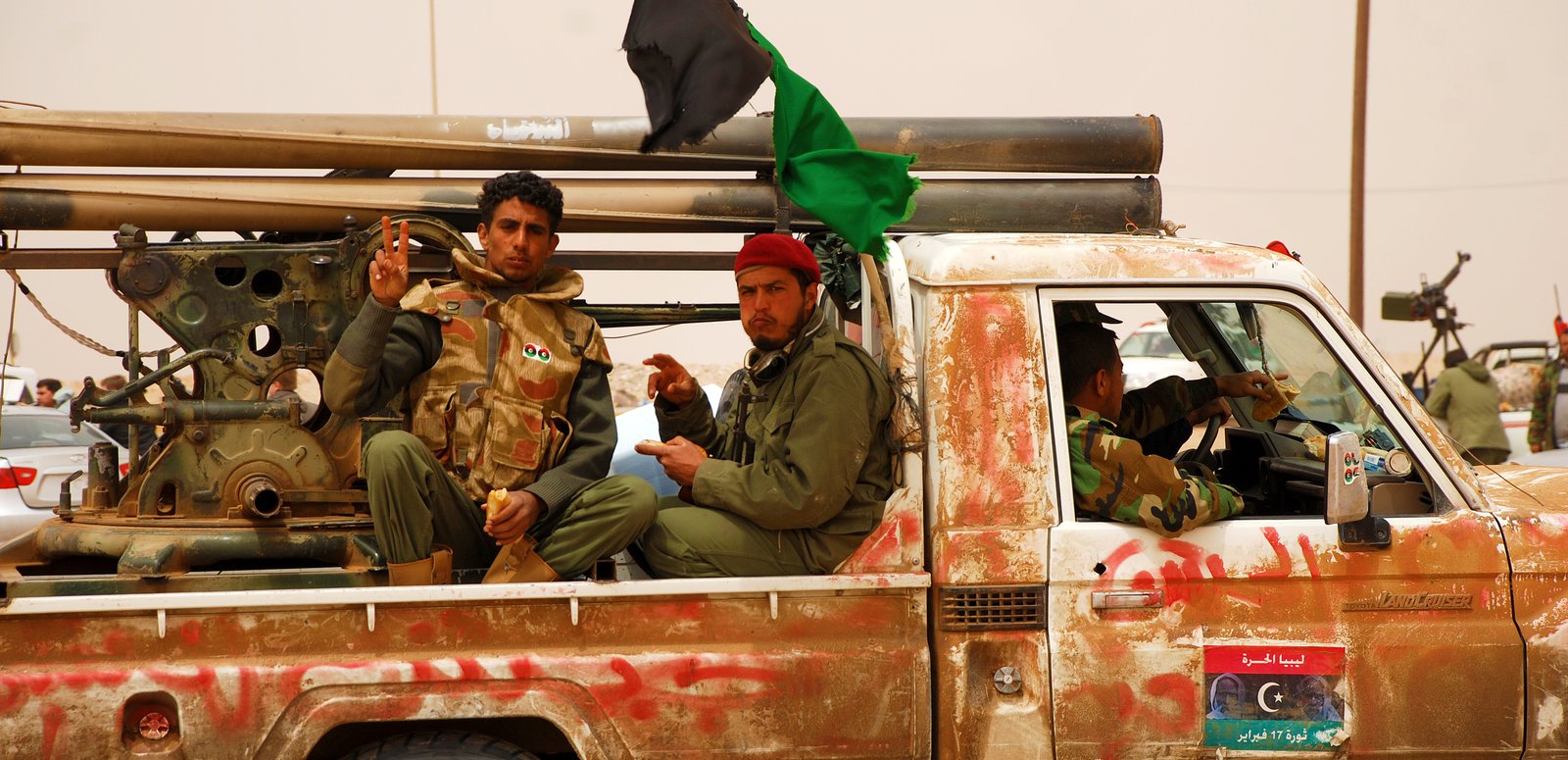
Weeks after the uprising against Libyan dictator Muammar al-Gaddafi in 2011, the International Criminal Court, the World Health Organization, and the UN declared civilians were at heightened risk.1 UN Security Council Resolution 1970 (February 2011) passed in an attempt to maintain some semblance of structure before the country collapsed. It called for an arms embargo, a travel ban, and asset freeze on Gaddafi’s family and affiliates.2 However, Gaddafi continued his violent, unflinching campaign in pursuit of defeating various rebel groups across Libya until the Security Council passed Resolution 1973 (March 2011) to protect civilians in grave danger.3
In support of the UN resolution, France, the United States, and the United Kingdom participated in an air campaign against the Libyan government and military targets associated with Gaddafi.4 In total, 18 countries participated in the NATO intervention in Libya.5 France and the United States coordinated surveillance in a joint operation to locate Gaddafi, who was attempting to escape the city of Sirte on October 21, 2011. A French aircraft struck his convoy, and then rebel fighters killed him.6 Despite pleas from the interim government for NATO to remain in Libya until the close of 2011, the UN voted to end the international intervention.7 NATO closed its mission on October 31, 2011.8 Libya was then left to its own devices.
2011-2020: The Endless Civil War
Interim Government
The National Transitional Council (NTC) became the acting government at the close of the NATO intervention in October 2011. The NTC governed with the intention of establishing the future government of Libya, and was led by acting Prime Minister Mahmoud Jibril. The NTC designed a plan to create an 18-month transition,9 but was so weak that the minimal structure it was able to implement began to unravel. Corruption and extortion from militant groups established a dangerous precedent for those wishing to obtain government jobs.10
On July 7, 2012, Libya’s parliamentary elections took place, the first since 1969. These elections created the General National Congress (GNC),11 a government projected to oversee the country for 18 months while a new constitution and parliamentary elections were completed. The design for parliamentary seats included proportional representation of Islamists, including Salafists and the Muslim Brotherhood; the moderate National Forces Alliance affiliated with Mahmoud Jibril; and independents. 12
The GNC, which never effectively governed Libya, forced the passing of the 2013 Political Isolation Law. This law prevented large populations across the country from holding segments of the government should they have previous Gaddafi allegiance.13 The GNC was set to end its term in February 2014, but decided to extend past the agreed upon date,14 despite pushback from the public.15 Haftar, frustrated by this announcement, declared the dissolution of the GNC that February, and by May 2014 his coup attempt called “Operation Dignity”—with the intention of eradicating radical Islamists from Benghazi—began.16 Elections took place in June 2014, and Islamists who once ruled the government were sorely defeated. Voter turnout represented less than half of those eligible to vote, and a number of deaths resulted from continued armed conflict.17 The outcome was the creation of the House of Representatives in eastern Libya. In July, Operation Libya Dawn began in support of the outgoing GNC. This militia-based operation prevented the House of Representatives from taking power in Tripoli, so they formed in the eastern city of Tobruk. By November, Libya’s Supreme Court ruled that the House of Representatives was illegitimate.18 The conflict between the GNC and House of Representatives continued to spiral out of control, creating the two governments Libya is managing today—that of the UN-backed government and that of Haftar. Each has its own parliament, militia, and ties to the Central Bank. 19
Since then, many international diplomatic interventions have attempted to create a ceasefire and establish a functioning democratic electoral process. Each international Libya Summit since 2018 has called for fair elections. However, each time a possible date is set, it is delayed again. The most recent Berlin Summit called for the creation of an International Follow-Up Committee (IFC), which would meet regularly to continue the dialogue from the Summit and support the peace process.
Civil War, Airstrikes, and International Intervention
In April 2016, the GNA took over as the new government20 after more than a year of civil unrest, and was still contested by Haftar’s LNA.21 These dire circumstances forced the international backing of either side. Countries such as the United Arab Emirates, Egypt, and the United States all began conducting air/drone/artillery strikes on behalf of the GNA or LNA and/or actively targeting Islamist militants.22 The United States, France, and the United Kingdom were all actively involved in the mediation process that helped to create the GNA. The United States conducted at least 550 airstrikes in Libya with the consent of the GNA since 2012, resulting in at least 11 and potentially as many as 21 publicly reported civilian fatalities. Most occurred during the U.S.-led Sirte campaign in 2016, but since June 2018, the United States conducted an additional 11 strikes. Only one of those 11 has resulted in possible civilian casualties.
The LNA is responsible for over one-half of all air, drone, and artillery strikes that have occurred since 2012, and is responsible for more than one-third of civilian deaths and one-third of overall deaths.
The LNA and GNA each receive support from various countries, which has created an aggressive proxy conflict in Libya. Some provide financial support, like Saudi Arabia23 and Qatar,24 but others provide weapons and foot soldiers, such as the UAE25 (in support of the LNA) and Turkey (in support of the GNA). Those who provide weapons have each participated in deadly strikes, fueling the narrative of each side. For example, on July 3, 2019, the UAE bombed a migrant center in Tripoli, killing at least 53 civilians, and then on August 4, 2019 they bombed the city of Murzuq, allegedly targeting combatants from the Chadian opposition.26 That strike killed another 42 or more civilians.27 On July 26, the GNA struck the key LNA airbase Al Jufra by Turkish drone, which destroyed two cargo planes and killed a mercenary pilot from Ukraine.28 The next day, the LNA targeted a drone control room, as well as the Air Force Academy in Misrata,29 which was an area of the country that had been somewhat untouched, compared to Tripoli, Benghazi, or Sirte, for example. Enough Turkish drones were destroyed in airstrikes that summer by the UAE that they had to be constantly moved around in a desperate attempt at deterrence.30
The recent increase in violence stemmed from Haftar’s April 2019 Tripoli offensive, when the LNA declared they would head “to the western region to cleanse it of the remaining terrorist groups”31 in “Operation Flood of Dignity.” On April 5, the second day of the offensive, UN Secretary-General António Guterres flew to Benghazi to meet with Haftar32—after meeting with al-Sarraj and visiting Ain Zara Detention Center to meet with refugees and migrants33—imploring him to rethink his incursion, particularly because the war had gone on for so many years. At the end of their meeting and without a promise from Haftar to end the strikes or commit to a ceasefire, Guterres left Libya, concerned for its future. Then Special Representative of the Secretary-General and Head of the UN Support Mission in Libya, Ghassan Salamé, dubbed Haftar’s call for al-Serraj’s arrest by Haftar a coup attempt. Salamé had plans for a national reconciliation conference in mid-April 2019 but had to postpone it after the LNA and GNA conducted 30 airstrikes each.34
Prior to April 2019, air attacks on Tripoli were relatively few in comparison to those on Benghazi, Sirte, or Derna. After all, the LNA only has 25,000 fighters35 (7,000 are Army members, and the remainder are from militias, international mercenaries, or Salafist fighters) which is five times the number of soldiers the GNA has.36 ISIS, at its height, ensnared Derna,37 but lost the city in 2016, similar to Sirte. However, Haftar has long claimed that the intent of the LNA campaign across the country was to battle ISIS and other radical Islamists. By the time he attacked Derna in 2019, the city was still in recovery from ISIS occupation three years prior.
Tripoli has been one of the hardest hit cities in all of Libya throughout the conflict. Most strikes between June 2018 and February 5, 2020 took place in Tripoli, with over 1,200 individual strikes resulting in nearly 400 deaths. Outside of Tripoli, more than 300 additional people died during that timeframe. Throughout 2019, the LNA conducted 910 strikes; 890 of those took place during Haftar’s Tripoli offensive, which resulted in between 62 and 93 civilian deaths. The GNA conducted 336 strikes during that same timeframe, 204 of which were in Tripoli. These strikes yielded between 38 and 53 civilian deaths, which is more than half of all civilian deaths by the GNA since 2012.
The LNA and GNA continue to accuse each other of wreaking havoc across Libya; they remain caught in a vicious cycle of violence that vindicates their respective actions against the other. Since 2012, the LNA has reportedly conducted at least 2,348 airstrikes, killing between 214 and 356 civilians. The GNA strike count is nowhere near that of the LNA, even with international intervention. The GNA’s 453 strikes have killed between 53 and 72 civilians.38
International Diplomacy Interventions: United Nations Resolutions
February 12, 2020 marked the most recent UN Security Council Resolution (2510) to order a ceasefire. It was nearly passed unanimously, with Russia abstaining instead of voting it down. The resolution focused on supporting the continuing UNSMIL, as well as the promises made at the Berlin Summit.39 Furthermore, the resolution emphasized the security council’s ongoing concerns of terrorist activity in the country, intervening mercenaries, and the need for significant ongoing humanitarian aid.
UN talks held in early February 2020 in Geneva, Switzerland showed promise, according to Salamé.40 The Libya Joint Military Commission, or 5+5 talks as they are commonly known, allow for representation from both the GNA and LNA, at the decision of al-Sarraj and Haftar. The 5+5 includes selected representatives from both the LNA and GNA.
Al-Sarraj last spoke at the United Nations during the 74th session of the UN General Assembly gathering in September 2019.41 He addressed the General Assembly with an update on the status of the war in Libya, and pleaded with the international community to recognize what he referred to as war crimes by Haftar and the LNA, the targeting of hospitals, airports, bombing of neighborhoods, and child recruitment. He highlighted that this conflict has yielded 3,000 casualties and hundreds of thousands of internally displaced people, stating, “No one wins in a military conflict, and only Libya loses.”42 He asked the International Criminal Court to investigate the allegations against Haftar, as well as asked the UN to complete a fact-finding mission, particularly after the April 2019 attempted overtake of Libya’s capital city Tripoli.
See Appendix A for a full list of Security Council Resolutions on Libya since June 2018.
Recent Diplomatic Intervention Attempts
The Istanbul and Moscow Summits
Within a week of Turkey sending troops to Libya in support of the GNA, representatives from Russia and Turkey met in Istanbul in early January 2020, calling for a ceasefire between rival factions, the LNA and GNA. Diplomats from both sides released a joint statement declaring a ceasefire from January 12. Simultaneously, both Haftar and al-Sarraj flew to Europe for separate meetings with European officials looking for support to end the conflict.
Later in January, representatives from the LNA and GNA met in Moscow to discuss mutually agreed upon approaches to ending the conflict.l-Sarraj and Haftar participated in a full day of “indirect talks” without meeting each other in person. Russia and Turkey attempted to broker a deal between the two parties, but after al-Sarraj signed the agreement, Haftar left Moscow without agreeing to the terms.
The two rivals convened for other notable meetings in the last two years: in Abu Dhabi, United Arab Emirates in February 2019, hosted by Salamé; and Palermo, Italy in November 2018.
The Berlin Summit
On January 19, 2020, representatives from the governments of Algeria, China, Egypt, France, Germany, Italy, Russia, Turkey, the Republic of the Congo, United Arab Emirates, the United Kingdom, and the United States, in addition to representatives from United Nations, the African Union, the European Union, and the League of Arab States, met in Berlin, Germany for the next phase of diplomatic discussion attempts to assuage the conflict in Libya. Despite representation from a number of invested governments, Haftar and al-Sarraj did not meet face-to-face to discuss the proposed agreement.
The parameters of the agreement included a ceasefire; recognition of and continued adherence to the arms embargo from 2011, which was established by UN Security Council Resolution 1970; a return to the political process focused on Libyan-owned and led operations; security sector reform; economic and financial reform, including the recognition of Libya’s National Oil Corporations as the only “legitimate oil company,” citing UN resolutions 2259 (2015) and 2441 (2018); and respect for international humanitarian law and human rights.
The participants at the Summit determined that the next step was to create an International Follow-Up Committee (IFC), which would meet regularly to continue the dialogue from the Summit and support the peace process. In addition, the proposed UNSMIL 5+5 Committee should continue as planned. The participating governments agreed that as long as the truce between the LNA and GNA is adhered to, they would “refrain from any further military deployments or operations.” Since the Summit, the GNA, with the support of Turkey, and the LNA, with the support of the UAE, as well as multiple “unknown” belligerents, have conducted strikes in Libya, the majority of which were in Tripoli and include civilian deaths.
Citations
- Peter Bergen and Alyssa Sims. “Airstrikes and Civilian Casualties in Libya: Since the 2011 NATO Intervention,” New America, June 20, 2018. source
- U.N. Security Council Resolution 1970 (2011), Feb. 26, 2011, source (2011)
- United Nations Security Council Resolution 1973 (2011), March 17, 2011, source search/view_doc.asp?symbol=S/RES/1973 (2011)
- Allan Little, “Libya: US, UK and France attack Gaddafi forces,” BBC, March 20, 2011, http:// www.bbc.com/news/world-africa-12796972
- Ivo H. Daalder and James G. Stavridis, “NATO's Success in Libya,” New York Times, October 31, 2011. source
- Tim Gaynor and Taha Zargoun, “Gaddafi caught like ‘rat’ in a drain, humiliated and shot,” Reuters, Oct. 21, 2011, source
- Rick Gladstone, “U.N. Votes to End Foreign Intervention in Libya,” New York Times, Oct. 27, 2011, source middleeast/security-council-ends-libya-intervention-mandate.html
- Peter Bergen and Alyssa Sims, “Airstrikes and Civilian Casualties in Libya: Since the 2011 NATO Intervention,” New America, June 20, 2018. source
- Peter Bergen and Alyssa Sims, “Airstrikes and Civilian Casualties in Libya: Since the 2011 NATO Intervention,” New America, June 20, 2018. source
- Peter Bergen and Alyssa Sims, “Airstrikes and Civilian Casualties in Libya: Since the 2011 NATO Intervention,” New America, June 20, 2018. source
- Peter Bergen and Alyssa Sims, “Airstrikes and Civilian Casualties in Libya: Since the 2011 NATO Intervention,” New America, June 20, 2018. source
- David D. Kirkpatrick, “Braving Areas of Violence, Voters Try to Reshape Libya,” New York Times, July 7, 2012, source africa/libyans-vote-in-first-election-in-more-than-40-years.html
- Peter Bergen and Alyssa Sims, “Airstrikes and Civilian Casualties in Libya: Since the 2011 NATO Intervention,” New America, June 20, 2018. source
- Patrick Markey and Ghaith Shennib, “In Standoff, Libyans Protest Over Parliament Extension,” Reuters, Feb. 7, 2014, source
- Reuters Staff, “Libya parliament agrees to ‘early’ election amid public anger,” Reuters, Feb. 17, 2014, source libya-parliament-agrees-to-early-election-amid-public-anger-idUSBREA1G0RA20140217
- Peter Bergen and Alyssa Sims, “Airstrikes and Civilian Casualties in Libya: Since the 2011 NATO Intervention,” New America, June 20, 2018. source
- Ahmed Elumami and Ayman al-Warfalli, “Poor Turnout in Libyan Parliament Vote as Prominent Lawyer Killed,” Reuters, June 25, 2014. source
- Alexander A. Decina, “Libya's Next Elections,” United States Institute of Peace, August 2018. source
- Christopher M. Blanchard, “Libya: Transition and U.S. Policy,” Congressional Research Service, May 2, 2018, source
- Ahmed Elumami, “Libya’s self-declared National Salvation government stepping down,” Reuters, April 5, 2016, source
- Peter Bergen and Alyssa Sims, “Airstrikes and Civilian Casualties in Libya: Since the 2011 NATO Intervention,” New America, June 20, 2018. source
- Peter Bergen and Alyssa Sims, “Airstrikes and Civilian Casualties in Libya: Since the 2011 NATO Intervention,” New America, June 20, 2018. source
- Jared Malsin and Summer Said, “Saudi Arabia Promised Support to Libyan Warlord in Push to Seize Tripoli,” The Wall Street Journal, April 12, 2019. source
- Walid Abdullah, “Qatar Vows Support for Libya's UN-Recognized Gov't,” Anadolu Ajansı, December 15, 2019. source ;Nabhi Bulos, “Libya Civil War and Natural Resources Attract Mix of Nations,” Los Angeles Times, August 2, 2019. source ;Borzou Daragahi, “Libyan Warlord Defeated in Fierce Battle with Government Forces over Key City,” Independent, June 27, 2019. source Vows Support for Libya's UN-Recognised Government.” Middle East Monitor, December 15, 2019. source
- Ulf Laessing, “After Tripoli Assault, Libya's next Battle Could Be over Banks,” Reuters, April 25, 2019. source; Emadeddin Badi, “Libya's War of the Many.” Carnegie Endowment for International Peace, December 17, 2019. source.; Jalel Harchaoui, “The Libyan Civil War Is About to Get Worse.” Foreign Policy, March 18, 2020. source.; Paul Iddon, “Turkey Is Fighting a Formidable Drone War in Libya.” Ahval, September 14, 2019. source.; Jason Pack and William Lawrence, “Turkey Doubles down on Libya.” Middle East Institute, April 9, 2020. source.
- “Source: Air Force Targeted The Chadian Opposition Militants In Murzuq.” Libya News 24, 5 Aug. 2019, archive.is/tH8Fc#selection-2487.133-2487.179
- Oliver Imhof, “Increasing Foreign Role Risks Spiralling Libya Conflict out of Control,” Airwars, September 25, 2019. source
- Al Jazeera and News Agencies, “UN-Recognised GNA Attacks Key Haftar Airbase in Central Libya,” Al Jazeera, 27 July 2019, www.aljazeera.com/news/2019/07/recognised-gna-attacks-key-haftar-airbase-central-libya-190727135849634.html
- The Army Bombs the Air Force in Misurata. 218 TV, 27 July 2019, www.218tv.net/الجيش-يقصف-مواقع-متفرقة-بمصراتة/.
- Oliver Imhof, “Increasing Foreign Role Risks Spiralling Libya Conflict out of Control,” Airwars, September 25, 2019. source
- “'Brief Skirmish' near Libya's Tripoli as Haftar's LNA Heads West.” Al Jazeera, April 4, 2019. source
- Jared Malsin and Summer Said, “Saudi Arabia Promised Support to Libyan Warlord in Push to Seize Tripoli,” The Wall Street Journal, April 12, 2019. source.
- United Nations, April 16, 2019. source
- Ahmed Elumami and Ulf Laessing, “U.N. Libya Envoy Says Haftar Made Coup Attempt with Advance on Tripoli,” Reuters, April 15, 2019. source
- Oliver Imhof and Osama Mansour, “Civilians in Peril as Rival Air Forces Target Tripoli,” Airwars, April 15, 2019. source
- Oliver Imhof and Osama Mansour, “Civilians in Peril as Rival Air Forces Target Tripoli,” Airwars, April 15, 2019. source
- Oliver Imhof and Osama Mansour, “The Last Days of ISIS’ Libya Stronghold,” Daily Beast, July 5, 2018. source
- Some allegations of strikes or civilian casualties are attributed to more than one belligerent, which could mean that a plane was misidentified or that a strike was conducted jointly by, say, both LNA and GNA warplanes, accounting for higher strike and casualty numbers on both sides.
- “Berlin Summit on Libya Conflict: What Did World Powers Agree?” Al Jazeera, January 20, 2020. source
- Barbara Bibbo, “Libya Rivals Show 'Genuine Will' to Start Ceasefire Talks: UN,” Al Jazeera, February 4, 2020. source
- “Libya Facing 'Serious Crisis' Fueled by Outsiders Bent on Dividing the County, UN Assembly Told | UN News.” United Nations. United Nations, September 25, 2019. source
- “Libya Facing 'Serious Crisis' Fueled by Outsiders Bent on Dividing the County, UN Assembly Told | UN News.” United Nations. United Nations, September 25, 2019. source