Table of Contents
Strikes by Libyan Belligerents: the GNA and the LNA
The local warring factions are the Libyan National Army and the Government of National Accord, each with international backing, financing, and weapons support.
Tensions between General Khalifa Haftar, who leads the Libyan National Army faction, and Prime Minister Fayez al-Sarraj, who heads the government recognized by the UN, have left Libya fractured despite several formal attempts to broker ceasefire or peace agreements between them. The two strongmen lead the main forces operating on the ground in Libya: al-Sarraj’s internationally recognized GNA, which controls the capital and territory in western Libya; and the LNA, which maintains influence in eastern Libya and seized major oil ports. The LNA currently controls more than two-thirds of Libya’s territory.1
Various militias, some of which have ties to the Muslim Brotherhood, back the GNA.2 Compared to the funding that Haftar’s LNA reportedly receives from countries like Saudi Arabia, Jordan, or the UAE, the GNA militias reportedly use old Soviet weapons from Gaddafi’s reign.3 As discussed in a previous section, a Hashemite Kingdom of Jordan official source told New America before the release of this report that Jordan has not financially backed or provided any military resources or training in Libya. Turkey attempted to fill that gap by selling hundreds of millions of dollars’ worth of equipment to the GNA,4 however, Turkey is only one country compared to the numerous financial backers and strike partners of the LNA.
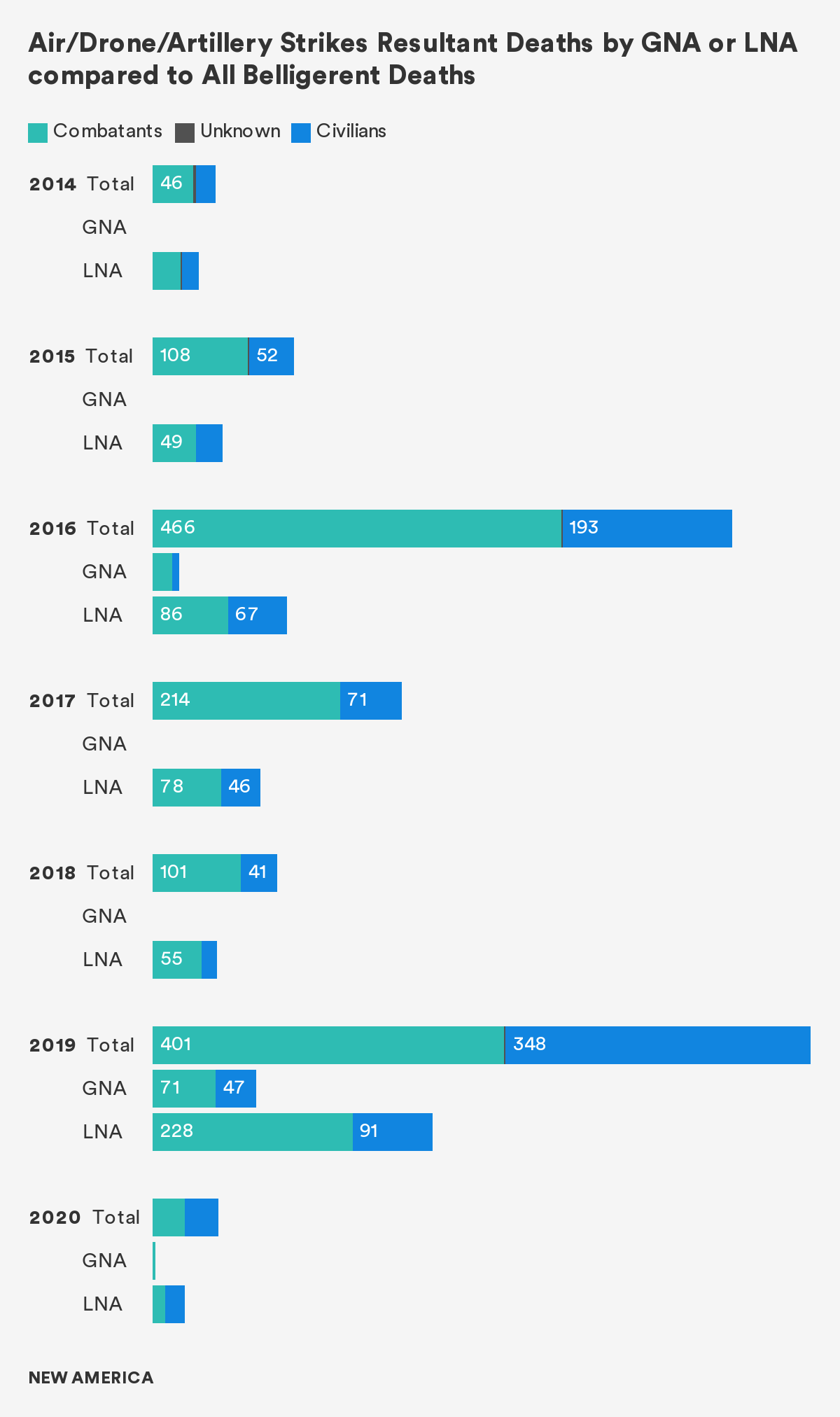
The LNA, in its early stages, promised to liberate Libya from what Haftar perceived to be corrupt and radical Islamists, particularly those governing the country. Haftar launched the Benghazi offensive in 2014 to cleanse the city of jihadist combatants, followed by multiple, yet unsuccessful, attempts to take over Tripoli. Over time, Haftar’s secular focus has changed by continuously seeking out help from just about anyone who is willing to assist, from Salafists to former Gaddafi affiliates.5 Note that support from Salafists is something the UAE has had difficulty reconciling since leaders are staunch supporters of containing political Islam.6 Haftar also receives support from local tribal leaders he allegedly pays off7 for permission to absorb their land into the jurisdiction of the LNA.With air support from the United States, the GNA has sought to hold territory and protect its legitimacy as Libya’s central government. However, over the years, Haftar has significantly increased LNA territory. In the last two years, civilian fatality counts have drastically increased. See Figure 6 for more on GNA and LNA strikes.
Figure 6:
Strikes by the Government of National Accord
GNA Prime Minister al-Sarraj has continued to try to reach a compromise with Haftar’s LNA, but has been unable to negotiate a successful ceasefire or disarm militias, which the UN hoped his unity government would achieve. Since the conflict with the GNA began, Haftar and the LNA have effectively dodged multiple scenarios where sanctions should have been implemented.8 Furthermore, Haftar’s campaign continued without him signing and following through on any agreements made in official diplomacy negotiations. The GNA declared a state of emergency in September 2018 after a declared ceasefire broke into conflict again.9 Six months later, Haftar began his Tripoli offensive, hoping to take over the capital.
According to New America and Airwars data that captures public reports of GNA strikes, from June through December 2018, the GNA conducted two airstrikes, and may have conducted an additional joint strike with Italy. However, the GNA was much more active in 2019, conducting 338 strikes with between 39 civilian deaths, taking the lowest estimate and as many as 54 taking the highest estimate. The GNA conducted 10 additional strikes with Turkey, which yielded between seven and nine civilian deaths. In some cases it is not discernible whether Turkey operated independently. There are another 22 GNA or LNA strikes that are either attributed to both groups or undetermined, which resulted in between 12 and 13 civilian deaths.
In 2020, there have been 12 strikes conducted by the GNA through February 5, two strikes with Turkey, and possibly an additional four that are either GNA or LNA, resulting in one civilian casualty. Cases where either the GNA or LNA is listed implicate more than one belligerent, which could mean either or both parties were responsible. New America reached out to the government of Libya for comment before the report’s release, but did not receive a response. See Appendices B and K for more strikes by the GNA.
Strikes by Libyan National Army
The LNA’s relentless airstrike campaigns across the country have yielded a vast territorial gain since the summer of 2018. After the battle for the city of Derna, which started in 2018, the LNA refocused its attention on the southern oil crescent. According to New America and Airwars data that captures public reports of LNA strikes, from June through December 2018, the LNA launched at least 60 strikes with eight to 11 civilian fatalities, as well as another seven strikes that were likely in coordination with France. By the end of January 2019, Haftar had taken over the southern city of Sabha, and continued capturing other cities until he announced his pending takeover of Tripoli.10 The LNA’s controlled territory encompasses more than two-thirds of Libya.11
“Operation Flood of Dignity,” while impactful in the number of strikes and resultant deaths, was unsuccessful in taking over the capital in 2019. The day after this western Libya offensive commenced, UN Secretary-General António Guterres flew to Benghazi to meet with Haftar.12 He beseeched the General to change course, without success. Later that day, as he departed, Guterres tweeted, “I leave Libya with a heavy heart and deeply concerned. I still hope it is possible to avoid a bloody confrontation in and around Tripoli. The UN is committed to facilitating a political solution and, whatever happens, the UN is committed to supporting the Libyan people.”13
The LNA launched 910 strikes over the course of 2019. As a result, there were 67 civilian deaths taking the lowest estimate, and as many as 114 taking the highest estimate. The LNA also conducted at least 67 strikes in coordination with the UAE, causing 125 civilian deaths, taking the lowest estimate, and as many as 167 taking the highest estimate. There are an additional 22 unidentified GNA or LNA strikes, which resulted in 12 to 13 civilian deaths. Cases where either the GNA or LNA is listed implicate more than one belligerent, which could mean either or both parties were responsible.
The LNA and its affiliates launched a few unconcealed attacks on civilians that received significant international coverage, as well as backlash from the international community. For example, on July 3, 2019, the LNA and UAE jointly struck a migrant detention center in Tajoura, right outside Tripoli. Between 40 to 80 civilians died in that strike out of 120 individuals in the building. The LNA denied that its strike hit that location, but local media associated with the LNA reported that there were airstrikes taking place in that exact area of Tripoli.14 Then, there was the Janzur Equestrian Club15 strike outside of Tripoli that injured six children, killed several horses, and destroyed club facilities. The UNinvestigated the nature of the strike location, determining that there were no military targets located in the facility.16
The LNA and affiliates’ aggressive strategy over the last year has shown their collective disregard for ensuring civilian safety. The LNA launched 69 strikes between January 1, 2020 and February 5, 2020, which have yielded between 15 to 16 civilian deaths, and another three strikes with the UAE, yielding three civilian deaths. There are another possible four strikes either by the GNA or LNA that have resulted in one additional civilian fatality. The indiscriminate bombing of civilian targets is increasingly common with the LNA, and many of these strikes have been identified as war crimes. However, Haftar, like many others, has not been charged. Even those who have intentionally ignored the weapons embargoes go unscathed. The only sanctions have been against human traffickers,17 while Haftar ignores warrants from the International Criminal Court.18 See Appendices C and K for more strikes by the LNA.
Other International Supporters Not Conducting Strikes
Multiple additional states are actively involved in the Libyan conflict. Each of them participates in various capacities, from funding to providing weapons to training. Open sources reports state that Jordan, Sudan, and Saudi Arabia all support the LNA. Both Jordan and Sudan have allegedly offered weapons to the LNA, and Sudan’s Rapid Support Forces (RSF) involvement is debated. As stated in a previous section of this report, a Hashemite Kingdom of Jordan official source told New America before the release of this report that Jordan has not financially backed or provided any military resources or training in Libya. In December 2019, the Libya Panel of Experts19 for a UN report claimed that 1,000 Sudanese RSF were sent to Libya in July 2019 to support Haftar, but the Sudan Panel of Experts a month later claimed that the RSF was not involved to that extent.20 Some of these Sudanese individuals were linked to alleged killings, kidnappings, and robberies against southern Libyans.21 Jordanian armored vehicles were identified in Libya.22 Saudi Arabia allegedly provided millions of dollars in financial support, intended to train LNA fighters, and paid off local officials, similar to what the UAE’s funding has accomplished. Saudi Arabia’s funds in April 2019 were intended to support Haftar’s Tripoli offensive.23 Qatar, on the other hand, currently financially backs the GNA24 but does not conduct airstrikes on its behalf.Russia holds a unique supporting role in Libya. Russian mercenaries are not new to the conflict in Libya, nor is their relationship with Libya and the wider region. After Gaddafi was ousted after the 2011 NATO intervention, Russia reportedly lost arms contracts worth 7 billion USD, something that had ensured their influence in the country, as well as with Libya’s surrounding neighbors.25 New America reached out to the governments of Sudan, Saudi Arabia, and Qatar for comment before the report’s release, but did not receive a response.
While difficult to ascertain whether they have conducted airstrikes, they are allegedly supporting the LNA with weapons and financing, according to the GNA, the United States, and others.26 When representatives from the United States and the LNA met in November 2019, part of the statement the United States released read: “The officials underscored the United States’ full support for the sovereignty and territorial integrity of Libya and expressed serious concern over Russia’s exploitation of the conflict at the expense of the Libyan people.”27 The official U.S. AFRICOM posture statement says that “Russian private military companies (PMCs) have a highly destabilizing influence in Africa…In Libya, Russian PMCs almost certainly downed a U.S. unarmed, unmanned aircraft in November using a sophisticated Russian air defense system.” Additionally, AFRICOM states, “Russia continues to harvest benefits from the instability in Libya – its military meddling has prolonged the conflict and exacerbated casualties and humanitarian suffering…its private military companies, such as the Wagner Group with strong links to the Kremlin, are leading the fight for the self-styled ‘Libyan National Army.’” It is becoming increasingly clear that, as the United States steps back in some of the conflicts it was once active in, Russia is finding ways to insert itself in hopes of securing regional influence.
Investigative reporting by the Daily Beast in September 2019 alleges that Russian mercenaries claim Haftar has gained territory across Libya not by military might, but by bribing local officials with money from the United Arab Emirates.28 Yet, with this alleged LNA alliance, Russia has a Russia-first policy, and has chosen, when appropriate, to upend Haftar’s advances if it helps the Kremlin. For example, Russia allegedly met with Gaddafi’s son, Saif al-Islam Gaddafi, and has allegedly plotted with Sudan to complicate the military advances of Haftar on Tripoli.29 However, Russia changed its posture again when it held diplomatic talks in Moscow between the LNA and GNA in January 2020.30 Russia continues to claim that it does not have any military presence or troops within the borders of Libya but, reportedly, there are at least 50031 and as many as 80032 or even thousands33 of Russian mercenaries in Tripoli. New America reached out to the government of Russia for comment before the report’s release, but did not receive a response.
The U.S. Counterterrorism War and Libya
Libya is one of the many countries where the United States conducts air and drone strikes as part of its international counterterrorism measures outside of traditional war zones. Other countries where the United States. has similar counterterrorism campaigns include Pakistan, Somalia, and Yemen.34
Civilian Deaths by United States from Airstrikes Across Conflicts
| Libya | Somalia | Yemen | Pakistan | |
|---|---|---|---|---|
| 2012-2020 | 2003-2020 | 2002-2020 | 2004-2020 | |
| Estimated range of civilians deaths | 11-21 | 26-57 | 115-149 | 245-303 |
| Total strikes | 550 | 196 | 289 | 414 |
Source: Libya civilian deaths data are based on the New America-Airwars study; Pakistan, Somalia, and Yemen civilian deaths data are based on figures from New America databases as of February 5, 2020. Note: Operations in Somalia and Yemen include a number of ground raids in addition to airstrikes.
Compared to other belligerents in the Libya conflict, the United States has been transparent in its reporting of air and drone strikes, as well as any resultant civilian fatalities.35 However, in the past few years, the Trump administration started to walk back Obama-era policies that required strike reporting by the U.S. government. This action by the Trump administration forces the public to push the Pentagon for continued transparency regarding U.S. involvement in conflicts abroad. For example, President Trump replaced the Obama administration’s 2013 Presidential Policy Guidance (PPG) with the Principles, Standards and Procedures (PSP) in 2017.36 Many of the policies were not drastically different from this document’s predecessor, yet a couple of policies stood out in stark contrast to old protections. For example, the Trump administration lowered the threshold at which the United States can track and kill an alleged terrorist, and drone strikes under the U.S. counterterrorism program going forward would not require the same assessments as before, meaning that the previous number of approvals before a strike were no longer required.37
How United States Africa Command Determines Strike Counts
When AFRICOM confirms a “strike” in Libya, this may include one munition, or multiple bombings on a single target, based on information from press releases. In releases related to the U.S.-led coalition in Iraq and Syria, AFRICOM defined strikes in press releases as the following:
“A strike, as defined in the Coalition release, refers to one or more kinetic engagements that occur in roughly the same geographic location to produce a single, sometimes cumulative effect in that location. For example, a single aircraft delivering a single weapon against a lone Daesh vehicle is one strike, but so is multiple aircraft delivering dozens of weapons against a group of Daesh-held buildings and weapon systems in a compound, having the cumulative effect of making that facility harder or impossible to use. Strike assessments are based on initial reports and may be refined.”38
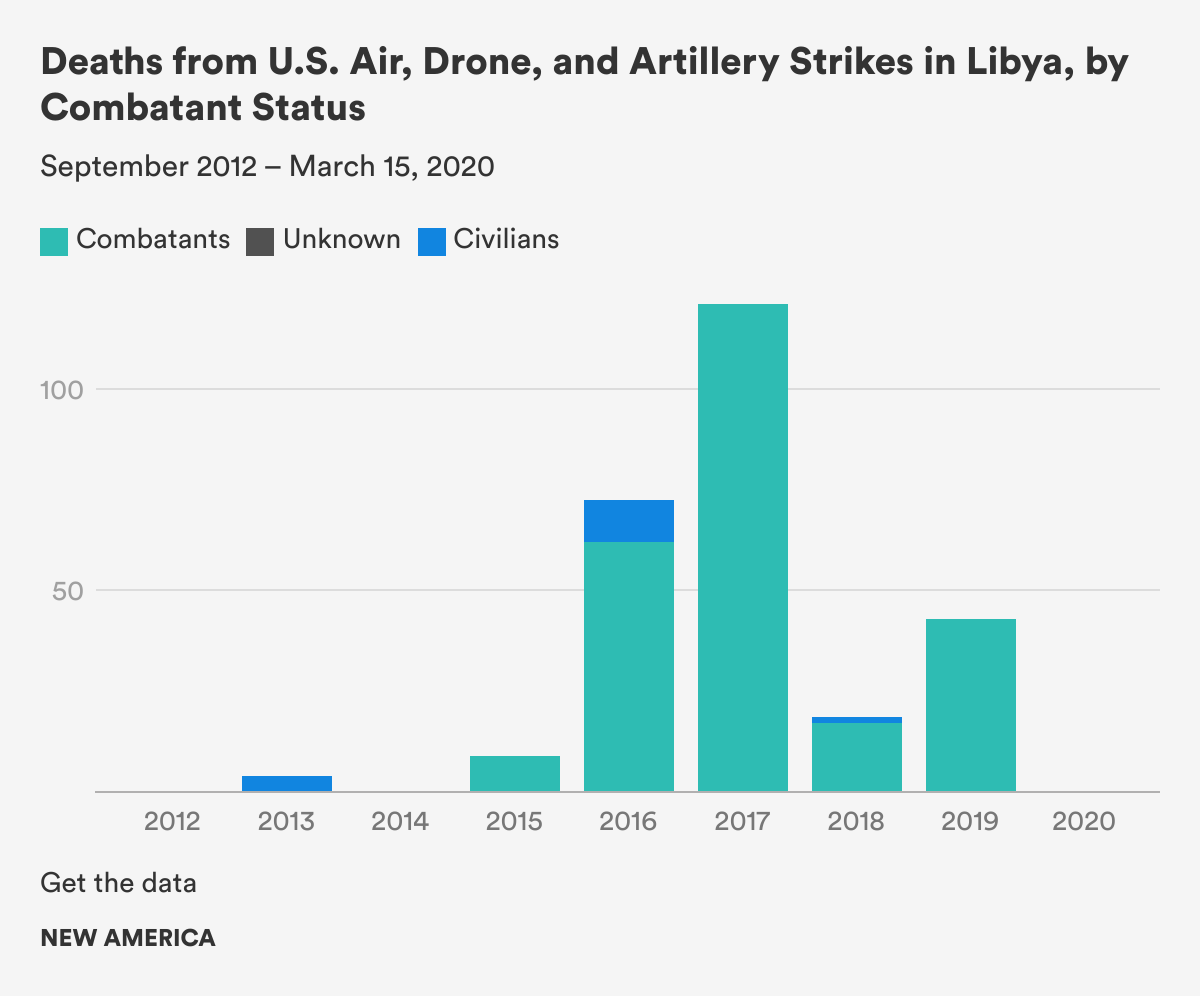
Since June 2018, New America and Airwars research has found 11 airstrikes conducted by the United States in coordination with the Government of National Accord, killing at least 59 combatants. In an email to New America before the report was released, U.S. AFRICOM stated that the United States had conducted 10 airstrikes against ISIS-Libya and AQIM terrorist targets (six total airstrikes in Libya in 2018, and four in 2019). New America and Airwars have not counted any civilian deaths caused by U.S. airstrikes in this timeframe. Many of those strikes occurred in the southern area of Murzuq, where ISIS resides. See Figure 7 and Figure 8 for more on U.S. strikes.
Figure 7:
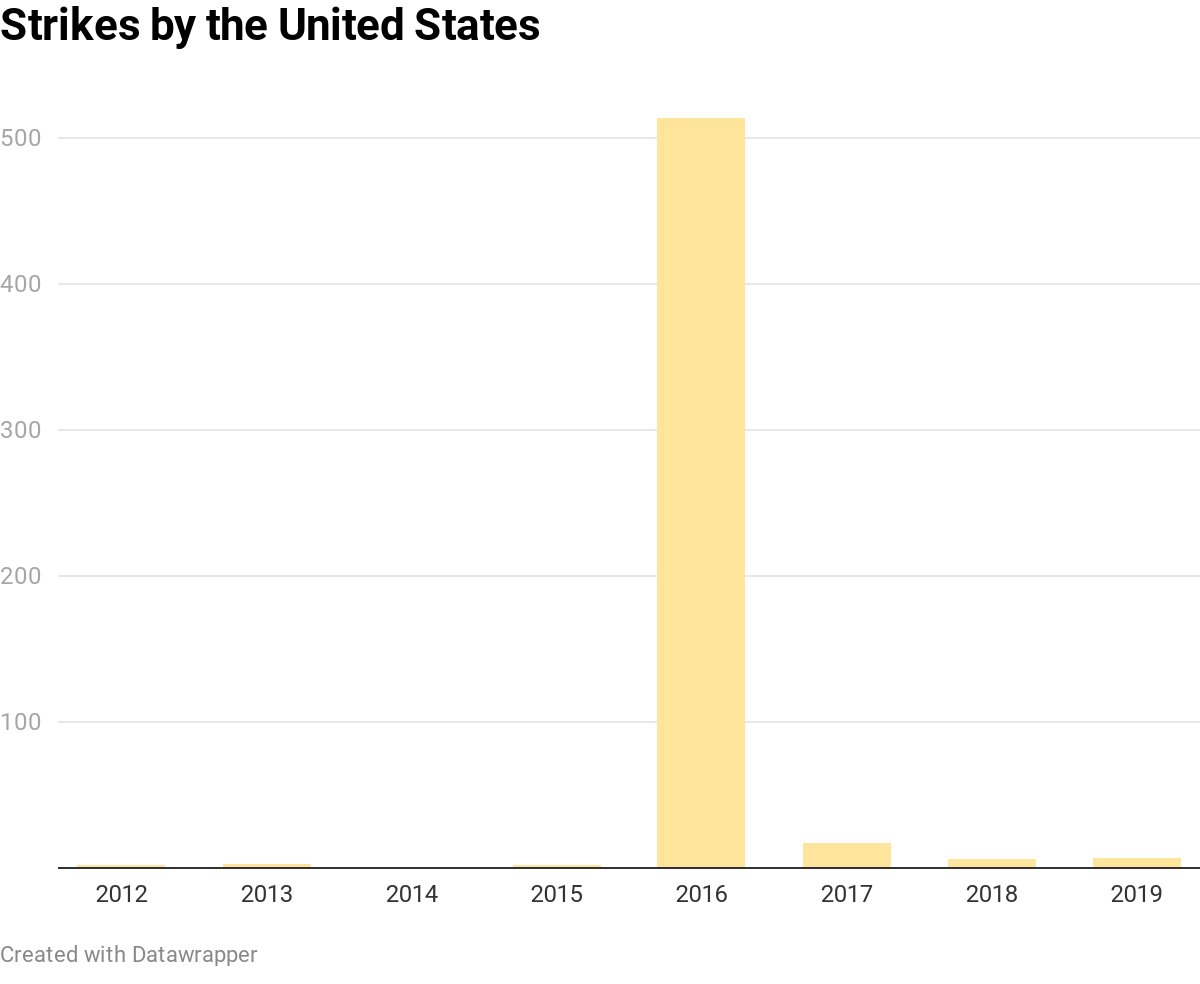
Figure 8:
The LNA mistakenly shot down a U.S. drone in November 2019.39 Representatives from the LNA stated that the drone looked similar to a Turkish drone. Around the same time, an unarmed Italian Air Force Reaper drone40 was also shot down. The LNA alleged that the Italian drone also looked similar to GNA-supporting Turkish drones. In the United States AFRICOM 2020 posture statement for Libya, the U.S. stated, “In Libya, Russian PMCs almost certainly downed a U.S. unarmed, unmanned aircraft in November using a sophisticated Russian air defense system.”
Then, in December 2019, a press statement issued by the U.S. Department of State read:
The United States is concerned by the Government of National Accord’s request for military support, and by the LNA’s threat to use foreign-supplied air assets and mercenaries to attack Misrata. External military intervention threatens prospects for resolving the conflict. We deplore attacks on innocent civilians and call on all sides to refrain from escalation. The United States is prepared to work with the U.N. and all the parties to initiate political negotiations. The recent inclusive U.S.-Libya Economic Dialogue in Tunis demonstrated constructive progress is possible if external actors give Libyans the time and space to engage with each other.41
There have not been any subsequent airstrikes after the release of this statement. Over the course of our research since 2012, New America and Airwars have documented 550 total airstrikes attributed to the United States in media reports. Strikes in our database attributed solely to the United States resulted in a minimum of 11 and maximum of 21 civilian deaths.
What Is the U.S. Policy on Libya?
The U.S. involvement in Libya has generally lessened since President Trump took office. In 2017 the U.S. strike count peaked at 17, in 2018 there were five, and in 2019 there were seven.
In July 2018, Prime Minister Giuseppe Conte of Italy visited the White House. In a joint press conference, he and President Trump discussed Libya and Italy’s role in stabilizing the region.42 The following November, the Palermo conference on Libya took place in Italy; neither President Trump nor Secretary of State Pompeo attended, but Acting Assistant Secretary for Near Eastern Affairs David Satterfield attended. Palermo had fewer senior global leaders than anticipated. Some argue low attendance was due to the earlier scheduling of the Paris Peace Forum.43 President Trump did not attend the Forum either.
On February 19, 2019, right before 2011 Executive Order 13566—which declared a formal pause on specific financial/economic transactions with Libya due to fear of mismanagement by the Gaddafi regime—was about to expire, President Trump extended the order to continue beyond the end of the month.44 Trump mentioned the intractable conflict as reason to extend the order, highlighting the concern over instability from groups formerly aligned with Gaddafi. He ordered to keep sanctions in place; otherwise, ISIS and other terrorist groups could thrive off any diverted resources entering the country, causing a national security threat to the United States.
The following April, a controversial phone call took place between General Haftar and President Trump. After reported discussions between President Trump and Egypt’s President Abdel Fattah El-Sisi, as well as Abu Dhabi’s Crown Prince Mohammed bin Zayed Al Nahyan—both staunch supporters of Haftar—President Trump had a conversation with Haftar about his Tripoli offensive, and allegedly praised the General for his dedication to fighting terrorism.45 Many viewed this conversation as problematic because the United States has long supported the GNA, and was instrumental in the NATO intervention in 2011. Discussing success with Haftar sent mixed messages to the international community about U.S. support,46 as well as confusion about whether or not the United States could maintain a policy in Libya that supported the GNA while its strong trade partners—the UAE, Saudi Arabia, and Egypt—backed the LNA.47
The U.S. embassy in Libya closed in 2015, relocating to Tunis, Tunisia. On August 1, 2019, the U.S. Senate confirmed Ambassador Richard B. Norland to serve as U.S. ambassador to Libya. Nearly four months later, representatives from the U.S. State Department met with General Haftar. Ambassador Norland was present, as well as Deputy National Security Advisor for Middle Eastern and North African Affairs Victoria Coates, Principal Deputy Assistant Secretary for International Affairs at the U.S. Department of Energy Matthew Zais, and AFRICOM Deputy Director for Strategy, Engagement, and Programs Brigadier General Steven deMilliano.48 According to the press release issued by the State Department, at the meeting, U.S. officials highlighted the sovereignty of Libya as a country, and discussed concerns regarding Russia’s support of the LNA, and the consequences that would yield.
GNA Prime Minister Al-Sarraj traveled to the UN in New York in September 2019,49 followed by a trip to Washington, D.C. to plead with the United States to become more involved in the crisis. In November 2019, U.S. officials met with General Haftar to discuss prospects for ending the war. This was the week after the LNA mistakenly shot down both an Italian drone and a U.S. drone. By the end of 2019, the United States still affirmed that its airstrikes in Libya against ISIS were in direct support of and approved by the GNA.50 The United States AFRICOM 2020 posture statement says, “Our persistent focus on ISIS-Libya, in coordination with our interagency and African partners and at low cost in Department of Defense resources, continues to disrupt ISIS freedom of action as a regional terrorist threat.”
Citations
- Tommy Hilton, “Libyan National Army Gains Control of Third Largest District in Libya's Sirte,” Al Arabiya English, January 6, 2020. source
- Nicholas Saidel, “The Middle East conflict You Haven’t Heard About,” Wall Street Journal, February 9, 2020. source.; Bacardit de Alburquerque, Luis Antonio, Amanda Kadlee, Moncef Kartas, Yassine Marjane, and Adrian Wilkinson, “Letter Dated 29 November 2019 from the Panel of Experts on Libya Established Pursuant to Resolution 1973 (2011) Addressed to the President of the Security Council,” United Nations Security Council, December 9, 2019.
- Raja Abdulrahim, “Foreign Backing Brings Militias in Libya to a Stalemate – and No Further,” Wall Street Journal, October 1, 2019. source.; Bacardit de Alburquerque, Luis Antonio, Amanda Kadlee, Moncef Kartas, Yassine Marjane, and Adrian Wilkinson, “Letter Dated 29 November 2019 from the Panel of Experts on Libya Established Pursuant to Resolution 1973 (2011) Addressed to the President of the Security Council,” United Nations Security Council, December 9, 2019.
- Raja Abdulrahim, “Foreign Backing Brings Militias in Libya to a Stalemate – and No Further,” Wall Street Journal, October 1, 2019. source; Emadeddin Badi, “Libya's War of the Many.” Carnegie Endowment for International Peace, December 17, 2019. source.; Jalel Harchaoui, “The Libyan Civil War Is About to Get Worse.” Foreign Policy, March 18, 2020. source.; Paul Iddon, “Turkey Is Fighting a Formidable Drone War in Libya.” Ahval, September 14, 2019. source.; Jason Pack and William Lawrence, “Turkey Doubles down on Libya.” Middle East Institute, April 9, 2020. source.
- David Kirkpatrick, “A Police State With an Islamist Twist: Inside Hifter’s Libya,” New York Times, February 20, 2020. source
- David Kirkpatrick “A Police State With an Islamist Twist: Inside Hifter’s Libya,” New York Times, February 20, 2020. source
- Jared Malsin and Summer Said. “Saudi Arabia Promised Support to Libyan Warlord in Push to Seize Tripoli,” Wall Street Journal, April 12, 2019. source
- Anas El Gomati, “Libya's Civil War: Navigating Its Dangerous New Phase,” War on the Rocks, July 12, 2019. source
- State of Emergency Declared in Tripoli after Days of Fighting. September 2, 2018. source
- The LNA has primarily struck Tripoli since June 2018 through February 2020. The strike count is at least 678, with an additional 20 strikes likely in coordination with the UAE. The 678 strikes account for 75 percent of the LNA’s strikes throughout this period.
- Tommy Hilton, “Libyan National Army Gains Control of Third Largest District in Libya's Sirte,” Al Arabiya English, January 6, 2020. source
- Jared Malsin and Summer Said, “Saudi Arabia Promised Support to Libyan Warlord in Push to Seize Tripoli,” The Wall Street Journal, April 12, 2019. source
- UN committed ‘to support the Libyan people’ as Guterres departs ‘with deep concern and a heavy heart’ § (2019). source
- “About 40 Dead and More than 70 Wounded in an Air Strike on a Detention Center for Migrants in Libya (Paramedics).” France 24, July 3, 2019. source ; “40 Killed and 80 Injured after Bombing a Migrant Detention Center in Libya.” Aawsat News, July 3, 2019. source
- “Libya: Deadly Airstrike Apparently Unlawful.” Human Rights Watch News, October 19, 2019. source ; Sami Zaptia, “Hafter-Attributed Airstrike on Janzur Equestrian Club Condemned.” Libya Herald, October 7, 2019. source
- “UNSMIL APPALLED BY AN AIRSTRIKE TARGETING THE EQUESTRIAN CLUB IN TRIPOLI’S JANZOUR, REPORTEDLY INJURING A NUMBER OF CHILDREN.” United Nations Support Mission in Libya, October 6, 2019. source
- “UN Sanctions for People Traffickers in Libya in Global First,” BBC, June 8, 2018. source
- Bel Trew, “Libyan Commander Courted by European Countries Accused of War Crimes,” The Independent, January 31, 2019. source
- Bacardit de Alburquerque, Luis Antonio, Amanda Kadlee, Moncef Kartas, Yassine Marjane, and Adrian Wilkinson, “Letter Dated 29 November 2019 from the Panel of Experts on Libya Established Pursuant to Resolution 1973 (2011) Addressed to the President of the Security Council,” United Nations Security Council, December 9, 2019. source
- Priscilla Ciesay, Vincent Darracq, Nikolai Dobronravin, and Rajeev Yadav, “Letter Dated 14 January 2020 from the Panel of Experts on the Sudan Addressed to the President of the Security Council.” United Nations Security Council, January 14, 2020. source
- “Letter Dated 29 November 2019 from the Panel of Experts on Libya Established Pursuant to Resolution 1973 (2011) Addressed to the President of the Security Council,” United Nations Security Council, December 9, 2019. source
- “Jordanian Armoured Vehicles Spotted in Libya,” defenceWeb, May 28, 2019. source; Bacardit de Alburquerque, Luis Antonio, Amanda Kadlee, Moncef Kartas, Yassine Marjane, and Adrian Wilkinson, “Letter Dated 29 November 2019 from the Panel of Experts on Libya Established Pursuant to Resolution 1973 (2011) Addressed to the President of the Security Council,” United Nations Security Council, December 9, 2019.
- Jard Malsin and Summer Said, “Saudi Arabia Promised Support to Libyan Warlord in Push to Seize Tripoli,” Wall Street Journal, April 12, 2019. source
- Walid Abdullah, “Qatar Vows Support for Libya's UN-Recognized Gov't,” Anadolu Ajansı, December 15, 2019. source ;Nabhi Bulos “Libya Civil War and Natural Resources Attract Mix of Nations,” Los Angeles Times, August 2, 2019. source ;Borzou Daragahi, “Libyan Warlord Defeated in Fierce Battle with Government Forces over Key City.” Independent, June 27, 2019. source ;“Qatar Vows Support for Libya's UN-Recognised Government.” Middle East Monitor, December 15, 2019. source
- Candace Rondeaux, “Decoding the Wagner Group: Analyzing the Role of Private Military Security Contractors in Russian Proxy Warfare,” New America, November 2019. source
- Joyce Karam, “US Officials Push Libya’s Haftar for Ceasefire in First Meeting,” The National, November 26, 2019. source
- U.S. Delegation Meets with General Khalifa Haftar § (2019). source ; General Stephen J. Townsend, “Statement of General Stephen J. Townsend, United States Army Commander United States Africa Command Before the Senate Armed Services Committee.” January 2020.
- Michael Weiss and Pierre Vaux, “Russia’s Wagner Mercenaries Have Moved Into Libya. Good Luck With That,” September 28, 2019. source
- Weiss, Michael, and Pierre Vaux. “Russia’s Wagner Mercenaries Have Moved Into Libya. Good Luck With That.” September 28, 2019. source
- Wintour, Patrick. “Libya Talks in Moscow in Diplomatic Coup for Putin.” The Guardian, January 13, 2020. source
- Wintour, Patrick. “Libya Talks in Moscow in Diplomatic Coup for Putin.” The Guardian, January 13, 2020. source
- Libyan officials cite evidence of Russian mercenaries in war, Libyan officials cite evidence of Russian mercenaries in war § (2019). source
- Raghavan , Sudarsan. “Arrival of Russian Mercenaries Adds Deadlier Firepower, Modern Tactics to Libya’s Civil War.” The Washington Post, November 5, 2019. source
- New America tracks U.S. drone strikes and other operations in Pakistan, Yemen and Somalia. Our data can be accessed here: source in-depth/americas-counterterrorism-wars/
- Peter Bergen and Alyssa Sims, Airstrikes and Civilian Casualties in Libya: Since the 2011 NATO Intervention. New America, 2018, source
- Stephen Tankel, “Donald Trump’s Shadow War,” Politico Magazine, May 9, 2018. source
- Stephen Tankel, “Donald Trump’s Shadow War,” Politico Magazine, May 9, 2018. source
- Peter Bergen and Alyssa Sims, “Airstrikes and Civilian Casualties in Libya: Since the 2011 NATO Intervention,” New America, June 20, 2018. source
- “Libyan Officials Say American Military Drone Shot down by Mistake,” Military Times, November 25, 2019. source
- Kington, Tom. “Italy Confirms Military Drone Crashed in Libya,” Military Times, November 20, 2019. source ; General Stephen J. Townsend, “Statement of General Stephen J. Townsend, United States Army Commander United States Africa Command Before the Senate Armed Services Committee.” January 2020.
- “Situation in Libya,” U.S. Department of State, December 21, 2019. source
- Sigonella in Sicily, Italy is the military base from which the U.S. launches drones to North Africa.
- Giovanna De Maio, “Brookings,” Brookings (blog), November 19, 2019. source
- Donald J. Trump, Text of a Letter to the Speaker of the House of Representatives and the President of the Senate, Text of a Letter to the Speaker of the House of Representatives and the President of the Senate § (2019). source
- Samer Al-Atrush, Jennifer Jacobs, and Margaret Talev, “Trump Backed Libyan Strongman’s Attack on Tripoli, U.S. Officials Say.” Bloomberg Politics. April 24, 2019. source
- Philip H. Gordon and Andrew Miller, “Trump’s Support for Haftar Won’t Help Libya,” Foreign Policy, April 24, 2019. source
- Anas El Gomati, “Libya's Civil War: Navigating Its Dangerous New Phase,” War on the Rocks, July 12, 2019. source
- U.S. Department of State, November 25, 2019. source
- “Libya Facing 'Serious Crisis' Fueled by Outsiders Bent on Dividing the County, UN Assembly Told | UN News.” United Nations. United Nations, September 25, 2019. source
- Donald J. Trump, Text of a Letter from the President to the Speaker of the House of Representatives and the President pro tempore of the Senate, Text of a Letter from the President to the Speaker of the House of Representatives and the President pro tempore of the Senate § (2019). source General Stephen J. Townsend, “Statement of General Stephen J. Townsend, United States Army Commander United States Africa Command Before the Senate Armed Services Committee.” January 2020.