What a Robust Housing Data System Looks Like
A robust housing data system would encompass a broad range of housing domains. The domains that are critical to track correspond to questions that are most essential for understanding our housing system. These are:
- Housing stock and its physical condition: What housing exists, where, and in what condition?
- Housing production, loss, and preservation: How much housing is being added, removed, or preserved?
- Housing costs and affordability: What does housing cost? And can households afford it?
- Housing assistance: Who receives housing assistance, and what kind?
- Demand and household characteristics: Who needs housing currently and in the future, and what kind?
- Housing finance and capital access: Who can buy, build, or repair housing, and under what conditions?
- Housing stability: Who, where, when, and why are households facing unstable housing conditions?
- Governance and regulation: What is the policy and regulatory environment in which housing exists?
These housing domains, including specific metrics, are detailed here. It is clear that we do collect relatively robust data in some domains relative to others. For example, data collected on mortgage markets and our housing finance systems are more closely tracked relative to housing stability, or housing preservation. While some domains have large gaps in what is and is not collected, others that do have existing data may not be timely or geographically granular enough to meet state and local housing leaders’ needs or may be proprietary, making access cost-prohibitive and uneven.
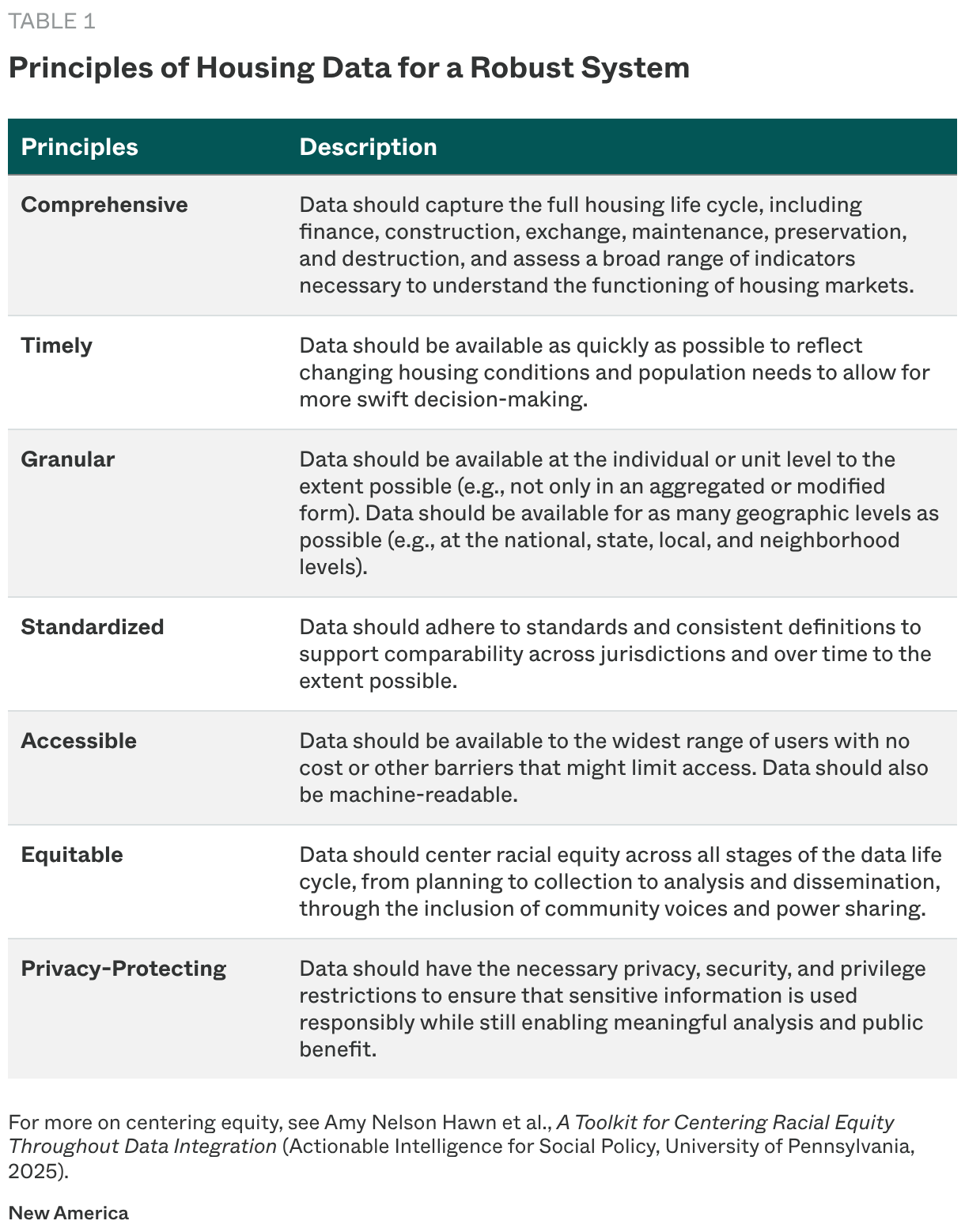
A robust system should also adhere to the principles of data that are essential to a functioning democracy. Table 1 describes these principles and their application to housing data.18
How Do We Get from Here to There?
To move our housing data system from one that is fragmented, decentralized, and incomplete to one that is coordinated, accessible, and robust, we need to invest in two areas: data improvement and data infrastructure.19
Improving housing data involves ensuring that housing data is as comprehensive, timely, geographically granular, standardized, accessible, and privacy-protecting as possible across all domains. Doing so involves creating new tools and pathways to address existing gaps in data quality and coverage, and continuous re-assessment as housing markets and technological innovation evolve over time.
Building housing data infrastructure involves building the systems that coordinate across fragmented data systems and ensure housing data can be accessed, analyzed, and used by a broad range of housing data actors.
While data improvement and data infrastructure are interconnected, the types of investments, resources, and capacity needed to support and advance each differ. In the next section, we lay out the overarching infrastructure needed to advance both.

Citations
- To the extent possible, a robust housing data system should also align with the principles of open government data (OGD), which posit that data should be complete, primary, timely, accessible, machine-processable, nondiscriminatory, nonproprietary, and license-free.
- To build a robust housing data system for the 21st century in the United States, we need not start from scratch. The United States has a legal and privacy infrastructure for data sharing that can be leveraged for housing data. The Foundations for Evidence-Based Policymaking Act of 2018, and particularly its Confidential Information Protection and Statistical Efficiency Act (CIPSEA), established both the confidentiality rules and the access pathways for federal evidence-building.