The Participatory Campus: A Collaborative Vision
A “Participatory Campus” is one where democratic education and engagement are defined by close collaboration between students and staff, who focus on addressing concrete local challenges.
This method requires combining all three models of existing civics opportunities—investing in institutional capacity, supporting civic learning in the curriculum and beyond, and partnering with students as civic leaders. At the same time, the Participatory Campus approach seeks to expand on traditional civics models at community colleges by prioritizing four principles.
First, organizers should follow best practices when designing engagement projects, paying particular attention to the subject of engagement (the “what”), the tools and methods of engagement (the “how”), the purpose of engagement (the “why”), and the participating constituents (the “who”). It is essential that these elements complement each other, whether the engagement project is part of a classroom assignment or an off-campus initiative.
As outlined in the City Leader Guide on Civic Engagement, published by the Bloomberg Harvard City Leadership Initiative, engagement often fails when these basic questions are not considered early in the process.55
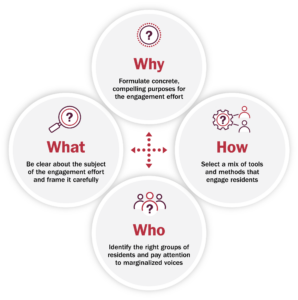
If stakeholder input is not aligned with the desired outcomes, or if the tools are not realistic for the group of constituents involved, engagement processes can backfire and lead to more distrust and disillusionment for both organizers and participants. Though this model was originally designed for municipal officials, the same principles apply to civic education and engagement efforts in higher education.
Second, administrations should ensure accessibility by developing a broad spectrum of civic opportunities, ranging from low to high levels of involvement, that all receive some form of compensation. For example, students can complete a civically focused exercise during established class hours that counts toward their final grade and course credit. Students who can and want to get more involved could hold a paid role organizing engagement projects at a center for civics.
Third, student leadership and decision-making should be incorporated into initiative planning and implementation. With this principle, civic education and engagement efforts would emphasize active, concrete, and ongoing democratic development rather than stand-alone participation opportunities. Taking this approach inside a classroom might look like asking students to develop proposals for addressing a community challenge and then inviting government staff to visit class for student-led presentations. Students could also partner with community organizations or officials to create a civic programming series that tackles a local need in place of a single-day, campus-wide volunteering event.
Finally, schools can apply democratic ideals within their own institutional structures in addition to externally focused engagement. Kelly Siegel-Stechler, a former associate director of Tufts University’s Center for Information & Research on Civic Learning and Engagement, has argued for this broader shift. In a 2024 interview with the National Center for Free Speech and Civic Engagement, she encouraged administrators to ask, “What avenues do students have to use their voices and advocate for change? And when they do, how are their efforts received by faculty, staff, and administrators?” According to Stechler, these dynamics are especially important at public institutions, where students’ “experiences will set a precedent about what to expect from institutional and civic engagement throughout their lives.” To her, “civic learning is happening all the time, whether we are paying attention or not.”56
Incorporating students’ perspectives in internal decision-making may also help improve administrations’ efficiency and efficacy. Here, higher education institutions could again learn from broader political science literature and public policy best practices, including an approach called collaborative governance. Also known as co-governance, this style of civic engagement brings constituents into the decision-making process through models like participatory budgeting and civic assemblies. Officials identify a specific decision, such as how to allocate part of the municipal budget or rezone a public plot of land. Representative groups of residents are then able to weigh in and offer recommendations to government officials. This approach reflects a shift of power and trust allowing officials and constituents to treat each other not as adversaries but as colleagues in democratic decision-making.57 When governments incorporate this kind of civic engagement into the policymaking process, the outcomes are more likely to be successful. Officials are more likely to secure their constituents’ buy-in, bolster public trust in government, and accurately identify community priorities.58
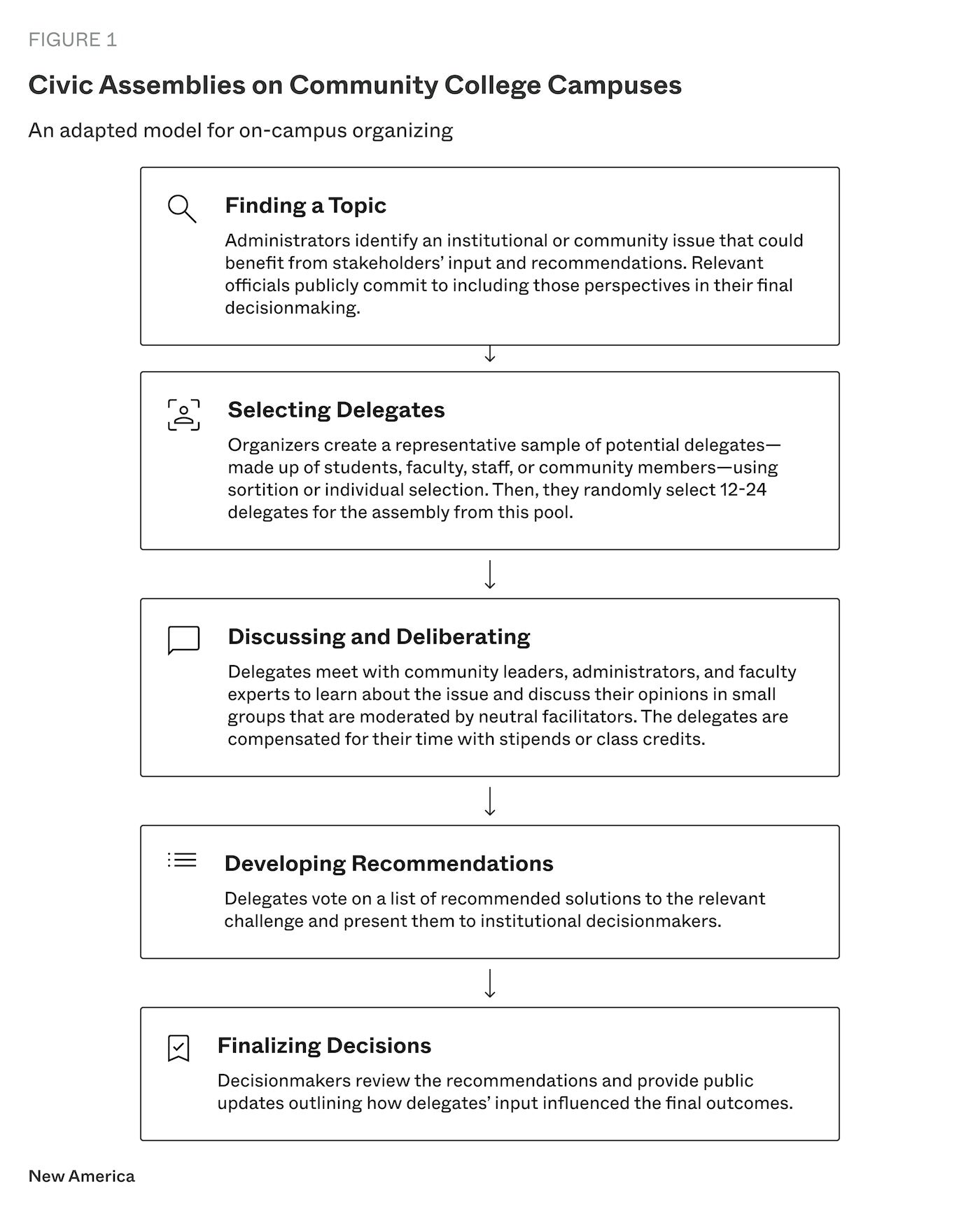
Higher education institutions might see similar benefits if they brought these kinds of engagement structures—particularly civic assemblies—to their campuses. Doing so would require adopting the standard model to fit these institutions’ resources, settings, and constraints—as broken down in the New America report Civic Assemblies: A Framework for Community Colleges. Ultimately, though, such initiatives would offer significant advantages to both students and institutions as a whole. As Ramirez put it, “Students and the community members have information and experiences that can really teach faculty and administrators and the institution about how it can better serve them.” In this way, “it’s not just about being fair, it’s about actually getting to the best solution.”59
For example, a president could institute a civic assembly—made up of administrators, faculty, and students—to create a new code of ethics guiding the use of artificial intelligence in classrooms (see Figure 1). An academic department could set up an assembly to determine how to use limited programming funds, combining faculty and student input through a collaborative process. Assemblies like these would help administrators weigh complicated trade-offs, strengthen relationships across campus, and identify the best solutions for their community members. Students, in turn, would develop a deeper understanding of institutional issues and decision-making, practice advocating for themselves and others, gain leadership experience, and help shape policies that will directly affect their lives.
Within the Participatory Campus Framework, these principles could all be implemented to varying degrees, translating to different levels of student participation, institutional partnership, and power.
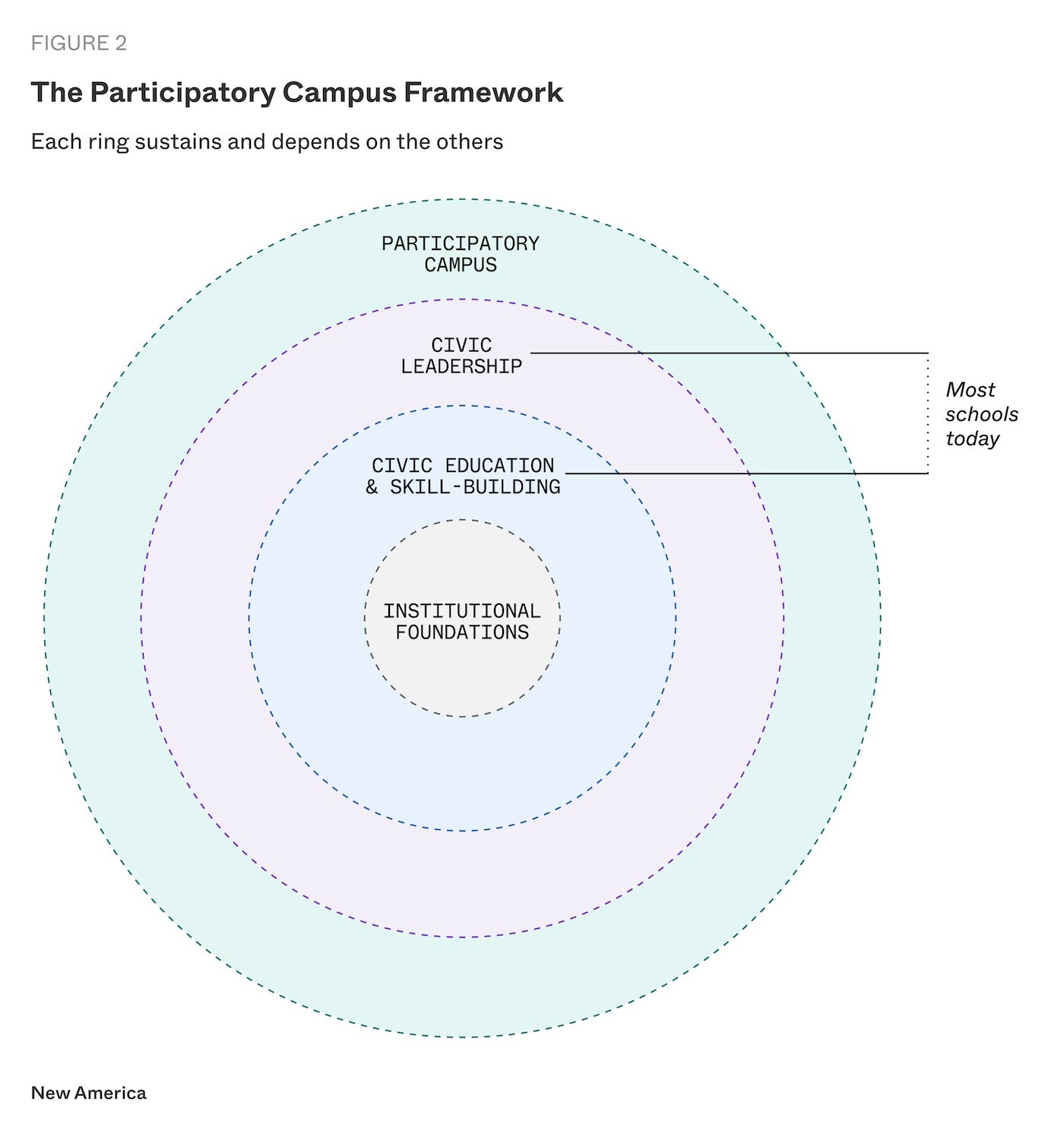
In this framework, each level of engagement includes some of the activities from the prior category (see Figure 2). The boundaries between levels are not rigid. Schools and stakeholders may move between categories during different periods of time and under different administrations. Similarly, schools may combine aspects of one category with the characteristics of another depending on their specific circumstances.
Therefore, this framework is not intended to impose labels or to be used as a diagnostic tool but rather to help schools map their current activities and consider how they might work toward other categories of engagement in sustained, regimented ways.
Today, a majority of civic opportunities at community colleges are focused on the levels of “Institutional Foundation” and “Civic Education and Skill-Building.” Some schools work within the “Civic Leadership” tier. (See Tables 1, 2, and 3, respectively, for corresponding definitions and activities.) The “Participatory Campus” builds on and is sustained by all three of these approaches (see Table 4).
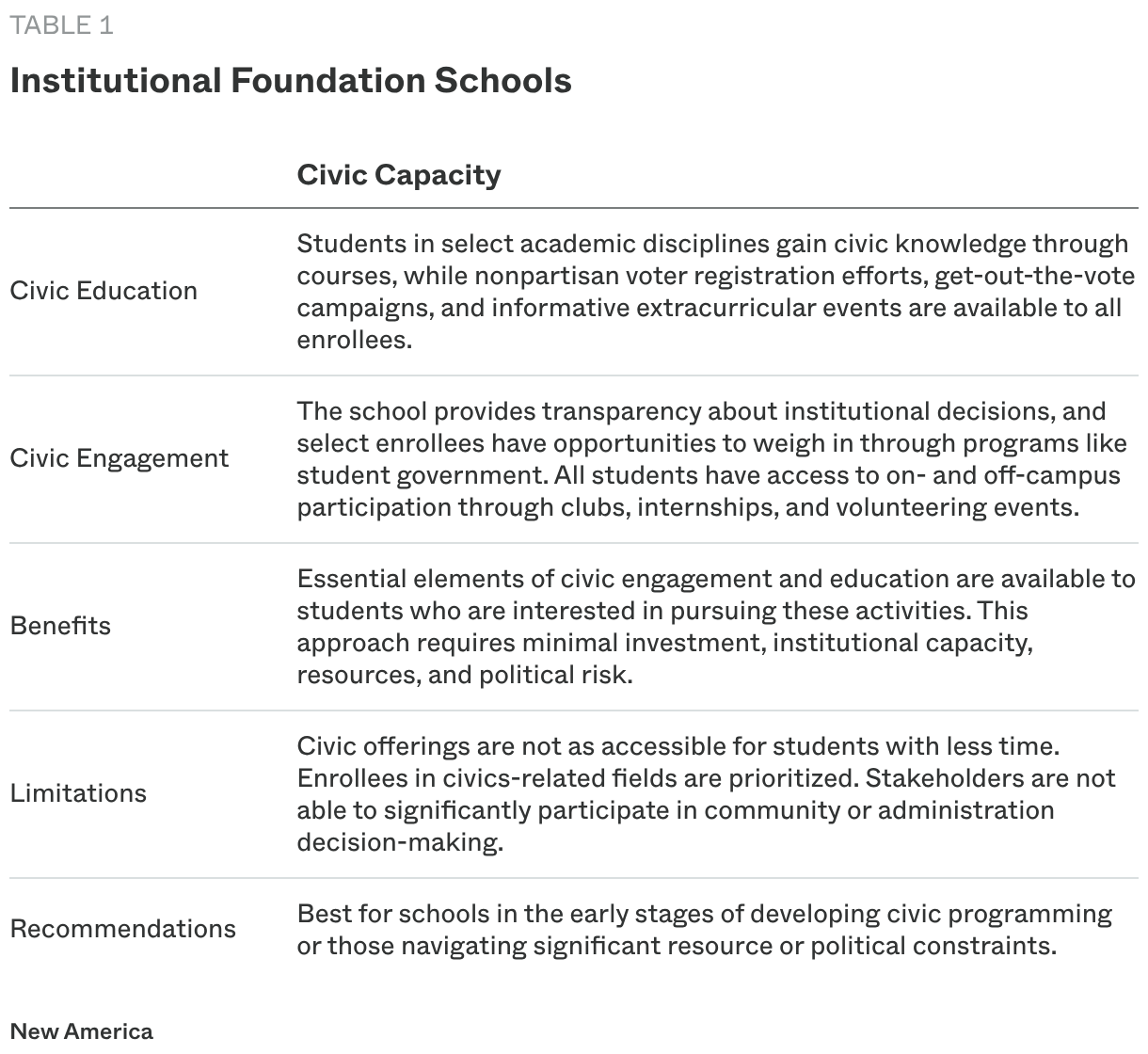
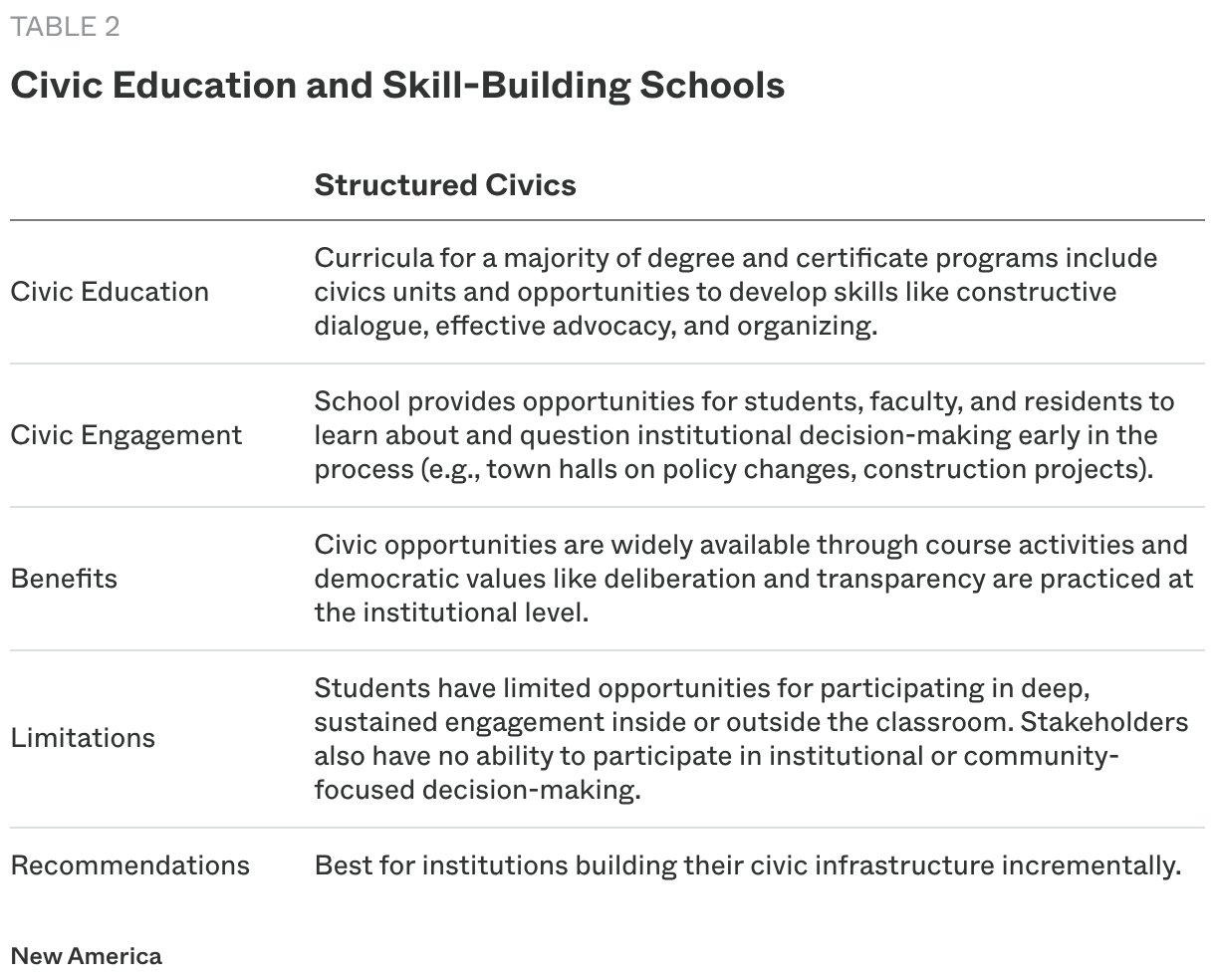
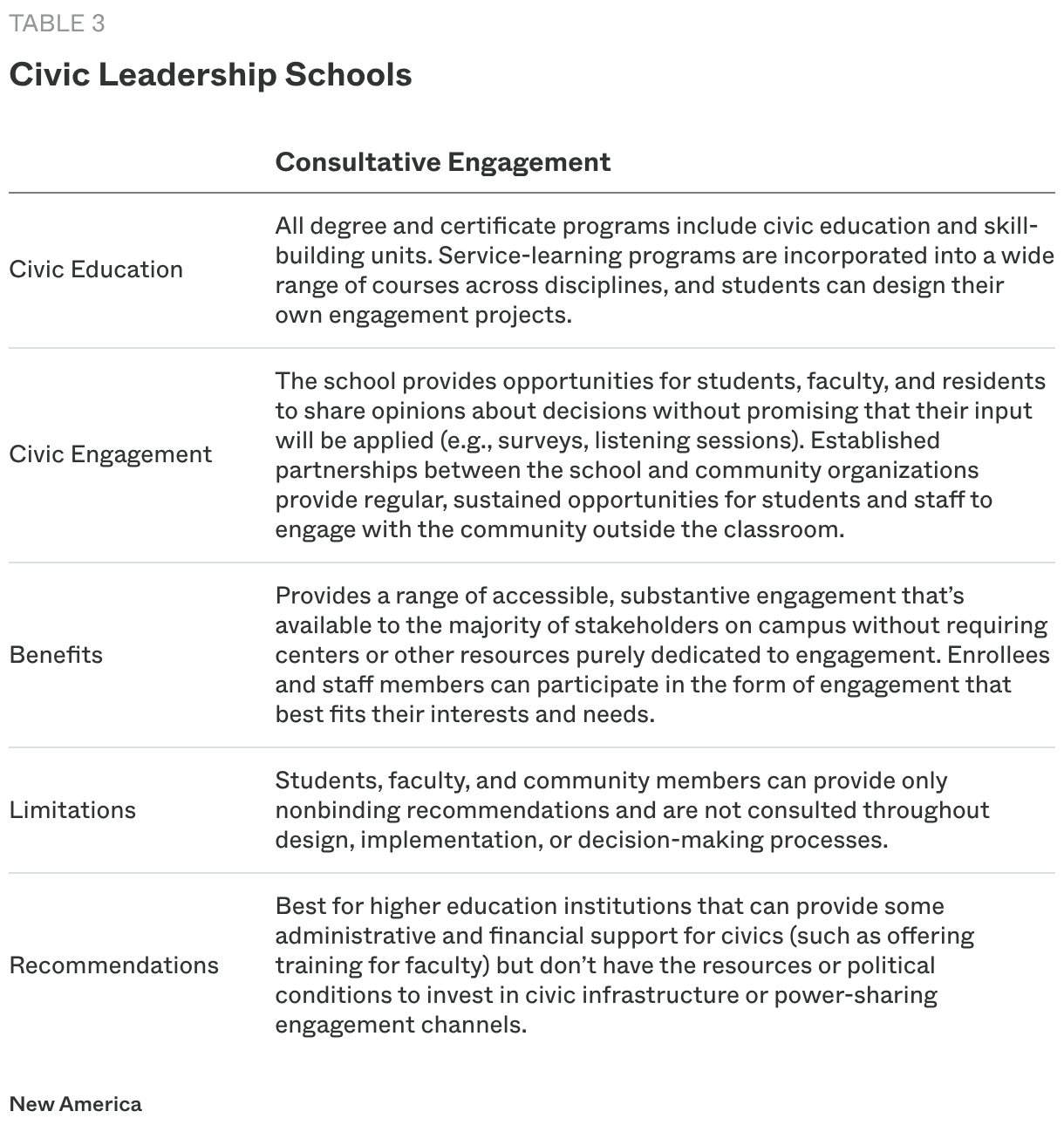
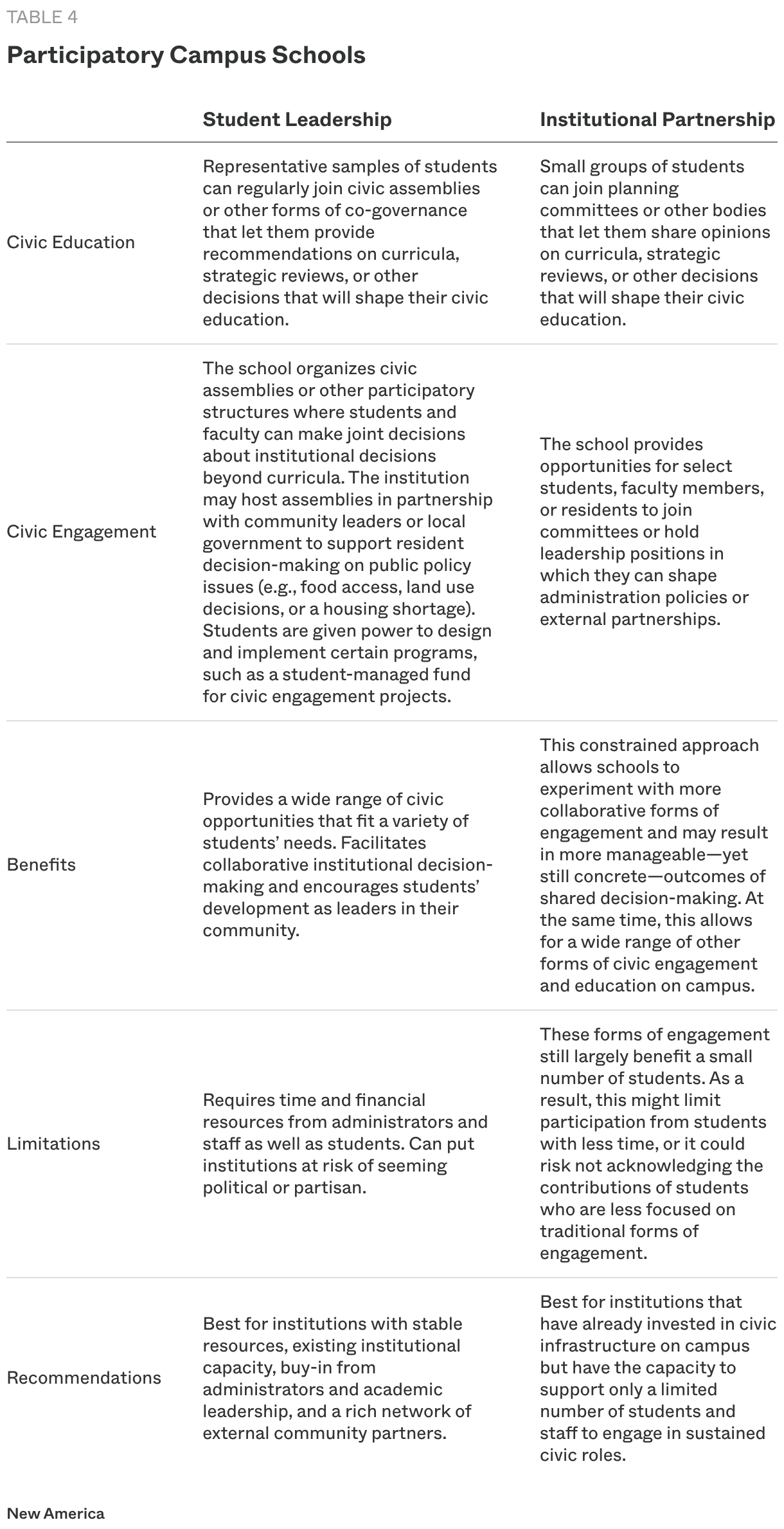
Any of these approaches to engagement may be the best fit for some institutions based on their resources, their political climates, and the needs of their students and broader community.
However, if students, faculty, or administrators are interested in broadening their civic offerings into other segments of the engagement spectrum, they can do so in manageable, tailored ways.

Citations
- Hollie Russon Gilman et al., City Leader Guide on Civic Engagement (Bloomberg Harvard City Leadership Initiative, 2023), https://www.cityleadership.harvard.edu/resources/collection/city-leader-guide-civic-engagement/.
- “Ask the Experts: Best Practices for Incorporating Civic Learning,” University of California National Center for Free Speech and Civic Engagement, March 14, 2024, https://freespeechcenter.universityofcalifornia.edu/programs-and-resources/resource-materials/ask-the-experts/civic-learning-week/.
- Mark Schmitt and Hollie Russon Gilman, Building the Relationships for Collaborative Governance: Case Studies from Across America (New America, November 17, 2021), https://www.newamerica.org/political-reform/reports/building-the-relationships-for-collaborative-governance/; Sarah Johnson and Elianne Farhat, “Governing Together: Layers and Lessons,” The Forge, October 21, 2021, https://forgeorganizing.org/article/governing-together-layers-and-lessons.
- Untung Muhdiarta, “The Role of Community Participation in Shaping Policies and Its Implications for Government Legitimacy,” Journal of Academic Science 2, no. 4 (April 2025): 1109–1117, https://thejoas.com/index.php/thejoas/article/view/325; Rajvir Saini and Sandeep Soni, “Citizen Participation and Governance in Local Government Decision-Making Processes and Addressing Challenges,” Journal of Local Self-Government 23, no. S2 (2025): 35–39, https://www.proquest.com/openview/9c144b9388f932d96e92866a6ade07d9/1?pq-origsite=gscholar&cbl=55210; Sazzad Islam, “Public Finance and Policy Effectiveness: A Review of Participatory Budgeting in Local Governance Systems,” SSRN (June 2025), https://papers.ssrn.com/sol3/papers.cfm?abstract_id=5287147.
- Ramirez, interview.