Lee Drutman
Senior Fellow, Political Reform Program



Midterm elections are usually reduced to a few familiar stats: seats lost by the majority party, seats gained by the party out of power, and the margins of victory. Most midterms represent “thermostatic shifts” in the balance of power, as voters shift away from the incumbent, much like a thermostat switches on and off to regulate the temperature. Every so often, however—as in 1974, 1994, and 2010—they reshape the parties and political system in ways that far outlast a single Congress.
So, what kind of election will 2026 be? The numbers that help answer that question may not be the ones dominating election-night coverage. Here are the five numbers the Political Reform program is watching this November, and what they tell us about where American politics is headed.
About one in five voters now dislikes both the Democratic and Republican parties, a September Wall Street Journal poll found. That share jumped from 13 percent in the 2022 midterms and about 12 percent in the last two presidential elections. In the same poll, roughly 60 percent of all voters viewed each party negatively. Gallup tracks the same trend: Democrats sit at 43 percent favorable and Republicans at 35 percent, both below their averages since 1992, and neither party has topped 51 percent in 15 years.
Don’t mistake these voters for the apathetic. Nearly two-thirds say politics matters to their identity. They are mad at the system: More than three-quarters of adults told the Journal the economic and political systems are “stacked against people like me,” and Americans tell Gallup that government and poor leadership top the nation’s problems. Cook Political Report’s Amy Walter sees “a deeper structural anger” that “isn’t going away after November.”
This year, these “double haters” favor Democrats, 55 to 27, though more than 40 percent still haven’t fully committed. But in 2022, when Democrats ran Washington, they backed Republicans, and when Republicans ran Washington in 2018, they backed Democrats. They punish whoever holds power.
So if Democrats win the House in November, remember the 21 percent. A fifth of the electorate will have handed power to a party it dislikes. And it can take that power back just as fast. Until these voters get more parties to choose from, they will keep firing the incumbent majority.
—Lee Drutman, Senior Fellow, Political Reform
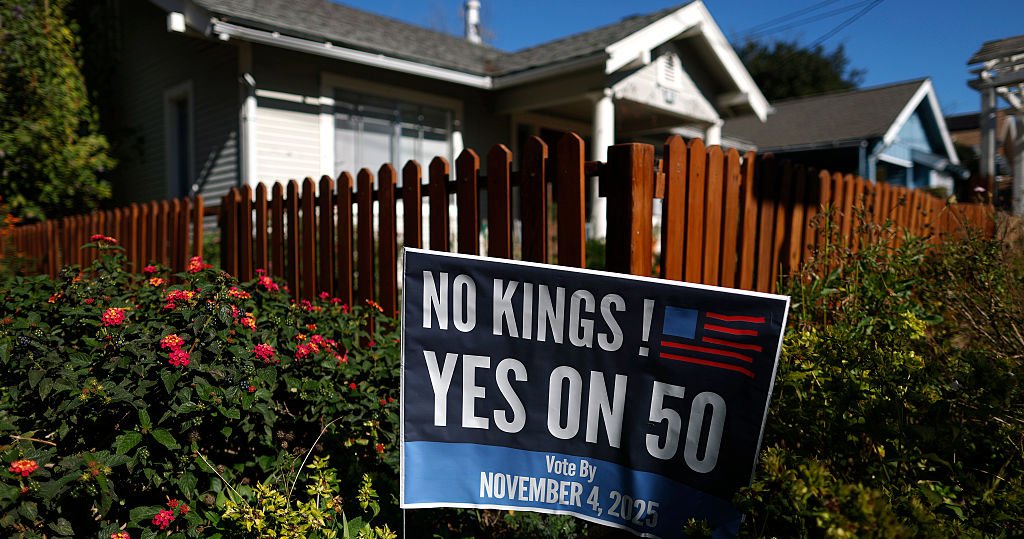
For a campaign so defined by numbers, I struggled to choose which one best captures the story of the Prop 40 ballot initiative in California. There’s $102 million, the amount Google co-founder Sergey Brin alone has contributed to the opposition campaign as of October. Or 9 to 1, the advantage opponents currently have in spending over supporters.
But I’m watching 5 percent: the one-time tax on the wealth of California billionaires that voters in the Golden State will decide on this November, with most of the proceeds dedicated to health care.
The stakes—and the historical arc that led to this political moment—extend well beyond California and the need to offset federal cuts to Medicaid, which motivated the measure’s sponsors. More than a century ago, the populist and progressive movements championed ballot initiatives, or direct democracy, as emergency mechanisms to bypass legislatures they believed had become too beholden to the railroads and other powerful economic interests. Today, amid renewed concerns about concentrated wealth and political power—evidenced by the viral candidacies of democratic socialists and the mainstreaming of anti-oligarchy rhetoric—Californians can use that same “People’s Tool” to authorize a tax directly on some of the richest people in the world and most politically influential people in the Trump administration.
And many of those wealthy individuals and interests are spending extravagantly to stop it. At $231 million spent so far, it’s likely to beat the record for the most expensive “no” campaign in ballot measure history, now held by California’s failed initiative to legalize online sports betting in 2022. Prop 40 could easily fail, especially given the financial firepower arrayed against it and confusing cues about it from the state’s Democratic elites. But if the initiative succeeds, it could provide a blueprint for activists in other states, particularly those frustrated by even left-leaning lawmakers’ reluctance to take on powerful interests in the AI and tech sector and beyond.
The inequities of the original Gilded Age provoked democratic reforms to both our political and economic systems that spread from state to state, including the initiative process itself. If our present Second Gilded Age is producing a political backlash anything like the first, California’s experiment this year could offer an early indication of whether another sea change is imminent—and whether direct democracy will once again be the vessel that takes us there.
—Maresa Strano, Deputy Director, Political Reform
In four states currently represented by Republican senators, and that have backed Republican presidential candidates in every one of the last 15 elections, the main opposition is coming from candidates running as independents. In three of those states—Idaho, South Dakota, and Nebraska—Democrats have stepped aside in a tacit endorsement of the independent, while the winner of Montana’s Democratic primary has remained in the race. None is favored to win, but if even one of them—most plausibly Dan Osborn, running against wealthy incumbent Pete Ricketts in Nebraska—were to break through, it could mark the beginning of a transformation of our two-party structure.
Osborn, along with any of the others if they win, would join two independents already in the Senate—Angus King of Maine and Bernie Sanders of Vermont, while Alaska Republican Lisa Murkowski has moved toward independence most recently by endorsing the Democratic candidate for governor—to form a bloc that could at times have influence. They are not aligned on issues, to be sure, and came to independence by different paths, but could exercise some power on the rules of the institution. And they would vindicate a theory that many voters are simply reluctant to embrace a candidate bearing the Democratic Party label while supporting many of the party’s policies. All four of the 2026 candidates are veterans, two have working-class backgrounds, and all four have platforms focused on economic policies that benefit working people.
For decades, pundits have predicted that a new party might emerge in the middle zone of American politics—centrists who are conservative on government spending and moderate on social issues. But that’s an elite position that actually has little support among voters. Instead, these independents, like Sanders, represent a mix of positions and support an active government role in the economy. Their back-to-basics focus evokes previous successful politicians from those same states with cross-party appeal, such as Montana’s Jon Tester.
While these independents have gotten some attention, another hidden development might also help move toward a multiparty democracy: the astonishing success this year of candidates affiliated with the Working Families Party, which, much like this year’s independents, takes an economics-forward approach. In New York and Connecticut, which allow a party to cross-endorse another party’s nominees on its ballots, the WFP functions as a political party, and its candidates won several primaries. Elsewhere, it functions mostly through endorsements. Candidates with the party’s endorsement defeated five incumbent state representatives in Delaware, driven by anger over legislation that benefited Elon Musk. A WFP challenger defeated the incumbent mayor of Providence, Rhode Island, and the party captured several legislative seats in that state as well as in Massachusetts and Wisconsin.
While Democrats affiliated with or backed by the Democratic Socialists of America have received more attention, it is the Working Families Party—in part because it functions as a party, not just an advocacy group—that has begun to transform politics. If we expand the number of states that allow parties to cross-endorse (a once-common practice also known as fusion), the WFP and other intermediary parties, along with the growing crop of independents, might well lead the way to a more diverse and fluid multiparty system in which more viewpoints are represented.
—Mark Schmitt, Director, Political Reform
In the current House of Representatives, 12 states have only Republican representatives and nine states have only Democratic representatives. In six of these states, this is because they only have one at-large district. In others, like Utah and Oklahoma, it’s because the state has been gerrymandered to give one party an unfair advantage. And in others, like Massachusetts, the geographic distribution of voters makes it extremely difficult to draw maps for single-member districts that would provide the appropriate level of representation for voters of both parties.
Whatever the reason, it means that the House of Representatives, which, in the words of John Adams is supposed to be “in miniature, an exact portrait of the people at large,” is left without representatives who might express the diverse views of voters from those states. Left out from the House are the voices of Massachusetts Republicans, Oklahoma Democrats, Republicans from New Mexico, and Democrats from Idaho. Congress is worse off for that, and so are voters who are left with limited meaningful representation and oftentimes no real choices on the ballot.
On the days after the midterm elections, I’ll be watching for whether states leave or join this group of 21 states. Utah is likely to exit this group, but, after a mid-cycle redistricting that produced a severely gerrymandered map, Tennessee is sure to join it. Other states will get close. After recent Supreme Court rulings, Alabama and Louisiana were able to use biased maps that—barring an election-night surprise—all but guarantee that only one Democratic candidate will be elected from each state. Such redistricting efforts are only getting started and, in the near future, more states might try to gerrymander their maps so that their preferred party dominates in House races. (Bonus number to watch for: 39, the current number of trifectas in state governments, which oversee redistricting.)
A tit-for-tat redistricting can easily devolve into a gerrymandering frenzy that leaves most states with representatives from only one party and the country worse off for it. It doesn’t have to be that way. The House of Representatives can be expanded to include more members, which would make gerrymandering harder. More transformative would be to move away from a winner-take-all electoral system to a type of proportional representation that allocates seats proportionally to vote share. Whether it’s a list-based system, a mixed-member proportional system, or some other variation, these systems will minimize gerrymandering and ensure fairer representation for voters in all states.
—Oscar Pocasangre, Senior Data Analyst, Political Reform
There is a historic number of Black candidates in this year’s gubernatorial races. Eight candidates—five Democrats and three Republicans—are running in states from the Mountain West to the Deep South. Two outcomes are certain: All of them will not win, and all of them will not lose. Aside from that, I’ll be watching for a few things.
First, the closest contests will offer indicators about the direction of the broader electorate. Two contests are unlikely to surprise: Incumbent Governor Wes Moore (D) in Maryland leads by a wide margin, while South Carolina state representative Jermaine Johnson (D) faces a large deficit. Two other Black candidates—Representative John James (R) in Michigan and state house speaker Lisa Demuth (R) in Minnesota—are down about 8 percentage points and will need turnout and swing voters to break their way to have a chance.
But the latest polling shows the remaining races are in statistical ties, featuring Representative Byron Donalds (R) in Florida, former Atlanta mayor Keisha Lance Bottoms (D) in Georgia, Milwaukee County executive David Crowley (D) in Wisconsin, and Attorney General Aaron Ford (D) in Nevada. The manner in which these candidates win or lose and what emerges as the most salient issues for voters may be a bellwether leading up to the 2028 presidential election.
Next, voter share will be an essential data point. Black Democrats usually increase turnout among Black voters; Black Republicans do not. And as with presidential and congressional elections over the last six decades, Democratic candidates for governor routinely win upwards of 85 percent of this bloc. Republicans can make inroads—such as former Maryland Governor Larry Hogan, who won 33 percent of Black voters in his 2018 reelection—but at present, none of the three Republicans are polling better than 10 percent.
And finally, history could be made beyond the number of candidates running. There have only been three elected Black governors in the nation’s history, all Democrats and men: Douglas Wilder of Virginia in 1990, Deval Patrick of Massachusetts in 2007, and Wes Moore of Maryland in 2022. By year’s end, the nation may have elected the first Black woman to be governor, the first elected Black Republican, or more than one elected Black governor at a time.
Either way—history or status quo—the story today begins with these eight.
—Ted Johnson, Senior Fellow, Democratic Futures
Senior Fellow, Political Reform Program
Deputy Director, Political Reform Program
Senior Director, Political Reform Program
Senior Data Analyst, Political Reform Program
Senior Fellow, Democratic Futures