Rachel Fishman
Director, Higher Education

Nearly 40 percent of low-income Parent PLUS borrowers have defaulted on their loan after a decade in repayment, according to data released as part of the rulemaking process of the One Big Beautiful Bill Act (OBBBA).
OBBBA made significant changes to federal loan limits, including for parent borrowers under the PLUS loan program. This year, instead of being able to borrow up to the full cost of attendance of an undergraduate program, which includes tuition and fees and living expenses, parents newly borrowing for a dependent child will only be able to borrow $20,000 a year, with an overall cap of $65,000 per child.
In general, Parent PLUS loans tend to have lower default rates than student loans because a parent is required to undergo an adverse credit history check, which narrows the pool of eligible borrowers to only those who haven’t experienced negative credit events such as delinquent payments beyond 90 days. That check, however, does not look at a parent’s ability to repay the loan.
As part of the rulemaking process, the Education Department released repayment and default data about the Parent PLUS loan program that reveal just how predatory these loans are for low-income families. And unfortunately, even under the new OBBBA limits, the federal government will continue to allow institutions to make loans to very-low-income parent borrowers without fixing the underlying problems with the program, and the affordability issues these families face. Changes were also made to loan repayment so that parent borrowers have even less of a safety valve than they had before.
Taken together, the Department’s data tell a stark story about risk, repayment, and default. Three findings are particularly instructive of why the Education Department and Congress must act to fix this predatory lending program:
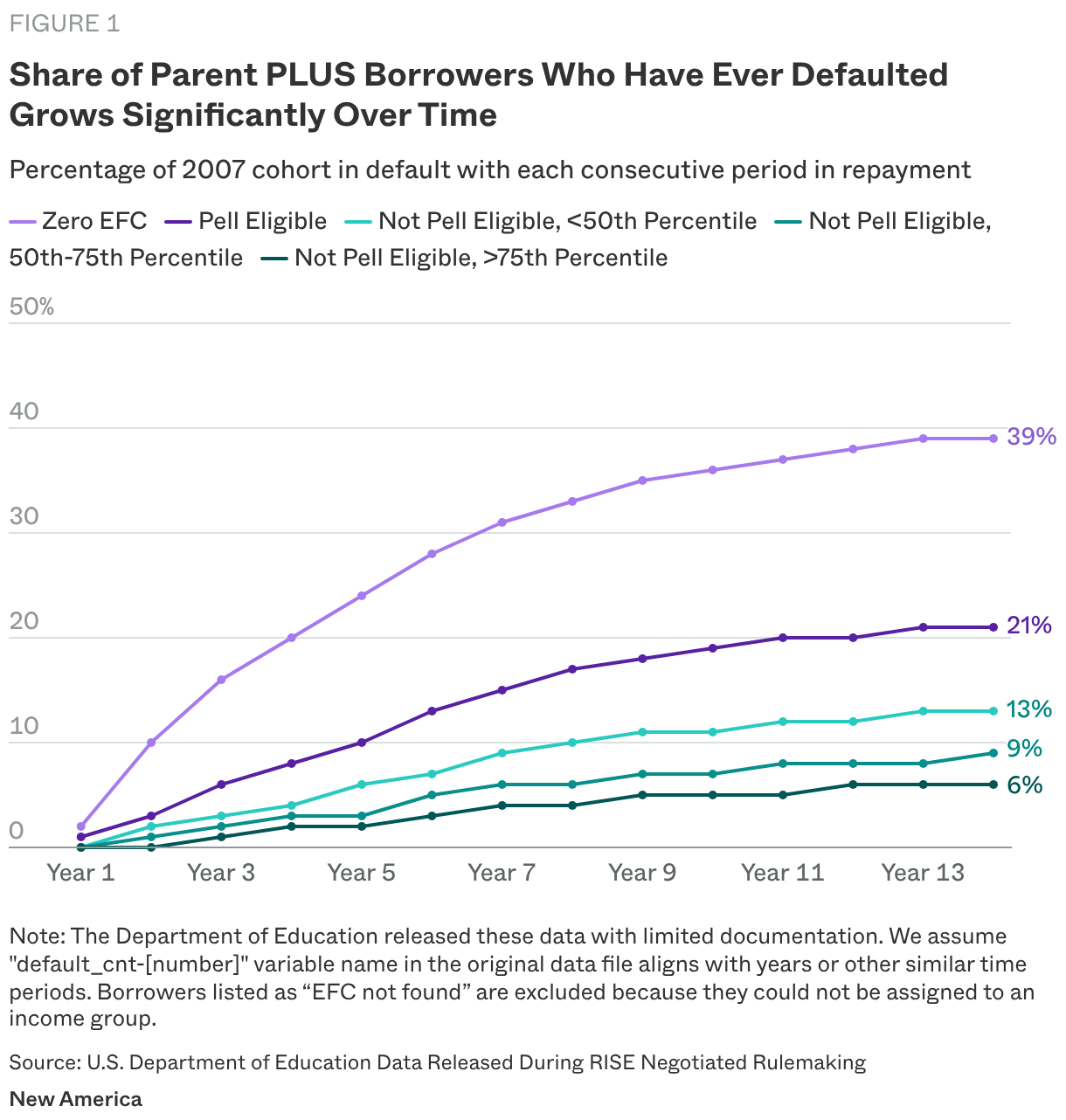
1. After more than a decade in repayment, 40 percent of very-low-income borrowers had defaulted. The Education Department included data from cohorts of parent borrowers from 2007 to 2019, and their default rates over time. For the 2007 cohort, the year reported by the Department with the most years of repayment data, nearly 40 percent of zero-Expected Family Contribution (EFC) families have ever defaulted on their Parent PLUS loan almost 15 years in (See Figure 1). EFC (now called the Student Aid Index or SAI) is the result of a calculation from information a family provides on the FAFSA—the lower the number, the less a family is “expected” to contribute toward their child’s education and the more need-based aid they are likely to receive. A 0 EFC results in a student receiving the maximum Pell Grant, the federal government’s primary source of need-based aid to college students. These are students who come from families that have an AGI of about $27,000 or less.
As Figure 1 further shows, while very-low-income families face very high rates of default on Parent PLUS, other Pell-eligible families—those still considered low-to-moderate income by the federal government—also face high default rates. Over a decade in, nearly 1 in 5 defaulted on their loans. When borrowers default on their federal student loans they can face severe consequences such as tax refund or Social Security offsets, wage garnishment, and further credit score damage along with ineligibility for other federal assistance.
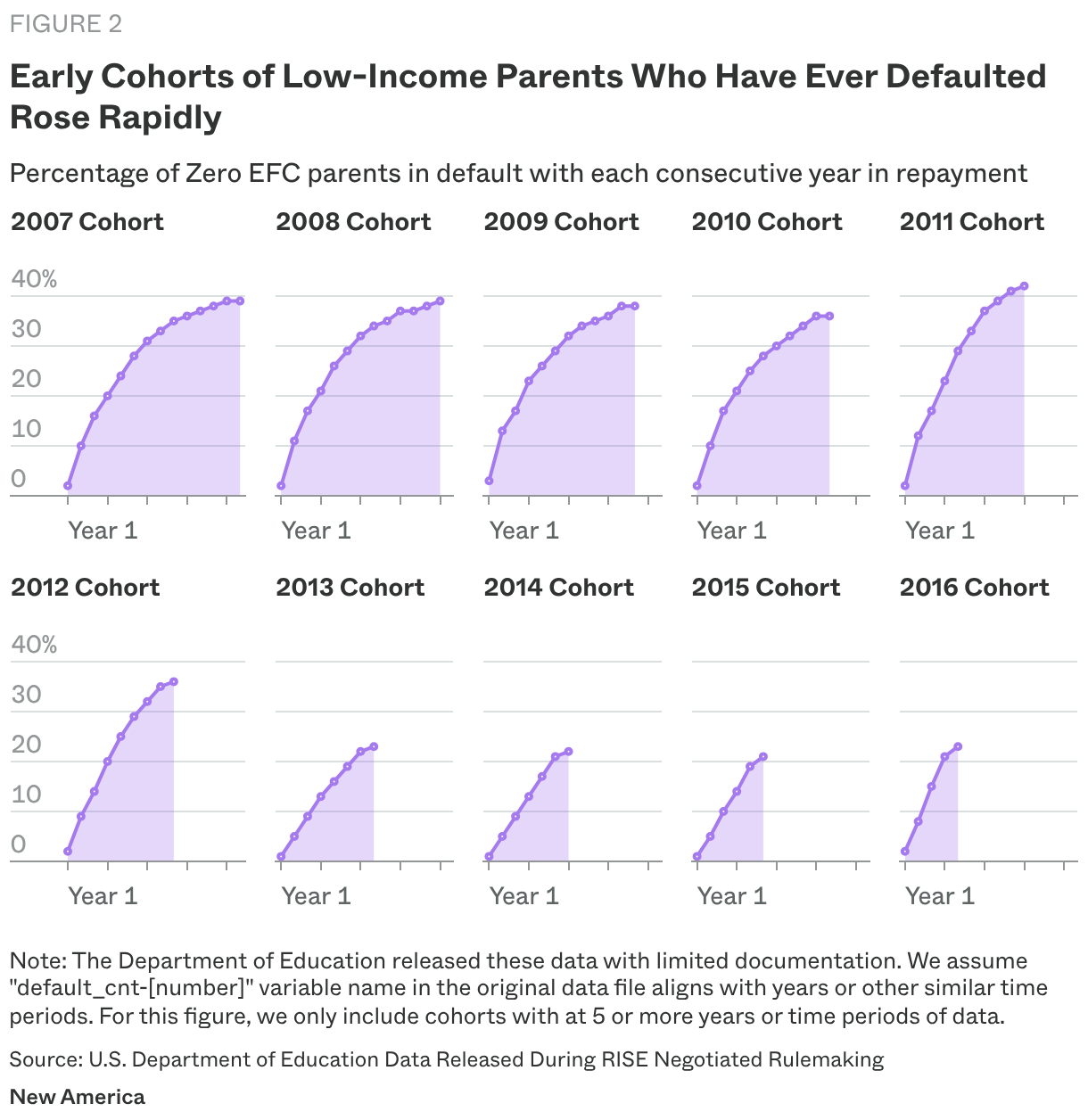
While the 2007 cohort faced challenges due to the Great Recession, this trend of high default rates for very-low-income parents still follows a similar trajectory across all cohorts, showing that later cohorts have similar patterns (See Figure 2).
For cohorts in later years, there is not enough data before the pandemic hit, when repayment was paused along with collections on defaulted loans, to know whether the trajectory will play out in the same ways. But the trend data in the lead-up to the pandemic payment pause is concerning.
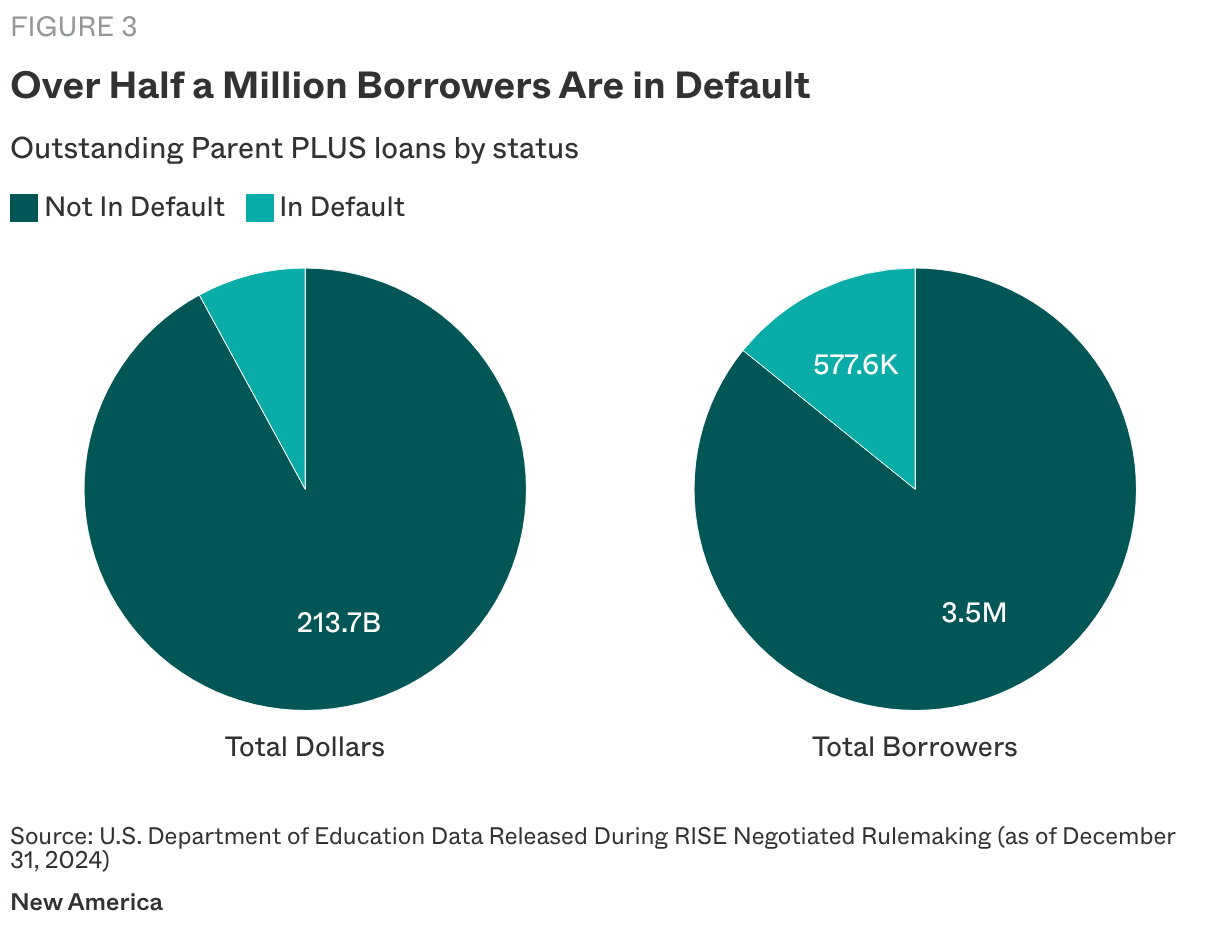
2. More than half a million parent borrowers were in default at the end of 2024. Almost 20 percent of Parent PLUS borrowers were in default in the most recent figures we have received from the Department (see Figure 3). This amounts to more than $18 billion in default. This number has likely increased with the looming default cliff from the post Covid payment pause.
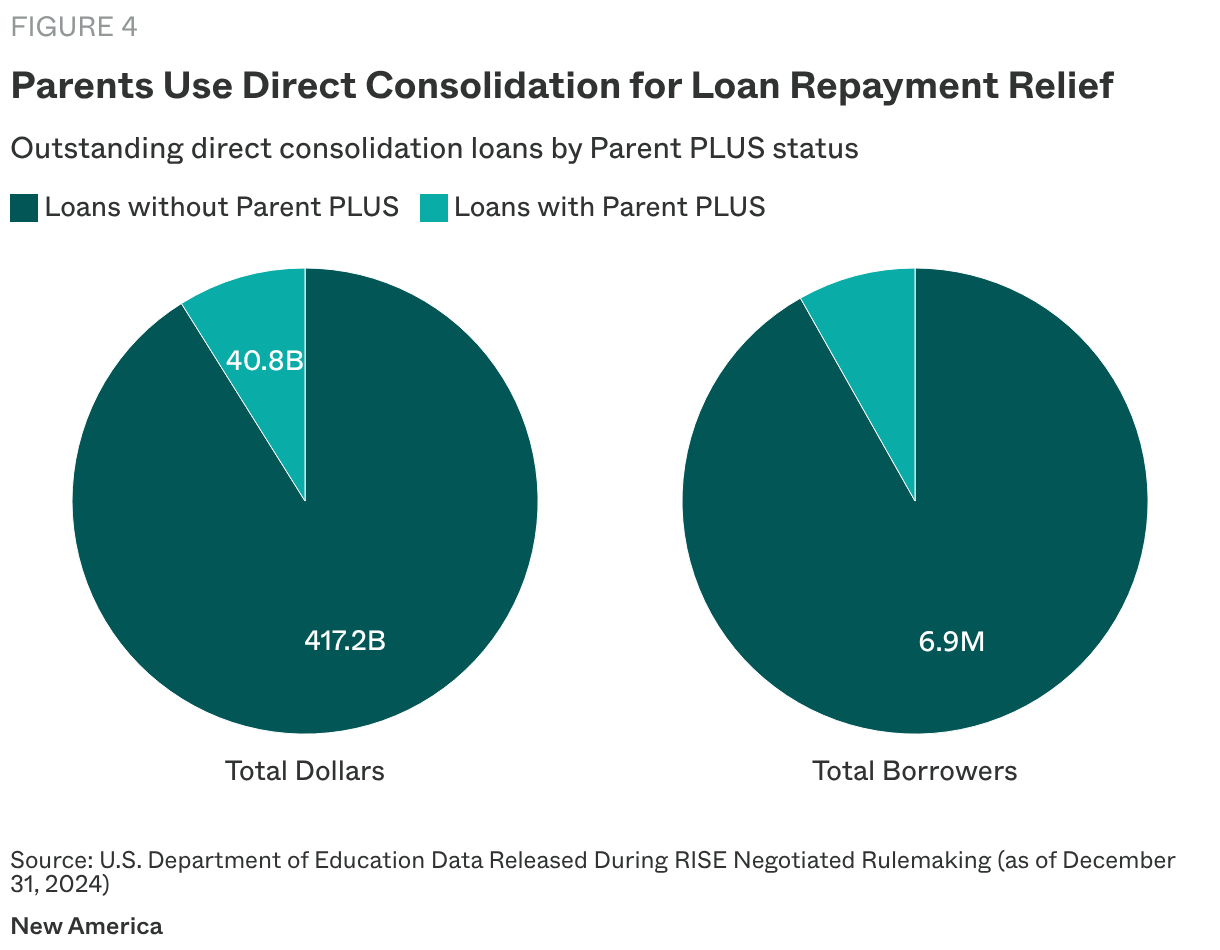
3. Roughly one in six Parent PLUS borrowers have consolidated their loans, and nearly a quarter of those borrowers have a $0 payment under income-contingent repayment. One way to provide repayment relief and avoid default is for a parent to consolidate their Parent PLUS loans into a Direct Consolidation Loan. Approximately 625,000 parent borrowers have done so (see Figure 4), which works out to roughly 15 to 18 percent of all Parent PLUS borrowers. The data don’t make clear whether the Department’s count of Parent PLUS borrowers includes those whose loans are now held inside a consolidation loan, so we present this as a range. Borrowers may consolidate for a variety of reasons, but one key benefit is that consolidation lets parents stretch out repayment over a longer period. It also used to give them the ability to access an income-driven repayment (IDR) plan called income-contingent repayment (ICR).
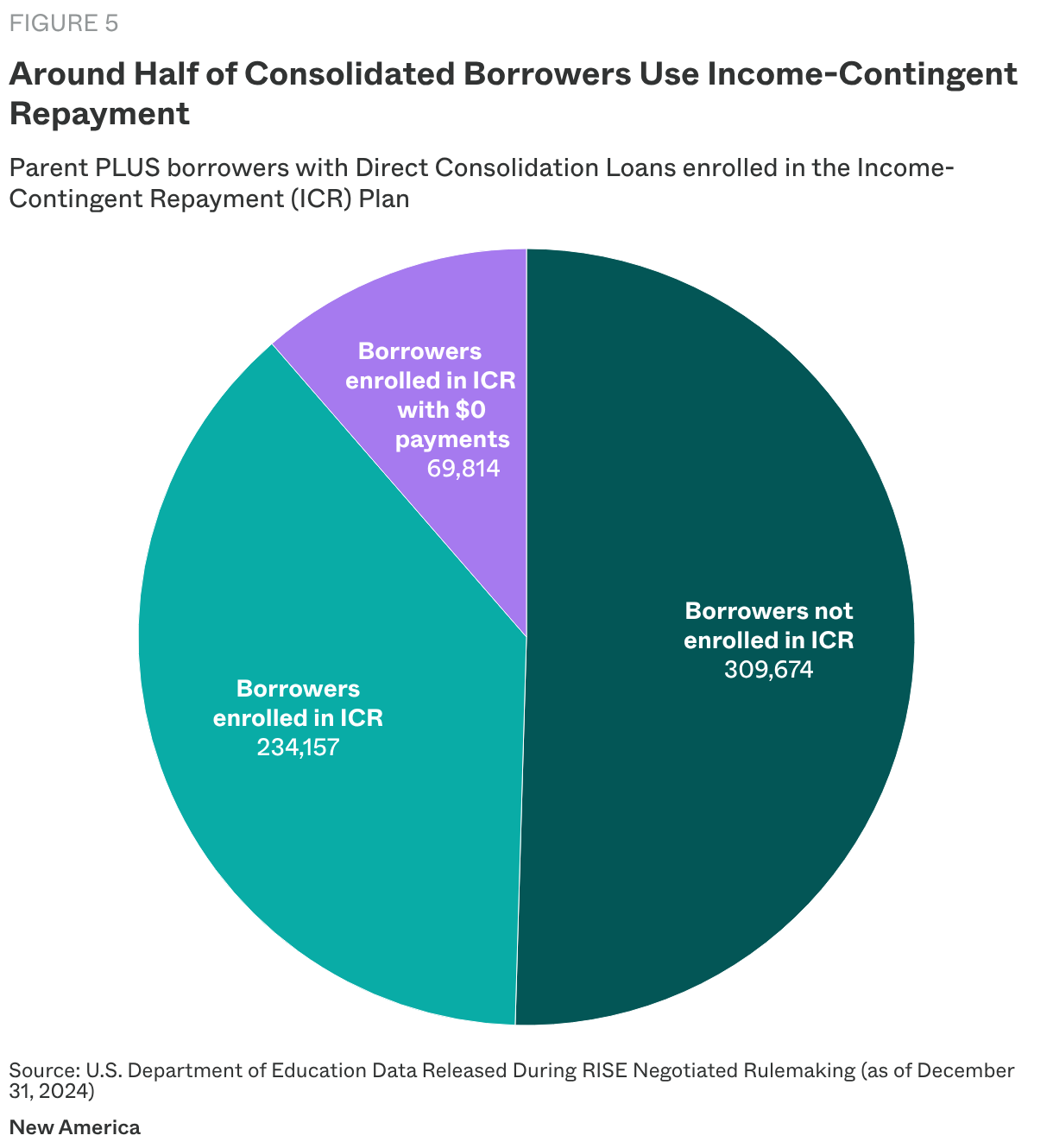
Traditionally, IDR plans are only available to student borrowers and not their parents, but a loophole in previous regulations allowed parents to access ICR. That loophole was closed with OBBBA. Currently, nearly half of Parent PLUS borrowers who have consolidated their loans are enrolled in ICR; and nearly one quarter of those are making $0 payments (see Figure 5). In other words, their incomes are low enough to permit $0 payments and remain current on their loans. After 25 years in ICR, a borrower’s loans are forgiven.
Moving forward, this safety valve will no longer exist for parent borrowers who will only have access to the new tiered standard plan as a repayment option. Existing Parent PLUS borrowers had one last opportunity to access ICR plans by consolidating their loans by July 2026. If they failed to do so, it is now no longer an option. In addition, the tiered standard plan is ineligible for Public Service Loan Forgiveness (PSLF), so parent borrowers have now lost access to PSLF as an avenue for forgiveness moving forward.
The data released from the Education Department are invaluable in illuminating the serious challenges faced by very-low-income Parent PLUS borrowers. The data confirm what many advocates have long observed: limiting Parent PLUS borrowing—as OBBBA did—by itself does not solve the underlying problem for families with the least financial capacity. The underlying structural issue remains unresolved: Families with 0 or negative SAIs have very little capacity to repay any Parent PLUS loan, yet the federal government continues to allow parents in risky situations to borrow (up to $20,000 per year, even under the new limits) without adequate guardrails. The federal government is then allowed to collect on that defaulted debt through harsh means such as Social Security and tax refund offset and wage garnishment.
In our public comment to the Education Department during the rulemaking process, we called for changes related to the approval process of the Parent PLUS Loan. Unlike federal unsubsidized and subsidized loans, Parent PLUS loans do have some underwriting related to adverse credit history. This adverse credit history, however, does not take into consideration a parent’s ability to repay the loan. And an absence of a credit history also doesn’t result in a denial.
The Department should consider, in light of these data, regulating adverse credit history to consider modest safeguards that reflect the reality of very-low-income households. The Department should evaluate whether applicants with an SAI that is zero or negative should be automatically rejected when the parent applies for the PLUS loan. When a parent is rejected for a Parent PLUS loan, his or her student gets access to extra loan amounts as if they were an independent student (an extra $4,000-$5,000 per year). These student loans come with many more repayment protections than are available on parent loans, including access to the new IDR plan, RAP.
Congress has a role to play, too. This month’s midterm elections showed how front and center affordability is for Americans. Policymakers on both sides of the aisle heading into the new Congress have pledged to work to lower costs for American families, and college costs and the pain of intergenerational debt brought on by Parent PLUS loans belong in that conversation.
The new Congress should undertake fixing this predatory loan program, particularly during a time when Americans face affordability crises nationwide. The truth is, there has never been an easy “fix” for the Parent PLUS loan program. Reliance on the program has been increasing over time, particularly for very-low-income borrowers, as a stop-gap for a higher ed affordability crisis. This means we need to better fund low-income students and the institutions where many of those students land, like public four-year schools and Historically Black Colleges and Universities. This is no small undertaking in the current policy environment, with the Pell Grant facing a huge shortfall, and the Higher Education Act long overdue for reauthorization.
Without structural reforms to pricing, grant aid, and loan safeguards, Parent PLUS will remain a backdoor financing mechanism for a system that asks too much of families with the least to give. Congress and the Department must confront this reality head on, or continue presiding over a program that too often ends not in opportunity, but in default.
Author’s note: The Department of Education released these data with limited documentation. We contacted the Department to confirm our interpretation, but did not receive a response. We have made every effort to present the data accurately.
Director, Higher Education