Sarah Jacob
Senior Research Associate, Political Reform Program
From the top down and the bottom up, what does real public engagement look and feel like?

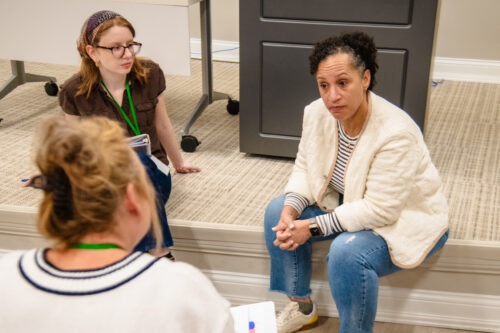
“When they’re sitting at the table with government, there’s a level of power [New Yorkers] have already claimed,” Kesi Foster shared with the audience. This is what New York City’s Office of Mass Engagement aims to do through engagement.
Foster is Director of Co-Governance at the city’s newly formed Office of Mass Engagement, he leads an office that strategizes and executes engagement reaching the masses across New York City and, as he puts it, “remain[s] accountable to the people of this city.” Foster was part of a conversation hosted by New America and the Reconstructing Democracy Project on October 22 that unpacked how the next pro-democracy administration could restore public trust through meaningful public engagement.
Alongside Foster was Kat Welbeck at the Roosevelt Institute, who is thinking about what participation might look like in the next administration through a report produced in partnership with Workshop. The conversation was moderated by Sabeel Rahman and his fellow architects at the Reconstructing Democracy Project: Sam Berger, Alexander Hertel-Fernandez, and Hollie Russon Gilman.
The conversation was introduced by findings from a new report published by the Reconstructing Democracy Project and New America, Toward Democracy: Deepening Public Participation and Engagement in Federal Policymaking. The report, built on conversations with state, local, and federal leaders, emphasizes not only why public participation is crucial for the next pro-democracy administration, but also how to create meaningful pathways for it. Ultimately, the report finds that improving participation in federal government processes requires a new federal mindset toward participation, lessons from state and local innovations, and investment in regional and local capacity.
Welbeck emphasized the importance of these takeaways, particularly a new federal mindset toward participation. “When you have leaders that see public participation [and] engagement as central to both their responsibilities as senior executives, but also that continues throughout various levels of leadership across an agency.” This illustrates that while participation builds power from the bottom up, it also needs buy-in from the top down to be executed effectively.
Even with new leaders who genuinely believe in the process and its value, there needs to be concrete evidence and examples to inform their approach, and much of that innovation is already happening at the local and state level. Foster offered an example from the city level: the Talk to Tenants program, which creates durable power through a tenant organizing campaign. This past summer, the office recruited 500 volunteers who knocked on 9,000 doors to learn about New Yorkers’ concerns in their buildings and whether they had a tenant union or tenant organizing in place. Tenants without one were invited to a series of workshops put on by the office to learn about their rights and how to build a tenant union, and were connected with resources and organizations that could help them build one.
Welbeck underscored the need for intermediaries, people who can translate the technical jargon that often clouds government processes. She has also noticed a theme in conversations with state and local leaders – listening and learning now, then delivering. As the groundwork is laid to understand what people need, the next step is translating what they hear into priorities that can be delivered immediately when a new administration takes office, so that people feel a sense of restored trust in government.
At the local level, Foster understands that robust engagement programs don’t happen overnight. While there is a tension between bringing people into shaping outcomes and having them contribute to long-term goals, he notes that when first starting out, early forms of participation might not fit neatly into the engagement process.
True participation is not a box for agencies to check. It is a process that fosters ownership and agency, giving people a real stake in their own lives, government, and communities. In New York City, that means to “build projects that help everyday New Yorkers build and claim power.” As Foster puts it, that is “a big difference in how participation feels to people.”
Senior Research Associate, Political Reform Program
Senior Fellow, Political Reform Program
Reconstructing Democracy Project
Reconstructing Democracy Project
Reconstructing Democracy Project