Dylan Pederson
Founder and Director, Landlord Mapper
This article is part of The Rooftop, a blog and multimedia series from New America’s Future of Land and Housing program. Featuring insights from experts across diverse fields, the series is a home for bold ideas to improve housing in the United States and globally.
Asserting your rights as a tenant can be an incredibly difficult task. It often involves taking your landlord to court, which requires understanding local and state laws, extensive documentation of housing condition issues and communication with management, as well as financial resources to hire an attorney. It also demands a considerable amount of time and energy, as legal battles can last months or even years. But before any of that can happen, you need to actually know who your landlord is.
The bare minimum information you need is a name and a mailing address, either the name of the individual or the company that owns your building, and an address at which you can serve a summons. Knowing who the property manager is isn’t enough; you need the name and address of the “true owner”, or the beneficial owner of that property, as they are ultimately the liable party. Without this information, it can be incredibly difficult and sometimes outright impossible for tenants to serve their landlord. A well-hidden landlord, therefore, could practically strip you of your rights as a tenant by indirectly taking away your ability to serve them a court summons.
The term “ownership obscurity” refers to the range of different strategies and legal structures used by property owners to obscure their true identities in ownership records. The most common examples in the context of rental real estate are shell companies and real estate trusts. Shell companies are generally less “obscure” than trusts; the true owner of a property is often listed as an officer on the Secretary of State record for a shell company. This is not always the case, though, as many simply list the name of the incorporator as the registered agent, which keeps the name of the true beneficial owner off the record. A real estate trust goes even further by completely concealing the true owner’s identity. And while some states allow lawsuits to be filed against the trust as a stand-in for the “true owner”, it adds an additional layer of legal complexity, making the process of holding a landlord accountable all the more convoluted.
The problems created by ownership obscurity extend beyond individual tenant-landlord litigation. It imposes technical barriers for tracking property ownership, limiting municipal and county governments’ ability to identify and regulate large landlords who systematically neglect their properties and mistreat their tenants. The result is that large gaps in the data persist, especially when aggregating code violations and evictions at the property-owner level. Without the ability to link properties to their true owners, local data departments with limited resources face a costly, time-consuming process to aggregate the data. Yet this aggregation would enable local governments to identify the “worst offenders” and crack down on systematic violations.
Ownership obscurity persists despite the incentives for local governments to collect better data on landlords. Beyond tenants rights and eviction protection, improved landlord data would help different jurisdictions with improving tax collection, disaster or emergency planning, statewide oversight into corporate owner networks, and other administrative and regulatory problems that ownership obscurity causes.
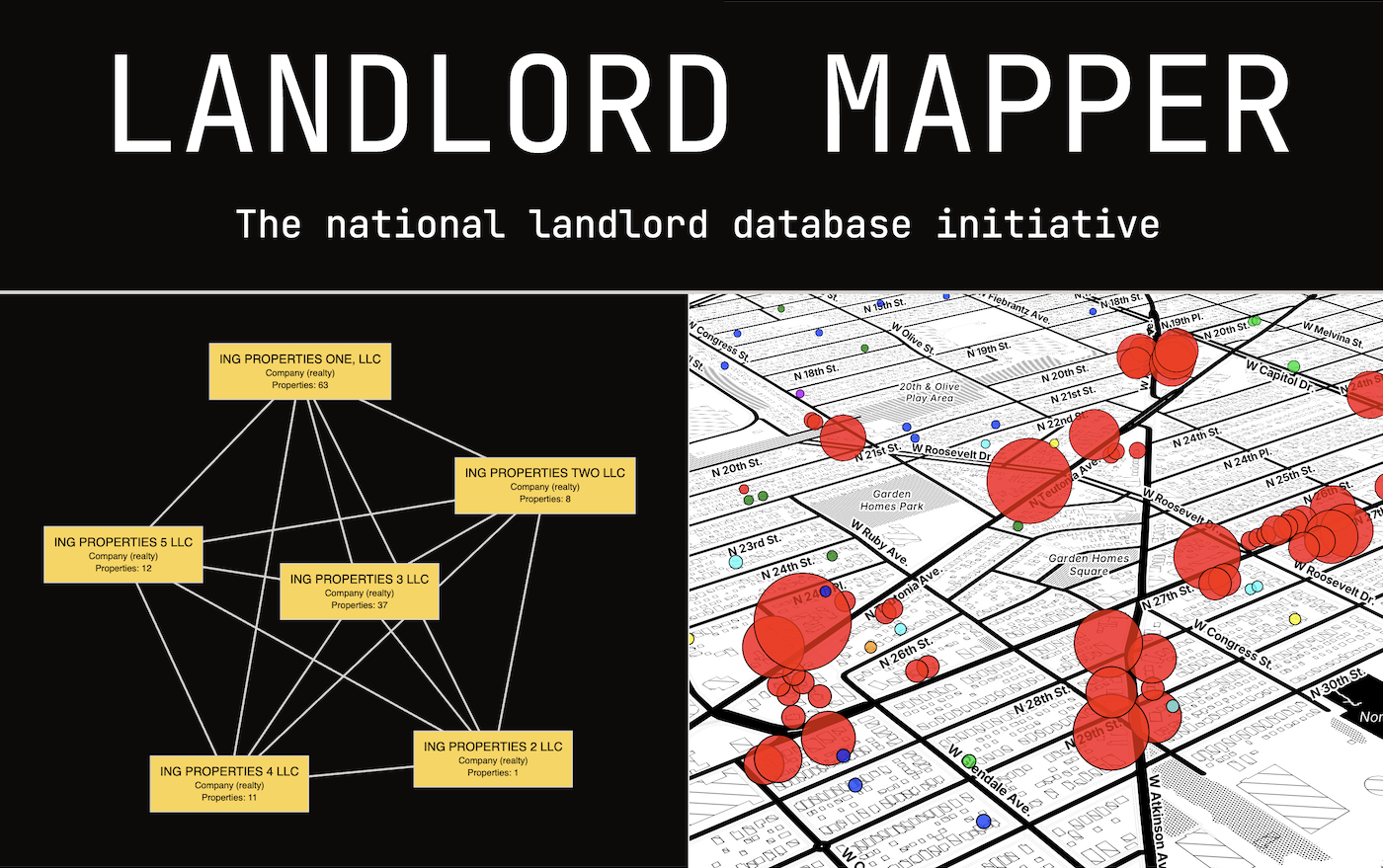
Landlord Mapper is a civic transparency tool aimed at directly addressing the problem of ownership obscurity. It works by running bulk property owner and business filings datasets through a processing pipeline that links the name and address records to create a web of associations between people, companies, and mailing addresses. The methodology for linking public records is rooted in academic research, drawing particularly on the Gomory method for entity resolution and owner network generation.
The primary output of the methodology is the “owner network”, or an interconnected web of names and addresses from the public records that link properties to their hypothesized “true owners”. It is a “hypothesis” because ultimately the methodology is only as accurate as the source data collected by county and state bodies, which can at times be inadequate. Despite these constraints, it can reveal connections in the public records that otherwise would remain invisible.
The property owner networks allow code violation and eviction data to be aggregated per-network to reveal patterns of neglect and displacement. How many open code violations does this landlord have? How severe are these violations? How many evictions has this landlord filed over the past year? Out of all evictions filed by this particular landlord, how many have been executed? These are the questions that the methodology can help answer.
The limitations of Landlord Mapper and similar methodologies are that the government bodies collecting property owner data fail to record beneficial owner information on rental properties. A major barrier to localized rental transparency is the lack of rental registry systems. Some cities, such as NYC or Minneapolis, maintain an explicit registration system for rental housing units that require landlords to submit owner information. Most American cities do not have such systems, however, due to the lack of political will within local legislatures to regulate landlords.
This lack of data leaves tenants and data scientists alike with two options: the tax assessor information, Landlord Mapper’s primary source for owner names and addresses, or recorder of deeds data, which is sometimes accessible for individual property searches but prohibitively expensive to obtain in bulk. The lack of rental registry systems combined with astronomical asking prices for bulk deed data leave few options for those attempting to uncover true ownership.
Another major transparency issue lies in the state-level business filings data. Many states, such as Tennessee or Wisconsin, simply do not collect officer information beyond a single registered agent. This allows landlords to avoid putting down their name and address on the business record by hiring law firms as incorporators, who put down the name of the incorporating attorney as the “registered agent” and the address of the law firm instead. For tenants, this means that the traditional route to identifying your landlord becomes null and void. A tenant would search their property on the county assessor’s site, find out their landlord is an LLC, search for the LLC on the secretary of state’s site, and find only an incorporating attorney’s name and address. While some jurisdictions would allow tenants to serve a court summons to the incorporator, the lack of officer data collection on the part of the secretary of state has real consequences for tenants seeking to hold their landlords accountable.
In contrast, states like New York and Minnesota collect extensive officer information, allowing multiple individuals or companies to be listed as officers for a single filing. Officers are often key to uncovering shell company ownership, and can add considerable depth to the owner networks that underlie Landlord Mapper. Even then, however, many companies can simply use their attorney’s name, another shell company, or a trust in place of an individual’s name as the ‘officer name’, thus defeating the purpose of requiring officer information in the first place.
Kestelman et al. gets around these limitations by implementing a methodology using bulk tax filings from the IRS and unique person identifier data from the Census Bureau to uncover owner networks and subsidiary chains. Their study represents a groundbreaking development in property owner network research, as the tax filings data allow them to model ownership with unprecedented precision. The problem is that this data is highly sensitive and protected, and is generally inaccessible outside of elite professional networks comprising the highest echelons of academia and government.
Despite the limitations, there are many actions that can be taken to improve rental market transparency that don’t require IRS data. State and local governments, NGOs, research institutes and philanthropic organizations all play critical roles in promoting such transparency.
State governments can implement additional disclosure requirements for incorporating business entities, such as submitting names and addresses of all officers, manager/members, and otherwise beneficial owners of the incorporated entity, or submitting subsidiary information if an entity is owned by a parent company.
Local governments can pass rental registration laws that require landlords to disclose ownership information as part of a broader registry system. The prime example is New York City’s HPD multiple dwellings registration system. It collects name and address information for a building’s owner, and if the owner is a corporation or a joint venture, it requires officer, shareholder and agent information in addition. It also collects name and address information for the property manager, in case it differs from the “true owner”. This level of granularity not only provides tenants with ample information about who their landlord is, but also generates more accurate and precise property owner networks
The nonprofit, academic and philanthropic sectors also play a key role in the push for greater rental market transparency. Universities and research institutes can wield their technical expertise and community connections to build tools and produce analyses that go beyond what local governments have the capacity for. Philanthropic grant-making can support work that bridges the gap between academic research and on-the-ground organizing, as the success and impact of housing justice campaigns often depends on access to property owner data. Together and in coordination, these different sectors can make tremendous contributions to advancing tenants’ rights and transparency in rental markets.
Editor’s note: The views expressed in the articles on The Rooftop are those of the authors alone and do not necessarily reflect the opinions or policy positions of New America.
Founder and Director, Landlord Mapper