Establishing a National Housing Data Authority
To improve housing data and build the necessary infrastructure, the United States needs a centralized coordinating institution—a National Housing Data Authority (NHDA). The NHDA must have a clear mandate to build, maintain, and strengthen the data infrastructure necessary to coordinate decision-making across the housing system. The NHDA would not replace existing data collection efforts within federal agencies, state and local governments, or other institutions, nor would it attempt to consolidate all housing data in a single repository. Instead, it would provide the connective infrastructure, institutional capacity, and sustained resources needed to make existing data more interoperable, accessible, consistent, and useful, while supporting continuous improvements in the quality and coverage of housing data.
Crucially, the NHDA must be conceived not as a one-time investment or short-term pilot, but as a durable public institution with the authority, expertise, resources, and political commitment to evolve alongside the housing system. As in other areas of national importance in the United States where fragmented data systems have constrained effective decision-making, addressing housing data challenges requires sustained institutional capacity rather than a singular technological innovation or temporary initiative.
Past Precedent for a Federal Agency
The establishment of an NHDA would follow the well-trodden practice of establishing dedicated agencies to coordinate data collection within sectors deemed crucial to the U.S. economy. Between 1862 and 1992, the United States established 13 principal statistical agencies, all housed within federal agencies, including the Bureau of Labor Statistics (BLS) within the Department of Labor, the National Center for Education Statistics (NCES) within the Department of Education, and the Bureau of Justice Statistics (BJS) within the Department of Justice.20 Each of the 13 agencies reflect a national policy priority, and recognition that sustained investment in high-quality data collection and analysis is critical to making informed decisions that shape people’s lives and communities.
Over time, these agencies have developed some of the most rigorous and trusted data collection efforts in the country, including the Census Bureau’s American Community Survey, which serves as the premier source for detailed social, economic, housing, and demographic information nationwide, and NCES’s Integrated Postsecondary Education Data System (IPEDS), which covers data from every college, university, and technical and vocational institution participating in federal student financial aid programs. And yet, no similar agency exists for housing.
While the Department of Housing and Urban Development (HUD) makes available administrative data on housing choice vouchers, the Low-Income Housing Tax Credit (LIHTC), and other HUD-administered programs (and collects survey data on housing market characteristics such as vacancy and physical housing stock21) it does not have the same statutory mandate as the principal statistical agencies. NCES, for example, is tasked with producing “accurate, timely, and nonpartisan insights on the condition of education—from early childhood to adult education—with the goal of improving student outcomes.” Its parent agency, the Institute of Education Sciences, has a mission to “provide data that describes how well the United States is educating its students.”
Structural Models for a National Housing Data Authority
The NHDA could be established as a fully federal entity, akin to the principal statistical agencies, or as a quasi-federal entity with a federated structure. Regardless of the exact structure, the common denominator is federal support and investment, without which the Agency will not be set up to produce the kinds of insights that will meaningfully impact housing outcomes.
In a federated structure, a central federal agency could coordinate the core functions of the NHDA (described in more detail below), but some of those functions could be carried out by external entities. One example is a Federal Reserve System-style model, where a central entity—in this case, the central bank of the United States—coordinates a decentralized, largely private system of banks, credit unions, and financial regulators to maintain the safety, soundness, and stability of the country’s financial system. Another model is that of the Legal Services Corporation (LSC), a congressionally established and federally funded nonprofit organization to provide civil legal assistance to low-income Americans.
The Fed and LSC are examples of a hybrid public-private structure in areas of national importance—monetary policy and civil legal aid—while maintaining independent governance and funding structures. Each have a data and research component as well: The Fed’s regulatory authority over banks, credit unions, and financial regulators allows it to collect and aggregate housing finance data from several public and private sources, and LSC’s Civil Court Data Initiative provides real-time access to civil data, including local eviction data for 1,250 counties and municipalities.
University partnerships may make sense for carrying out some of the core activities of an NHDA, such as advancing more complex housing research.22
The Core Functions of a National Housing Data Authority
The National Housing Data Authority should oversee three core functions:
- Increasing access to and analysis of existing national housing data through a National Housing Data Exchange (the Exchange).
- Generating high-quality, robust housing data through an innovative Housing Data Action Lab (the Lab).
- Building state and local capacity to improve and standardize data through a State and Local Housing Data Hub (the Hub).
Table 2 gives an overview of each of the NHDA’s core functions, including its core activities, and the human resources needed to establish them effectively.
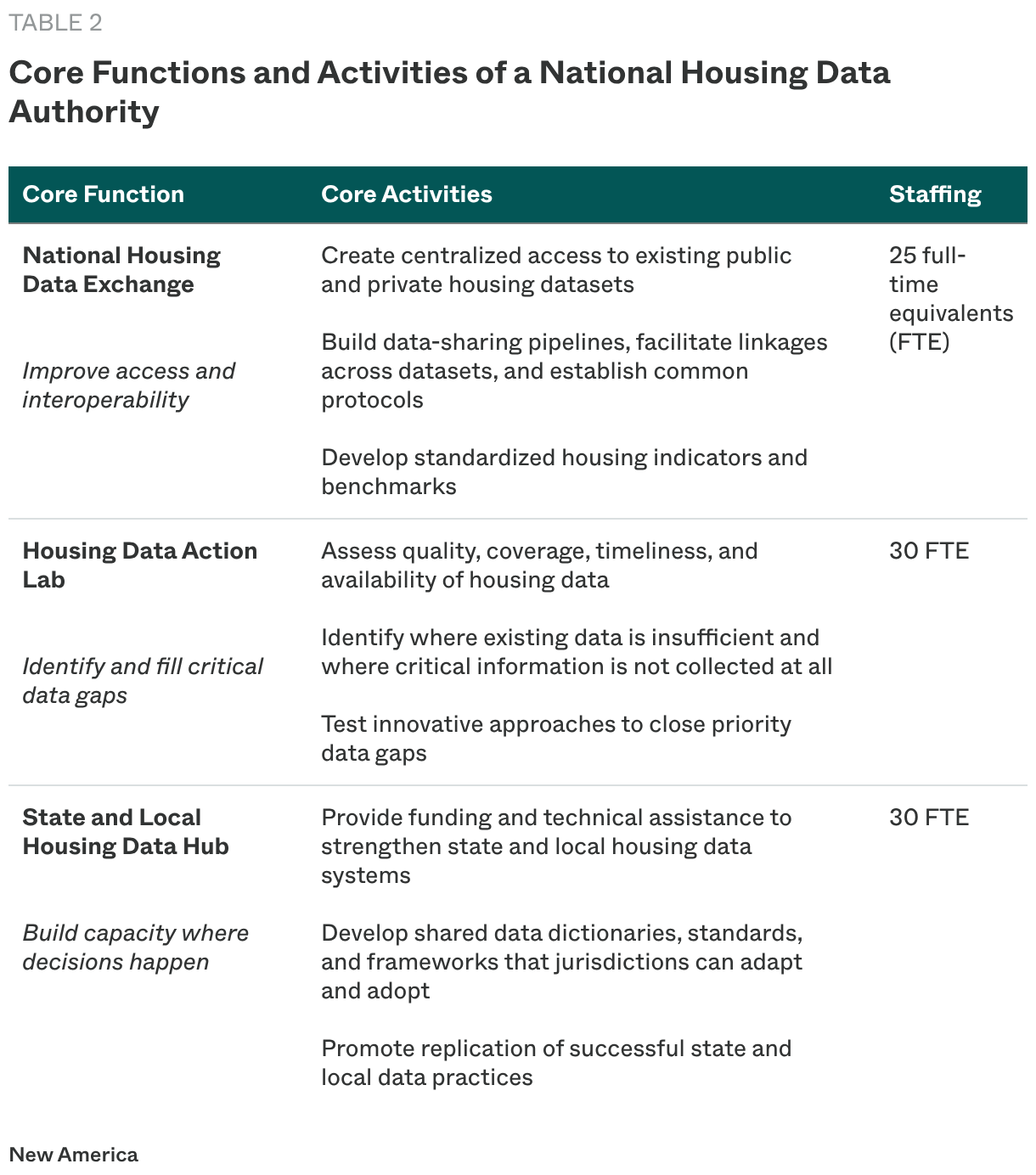
In its first year, the NHDA would require an annual budget of $75 million to $100 million. This level of funding is sufficient to bring together relevant expertise across technical, legal, governance, data, and housing areas and establish the necessary infrastructure, and aligns with investment in other federal statistical agencies.23 This budget should also include funding for meaningful grants and incentives to states, localities, and researchers for data improvement efforts.
While the federal government need not be the sole source of funding, federal resources and engagement will be critical to enabling the NHDA’s cross-sector coordination and driving meaningful improvements in housing data. Key enabling conditions include a clear federal mandate that establishes institutional authority and clarifies governance structures and decision-making processes; sustainable funding, ideally through annual federal appropriations complemented by other public and private sources; a flexible implementation and incentive funding budget to support adoption and innovation; and broad buy-in and trust among federal, state, and local governments, academic institutions, nonprofits, private-sector actors, and the general public.
Below we discuss each core function in more detail, including the key challenge it addresses, the proposed solution (or core function), and its core activities.
The Exchange: Improving Housing Data Access and Analysis
Challenge: The United States has robust housing data on many of the domains discussed in the previous section, but access to this data is varied and often requires specialized knowledge, technical skills, time, and resources—for example, negotiating data-sharing agreements or purchasing proprietary data from private vendors. This not only creates unequal access, but prevents the housing data that is collected from being effectively used for better policymaking, advocacy, and research.
Solution: A National Housing Data Exchange would develop pipelines to public and private national housing datasets that already exist. This entity would not centralize data in a single repository but rather provide a centralized point of access to disparate housing datasets, creating linkages, shared frameworks, and common benchmarks and indicators that speak to the condition of housing in the United States. Staff would help housing actors access and navigate the data.
Core Activities of the Exchange:
- Create pipelines to existing public and private national housing and real estate datasets to improve access and use, including by facilitating access to proprietary or cost-prohibitive housing datasets through negotiated agreements with commercial data owners and proprietary government databases.
- Develop data linkages across sources and household- or address-level data, enabling integration with other data sources and researchers to tie housing outcomes to data on criminal justice, education, employment, and other areas.
- Establish shared governance frameworks and protocols for data use and accountability, including standardized metadata, and processes for requesting access to proprietary data sources.
- Develop housing data benchmarks, research, and analysis, using existing datasets at the national, regional, state, and local levels (where possible). This includes, for example, standardized production and preservation targets broken out by place, specifying the number of market-rate and subsidized units that must be created or preserved at varying levels of affordability, and developing new metrics to assess renter instability.
- Provide research funding to advance housing knowledge, especially for complex, controlled, multi-method research that integrates public and private data and paints a more comprehensive picture of housing outcomes over time.
The Lab: Innovating to Improve Housing Data
Challenge: Our current data infrastructure is not equipped to capture housing as a dynamic system that evolves over time. Critical data are often incomplete, inconsistent, outdated, or unevenly available across geographies and markets, and in some cases, essential information is not collected at all. A robust housing data system must therefore do more than organize existing information: It requires a sustained process for identifying data gaps, improving data quality and coverage, and developing new sources of information as housing markets, policies, and needs evolve.
Solution: A Housing Data Action Lab would assess critical gaps in our housing data system through a “data discovery” process, prioritizing critical and urgent gaps in our housing data. The Lab would also develop viable pathways for addressing these gaps through action plans, and work with relevant public and private entities to advance those action plans.
Core Activities of the Lab:
- Carry out housing data discovery processes. Conducting a comprehensive “data discovery” involves mapping existing data sources, identifying missing or low-quality data, and assessing feasible pathways for improving collection and access. To do so, data discoveries would convene practitioners, researchers, statisticians, and other groups impacted to weigh in on key questions, including:
- What data currently exists to address key questions within a housing domain, and what can this data actually tell us?
- What are the characteristics of the sources of these data, and how do they align with the criteria for robust data (timely, comprehensive, privacy-protecting, etc.)?
- Which entities are responsible for collecting, maintaining, and governing this data?
- Where are shared definitions, standards, and taxonomies needed to support consistency across jurisdictions and datasets?
- Develop and carry out improvement action plans. Data improvement action plans include the different pathways for improving the collection and access to each specified data type along with the trade-offs involved. An action plan should identify concrete ways to improve data through pilots, legislation or executive action, or expanding the scope of existing collection efforts. The section below illustrates a range of strategies for improving and generating high-quality housing data.
Illustrative Data Improvement Action Plan Strategies
Strategies for improving or preserving existing data access or quality:
- Modify or expand federal survey sample size, geographic granularity, or scope, or dedicate additional resources for more frequent data collection using congressional authority (e.g., the American Housing Survey or Household Pulse Survey).
- Provide dedicated resources and technical assistance to state and local entities for standardizing administrative data within and across jurisdictions.
- Increase the timeliness with which data collectors (in particular federal agencies) make data publicly available.
- Increase data fidelity by tying compliance to reporting standards, or strengthen reporting guidance and administrative requirements (e.g., local client-level data through HUD’s Homeless Management Information System).
Strategies for generating new data collection:
- Pilot state and local housing data collection models, paired with funding and technical assistance, such as rental registries.
- Combine administrative data with survey data to create new housing-related datasets (as the FHFA has done with its National Survey of Mortgage Originations, which combines mortgage administrative data with borrower surveys).
- Draft legislation requiring new housing data collection efforts (like the Home Mortgage Disclosure Act)24 or a national housing register where each housing unit can be linked to other systems and tracked across time, creating a comprehensive view of housing as a dynamic system.
Action plans would specify the relevant actors, the funding or technical assistance needed, and the pathway for implementation. Implementation of these action plans can take several forms depending on the relevant actor, including providing funding for technical assistance and incentives, developing a pilot program that can be scaled, or through recommendations to federal agencies, including HUD, the Federal Housing Finance Agency (FHFA), and the Census Bureau. In some cases, components of the action plan can be carried out by the NHDA (e.g., if grant funding or incentives were involved to pilot the use of a new data collection method or tool).
Crucially, data discoveries should seek to fill gaps in ways that are responsive to local use cases and grounded in the practical realities of data collection by practitioners. Otherwise, data discoveries and action plans will, at best, create efficiencies around insights that are not useful and, at worst, make inaccurate or incomplete information accessible at scale.
- Enforce action plans. The NHDA could take a graduated approach to enforcing action plan implementation, from developing guidance and common protocols to conditioning federal funding on data compliance, in partnership with HUD or other federal agencies. Depending on the institutional authority of the NHDA and relevant actors (e.g., federal agencies, financial institutions, public housing authorities, etc.), enforcement could take several different forms, including:
- Required agency response plans and progress reporting.
- Public scorecards and designations of compliance or noncompliance.
- Conditions on federal funding or program participation.
- Binding data and reporting standards.
- Referral to relevant oversight or regulatory bodies in cases of persistent noncompliance.
The NHDA could also use incentives—including technical assistance, competitive grant programs, and additional funding—to encourage implementation. This graduated approach would allow the NHDA to tailor its enforcement mechanisms to the authority it has over a particular actor while ensuring that action plans translate to measurable progress as opposed to simply recommendations or guidance.
The Hub: Improving State and Local Data Capacity and Coordination
Challenge: Most housing programs and policies are carried out at the state and local level by an ecosystem of service providers, nonprofit organizations, and housing data intermediaries. This means that much of the most useful housing data is generated at the state and local level, often via administrative processes.25 State and local housing data commonly lacks standardization and requires piecing together information across multiple sources. But because there are scant resources and capacity to do this work, the data most necessary to obtain a complete picture of housing stability, affordability, and supply—local data that is geographically granular, detailed, and useful for informing policy, program, and intervention strategies—varies across and even within geographies.
Solution: A State and Local Housing Data Hub would have the mandate, expertise, capacity, and funding to invest specifically in improving state and local data. This Hub would provide funding and technical assistance to city, county, and state entities that maintain and improve housing data, and would develop data playbooks, dictionaries, taxonomies, and frameworks for stewarding state and local housing data.
Core Activities of the Hub:
- Provide funding, technical assistance, and capacity-building support for state and local housing data needs. This could include funding and technical assistance for modernizing legacy and paper-based data systems, helping jurisdictions design data collection processes around specific policy use cases and interventions, and providing technical assistance for standing up innovative methods (e.g., creating rental registries or documenting state-level land record documentation as in Iowa).
- Develop shared taxonomies, standards, and data documentation (or metadata). Establish or support the development of frameworks for cross-jurisdictional cataloging of data and data use that individual data-generating entities may not be able to facilitate.
- Fund state and local housing data improvement and implementation. Provide grants and funding opportunities for housing data pilots, projects, and local innovation, including supporting data standardization efforts across multiple geographies.
- Elevate state and local data best practices and tools for replication. This includes creating implementation playbooks and templates to help other jurisdictions replicate successful approaches to housing data collection and analysis,26 including guides for the types of questions that can be asked and answered with specific kinds of data.27
- Create incentives for better housing data, including, for example, grants tied to adoption of developed data standards or for jurisdictions that meet data quality benchmarks; funding for places that participate in multi-jurisdiction or state data initiatives; and matching grants that reward local investment in data infrastructure.
Case Studies: Building State and Local Capacity for Housing Data Use
EDRN and Tolemi are two examples of private-sector data efforts that are working to fill major gaps in state and local data capacity and infrastructure. But these efforts are not evenly applied across the United States, nor can they be. Rural areas and small cities that still use paper forms to collect and store data are not in a position to make use of these efforts, and not every jurisdiction has the political willingness or legal authority to pursue them either. Without a dedicated national authority that has the mandate, capacity, and funding to improve state and local data collection and analysis, the impact of these initiatives will remain ad hoc.
The Eviction Data Response Network (EDRN) is a New America-led initiative to help 11 states build the data infrastructure necessary to reduce evictions. EDRN provides state partners tailored technical assistance and funding to build centralized, comprehensive, and high-quality eviction data infrastructure to strengthen eviction prevention and housing stability policies, design effective legal aid and landlord intervention strategies, and sustainably track displacement and instability as a result of eviction over time. New America is providing this assistance in response to an overwhelming need: Over 30 states applied to EDRN.
Building a robust eviction data infrastructure is a huge undertaking—and not just a technical one. One of the biggest barriers to data access is assembling and building relationships with the entities that control that access. In the case of eviction data, this includes the county court system that generates the data, the sheriff’s office that carries out evictions, and a host of legal aid and service provider organizations that directly intervene to prevent evictions. EDRN increases the human resource capacity to assemble a multi-sector team around a shared goal of data improvement.
Beyond access to data, EDRN supports partners in improving data quality. Due to a combination of human entry errors and a lack of standard definitions and documentation, court eviction records are rife with inaccurate and incomplete information, requiring manual verification, data cleaning, and specialized legal knowledge. EDRN provides peer-to-peer learning and technical expertise to help state and local partners collect comprehensive data from courts, apply common data standards, and leverage it for eviction prevention strategies.
Tolemi, a civic tech company founded in 2017, helps cities integrate local housing and property data systems into a single dataset through a software-as-a-service model. Tolemi primarily works with midsize cities, ranging from 10,000 to 1 million residents, and have digitized data and IT staffing but may lack the resources and technical capacity to undertake this effort on their own.28 Their custom, user-facing product BuildingBlocks sits atop Swarm, a spatial extract, transform, and load (ETL) tool that is able to work with and pull data from the vast majority of local government data systems. BuildingBlocks and Swarm are designed to address the exact challenge that cities face: They are flexible enough to collect and integrate messy data from antiquated, unreliable, and fragile systems—something that many cities do manually, if at all.
Tolemi pulls records from disparate local systems, including property assessments, code enforcement, construction permits, utility billing, police and fire calls, and civil court records—and integrates them into an easy-to-use database. But the fact that Tolemi has seemingly cracked this code and replicated it across hundreds of cities marks what a complicated undertaking it is to begin with. Take, for example, a city that is interested in standing up more robust oversight of rental housing. Tolemi starts by identifying the core datasets—in this case, baseline parcel assessment, code violations, permitting, beneficial ownership data, among others—and creates a complete data inventory, including the data owners and access status. Tolemi and the city then work to define key concepts (e.g., What constitutes a nuisance property?) to figure out how to best triangulate data sources (e.g., Who is paying the utility bills, and who is the property owner?).
Tolemi then works with database administrators to get the data into the system, whether through more sophisticated infrastructure like data lakes (which store large volumes of data from many different sources) or sifting through data dumps. Once all the available data is in Tolemi’s staging area, data engineers can run transformations of the raw data into a data standard, allowing for pre-packaged insights and analysis. This process allows Tolemi to create tools that help leaders address local housing challenges, from tackling foreclosures and vacancy in Scranton, Pennsylvania, to developing a rental registration system in Monterey, California.

Citations
- National Academies of Sciences, Engineering, and Medicine et al., Principles and Practices for a Federal Statistical Agency: Sixth Edition (National Academies Press, 2017), 171–95, https://www.ncbi.nlm.nih.gov/books/NBK447392/.
- Yonah Freemark and Amanda Hermans, How Does the Federal Government Support Housing? (Urban Institute, October 2025), https://www.urban.org/research/publication/how-does-federal-government-support-housing#catalog.
- For example, the University of Michigan’s Inter-university Consortium for Political and Social Research (ICPSR) is one of the largest social science data repositories in the country, collaborating across public and private sectors to archive and fund data. While tiered access may be necessary to protect privacy and ensure ethical data use, limiting access with costs or by user status may be difficult for small to medium jurisdictions, nonprofits, advocacy groups, and other users to overcome, and is unlikely to meet the needs of increased and more real-time data access geared toward policy and practice—a core function of the NHDA.
- See budgets of other federal data and research agencies of various sizes: “Federal Statistical System,” American Economic Association, https://www.aeaweb.org/about-aea/committees/economic-statistics/agencies; “2026 Midyear Update: Resources and Leadership Supporting Federal Statistics,” American Statistical Association, https://www.amstat.org/docs/default-source/amstat-documents/FedStatHealth_MidYearUpdate.pdf.
- Legislation has historically been a key driver in increasing the transparency of housing market data, with a particular focus on consumer protection. For example, the Home Mortgage Disclosure Act (HMDA), enacted in 1975, requires financial institutions to maintain, report, and publicly disclose loan-level information about mortgages. In 2010, the Dodd-Frank Wall Street Reform and Consumer Protection Act created the Consumer Financial Protection Bureau (CFPB), a critical body for housing finance oversight and transparency. The CFPB further enforces and centrally collects HMDA data. In 2022, the Financial Data Transparency Act was enacted, requiring joint data collection standards among all federal financial regulatory agencies to ensure information is uniform, machine-readable, and nonproprietary.
- “Unlocking the Power of Local Housing Data,” Housing Solutions Lab, NYU Furman Center, July 6, 2023, https://www.housingsolutionslab.org/build-a-strategy-resource/analyze/local-data-for-housing/.
- A HUD report on housing loss and housing stability data notes that “the development of clear, practical guidance that aims to standardize practices across jurisdictions is a pivotal role that the federal government could play in supporting local housing data collection.”
- For example, see Sabiha Zainulbhai and Helen Bonnyman, Understanding Evictions: A Guide to Using Local Court Data (New America, 2024), https://www.newamerica.org/insights/understanding-evictions-a-guide-to-using-local-court-data/.
- Andrew Kieve (Co-Founder, Tolemi), in conversation with the author, August 12, 2026.