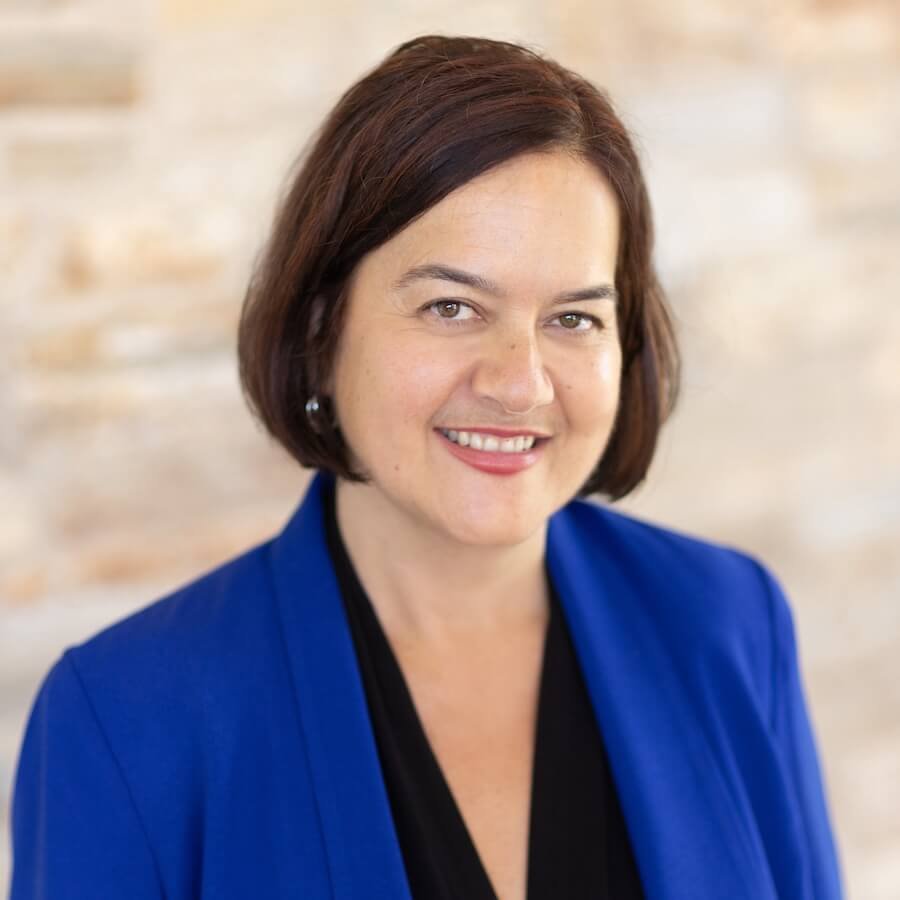
Marielena Hincapié
New America (ASU Future Security) Fellow, 2026
New America’s Fellows Program offers thinkers and creators the space and community to carry out ambitious projects that embody their bold ideas and spark meaningful conversations. For Marielena Hincapié, a 2026 New America (ASU Future Security) Fellow, this meant stepping back from her on-the-ground work as an immigrant justice leader, strategist, and democracy advocate to focus on telling a more personal story about immigration—her own family’s.
Hincapié, who was recently appointed president of the Robert & Ethel Kennedy Human Rights Center, shared the challenges of writing about family and memory and the lessons she hopes readers take from her forthcoming book, Becoming America: A Personal History of a Nation’s Immigration Wars.
Editor’s note: This interview has been lightly edited for brevity and clarity.
Your forthcoming book, Becoming America: A Personal History of a Nation’s Immigration Wars, tells the story of American immigration through a single family—your own. Why does this history need a family to tell it?
Immigration is among the most polarizing issues of our times. Even first- or second-generation immigrants in America, including my family members, are generally empathetic and compassionate but feel overwhelmed by the complexity of the issues. But we all understand family. I narrate the U.S. immigration system’s embraces and rejections of my family to take an intimate look at the forces that brought them to America from across the world. Through weddings, funerals, divorces, graduations, quinceañeras, incarcerations, and reunions, I tell the story of our nation’s immigration policies as an unfolding family drama. By following one family across generations, readers can see that immigration is one of the ways America has continually defined who counts, who belongs, and, ultimately, who we are.
You’re the youngest of ten children, and the book turns your siblings and in-laws into characters. How do you think about what you owe them?
This is one of the questions I’ve wrestled with most. These are not simply characters; they are complex people I love. I owe them honesty, dignity, and the chance to recognize themselves in the pages, even when our memories differ. I also owe them compassion. The book is about ordinary people navigating extraordinary systems while carrying their own dreams, fears, mistakes, and contradictions. Mostly, I owe them accuracy without exposure. That has required the discipline to render them fully human without flattening them into symbols. No book can contain the fullness of a family. Because not everyone’s story belongs in these pages, I’m also committed to preserving those untold stories through an oral history project for future generations of our family.
With legal writing, which you did for 22 years at the National Immigration Law Center, there’s a strong focus on the objective facts, as you’re presenting an argument to win a case or persuade an audience. In contrast, autobiographical writing asks you to reveal yourself and wrestle with deeper emotions. How did you make that tonal shift?
The journey has meant allowing the storyteller in me to take the lead over the lawyer and advocate. The hardest part has been unlearning the instinct to build an argument or a case. Early drafts read like policy and legal briefs. The book asks me to tell the truth, even when it complicates the argument. I have been learning to sit with uncertainty, memory, grief, and love without immediately trying to resolve them. The lawyer in me still cares deeply about accuracy. I’ve learned to explore what those facts meant to the people who lived them—and why they matter, not just to my family, but to the country.
The country marked its 250th birthday this year. You’ve called this anniversary a rare moment of national reflection. What should the country be reflecting on that it isn’t?
Every immigration law in our history has drawn a line between who belongs and who doesn’t. Lines that have moved constantly, based on who was in power and what the country feared that decade. At 250, I want us reflecting less on immigration as a policy problem to be solved and more on it as a democratic mirror. It shows us, more clearly than almost anything else, what citizenship means, who we think has earned it, and how often we’ve been willing to change the rules mid-game. If we reflected more deeply on those moments—not to assign blame, but to learn—we might discover that the story of immigration has always been the story of American democracy. Our future depends on deciding who we aspire to become together.
You’ve said you want readers to see themselves in your family and trace their own immigration stories. What do you hope will happen if Americans actually do that?
My hope is that readers close the book not simply understanding my family better but becoming curious about their own. Almost every family has a migration story, whether that’s across a national border or across states or towns, and whether the move was by free choice, force, or displacement. Democracy depends on our ability to see ourselves in one another’s stories, and family history is one place that work can begin. I hope more people find out their family’s story is stranger, more contingent, and less inevitable than they assumed. Our individual family stories are deeply particular, yet they are also one of the strongest bridges to a shared identity. Ultimately, I hope those stories expand our sense of “us.”
As you reflect on your fellowship year, what did being a New America Fellow mean to you and your work?
Joining a community of supportive Fellows whose work challenged and expanded my own thinking was invaluable. After decades leading an organization and responding to the urgency of each day’s immigration battles, I had space to step back and ask bigger questions about history, democracy, and belonging. Being in community with people invested in each other, working across genres and disciplines—all wrestling with their own versions of “How do I tell this true thing?” problems—gave me permission to be uncertain on the page and to take risks in sharing early drafts. That combination of time, intellectual generosity, and genuine curiosity is allowing me to write a book that reaches beyond immigration policy to ask what kind of country we want to become.
New America (ASU Future Security) Fellow, 2026