Jeremy Bauer-Wolf
Investigations Manager, Higher Education
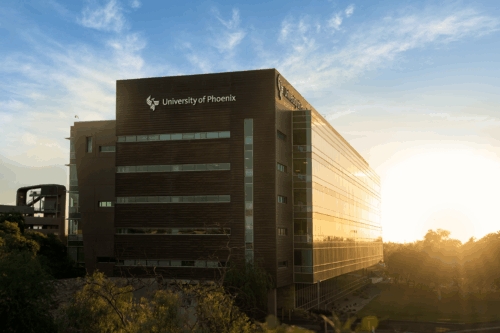
The University of Phoenix, one of the most notoriously predatory for-profit colleges in U.S. history, will pay up to $8.75 million to settle a class-action lawsuit accusing it of sharing students’ personal information with tech companies, including Meta, without permission.
This settlement, which requires formal court approval, comes after the University of Phoenix has spent years trying to shed its reputation as a shoddy for-profit alleged to have deceived thousands of students about their job prospects and debt loads.
It should serve as a warning to students that the University of Phoenix may not have truly reckoned with those abuses—and to colleges that may be interested in working with it. Any institution should be wary of lending its credibility through transfer agreements, for instance, or other partnerships.
The University of Phoenix has denied all wrongdoing in the case, which stems from a federal lawsuit one of its students filed last year.
The school allegedly inserted code on its website, unbeknownst to students, that tracked their activities, including academic work, and forwarded that information to Meta, which owns Facebook, and other tech behemoths.
Janielle Dawson, who enrolled at the university a decade ago and who brought the lawsuit, alleged that this violated state and federal statutes and enabled social media companies to leverage the student data for their own purposes, including shaping advertisements.
“Facebook benefits from the information it collects from its clients’ websites … because Facebook uses this information to improve its advertising network, including its machine-learning algorithms and its ability to target users with ads,” the lawsuit states.
Use of the code, called Meta Pixel, is common—one analysis of more than 3,400 U.S. websites found that nearly half used Pixel. That ubiquity has fueled lawsuits concerning the tool, including one against the Education Department in 2024. The department had used Pixel to gather the information of students who completed the Free Application for Federal Student Aid, or FAFSA.
However, the University of Phoenix is not an ordinary case. It allegedly built its business practices on aggressive advertising—handing student data to one of the world’s largest ad platforms would simply fit its pattern.
The settlement emerged after Dawson began mediating with the University of Phoenix in June, according to court filings.
Dawson dropped the federal lawsuit in July, and a state court in Illinois took over the case. While the University of Phoenix’s primary campus is based in Arizona, the lawsuit had argued the data disclosure violated a state law, the Illinois Eavesdropping Act.
The settlement likely won’t affect the University of Phoenix’s operations or finances, the school has said in U.S. Securities and Exchange Commission documents. Its parent company became publicly traded last year.
“It is reasonably possible that the ultimate resolution of this matter could result in a loss in excess of the amount accrued,” the University of Phoenix wrote in SEC filings. “However, based on information available to us at present, we do not believe that any such additional loss would be material to our consolidated financial position.”
The University of Phoenix enjoyed explosive growth for decades. It became one of the most visible for-profit schools in the country, enrolling nearly half a million students at its peak in 2010.
However, government scrutiny, lawsuits, and other scandals surrounding the school drove down its student numbers.
In 2019, the Federal Trade Commission reached a mammoth $191 million settlement with the school after suing it for allegedly drafting deceptive advertisements featuring well-known employers like Adobe and Microsoft that led students to believe the University of Phoenix had worked with those companies. The FTC had argued those ads targeted vulnerable populations, including veterans and Hispanic students.
And in 2023, based on the FTC case, the U.S. Department of Education moved to cancel tens of millions of dollars in student loans to University of Phoenix students. At the time, the department said it would try to recoup some of those costs from the institution.
The University of Phoenix has since attempted to rehabilitate its reputation, including by striking a deal with the University of Idaho to buy the school.
The University of Idaho intended to convert the school to a nonprofit, which it would then use as an online platform. However, the arrangement fell apart in 2025, in part over concerns the school still lacked in quality—at the time, its largest online unit only had a 14% graduation rate. Idaho higher education officials and lawmakers also expressed fears about being on the hook for the school’s liabilities. About two years before that, the University of Arkansas system governing board rejected a similar purchase proposal over worries regarding the for-profit school’s reputation.
The University of Phoenix still deserves skepticism—from prospective students and its investors. The company claims this settlement won’t be material, but it’s the latest in a string of legal and regulatory costs. Anyone attending the school, or buying shares today, should weigh those risks seriously.
For the settlement, students enrolled at the University of Phoenix between April 2023 and October 2026 can claim $25 each if a state court approves the settlement Nov. 20. For Illinois students, the window extends back to April 2020. Students must file claims by Nov. 5.
Investigations Manager, Higher Education