
Braden Goetz
Senior Policy Advisor, Center on Education & Labor
Our waning commitment to youth who aren’t working or in school

Youth workforce development today is a lot like the television show The Pitt: endless emergency room-style triage as the needs of young people continually collide with a chronically underfunded system. It’s exhausting and heartbreaking.
Fifteen years ago, there were few more urgent priorities in workforce development policy than reengaging youth who were neither working nor enrolled in school. In 2010, the National Center for Children in Poverty profiled these young people, describing them as “disconnected youth,” and emphasized that they face devastating consequences if they are not reengaged. The Obama administration called these young people “opportunity youth” for their untapped potential, and published research estimating their number and calculating the economic fallout if we ignored their disconnection. Measure of America mapped opportunity youth by metropolitan area. The Annie E. Casey Foundation, Civic Enterprises, the National League of Cities, and the Center on Law and Social Policy, among others, published reports on the imperative of addressing their needs.
In 2014, Congress acted. In the Workforce Innovation and Opportunity Act (WIOA), it increased from 30 to 75 percent the share of federal youth employment dollars that states and local areas must spend on low-income youth ages 16 to 24 who were not enrolled in school, described by the law as “out-of-school youth” (OSY). Opportunity youth moved from the periphery to the center of the youth workforce development program, which is currently funded at $948 million.
Advocates had argued that centering the program on reengagement was critical because it was the only federal funding stream available for this purpose. They acknowledged that in-school youth (ISY) with economic and other disadvantages also had compelling needs, but emphasized that other funding streams could address them. For example, funded at $18.4 billion, Title I, Part A of the Elementary and Secondary Education Act provides funding to schools to improve the academic achievement and on-time graduation of students from low-income families, while the $14.2 billion Individuals with Disabilities Education Act program supports states and school districts in helping students with disabilities succeed academically and prepare for further learning, employment, and independent living. The $1.4 billion Carl D. Perkins Career and Technical Education Act supports career and technical education in high schools.
Fast forward to today, and our commitment to these young people has waned.
WIOA gives the Department of Labor (DOL) authority to waive provisions of the law and its regulations. In 2018, the first Trump administration encouraged states to seek waivers. It highlighted reducing the OSY spending mandate as an option, a significant policy change because DOL had not used the waiver authority in this way previously. (Instead, the Obama administration had used temporary transition authority to permit states to spend 50 percent of their youth dollars on OSY for the first year of WIOA implementation only). DOL’s authority to grant such waivers is dubious. WIOA and its regulations bar waivers of “requirements relating to the basic purposes of title I” of the law. And what’s the number one purpose? “Increasing access to, and opportunities for individuals to receive, the employment, education, training, and support services necessary to succeed in the labor market, with a particular focus on those individuals with disabilities or other barriers to employment including out-of-school youth.”
The Trump Administration plowed ahead, giving 21 states waivers to reduce their OSY spending from 75 to 50 percent by the end of the first term. While the Biden administration did not promote OSY spending waivers, it approved them when requested. And now the second Trump administration has come roaring back with a push for even more expansive waivers.
Information on DOL’s website and some state websites indicates that DOL has approved requests from at least 26 states allowing them to reduce OSY spending to 50 percent. OSY will still be served in these states, but they are no longer the program’s chief focus. What’s new this year—and startling—is that DOL also approved a request from one more state, Tennessee, for a waiver that eliminates the OSY spending mandate altogether. Local workforce boards in that state need not serve any OSY over the next two years.
Based on data from Measure of America’s 2024 report, Broad Recovery, Persistent Inequity: Youth Disconnection in America, about 63 percent of opportunity youth live in states with these waivers. That’s 2.7 million young people. According to those data, three of the five states with the highest youth disconnection rates in the nation (Mississippi, Nevada, and New Mexico) are among those with an OSY spending waiver (See Figure 1).
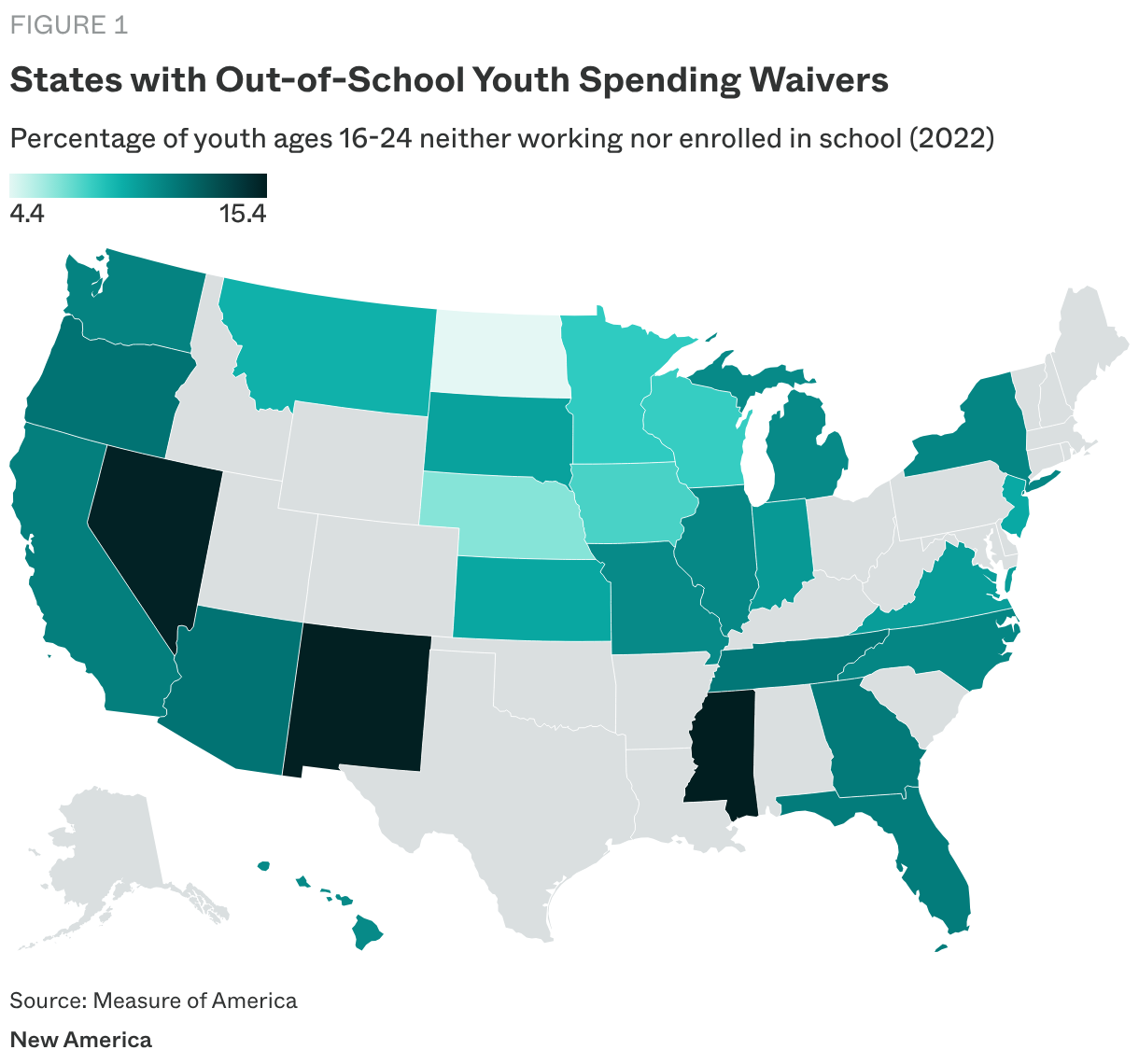
DOL published some state waiver requests along with the waiver approval letters, and we can glean from them some insights into what’s behind the state requests.
A few argued that local workforce boards struggled to recruit enough OSY to fulfill the mandate. However, those boards may not be looking in the right places. In almost every state that has an OSY waiver, there were more OSY enrolled in the federal adult education program in 2024-25 than the combined total of OSY and ISY enrolled in the state’s WIOA youth program. In some states, there were three to four times as many OSY in adult education as participants in the WIOA youth program. Local boards could probably meet their OSY spending targets if they co-enrolled the adult education OSY in the youth program. (Co-enrollment is uncommon: Last year, just 7.2 percent of adult education participants were co-enrolled in any DOL WIOA program or vocational rehabilitation).
Co-enrollment would also help adult education OSY get all of the support they need. They are receiving academic instruction and preparation for a high school equivalency credential, but, unlike the WIOA youth program, support services are rare, and opportunities for work experience and occupational training are limited. Co-enrolling them in the WIOA youth program would round out their preparation for the future.
Just about every state argued that investing in ISY now will reduce the number of OSY in the future. As Georgia explained in 2024, “By implementing ISY programs, local areas are able to make connections with these youth prior to school dropout or other situations that may disconnect them from education and employment…early intervention is a key strategy to support positive personal and economic outcomes for youth.” They’re right. Prevention is critical. WIOA youth funds can make a big difference if they are invested intensively in evidence-based programs and practices. A high-quality Registered Apprenticeship, for example, can put young people with difficult lives on a path to success. But DOL has neither required that ISY spending be directed to what works nor launched an evaluation to find out if states achieve their prevention goals.
And diverting OSY funds to ISY leaves unanswered an uncomfortable question: What happens to the opportunity youth who don’t get served as a result? No new funding sources for OSY have sprung up in the interim. So what is available to support education, work experience, and training for these young people? Other federal programs like Job Corps, YouthBuild, and National Guard Youth Challenge can serve only a fraction of OSY. There’s the military, maybe—if the young person has a high school credential. But what else? The 3.3 percent of Temporary Assistance for Needy Families funding that states spend on education and training for low-income parents? The $680 million Supplemental Nutrition Assistance Program Employment and Training program? There aren’t many options.
It’s important to re-engage opportunity youth because the consequences of disconnection deepen the longer it lasts. Measure of America followed a cohort of youth ages 16 to 24 through the next 15 years of their lives. Five years later, 24 percent of those who had been disconnected had not completed high school, compared with fewer than 4 percent of those who had stayed connected. The shortfall grew with the duration of disconnection, to 29 percent among those disconnected two or more years and 37 percent among those disconnected three or more years. Earnings followed the same pattern. By their thirties, median family income was roughly $78,000 for the connected group, about $44,000 for those disconnected a year or more, and roughly $31,000 for those disconnected two years or more.
It is an outrage that, here in the richest country in the world, services for youth are so underfunded that we put states and communities in The Pitt every day.
It is an outrage that, here in the richest country in the world, services for youth are so underfunded that we put states and communities in The Pitt every day. We force communities to assess the relative “neediness” of a teenager who is living in his mother’s car but who’s stayed enrolled in school versus a peer who dropped out two years ago and can’t find a job. We ask them to pick which one should be served. These are impossible decisions. But, with most opportunity youth now living in states where their needs are no longer a top priority, we need to ask ourselves: Are we making the right choices?
Senior Policy Advisor, Center on Education & Labor