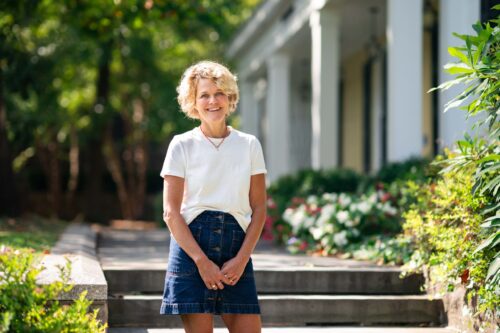
Eliza Griswold
Director, Program in Journalism, Princeton University; Pulitzer Prize–Winning Journalist; Author of The Tenth Parallel: Dispatches from the Fault Line Between Christianity and Islam; 2010 Bernard L. Schwartz Fellow, New America

New America 2010 Fellow Eliza Griswold spoke about her book Amity and Prosperity and the environmental and societal impact of the energy industry for “Three questions” in The Fifth Draft, the Fellows Program’s monthly newsletter. Griswold is a journalist and author who reports on religion, conflict, climate change, and environmental issues.
Where did you get the idea to write Amity and Prosperity, and how were you introduced to the central characters of the book?
I started thinking about how to write this book while I was in Nigeria in 2007 when I was writing my first book, The Tenth Parallel. While there, I had to get across a river where a bridge had collapsed, so I did what you would do as a journalist, and rode across it in an empty oil barrel. A few weeks before this, Interstate 35W had collapsed in Minneapolis, and I found myself thinking it was time to go back to the United States and to write about our collective poverty. I had been sitting in New America conferences for years, listening to Sherle Schwenninger talk how we don’t invest in infrastructure as Americans. When I returned to the United States, I found out that statistically, the highest number of structurally deficient bridges are in southwestern Pennsylvania. I got the idea to tell the story of a crumbling bridge so I headed out to Pittsburgh to begin reporting. While there, I met Stacey Haney, the woman at the center of what was to become Amity and Prosperity.
It turned out to be even more complicated to write about these little towns of Amity and Prosperity than writing about a line of latitude that wraps around the entire globe. That was humbling.
Your other projects stand in sharp contrast to Amity and Prosperity, so was there anything in particular that led to your transition from writing about foreign affairs and religion to domestic and environmental issues?
Two things stand out to me. First, I’ve long been interested in how environmental concerns cause conflict. When I wrote The Tenth Parallel, I posited that what’s driving the conflict between Christians and Muslims along the literal 10th parallel is climate change. With that in mind, I wanted to better understand how rural Americans have paid for the energy appetites of urban Americans. How do these quiet stories that undergird so much of what’s going on really come into play? Second, I think reporting on America is often overlooked. We don’t do it. We’ve gotten better at it now since the election of President Trump created a huge shock to the system. However, I was in what we call “Trump country” years before CNN showed up in my Hilton Garden Inn. To suddenly watch the places where I’ve been reporting from for so long become the subject of national interest was curious to me and I wanted to explore that as well.
Given that the book encompasses seven years of reporting, what was your process for completing it and how did you manage your deadlines without knowing how long it would take you to complete the book?
I never would’ve been able to do it without the Fellowship grant from New America. This kind of immersion reporting is expensive. I made about 37 trips to the region over those seven years, and I tried to keep myself accountable to a reporting schedule that took me down there for a week every couple of months. I also wouldn’t say that I managed my deadlines—I just blew deadline after deadline over a series of years. This story just took a really long time. My fantasy after writing The Tenth Parallel, a book that had taken seven years to write, and 10 thousand miles of travel over two continents, and 10 countries, was that I would be able to find a little town, be able to write about what happened there, and that that would be much easier. It turned out to be even more complicated to write about these little towns of Amity and Prosperity than writing about a line of latitude that wraps around the entire globe. That was humbling.
Subscribe here to receive next month’s issue of The Fifth Draft.
Director, Program in Journalism, Princeton University; Pulitzer Prize–Winning Journalist; Author of The Tenth Parallel: Dispatches from the Fault Line Between Christianity and Islam; 2010 Bernard L. Schwartz Fellow, New America