
Rebecca Gale
Staff Writer, Better Life Lab
The Better Life Lab's 2025–2026 reporting grants kept the need for child care solutions at the forefront of the national conversation.

Beginning with the COVID pandemic and continuing through expansive funding brought about by the American Rescue Plan, news coverage of child care in the United States has surged. With this increased attention, the stories of families, educators, children, and those affected by the child care crisis in this country gained new audiences. As part of a long-standing mission to promote high-quality journalism on work and care, the Better Life Lab offered a series of grants to reporters to tell the story of child care and its pivotal role in our economy, communities, businesses, and families. This report highlights the articles and video documentary created as a result. By supporting independent writers and content creators, the Better Life Lab continues to play a crucial role in keeping the need for child care solutions at the forefront of the national conversation.
With gratitude to the Bainum Family Foundation WeVision EarlyEd initiative for their support of the Better Life Lab’s child care reporting grants.
Editorial disclosure: The views expressed in this report are solely those of the authors and do not reflect the views of New America, its staff, fellows, funders, or board of directors.
Building on the success of our previous child care reporting grants, the Better Life Lab launched another round of reporting grants to deepen public understanding of the child care crisis and highlight communities, policymakers, educators, and innovators working toward solutions. Guided by a solutions-journalism approach, we continued to invest in rigorous reporting that documents the challenges facing families and providers as well as promising practices emerging across the country.
This reporting cycle produced 35 stories and projects across multiple formats and platforms. While most were written features, the collection also included a documentary film, an audio story, and a series of stories exploring child care from multiple angles, funded by a single reporting grant. Together, these projects demonstrated the many ways journalists can engage audiences and tell complex stories about care infrastructure.
state or local stories
national stories
international stories
Please note that one story covered two locations: Denmark and Wisconsin.
Approximately half the stories were written by two Better Life Lab members, Elliot Haspel and Rebecca Gale, with the remaining stories produced by a diverse group of reporting grantees. This cohort primarily included experienced journalists, alongside two new writers and one emerging voice, reflecting Better Life Lab’s continued commitment to supporting both established and rising storytellers who can bring nuance, expertise, and fresh perspectives to child care reporting.
The stories reached audiences through a broad range of publications. The reporting appeared in national outlets, including Vox, The Atlantic, Fast Company, The Guardian, The Purse, and BlackPressUSA, and local outlets, including the Wisconsin Examiner, The Daily Yonder, the Santa Fe New Mexican, the Las Cruces Sun-News, and KERA in Dallas. We also intentionally sought to reach audiences across the political spectrum with stories in publications such as The Dispatch, The Nation, and Jacobin, recognizing that child care affects families regardless of political affiliation. In addition, we maintained a strong presence in outlets focused on education and early childhood, including The 74, The Hechinger Report, and EdNC, ensuring that reporting reached policymakers, practitioners, and education stakeholders.
Throughout the reporting process, the Better Life Lab continued to provide editorial collaboration and strategic support to grantees, helping to strengthen reporting, connect journalists with sources, and maximize the reach and impact of each story. This reporting cycle also expanded our approach to audience engagement. In addition to published stories, each reporting grantee was encouraged to create a short video introducing their work on social media, extending the life of each project and helping them reach audiences beyond traditional news consumers. We also launched a partnership with Public News Service, which adapted one story each month as an audio news feature widely distributed to radio stations, bringing reporting on child care innovations to tens of thousands of additional listeners.
Together, these stories reinforce a central lesson of our reporting: Meaningful change is already happening. Across the country, communities are testing new ideas, expanding public investment, and developing innovative approaches to child care. By documenting both successes and challenges, these stories create a growing body of evidence that can inform future policy, inspire local action, and demonstrate what effective child care systems can look like.



















These multimedia stories explore this central question: What policy solutions or innovations are underway that could scale or help build an equitable, high-quality, affordable, accessible, and universal child care system in the United States?
Our innovation reporting grants went to over a dozen writers and visual storytellers, both experienced and novice. In one case, we contracted with a team of writers in a newsroom. We also relied on our own reporters at the Better Life Lab to tell these stories and identify trends, bright spots, and new ideas permeating the child care space.
The child care reporting of the Better Life Lab team and independent journalists serves as a wake-up call. Our current system fails to support children and families—particularly mothers—and exacerbates racial, income, and gender inequality. Perhaps more importantly, these stories offer hope for a way forward and show that communities deciding to make child care a priority can have a transformative effect. We can make tremendous gains when we invest in the people and places that support our families and care for our youngest generation.
Creating and implementing a series of reporting grants also gave us insight into how journalism and storytelling can benefit from a collaborative process. And it allowed us to provide editorial support and encouragement to reporters with varying levels of expertise in policy reporting. The lab’s narrative change strategy calls for creating and maintaining a firehose of information to challenge status quo thinking and show different ways of thinking and acting. That information includes rigorous research and data; evidence-based experiments; compelling stories; economic, demographic, political, and historical context; and policy analysis and solutions. In offering reporting grants to a cohort of independent journalists and writers and posing questions for them to dig into, the Lab is able to broaden the spectrum, diversity, and reach of that firehose.
As part of this project, the Better Life Lab offered a solutions-journalism framework to our cohort of reporters. Each reporter worked independently (with editorial support available upon request), using their journalism skills to report and write their stories.
Here are the key takeaways from our child care innovation reporting grants process:
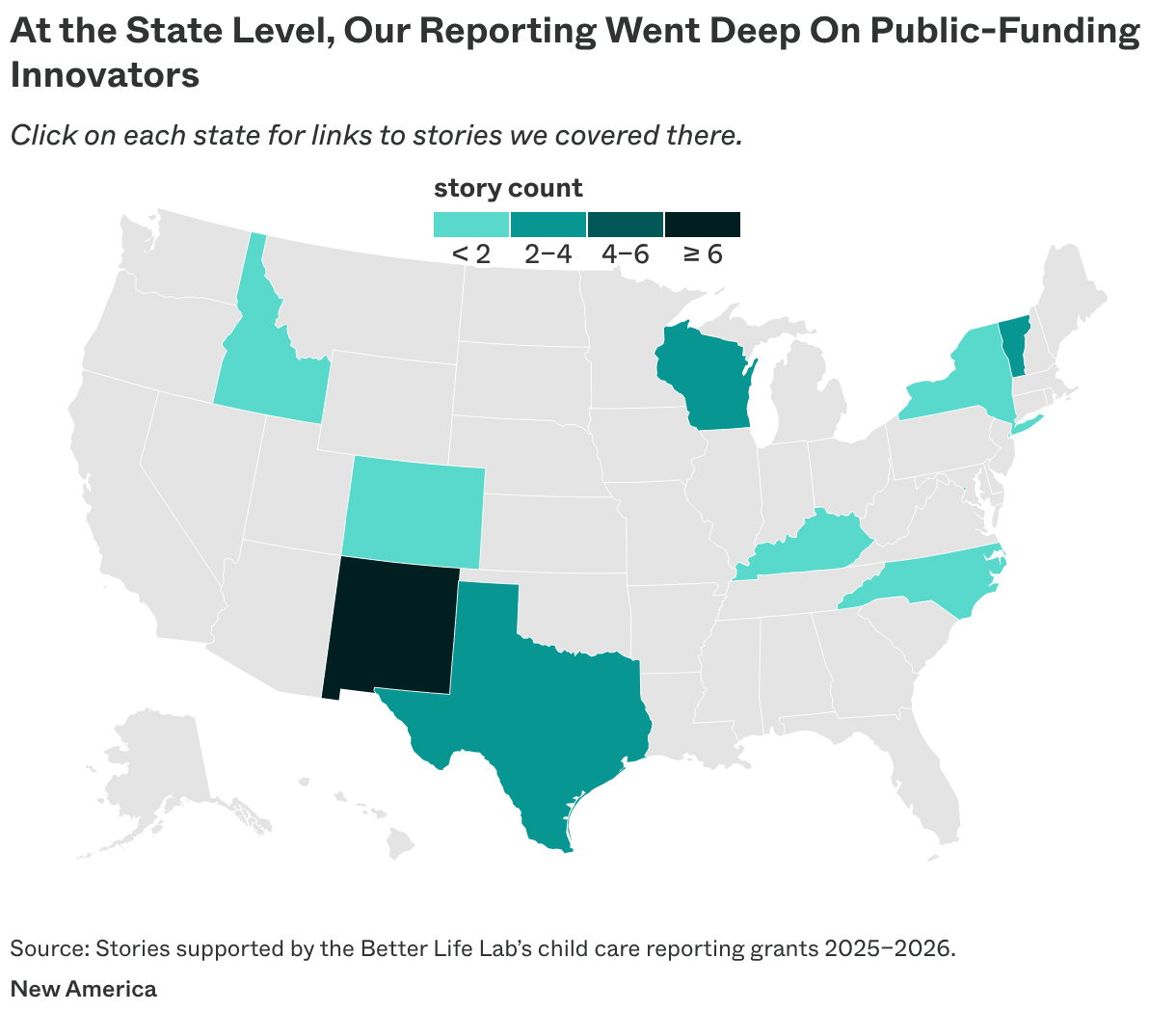
Below is a list of stories supported by Better Life Lab’s 2025–2026 reporting grants. To read the full article, click on the link before each story summary.
By Rebecca Gale, The 74
August 6, 2025
Finland is often cited as a model of family-friendly policies, but stay-at-home parents there face many of the same challenges as their counterparts in the United States. While both countries offer support for families, much of it is geared toward parents who rely on outside child care, leaving those who choose to provide care themselves with limited financial assistance and few resources tailored to their needs.
In this story, Rebecca Gale explores how families in Finland and the United States navigate these gaps and what they reveal about the assumptions embedded in family policy. As both countries grapple with declining birth rates, experts and parents argue that a stronger system would recognize and support a wider range of caregiving choices, including opting to stay home with young children.
By Rebecca Gale, The 74
August 21, 2025
While Congress expanded the Child Tax Credit in 2025, millions of children will still be unable to receive the full benefit. Families with very low incomes, children in immigrant households, and larger families are among those most likely to be left behind under the updated policy, which continues to tie eligibility to earnings.
In this story, Rebecca Gale examines who remains excluded and why advocates argue that partial reforms fail to reach the families with the greatest need. Researchers warn that if the credit is not made fully refundable, millions of children will continue to miss out on a policy widely recognized as one of the most effective tools for reducing child poverty.
By Rebecca Gale, The 74
September 15, 2025
New Mexico became the first state in the nation to guarantee free child care for all families, the culmination of years of policy changes and grassroots advocacy. The state’s approach built on the creation of a dedicated early childhood agency, a voter-approved constitutional amendment, and a permanent funding stream supported by oil and gas revenues.
In this roundup, Rebecca Gale traces the milestones that transformed New Mexico into a national leader in early childhood policy. The story highlights how sustained investments in providers, educators, and access have expanded opportunities for families and created a model that other states are beginning to study as they consider their own child care reforms.
By Elliot Haspel, The Atlantic
October 28, 2025
New Mexico’s promise to provide free child care to all families has made it a national leader in early childhood policy, but turning that promise into reality presents significant challenges. While the state has dramatically expanded access in recent years, many families who qualify for assistance still struggle to find available slots, particularly in rural areas, and providers continue to face workforce shortages and capacity constraints.
In this story, Elliot Haspel explores the opportunities and risks associated with New Mexico’s ambitious approach. State leaders are investing in educator recruitment, home-based care, and new facilities, but questions remain about long-term funding and whether the supply of care can keep pace with demand. The article argues that the success or failure of New Mexico’s experiment could shape how policymakers across the country think about universal child care for years to come.
By Elliot Haspel, The Guardian
November 1, 2025
As federal pandemic relief dollars disappear, child care providers across the country are confronting mounting financial pressures that threaten their ability to stay open. Programs that relied on stabilization grants to retain staff, expand capacity, and keep tuition affordable are now facing budget shortfalls, while some states have frozen enrollment in subsidy programs or reduced support for families.
In this story, Elliot Haspel examines how the loss of temporary funding is exposing long-standing weaknesses in the nation’s child care system. Providers, advocates, and researchers warn that without sustained public investment, many families—particularly those with lower incomes—will face fewer options and higher costs, further straining a sector that has struggled to meet demand for decades.
By Rebecca Gale, The 74
October 9, 2025
After a decade of advocacy, Vermont’s Let’s Grow Kids closed its doors in 2025—exactly as its founders had planned. Created as a time-limited organization with the goal of transforming the state’s child care system, the nonprofit viewed its eventual dissolution as a way to maintain focus and urgency while ensuring that responsibility for sustaining reforms would ultimately shift to public institutions and partner organizations.
In this story, Rebecca Gale examines how the group’s unusual sunset strategy helped build bipartisan support, mobilize advocates, and secure lasting policy changes, including the passage of Act 76, which created Vermont’s near-universal child care program. Leaders say the organization’s success demonstrates how mission-driven campaigns can be designed not to endure indefinitely but to achieve specific goals and then step aside as systemic change takes hold.
By Rebecca Gale, The Purse
November 14, 2025
In this essay, Rebecca Gale argues that the U.S. tax code’s treatment of child care as a personal expense rather than a business expense reflects a broader failure to recognize caregiving as essential infrastructure. While expenses such as travel, meals, and equipment are deductible for work, the cost of child care—often necessary to earn an income—remains largely excluded.
Drawing on examples from campaign finance rules and existing tax policy, Gale explores how current laws reinforce the idea that caregiving is a private responsibility rather than a shared societal investment. The piece highlights growing efforts to rethink these assumptions and make the tax code more responsive to the realities faced by working parents.
By Elliot Haspel (with Jason Resendez), Deseret News
November 23, 2025
Millions of Americans are simultaneously raising children and caring for aging parents, yet public policies continue to treat these responsibilities as distinct challenges. As demographic shifts increase the need for both child care and elder care, families are shouldering growing financial and emotional burdens while navigating systems that were never designed to address caregiving across the lifespan.
In this essay, Elliot Haspel and Jason Resendez argue that America’s fragmented approach to care no longer reflects the realities facing families. Drawing on new research showing the rapid growth of multigenerational caregiving, they call for integrated policies that recognize care as a continuum rather than a collection of isolated issues. The piece contends that without a more holistic approach, families will continue to struggle under the weight of responsibilities that touch nearly every stage of life.
By Rebecca Gale and Brigid Schulte, BlackPressUSA
November 25, 2026
As child care costs continue to rise across the United States, many families struggle to afford care while balancing work and family responsibilities. The article explains that open enrollment season offers an important opportunity for parents to review benefits that can help reduce child care expenses, particularly the recently expanded Dependent Care Flexible Savings Account (FSA) and the Child and Dependent Care Tax Credit. These programs allow eligible families to lower their tax burden and offset some of the high costs of child care.
Rebecca Gale and Brigid Schulte highlight recent federal changes that increased the amount families can set aside in Dependent Care FSAs and expanded tax credits for child care expenses. Financial experts encourage parents to take advantage of these benefits when available while noting important limitations such as employer participation requirements, income restrictions for some programs, and rules against claiming the same expenses through multiple benefits. Although these tax provisions do not solve the nation’s child care affordability crisis, they can provide meaningful financial relief for millions of working families.
By Rebecca Gale, The 74
December 12, 2025
Kentucky’s decision to provide free child care to many early educators has emerged as a promising strategy for addressing workforce shortages in the sector. By expanding eligibility for the state’s Child Care Assistance Program, Kentucky aimed to help recruit and retain teachers, who often struggle with low wages and high costs of care for their own children.
Rebecca Gale follows educators and center directors who say the benefit has made it possible to remain in the profession and has strengthened staffing stability. The story highlights how targeted investments in child care workers can support both educators and families, offering a model that other states are beginning to explore.
By Rebecca Gale, The 74
November 3, 2025
Frustrated by persistent challenges in the child care sector, a growing number of providers are seeking elected office to advocate for change from within government. From state legislatures to local offices, these candidates say firsthand experience navigating low reimbursement rates, staffing shortages, and regulatory barriers has convinced them that the system needs policymakers who understand the realities of providing care.
In this story, Rebecca Gale profiles providers who are translating their experiences into political action. Their campaigns reflect a broader movement to elevate the voices of caregivers and early educators, highlighting how those closest to the child care crisis are increasingly stepping forward to shape solutions.
By Anne Vilen, The Daily Yonder
January 26, 2026
Small towns across the country are experimenting with new, small-scale child care models—known as flex-plexes, pods, and micro-centers—to address chronic child care shortages while revitalizing Main Street economies. By converting homes and underused commercial spaces into turnkey sites for licensed family child care providers, communities are creating affordable child care slots, sustainable jobs, and environments that help young families stay local. These models lower startup costs, reduce regulatory burdens compared with traditional child care centers, and provide built-in peer support, shared substitutes, and administrative help. For providers, they offer a viable path into the profession and better work-life balance; for families, they deliver affordable, mixed-age, home-like care close to where they live and work. Anne Vilen learned about the child care triplex in Greensburg, Kansas, while reporting on the town’s remarkable recovery from an EF5 tornado and the lessons townsfolk learned about resilience and community sustainability. Along with other rural communities, Greenburg’s embrace of child care plexes, pods, and micro-centers demonstrates an innovative understanding of “right-sizing” child care to create more equitable, accessible, and sustainable options for families outside urban centers.
By Elliot Haspel, The Guardian
January 28, 2026
Universal child care has emerged as a major issue for Democratic candidates seeking to address the high cost of living and rebuild support among working families. From gubernatorial races to state legislative campaigns, candidates are increasingly proposing broad child care initiatives and framing care as essential infrastructure rather than a private family responsibility.
In this story, Elliot Haspel traces how child care evolved from a niche policy concern to a central part of the Democratic agenda. Drawing on lessons from states such as New Mexico and the experiences of candidates across the country, the article highlights a growing consensus that affordable, accessible care is both an economic and a political issue, even as debates continue over funding and implementation.
By Rebecca Gale, The 19th
February 6, 2026
Olympic athletes who are also mothers often face significant logistical and financial challenges balancing elite competition with caregiving responsibilities. Despite progress made at the 2024 Paris Olympics, parent athletes competing in the 2026 Winter Games will have fewer dedicated supports, with no permanent family spaces and limited accommodations for breastfeeding and child care.
Through interviews with athletes and advocates, Rebecca Gale highlights how mothers are forced to shoulder the costs of housing, travel, and caregiving while competing at the highest levels. The story explores how organizations like For All Mothers+ are filling gaps through grants and advocacy, while underscoring the broader need for policies that recognize caregiving as essential infrastructure for women in sports.
By Rebecca Gale, The 74
March 11, 2026
As Congress has scaled back pandemic-era expansions of the federal Child Tax Credit, states are increasingly turning to their own tax credits to support families and reduce child poverty. Fifteen states will offer some form of a child tax credit in 2026, with advocates and researchers pointing to these policies as an important tool for easing the cost of raising children.
In this story, Rebecca Gale examines how state lawmakers are designing credits to address affordability and economic security, while acknowledging that state programs cannot fully replicate the impact of the expanded federal credit. Experts say the growing number of state initiatives reflects a broader recognition that direct financial support for families can improve child well-being and help lift households out of poverty.
By Mark Swartz, Hechinger Report
March 20, 2026
The shortage of child care teachers is a well-known problem, but a lack of qualified substitute teachers doesn’t always get as much attention. In Denver, centers are legally required to maintain a certain number of adults for the children they have in care. Without reliable substitutes, full-time teachers can barely step out of the room for a short break, much less make longer appointments. Early Childhood Services Corps (ECSC) helps fill the gap by recruiting and training older adults. The program also offers volunteer business advisers who provide back-office support to centers that need it. Mark Swartz visited several early education sites that partner with ECSC, interviewing participants and program directors and discovering the many benefits of including retired professionals in the child care workforce.
By Rebecca Gale, The 74
April 17, 2026
The Washington, DC, Early Childhood Educator Pay Equity Fund faced possible elimination after Mayor Muriel Bowser’s proposed FY2027 budget called for cutting the program’s $60 million salary component. Established in 2022, the Pay Equity Fund provides wage supplements that help early childhood educators earn salaries comparable to those of public school teachers with similar credentials. Early childhood educators, advocates, and child care providers warned that eliminating the funding would likely lead to lower wages, staffing shortages, program closures, and reduced access to high-quality child care for families.
Rebecca Gale’s article was one of the first to be published when the news came out that the Pay Equity Fund was not fully funded in the budget. Advocates argued that ending the program would reverse progress made in stabilizing the child care sector and urged the DC Council to restore the funding. In June, the council restored the $60 million appropriation in the adopted fiscal 2027 budget, preserving the salary supplements for early childhood educators. Articles such as Gale’s helped raise awareness of the program’s benefits.
By Isabel K. Latz, Las Cruces Sun-News
April 17, 2026
When New Mexico became the first state to enact universal child care (UCC) in November 2025, the policy was widely praised for its commitment to expanding access to care, lowering the cost of living for families, and unlocking economic opportunity. In this story, journalist Isabel K. Latz centers the perspectives of parents, child care providers, and community leaders as they navigate the implementation of UCC, capturing both the financial relief and mental health benefits for families and the ongoing challenges related to statewide access and quality of early childhood education. This reporting highlights the concrete impacts of the policy, including business owners expanding child care capacity and young professionals choosing to remain in the state rather than relocate. Within the broader movement for universal child care nationwide, New Mexico’s experience shows that statewide action is possible and that community involvement is essential to turning policy into real support for families. The reporting is shaped by conversations with women across the state whose care, coordination, and persistence are bringing this policy to life.
By Elliot Haspel, The Atlantic
April 30, 2026
America’s child care system is under increasing strain as providers grapple with rising costs, staffing shortages, and the loss of pandemic-era support. Across the country, centers are closing, colleges and hospitals are scaling back their programs, and even large private providers are reevaluating their operations. At the same time, shifts in federal policy and growing financial pressures on states are making it harder to sustain subsidies that many programs rely on.
In this story, Elliot Haspel argues that the fragility of the child care sector extends far beyond families with young children. While a handful of states are pursuing innovative funding strategies, the article contends that piecemeal solutions are unlikely to address the scale of the problem. Without broader and more durable investments, providers, parents, and the wider economy will continue to bear the consequences of a system that remains fundamentally unstable.
By Rebecca Gale, The 74
April 30, 2026
Longtime child care advocate Aly Richards is seeking to bring her experience leading Vermont’s successful child care reforms to the governor’s office. After helping build support for Act 76, the landmark law that expanded access to child care and increased investments in the state’s early childhood system, Richards argues that child care is not only a family issue but a critical economic one.
In this interview with Rebecca Gale, Richards discusses how years of coalition-building and policy work shaped her approach to leadership and why she believes investments in early childhood can strengthen communities and state economies. The conversation highlights how child care policy has become central to her vision for Vermont’s future and offers insight into the growing political salience of care issues.
By Rebecca Gale, Vox
December 19, 2025
New Mexico’s decision to dramatically increase child care funding has allowed some providers to expand their businesses, raise wages, and improve benefits for workers. Rebecca Gale’s on-the-ground reporting follows child care center owner Crystal Romero, whose growing network now serves hundreds of children and offers employees higher pay and full benefits thanks to increased state subsidies and the state’s universal child care initiative.
Gale examines both the opportunities and the challenges that come with making child care a more profitable industry. While advocates argue that stronger funding can help stabilize the workforce and improve quality, others worry that increased profits could attract investors more interested in financial returns than in providing high-quality care. While it is true that public investment can strengthen the child care sector, policymakers may need to implement safeguards to ensure that expanded funding benefits children, families, and educators over profits.
By Elliot Haspel, Jacobin
May 2, 2026
Proposals to loosen or eliminate child-to-adult ratios in child care settings have reignited debates over safety, affordability, and the role of regulation. Supporters argue that fewer restrictions would increase access and lower costs, but opponents point to evidence that inadequate supervision can have tragic consequences and warn that deregulation could pressure providers to prioritize revenue over quality.
In this essay, Elliot Haspel examines efforts by Trump administration officials and their allies to reduce child care regulations, drawing on Idaho’s experience with attempts to weaken ratio requirements. He argues that the affordability crisis stems not from excessive regulation but from chronic underinvestment in the sector, and contends that maintaining reasonable staffing standards is essential to protecting children and ensuring quality care.
By Elliot Haspel, Vox
May 5, 2026
As birth rates continue to decline and Americans live longer, the country faces a future with fewer young people and a much larger elderly population. While many policymakers have focused on ways to encourage people to have more children, no nation has found a reliable formula for restoring fertility rates to replacement levels, suggesting that adaptation may be a more practical approach than reversal.
In this essay, Elliot Haspel argues that the United States should prepare for demographic change rather than treat it as a catastrophe. He explores ideas ranging from housing and neighborhood design to multigenerational living and community-based care, emphasizing that an aging society will require new approaches to supporting both children and older adults. The piece contends that with thoughtful planning and renewed social connections, a smaller and older population can still thrive.
By Elliot Haspel and Elise Anderson, The Dispatch
April 1, 2026
For millions of families, the challenge of child care is not simply affordability or availability but compatibility with work schedules. Parents who work evenings, weekends, or changing shifts often find themselves piecing together care arrangements because most child care programs are designed around a traditional workday. As employers increasingly rely on nonstandard schedules, many families are left with few reliable options.
In this story, Elliot Haspel and Elise Anderson examine how the mismatch between work schedules and child care availability places additional burdens on parents, particularly those in low-wage jobs. Researchers and advocates argue that addressing the child care crisis requires rethinking work itself, including developing more predictable scheduling and policies that better align employment practices with the realities of caregiving.
Kate MacCrimmon, Wisconsin Examiner
May 8, 2026
Kate MacCrimmon examines the difference between treating child care as a private family matter and providing universal child care as a public good. She also looks at the impact of paid maternity leave on mothers in the United States versus those in Denmark. By delving more deeply into the stories of one mother in Wisconsin and one mother in Denmark, MacCrimmon illustrates the effects of two different policy approaches on mothers’ overall well-being, financial health, and career possibilities. For the Wisconsin mother, the private approach entails intense financial and emotional hardship as she tries to navigate her two maternity leaves, juggle different credit cards to pay for child care, and keep her job. The mother in Denmark benefited enormously from affordable, high-quality child care that caused no stress, allowing her to pursue her high-powered career without being burdened by debt.
MacCrimmon’s reporting journey began after she witnessed how accessible, high-quality, and sustainable early childhood education is for everyone in Denmark while conducting her dissertation research. Knowing that Denmark’s early childhood system is just “ordinary” for Danes motivates MacCrimmon to advocate for change in the United States.
By Margaret O’Hara and Esteban Candelaria, Santa Fe New Mexican
May 10–11, 2026
May 1 marked six months since Gov. Michelle Lujan Grisham launched New Mexico’s universal child care system, which expands eligibility for state-subsidized care to all families regardless of income. But that system is still a work in progress, as an investigation published by the New Mexican found.
After combing through data from the New Mexico Early Childhood Education & Care Department, reporters determined that the state expanded capacity by about 1,300 child care slots between December and April. The true need is more than 10 times that, according to a gap analysis from the same state agency. New Mexico will also have to find a funding structure and the political will to keep it going—particularly given that Lujan Grisham’s term is set to end later this year and her successor may not prioritize universal child care in the same way.
This package of stories on child care access appeared on the front page of the Santa Fe New Mexican on May 10 and 11:
By Liz Bell, EdNC
May 13, 2026
Liz Bell tells the story of a military community grappling with the child care crisis. As in most places in the country, local child care is hard to find and hard to afford in Jacksonville, North Carolina. Yet the community is also home to the East Coast’s largest Marine Corps base, Camp Lejeune, and the country’s largest employer-backed child care model: military child care. Even with the military’s robust investment in on-base child care, however, the model is reaching its capacity due to space constraints. Bell’s story documents how both military and civilian families are relying on community-based providers who are struggling to make ends meet.
Insufficient care is affecting both local businesses and military readiness, local leaders said. Bell attended the first meeting of a local child care task force in October and, with the support of a New America reporting grant, returned to Jacksonville for meetings, roundtables, and child care program visits throughout the spring. Bell showed how the particular needs of the military population, who are often far from extended family, highly transitory, and increasingly young, are creating new opportunities and challenges for local child care programs. The military has been providing vouchers for military families to access off-base care, which provides a reliable source of revenue for child care programs operating with razor-thin margins. Yet more public investment is needed, experts told Bell, to keep the community’s infrastructure afloat. “It takes all of those puzzle pieces working together to help meet the overall need,” said Rachel Nelson, who oversees child care programs on base. “Not one of them could stand alone.”
By Kathleen Davis, Fast Company
May 20, 2026
Kathleen Davis’s story about employer-sponsored child care starts in March with Siemens announcing the closure of its on-site child care. Davis highlights the panic and uncertainty experienced by the 70 families that depended on the center and the journey of a group of parents who have banded together to try to keep the center open as a nonprofit. Their uphill battle illustrates the precariousness of employer-sponsored child care. This story explores the history of and trends in employer-sponsored child care, including what’s happening with the “Great Rollback” of benefits and perks offered to attract working parents. It also looks at the pitfalls of tying child care to employment. Davis spoke to child care experts about better solutions, from small payroll taxes to programs, like Iowa’s Statewide Child Care Solutions Fund, that can subsidize child care for all parents.
By Kathleen Davis, The Purse
May 21, 2026
Kathleen Davis’s story answers the question millions of working parents ask themselves every year when trying to find reliable care for 10 weeks of summer break. With day camp averaging $385 a week and subject to fierce competition for slots, finding and affording summer care can become a part-time job and cost as much as a monthly mortgage payment. This piece offers expert insights on and possible solutions to this uniquely American problem, including universal child care in New Mexico, free summer school in San Diego, and grants and proposals that could help ease some of the burden. Davis’s reporting journey began after a layoff, when she calculated that finding care for her two children so she could work might cost more than her freelance income.
By Rebecca Gale, The 74
June 15, 2026
San Antonio has built one of the nation’s most successful early childhood education programs by creating a dedicated local funding source through a voter-approved sales tax. Since launching in 2013, Pre-K 4 SA has served more than 23,000 children, providing high-quality preschool, supporting child care providers across the city, and investing heavily in teachers with competitive salaries and benefits. Studies have found that children who attended the program perform better academically, while families benefit from affordable care and increased ability to work.
The article highlights how stable, long-term funding has allowed San Antonio to prioritize both access and quality at a time when many early childhood programs rely on temporary federal aid. As communities nationwide search for sustainable child care solutions, Pre-K 4 SA offers a model of how local investment, strong public support, and a focus on high-quality education can improve outcomes for children, families, and the broader community.
By Rebecca Gale, The 74/Yahoo News
June 25, 2026
Wisconsin child care providers were preparing for major financial challenges as the state’s temporary Child Care Bridge Payments program ended on June 30. The funding, which extended pandemic-era stabilization grants, helped programs raise wages, retain staff, and avoid passing rising costs on to families. Without continued support, many providers say they will have to increase tuition, reduce services, lay off employees, or even close their doors. Experts estimate that as many as one in four providers could significantly reduce operations or shut down altogether.
The article explains that Wisconsin’s situation reflects a broader national child care funding challenge. Advocates argue that the end of stabilization funding threatens both families and the state’s economy by making child care less accessible and affordable. They stress that long-term public investment will be necessary to maintain a stable child care system that supports children, parents, and the workforce.
By Andrea Steffes-Tuttle, The 74
June 29, 2026
Andrea Steffes-Tuttle’s article looks at a group of employee-owned child care centers in New York City, Imagine Early Learning Centers, to understand whether the business model they adopted could be part of the solution for some of the sector’s long-standing challenges in retaining staff. It also considers whether the approach could offer inspiration for the city as officials explore pathways to recruit and retain the staff needed to expand child care access under a universal program for two-year-olds. The piece describes how employee ownership works at Imagine Early Learning Centers and looks at its impact on 200 educators who work across 12 sites serving 600 children. While teachers report greater wealth-building opportunities and more control over their jobs, the economics of running a child care business pose risks to the scalability of the model. It’s a story about an innovative business model, the educators who benefit from it, and the systemic forces that could limit its potential.
By Ava Thompson, KERA Dallas
July 9, 2026
Ava Thompson reported an audio story about nonprofits that provide child care in addition to their other services in a Dallas neighborhood called Vickery Meadow, which is home to a significant number of the immigrants and refugees in the city. Ava writes about adding free child care to a nonprofit’s (also free) adult English classes because it found that people weren’t able to attend classes otherwise. Another has a somewhat unique system of weekly Moms Groups, in which one mother receives a gift card to watch the children while the others participate in class on a rotating basis. Without these child care programs, parents and nonprofit leaders said it is more difficult for parents to participate.
In reporting this story, it became clear that free child care allowed parents to engage with their community and gain new skills they otherwise wouldn’t have. This story started with an interest in understanding the availability of child care in Vickery Meadow and how people in the neighborhood were showing up for each other. It became clear that informal care and a patchwork of nonprofits were working to provide child care in the neighborhood. And nonprofit leaders were creative in meeting those needs in low-cost, accessible ways.
Produced by Jen Bradwell and Todd Boekelheide
Available Fall 2026
In an age of political cynicism and amid a nationwide affordability crisis, one state is making the seemingly impossible a reality for its families: the first statewide universal free child care program. North Star Rising follows New Mexico’s audacious initiative and the first baby steps of its implementation, with rare how-the-sausage-is-made access to a historic political moment when the eyes of the nation were on New Mexico. With grit, humor, and pride in their state, advocates and leaders there offer a powerful lesson: Even in an era of political division, transformative public policy is possible through sustained organizing, unlikely collaboration, and deep engagement in democracy. There are many heroes in this story who are real agents of policy change, from ballot initiative organizers to visionary politicians to workforce advocates.
Chronicling their unlikely collaboration, as well as some of the constructive tension of a recent legislative session, was a several-month effort by filmmakers Todd Boekelheide and Jen Bradwell. They built trust with multiple stakeholders—embedding with child care providers, filming legislative committee meetings and press conferences, and capturing behind-the-scenes frustration and optimism. At the end of the heated legislative session, universal child care was codified into law with stable funding, though efforts to expand the early educator workforce to meet demand will be ongoing.
Editor’s note: A piece on New Mexico’s child care system by journalist Bryce Covert will run in The Nation in October 2026. Supported by a travel grant and reporting stipend from the Better Life Lab, Covert spent a week on the ground in Albuquerque and Santa Fe with child care providers, parents, lawmakers, and advocates.
Narrative change requires both a widening and deepening of the storytelling field. Expanding our efforts to include diverse media, publications, and a deeper bench of reporters will help us achieve and further this. It has also allowed our own team to grow as reporters, researchers, and editors, and with deeper expertise comes more meaningful and nuanced reporting. In disseminating funds directly to reporters to support their coverage of child care issues, we found that these grants extend the reach of care stories to new audiences, give journalists the flexibility to report on aspects of child care innovation that might not have otherwise been captured, and elevate the voices of more reporters on the topic.
The Better Life Lab intends to continue the reporting grants as one of our pillars of creating narrative change. We believe that more robust reporting on child care as a policy issue will require further investments of time and resources and the building of a cadre of journalists with a deep understanding of policy and the solutions-journalism model. While movements to fund care are happening in a handful of states, notably Vermont and New Mexico, most are left behind, and their families are left to fend for themselves. But knowing that change is an option may be the first step to imagining a new future, one in which care infrastructure is valued and supported.
We aren’t there yet, but we remain optimistic about the possibilities for change in the future.
Staff Writer, Better Life Lab