Hollie Russon Gilman
Senior Fellow, Political Reform Program
After three years of planning, Lexington's first civic assembly has officially concluded.
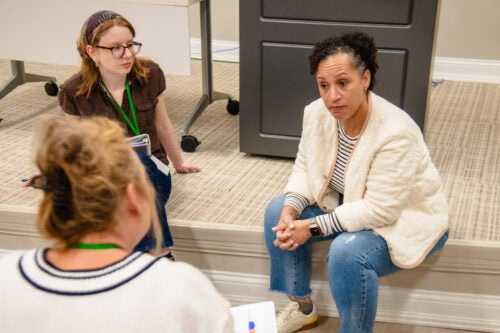

In March, strangers Hailey Small and Larry Smith found themselves debating the fine points of their local government’s charter with more than 30 other randomly-selected residents of Lexington, Kentucky.
Their meeting — and their conversations — took place under unique circumstances. Hailey was just beginning her career as a graduate student at the University of Kentucky’s College of Education. Larry was a self-proclaimed “boomerang” — a retiree who had left Lexington, Kentucky and found his way back after a career of advertising in New York. What brought these very different people together was the chance to be part of Lexington’s very first civic assembly.
Civic assemblies are forums where a representative sample of the community acts as a jury. Participants review information about a local challenge, deliberate amongst themselves, and present recommendations to decision-makers — reflecting a diverse cross-section of people who collaborate to reach consensus on issues that affect them all. By the end of the event, officials typically have a clearer sense of the public’s perspectives and preferences and a bolstered relationship with their constituents. Delegates often leave with a greater belief in the democratic process, a deeper understanding of government decision-making, and a stronger connection to their community, including fellow residents they may have never met otherwise.
As Larry describes it, being part of the assembly felt like getting the golden ticket. A once in a lifetime experience that no amount of money could buy.
Lexington’s assembly was organized by CivicLex, with team members Richard Young, Kit Anderson, and Lily Bramley leading the charge. To unpack the intricacies of this unique assembly, New America’s Political Reform Program hosted a conversation in partnership with DemocracyNotes on April 27th. The conversation was moderated by Senior Fellow Hollie Russon Gilman and, alongside the CivicLex staff, it featured two delegates chosen by sortition to share the delegates’ perspectives — Hailey and Larry.
The CivicLex team opened the conversation by explaining what led them to host an assembly in the first place. When the Urban County Council approached them about guiding the charter review process, Richard, Kit, and Lily saw an opportunity to try this collaborative model of engagement. The last charter review was conducted in 1998 and was not well received by the public. Civic assemblies are well-suited to tackle these kinds of thorny, highly specific issues. So CivicLex dedicated three years of work — and fundraised $225,000 from national and local funding sources — to host an assembly focused on the charter.
The assembly’s deliberations produced three concrete recommendations: increasing councilmember salaries, establishing publicly viewable attendance and accountability expectations for the Urban County Council, and requiring the Urban County Charter to be reviewed every eight years by a deliberative body of residents.
But the most compelling part of the conversation was hearing directly from Hailey and Larry about what the experience meant to them. Larry was candid: while he generally stood behind the recommendations, he didn’t necessarily agree with the majority. Even though his preferences ultimately didn’t win, Larry left the assembly feeling like the more than 100 hours he had invested in the process had been time well spent.
For Hailey, the impact was more personal. She first walked into the meeting room scanning for other people in their twenties; by the end of the experience, her favorite assembly member ended up being someone twice her age, whom she connected with beyond surface-level similarities. Hailey, who wants to work in public service and policy, also left the process feeling like there was room for her in local government — that “there is space for me and my opinion and what I have to say is valuable.”
That kind of connection didn’t happen by accident. CivicLex wove trust building into every layer of the assembly’s design. To recruit potential participants, they mailed out thousands of postcards that featured artwork from a local print shop — a small but intentional choice that reflected the organization’s broader commitment to rooting the assembly in the community. On the first day, assembly members were prompted by their facilitator, Tanya Torp, to write and share poems about their connection to Lexington. These design choices were foundational to what Kit says then led to the thornier debates. The art, poetry, and group activities helped everyone understand their shared values and connection to Lexington.
While the assembly itself is now concluded, the work is not. On April 28th, the recommendations were presented to the Urban County Council. The council has committed to publicly responding to the recommendations and, if approved, they will be placed on the ballot for a public vote in Lexington’s 2026 election.
As the process moves forward, Lexington’s assembly offers a powerful example of what can be accomplished by including everyday residents in the governing process — both for the residents and for the community as a whole.
Senior Fellow, Political Reform Program
Program Associate, Political Reform Program