Victor J. Blue
New America (ASU Future Security) Fellow, 2024
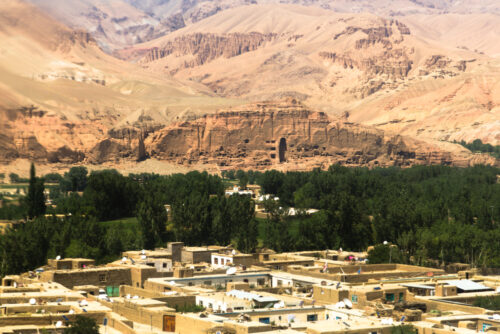
New America (ASU Future Security) 2024 Fellow Victor J. Blue spoke about his book project on the war in Afghanistan for “Three questions” in The Fifth Draft, the Fellows Program’s monthly newsletter. Blue is a photojournalist and writer focused on the legacy of armed conflict and unequal outcomes driven by policy and politics.
Your Fellows project will be a book of narrative photography that traces the arc of the war in Afghanistan from the initial stages of American intervention in 2009 to the Taliban takeover in 2021 and its aftermath. After reporting for newspapers and magazines, what made you decide to pursue a book-length project?
There’s a lot of things I wanted to communicate about the war, the scope of which expanded beyond any one magazine story or even a series of newspaper stories. I love those mediums, (you could cut me and I’d bleed ink,) but when I arrived in Afghanistan, I was always thinking in terms of a book. Photobooks are the best vehicle for engaging with a body of documentary photography—it’s kind of like visual literature. I was initially interested in creating a visual record that documented and interpreted counter-insurgency doctrine, the dominant military concept that defined President Obama’s surge of U.S. forces into Afghanistan. After doing that for years, my interest shifted to the effect of the war on the Afghan people and how the war was metastasizing even as the U.S. pulled out. Then the Taliban showed up, the war was over, and we had to scramble to reexamine nearly all of the assumptions we had made about the conflict for 20 years.
I think readers want to know the truth and their default understanding of the war in Afghanistan is confusion.
Do you feel a responsibility to correct American’s misconceptions about the war in Afghanistan? If yes, how do you hope your project might do that?
Yes. I feel a sense of obligation—not so much to correct but to educate. I think readers want to know the truth and their default understanding of the war in Afghanistan is confusion. I get that, it is complicated and to understand it requires time and patience. I hope that this book, if I work really hard on it and it communicates in a strong, clear way, can serve as a signpost readers can use to orient themselves and understand what happened there better. I think pictures are the ultimate vehicle for that reappraisal. The pictures depict interactions, scenes, landscapes, and characters that I hope will spark a curiosity and a reckoning for them.
Your short film with the late filmmaker Ross McDonnel, Swift Justice, was nominated for a News and Documentary Emmy. What did you hope to capture about Afghanistan in the film/on film that those in the West may not have previously understood?
There is a disconnect between the reality of Afghanistan and the Taliban and the narrative that built up over the decades to justify the continued occupation and counter-insurgency fight there. But that version didn’t explain some obvious paradoxes—like if the Taliban were so hated by Afghans in the south and east of the country, why was the Western-backed government and army losing? We wanted to get at the heart of the appeal of the movement for many Afghans, and to see what Taliban governance actually looked like, so we parked ourselves in one of their sharia courts. What we found was surprising and it illuminated the tough job they have of bringing stability and a degree of fairness to a society that has been buffeted by war for over 40 years. We didn’t want to speak for them and we didn’t want to comment on the relative merits or weaknesses of what they were doing. We recognized that in the west, the term sharia carries such negative connotations—we wanted to see what it looks like when sharia instead serves as a conduit for legitimacy and reconciliation. We did our best to depict the effort as honestly and observationally as we could and let audiences feel the complexity of that.
Subscribe here to receive next month’s issue of The Fifth Draft.
New America (ASU Future Security) Fellow, 2024