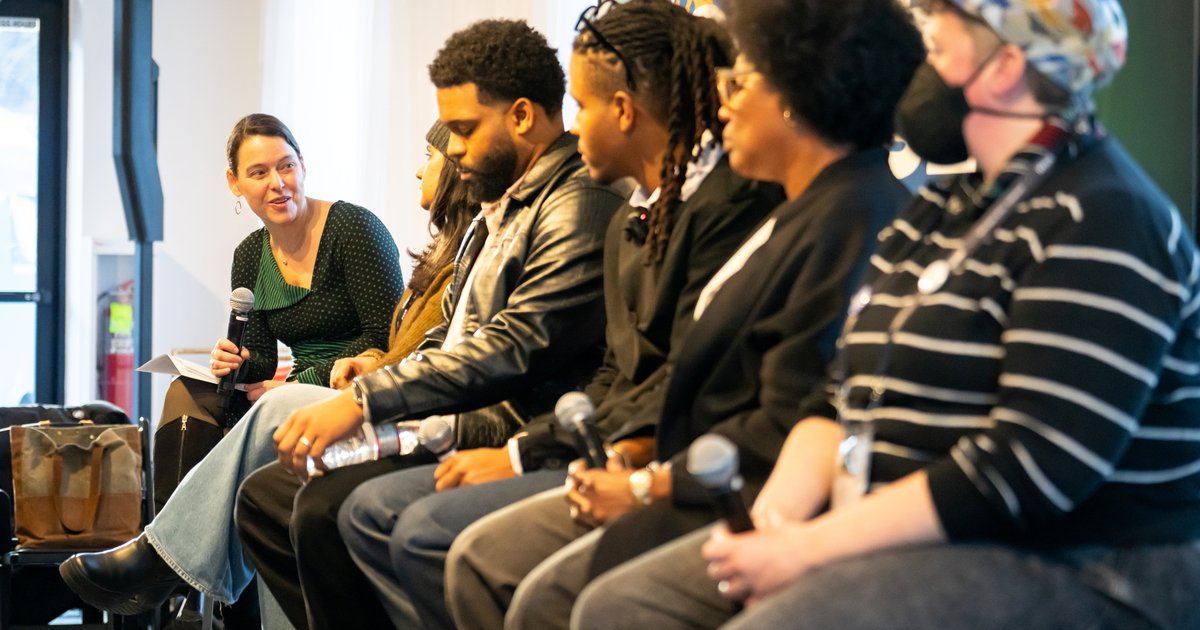
Jason Fitzroy Jeffers
New America (Jonathan Logan Family Foundation) Fellow, 2025
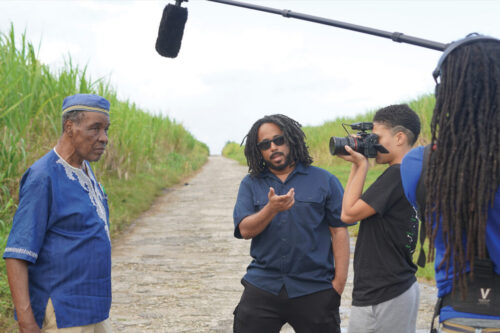
New America (Jonathan Logan Family Foundation) 2025 Fellow Jason Fitzroy Jeffers spoke about his film, The First Plantation, for “Three questions” in The Fifth Draft, the Fellows Program’s monthly newsletter. Jeffers is a filmmaker from Barbados and co-founder of the Third Horizon Film Festival.
Your Fellows project will be a film, The First Plantation, about the legacy of Drax Hall, the oldest continuously owned and operated sugar plantation in the Americas. Why did you decide to make a film about this topic?
I’m originally from Barbados and grew up 20 minutes away from Drax Hall. I used to drive past it pretty regularly on family outings but didn’t know the history of the plantation until an article was published in The Guardian in 2020 about it being inherited by Richard Drax, then MP for Dorset in the United Kingdom, and the wealthiest landowner in the House of Commons.
This unsettled me: How could it be that in a country as small as Barbados—the 13th smallest in the world, small enough to drive around the entirety of in roughly three hours—that the legacy of Drax Hall remained a secret among most of our people? It helped influence norms and legislation concerning plantation slavery across the hemisphere, from the Caribbean to the 13 colonies, and yet, it’s still in operation, with the Drax family still profiting from it after nearly 400 years.
The questions just kept unspooling, and I realized a film was the vehicle through which I could seek answers.
The film has become just as much a documentary about the island’s reparations campaign as it is a meditation on what it means to decolonize oneself.
How does the storytelling structure of your work reflect the complexities of heritage, identity, and memory for the descendants of enslaved people in the Caribbean? How do you balance your personal story and the wider context of transatlantic slavery?
When I first set out to make the film, I didn’t intend to include anything from my own experience. I was mostly interviewing people whose ancestors worked on the plantation or the local activists and politicians who have mounted a campaign seeking reparations from Mr. Drax. Shortly after we began filming, however, I learned that I had a previously unknown family connection to the plantation.
That prompted a great deal of reflection, and I realized that my experiences growing up on the island were incredibly relevant to everything I was trying to unpack. From receiving schooling not too different from that of a traditional British grammar school—think a Caribbean version of Harry Potter’s Hogwarts—to so many of our place names and personal mannerisms being steeped in hand-me-down Britannia—other Caribbean people joke derisively that Barbadians are “more British than the British”—the film has become just as much a documentary about the island’s reparations campaign as it is a meditation on what it means to decolonize oneself.
How do you approach telling stories that resonate both locally and globally? Do you think about having to maintain authenticity while appealing to a wider audience?
Those on the frontlines of Barbados’ reparations campaign believe that it could be a watershed moment in the fight for reparations for the descendants of Transatlantic slavery, and not just in the Caribbean. Our Prime Minister Mia Mottley—favored in many corners to be the next Secretary General of the United Nations—spoke to Barbados’ ignoble legacy as the birthplace of chattel slavery at the 2022 TIME100 Summit when she said that “Barbados is that country where modern racism in the Americas started…and we feel that we have a moral obligation to be able to start to deconstruct the racism in all of its forms.”
Those words echo loudly for me when I think about how to tell this story. It is crucial to me that I make a film that enlightens and feels true to people in Barbados who’ve been shielded from our history, while also drawing in American, British, and global audiences who may not have known how the island was the testing ground for evils that still plague them today. Striking that balance is like walking a tightrope, but that’s where the magic is to be found.
Subscribe here to receive next month’s issue of The Fifth Draft.
New America (Jonathan Logan Family Foundation) Fellow, 2025