Future-Proofing U.S. Nuclear Policy: Forecasting Security Outcomes of the Nuclear-Armed Sea-Launched Cruise Missile (SLCM-N)
Table of Contents
Abstract
While debate over the nuclear-armed sea-launched cruise missile (SLCM-N) has long been framed around whether the system is stabilizing or destabilizing, our analysis shows that its strategic value depends primarily on future conditions—not on the system itself. This report finds that SLCM-N is unlikely to be a decisive contributor to U.S. deterrence in the most plausible future the United States faces.
Using expert interviews, scenario planning, and probabilistic forecasting, this project evaluates how SLCM-N performs across four plausible futures in the mid-2030s. We find that disagreement over the system is driven less by disputes over technical facts than by fundamentally different assumptions about how future crises will unfold—how adversaries interpret U.S. intent, how escalation is managed amid uncertainty, and how technological change affects deterrence and signaling.
Across methods, the most likely future is Adaptive Deterrence, characterized by disruptive technological change and a U.S. nuclear posture largely perceived by allies and adversaries as defensive. In this future, SLCM-N provides limited and conditional value, functioning at most as a selective hedge rather than a decisive deterrent capability. The system has its greatest effect in a less likely future—Assertive Stability—where technological change is steadier and U.S. nuclear posture is viewed as offensive. Overall, the findings show that SLCM-N is not a “magic bullet” in any future: Its impact is contingent on how it is communicated by the United States, how it is perceived by adversaries and allies, and how it is integrated in future crisis scenarios. In the most likely future, its benefits are modest and easily offset by misperception risks if poorly employed.
Acknowledgments
The authors thank Peter Scoblic for his expertise on forecasting methods, Lily Boland for support in designing and facilitating the scenario planning exercise, Alex Montgomery for thoughtful comments and feedback that strengthened the analysis, and Russell Rumbaugh for planting the seed of the SLCM-N puzzle. We are grateful to Longview Philanthropy for its financial support, which made this work possible.
These reports are a team effort. We are deeply grateful to our colleagues at New America for their partnership, insight, and sustained support throughout the project.
Editorial disclosure: The views expressed in this report are solely those of the authors and do not reflect the views of New America, its staff, fellows, funders, or board of directors.
Downloads
Introduction
The United States is moving toward deployment of a nuclear-armed sea-launched cruise missile (SLCM-N), a low-yield, theater-range nuclear capability intended for deployment on U.S. attack submarines. First proposed in the 2018 Nuclear Posture Review, SLCM-N was designed to restore a forward-deployed, sea-based nuclear option in Europe and the Indo-Pacific following the retirement of comparable capabilities at the end of the Cold War. Since its proposal, the system has generated sustained debate over whether it would meaningfully strengthen deterrence and allied assurance or increase escalation and misperception risks without providing decisive military benefits.
That debate has unfolded largely in the context of present-day threats and historical analogies. Yet SLCM-N is a long-horizon capability. Even on optimistic timelines, it is unlikely to enter service until the mid-2030s. By that time, the United States is likely to face even more intense strategic competition with both Russia and China alongside continued advances in technologies that complicate military planning and readiness. The strategic environment in which SLCM-N would be deployed is therefore likely to differ meaningfully from the one in which it is being debated.
Despite years of analysis, the disagreement over the effects of deploying SLCM-N remains unresolved. This report argues that the persistence of this disagreement is not primarily the result of missing data or unsettled technical questions. Rather, it reflects deeper differences in how experts and policymakers expect future crises to unfold—how adversaries interpret U.S. intent, how escalation occurs amid increased uncertainty, and how technological change affects deterrence dynamics. These assumptions are often implicit, rarely tested against alternative futures, and difficult to adjudicate using traditional policy analysis.
This report approaches the SLCM-N debate from a different starting point. Rather than asking whether the system is inherently stabilizing or destabilizing, it examines how SLCM-N’s effects vary across plausible future strategic environments. This approach avoids static judgments about a dynamic system and instead evaluates the conditions under which the capability could mitigate risk, exacerbate instability, or prove strategically marginal. To do so, the project combines expert interviews, scenario planning, and forecasting to surface the assumptions shaping expert judgment and to assess how SLCM-N performs across four plausible versions of the mid-2030s. These futures vary along two dimensions: (1) how U.S. nuclear posture is perceived by allies and adversaries and (2) the pace of technological change. This approach allows us to clarify where assessments of SLCM-N are robust, where they are contingent, and which future developments matter most for policy decisions today.
Why Anticipating Divergent Futures Matters
Today’s nuclear security environment is defined by two structural shifts: the consolidation of tripolar nuclear competition and rapid advances in military-relevant technologies, which are reshaping deterrence, escalation, and force survivability. The United States now competes simultaneously with Russia and China, creating what U.S. Strategic Command has labeled a nuclear “three-body problem,” in which interactions among three nuclear-armed peers are more complex and less predictable than the bipolar dynamics of the Cold War.1 At the same time, emerging technologies—from artificial-intelligence-enabled decision support to cyber capabilities and hypersonic glide vehicles—are changing how crises unfold and how quickly leaders must make decisions.
These external pressures are compounded by domestic political polarization. Disagreement over basic facts and long-term priorities has narrowed the space for shared threat assessment. Together, these trends make it harder to rely on a single set of expectations about how deterrence will work in the future.
Under these conditions, traditional planning approaches—grounded primarily in historical analogy or institutional experience—are increasingly insufficient, and relying on them risks locking in capabilities that perform poorly if key assumptions prove wrong.2
Anticipating divergent futures matters because it reduces that risk. Tools like scenario planning and forecasting do not attempt to predict a single outcome; instead, they surface underlying assumptions and test whether judgments hold when key conditions change. Applied to nuclear policy, these tools help distinguish between capabilities that remain useful across a range of plausible futures and those whose value depends on narrow or optimistic assumptions—an essential distinction when decisions are costly, long-lasting, and difficult to reverse.
The Debate and Why SLCM-N Is the Right Test Case
The debate over SLCM-N centers on whether the United States should field a low-yield, nuclear-armed sea-launched cruise missile to address perceived gaps in deterrence. Proponents argue that SLCM-N would strengthen extended deterrence, provide credible response options below the strategic level, and hedge against adversaries’ growing nonstrategic nuclear arsenals. Critics counter that the system would add limited military value while increasing risks of misperception, inadvertent escalation, and blurring of the line between conventional and nuclear operations at sea.
At its core, this disagreement reflects different expectations about how future conflict is likely to unfold. Some experts anticipate intensifying military confrontation with China and Russia, including scenarios involving limited nuclear use, and therefore prioritize additional low-yield options. Others expect prolonged strategic competition below the threshold of major conflict, in which adding such capabilities could increase escalation risks rather than reduce them. These differences are less about factual disagreement than about how experts assess escalation, signaling, and risk amid uncertainty—assumptions that are often implicit and difficult to test directly.
Political polarization has further entrenched these divides. Since its introduction, SLCM-N has experienced repeated reversals between administrations and Congress, with executive branch decisions to advance or cancel the program frequently countered by congressional efforts to restore funding. Over time, SLCM-N has become a proxy for broader disagreements over deterrence, escalation risk, and the role of low-yield nuclear weapons, reinforcing debate driven more by competing worldviews than by shared strategic assessment.
Importantly, expert views on SLCM-N do not fall neatly into pro- and anti- camps. Instead, assessments span a spectrum—from strong confidence in the system’s deterrence value, to judgments that its effects would be modest or highly contingent, to firm opposition. As this report shows, this dispersion reflects divergent mental models of deterrence—the assumptions, priorities, and beliefs experts use to interpret the security environment and evaluate policy choices—rather than disagreement over the system’s basic technical characteristics.
The debate is further complicated by timing. Although SLCM-N is now funded and under development, it would not be deployable until the mid-2030s. Yet most assessments continue to evaluate the system through the lens of today’s crises or a single anticipated future rather than examining how its effects might vary if the strategic environment evolves in different plausible ways.
Finally, SLCM-N cannot be considered in isolation. It is being developed alongside a broader nuclear modernization effort as the United States replaces or upgrades all three legs of its nuclear triad (i.e., land-based intercontinental ballistic missiles, submarine-launched ballistic missiles, and strategic bombers) while introducing new capabilities. These systems will enter service on different timelines and interact in ways that may not be apparent in advance, making judgments about any single capability highly sensitive to assumptions about the future force as a whole.
For these reasons, SLCM-N is a useful test case for futures-based analysis. Its long deployment horizon, its integration into a changing modernization portfolio, and the persistence of expert disagreement make clear that the key question is not whether SLCM-N is inherently “good” or “bad” but which assumptions about the future are driving those judgments.
Citations
Background
What Is SLCM-N?
SLCM-N is a short-range, nuclear-armed sea-launched cruise missile designed for deployment on U.S. attack submarines (SSNs). It follows a low, maneuvering trajectory that enables it to better evade air defenses and deliver precise strikes at regional distances. Intended to operate in theater, SLCM-N is classified as a nonstrategic (or “tactical”) nuclear weapon—meaning it is designed for limited, battlefield or regional use rather than large-scale strikes—and is intended to strengthen U.S. extended deterrence in Europe and the Indo-Pacific.1
The system’s value derives from the survivability (that is, the ability to avoid detection and destruction), stealth, and mobility of its submarine launch platform. Submarines—the most survivable leg of the U.S. nuclear triad—can remain undetected, operate independently in open waters, and generate strikes without visible preparation. SLCM-N is also comparatively prompt: Once authorized, a forward-deployed missile could reach regional targets within hours. By contrast, air-launched cruise missiles delivered by strategic bombers must be generated from the U.S. homeland, may require refueling en route, and often take significantly longer to arrive in theater. As a sea-based capability, SLCM-N also sidesteps many of the political sensitivities associated with basing nuclear weapons on allied territory.
Operationally, a forward-deployed SLCM-N would provide the president with proportional response options in a crisis. If an adversary employs tactical nuclear weapons in a conflict, American use of higher-yield or longer-range strategic systems risks appearing escalatory or disproportionate—essentially skipping over several ladders in escalation management. SLCM-N is designed to offer a calibrated, low-yield, theater-level response option. It broadens the set of choices available to the president and thus gives more flexibility to decision makers.
The purpose of SLCM-N is threefold: (1) to reassure allies and strengthen U.S. extended deterrence, (2) to deter adversaries such as China and Russia from contemplating limited nuclear escalation, and (3) to give the American president a more flexible set of nuclear options. Its presence is intended to signal that no aggressor can expect to gain advantage from limited nuclear use without facing an assured and proportional U.S. response.
A Brief History of SLCM-N, from the Cold War to 2024
The United States first deployed a nuclear-armed sea-launched cruise missile in the mid-1980s, when the Navy fielded the Tomahawk land attack missile–nuclear (TLAM-N) on surface ships and attack submarines.2 With a range of roughly 2,500 kilometers (1,550 miles), TLAM-N was classified as a “tactical” nuclear weapon—referring to shorter-range, typically lower-yield nuclear systems intended for regional use rather than long-range strategic strikes. The Tomahawk was viewed as precise, stealthy, and therefore survivable—a tool bolstering U.S. presidents’ flexibility and countering the Soviet Union’s own deployment of sea-launched cruise missiles.
The United States withdrew TLAM-N from deployment in 1991 as part of President George H.W. Bush’s Presidential Nuclear Initiatives, which ordered the removal of all sea-based tactical nuclear weapons.3 Although the missiles were taken off operational platforms, they were kept in storage with the option to return them to submarines. The Obama administration ultimately determined that the system was no longer necessary and formally retired it in 2010.4
The debate over reviving a sea-launched nuclear cruise missile resurfaced under the first Trump administration’s 2018 Nuclear Posture Review (NPR), which proposed developing a new SLCM-N as a modern successor to the TLAM-N mission. The NPR criticized the Obama administration’s decision to retire TLAM-N, arguing that its withdrawal removed a key assurance tool for U.S. allies in Asia and left the United States relying almost exclusively on strategic nuclear forces for deterrence in the Indo-Pacific. In this context, the NPR argued that SLCM-N would “provide additional diversity in platforms, range, and survivability,” offering a politically uncontested means of reinforcing regional deterrence and strengthening allied confidence in U.S. defense commitments.5
The 2018 NPR reflected a reassessment of the threat environment, driven primarily by two trends:
- Russia’s significant, 10-to-1 advantage over the United States in nonstrategic nuclear weapons, combined with its increasingly assertive behavior, such as the deployment of ground-launched cruise missiles in violation of the Intermediate-Range Nuclear Forces (INF) Treaty.6 These developments informed the NPR’s judgment that Moscow sees limited nuclear first use with low-yield, short-range weapons as a means of coercion. This assessment reflects broader concerns about Russia’s so-called escalate-to-deescalate strategy.7
- China’s rapid expansion and modernization of its nuclear forces, including diversification of delivery systems to complete its nuclear triad and increase survivability as well as movement toward a larger and more sophisticated warhead stockpile. These trends informed the NPR’s assessment that Beijing is shifting away from a historically minimal deterrent toward a more flexible force posture, raising concerns about China’s future willingness to rely on nuclear signaling or limited use in crises, particularly in a Taiwan contingency.8
The 2018 NPR formally acknowledged the emergence of a second major nuclear competitor, China, alongside Russia; warned that both states could feel emboldened to test U.S. resolve through limited nuclear escalation; and expressed concern that a proportional, theater-range U.S. nuclear option was needed to quell adversaries’ doubts about U.S. willingness to escalate during a regional confrontation, thereby creating a perceived “deterrence gap.”9
To address this challenge, the 2018 NPR called for forward-deployed, flexible, tailored nuclear options, including developing a modern SLCM-N and modifying a small number of submarine-launched ballistic missiles (SLBMs) to carry low-yield warheads. These new capabilities would complement existing and forthcoming systems—such as the long-range standoff (LRSO) air-launched cruise missile carried by strategic bombers—by adding credible, theater-appropriate, and sea-based options to the U.S. deterrence posture.
Just a few years later, the Biden administration reached a different conclusion: Existing and planned U.S. capabilities—like low-yield SLBM, LRSO, and dual-capable F-35 fighters able to carry either conventional munitions or nuclear bombs—were sufficient to deter limited nuclear use without pursuing a new SLCM-N program. On this basis, the 2022 National Defense Strategy canceled SLCM-N.10
This decision, however, was met with congressional pushback. The 2023 bipartisan Strategic Posture Commission assessed that, faced with the so-called two-peer threat, the United States needed a larger and more diversified nuclear arsenal, with survivable, forward-deployed options that SLCM-N uniquely meets.11 Later that year, Congress reversed the administration’s cancellation, mandating that the Pentagon resume fielding the program under Section 1640 of the National Defense Authorization Act (NDAA) for fiscal 2024, with the goal of achieving initial operational capability (IOC) by 2034.12
2026 and Forward: Deployment Timeline and Operational Uncertainty
As of 2026, SLCM-N is moving forward, originally propelled by sustained congressional support and now aligned with executive policy. The U.S. Navy has selected five companies to advance early development work.13 Although the second Trump administration did not request additional discretionary funding for SLCM-N in the fiscal 2026 Navy budget, this reflects prior funding decisions rather than diminished momentum. The fiscal 2025 reconciliation legislation (also known as the One Big Beautiful Bill Act) provided $2 billion in mandatory funding to accelerate the development and procurement of SLCM-N, along with $400 million for its associated warhead.14 Congress is now shaping the program’s pace through the 2026 National Defense Authorization Act (NDAA), which authorized $210 million for the missile and $50 million for the warhead.15
However, even given optimistic assumptions, SLCM-N would not enter force until the early to mid-2030s. Several key parameters remain classified to the public, undetermined, or deliberately ambiguous, including:
- How many SLCM-Ns the United States would ultimately build and deploy—and how many each platform could carry (reportedly up to 12 per ship)16
- On December 22, 2025, President Donald Trump announced a new “Golden Fleet” initiative to build 20 to 25 battleships designated under a new “Trump class.” The president said the lead ship, the USS Defiant, would carry SLCM-N.17
- Platform choices change the signaling and deterrent value. A surface-combatant (or otherwise surface-based) deployment would involve more visible generation than SSN deployment, which, according to some of the experts we interviewed, could strengthen allied assurance and reduce ambiguity about whether a U.S. posture shift is underway. But greater visibility could mean lower survivability and increase incentives for adversary preemption.
- Whether the missiles would be kept at sea routinely or remain in U.S. central storage during peacetime
- Where the weapons would be stored, loaded onto submarines, and prepared for use (central storage versus forward loading sites)
- How many SLCM-Ns would be loaded onto the Virginia-class submarines (the Navy’s newest class of nuclear-powered attack submarines) or the new “Golden Fleet”
- How the Navy would balance the trade-off between nuclear and conventional capabilities, given that submarines have limited tube space and no at-sea reload capacity
- How often nuclear-certified vessels would deploy and how their movements might be interpreted by adversaries
- What targeting options SLCM-N would have, including whether it would be limited to military targets (counterforce posture) or extend to command-and-control and leadership targets (countervalue posture)
- What command-and-control procedures would govern a submarine carrying both nuclear and conventional weapons
- How SLCM-N deployment could place new burdens on the Navy’s infrastructure and industrial base—requiring expanded production capacity, a larger skilled workforce, crew retraining for nuclear missions, and platform modifications to support nuclear operations
Taken together, SLCM-N’s long development horizon and unresolved concept of operations (CONOPS) mean its strategic effects will be determined less by today’s debates than by the security environment into which it is eventually deployed. By the early to mid-2030s, the United States may confront two fully mature nuclear peers simultaneously, each fielding more integrated nuclear and non-nuclear capabilities as well as more sophisticated undersea sensing, with evolving doctrines shaped by rapid technological change. Decisions made now about SLCM-N’s scale, basing, employment, and signaling role will therefore interact with a future strategic balance that is likely to differ substantially from today’s. In this context, the uncertainty surrounding SLCM-N is not merely a programmatic challenge; it is a central determinant of whether the system ultimately functions as a stabilizing hedge, a marginal addition, or a source of new escalation risk.
Citations
- Anya L. Fink, Nuclear-Armed Sea-Launched Cruise Missile (SLCM-N) (Congressional Research Service, 2025), source.
- Fink, Nuclear-Armed Sea-Launched Cruise Missile (SLCM-N), source.
- Arms Control Association, The Presidential Nuclear Initiatives (PNIs) on Tactical Nuclear Weapons at a Glance (Arms Control Association, 2017), source.
- Fink, Nuclear-Armed Sea-Launched Cruise Missile (SLCM-N), source.
- Here, “politically uncontested” refers to the fact that SLCM-N would be deployed at sea on U.S. submarines and therefore would not require host-nation consent or the basing of nuclear weapons on allied territory, making it less politically sensitive than land-based nuclear deployments. Office of the Secretary of Defense, Nuclear Posture Review (U.S. Department of Defense, 2018), source.
- Matthew Kroenig, Mark J. Massa, and Christian Trotti, Russia’s Exotic Nuclear Weapons and Implications for the United States and NATO (Atlantic Council, 2020), source.
- Kroenig, Massa, and Trotti, Russia’s Exotic Nuclear Weapons, source.
- Hans M. Kristensen, Matt Korda, Eliana Johns, and Mackenzie Knight, “Chinese Nuclear Weapons, 2025,” Bulletin of the Atomic Scientists 81, no. 2 (2025): 135–160, source.
- John R. Harvey and Robert Soofer, Strengthening Deterrence with SLCM-N (Atlantic Council, 2022), source; Mariam Kvaratskhelia, “How a Second Trump Term Could Shape U.S. Nuclear Posture in Europe and the Indo-Pacific,” Center for Strategic & International Studies Nuclear Network, April 10, 2025, source.
- U.S. Department of Defense, 2022 National Defense Strategy of the United States of America, Including the 2022 Nuclear Posture Review and the 2022 Missile Defense Review (U.S. Department of Defense, 2022), source.
- Anya L. Fink, Congressional Commission on the U.S. Strategic Posture (Congressional Research Service, 2025), source.
- National Defense Authorization Act for Fiscal Year 2024, Pub. L. No. 118-31, § 1640 (2023), source.
- “U.S. Navy Advances Development of Sea-Launched Cruise Missile–Nuclear (SLCM-N) with Key Contractor Selections,” SSBCrack News, September 10, 2025, source.
- National Defense Authorization Act for Fiscal Year 2026, Pub. L. No. 119-21 (2025), source.
- Fink, Nuclear-Armed Sea-Launched Cruise Missile (SLCM-N), source.
- Peter Suciu, “Trump Announces New Class of Battleships—Named for Himself,” National Interest, December 23, 2025, source.
- Carter Johnston, “Trump Announces Nuclear-Armed Battleships for the U.S. Navy,” Naval News, December 23, 2025, source.
Methodology
This project uses a structured three-phase approach to examine how expert judgments about the nuclear-armed sea-launched cruise missile (SLCM-N) change under different future conditions and to identify the uncertainties that most strongly shape assessments of whether the system would be stabilizing, destabilizing, or marginal in the 2030s.
First, we conducted in-depth interviews with a diverse set of experts, including proponents of SLCM-N, critics, and those with mixed views. These interviews focused on identifying the assumptions and mental models underlying expert judgments about SLCM-N’s purpose, deterrent effects, and risks. Interview data were systematically coded and mapped to reveal areas of convergence and disagreement, even when experts use similar language to justify opposing conclusions.
Second, we employed a scenario planning exercise set in the mid-2030s to test how judgments vary across different strategic environments. Rather than forecasting a single outcome, we explored how SLCM-N’s value and risks vary across four plausible futures generated by two high-impact uncertainties identified by experts: perceptions of the U.S. nuclear arsenal and the pace of technological change.
Finally, we incorporated expert probability assessments to identify early indicators of a shift in the strategic environment toward one future or another. This step provided a way to track directional change without implying prediction or false precision.
Together, these methods allow the analysis to inform policy choices despite deep uncertainty by clarifying which judgments are robust, which are contingent, and what developments would warrant reassessment.
Phase I: Expert Interviews
We conducted 18 structured interviews with senior nuclear experts from think tanks and policymaking circles to examine the assumptions underlying their assessments of the security environment, nuclear escalation dynamics, and the utility of SLCM-N. These interviews were designed not only to capture substantive judgments but also to probe experts’ confidence in those judgments and the conditions under which those views might change. This approach enabled systematic comparison of where expert perspectives converged and where they diverged.
Interviews followed a common protocol of approximately 50 questions organized around three themes: (1) core assumptions and context dependencies, (2) key drivers and uncertainties, and (3) plausible future strategic environments.
To visualize patterns across respondents, we mapped experts into an “opinion space” based on the similarity of responses across interview questions (see Figure 1).1 This visualization highlights clusters of shared assumptions as well as areas of disagreement, including cases in which experts reached different conclusions despite relying on similar underlying premises.
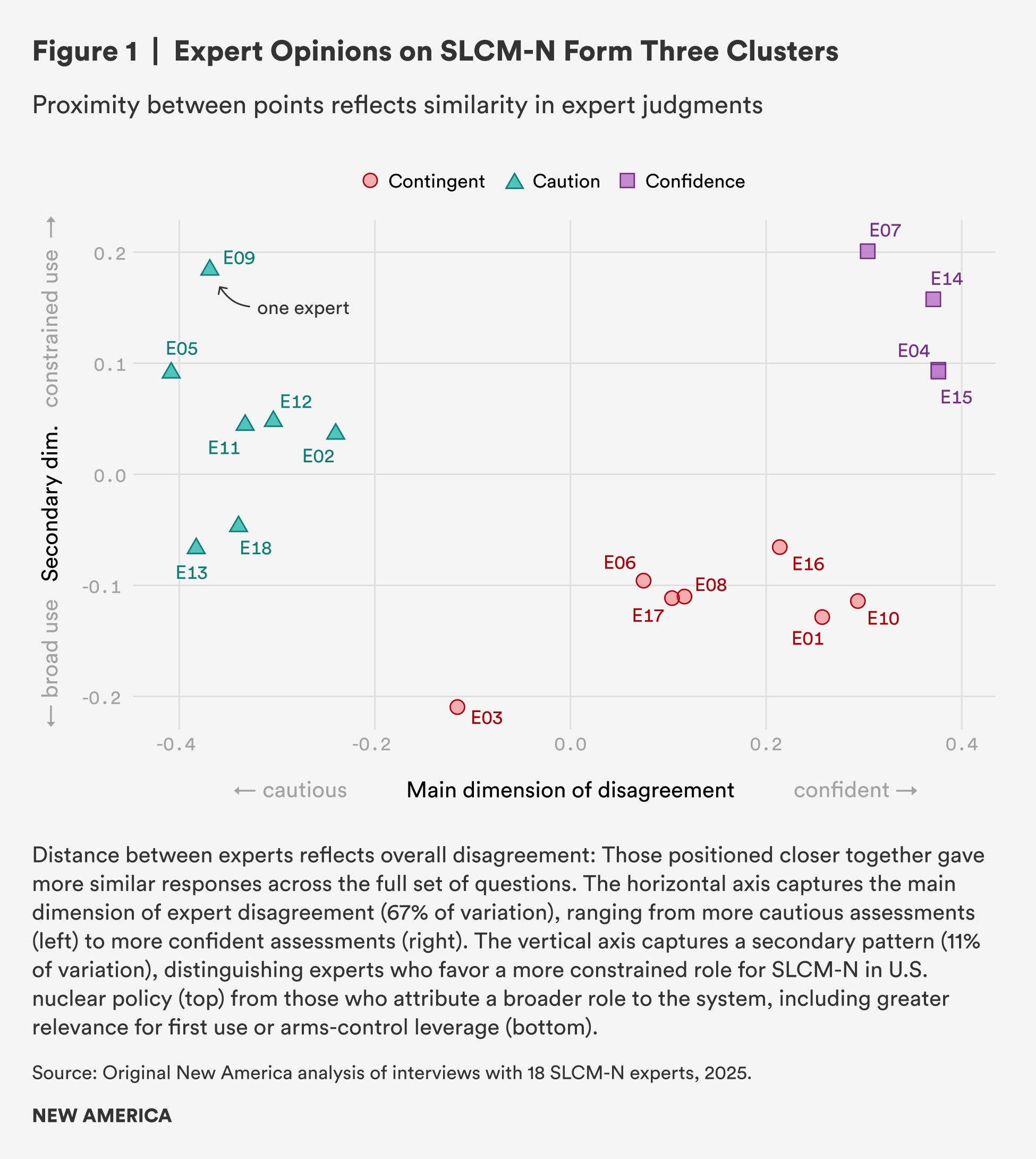
Experts positioned closer together expressed more similar assumptions and conclusions, while greater distance reflects more divergent perspectives.
Figure 2 uses hierarchical clustering to group experts based on similarity across the full set of coded variables. Experts who merge earlier in the tree share more closely aligned underlying judgments, while those whose branches connect later reflect deeper disagreement across multiple dimensions.
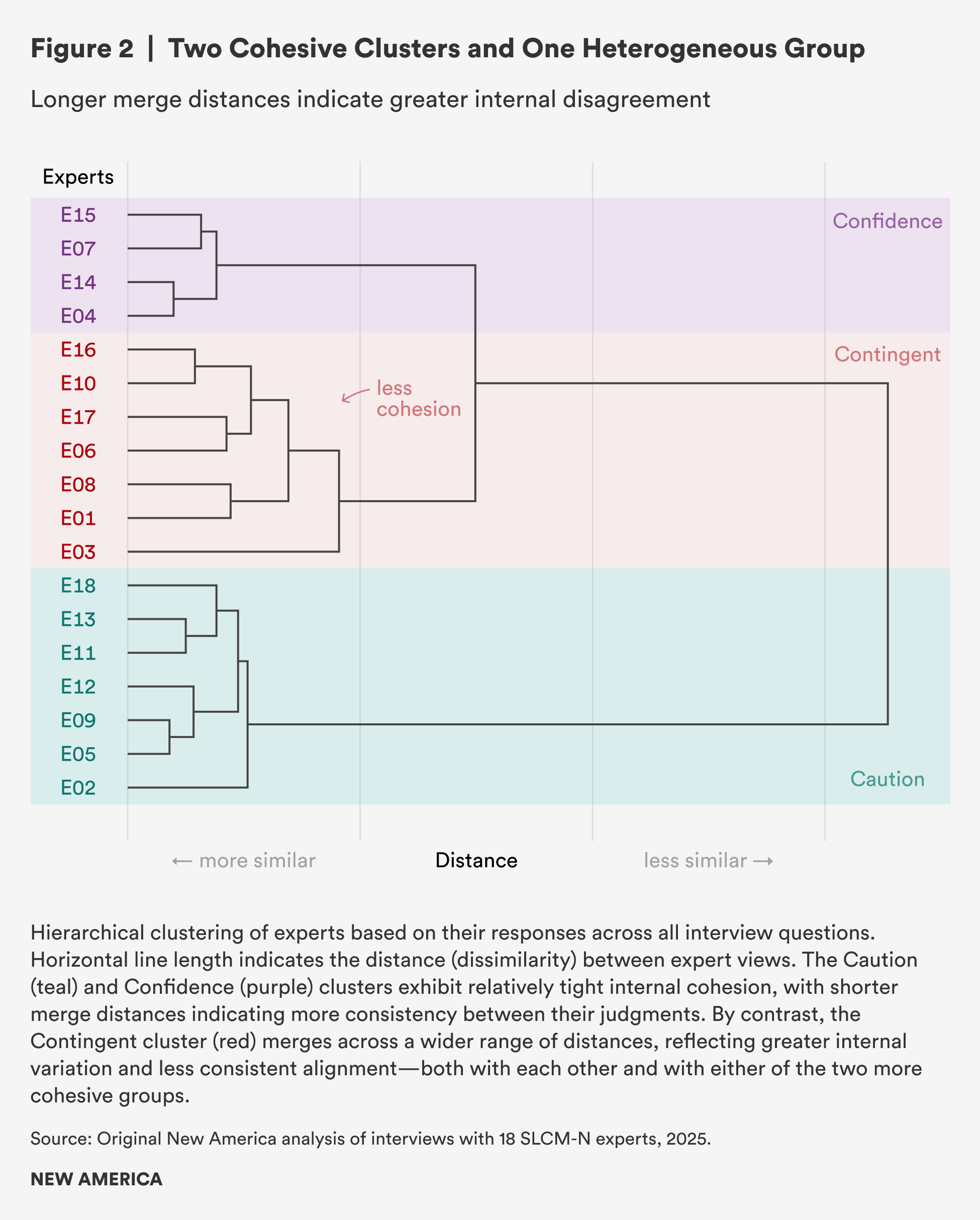
Interestingly, both the opinion-space map (Figure 1) and the hierarchical clustering (Figure 2) identify three distinct groups of experts. Though we initially expected two, those in favor of SLCM-N and those against, we also found a third group with more of a mixed or nuanced viewpoint.
Taken together, these belief patterns allow us to define three distinct “mental models,” defined as coherent frameworks of assumptions, priorities, and causal beliefs that experts use to interpret the security environment and evaluate policy choices. Group 1 aligns with a Confidence Model, emphasizing deterrence gaps, flexibility, and the stabilizing value of additional nuclear options such as SLCM-N. Group 2 reflects a Caution Model, prioritizing escalation risks, redundancy within existing forces, and the dangers of misperception or arms racing. Between these poles is Group 3, which corresponds to a Contingent Model: Experts in this group do not view SLCM-N as inherently stabilizing or destabilizing, instead assessing its value as highly dependent on future conditions, including technological change, adversary behavior, and the broader strategic context. This group draws selectively on elements of both Groups 1 and 2, helping to explain its intermediate position in the opinion space.
The Confidence Model: Flexibility and Assurance Benefit
Experts aligned with the Confidence Model view SLCM-N as a necessary tool for strengthening—and restoring—deterrence in regional conflict scenarios. Their core concern is adversary opportunism: They believe Russia or China may attempt limited, theater-level nuclear use precisely because they question whether the United States has credible, proportional response options at that level of conflict.
From this perspective, SLCM-N fills a critical gap. It provides a survivable, prompt, and precise response option that expands presidential choice without forcing an immediate leap to large-scale nuclear use (overwhelming escalation) or inaction (surrender). As one participant described the U.S. deterrence gap problem:
“[If] adversaries are losing a conventional war, they could use low-yield nuclear weapons within a specific theater to try to limit escalation. The Americans [would] have nothing to respond to in kind. They can’t go tit-for-tat or move one rung up the escalation ladder. The only options left are high-yield SLBMs [submarine-launched ballistic missiles], ICBMs [intercontinental-range ballistic missiles], or bombers—which [would be] already heavily tasked.”
A defining feature of the Confidence Model is its approach to risk. These experts do not deny escalation dangers, but they rank them below what they see as the greater threat: a deterrence posture that appears weak or constrained. In their view, deterrence fails not through inadvertent escalation but when adversaries perceive an opportunity to test U.S. resolve—particularly given Russia’s large nonstrategic nuclear arsenal and China’s rapid expansion. As one participant put it bluntly:
“[SLCM-N] enhances deterrence and is stabilizing because it increases escalation risks. It gives us the ability to escalate in response to adversary actions. I don’t see escalation itself as the problem; our ability to raise the level of violence is what gives [adversaries] pause, just like their weapons give us pause.”
Confidence Model experts also stress that SLCM-N’s flexibility derives not only from yield or promptness but also from how it can be deployed. Because it can be carried on attack submarines operating from international waters, SLCM-N allows the United States to shift capability across regions without overt basing decisions or visible force generation. One participant noted that the U.S. can “swing” Virginia-class submarines armed with SLCM-N to whichever part of the world the state leaders desire, choosing “exactly what effect [they] want the weapon to have.” Another participant agreed, saying: “Since seas are worldwide, SLCM-N can go worldwide.”
Non-visible generation is central to this logic. Unlike the air leg of the triad—which relies on visible alerting, forward basing, and host-nation approval—SLCM-N allows the United States to enhance military readiness without explicit signaling. If adversaries cannot observe when or where the capability is deployed, they must assume it could be available, increasing caution while reducing incentives for (and the likelihood of) preemption.
This emphasis on non-visible generation reflects a broader view within this group that strategic ambiguity is stabilizing—particularly in a political environment where adversaries themselves field dual-capable systems and commingle nuclear and conventional forces. As one expert explained:
“Ambiguity is a feature, not a bug. [SLCM-N] is meant to be ambiguous. Right now, [adversaries] know the answer: Every Virginia-class submarine out there does not have a nuclear weapon on board.”
Adherents of the Confidence Model argue that deterrence depends on capability and credibility. Credibility flows from visible demonstrations of strength—posture and political resolve—rather than from formal mechanisms or transparency. Strategic ambiguity is seen as a strength, not a liability, maintaining adversary caution and allied confidence. In this worldview, stability arises from mastery rather than elimination of risk. The idea is that danger, properly managed, can itself be a stabilizing force.
This endorsement of strategic ambiguity is the reason this group does not see SLCM-N’s dual-capable nature as destabilizing: Since adversaries cannot readily determine whether U.S. submarines carry nuclear or conventional payloads, they argue, their decision-making is complicated, inducing caution in a crisis. Several experts argued that SLCM-N’s dual-capable nature and its associated ambiguity could actually lower miscalculation risks compared with existing options. One expert suggested China is leveraging ambiguity similarly by integrating its conventional and nuclear forces: “China simply does not appear to be very concerned about separating its nuclear and conventional forces…In fact, [it] sees deterrent value in commingling those forces and maintaining dual-capable systems…They have to deal with that ambiguity and so do we.”
Another expert agreed, asking: “If the other guy is deploying dual-capable weapons systems, does he really care about ambiguity?”
Another key pillar of the Confidence Model is the role of SLCM-N in providing allied assurance, particularly in the Indo-Pacific. Experts frequently contrasted assurance in Asia with that in Europe, where roughly 100 U.S. B61 nuclear gravity bombs provide a visible, theater-level manifestation of extended deterrence. In Asia, they argued, no comparable forward-deployed nuclear option exists. A survivable, sea-based capability is therefore seen as essential to reinforcing U.S. commitments to Asian allies and reducing incentives for indigenous nuclear proliferation in countries such as South Korea and Japan. As one expert put the logic, “If you care about nonproliferation and the NPT [Treaty on the Non-Proliferation of Nuclear Weapons], we have to return American nuclear weapons to the Western Pacific.” Another expert stated that “renewed faith in the American umbrella is an anti-proliferant.”
Across these arguments, this group of experts expressed consistently high confidence in its assessments. They generally treated uncertainty as manageable and discounted escalation risks as secondary to what they saw as the greater danger of a weak deterrence posture—one that could encourage adversaries to test U.S. resolve and increase the risk of war.
As one expert conceded, deterrence may fail not due to miscalculation but because leaders consciously choose to challenge deterrence, believing they can absorb or manage the risks.
Confidence levels and openness to counterfactual scenarios are examined in detail in later sections of the report.
The Caution Model: Redundancy and Escalation Risks
Experts aligned with the Caution Model view SLCM-N as a marginal and largely redundant addition to U.S. deterrence—or, as one expert described it, “a solution in search of a problem”—that carries disproportionate escalation and misperception risks. Rather than identifying a clear deterrence gap, they argue that perceived weakness in U.S. deterrence stems from political commitment, communication, and signaling issues, not from the absence of a particular weapons system or hardware. One expert noted that “all the weapons in the world don’t fix the political problem,” while another emphasized the relative importance of soft power over hard: “Deterrence is credibility times capability; if either credibility or capability is zero, then deterrence is zero.” Another expert concluded, “The problem isn’t that we lack nuclear options. The problem is that adversaries question our political commitment.”
The United States, they argue, already possesses a wide range of nuclear options that span the spectrum of yield, delivery mechanism, survivability, and deployment plan. As one expert summarized, “We [already] have low-yield options. We have non-ballistic options. We have survivable options. We have deployed options.” In their view, the greater danger lies not in insufficient nuclear options but in misjudging how new capabilities interact with perception, escalation, and decision-making under stress. Any additional capability therefore must be evaluated not by its technical attributes alone but also by how it is perceived and interpreted by adversaries and allies.
A central concern within the Caution Model is escalation risk driven by misperception and entanglement. Because SLCM-N would be indistinguishable from conventional cruise missiles, it could blur the line between conventional and nuclear operations. In a crisis, adversaries may be unable or unwilling to wait to determine whether an incoming strike is nuclear or conventional. This ambiguity, they argue, incentivizes worst-case assumptions, increasing pressure to act first rather than risk losing retaliatory options. One expert warned, “That ambiguity could precipitate the sort of nuclear strike that you’re trying to avoid,” adding that “everybody thinks they can control escalation, but nobody can.”
Unlike experts aligned with the Confidence Model, those in the Caution Model reject the notion that strategic ambiguity is stabilizing in a crisis. While uncertainty may have deterrent value in theory, they argue that it has the opposite effect in a live crisis: Leaders expect the worst and plan accordingly. As one expert observed, “Ambiguity might sound stabilizing in theory, but not during a crisis—because during a crisis you expect the worst…If you’re an adversary and you see a sea-launched cruise missile coming at you, you don’t know whether it’s nuclear or conventional—and that uncertainty creates pressure to act first.” In this view, once nuclear weapons are already present in a theater, the distinction between conventional and nuclear payloads matters less than the fact that nuclear use is now conceivable.
More broadly, some experts contend that the introduction of SLCM-N itself adds risk by shaping adversary perceptions and prompting reactive behavior. Adding another low-yield nuclear system, they argue, risks reinforcing fears of preemption, lowering the perceived threshold for nuclear use and prompting reciprocal deployments in an action-reaction arms race. One expert noted that U.S. decision makers “don’t seem to think beyond 10 or 15 years,” warning that by the time the system is deployed, America’s adversaries “may already have a capability out there that negates whatever advantage the U.S. was trying to achieve.” And when adversaries build more, proponents of such weapons “will say we have another deterrence gap.”
Because any nuclear weapon deployed on submarines has unavoidable strategic undertones, experts in the Caution Model also worry that allies and adversaries may perceive SLCM-N less as a theater-level option and more as a strategic delivery system, increasing fears of surprise attack or even a disarming first strike.
Finally, these experts question whether SLCM-N adds meaningful capability relative to its costs. They point to existing and planned alternatives, including the W76-2 warhead on SLBMs, air-launched cruise missiles, and the LRSO (long-range standoff weapons), and argue that any deterrent benefit from SLCM-N would likely be temporary as adversaries adapt. They also emphasize opportunity costs: SLCM-N could divert resources from already-strained modernization programs, impose operational burdens on the Navy, displace conventional weapons on attack submarines, and offer limited signaling value—even for allies—precisely because submarines are designed to remain unseen. As one expert put it bluntly, “I don’t think this is decisive for Japan or South Korea.”
Taken together, this model emphasizes restraint, predictability, and transparency as the foundations of stability. It assumes that escalation is more likely to arise from accidents, misperceptions, or system failures than it is from deliberate aggression. Accordingly, it privileges diplomacy, risk-reduction mechanisms, and clear communication as instruments of maintaining equilibrium. Ambiguity is viewed not as strategic leverage but as a source of danger—an invitation to the adversary to probe further.
Across these arguments, experts aligned with the Caution Model expressed lower confidence in their assessments than their Confidence Model counterparts. They treated uncertainty as difficult to manage and warned against assuming that additional hardware can compensate for political will.
Beneath the Arguments: Decision Styles Within Confidence and Caution
Taken together, the Confidence and Caution Models capture two dominant decision styles that experts use to think about deterrence, escalation, and uncertainty. (The Contingent Model, discussed below, reflects a shared approach rather than a shared style.) The Confidence Model centers on emboldening—showing strength to prevent adversary opportunism born of perceived weakness. This decision style treats risk as something to be managed through action rather than eliminated through control. It seeks gains in deterrence credibility and strategic advantage through decisiveness, embracing risk as a tool for shaping adversary behavior amid uncertainty.
The Caution Model, by contrast, focuses on preventing accidents, misperceptions, and inadvertent escalation arising from ambiguity. Its decision style is prevention-focused and highly sensitive to uncertainty, which it seeks to reduce through clarity, guardrails, and institutional constraints. Escalation is assumed to stem primarily from human or systemic errors—misunderstandings, misinterpretations, or miscommunications—and stability is pursued by minimizing noise and maximizing predictability. In this style, stability and confidence depend on mechanisms that constrain uncertainty and make adversary behavior more legible, such as arms-control agreements, crisis hotlines, and verification regimes. The resulting decision seeks loss avoidance through control and clarity: Risk is managed not by embracing uncertainty but by designing systems and behaviors that make it legible and containable.
Figure 3 summarizes how these two decision styles map onto the core arguments and risk preferences that experts most frequently invoked when discussing SLCM-N.
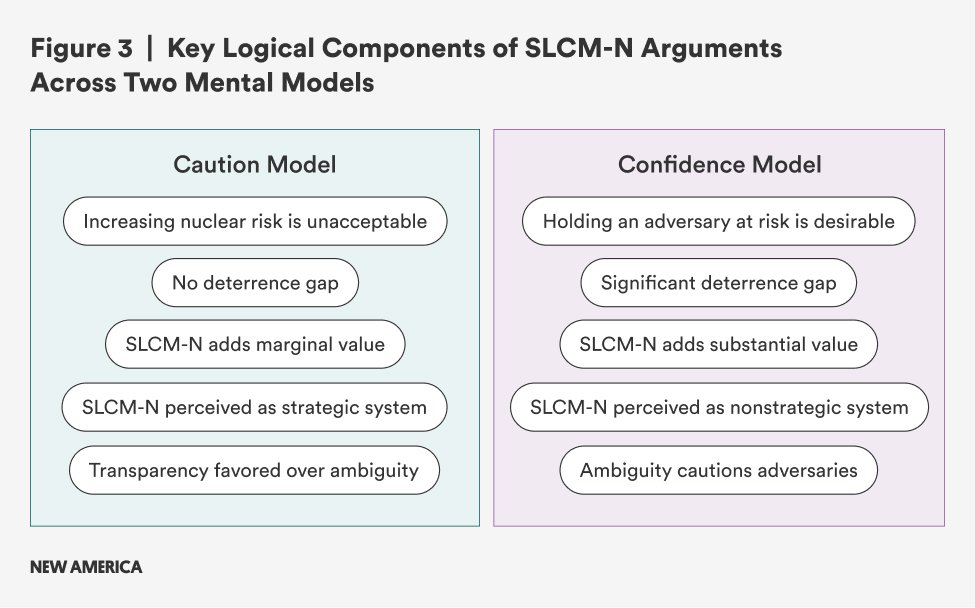
Experts aligned with the Confidence Model argue that the United States faces a significant deterrence gap vis-à-vis adversaries—and a parallel assurance gap vis-à-vis allies—and that SLCM-N helps address both. Many in this group treat SLCM-N as a nonstrategic capability precisely because it enables more proportional and flexible response options below the level of large-scale strategic exchange. Strategic ambiguity is therefore viewed as a benefit rather than a flaw: Adversaries should contemplate how, not whether, the United States would respond to a potential aggression. As one expert argued, “If you don’t provide an aggressor with probability that we have local capabilities…then deterrence is undercut.” Another expert shared this view, noting that SLCM-N not only maintains but improves the United States’ deliberate ambiguity, and “maintaining that ambiguity in our doctrine, in our policy, is very, very important.” Another framed the problem diagnostically, noting that Russia and China present “two very different deterrence gaps”—Russia poses an immediate risk, while China represents a longer-term challenge.
Experts aligned with the Caution Model take the opposite view. They argue that increasing nuclear risk—regardless of the lever that triggers it—is unacceptable and that the United States does not face a deterrence gap with Russia and China. From this perspective, SLCM-N adds at best marginal value to an already sufficient force posture. Skepticism about expanding nuclear options is central to this logic. As one expert put it bluntly, “How many options does the president need?” These experts favor transparency and restraint over ambiguity, warning that escalation risks cannot be reliably managed through signaling or force design alone, and call for “more clarity, not less clarity, about our nuclear posture.”
Interestingly, disagreement over SLCM-N does not map cleanly onto whether experts view nuclear weapons as “strategic” or “nonstrategic.” Several experts across models rejected the distinction altogether. One Confidence Model expert argued that “in this era, any nuclear weapon is of strategic importance,” yet still supported SLCM-N as a useful capability. By contrast, Caution Model experts often drew the same conclusion—that any nuclear use would be “effectively strategic”—but used it to argue against adding nuclear options. As one Caution Model expert noted, “Nuclear things that come out of submarines are very strategic and very much intended to have a deterrent effect, and so that really worries me.”
This divergence highlights that the core disagreement is not about terminology but about whether recognizing the strategic nature of nuclear use implies restraint through fewer options or stability through more options.
Figure 4 complements this analysis with a descriptive word-frequency comparison of interview transcripts, illustrating how experts aligned with each mental model tended to talk about SLCM-N. We identified recurring terms across interviews and then counted uses by each expert. Experts were classified under the Confidence or Caution Model based on our prior analysis of their overall reasoning and position in the opinion space illustrated in Figure 1 (not based on word usage). Term frequencies were then aggregated within each model and visualized to highlight patterns of emphasis.
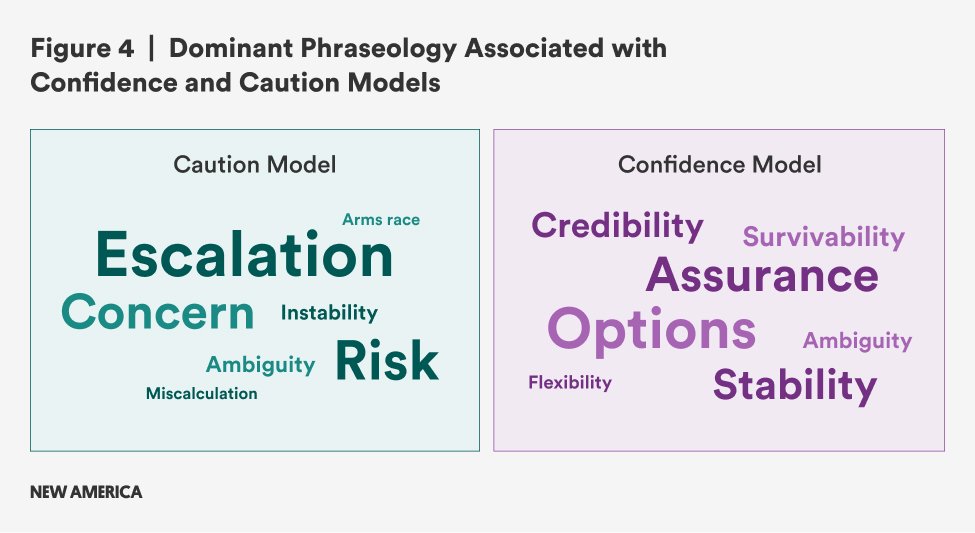
These word clouds should be read as reflecting differences in framing and emphasis, not exclusive ownership of particular terms. Experts in both models discussed escalation, risk, stability, and credibility, often in starkly different ways. What distinguishes the two models is how frequently and centrally these concepts featured in their reasoning.
These figures are not intended to suggest that all experts fall neatly into one of two camps. As shown in the opinion-space mapping and clustering analysis (see Figures 1 and 2), a third group occupies an intermediate position, drawing on both confidence- and caution-oriented assumptions. The Contingent Model discussed below reflects this conditional mode of reasoning, which does not constitute a third pole so much as a flexible position between the two dominant models.
The Contingent Model: Pragmatic and Limited Endorsement
Experts aligned with the Contingent Model do not agree on a single judgment about SLCM-N’s net effect on deterrence or strategic stability. Instead, they are united by how they evaluate the system: through conditional, context-specific reasoning rather than categorical claims. Experts in this group tended to draw on elements of both the Confidence and Caution perspectives; rely on conditional reasoning; and express low to moderate levels of epistemic confidence, having more of an information-seeking mindset and drawing multiple conclusions.
Across interviews, these experts repeatedly emphasized that SLCM-N’s effects cannot be assessed in isolation but depend on assumptions about timing, concepts of operation, signaling, adversary interpretation, and the broader strategic environment. As one expert noted, “Any new capability always faces the challenge of ‘It’s not here yet, so we don’t know how we intend to use it,’” underscoring the difficulty of evaluating a system whose employment concepts and political context remain unsettled. Whether SLCM-N is useful in a particular conflict is, per one expert, “going to be up to one person [the president] and…highly context-dependent.”
From this perspective, SLCM-N is neither inherently stabilizing nor inherently destabilizing. Its impact varies across phases of conflict and modes of employment. One interviewee maintained, “SLCM-N is not a game-changer to my mind.” As a result, experts in this group consistently rejected generalized or categorical arguments about deterrence “gaps” or escalation dynamics, instead asking how the system would function under specific conditions. As one expert put it, the relevant question is not whether SLCM-N is good or bad but “what problem is it actually trying to solve.” Another cautioned against overweighting any single capability, arguing that “we are well beyond a world in which the deployment of one nuclear-capable system has a fundamental change in the stability and instability dynamics of the present or the near future.”
A distinguishing feature of the Contingent Model is differentiation among phases of a conflict. Many experts explicitly distinguished peacetime, crisis, and wartime effects. In peacetime, SLCM-N was often viewed as neutral or modestly positive, with potential value primarily in allied assurance. In crisis scenarios, however, these experts identified both the greatest potential utility and the greatest risk: generation or deployment of SLCM-N could signal resolve and complicate adversary planning, but it could also accelerate escalation if signaling is misinterpreted. One expert summarized this tension succinctly, noting, “The study of nuclear deterrence most challengingly is the study of the inside of the head of an adversary decision maker. That’s a difficult space to access.” In wartime, SLCM-N was discussed less as a deterrent than as a possible tool for managing escalation and shaping the scope of subsequent phases of conflict.
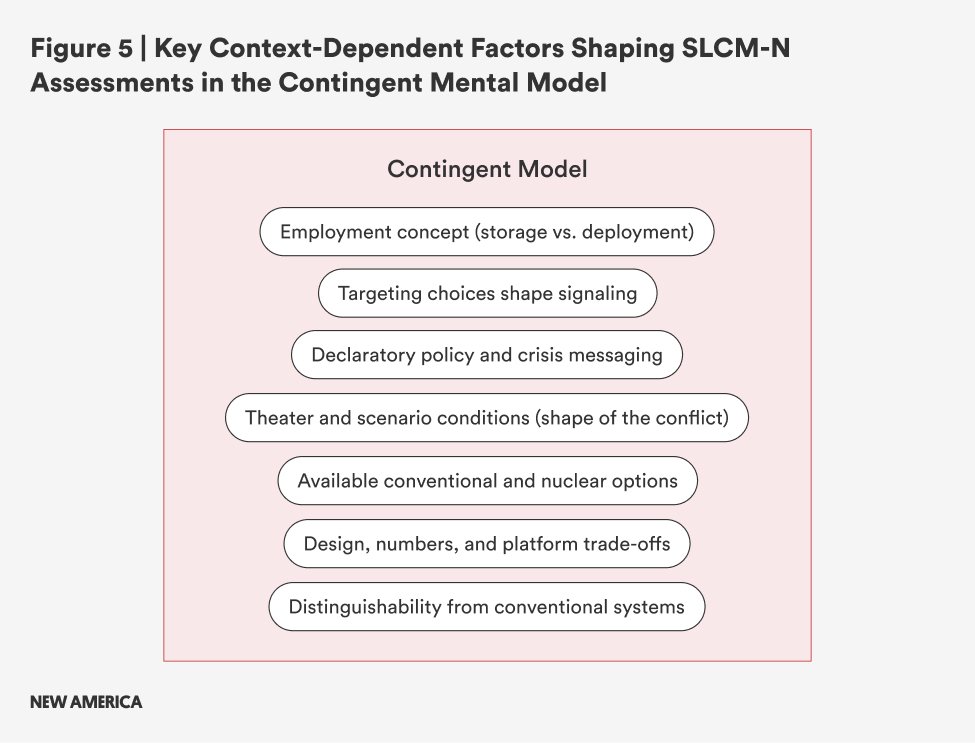
Rather than focusing on the weapon’s technical attributes alone, experts in this group emphasized concepts of operation and employment choices as the primary determinants of risk and value. These include variables such as storage choices, fielding numbers, and commingling choices. Many of the risks referred to by the Caution Model, such as misperception and entanglement, were therefore seen as contingent on operational and political decisions rather than intrinsic features of the capability itself. As one expert explained, “It’s not just about nuclear versus conventional; it’s about where it’s being used, how it’s being used, and how the adversary assesses its own security.”
This model is marked by intragroup heterogeneity on certain issues. Variation within the Contingent Model is especially noticeable on questions of visibility versus ambiguity. Some experts argued that visible generation and clearer signaling (as with the air leg) can be stabilizing in crises as they can demonstrate resolve. Others saw ambiguity surrounding SLCM-N’s presence as potentially complicating adversary decision-making and increasing caution. Importantly, these differences were framed not as definitive conclusions but as context-dependent hypotheses. One expert stressed that ambiguity should not be treated as unique to SLCM-N, arguing that “I wouldn’t differentiate the strategic ambiguity of this system from our broader approach to all things nuclear,” while another emphasized that transparency about purpose and posture remains essential for allied confidence specifically.
Experts in the Contingent Model also expressed a pronounced tendency toward information-seeking and epistemic humility. They frequently highlighted uncertainties and were cautious about claims of control over escalation dynamics. As one interviewee noted, “I’m of two minds.” Several stressed that deterrent effects, if they exist, may be temporary as competitors adjust, and that SLCM-N’s relevance could be undercut—or amplified—by developments elsewhere, either within the U.S. force structure or in alliance or adversary politics. As one interviewee observed, “Allied assurance is like a magical, unfillable bucket.” Another added that “whatever deterrence value you squeeze out of [SLCM-N] is temporary until [adversaries] come up with a way to compete their way out of that deterred state.”
As such, the Contingent Model becomes analytically distinct from both the Confidence and Caution perspectives, understanding SLCM-N not as a decisive solution but as a contingent option whose value depends on choices yet to be made. Rather than anchoring on a dominant theory of deterrence or privileging a single risk pathway, experts in this group tend to reason through conditional logic, asking how outcomes vary across contexts, actors, and phases of interaction. Their judgments are shaped less by first principles or doctrinal commitments than by situational assessment and comparative reasoning.
Decision-making within this model emphasizes problem framing over solution advocacy. Experts tend to begin by interrogating what specific strategic or political problem a capability is intended to address, and only then do they assess whether SLCM-N meaningfully contributes under those conditions. This results in a tendency toward incremental evaluation, where capabilities are assessed as part of a broader portfolio rather than as decisive instruments in their own right.
The Contingent Model also reflects an uncertainty-acceptant decision style, and experts in this group frequently acknowledge the limits of prediction. Rather than resolving uncertainty through confident judgment (as in the Confidence Model) or treating it as a source of risk requiring constraint (as in the Caution Model), they treat uncertainty as an enduring feature of the strategic environment that must be continuously managed.
In practical terms, this decision style favors effective uncertainty management through option preservation, adaptive planning, and ongoing reassessment over early commitment or categorical judgments. It is analytically well-suited to environments characterized by deep uncertainty, but it also resists clear bottom-line conclusions, which helps explain why this group does not converge on a single verdict about SLCM-N’s net effect.
Figure 5 below lists key context-dependent factors that experts in the Contingent Model often refer to throughout their interviews.
How Confidence and Counterfactual Reasoning Shape Nuclear Risk Assessments
The key dimensions differentiating experts’ views on SLCM-N include not only the conclusions they reach but also the degree of confidence with which they reach them and how they engage uncertainty through counterfactual reasoning. To examine confidence, we asked how certain experts felt in their judgments about SLCM-N relative to other nuclear policy questions. Additionally, to observe how experts handled uncertainty, we asked them to envision plausible futures in which SLCM-N produced effects opposite to those they anticipated—an exercise designed to probe whether uncertainty was treated as something to be resolved or as something to be explored and incorporated into their assessments. Higher self-reported confidence was typically associated with constrained uncertainty—treating key assumptions about SLCM-N as relatively fixed—whereas lower or more qualified confidence reflected greater openness to alternative futures.
Experts aligned with the Confidence Model often grounded their certainty in long experience in the field. As one expert stated, “I’m equally confident in all of [my views] because I’ve been in the business for a long time. I am very firm in my views.” Another attributed confidence to institutional trust, noting that “my high confidence is because I have innate trust…[and] an unspoken assumption in the fact that [the United States] as a democracy behaves responsibly.” The same expert contrasted this with “zero trust…with the Russians and the Chinese” based on long experience engaging with them on nuclear and arms control issues.
Many experts aligned with the Confidence Model argued that under current and anticipated threat conditions vis-à-vis Russia and China, SLCM-N functions as a stabilizing counterweight. Within this framing, the risks of not deploying SLCM-N were consistently judged to outweigh the risks of deployment. This logic extended to cost considerations as well; one expert argued that SLCM-N is “absolutely worth the price, even at [$]30 billion.” Counterfactual scenarios in which SLCM-N became destabilizing were generally described as either highly unlikely or contingent on profound structural shifts in the international system that experts viewed as implausible. As one interviewee put it, only in a world where “catastrophic peace [has] broken out…[and] everything’s fine” would SLCM-N have little or no strategic effect—an intentionally ironic way of underscoring how unlikely they view that scenario.
By contrast, we observed that experts aligned with the Caution and Contingent Models exhibited a markedly different relationship with uncertainty, treating it as an inherent component of their logic. Several explicitly flagged uncertainty in their judgments, using phrases such as “I genuinely don’t know” or “I’m not very confident.” Notably, in this model, the expressions of uncertainty were often paired with the same deep professional experience that we found in the Confidence Model. “I’ve stared at this problem a lot, so I feel pretty comfortable in how I think about it,” one expert noted. This highlights a central distinction between the models: While both draw on experience, Confidence Model experts tend to use it to justify firmer conclusions, whereas Caution and Contingent Model experts invoke experience to emphasize epistemic humility and openness to revision.
Taken together, these differences suggest that disagreement over SLCM-N reflects not only substantive judgments about deterrence and escalation but also deeper differences in how experts reason amid uncertainty—how firmly they anchor their conclusions, how seriously they engage counterfactuals, and how willing they are to revise beliefs as future conditions unfold.
Areas of Agreement Across Expert Views
Across interviews, several areas of agreement emerged regarding both SLCM-N’s potential role and its limits. Most notably, experts broadly agreed that SLCM-N is not a “magic bullet” for deterrence. While many acknowledged that the system could strengthen U.S. deterrence posture under certain conditions, few viewed it as a decisive or standalone solution to perceived credibility gaps. Instead, deterrence effectiveness was widely seen as hinging on communication, signaling, and broader force posture rather than arsenal size alone—a noteworthy point given that the number of SLCM-Ns to be deployed remains classified.
Second, experts across different mental models generally agreed that SLCM-N could play an effective role in signaling U.S. commitment to allies, particularly in the Indo-Pacific, where partners such as South Korea and Japan increasingly question the credibility of U.S. extended deterrence. At the same time, most emphasized that SLCM-N would be only one component of alliance assurance, insufficient on its own to resolve underlying political or strategic concerns.
Third, there was broad agreement that SLCM-N would be more effective in the Indo-Pacific than in Europe, reflecting the region’s maritime geography, the lack of forward-deployed U.S. nuclear options, and distinct threat perceptions. By contrast, many experts viewed the system as offering more limited benefits in Europe, where existing dual-capable aircraft already provide a visible manifestation of extended deterrence.
Phase II: Scenario Planning Exercise
If expert judgments are shaped by underlying mental models rather than facts about the system, an important question is whether structured engagement with alternative futures can meaningfully alter how experts think about the system. Phase II of the project used scenario planning to test how those assumptions operate under stress. In practice, scenario planning does not dissolve mental models; it surfaces them.2 By placing participants in systematically different futures, the exercise forces them to apply their assumptions under conditions that disrupt present-day defaults.3 This does not eliminate underlying biases, but it does temper them by diminishing anchoring effects, challenging preferred trajectories, and revealing how each mental model responds when key variables shift.4 The result is not a harmonized view but a clearer understanding of why experts diverge and how their divergences depend on contingent features of the future.
To move from present-day judgments to forward-looking assessment, we conducted a structured scenario-planning exercise grounded in insights from Phase I. Building on what experts believed—and why their beliefs differed—we examined how competing assumptions about deterrence, escalation, and signaling would shape judgments across plausible future strategic environments in which SLCM-N might operate.
The exercise began with a horizon-scanning process, identifying a broad set of political, technological, and military factors that could shape SLCM-N’s future relevance. Participants then assessed these factors using two criteria: uncertainty about their future values and their potential impact on the value and risks of SLCM-N. Through facilitated discussion and clustering, we narrowed this list, eliminated overlapping variables, and focused on those that most consistently structured disagreement in Phase I rather than those that simply reflected present-day debates.
Two drivers emerged as both highly uncertain and highly consequential because they operate as system-level modifiers rather than marginal inputs. The first is the pace of technological change: whether advances in sensing, tracking, and strike capabilities unfold at a steady pace or through disruptive breakthroughs. This variable matters not only for technical performance but also because it shapes assumptions about survivability, escalation control, and the durability of existing deterrence relationships. Small changes in its trajectory can therefore produce nonlinear effects on perceived stability.
The second driver is how U.S. nuclear posture is perceived by allies and adversaries—specifically, whether U.S. nuclear forces, including SLCM-N, are interpreted as primarily defensive and stabilizing or as increasingly offensive and threatening. This variable is critical because deterrence hinges on interpretation rather than capability alone: The same system can reassure allies or provoke adversaries depending on how intent is inferred. As a result, perceptions of U.S. posture directly mediate whether SLCM-N functions as a stabilizing signal or a source of escalation risk.
Together, these variables capture key aspects of both the material and interpretive dimensions of deterrence and help explain why similar capabilities can generate sharply different risk profiles across plausible futures.
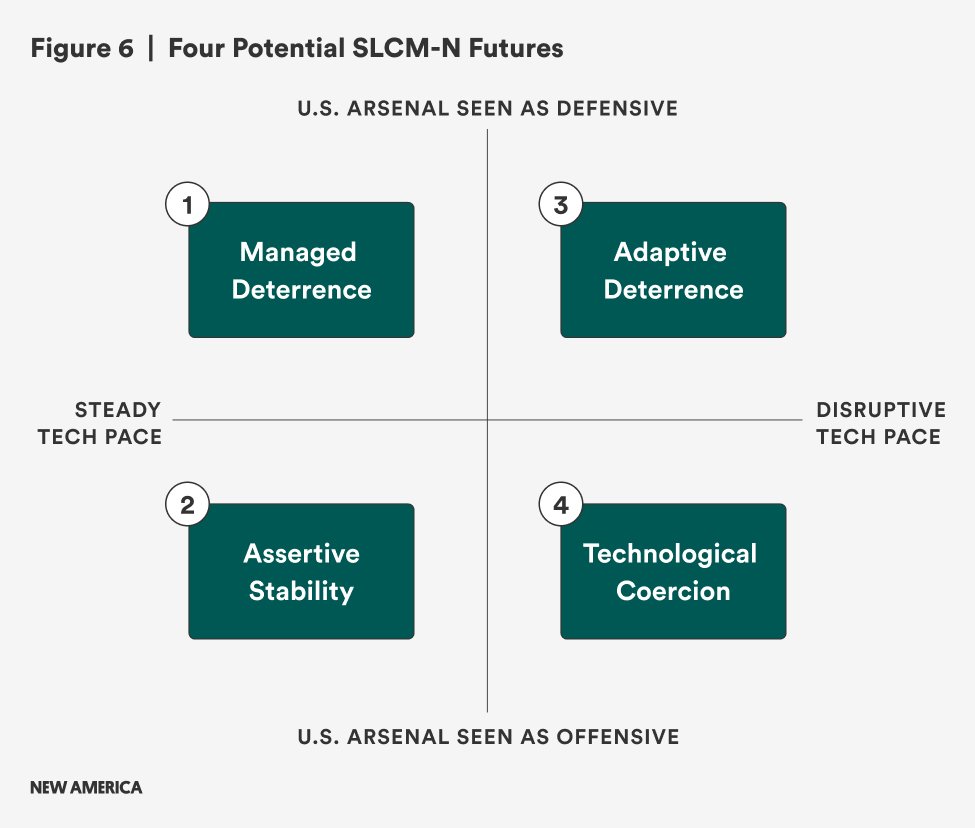
Using these two drivers, we constructed a two-by-two matrix that generates four distinct futures for SLCM-N (Figure 6). Each quadrant represents a different combination of technological change (steady versus disruptive) and perception of U.S. nuclear forces (defensive versus offensive).
Participants were then assigned to one future and asked to assess how SLCM-N functions within that environment: how it shapes allied and adversary perceptions, affects escalation dynamics, and operates across peacetime, crisis, and conflict. The sections that follow examine each future in turn, identifying the conditions under which SLCM-N is stabilizing, destabilizing, or largely neutral.
Future 1: Managed Deterrence
Tech Pace: Steady
U.S. Posture: Viewed as defensive
SLCM-N’s Role: Neutral baseline, selective hedge, limited distinct value
In this future, steady technological change converges with a widespread belief that the United States maintains a fundamentally defensive nuclear posture. Steady advances in sensing, anti-submarine warfare, missile defense, and autonomy improve performance at the margins but do not fundamentally undermine the survivability of existing forces. Command-and-control systems and delivery platforms evolve slowly due to complexity and institutional constraints. U.S. nuclear modernization is interpreted as planned and evolutionary rather than transformative, reinforcing perceptions of a primarily defensive posture.
Steady technological change still creates pressure but not disruption. Improvements in Chinese undersea sensing modestly increase risks to U.S. submarines, prompting incremental responses: investments in survivability and resilience rather than wholesale changes to force structure. Missile-defense developments follow similar trajectories: Allies largely see them as reassurance tools, while adversaries view them as manageable adjustments. Taken together, these trends do not materially destabilize the strategic environment.
Within that context, participants judged SLCM-N to have limited distinct value. Because both the technological environment and perceptions of U.S. intent remain relatively predictable, SLCM-N is seen as largely redundant with existing capabilities and unlikely to reshape escalation dynamics or change how adversaries interpret U.S. intentions. Its relevance is therefore narrow: a selective hedge for specific regional contingencies where other options carry clear operational or signaling liabilities. Participants emphasized, for example, that B61 gravity bombs are not forward-deployed in Asia; air-launched cruise missiles have long flight times; and low-yield submarine-launched ballistic missiles (SLBMs) can be misread because any SLBM launch might be interpreted as strategic. Against this backdrop, SLCM-N can offer a lower-visibility option in the limited set of scenarios in which timeliness, survivability, and escalation management matter more than raw capability. Even then, its value lies in preserving options, not in shifting the broader balance.
Expectations remain modest: Participants emphasized that leaders tend to think in categorical terms (nuclear versus non-nuclear), which limits how much an additional “tailored” option can influence real crisis behavior. As a result, SLCM-N may marginally expand a menu of politically viable responses, but it does not become a decisive tool for shaping escalation.
To assess how these dynamics vary across stages of state interaction, participants evaluated SLCM-N’s effects in peacetime, crisis, and conflict. In peacetime, SLCM-N provides marginal reassurance and niche deterrence value with low misinterpretation risk because adversary paranoia is limited and U.S. intent is relatively trusted. In crisis, it offers some additional flexibility for signaling and messaging, but participants generally agreed it would not significantly alter crisis dynamics. Allies tended to view it as a useful hedge, while adversaries assigned it only modest deterrent weight in a context where technological trajectories are steady and perceptions of U.S. posture remain defensive. In conflict, SLCM-N is unlikely to drive escalation dynamics, with effects overshadowed by larger nuclear systems; even under heightened stress, adversary fears of U.S. first use remain limited in this future precisely because the baseline expectation is restraint rather than opportunism.
Overall, Managed Deterrence is a future where steady technological change and trusted defensive U.S. intent keep deterrence architecture stable. In that setting, SLCM-N stays in the background: a neutral baseline capability and a selective hedge for narrow contingencies, not a central driver of strategic competition or stability.
Future 2: Assertive Stability
Tech Pace: Steady
U.S. Posture: Viewed as offensive
SLCM-N’s Role: Conditionally stabilizing—with limits
In this future, steady technological change converges with a persistent belief that the United States is pursuing a more assertive, offensive nuclear posture. Even routine modernization is viewed as part of a counterforce-oriented strategy: Force structure adjustments, visible deployments, and public messaging are read as signals that Washington aims to shape regional environments and may be willing to act preemptively in a severe crisis. Allies generally welcome strong U.S. commitment but are also uneasy about cues that suggest shorter decision timelines or more aggressive deterrence concepts.
Within that context, participants judged SLCM-N to be stabilizing only conditionally—and in ways that varied across phases of state interaction. In peacetime and early in crises, the system was seen as strengthening U.S. reassurance and signaling, contributing to deterrence without materially altering the strategic balance. Adversaries interpreted SLCM-N through a generally skeptical lens, viewing it as part of a broader suite of U.S. regional capabilities, but steady technological change and clear U.S. presence were judged to reinforce restraint.
As tensions rise short of war, U.S. forward presence and regional commitments become more salient, and SLCM-N is seen as contributing to deterrence messaging alongside long-range strike and other flexible systems. Its stabilizing effects were judged to persist, but participants emphasized that these benefits had clear limits: SLCM-N shaped expectations and enhanced allied resilience to coercion, yet it did not decisively influence whether conflict would occur. Visibility and scale were seen as important, however, as larger or more prominent deployments increased adversary concern about U.S. counterforce options, even when adversaries doubted Washington’s ability to neutralize their arsenals.
During conflict, participants judged that the stabilizing logic would be reversed. In wartime, SLCM-N becomes one of several capabilities that heighten adversary anxiety, compress decision time, and increase the risk of inadvertent escalation. Adversaries, particularly China, are seen as fearing that the United States might use SLCM-N or related assets to preemptively degrade command and control or to blunt escalation options. Narrative effects amplify these concerns: Years of U.S. messaging framing SLCM-N as a response to regional challenges could, in wartime, reinforce perceptions that it is optimized for rapid, limited counterforce use. Missile defense further complicates interpretation, as even modest improvements activated worst-case thinking and could prompt adversaries to accelerate arsenal expansion or escalate earlier than intended.
Overall, in this future, SLCM-N is stabilizing only up to a point: It strengthens deterrence messaging and alliance confidence before a conflict, but once fighting begins, its association with a broader counterforce-oriented posture amplifies adversary anxiety and escalation risk. The conditional stability of this future stems not from the weapon itself but from how SLCM-N is interpreted within an already skeptical strategic framing of U.S. intent.
These mixed effects stem from the broader strategic frame: steady technological evolution combined with persistently negative perceptions of U.S. intent. Because adversaries already view the U.S. posture as offensive, they read SLCM-N as part of a wider architecture built for early advantage, not as a discrete deterrent tool. This interaction between perception and capability is what produces the conditional stability of Future 2.
Future 3: Adaptive Deterrence
Tech Pace: Disruptive
U.S. Posture: Viewed as defensive
SLCM-N’s Role: Stabilizing under narrow conditions/conditionally stabilizing with limits
In this future, rapid and disruptive technological change converges with a widespread belief that the United States maintains a fundamentally defensive nuclear posture. Advances in autonomy, decision support, sensing, counterforce capabilities, integrated air and missile defense, and new delivery systems (including long-range strike) produce a continually shifting landscape. These developments compress operational timelines, obscure the survivability of long-standing force structures, and create persistent uncertainty for both allies and adversaries. While the perception of a defensive U.S. posture is perhaps not intuitive in this environment, the belief emerges as a product of how U.S. declaratory policy, alliance reassurance practices, and visible investments in command-and-control resilience continue to signal restraint even as capabilities evolve. Despite technological disruption, the United States is widely perceived as maintaining a defensive, deterrence-oriented nuclear posture (centered on restraint, assurance, distributed command and control, and continuity of extended deterrence commitments).
Within the working group’s interpretation of this environment, SLCM-N is treated as a central stabilizing feature of the deterrence architecture. Their view is that rapid technological disruption does not reduce SLCM-N’s utility or introduce vulnerabilities distinct from those faced by other nuclear systems. Even in scenarios of increased “ocean transparency,” in which advances in sensing technologies make submarines easier to detect, or in futures marked by new anti-submarine capabilities, fractional orbital bombardment systems, or more layered missile defenses, SLCM-N is described as no more vulnerable than other legs of the force and as adaptable to technological evolution over time.
From this perspective, SLCM-N’s value lies in its prompt availability, flexibility, and independence from host-nation support or overflight permissions. Participants emphasized its ability to put an expanded, evolving target set at risk as adversaries modernize and to preserve ambiguity in U.S. decision-making under conditions of rapid change. In a highly dynamic environment, SLCM-N was treated as strengthening both central and extended deterrence, particularly for allies such as Japan, South Korea, and Poland, who were assumed to seek visible and credible indicators of U.S. resolve amid technological disruption.
Participants further argued that adversary advancements—expanding arsenals, new delivery systems, and destabilizing technologies—would otherwise erode the credibility of existing U.S. options. In this context, SLCM-N, integrated with broader modernization efforts such as Columbia-class nuclear-powered ballistic missile submarines (SSBNs), long-range standoff weapons (LRSO), and the B-21 bomber, can slow or reverse erosion of the current posture. This group also discussed potential evolution of SLCM-N, including hypersonic variants, variable-yield or insertable-core warheads, and possible deployment from additional platforms such as surface combatants or even road-mobile systems. In their view, such adaptations would ensure continued relevance as technological conditions evolve and would preserve ambiguity and flexibility for national decision makers.
The scenario design originally asked whether SLCM-N would be stabilizing, neutral, or destabilizing under conditions of rapid technological disruption and a U.S. deterrent posture. Interestingly, the group moved quickly to a conclusion that it would be stabilizing across peacetime, crisis, and conflict. They did not engage deeply with how alternative assumptions might shift that outcome, nor did they explore how allied or adversary perceptions could diverge from U.S. intent. They focused instead on how SLCM-N could be integrated into a broader vision of posture adaptation and resilience in a disruptive technological era.
As a result, the working group’s version of Future 3 reflects a strong presumption that technological disruption itself increases the value of SLCM-N. In this interpretation, rapid change is understood to erode confidence in the credibility, usability, and proportionality of existing nuclear response options, creating new deterrence gaps and signaling risks. Under conditions of compressed timelines and heightened ambiguity, SLCM-N is framed as a means of restoring interpretive clarity, offering a flexible and visibly distinct capability that reassures allies, mitigates perceived response shortfalls, and reinforces extended deterrence as technological change accelerates.
However, the original scenario design could have allowed for a different baseline assumption about how stability is produced. In that alternative framing, technological disruption would not automatically generate instability requiring new nuclear capabilities. Instead, stability arises from the interaction between disruptive technologies and a U.S. posture that is clearly defensive—one emphasizing reassurance, transparency, diversified planning, and continuity of commitments. Within this logic, SLCM-N functions as a flexible hedge rather than a primary stabilizer: a supporting capability that complements a stability-producing posture rather than the principal source of stability.
The working group’s discussion diverged from this logic by elevating SLCM-N to a central pillar of deterrence, advocating expansion across multiple platforms, and assuming that ambiguity and capability growth would be interpreted as stabilizing.
Taken together, these interpretations illustrate that Future 3 contains a wide range of plausible outcomes. Depending on how technological change interacts with perceptions of U.S. intent, SLCM-N could remain a limited adaptive tool, become a more assertive posture element, or land somewhere between these positions.
In peacetime, high transparency and rapid technological change increase uncertainty across the strategic environment, but assessments diverge on whether this uncertainty is stabilizing or destabilizing. Within the working group’s interpretation, visibility into U.S. capabilities, including SLCM-N, reinforces perceptions of restraint and defensive intent, particularly when coupled with alliance consultation and consistent signaling. From this perspective, SLCM-N functions as an assurance mechanism that mitigates perceived deterrence gaps and reduces incentives for adversaries to probe U.S. commitments.
Under the alternative baseline, however, the same transparency interacts with technological disruption to heighten anxiety and reinforce worst-case thinking. Rather than reassuring, visibility amplifies concern about latent escalation dynamics, and SLCM-N is interpreted as evidence of coercive U.S. intent. In this framing, arms racing, force dispersal, and hedging behavior accelerate even in the absence of an acute crisis.
During crises, these differences become more pronounced. The working group views SLCM-N as strengthening deterrence by expanding credible response options without requiring early or escalatory employment. Its mobility and survivability are assumed to complicate adversary calculations and discourage opportunistic escalation, while reassuring allies of U.S. resolve and commitment. In this interpretation, SLCM-N contributes to clearer signaling by reducing pressure for rapid escalation.
By contrast, the alternative baseline assumes hypervigilant adversaries operating under compressed timelines, for whom SLCM-N movements are interpreted as preparation for early nuclear use. Allies respond unevenly: Some experience reassurance, while others express heightened fears of entrapment or inadvertent escalation. As competitive adaptation accelerates, signaling becomes increasingly ambiguous, undermining efforts to communicate either restraint or resolve.
In conflict, the working group anticipates that SLCM-N contributes to escalation management rather than escalation pressure. Integrated with broader modernization efforts, it is seen as preserving ambiguity for U.S. decision makers while sustaining deterrence credibility and alliance cohesion under stress.
The alternative baseline, however, suggests that the cumulative effects of mistrust, compressed decision timelines, and ambiguous signaling erode escalation control. In this case, SLCM-N’s presence does not stabilize behavior but instead narrows the space for calibrated nuclear decision-making, increasing the risk of rapid and uncontrolled escalation.
Taken together, assessments of SLCM-N in Future 3 highlight its fundamentally contingent effects on strategic stability. Under the working group’s interpretation, SLCM-N functions as a stabilizing capability that enhances assurance, expands credible response options, and supports escalation management in an environment of rapid technological change. Under the alternative baseline, however, SLCM-N’s effects are not intrinsic to the system itself. Its stabilizing potential depends on the surrounding posture, the quality of signaling and consultation, and how technological disruption shapes interpretation rather than capability alone. In this future, SLCM-N remains conditionally stabilizing, valuable as a hedge under narrow circumstances but insufficient as a primary source of stability in an environment defined by rapid technological change.
Crucially, the effects of SLCM-N in this future are shaped less by any single factor than by the interaction among technological disruption, signaling practices, and institutional cognition under stress. Rapid innovation amplifies the volume and speed of signals while simultaneously degrading shared interpretive frameworks, increasing the risk that actions intended as reassurance are read as preparation or coercion. Transparency, alliance consultation, and posture continuity can mitigate these dynamics, but only imperfectly and unevenly across actors. Where interpretive capacity is strong, SLCM-N can function as a bounded hedge within a clearly defensive posture. Where it is weak, the same capability interacts with compressed timelines and worst-case reasoning to magnify anxiety and competitive adaptation. In this sense, SLCM-N’s stabilizing or destabilizing effects emerge from second-order interactions among technology, perception, and decision-making processes rather than from the presence of the capability itself.
Future 4: Technological Coercion
Tech Pace: Disruptive
U.S. Posture: Offensive
SLCM-N’s Role: Tilts towards destabilizing
In this future, rapid technological change converges with a widespread belief that the United States has an offensive nuclear posture. Breakthroughs in AI-enabled sensing, autonomous maritime systems, hypersonic delivery platforms, and integrated missile defenses, including a fully operational Golden Dome missile defense system, convince adversaries that Washington seeks early warfighting options and has growing confidence in its ability to blunt or absorb retaliation. Military movements are highly visible, attribution is fast, and states operate with continuous transparency and hypervigilance. Adversaries interpret nearly every new U.S. capability as aggressive, hardening their threat perceptions and reducing their risk tolerance.
Adversaries respond by expanding and diversifying arsenals and by experimenting with more reactive postures. Russia and China increase both strategic and nonstrategic nuclear forces and invest in systems that complicate U.S. operations and defenses. China increasingly embraces low-yield options, develops a wider range of warhead types, adopts “put a nuclear option on everything” thinking, and seeks asymmetric advantages in space and counterspace. Under pressure, Chinese planners consider greater automation in nuclear decision-making and more rapid launch postures. Russia, constrained conventionally, leans on cyber-operations, gray-zone activities against allies, and disruptive behavior in regions such as the Middle East and the Korean Peninsula. Both states explore space-based nuclear or anti-satellite systems and other “exotic” capabilities that challenge U.S. sensing and missile defense architectures.
Allies become more capable and operationally autonomous. In Europe, long-standing investments in conventional forces reduce day-to-day reliance on U.S. power even as NATO’s strategic alignment endures. In both Europe and Asia, however, leaders worry about entrapment in crises shaped by a U.S. posture that appears increasingly aggressive. Some allies view new American capabilities, including SLCM-N, as overdue demonstrations of resolve. Others see them as evidence that Washington has shifted away from a primarily defensive role and now accepts higher escalation risks, particularly under the perceived protection of advanced defenses and strike systems.
Within this setting, SLCM-N fits neatly into a broader pattern of new and modernized U.S. capabilities that adversaries read collectively as coercive. Its deployment at sea, with invisibility and unknown employment concepts, reinforces their belief that the United States wants flexible options early in a conflict and is willing to shorten decision times by operating close to their territory. This perception amplifies paranoia, accelerates efforts to disperse and harden forces, and strengthens arguments for launch-under-attack or even launch-on-warning postures. The discrimination challenge, especially amid eroding trust in sensors and data, raises the risk that any movement or signaling involving SLCM-N will be interpreted as preparation for first use.
For allies, SLCM-N’s effects tilt toward destabilization rather than reassurance. In peacetime, some see it as a needed adjustment that closes perceived gaps relative to expanding Chinese and Russian dual-capable systems and signals U.S. readiness to respond across escalation levels. But others view it as another indicator that U.S. nuclear policy has become less predictable and that Washington may rely on nuclear tools more readily under the Golden Dome’s perceived protection. In crisis conditions, these divergent interpretations complicate alliance management and undermine coherent signaling. While SLCM-N may reassure some actors and deter certain forms of aggression, in an environment shaped by technological coercion, its marginal effect is to amplify existing anxieties about U.S. offensive intent and accelerate competitive nuclear and technological adaptation.5
In a variant of Future 4 suggested by some group members, rapid technological disruption still reshapes the strategic environment, but U.S. nuclear posture is interpreted by many actors as restrained and rule-bound rather than coercive. This pathway rests on the assumption that shared interpretive frameworks remain sufficiently robust that signaling, declaratory policy, and alliance consultation continue to anchor assessments of intent even as capabilities evolve. Although new capabilities increase baseline uncertainty, they do not consistently trigger worst-case threat perceptions because U.S. signaling, declaratory policy, and alliance consultation anchor expectations of defensive intent. In this pathway, SLCM-N adds options to the U.S. deterrence toolkit but remains secondary to the broader posture shaping perceptions of intent. Allies are generally supportive, interpreting the system as consistent with established commitments, and adversaries tolerate its presence as one element within a highly competitive but familiar technological environment. This reading diverges from the dominant Future 4 logic by assuming that transparency and signaling can still encourage benign interpretations of U.S. intent.
During crises in this alternative Future 4, emerging technologies generate noise and ambiguity, compressing timelines and increasing cognitive strain, but U.S. intent is not widely assumed to be escalatory. Misinterpretation risks thus stem primarily from technical complexity, sensor saturation, and information overload rather than from fears of deliberate early nuclear use. SLCM-N can in some cases clarify U.S. commitment—particularly in Asia—by reinforcing extended deterrence at moments of stress. This stands in contrast to the dominant Future 4 variant, in which the same signals are read as coercive and heighten fears of preemption or entrapment.
During a conflict in this alternative, assessments of SLCM-N’s effects hinge on U.S. employment concepts and signaling discipline. If SLCM-N is embedded within a clearly articulated escalation management framework, it may contribute to stabilizing outcomes by preserving decision space and offering options short of large-scale escalation. However, this pathway remains fragile. Even modest shifts in perception—toward viewing U.S. capabilities as enabling warfighting rather than deterrence—would quickly collapse this stabilizing logic and pull dynamics back toward the dominant Future 4 pattern of technological coercion.
In this alternative Future 4, outcomes are driven by the effects of interaction among technological acceleration, signaling discipline, and persistent shared interpretive frameworks. Rapid innovation increases uncertainty and compresses decision timelines, but its destabilizing potential is mediated by how signals are processed rather than by capability growth alone. Where transparency, alliance consultation, and declaratory consistency reinforce expectations of restraint, new capabilities are incorporated into existing mental models instead of triggering worst-case escalation dynamics. SLCM-N’s effects therefore depend on its interaction with these interpretive and institutional buffers: When embedded within a posture that reliably communicates defensive intent, it functions as an additional option within that posture; when those buffers weaken, the same capability risks tipping perceptions toward coercion. Stability in this variant is thus an emergent property of these interactions, not a direct consequence of technological restraint or capability limitation.
Futures Assessment
Encompassing the spectrum of uncertainty about how technology and perceptions will interact to shape strategic stability, these four futures show that SLCM-N’s effects are not intrinsic to the system but contingent on broader structural conditions. When the pace of technological change is stable and U.S. posture is perceived as defensive, SLCM-N exerts limited influence. When perceptions shift towards offensive or technological change is disruptive, it becomes an accelerant of misperception and competitive adaptation. The alternative futures demonstrate the wide range of plausible environments in which policymakers may evaluate SLCM-N’s risks, signaling value, and potential contribution to regional deterrence a decade from now.
SLCM-N’s Marginal Versus Decisive Value
SLCM-N’s influence varies widely across the four futures. It is most decisive in Future 2 (Assertive Stability), in which steady technological evolution and adversary perceptions of an assertive U.S. posture elevate the importance of visible regional capabilities. In this environment, SLCM-N becomes a meaningful instrument for shaping expectations about U.S. presence and commitment, particularly in the Indo-Pacific. It reinforces extended deterrence, strengthens early-crisis resolve, and signals that Washington intends to remain engaged even as escalation risks rise. These effects give SLCM-N disproportionate leverage relative to its size within the broader force posture.
In Future 1 (Managed Deterrence), by contrast, SLCM-N is marginal. Sustained positive perceptions of the U.S. posture and predictable technological change lower the demand for additional flexible nuclear options. Assurance is already strong, adversary paranoia is muted, and crisis stability is robust. In this setting, SLCM-N functions as a supplemental hedge or niche deterrent rather than as a capability that alters strategic dynamics. It is likewise marginal in Future 3 (Adaptive Deterrence), in which disruptive technological change introduces uncertainty but the United States is still viewed as a stabilizing actor. Although it can contribute to reassurance in specific regional contexts, its peacetime reassurance effects are overshadowed by the broader volatility introduced by rapid technological shifts and are reversed during conflicts. Its value depends heavily on signaling and employment concepts rather than on the system itself.
In Future 4 (Technological Coercion), SLCM-N is not decisive in the constructive sense, but it is highly consequential as a contributor to instability. Disruptive technological change, pervasive transparency, and negative interpretations of U.S. intent create an environment in which adversaries read SLCM-N as a coercive tool designed for early use. It becomes an accelerant of arms racing, misperception, and preemptive incentives. Although its impact on outcomes is significant, it does not decisively improve deterrence; instead, it deepens crisis instability.
Taken together, these distinctions show that SLCM-N has a positive impact or is considered useful only when perceptions of U.S. assertiveness raise the value of forward engagement but technological conditions remain stable enough to prevent runaway escalation (Future 2, Assertive Stability). In all other futures, the capability is either marginal or contributes primarily to instability rather than deterrence.
SLCM-N in the Indo-Pacific Theater
The scenario planning exercise reinforced one of our findings from Phase I of the project: that SLCM-N has the most relevance for the Indo-Pacific, though that value also varies across futures. In that region, it delivers its greatest strategic utility in Future 2 (Assertive Stability), in which technological change is steady but U.S. intentions are interpreted as more offensive, because U.S. allies in the Indo-Pacific face intense coercive pressure and place a premium on visible indicators of U.S. commitment. SLCM-N strengthens extended deterrence by demonstrating that Washington is prepared to remain engaged even as escalation risks rise, and it signals deeper U.S. interest in the region without requiring early movement of strategic forces. Adversaries, particularly China, are expected to read the capability as evidence that the United States will not be pushed out of theater, which can temper coercion at the conventional level and reinforce allied resilience in the early stages of crises.
By contrast, SLCM-N’s value is more modest in Future 1 (Managed Deterrence), when positive perceptions of U.S. intent reduce the need for additional regional signaling. Its regional utility becomes mixed in Future 4, in which disruptive technological change and negative interpretations of U.S. posture generate acute misperception risks that diminish the stabilizing benefit SLCM-N might otherwise provide. In Future 3 (Adaptive Deterrence), while rapid technological change creates uncertainty, benign interpretations of U.S. behavior keep SLCM-N’s role context-dependent rather than decisive.
Together, these comparisons show that SLCM-N’s Indo-Pacific value is highest when allies seek reassurance, adversaries test U.S. resolve, and the broader environment remains technologically manageable enough to avoid runaway escalation dynamics.
Crux Point: China’s Reaction
A crux point is a factor that plays an outsize role in determining which strategic path emerges when underlying conditions are otherwise similar. Such points matter because they show where outcomes depend most on how situations are interpreted, signaled, and acted upon rather than material capabilities alone.
Across all scenarios, discussion repeatedly returned to the question of China’s interpretation of the U.S. posture. Beijing’s reaction to SLCM-N constitutes the central crux point in this analysis, influencing whether similar technological and geopolitical pressures translate into stabilizing or destabilizing pathways.
The forecasting discussed in the next section reinforces this conclusion. Chinese nuclear expansion is the area of strongest expert consensus; China’s potential signaling behavior around Taiwan is the most uncertain geopolitical variable; and any doctrinal shifts in either would have disproportionate effects on U.S. force planning. Together, these patterns highlight that China’s response is both highly consequential and highly sensitive to interpretation.
These dynamics underscore once again that SLCM-N’s utility is not inherent to the capability itself (as scenario discussions revealed) but contingent on how Beijing interprets the deployment’s purpose, risks, and escalation thresholds. In futures where China views the U.S. posture as defensive and predictable, SLCM-N adds limited marginal value. In futures where Beijing interprets U.S. actions as competitive or coercive, SLCM-N becomes a focal point for counter-posture, signaling cycles, and crisis instability. As a result, China’s reaction consistently distinguishes stabilizing from destabilizing trajectories across all four alternatives.
Phase III: Forecasting
In the forecasting stage, we asked experts to assign probabilities to a set of 15 questions about the strategic environment in the year 2035. Our goal was to identify indicators of drift to examine which of the four futures gain or lose plausibility in light of expert judgments about key developments, not as forecasts of inevitability or predictions of a single future.
The future scenarios developed earlier—Managed Deterrence, Assertive Stability, Adaptive Deterrence, and Technological Coercion—are treated as alternative strategic baselines against which forecasting results were interpreted. Each represents a distinct configuration of technological conditions, geopolitical behavior, and perceptions of U.S. nuclear posture.
We developed forecasting questions to capture observable developments that could signal movement toward or away from any of the four potential futures. The questions focused on changes in strategic stability conditions, posture and doctrinal adaptation, and political or behavioral shifts relevant to the scenarios. (To examine the full set of questions, refer to Figure 7.)
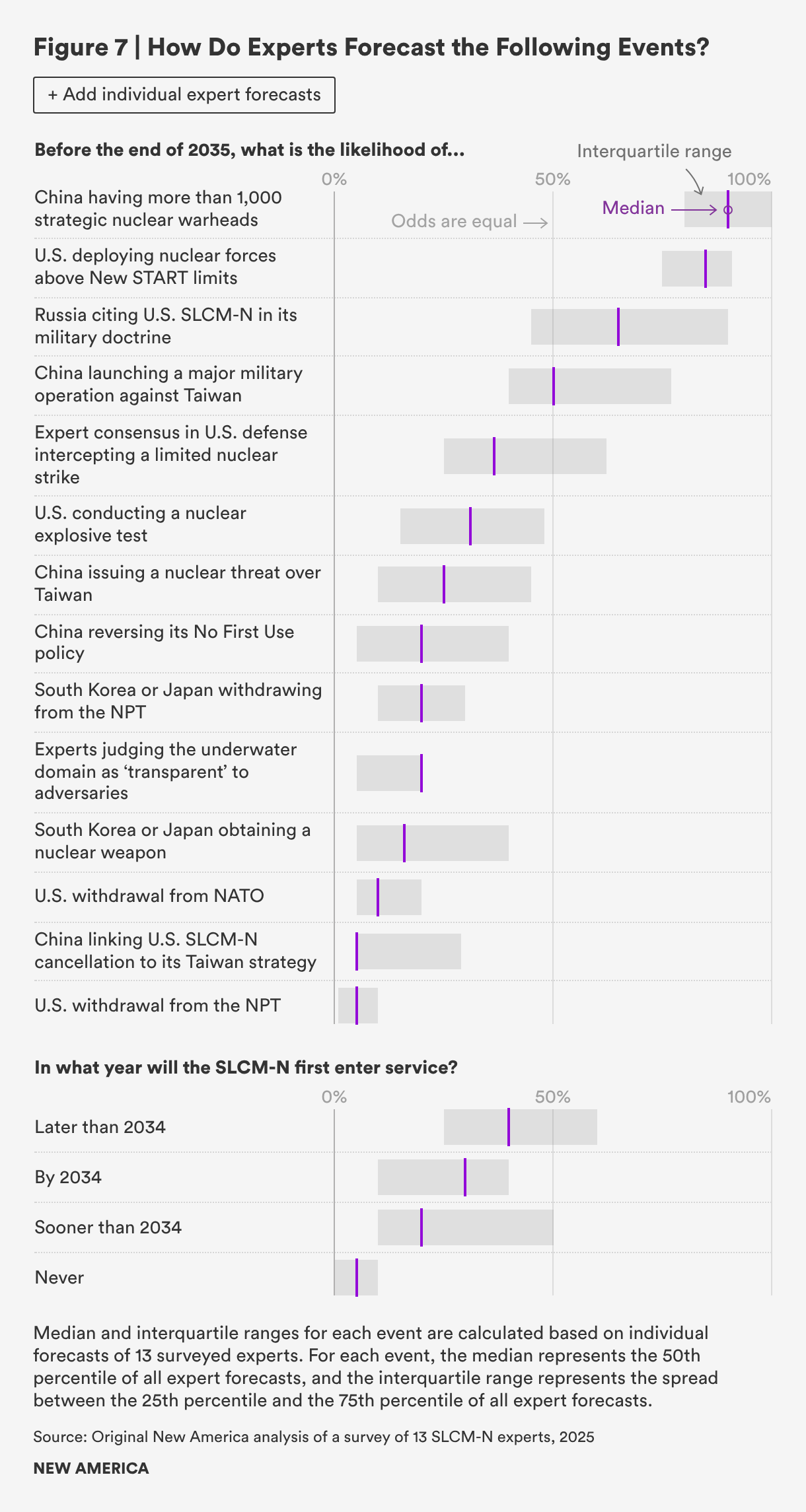
We then classified forecasting indicators by functional role—structural, posture/doctrinal, or political/behavioral—and weighted them according to their relevance for each scenario. We assigned weights using two criteria: (1) necessity, capturing whether a development is required for a given scenario to exist coherently, and (2) constraint power, capturing the extent to which an indicator would limit strategic choices by altering survivability, warning time, or escalation control. We applied ordinal weights using the maximum of these two criteria.
Finally, we applied expert probability assessments to the weighted indicators to evaluate patterns of reinforcement and refutation across scenarios. Rather than aggregating probabilities numerically, the analysis examines whether high-weight indicators are judged likely or unlikely and whether reinforcing indicators cluster within particular futures. This pattern-based interpretation allows the forecasting results to discriminate among the four futures, revealing which ones are being reinforced, weakened, or left contingent, and to assess how the strategic relevance of specific capabilities, including SLCM-N, varies across the four plausible futures.
Discriminating Patterns Among Scenario Futures
According to forecasting data, Managed Deterrence (tech pace steady; U.S. posture defensive) is increasingly difficult to sustain as a baseline future. Experts assign relatively low probabilities to destabilizing geopolitical shocks such as alliance withdrawal, treaty exit, explicit nuclear threats, or rapid allied proliferation (see Figure 7). But these signals are outweighed by higher probabilities of structurally disruptive developments, including expectations of significant Chinese nuclear force expansion, plausible erosion of undersea survivability, and growing confidence in missile defense effectiveness. These signals collectively undermine the structural continuity on which Managed Deterrence depends. Even in the absence of overt nuclear brinkmanship, these developments weaken the assumptions of stable mutual vulnerability and bounded competition. As a result, Managed Deterrence appears increasingly implausible as a durable trajectory toward which the strategic environment is heading. This would not be the case if technological change stalls, proves strategically inconsequential, or is distributed and absorbed across systems in ways that preserve stable mutual vulnerability, all of which would make Managed Deterrence appear to be a coherent and durable baseline future.
Assertive Stability (tech pace steady; U.S. posture offensive) remains a plausible but fragile pathway. Forecasting data show meaningful probabilities of posture and doctrinal indicators associated with competitive signaling, including Russian doctrinal revision referencing SLCM-N, nontrivial expectations of U.S. nuclear testing, and the potential deployment of SLCM-N. These developments align with a world characterized by heightened nuclear signaling and visible posture adjustment within an otherwise intact deterrence framework. Curiously, during scenario planning, members assigned to this future felt that it was the most plausible one.
However, Assertive Stability presumes that technological conditions underpinning survivability and escalation control remain largely stable. The same structural indicators that undermine Managed Deterrence also strain this assumption. As technological uncertainty increases, the signaling logic central to Assertive Stability becomes harder to sustain, rendering this world viable but increasingly contingent on technological disruption proving more limited than many experts expect. This assessment would change if technological conditions remain sufficiently stable to preserve survivability, warning, and escalation control and if competitive signaling and posture adjustments consolidate into a durable equilibrium rather than eroding under growing technological uncertainty.
Adaptive Deterrence (tech pace disruptive; U.S. posture defensive) emerges as the most strongly reinforced (or anticipated) future. Expert forecasts converge most clearly on indicators associated with technological disruption: large-scale Chinese nuclear expansion, plausible erosion of undersea survivability, and growing belief in the effectiveness of missile defense against limited strikes. At the same time, experts assign relatively low probabilities to explicit nuclear threats, alliance breakdown, or treaty exit. This combination—structural disruption without overt geopolitical rupture—is precisely the condition under which Adaptive Deterrence arises. In this world, states adapt to eroding assumptions about survivability, warning, and escalation control through greater flexibility, hedging behavior, and probing, even as institutional frameworks and formal restraint largely persist. This assessment would be altered if technological disruption either fails to materialize (or stalls) or drives overt geopolitical rupture—such as explicit nuclear coercion, alliance breakdown, or rapid abandonment of restraint—rather than adaptation within existing institutional frameworks.
Technological Coercion (tech pace disruptive; U.S. posture offensive) remains a plausible but unlikely future. While several structural prerequisites for coercive leverage appear increasingly plausible, the political and behavioral indicators required to align with this future—explicit nuclear threats, China’s abandonment of a No First Use policy, alliance or treaty collapse, or overt nuclear coercion—remain comparatively unlikely, according to expert assessments. Absent convergence across these categories, Technological Coercion does not dominate. Instead, it represents a plausible escalation pathway should multiple high-impact thresholds be crossed. This assessment would change if political and behavioral indicators converge with structural developments—most notably through explicit nuclear threats, abandonment of No First Use, alliance or treaty collapse, or sustained coercive signaling—elevating Technological Coercion from a contingent pathway to a dominant strategic trajectory.
Taken together, the forecasting results reinforce Adaptive Deterrence as the most plausible trajectory toward which our strategic landscape is headed, with Assertive Stability as a secondary but fragile alternative. Managed Deterrence is increasingly ruled out, while Technological Coercion remains a contingent risk dependent on additional geopolitical escalation.
Importantly, the two futures experts judged to be most likely, Assertive Stability and Adaptive Deterrence, sit diagonally opposite one another on the scenario matrix (Figure 6). This pattern suggests that technological change and U.S. nuclear posture are not independent variables but interact in ways that shape leaders’ confidence, risk tolerance, and strategic judgment. When technological change is relatively steady, as in Assertive Stability, leaders tend to believe they understand escalation dynamics, signaling pathways, and adversary responses with sufficient clarity. That confidence makes greater risk-taking and a more assertive U.S. nuclear posture appear both manageable and stabilizing, reinforcing the view that firmness and capability can be exercised without losing control.
By contrast, when technological change is disruptive, as in Adaptive Deterrence, uncertainty expands faster than shared understanding. Compressed timelines, opaque system interactions, and unclear escalation thresholds weaken leaders’ confidence in their ability to predict how actions will be interpreted or where escalation might lead. In this environment, caution becomes a stabilizing strategy. The United States is more likely to emphasize restraint, reassurance, and defensive signaling, not because threats are lower but because the costs of misinterpretation and unintended escalation are perceived to be higher.
This interaction helps explain why SLCM-N’s value varies across futures. Its utility depends less on the capability itself than on whether the strategic environment rewards flexibility and assertiveness or favors restraint and caution. The diagonal pattern therefore reflects an expectation that U.S. nuclear strategy adjusts to levels of technological uncertainty.
Citations
- Interview responses were coded across 19 variables that repeatedly surfaced in expert discussions (e.g., beliefs about deterrence gaps, perceived risks of escalation, arms-race dynamics, and expectations of adversary responses). Each variable was scored on a five-point scale using a predefined rubric and codebook, with intermediate values capturing conditional or qualified positions. Scores were used to estimate relative similarity across experts, producing the clustering and distances shown in Figures 1 and 2.
- Paul J.H. Schoemaker, “Scenario Planning: A Tool for Strategic Thinking,” Sloan Management Review 36 (Winter 1995), source.
- Peter Schwartz, The Art of the Long View: Planning for the Future in an Uncertain World (Doubleday, 1991).
- Sohail Inayatullah, “Future Studies: Theories and Methods,” Metafuture (2013), source.
- The horizon scan preceding scenario planning also surfaced a critical background assumption: Experts initially rated the prospect of nuclear use by 2035 as highly consequential and highly uncertain, then gradually treated limited nuclear use as more likely than not. If a precedent for nuclear use emerges during this period, assessments of SLCM-N could shift again. Analysts might judge it less uniquely destabilizing in a world where nuclear thresholds have already eroded, or they might view additional flexible options as especially dangerous. The likelihood and character of nuclear use before 2035 thus become essential inputs for any forecasting exercise tied to this scenario.
Findings
This study yields nine core findings.
1. Disagreement over the nuclear-armed sea-launched cruise missile (SLCM-N) reflects competing mental models, not disputed facts. Expert disagreement is driven less by different assessments of SLCM-N’s technical performance or force structure than by divergent underlying models of deterrence, escalation, and risk. Confidence-, Caution-, and Contingent-oriented experts often reference the same strategic trends—such as Chinese nuclear expansion and the concerns of South Korea and Japan—but reach opposing conclusions because they reason from different assumptions about adversary behavior, crisis dynamics, and escalation control. As a result, debates over SLCM-N persist even when factual premises largely converge.
2. SLCM-N’s value is conditional, not intrinsic. Across the four futures examined, SLCM-N proves decisive only in a narrow set of conditions. It matters most when U.S. resolve is actively contested and escalation dynamics remain relatively predictable—specifically, given a more assertive U.S. posture and steady technological change. In more benign environments, SLCM-N adds little marginal value; in highly disruptive environments, it can increase misperception and escalation risk. No future supports a claim that SLCM-N is either categorically stabilizing or categorically destabilizing.
3. How U.S. actions are interpreted matter as much as what capabilities are deployed. Across interviews and scenarios, outcomes are shaped less by the presence of SLCM-N than by how adversaries—particularly China—interpret U.S. intent. The same deployment can deter coercion and reassure allies in one future while provoking arms racing or escalation in another. This finding reinforces a practical lesson: Posture choices cannot be evaluated independently of how they are read by others. Declaratory policy, signaling, and communication strategy therefore shape escalation risk as much as hardware.
4. U.S. nuclear posture tracks the pace of technological change. Forecasting results show that the two most likely futures sit diagonally from one another: Assertive Stability (steady technological change with a more assertive U.S. posture) and Adaptive Deterrence (disruptive technological change with a more defensive posture). This pattern indicates that experts do not view technological change and U.S. posture as independent drivers. When technological change is steady, leaders feel more confident in escalation dynamics and signaling, making offensive nuclear posture appear manageable. When technological change is disruptive, uncertainty pushes the United States toward defensive nuclear strategy.
5. Experts judge Adaptive Deterrence as the most likely future in 2035. The most likely future is characterized by disruptive technological change combined with a U.S. posture perceived as defensive. Interestingly, Adaptive Deterrence is not the future where SLCM-N has the greatest utility.
6. The Indo-Pacific is where SLCM-N’s effects matter most—and where risks concentrate. Experts broadly agree that SLCM-N has greater potential relevance in the Indo-Pacific than in Europe given maritime geography, the lack of forward-deployed U.S. nuclear weapons, and alliance assurance dynamics involving Japan and South Korea. Forecasts indicate a meaningful probability of large-scale Chinese military action against Taiwan alongside a low likelihood of explicit nuclear threats or an abandonment of China’s No First Use policy. This combination suggests that escalation risks are driven primarily by conventional conflict dynamics rather than immediate nuclear signaling. U.S. policy should therefore prioritize crisis management, early-warning coordination with allies, and avoiding posture changes that heighten Chinese threat perceptions during conventional crises.
7. Alliances and norms remain the strongest stabilizing force. Experts consistently assessed NATO cohesion and allied nonproliferation as durable across most futures, with low probabilities of alliance fracture or allied nuclear proliferation. Importantly, these assessments were made before the recent tensions over Greenland and the end of the New START arms reduction treaty. While the forecasts suggest that alliance stability is robust under baseline conditions, the analysis also indicates that risks rise significantly in futures marked by more offensive state behavior, a pattern recent developments may help illuminate.
8. SLCM-N is a contested and highly conditional bargaining chip for future arms control. Experts were divided on whether SLCM-N would provide meaningful leverage in future arms control negotiations. Some viewed it as a potential negotiating chip that could be traded for limits on nonstrategic nuclear weapons or emerging systems, particularly if broader arms control frameworks are revived. Others argued that its value as a bargaining chip is limited by verification challenges, its role in alliance assurance, and the risk that giving it up would yield little reciprocal restraint. Additionally, SLCM-N effects in the four futures indicate that its bargaining value could depend on timing and context: It may be tradable in an environment of bounded competition and credible arms control, but it risks undermining deterrence and assurance if it’s used for bargaining in more competitive conditions.
9. Resumed U.S. nuclear testing would have grave consequences. Our scenario planning phase showed that any U.S. test—regardless of yield—would carry disproportionate signaling consequences, affecting global norms, alliance confidence, and competitor threat perceptions, and could prompt reciprocal testing by China or Russia. Decisions about testing should therefore be evaluated primarily as strategic signals rather than as technical measures.
Policy Implications
The findings above carry several implications for U.S. nuclear policy and force planning.
1. The nuclear-armed sea-launched cruise missile (SLCM-N) should be treated as a hedge, not a fix. Our analysis does not support treating SLCM-N as a cornerstone of extended deterrence or a singular response to perceived deterrence gaps. Its contribution is contingent and time-bound. Overreliance on the system risks crowding out attention to broader posture, signaling, and alliance-management challenges that ultimately determine credibility.
Because SLCM-N’s relevance varies across strategic conditions, decisions about its development, deployment, and signaling should be tied to observable indicators rather than treated as a static requirement. Policymakers should focus in particular on:
- Whether adversary perceptions of U.S. escalation options are narrowing
- Whether technological trends undermine air-delivered or dual-capable systems
- Whether Russia integrates U.S. sea-based systems into force-planning narratives
- Whether Chinese nuclear signaling becomes more explicit or assertive
Adjusting SLCM-N development or deployment in response to these indicators would allow the United States to manage uncertainty without overcommitting to a capability that may have limited relevance in more stable futures.
2. Concept of operations (CONOPS) ambiguity is now a strategic variable. Unresolved questions about deployment patterns, visibility, commingling with conventional payloads, and command-and-control procedures are not merely technical. They will shape how SLCM-N is interpreted and therefore how it affects stability. Leaving these questions unresolved increases the risk that the system’s effects will be driven by adversary inference rather than U.S. intent.
3. Modernization interactions matter more than individual systems. SLCM-N will emerge alongside long-range standoff weapons (LRSO), the B-21 bomber, low-yield submarine-launched ballistic missiles (SLBMs), missile-defense developments, and possible testing decisions. Its impact will be cumulative, not discrete. Policymakers should therefore evaluate SLCM-N as part of an evolving portfolio rather than in isolation, especially given how adversaries aggregate signals across systems.
4. Alliance assurance is poorly specified but strategically decisive. Throughout this project, “assurance” functions as a shorthand rather than a clearly articulated requirement. Allies appear reassured by the existence of capability but uncertain about its meaning, employment, and implications. This ambiguity can stabilize or destabilize depending on context. Without a clearer understanding of what allies actually find reassuring, SLCM-N risks becoming a symbolic substitute for sustained political engagement.
5. China’s interpretation is the central crux point. Across all futures, China’s response functions as the decisive crux point. Whether SLCM-N stabilizes or destabilizes depends less on U.S. intent than on Beijing’s beliefs about U.S. escalation thresholds, warfighting concepts, and confidence in defenses. Monitoring Chinese doctrinal signals and perception shifts is therefore as important as tracking the system’s technical development.
Policy Recommendations
Based on these findings and implications, the report offers seven recommendations aimed at improving nuclear decision-making amid deep uncertainty.
1. Plan for sustained nuclear competition with China and Russia. Expert forecasts show a strong consensus that we should expect Chinese nuclear expansion and ongoing Russian doctrinal adaptation. These developments represent a durable trend toward a more contested nuclear environment even under otherwise stable geopolitical conditions. Policymakers should expect pressure on extended deterrence, increased signaling risks, and narrower margins for misinterpretation in crises. This trend strengthens the importance of flexible, resilient force options but also elevates the need for disciplined communication and transparency to prevent unintended escalation.
2. Treat technological disruption as a source of uncertainty, not a prediction. Experts do not agree on whether disruptive technologies—such as improved submarine sensing, advanced missile defense, or novel intelligence, surveillance, and reconnaissance (ISR) capabilities—will decisively transform the military balance, even as many anticipate increasing technological pressure on existing deterrence assumptions. Policymakers should therefore avoid planning anchored to assumptions of either continuity or imminent, system-wide disruption. Instead, force design should prioritize modularity, platform diversity, and hedging options that mitigate the risk of surprise. Investments that reduce reliance on any single survivability assumption (undersea, airborne, or space-based) are most robust across the range of futures identified.
3. Stress-test the nuclear-armed sea-launched cruise missile (SLCM-N) across futures before committing to a scale or posture. Rather than assuming a single future, policymakers should evaluate how different deployment choices perform across the four possible worlds. This approach identifies where SLCM-N is robust, where it is fragile, and where mitigating measures are required.
4. Link SLCM-N development and deployment to observable indicators. Decisions about numbers, visibility, and employment should be tied to indicators such as adversary signaling behavior, technological developments affecting survivability, and alliance confidence trends. This enables an adaptive posture rather than a static commitment.
5. Clarify concept of operations (CONOPS) early to shape perception. Even if some ambiguity is retained, the United States should articulate internally coherent concepts of operation and externally consistent messaging. Allowing adversaries to infer intent from silence increases the risk of worst-case interpretation.
6. Invest in alliance consultation as a stabilizing mechanism. Allies differ in how they interpret ambiguity, visibility, and escalation risk. Tailored consultation, rather than uniform messaging, will better align expectations and reduce crisis miscalculation.
7. Make underlying mental models explicit in policy deliberations using futures tools. Policy discussions should explicitly surface the assumptions driving expert advice and recommendations. Doing so clarifies whether disagreements stem from facts or from competing theories of escalation and deterrence, reducing circular debates and improving analytic rigor. Futures tools—such as forecasting, scenario planning, red teaming (mimicking real-world threats), pre-mortems, and competing hypothesis analysis—can help expose untested assumptions embedded in expert judgments. This process clarifies risks and improves policy resilience.
Future Research and Analysis
This study shows that disagreements over the nuclear-armed sea-launched cruise missile (SLCM-N) stem less from disputes over evidence than from fundamentally different assumptions about how deterrence works, how crises unfold, and how adversaries respond to U.S. actions.
Two research-relevant implications follow.
1. Additional evidence alone is unlikely to resolve policy disagreement. Because experts weigh risks differently and prioritize different failure modes, new technical analyses or capability comparisons tend to reinforce existing positions rather than create consensus. What appears to be a factual disagreement is often a disagreement about which risks matter most and which can be managed. Research that treats disagreement as an information gap risks missing the real sources of contention.
2. Mental models act as “hidden drivers” of expert recommendations and positions. The Confidence, Caution, and Contingent Models identified in the study produce consistent differences in how experts evaluate ambiguity, flexibility, and restraint. Policymakers assessing expert advice therefore need to understand which model a recommendation reflects to understand why it is being made.
Each mental model privileges certain risks and downplays others. For example:
- The Confidence Model may underweight misinterpretation risks.
- The Caution Model may overstate the escalatory impact of marginal posture changes.
- The Contingent Model may underestimate moments when clarity and commitment become decisive.
Making these tendencies explicit helps identify where planning and analysis may be skewed. These implications point to several research extensions that would improve policy-relevant understanding of SLCM-N and nuclear risk more broadly.
3. Scenario-driven war-gaming of SLCM-N in crisis and conflict. A direct continuation of this project would adapt the four futures into war games that would force participants to make concrete choices about deployment, signaling, and escalation under time pressure. This would clarify when SLCM-N meaningfully alters outcomes, when it does not, and which assumptions about adversary behavior drive those judgments.
4. A focused study of alliance assurance requirements and/or track II dialogues (which are informal discussions among former officials, experts, and academics intended to explore sensitive issues outside official diplomatic channels). Throughout this report, “assurance” often functions as shorthand for a complex and poorly specified set of allied expectations. A focused follow-on study or track II dialogues could examine what allies—particularly Japan and South Korea—actually find reassuring or destabilizing, how nuclear versus non-nuclear signals are interpreted, and whether SLCM-N contributes directly to confidence or merely signals U.S. presence. This would replace assumption-driven reasoning with empirically grounded insight that would strengthen both alliance management and force-planning decisions.
5. Longitudinal forecasting to track shifts in expert beliefs. A natural extension of our project’s forecasting effort would be a study in which the same cohort of experts periodically revisits its judgments as geopolitical conditions, technologies, and doctrines evolve. Iterated elicitation would allow researchers to observe how beliefs update over time, which indicators drive reassessment, and where consensus hardens or fragments. Such a study would create a dynamic risk-tracking capability directly relevant to long-term posture planning.
Beyond these core potential research extensions, several additional lines of inquiry could address persistent analytical gaps, including:
- How Chinese and Russian strategists interpret specific U.S. posture changes
- How emerging technologies compress decision time and affect escalation pathways
- How bureaucratic roles, civil-military relations, and domestic political incentives shape expert judgment and nuclear decisions
Conclusion
This report does not argue for or against the nuclear-armed sea-launched cruise missile (SLCM-N). Instead, it demonstrates a more consequential point: The value and risk of SLCM-N depend on the future strategic environment into which it is introduced. The persistent debate over the system is therefore not driven by information gaps among experts. Rather, it reflects different expectations about how future crises will unfold—how adversaries interpret U.S. actions, how technological change affects escalation control, and how much uncertainty future leaders believe can be managed. This pattern suggests that similar disagreements are likely to arise whenever new nuclear capabilities are proposed or nuclear doctrine is adjusted.
The futures tools employed in this project demonstrate that SLCM-N is most consequential only under specific conditions: when U.S. resolve is contested and escalation dynamics remain relatively predictable. Outside those conditions, its effects are limited: In some futures it adds little marginal value, while in others it risks increasing instability. No scenario supports the view that SLCM-N is either a decisive solution or an inherently destabilizing capability across all environments.
Forecasting results further indicate that the most likely trajectory toward the mid-2030s is neither stable continuity nor overt breakdown but Adaptive Deterrence: a world shaped by disruptive technological change alongside continued restraint on the part of the United States. In this environment, posture choices are judged less by their technical characteristics than by how they are perceived—particularly by China. Across scenarios, Beijing’s interpretation of U.S. intent emerges as the central factor separating stabilizing from destabilizing outcomes.
Taken together, these conclusions point to a broader methodological lesson. Forecasting and scenario-based judgment are not only possible in nuclear policy, they are necessary. Long-horizon capabilities like SLCM-N will be judged by future leaders and adversaries and in crises that differ markedly from those of today. Structured futures methods provide a way to discipline judgment despite deep uncertainty, clarify where assessments are robust or fragile, and identify the conditions under which policy choices should be revisited.
Looking forward, future nuclear policy should blend expert insight with structured futures tools rather than privileging one over the other. Expertise remains indispensable, but without methods that surface assumptions, test counterfactuals, and track changing expectations, even seasoned judgment risks becoming anchored to outdated frames. The approach used here offers a template for integrating qualitative expertise with scenario planning and probabilistic forecasting to inform decisions amid uncertainty.
Appendix
Glossary of Terms
- ALCM: air-launched cruise missile
- Assurance: measures and commitments intended to signal to allies that the U.S. will defend them credibly and reliably
- ASW: anti-submarine warfare
- CONOPS: concept of operations
- Extended deterrence: U.S. commitment to defend allies—including through the threat of nuclear retaliation—against coercion or attack
- ICBM: intercontinental-range ballistic missile
- IOC: initial operational capability
- Low-yield: describes a nuclear warhead with a smaller explosive yield compared with strategic warheads; typically intended for regional or limited-use scenarios
- LRSO: long-range standoff weapon
- NC3: nuclear command, control, and communications
- NDAA: National Defense Authorization Act
- NPR: Nuclear Posture Review
- SLBM: submarine-launched ballistic missile
- SLCM-N: nuclear-armed sea-launched cruise missile
- SSBN: nuclear-powered ballistic missile submarine
- SSN: nuclear-powered attack submarine
- Theater-range/short-range: describes a nuclear or conventional weapon designed for regional use rather than intercontinental distances—typically capable of striking targets within a specific theater (e.g., Europe or the Indo-Pacific)
- TLAM-N: Tomahawk land attack missile–nuclear
Interview Guide
Questions asked during the interview were adapted as needed based on interviewee responses and positions.
Fundamental Assumptions, Conditions, and Context Dependencies
- How does the nuclear-armed sea-launched cruise missile (SLCM-N) affect strategic stability? Would you characterize its effects as positive, neutral, or negative?
- Would the deployment of SLCM-N detract from an existing state of stable deterrence? And if so, how?
- Could SLCM-N lower the threshold for nuclear use? And if so, how?
- How much do you think the argument in favor of SLCM-N hinges on perceived “deterrence gaps”?
- Is there a gap to begin with?
- What is it?
- How do we know?
- Why—and under what conditions—do you believe that SLCM-N would deter adversaries effectively?
- How does the justification for SLCM-N today compare to the justification that led to the deployment of the Tomahawk land attack missile–nuclear (TLAM-N) during the Cold War?
- What strategic theory underpins the belief that the presence of SLCM-N enhances deterrence without increasing escalation risks?
- Does restoring deterrence hinge primarily on doctrine, policy, or strategy?
- How would we know whether deterrence is “restorable”?
- Does effective deterrence require a plan for the use of SLCM-N?
- Do you conceive of SLCM-N primarily as a first-use option, a response option, or something else?
- What is the value of SLCM-N relative to existing U.S. capabilities?
- How survivable is SLCM-N?
- Why might the United States need the flexibility that SLCM-N is said to provide?
- To what extent does the effectiveness of SLCM-N rely on adversary uncertainty about its location (stealth) and readiness status?
- How prompt is SLCM-N?
- Of peacetime, crisis, and conflict, in which context—if any—is SLCM-N most likely to have value?
- To uphold peace?
- To manage a crisis?
- To prevail in a conflict?
- How might the strategic value of SLCM-N vary by regional theater (e.g., Europe versus Indo-Pacific versus Middle East)?
- Is SLCM-N more beneficial in one theater than another?
- How does SLCM-N’s credibility as a deterrent depend on a specific adversary’s nuclear doctrine or escalation thresholds? What about those of allies?
- What effect would SLCM-N deployment have on U.S. commitments in different theaters or geopolitical contexts?
- What about the cost? Is it worth it?
- If you think SLCM-N is necessary for deterrence, is it sufficient?
- What potential costs or trade-offs does SLCM-N introduce?
Drivers and Key Uncertainties
- What specific factors make it hardest to predict how SLCM-N readiness or deployment would affect U.S. and global security?
- What political, technological, military, or alliance-related unknowns are most likely to influence the future relevance of SLCM-N?
- What two or three factors could unexpectedly shift the strategic calculus around SLCM-N?
- Is there anything that could emerge as high-priority enough to replace the perceived desirability of SLCM-N?
Uncertainty About Adversary Responses
- How—and under what conditions—could SLCM-N escalate a conventional conflict to a nuclear one?
- How could SLCM-N trigger reciprocal deployments by other nuclear powers, potentially leading to arms racing at the strategic level?
- Could SLCM-N’s ambiguity and dual-capable nature create misperceptions, and if so, how?
- Would conventional and nuclear SLCMs be distinguishable?
- What difference does the ability to distinguish between them make for adversary response?
- Could this ambiguity be beneficial or stabilizing in some scenarios?
- Does China or Russia have the intelligence, surveillance, and reconnaissance (ISR) capabilities necessary to distinguish SLCM-N deployments?
- Under what circumstances does the potential for entanglement give China greater incentive to automate response systems?
- How could U.S. attempts at nuclear signaling involving SLCM-N be misunderstood?
- Would China perceive SLCM-N as eroding its deterrent?
- How would China interpret a low-yield nuclear strike? As a tactical signal? As a prelude to strategic escalation?
- Under what circumstances might China or Russia assume the worst?
- Does the United States intend to use SLCM-N as a first-strike option or as a response to adversarial aggression?
- What would the U.S. definition of “deterrence failure” be?
- What is the difference between a country’s nuclear doctrine and its declaratory policy?
- To what extent does declaratory policy matter?
- How would we know whether adversaries view SLCM-N as credible?
Uncertainty About Allies
- If allies see SLCM-N as a credible nuclear guarantee, would it strengthen alliances or merely maintain them?
- Would it reduce incentives for nuclear proliferation?
- If the stated goal of SLCM-N is to reduce a deterrence gap and reassure allies, what should the United States do in cases such as South Korea, where some argue U.S. assurances have reached their limits?
- What if South Korea pursues nuclear weapons anyway?
- How does SLCM-N factor into Europe/NATO dynamics?
- How should Franco-British signals to “Europeanize” nuclear forces be understood in relation to SLCM-N?
Imagining Future Worlds
- Is there a future in which SLCM-N has the opposite effect on strategic stability from what you described earlier? What factors or events would be most likely to determine that outcome?
- In a future where SLCM-N deployment becomes widespread, what major events or developments led to that world?
- Imagine a future in which SLCM-N is canceled or withdrawn. What key events caused that outcome?
- Could SLCM-N help facilitate arms control negotiations with Russia (for example, as the SS-20 and Pershing II missiles led to the Intermediate-Range Nuclear Forces [INF] Treaty)?
- In a world where the United States deploys SLCM-N while seeking to mitigate destabilizing effects, what information exchanges, notifications, or diplomatic mechanisms would help?
- Is there a future in which SLCM-N has little to no utility?
- What developments could render SLCM-N ineffective or obsolete—for example, advances in adversary anti-submarine warfare that undermine stealth?
- Is there a future in which SLCM-N is less destabilizing than expected? Are there additional arms control concepts—such as total warhead regimes—that become more relevant in these futures?
Wrap-Up
- Is there anything important about SLCM-N that most analysts or policymakers overlook?
- How confident are you in your views on SLCM-N compared with other nuclear policy issues?
- What is something you wish others understood better about SLCM-N?
Forecasting Questions
- Will China go back on its No First Use policy before the end of 2035? The event is considered to have occurred if China is credibly reported to have gone back on its No First Use nuclear weapons policy by either (a) officially stating that it no longer abides by a policy of No First Use or (b) conducting a deliberate, non-retaliatory nuclear attack. (For the purposes of this question, inadvertent or accidental launches do not count as violations of the policy.)
- Will China initiate a large-scale military operation to seize or control Taiwan’s territory before the end of 2035? The event is considered to have occurred if Beijing launches an armed operation with the clear intent to seize/occupy Taiwanese territory, as assessed by a consensus of regional security experts. (Limited clashes, blockades, gray-zone actions, cyber-operations, or coercive exercises without attempts to seize territory do not count.)
- By the end of 2035, will the Chinese government issue an official statement explicitly threatening the use of nuclear weapons if the United States or its allies intervene militarily to defend Taiwan? The event is considered to have occurred if an official Chinese government document or a statement by senior leadership explicitly threatens nuclear use in response to U.S. or allied military intervention on Taiwan's behalf.
- If the United States cancels SLCM-N before the end of 2035, will Chinese officials or official Chinese policy documents publicly characterize this decision as influencing Beijing’s calculus on Taiwan? The event is considered to have occurred if China’s government statements or senior leaders explicitly link U.S. cancellation of SLCM-N to Beijing’s Taiwan strategy, deterrence calculus, or military planning. If SLCM-N is not canceled before December 31, 2035, the question will be annulled and will not be scored, so you should forecast the likelihood the event occurs assuming SLCM-N has been canceled.
- Will China have more than 1,000 strategic nuclear warheads by the end of 2035 based on publicly available sources? The event is considered to have occurred if the Federation of American Scientists’ Status of World Nuclear Forces database reports that China possesses more than 1,000 strategic nuclear warheads (as defined by the federation) as of December 31, 2035.
- By the end of 2035, will Russia revise its publicly available military doctrine or strategic deterrence policy to explicitly reference U.S. sea-based nuclear weapons (such as SLCM-N) as a justification for changes in its nuclear or conventional force posture? The event is considered to have occurred if Russian military doctrine or strategic deterrence policy explicitly mentions U.S. sea-based nuclear systems (e.g., SLCM-N) as justification for force posture adjustments. If SLCM-N never enters service and Russian military doctrine and/or strategic deterrence policy is not revised, the question will resolve as “No.”
- By the end of 2035, will the United States withdraw from NATO? The event is considered to have occurred if the U.S. government formally withdraws from NATO.
- By the end of 2035, will the United States withdraw from the Treaty on the Non-Proliferation of Nuclear Weapons (NPT)? The event is considered to have occurred if the U.S. government formally submits a notice of withdrawal from the NPT.
- Will South Korea or Japan obtain a nuclear weapon before the end of 2035? The event is considered to have occurred if, by December 31, 2035, either (a) the government of South Korea or Japan claims to be in possession of at least one nuclear weapon and/or has successfully tested a nuclear weapon and/or (b) credible reports from other governments, intelligence agencies, or international bodies such as the International Atomic Energy Agency (IAEA) indicate that the named country is in possession of at least one nuclear weapon and/or has tested a nuclear weapon. For the purposes of this question, radiological weapons do not constitute nuclear weapons.
- Will South Korea or Japan withdraw from the NPT before the end of 2035? The event is considered to have occurred if either government submits an official withdrawal notice to the United Nations in accordance with NPT Article X.
- Will South Korea or Japan obtain a nuclear weapon before the end of 2035? For the purposes of this question, the event is considered to have occurred if, by December 31, 2035, either (a) the government of South Korea or Japan claims to be in possession of at least one nuclear weapon and/or has successfully tested a nuclear weapon or (b) credible reports from other governments, intelligence agencies, or international bodies (such as the IAEA) indicate that the named country is in possession of at least one nuclear weapon and/or has tested a nuclear weapon. Radiological weapons do not constitute nuclear weapons for the purposes of this question.
- Will the United States conduct a nuclear explosive test before the end of 2035? A nuclear explosive test is defined as a test producing a self-sustaining nuclear chain reaction, exceeding subcritical experiments under the Comprehensive Nuclear-Test-Ban Treaty (CTBT). The event is considered to have occurred if a nuclear explosive test is evidenced by U.S. government declarations, credible public reporting, or independent assessments.
- In what year will SLCM-N first enter service? This question is resolved in the year the U.S. Navy declares initial operational capability (IOC) or conducts the first operational deployment of the SLCM-N. Respondents are asked to assign probabilities across the following timelines such that the four percentages add up to 100 percent: (a) sooner than 2034, (b) in 2034, (c) later than 2034, or (d) never.
- By 2035, will a majority of surveyed experts assess that the underwater domain is effectively transparent to persistent adversary surveillance (i.e., that adversaries can reliably track U.S. submarines)? The event is considered to have occurred if, among experts participating in this exercise who respond to a follow-up survey in 2035, at least 50 percent agree that the underwater domain is effectively transparent to persistent adversary surveillance.
- In 2035, will a majority of surveyed experts agree that U.S. homeland missile defense can intercept a limited nuclear strike (e.g., 10 solid-fueled intercontinental-range ballistic missiles [ICBMs] or SLCM-Ns)? The event is considered to have occurred if, among experts participating in this exercise who respond to a follow-up survey in 2035, at least 50 percent agree that U.S. homeland missile defense can reliably intercept such a strike with greater than 80 percent probability.
More About the Authors

Amy J. Nelson
Director, Future Security Scenarios Lab; Senior Fellow, Future Security Program

Mariam Kvaratskhelia
Research Associate, Future Security Scenarios Lab