Vicki Shabo
Senior Fellow for Gender Equity, Paid Leave & Care Policy and Strategy, Better Life Lab
This summer, the need for a national paid family and medical leave policy has become a prominent topic in political dialogue in a way not seen since 2021, when the U.S. was dealing with the effects of the global pandemic.
In 2021, the Biden-Harris administration proposed a national paid family and medical leave program based on the 10 state paid leave programs in existence at the time. This plan aimed to cover important life events such as the arrival of a child, serious health issues affecting a worker or their family members, military deployment, and domestic violence. It offered substantial wage replacement for up to 12 weeks.
Despite passage of a more limited version of this plan in the House as part of the Build Back Better Act, the Senate halted the legislation’s momentum. But the fight continued in 2022 and 2023 with state-level victories in Delaware, Maine, Maryland, and Minnesota. In addition, recent advocacy efforts resulted in the delivery of 55,000 signatures to Congress urging passage of a comprehensive national paid leave plan, while bipartisan, bicameral efforts have sought to identify incremental paid leave policy options.
Among voters, a comprehensive approach to addressing paid family and medical leave has a long history of attracting bipartisan attention and support. Polling data released in June 2024 by Pivotal Ventures and Bipartisan Policy Action indicates strong bipartisan support for paid family and medical leave, with 82 percent of registered voters showing support for “a federal paid family and medical leave program to provide paid time off for workers to care for a loved one or tend to their own serious health condition.” This includes substantial support from Republicans (76 percent), Independents (79 percent), and Democrats (90 percent).
This is a signal that this summer’s resurgence of attention to paid leave in the presidential campaign is both exciting and long overdue.
In the presidential race, the Democratic Party platform includes a section on the party’s commitment to a national paid leave plan, and Democratic candidate Vice President Kamala Harris has emphasized paid leave as central to families’ economic security and well-being. On the presidential campaign trail, her agenda highlights the importance of caregiving policies and reflects the Biden-Harris administration’s commitment to paid family and medical leave as well as her past Senate work and her 2020 presidential campaign focus.
Minnesota Governor Tim Walz, now Harris’s vice-presidential running mate, celebrates Minnesota’s new paid leave program as a step towards making the state “a caring state.” Beginning in 2026, Minnesotans will have access to one of the strongest and most comprehensive paid leave programs in the United States. Walz argues that a national paid leave program is essential for financial well-being and family stability and the first policy Democrats should enact if they gain control of Congress and the White House.
On the Republican side, the party platform is silent on paid leave and mirrors Project 2025’s goals of limiting women’s roles in the economy and restricting access to reproductive care. However, when in office, former President Donald Trump moved the ball forward on certain aspects of paid leave. As part of negotiated bipartisan compromises in Congress, he signed national defense authorization legislation that introduced paid parental leave for federal workers and agreed to a historic but temporary paid sick and child care leave policy during the first eight months of the COVID-19 pandemic.
A national investment in paid leave is essential to meet the needs of workers and their families by providing financial stability when a serious family need arises. Currently, U.S. families lose an estimated $22.5 billion annually due to a lack of paid leave.
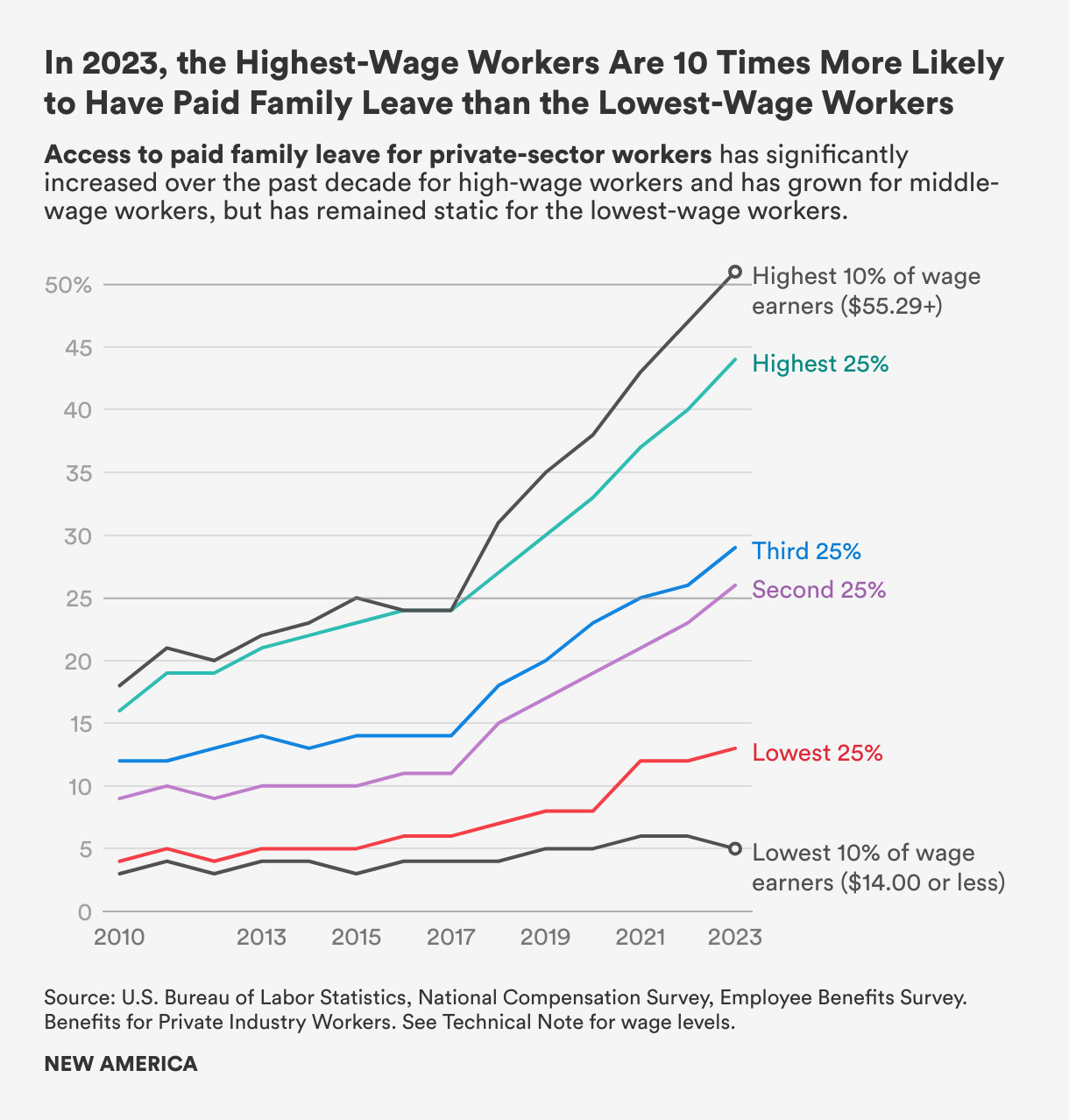
The private sector falls short of meeting people’s needs. As of September 2023, just 27 percent of U.S. workers had paid family leave, with significant disparities: about half of the highest-paid workers have access, compared to less than one-tenth of the lowest-paid workers. Access to paid medical leave through an employer’s disability plan is only slightly higher at 40 percent, but gaps remain, particularly between highest- and lowest-wage workers and across different job types.
A comprehensive national paid parental, family, and medical leave policy, building on successful state programs, could significantly benefit American workers, businesses, the economy, and public health by providing substantial wage replacement and job protections. A well-structured program, funded through public investments in benefits, administration, and outreach, would address key economic and health disparities, support workers and families of color, and meet the widespread need for paid leave. This policy is crucial for rural areas and underserved communities.
As political debates morph into policy conversations in 2025, lawmakers must champion paid family and medical leave to address the pressing needs of U.S. workers and families and to honor our core values of family, love, responsibility, freedom, and care. By enacting comprehensive paid leave, we can ensure that every working person—regardless of their job, employer, or the type of care they need—has the support they deserve. This is not merely about correcting America’s outlier status as the only high-wealth country without a paid leave policy; it’s about paving the way for a future where paid leave is a universal right and every individual is supported in times of need.
Senior Fellow for Gender Equity, Paid Leave & Care Policy and Strategy, Better Life Lab