Extracting Success in Pre-K Teaching
Acknowledgments
This paper benefited from the insights of many, including the interviewees listed below. We are especially grateful for the participation and support of Alissa Lange, Hagit Mano, and Irena Nayfeld, Dale Farran, Caroline Christopher, Lisa Wiltshire, Tamara Kaldor, Chip Donohue, Susan Landry, Chris Sciarrino, and Melinda Waller. Thank you to the teachers and instructional coaches who shared their professional learning experiences with us. Thanks to New America colleagues Kevin Carey, Lisa Guernsey, Amaya Garcia, Laura Bornfreund, and Sabrina Detlaf for their expert and editorial insight and to Anisha Ford for her support. Maria Elkin and Riker Pasterkiewicz provided layout and communication support.
This work would not have been possible without the generous support of the Bill & Melinda Gates Foundation and the David and Lucile Packard Foundation. The views expressed in this paper are of the authors alone.
Interviews Conducted
Nicole Arvenda Aguilo
Passaic, New Jersey Pre-K Teacher
Caroline Christopher
Research Associate, Peabody Research Institute
Chip Donohue
Dean of Distance Learning and Continuing Education and Director of Technology in Early Childhood Center at the Erikson Institute
Dale Farran
Director, Peabody Research Institute; Professor, Specialty in Poverty and Intervention; Research Professor, Department of Teaching and Learning
Madelyn Gardner
Research and Policy Associate, Learning Policy Institute
Bridget Hamre
Associate Research Professor and Associate Director, University of Virginia’s Center for Advanced Study of Teaching and Learning
Tamara Kaldor
Associate Director of the Technology in Early Childhood (TEC) Center at Erikson Institute
Susan Landry
Director and Founder of the Children’s Learning Institute at the University of Texas Health Science Center at Houston
Albert & Margaret Alkek Distinguished Chair in Early Childhood Development
Michael Matthew Knight Memorial Professor in the Department of Pediatrics at the University of Texas Health Science Center at Houston
Alissa Lange
Assistant Professor of Early Childhood Education, East Tennessee State University
Jennifer Norvell
Research Analyst, Peabody Research Institute
Chris Sciarrino
Director of Early Childhood Practice and Innovation, The Early Learning Lab
Ruby Takanishi
Senior Research Fellow, Early and Elementary Education Policy Program at New America
Alana Tunstel
Research Analyst, Peabody Research Institute
Melinda Waller
Director of Early Learning, Franklin-McKinley School District
Lisa Wiltshire
Policy Director, Tennesseans for Quality Early Education
Former Executive Director of the Office of Early Learning at the Tennessee Department of Education
Introduction
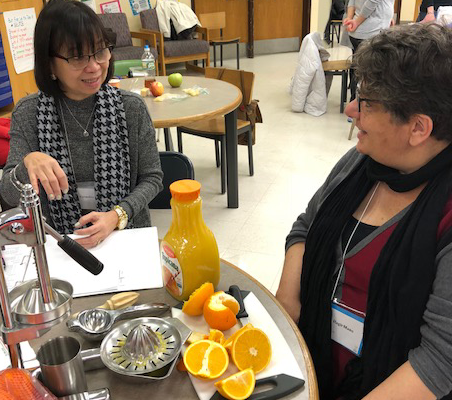
On a cold and rainy Saturday morning in Passaic, New Jersey, a handful of pre-K teachers and their instructional coaches crowd around a small table in the library at Dr. Martin Luther King, Jr. School No. 6, each holding an orange. Hagit Mano, an early childhood STEM (science, technology, engineering, and math) specialist, is talking about how to make orange juice. This small group lesson will help them understand how to teach young children about physical changes in matter.
Abbie Lieberman
Mano asks the teachers to look at the orange through the eyes of a four-year-old. “What is this?” she asks. “Has anyone seen one of these before?” Taking on the role of the child, one coach chimes in, “yes, we had these for snack!” Another teacher makes a connection to home life: “My mommy buys these at the bodega.” Mano encourages her “students” to examine the orange. “What does it feel like? How does it smell? What color is it?” The teachers and coaches fully embrace their roles, pointing out that it’s round, bumpy, and squishy but also hard, and that it doesn’t really have a smell.
Then Mano cuts the orange in half, and they observe it with all their senses. Now it is wet and juicy and has a distinctly sweet smell. Mano explains how over the course of a week, the pre-K class will go from exploring the oranges to understanding how they can be transformed into juice. Activities might include reading a story about orange juice, investigating where oranges come from, singing a song, recording observations about oranges, or doing a taste test with store-bought juice and class-made juice. Mano explains the importance of asking questions that require children to analyze and evaluate information and explain their thought process, as well as making appropriate modifications for dual language learners (DLLs).1
Mano asks the teachers, once they have stepped out of their role as students, to suggest additional lessons and activities they could do related to physical change. One suggests peeling the orange and letting the peel slowly decompose, another type of transformation. Another teacher wants to ask a parent to come in and teach about the transformation of beans from uncooked to cooked, making the lesson culturally relevant to her predominantly Latino school population. On this cold winter day, transforming a chocolate bar into hot chocolate is an idea that appeals to the entire group.
At the end of the day, the teachers will be sent home with a small juicer, a children’s book on making orange juice, and a few oranges. They will adapt the lesson to fit the needs of their students and conduct it while being observed by their district coach and an early childhood STEM specialist. After the lesson, they will meet to reflect, and later, they will discuss what worked with others in their professional learning communities (PLCs). Teachers will then return to their classrooms and repeat the cycle using a revised lesson.
These moments in New Jersey are an example of how a skilled professional development expert can guide teachers in turning a seemingly simple lesson like juicing oranges into an exploratory, language-rich science experiment that challenges children to think critically about how food changes and how people play a role in transforming it. This illustration incorporates multiple aspects of high-quality professional learning: developmentally appropriate instruction, opportunities for reflection and collaboration with peers, and one-on-one coaching. Research shows that these types of opportunities strengthen teacher practice.2
Unfortunately, professional learning of this caliber can be difficult for pre-K teachers to come by. Many pre-K programs do not have the resources, in time or funding, for professional learning that is aligned with the research on how adults learn best or tailored to building the knowledge and skills needed to work with young children.
Mano’s orange juice lesson is part of the SciMath-DLL professional learning program, which focuses on strengthening STEM instruction. It is one of five innovative programs providing high-quality in-service professional learning to pre-K teachers that we profile in this report. In Illinois, two dozen pre-K through third grade teachers in the Archdiocese of Chicago are bringing technology into their classrooms thanks to a mentoring program. In Nashville, Tennessee, researchers and coaches are working together using real-time teacher and student data to tailor professional learning to pre-K teachers’ needs. A program in San Jose, California is responding to teachers’ requests for help managing challenging classroom behavior with training on social-emotional skill development, paired with ongoing coaching and peer collaboration. And in Texas, a literacy program launched by former first lady Laura Bush has been scaled to reach pre-K teachers across the state working in various settings.
All of these programs are responding to an acute and growing need. There is more research than ever showing that a strong pre-K program can ensure kindergarten readiness and also support children’s long-term success.3 Access to and investment in public pre-K has been slowly expanding throughout the United States in recent years as a result. In 2016, 1.5 million children had access to state-funded pre-K programs, and more than 700,000 children attended the federal Head Start program, which serves three- and four-year-olds from low-income families.4 And many cities, like Seattle, San Antonio, and Philadelphia are expanding access with local funding sources. Hundreds of thousands of other families pay for pre-K out-of-pocket, although the cost of quality programs can be prohibitive.
But for pre-K to effectively set children on the path to success, it needs to be high quality. And while numerous factors are associated with higher quality, such as smaller class sizes and program alignment to early learning standards, research finds that teachers are the most important in-school factor impacting outcomes for young children.5 Young children learn through their interactions with adults.6 As Marcy Whitebook, founder of the Center for the Study of Child Care Employment, explained in a recent New York Times Magazine article, “an older kid might be able to learn about math or history from a teacher they don’t like. But a young child, a preschool-aged child, is going to have a very hard time learning anything from an adult that they feel averse to.”7 To effectively work with young children, pre-K teachers need a strong understanding of child development and early learning and the ability to provide age-appropriate instruction. Unfortunately, many early childhood educators are not equipped with the knowledge and skills needed to best support their students.
There are multiple explanations for why many children do not have access to well-prepared pre-K teachers. For one, qualification requirements for pre-K teachers and programs that prepare teachers are highly varied. Unlike in K–12 education, where all teachers are usually expected to have a bachelor’s degree and teaching credential, many pre-K programs have lower requirements for their educators. According to the National Institute for Early Education Research (NIEER), only 35 state-funded programs require pre-K teachers to have a bachelor’s degree.8 Head Start requires 50 percent of lead teachers to have a bachelor’s degree with specialized training in early childhood education. While more education and specialized training are associated with better instruction in early childhood education,9 a bachelor’s degree is no guarantee that teachers enter the classroom prepared to work with young children. A 2016 review of preparation programs certifying pre-K teachers from the National Council on Teacher Quality found that most programs are not covering the knowledge and competencies needed to work with young children.10 Teaching licenses certifying teachers in broader grade spans, such as pre-K through eighth grade, may exacerbate the problem when they do not require teachers to complete any coursework related to early learning and child development.
The five programs we profile in this report show that it is possible to give pre-K teachers rich, research-based training that prepares them to work with young children. However, there is a scarcity of opportunities focused on the developmental needs of young children and most programs lack the funding to execute them well.
Citations
- We use the term dual language learners (DLLs) to refer to children from birth through age eight who are learning English in addition to their native languages. Learn more about New America’s Dual Language Learners National Work Group at https://www.newamerica.org/education-policy/dual-language-learners/.
- LaRue Allen and Bridget B. Kelly, eds., Transforming the Workforce for Children Birth Through Age 8: A Unifying Foundation (Washington, DC: National Academies Press, 2015), 362, https://www.nap.edu/read/19401/chapter/15.
- Jill S. Cannon, M. Rebecca Kilburn, Lynn A. Karoly, Teryn Mattox, Ashley N. Muchow, and Maya Buenaventura, Decades of Evidence Demonstrate That Early Childhood Programs Can Benefit Children and Provide Economic Returns (Santa Monica, CA: RAND Corporation, 2017), https://www.rand.org/pubs/research_briefs/RB9993.html.
- W. Steven Barnett, Allison H. Friedman-Krauss, G. G. Weisenfeld, Michelle Horowitz, Richard Kasmin, and James H. Squires, The State of Preschool 2016: State Preschool Yearbook (New Brunswick, NJ: National Institute for Early Education Research, 2017), http://nieer.org/wp-content/uploads/2017/09/Full_State_of_Preschool_2016_9.15.17_compressed.pdf.
- Francisco Palermo, Laura D. Hanish, Carol Lynn Martin, Richard A. Fabes, and Mark Reiser, “Preschoolers’ Academic Readiness: What Role Does the Teacher–Child Relationship Play?” Early Childhood Research Quarterly 22, no. 4 (2007), https://www.ncbi.nlm.nih.gov/pmc/articles/PMC3856866/.
- LaRue Allen and Bridget B. Kelly, eds., Transforming the Workforce for Children Birth Through Age 8: A Unifying Foundation (Washington, DC: National Academies Press, 2015), http://www.nap.edu/catalog/19401/transforming-theworkforce-for-children-birth-throughage-8-a.
- Jeneen Interlandi, "Why Are Our Most Important Teachers Paid the Least?" New York Times Magazine, January 8, 2018, https://www.nytimes.com/2018/01/09/magazine/why-are-our-most-important-teachers-paid-the-least.html.
- W. Steven Barnett, Allison H. Friedman-Krauss, G. G. Weisenfeld, Michelle Horowitz, Richard Kasmin, and James H. Squires, The State of Preschool 2016: State Preschool Yearbook (New Brunswick, NJ: National Institute for Early Education Research, 2017), http://nieer.org/wp-content/uploads/2017/09/Full_State_of_Preschool_2016_9.15.17_compressed.pdf.
- Emily Workman, Lisa Guernsey, and Sara Mead. Pre-K Teachers and Bachelor’s Degrees: Envisioning Equitable Access to High-Quality Preparation Programs (Washington DC: New America, 2018), 7–8, https://na-production.s3.amazonaws.com/documents/PreK-Teachers-Bachelors-Degrees.pdf.
- Hannah Putman, Amber Moorer, and Kate Walsh, Some Assembly Required: Piecing Together the Preparation Preschool Teachers Need (Washington, DC: National Council on Teacher Quality, June 2016), https://www.nctq.org/publications/Some-Assembly-Required:-Piecing-together-the-preparation-preschool-teachers-need.
Pre-K Teachers and In-Service Professional Learning
Improving access to quality, relevant training for pre-K teachers requires an understanding of what constitutes an effective professional learning program and what the current barriers to access are, such as lack of funding or minimal buy-in from teachers. The research-based components of professional learning discussed in this paper will help administrators, policymakers, and other stakeholders understand what is needed to create a high-quality professional learning program. These components also help to inform successful implementation of a professional learning program that will lead to better child outcomes.
In 2015, the National Academies Press published a landmark report, Transforming the Workforce for Children from Birth Through Age 8: A Unifying Foundation. It explains that while professional learning can serve multiple purposes, its ultimate goal is to improve quality of practice and support child outcomes. For pre-K teachers, professional learning during ongoing practice comes in many forms (e.g., workshops, coaching and mentoring, learning networks) and can be delivered in numerous ways (e.g., in the workplace, offsite, via technology).
Researchers and policymakers in both birth-to-5 and K–12 education have been trying to determine which methods are most effective for improving practice. Many research groups, professional organizations, and policymakers have created definitions of high-quality professional learning in recent years to incorporate research findings.11 These definitions all overlap at least partially.
Based on the research, the National Academies report concludes that effective professional learning is “ongoing, intentional, reflective, goal-oriented, based on specific curricula and materials, focused on content knowledge and children’s thinking, and situated in the classroom.”12 Teachers who have a continuous improvement mindset may be more likely to alter their practice. It is also helpful when professional learning is relevant and useful to their work. Collaboration, such as through PLCs or one-on-one coaching, has also been shown to be effective when implemented well. Combining different methods of professional learning, such as workshops, coaching, and PLCs, around a specific content area may more effectively influence teacher practice than isolated methods.13
Multiple definitions stress the importance of using data to drive professional learning, both to determine where teachers need to strengthen their practice and to measure student progress.14 Learning Forward, an organization devoted to educator professional development, suggests that educators be committed to continuous improvement and acknowledges that professional learning must “meet the individual needs of educators, because all learners learn at different rates and in different ways.”15 In addition, educators need their program and school leaders to value continuous learning and development by allocating adequate funding and time for staff to participate. Leaders should reinforce what teachers are learning through professional development by giving them the space to practice new skills and incorporate developmentally appropriate practice. This may be challenging because leaders do not always have formal training in or experience teaching young children.16
While most components of quality professional learning resonate across pre-K and K–12 education, there are certain challenges unique to supporting pre-K teachers. The patchwork system of early childhood education in which pre-K children are served in different settings, in programs that adhere to different standards, and taught by teachers with different qualifications, can make pre-K professional learning more complex.17 When pre-service requirements for teachers vary, they come to the classroom with different competencies and knowledge of educational content and pedagogy, making it difficult to deliver and scale effective professional learning programs.
Professional learning for pre-K teachers tends to differ based on practice setting. Those working in public elementary schools usually have specific requirements around professional learning set by their school district and may have access to larger doses of professional development. But while they may have access to more hours, many of these pre-K teachers end up in school- or district-wide professional learning that is not focused specifically on teaching young children.18 According to the National Academies’ report, educators in publicly-funded programs like state pre-K or the federal Head Start program, where the government has set requirements and dedicated funding for professional learning, are more likely to participate in professional learning during paid work hours.
Expectations and resources for professional learning in other settings are often more varied because many pre-K teachers work in nonprofit and for-profit centers that are not affiliated with public school systems and therefore require few if any formal credentials. For those educators, ongoing professional learning may be the most formal training an educator receives. Early learning programs that seek accreditation or participate in a Quality Rating and Improvement System,19 a systemic approach to assess, improve, and communicate the level of program quality, may be incentivized to adopt professional learning standards for their teachers. Educators in privately operated programs that do not seek accreditation may be more likely to face barriers like limited funding, unsupportive leadership, and scheduling challenges.
Publicly funded pre-K programs have challenges of their own. Public pre-K programs often receive less funding than later grades. Many spend the few resources available on ineffective, one-off professional development sessions that are not aligned with the latest research.20 Effective professional learning is expensive, especially when it includes hiring additional personnel, such as mentors, coaches, and substitutes to cover classrooms during paid release time.
Researchers from the Curry School of Education at the University of Virginia created a framework for effective professional learning for pre-K teachers. The framework recognizes the program and policy conditions necessary for the effective implementation of a well-designed professional development program. For instance, the researchers note that regulations must focus on the quality of professional learning and that programs must allocate sufficient funds, staff, and time for effective implementation. All of these conditions lay the groundwork for effective professional development, which does three things:
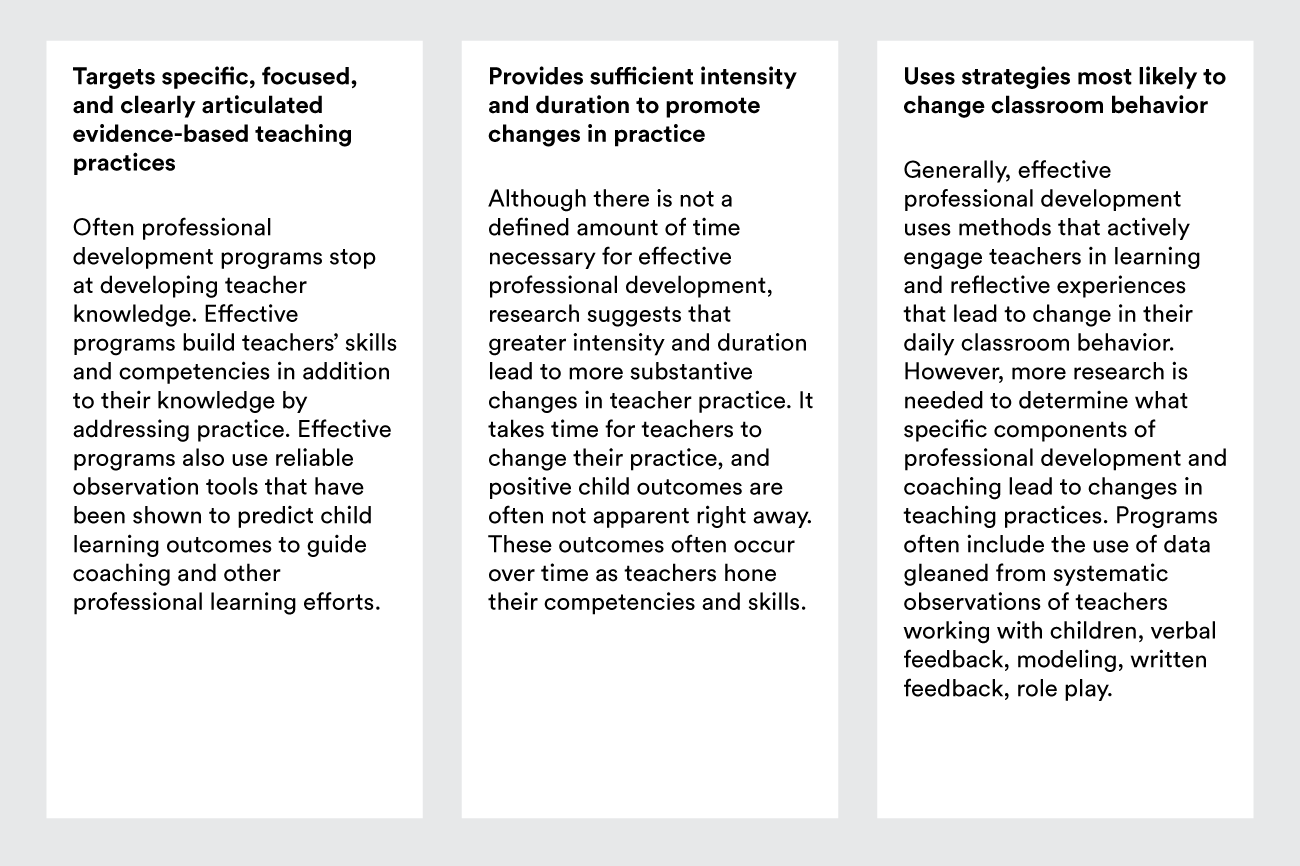
Successful models have both the policy and program conditions necessary to implement all three components of effective professional development. Strong programs have implementation plans that are clearly articulated, scoped, and sequenced.
A Closer Look at a Growing Trend: Coaching Pre-K Teachers
Many professional development methods in early education produce outcomes that fall short of expectations; however, increasing evidence implies that well-implemented and high-quality instructional coaching can yield positive outcomes for teachers and students.21
As a result, coaching is becoming a more popular form of professional learning for early childhood educators. In 2016, the U.S. Department of Health and Human Services released updated Head Start performance standards that require all programs to implement a “research-based, coordinated coaching strategy” and provide intensive coaching for staff identified as likely to benefit the most.22 Many states have also leveraged the federal Race to the Top–Early Learning Challenge and Preschool Development Grants funding to introduce coaching into early education programs in recent years.23 States were also encouraged by NIEER’s preschool quality standards benchmarks, which recommend that teachers and assistant teachers be provided with coaching. Twenty-five states now require coaching for educators in at least one of their publicly funded early education programs.24
But not all coaching is created equal. A 2017 paper by Bellwether Education Partners dives into the existing research on coaching in early childhood education and stresses that not all coaching models have proven to be effective and that small-scale coaching programs, where implementation can be carefully controlled, often produce better results than large-scale coaching programs.25 The National Academies explain that effective coaching “must be intensive, ongoing, and conducted by knowledgeable coaches.”26 Coaches are often former teachers and usually have extensive experience in early childhood education.27 Bellwether says that the effectiveness of coaching might be attributed to its individualized, ongoing, and job-embedded nature, which differs from the one-time lecture-style training educators often experience. Coaching concentrates on skills that can be practiced in the classroom in real time.
Approximately one-third of pre-K teachers reported receiving coaching, mentoring, or consultation in the last year according to the National Survey of Early Care and Education.28 While more states are mandating or encouraging coaching, there are challenges with implementation. As Bellwether notes, many states loosely define coaching, causing some providers to implement low-quality models just to meet state requirements.29 Successful coaching depends on quality coaches who can align their work with classroom curriculum. Coaches should have the expertise to teach adults and also children and be able to track progress accurately. Teachers tend to be more responsive to professional learning when they choose to participate, as opposed to when it is required. Coaching requires a substantial stream of funding and time. Its high cost can make it prohibitive for many programs.
Citations
- Linda Darling-Hammond, Marla E. Hyler, and Madelyn Gardner, “Effective Teacher Professional Development,” summary of report from Learning Policy Institute, June 5, 2017, https://learningpolicyinstitute.org/product/effective-teacher-professional-development-report; Standards for Professional Learning (Learning Forward, August 2011) https://learningforward.org/docs/august-2011/referenceguide324.pdf?sfvrsn=2.; Non-Regulatory Guidance for Title II, Part A: Building Systems of Support for Excellent Teaching and Leading (Washington, DC: U.S. Department of Education, September 27, 2016), https://www2.ed.gov/policy/elsec/leg/essa/essatitleiipartaguidance.pdf; U.S. Department of Health & Human Services, “Head Start Policy & Regulations, 1302.92 Training and Professional Development,” https://eclkc.ohs.acf.hhs.gov/policy/45-cfr-chap-xiii/1302-92-training-professional-development; A Conceptual Framework for Early Childhood Professional Development (Washington, DC: National Association for the Education of Young Children, 1993), https://www.naeyc.org/sites/default/files/globally-shared/downloads/PDFs/resources/position-statements/PSCONF98.PDF.
- LaRue Allen and Bridget B. Kelly, eds., Transforming the Workforce for Children Birth Through Age 8: A Unifying Foundation (Washington, DC: National Academies Press, 2015), 396, http://www.nap.edu/catalog/19401/transforming-theworkforce-for-children-birth-throughage-8-a.
- LaRue Allen and Bridget B. Kelly, eds., Transforming the Workforce for Children Birth Through Age 8: A Unifying Foundation (Washington, DC: National Academies Press, 2015), 398, http://www.nap.edu/catalog/19401/transforming-theworkforce-for-children-birth-throughage-8-a.
- Standards for Professional Learning (Learning Forward, August 2011) https://learningforward.org/docs/august-2011/referenceguide324.pdf?sfvrsn=2; Non-Regulatory Guidance for Title II, Part A: Building Systems of Support for Excellent Teaching and Leading (Washington, DC: U.S. Department of Education, September 27, 2016), https://www2.ed.gov/policy/elsec/leg/essa/essatitleiipartaguidance.pdf.
- LaRue Allen and Bridget B. Kelly, eds., Transforming the Workforce for Children Birth Through Age 8: A Unifying Foundation (Washington, DC: National Academies Press, 2015), 396, http://www.nap.edu/catalog/19401/transforming-theworkforce-for-children-birth-throughage-8-a.
- Bridget K. Hamre, Ann Partee, and Christina Mulcahy, “Enhancing the Impact of Professional Development in the Context of Preschool Expansion,” American Educational Research Association 3, no. 4 (2017): 1–16, http://journals.sagepub.com/doi/abs/10.1177/2332858417733686.
- Bridget K. Hamre, Ann Partee, and Christina Mulcahy, “Enhancing the Impact of Professional Development in the Context of Preschool Expansion,” American Educational Research Association 3, no. 4 (2017): 1–16, http://journals.sagepub.com/doi/abs/10.1177/2332858417733686; LaRue Allen and Bridget B. Kelly, eds., Transforming the Workforce for Children Birth Through Age 8: A Unifying Foundation (Washington, DC: National Academies Press, 2015), 393, http://www.nap.edu/catalog/19401/transforming-theworkforce-for-children-birth-throughage-8-a.
- Bridget K. Hamre, Ann Partee, and Christina Mulcahy, “Enhancing the Impact of Professional Development in the Context of Preschool Expansion,” American Educational Research Association 3, no. 4 (2017): 1–16, http://journals.sagepub.com/doi/abs/10.1177/2332858417733686.
- For more information, see “QRIS Resource Guide,” https://qrisguide.acf.hhs.gov/.
- Bridget K. Hamre, Ann Partee, and Christina Mulcahy, “Enhancing the Impact of Professional Development in the Context of Preschool Expansion,” American Educational Research Association 3, no. 4 (2017): 1–16, http://journals.sagepub.com/doi/abs/10.1177/2332858417733686.
- LaRue Allen and Bridget B. Kelly, eds., Transforming the Workforce for Children Birth Through Age 8: A Unifying Foundation (Washington, DC: National Academies Press, 2015), 406, http://www.nap.edu/catalog/19401/transforming-theworkforce-for-children-birth-throughage-8-a.
- Head Start Program Performance Standards (Washington, DC: U.S. Department of Health & Human Services, Administration for Children and Families Office of Head Start, 2016), https://eclkc.ohs.acf.hhs.gov/sites/default/files/pdf/hspps-appendix.pdf.
- Bonnie O’Keefe, Primetime for Coaching Improving Instructional Coaching in Early Childhood Education, (Washington, DC: Bellwether Education Partners, 2017), https://bellwethereducation.org/sites/default/files/Bellwether_ECECoaching_GHS_Final.pdf.
- Bonnie O’Keefe, Primetime for Coaching Improving Instructional Coaching in Early Childhood Education, (Washington, DC: Bellwether Education Partners, 2017), https://bellwethereducation.org/sites/default/files/Bellwether_ECECoaching_GHS_Final.pdf.
- Bonnie O’Keefe, Primetime for Coaching Improving Instructional Coaching in Early Childhood Education, (Washington, DC: Bellwether Education Partners, 2017), https://bellwethereducation.org/sites/default/files/Bellwether_ECECoaching_GHS_Final.pdf.
- LaRue Allen and Bridget B. Kelly, eds., Transforming the Workforce for Children Birth Through Age 8: A Unifying Foundation (Washington, DC: National Academies Press, 2015), 400, http://www.nap.edu/catalog/19401/transforming-theworkforce-for-children-birth-throughage-8-a.
- LaRue Allen and Bridget B. Kelly, eds., Transforming the Workforce for Children Birth Through Age 8: A Unifying Foundation (Washington, DC: National Academies Press, 2015), 406, http://www.nap.edu/catalog/19401/ transforming-theworkforce-for-children-birth-throughage-8-a.
- Bridget K. Hamre, Ann Partee, and Christina Mulcahy, “Enhancing the Impact of Professional Development in the Context of Preschool Expansion,” American Educational Research Association 3, no. 4 (2017): 1–16, http://journals.sagepub.com/doi/abs/10.1177/2332858417733686.
- Bonnie O’Keefe, Primetime for Coaching Improving Instructional Coaching in Early Childhood Education, (Washington, DC: Bellwether Education Partners, 2017), https://bellwethereducation.org/sites/default/files/Bellwether_ECECoaching_GHS_Final.pdf.
Our Approach
The following profiles show how communities within New Jersey, Texas, Illinois, Tennessee, and California are strengthening pre-K teachers’ knowledge and competencies to ensure that they are effectively prepared to work with young children. We include a range of models at different stages in their development that are taking different approaches to professional learning and focusing on different content areas. We sought out local models that were being evaluated for their effectiveness, because as Curry School of Education explains, while there are agreed-upon components of high quality professional learning, there is also evidence that many well-designed professional learning programs do not improve teacher practice or child outcomes.30 These five programs, while different from one another, each incorporate multiple aspects of what experts have determined to be high-quality professional learning.
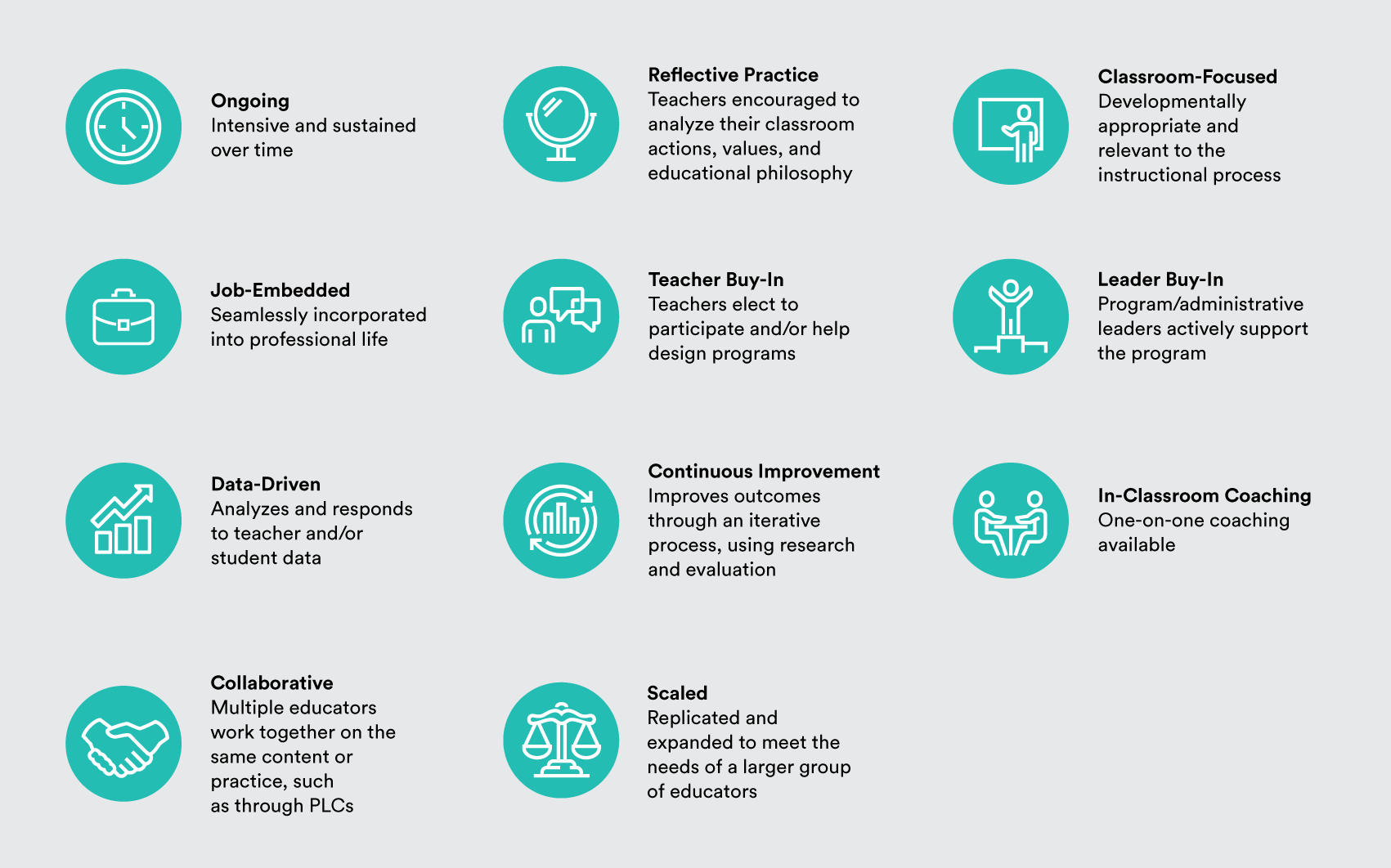
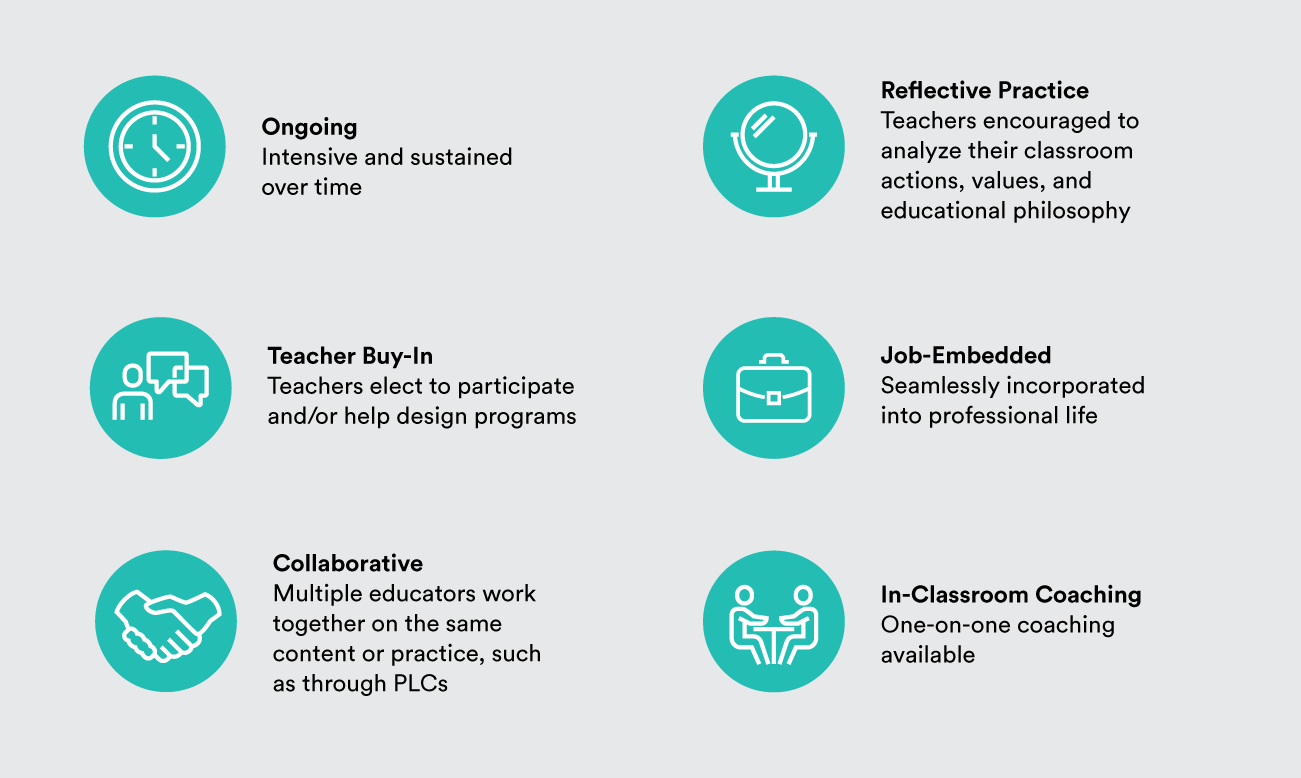
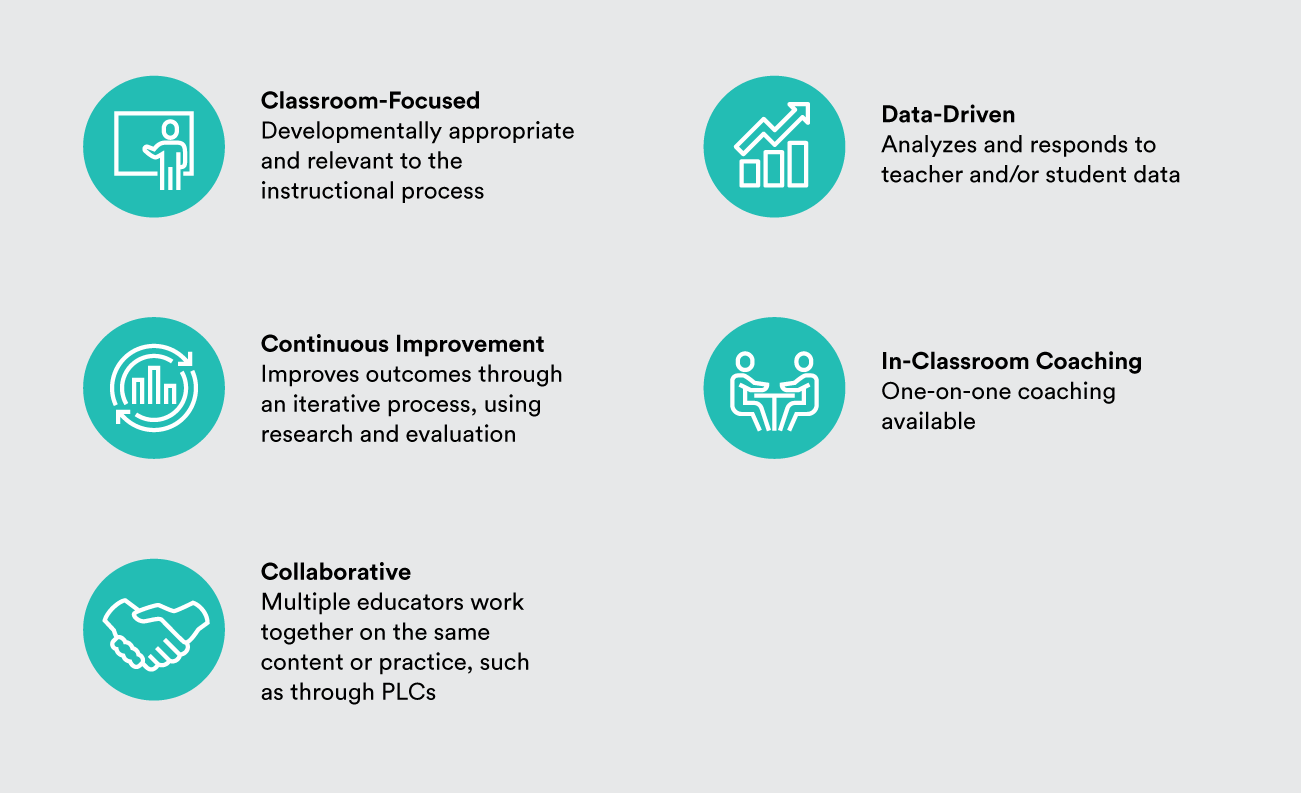
Throughout this report we use iconography to indicate which components of quality are associated with each professional learning program. These icons were chosen based on common components of high-quality professional learning identified in the research. For the icon definitions we borrowed heavily from Frontline Research & Learning Institute’s Bridging the Gap report series:31
Citations
- Bridget K. Hamre, Ann Partee, and Christina Mulcahy, “Enhancing the Impact of Professional Development in the Context of Preschool Expansion,” American Educational Research Association 3, no. 4 (2017): 1–16, http://journals.sagepub.com/doi/abs/10.1177/2332858417733686.
- Elizabeth Combs and Sarah Silverman, Bridging the Gap, (Malvern, PA: Frontline Research and Learning Institute, 2017), https://www.frontlineinstitute.com/reports/essa-report/.
Strengthening STEM Instruction in Passaic, New Jersey
SciMath-DLL serves a cohort of pre-K teachers in Passaic, NJ who work in both public schools and Head Start centers. All teachers are required to have a bachelor’s degree and teaching certification. Over 90 percent of Passaic students qualify for free and reduced-price lunch and more than 98 percent of students are non-white.32
Before they disseminate into small groups to make orange juice, approximately two dozen pre-K teachers and coaches gather in the library for coffee at MLK No. 6 before a full Saturday of professional learning. The group is participating in its second of four SciMath-DLL workshops with researchers from NIEER and East Tennessee State University. SciMath-DLL uses a three-pronged approach to improve STEM education for young children: hands-on workshops, individualized coaching, and participation in PLCs.
Director Alissa Lange leads the workshop with her colleagues Hagit Mano and Irena Nayfeld. They begin with a whole group reflection of a math lesson called “Roll and Build” involving large, colorful dice and Legos that teachers took back to their classrooms after the last workshop. Teachers and coaches share their successes and challenges with implementation. One teacher admits, “the first time I did it, it was really hard. My students were a little overwhelmed. I was focusing on two objectives instead of one. When I did it the second time I only had one objective and it worked really well.” Mano warmly affirms, “as teachers, we try something the first time and then wonder, ‘what was I thinking?!’ And then we try again.”
Then the SciMath-DLL team plays short videos of two teachers implementing the lesson plan. The videos show two different methods for teaching “Roll and Build” because teachers are encouraged to adapt the lessons to fit the needs of their students. In both videos the teachers are asking higher-order thinking questions, testing students’ understanding, following their leads, and differentiating instruction. The group analyzes the instruction and explains why these methods would or would not work in their own classrooms. One teacher admits, “at first I didn’t know that I could tweak the lesson, and I did it exactly as it was demonstrated [in the workshop] and it was a mess. But after getting suggestions from my PLC, I did it again differently, and I liked it that way better because I had more time to reach the children who were struggling.”
Filling a Void of STEM in Pre-K
High-quality professional learning focused on STEM instruction is hard to come by. According to the Transforming the Workforce report, children from low-income families are less likely to be exposed to math in the early years, and achievement gaps in math and science are already evident when children enter kindergarten.33 A 2009 study of Head Start enrollees found that “children arrived in kindergarten with lower science readiness scores than in any other subject area or developmental domain.”34
Math and science knowledge in pre-K are strong predictors of later achievement in multiple subject areas, yet few early educators spend adequate time on math and science instruction.35
A 2017 study from Michigan State University offers some insight. Researchers analyzed Head Start teachers’ self-efficacy in literacy, math, and science, and found that teachers were most confident in their ability to teach literacy, and that they lacked confidence in teaching both math and science.36 When STEM is taught in teacher preparation programs or in-service professional learning, it is not usually taught well, translating to low-quality STEM instruction for students.37 SciMath-DLL is helping educators understand how to teach higher-level concepts in math and science and recognize children’s learning trajectories in these subject areas.
A Morning of “Change and Transformation”
After reviewing “Roll and Build,” Lange switches to the topic of the morning: “Change and Transformation.” This can encompass earth science, life sciences, and physical sciences. But Lange reminds the teachers that “learning math and science requires language,” and thus, one of the main strategies they focus on is questioning with DLLs. There are certain technical words and vocabulary needed when teaching science and math, and this can be especially challenging for DLLs. Over 90 percent of students in Passaic City School District are Hispanic or Latino, and in pre-K many of them are just starting to learn English.38 Lange explains that “trying to learn both languages, DLLs often start to fall behind in the content. Some of these strategies can help make sure they don’t feel so lost in science and math.”
Lange calls her colleague Nayfeld up to the front of the room, where the screen has a picture of a jar of food labeled with an apple and words written in an unfamiliar language. Nayfeld starts speaking to the teachers in Russian. While no one can understand what she is saying, she points to the picture, picks up an apple off the table, uses hand motions to signal the relationship between the real apple and the picture, uses inflection in her voice that lets the audience know she is asking a question, and repeats herself numerous times. Despite the language barrier, the teachers catch on that it has something to do with applesauce.
Nayfeld has given the teachers a taste of what it feels like to be a DLL. While showing how frustrating the language barrier can be, she demonstrates multiple techniques for communicating effectively. She explains that “even if you were not 100 percent sure what I was getting at, I was able to scaffold it, so you at least started to understand what I meant.” The researchers discuss the stages through which DLLs tend to progress and explain the importance of adapting questions based on their developmental level. While the content is focused on STEM, developing children’s literacy and early language is a key component of SciMath-DLL.
Lange gives the remainder of the lesson in English. They are exploring change and transformation of food, and Lange walks through how they might teach students about how apples are transformed into applesauce. While the ultimate objective is to explore changes in matter by making applesauce, Lange acknowledges that this lesson should be spread out over several days and adapted to students’ interests and development. Lange says, “let the kids try things out! You value their ideas….That is inquiry! We want them to be scientists.”
The National Academies emphasized in its report that science is “more than teaching facts,” and that children need opportunities to explore in a way that supports science learning and also fosters school readiness in all other developmental domains.39 This is precisely the kind of instruction that Lange and her team are fostering.
Teachers Get in on the Action
After Lange finishes with the whole group instruction, the teachers and coaches are divided into three small groups. They rotate between stations, participating in the other lessons related to “Change and Transformation.” One table is making playdough, the second is exploring mixtures, and the third is making the orange juice depicted in the opening of this report.
In addition to the materials needed to make juice, the teachers will be sent home with binders containing the day’s PowerPoint slides, lesson plans, and additional handouts, all of which are translated into Spanish. Over the next month or so, teachers will make orange juice with their students while their coach, who attended the workshop with them, and a SciMath-DLL team member observe the lesson. They will reflect in an individualized meeting and exchange ideas with their PLC.
Preliminary Results Show Success
The SciMath-DLL model was developed with teachers and has evolved in response to teacher feedback. It incorporates numerous components of high-quality professional learning. Throughout the workshop, teachers are asked probing questions to help them analyze their practice and the coaches aid in drawing connections. Teachers are constantly reflecting on their practice, whether it is informally during the workshop, one-on-one with their coach, or with peers in their PLC.
This is the second cohort of Passaic teachers to go through SciMath-DLL training. SciMath-DLL was made possible with funding from the National Science Foundation. An initial grant led to the development of the program and a second grant is being used to support an experimental evaluation of the program in Passaic and an online technology pilot.
In 2015, 43 certified pre-K teachers in Passaic agreed to be randomly placed in the experimental or control group. The first experimental cohort participated in eight SciMath-DLL training sessions over two years, for a total of approximately 40 to 60 hours. From 2014 to 2016, the control group participated in regular professional development provided by the school district. Researchers evaluated teachers’ beliefs and attitudes about math, science, and DLL instruction. While all teachers “began the project with more positive attitudes towards teaching science and math and DLLs than expected,” the experimental group “showed marked improvements in their attitudes and beliefs compared to controls,” according to director Lange.40
Researchers have not yet been able to evaluate the impact of the program on student outcomes. But Nicole Arvenda Aguilo, a teacher from the first cohort, feels confident that her students benefited from her participation. Aguilo chose to participate in SciMath-DLL because she wanted to grow professionally. Despite having a bachelor’s degree in math, she was not using math effectively in her pre-K classroom. “It was my 14th year teaching and I learned a lot,” she said, and “I thought it was such a good experience that I brought it back to my school even after the program was over.” She asked her principal to keep the PLC in place, and her principal allowed her to design STEM workshops to share what she had learned with her colleagues. She recalls that being in the experimental group was difficult because “it was really hard not to share what we were learning with everyone in our school.”
Now the control group, or second cohort, is receiving a more condensed version of SciMath-DLL over one year. Part of the program’s success may be attributed to teacher buy-in. As Maria Lanni, a pre-K teacher who works at Lesley Head Start center, explained: “Coming on a Saturday after working all week is a sacrifice. But then I come and it’s worth it. It helps you think about new ways to do things. There are so many things to bring back.” Teachers are paid for their time, but it is still a commitment outside of regular work hours.
Scaling Up the Program
The SciMath-DLL team is exploring options for extending the reach of its work. One option is delivering the content in one year instead of two, as it is doing with the second cohort in Passaic. The group is also piloting an online version of the workshops with the Passaic teachers. The next workshop for this cohort will be available online, and teachers will have two weeks to complete the module, which does not have to be done in one sitting. Lange says that SciMath-DLL is also considering a “train the trainer” model where participants would go back to their schools and share what they have learned, as Aguilo did after participating in Passaic’s first cohort. Finally, the team recently secured an I-Corps grant from the National Science Foundation to evaluate the commercial potential of the work. The grant will support the team’s efforts to assess further options for scale-up and technological innovation, combining what the team already has and knows with what teachers and districts need right now.
These are all part of the effort to make SciMath-DLL more sustainable. Because SciMath-DLL is not tied to a specific curriculum, the program can be easily adapted to meet the needs of teachers in different settings or districts. In the Passaic workshops, Lange makes sure to show teachers how each lesson relates to their standards and curriculum, but the same can be done for all developmentally appropriate curricula. Lange is also working on adapting the program to meet the needs of teachers with varying qualifications and levels of expertise.
All children—including DLLs who can easily get left behind—can benefit from higher quality and more frequent STEM instruction. By helping more teachers overcome their anxiety around teaching STEM, SciMath-DLL is empowering teachers and bringing high-quality STEM instruction into more pre-K classrooms.
Citations
- Passaic Public Schools (website), “Passaic Public Schools,” http://passaicschools.org/district-information/passaic-public-schools/.
- LaRue Allen and Bridget B. Kelly, eds., Transforming the Workforce for Children Birth Through Age 8: A Unifying Foundation (Washington, DC: National Academies Press, 2015), 260, http://www.nap.edu/catalog/19401/transforming-theworkforce-for-children-birth-throughage-8-a.
- LaRue Allen and Bridget B. Kelly, eds., Transforming the Workforce for Children Birth Through Age 8: A Unifying Foundation (Washington, DC: National Academies Press, 2015), 268, http://www.nap.edu/catalog/19401/ transforming-theworkforce-for-children-birth-throughage-8-a.
- Foundations for Success: The Final Report of the National Mathematics Advisory Panel (Washington, DC: U.S. Department of Education, 2008), https://www2.ed.gov/about/bdscomm/list/mathpanel/report/final-report.pdf.; Paul L. Morgan, George Farkas, Marianne M. Hillemeier, and Steve Maczuga, “Science Achievement Gaps Begin Very Early, Persist, and Are Largely Explained by Modifiable Factors,” Educational Researcher 45, no. 1 (2016): 18–35, http://journals.sagepub.com/doi/abs/10.3102/0013189X16633182.
- Hope K. Gerde, Steven J. Pierce, Kyungsook Lee, and Laurie A. Van Egeren, “Early Childhood Educators’ Self-Efficacy in Science, Math, and Literacy Instruction and Science Practice in the Classroom,” Early Education and Development 29, no. 1 (2018): 70–90, http://www.tandfonline.com/doi/abs/10.1080/10409289.2017.1360127?journalCode=heed20.
- LaRue Allen and Bridget B. Kelly, eds., Transforming the Workforce for Children Birth Through Age 8: A Unifying Foundation (Washington, DC: National Academies Press, 2015), 260, http://www.nap.edu/catalog/19401/transforming-theworkforce-for-children-birth-throughage-8-a.
- Passaic Public Schools, “District Information,” http://passaicschools.org/district-information/.
- LaRue Allen and Bridget B. Kelly, eds., Transforming the Workforce for Children Birth Through Age 8: A Unifying Foundation (Washington, DC: National Academies Press, 2015), 269, http://www.nap.edu/catalog/19401/transforming-theworkforce-for-children-birth-throughage-8-a.
- Alissa A. Lange, K. Jung, Irena Nayfeld, Hebbah El-Moslimany, Hagit Mano & A. Figueras-Daniel, “Preliminary Effects of a Preschool STEM Professional Development Model on Teachers’ Attitudes and Beliefs.” Proposal accepted to the annual meeting of the American Educational Research Association, (New York, NY: April 13-17, 2018).
Building a Cohort of Early Childhood Technology Leaders in Chicago, Illinois

The Technology in Early Childhood (TEC) Mentor Program at the Erikson Institute serves pre-K through third grade teachers in parochial schools in Chicago, IL and at Eagle Academy Public Charter School in Washington, DC. The following profile focuses on the program’s work in Chicago. The program selects teachers who have a bachelor’s degree and teacher certification. The Archdiocese Office of Catholic Schools with support from the Big Shoulders Fund serves over 20,000 children in Chicago.41 Sixty-six percent of these children are from low-income households.42
Entering the TEC Playground
On a Thursday evening in January, 25 pre-K through third grade teachers across 25 Catholic schools in the Archdiocese of Chicago gather at the Erikson Institute, a graduate school of education focused on child development. Once the teachers check in, they immediately dive into the professional development workshop by entering what is known as “the TEC playground.” But there are no slides or monkey bars. The teachers freely circulate the room, stopping at tables to engage with hands-on technology activities related to electricity.
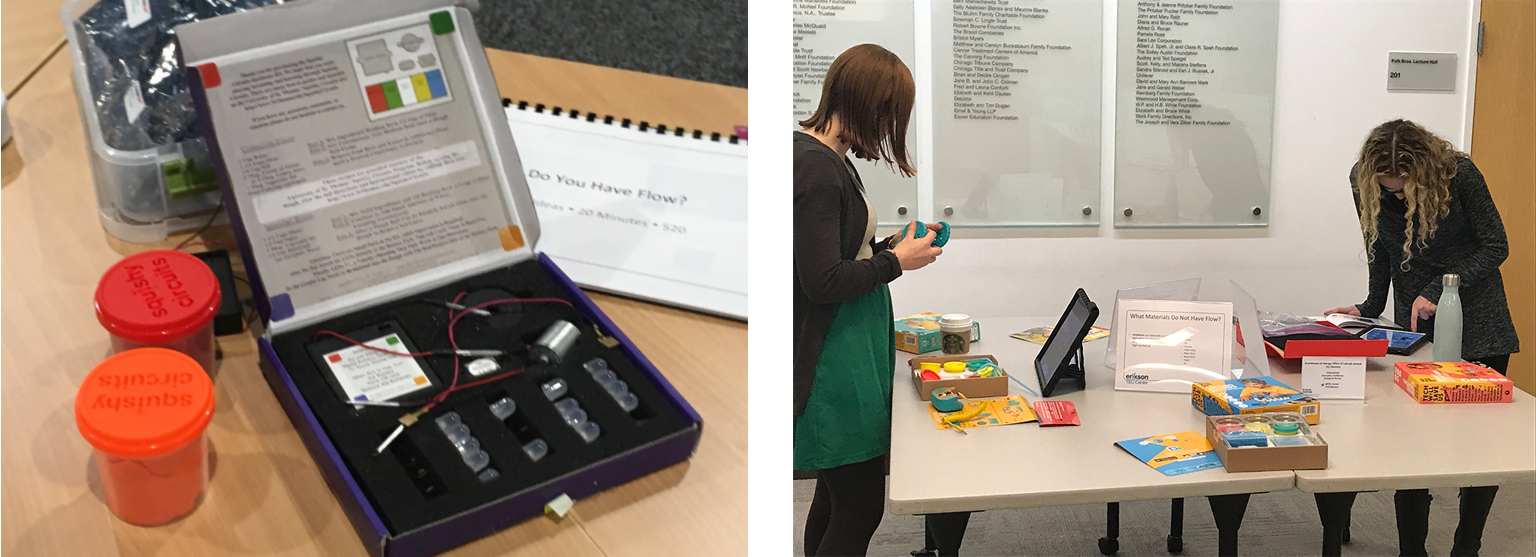
(Left) TEC Mentors Program (Right) Shayna Cook
At one table, there is conductive play dough, little light bulbs, wires, and children’s books on circuits. Two teachers flip through the children’s books and briefly look at the instructions. Then, they begin to play, working independently to build their circuits. One teacher begins by rolling her play dough into two balls. She uses wires to connect the balls with the light bulb. When she closes her circuit, the light bulb lights up. She is pleased and starts working again to build something more complex. As teachers play at this station, they discuss how they could incorporate these tools into their students’ learning. Agnie Szka, a pre-K teacher, says, “when I see a tool here, I try to see how it can be integrated throughout the curriculum, in my writing center or dramatic play center.”
The “playground” is a part of a professional development program called TEC Mentors at the Technology in Early Childhood (TEC) Center at the Erikson Institute. This program is designed to develop a cohort of early childhood educators who can be technology leaders and coaches. The teachers learn how to integrate technology into their early childhood programs, classrooms, and out-of-school initiatives.
Closing the Professional Development Gap in Tech
In Transforming the Workforce, the use of technology for high-quality instruction was identified as a gap in the education system, affecting teachers across grade levels.43 Two institutions—the National Association for the Education of Young Children (NAEYC) and the Fred Rogers Center for Early Learning and Children’s Media at Saint Vincent College—had already recognized this gap and published a joint position statement in 2012 on the use of technology and interactive media in early childhood programs, from birth through age eight.44 It clearly states that educators who are informed, intentional, and reflective in their use of technology and interactive media have additional tools for enriching the learning environment, particularly when their use of technology and media is child-centered, play-oriented, hands-on, relationship-building, and aligned with curriculum goals.
Although the release of this statement has increased early childhood educators’ awareness of this gap in their practice, educators still lack access to high-quality professional development opportunities around effective and developmentally appropriate technology instruction. According to a 2015 study, less than half of early childhood educators have ever had professional development in the use of educational technology,45 so there is a great need for high-quality professional development programs that can empower teachers with new tools that can be integrated into their practice. Chip Donohue, dean of distance learning and continuing education at Erikson and director of the TEC Center, and Tamara Kaldor, associate director of the TEC Center, started the TEC Mentors program in 2016 to fulfill this need.
Building a Cohort of TEC Mentors
Seventy teachers across the archdiocese applied to be a part of the TEC Mentors program and through a rigorous selection process about half were chosen. The teachers entered the year-long professional development program with the goal of building their knowledge and skills around the use of technology with young children. At the end of the program, teachers presented their final project, which consisted of tech- and play-related lesson plans. The teachers’ school leaders came to the first session and were present during the final project presentation. Throughout the year, they were kept abreast of what their staff was learning. The TEC Mentors program has demonstrated that when school leaders are familiar with the content of the professional development, they can create more buy-in from the teachers. In addition, many principals have not been trained in what high-quality technology integration looks like in early childhood. The TEC Mentors program helps them understand how to observe teachers and provide meaningful support and feedback to help create lasting changes in teacher practice.
The TEC Mentors program uses a blended learning model that incorporates in-person, hands- on professional development with online modules and an online professional learning network. Each new concept or idea presented is a way to build teachers’ thinking around technology and provide them with the skills needed for their final projects. Although teachers have dedicated time on workshop days to collaborate, they also use tools, like Facebook, to share ideas between workshops. Kaldor said that their program develops teachers’ foundational knowledge around technology instruction and differentiates to meet individual teacher needs.
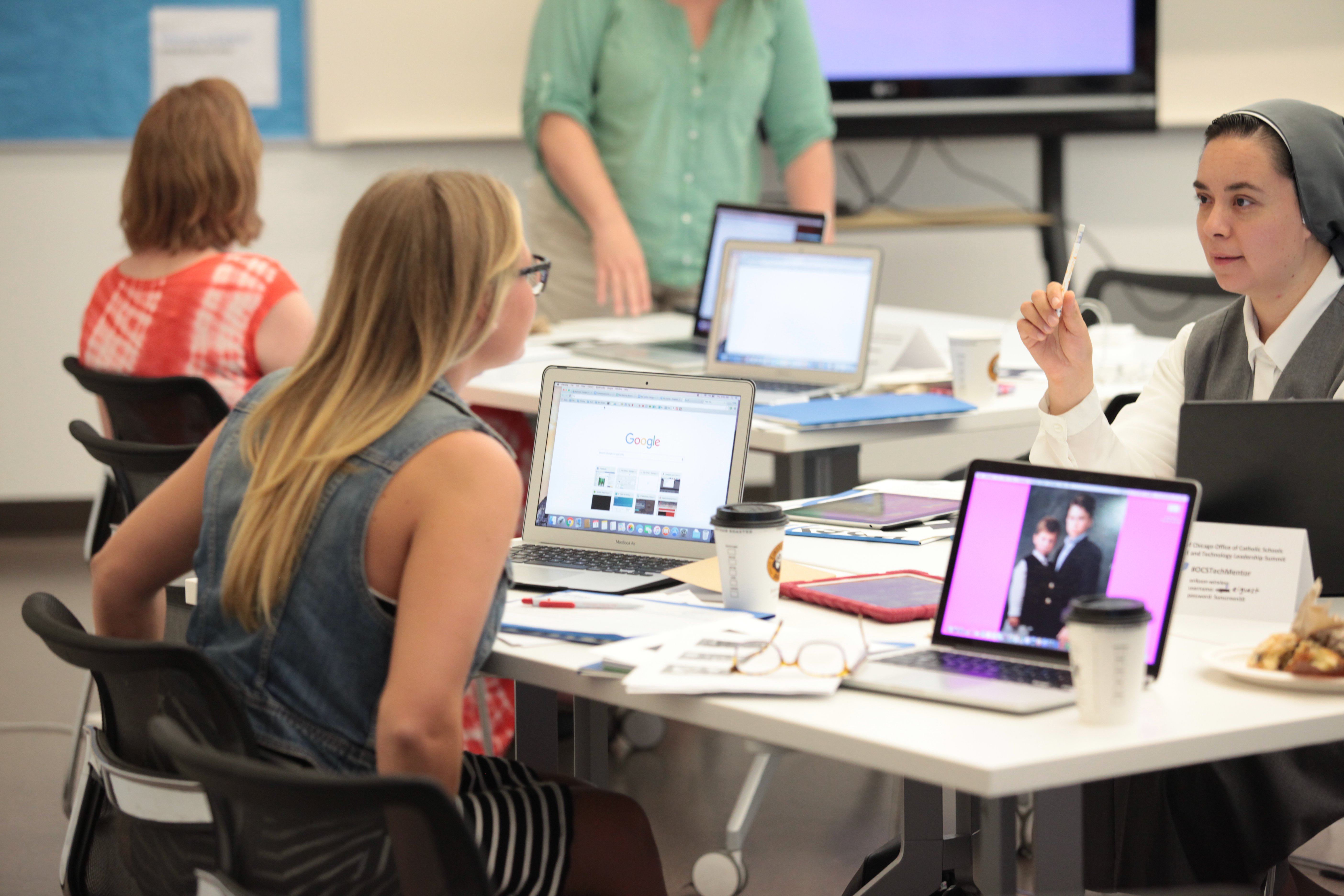
The TEC Center at the Erikson Institute
Teachers can contact experts at the Erikson Institute for virtual office hours through Skype for coaching to help them with the development of their lesson plans. Kaldor explains more about the program: “It’s the great equalizer. Some people are high-tech, but don’t have the teaching experience and vice-versa. Partnerships are formed for collaboration and teachers share with one another, fostering a community of practice.” For instance, one teacher, who initially was nervous about using technology with her students, shared a success story. One of her four-year-old students, a DLL, was at home during a power outage. He told his parents, “we need to check the circuit” and helped them get the power back on. He was able to connect what he was learning in school about electricity to a real-life situation.
After teachers visit all of the tables in the TEC playground, they watch a video of a model lesson from one of their cohort members. Teachers are captivated by the authentic lesson and openly share reflections on the video clip and examples from their own lessons. Participation in the TEC playground, model lessons, and reflection activities help teachers develop their teaching skills around the use of technology. Reflecting on her experience in the program, one teacher stated, “I approach teaching from a very developmental early childhood philosophy, and I was very hesitant to add technology. Through this program, I’m starting to feel a lot more comfortable, and I see it as a lot more appropriate.” After each workshop, teachers get to take home some of the technology tools they explored in the playground and integrate these new tools into their practice.
At the end of the program, teachers receive a certificate of completion during the mini-conference where they deliver their final presentation to their school leaders, peers, and sometimes parents and families. In 2016, the program was showcased by the White House at both the Computer Science for All and Early STEM initiatives.
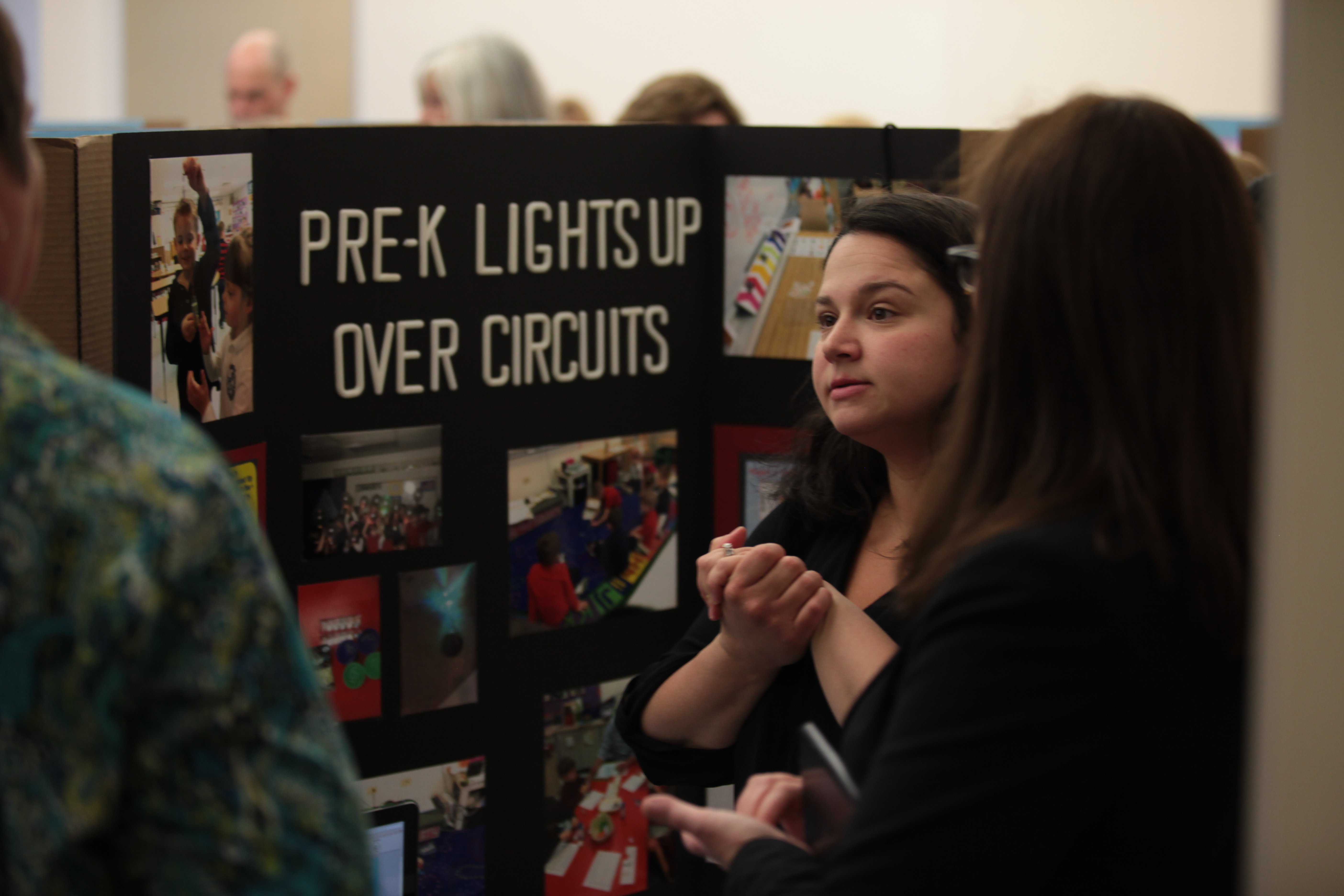
The TEC Center at the Erikson Institute
Empowering Teachers to Lead in Tech
Although the Archdiocese of Chicago provides funding for resources, the TEC Center is looking for more funding to conduct a rigorous evaluation of the program. Currently, the program uses entry and exit surveys to illustrate teacher growth over the course of the year. According to the survey results, the TEC Mentors program has decreased teachers’ anxiety around the use of technology in early childhood settings and has empowered teachers to facilitate tech exploration and creation.
These survey results are promising, particularly since the program’s goal is to build a corps of early childhood technology experts. Throughout the program teachers learn how to integrate technology into their daily classroom practice. They also learn how to share best practices with their colleagues who are not participating in the program and they are empowered to lead in their school communities. Donohue says, “in general, our success is based on a developmentally appropriate approach. When teachers start our program, most of them already know that. Building on this knowledge, we are able to help them integrate technology into their practice.” A future study could measure the effect of the program’s ability to change the attitudes and dispositions of teachers who have not participated in the program, but who are learning from their colleagues who are participants. If successful, this could be another approach to scale up.
Citations
- Big Shoulders Fund, “Our Mission is Simple,” https://www.bigshouldersfund.org/.
- Big Shoulders Fund, “Our Mission is Simple,” https://www.bigshouldersfund.org/.
- LaRue Allen and Bridget B. Kelly, eds., Transforming the Workforce for Children Birth Through Age 8: A Unifying Foundation (Washington, DC: National Academies Press, 2015), 404, http://www.nap.edu/catalog/19401/transforming-theworkforce-for-children-birth-throughage-8-a.
- National Association for the Education of Young Children, “Technology and Young Children: Online Resources,” https://www.naeyc.org/resources/topics/technology-and-media/resources.
- Technology in the Lives of Educators and Early Childhood Programs: Trends in Access, Use, and (Evanston, IL: Northwestern School of Communication, 2015), http://www.fredrogerscenter.org/wp-content/uploads/2015/07/Blackwell-Wartella-Lauricella-Robb-Tech-in-the-Lives-of-Educators-and-Early-Childhood-Programs.pdf.
Partnering to Connect Research to Practice in Nashville, Tennessee
Over 3,100 four-year-olds in Nashville had access to publicly funded pre-K in the 2016–17 school year.46 All lead pre-K teachers in Metro Nashville Public Schools (MNPS) are required to have a bachelor’s degree with certification in early childhood education and are paid on the same scale as K–12 teachers. Each of the district’s Early Learning Centers discussed in this profile serve a majority of non-white students.47 In 2017, approximately 75 percent of students in Davidson County qualified for free or reduced-price lunch.48
Back in 2013, when district leadership in MNPS sat down to develop a five-year strategic plan, pre-K rose to the top as a priority. Superintendent Jesse Register and his team knew that a strong start could set children on the path of long-term success. MNPS was already participating in the state’s Voluntary Pre-K Program, but district leaders wanted a better understanding of what really worked in pre-K. If they expected pre-K to fulfill its promise, they knew it needed to be high quality.
With financial support from the city of Nashville, MNPS decided to create three new Early Learning Centers that would act as hubs of innovation. The Early Learning Centers would serve only pre-K students and would function under an iterative, continuous quality improvement model so that MNPS could determine what led to high-quality pre-K. Lisa Wiltshire, who was MNPS’s executive director of early learning innovation at the time, recalls that one of the first phone calls she made was to Dale Farran at Vanderbilt University’s renowned Peabody Research Institute (PRI).
PRI was already evaluating the state’s pre-K program and had been following a cohort of Tennessee students since 2009. Wiltshire wanted to strengthen the district’s partnership with PRI researchers by having them conduct enhanced evaluations of program quality for the Early Learning Centers to determine what factors are associated with better child outcomes. Beginning in the Early Learning Centers’ first year, 2014–15, PRI conducted full-day observations in every classroom, three times per year, in addition to pre- and post-assessments of pre-K students. Teachers and leaders were hired with the understanding that working in the Early Learning Centers meant frequent observations, a willingness to use data to improve practice, and intensive professional learning.
In October 2014, the state of Tennessee applied for a federal Preschool Development Grant to improve access to high-quality pre-K in high-need communities. The proposal included efforts to improve the quality of pre-K in MNPS by providing personalized coaching for all of the district’s pre-K teachers, building on the instructional lessons learned in the new Early Learning Centers.49 A MNPS needs-assessment found that many of the pre-K teachers working in public schools were isolated and had limited access to tailored professional development practices. District leaders believed that PLCs bringing together pre-K teachers and instructional coaches could improve teacher practice.
The federal government granted Tennessee approximately $17 million per year for four years, with $8 million per year going to MNPS to make its vision a reality.50 The award included funding for an expanded partnership with PRI to assess the pre-K expansion and quality efforts. MNPS hired 11 pre-K coaches to work across schools and seven to work in the Early Learning Centers. One cohort of coaches was assigned to work with the researchers at PRI.
Not a Setback, but an Imperative
Less than one year into this work with MNPS, PRI released findings from its statewide study of the Tennessee Voluntary Pre-K Program, which caused unrest in the early education community and raised concerns about pre-K for policymakers nationwide.51 In their randomized controlled trial of Tennessee’s Voluntary Pre-K program, Mark Lipsey, Dale Farran, and Kerry Hofer found that children who attended the state’s public pre-K program showed gains at the beginning of kindergarten, but by the end of kindergarten performed no better than their peers who did not attend state pre-K.52 This “fade-out” phenomenon, where the gains made in pre-K diminish over time, has been documented in other programs.53 But what really raised eyebrows was the finding that Voluntary Pre-K students were performing lower on a host of academic and behavioral measures than their counterparts by the end of third grade. The findings seemed to contradict years of evidence that high-quality programs can help close the achievement gap and yield a strong return on investment.54
Voluntary Pre-K met a host of indicators that experts considered necessary for strong pre-K, such as teachers with bachelor’s degrees and specialized training in early childhood education, as well as small classes with low student-to-teacher ratios.55 The study made clear that while these indicators may be necessary for quality, they were not sufficient. While some skeptics used the PRI study to argue that pre-K is not a worthwhile investment, state officials had a different takeaway: they decided to figure out what was not working and try to improve the program. For leaders in MNPS, the investment in the Early Learning Centers became even more important. They needed to determine what specific teacher practices led to consistent gains for pre-K students so that those practices could be the focus for professional development and replicated to scale.
From 2014 to 2016, the PRI team observed 26 preschool classrooms in the three Early Learning Centers. The team collected data on classroom practices using the Child Observation in Preschool tool and the Teacher Observation in Preschool tool, which capture snapshots of child and teacher behavior, respectively, over a designated period of time.56 Both tools were developed by researchers at PRI over two decades ago and have been validated.57 Team members also collected individual assessment data on each of the 840 students in the 26 classrooms. By identifying specific classroom practices associated with quality outcomes, they hoped to create a validated model of what works in pre-K, and then use this data to influence coaching.
Predicting Better Pre-K Outcomes: Signs Point Toward the “Magic 8”
Collecting data on teacher practice and child outcomes was the first phase of the partnership between the Early Learning Centers and PRI, and it was not always smooth sailing. Teachers were anxious about the observation data being used punitively and had to adjust to having observers in their classrooms. According to Susan McClane, one of the coaches working with PRI, “there used to be no curriculum in pre-K. Pre-K was isolated in MNPS, so teachers got used to developing their own way of doing things. They worked so long by themselves without principal help, without coaches, that bringing in observers and coaches was an adjustment.” As Dale Farran said in an Education Week article, “most teachers have gotten into a situation where data are used to judge, not to help improve….So we [PRI] had to learn how to present the data in a more supportive way, but teachers also had to learn how to trust us to give them information that might help their practices to be better.”58
Coaches had to adjust too. PRI was presenting them with more data than they knew how to use. PRI wanted to be hands-off and let coaches decide what to do with the data, but it was not always intuitive how to translate the research into practice. According to PRI research associate Caroline Christopher, “what we originally envisioned was less than helpful for the coaches and teachers. We presented them with a 64-page document that we were excited about, but they didn’t know what to do with it. We realized they have competing demands and didn’t have time to parse through this lengthy document and try to make sense of it.”
To limit confusion and improve efficiency, the PRI research team decided to hone in on the eight classroom practices that the data showed were most consistently associated with student gains:
- Reduce transition time (routines and wait time for children)
- Increase the quality of instruction
- Create a more positive emotional climate
- Have teachers listen more to children
- Provide more sequential activities
- Foster social learning (associative and cooperative) interactions
- Foster high levels of child involvement
- Create more math opportunities
The researchers hoped that teachers and coaches would be more open to changing practice if the practices were shown to improve student growth.59 They were right. Ashley Aldridge Wilson, a pre-K coach who works with PRI, was eager to implement the eight evidence-based practices, which educators quickly termed the “Magic 8.” She said, “when I told my teachers about the Magic 8, there was not a lot of knowledge. If you were in a testing grade, and researchers identified eight strategies that you could do to show tremendous growth, wouldn’t we want to all know those secrets?”
But the next phase of the partnership—figuring out exactly how coaches would use the Magic 8—was another learning process. PRI worked with the coaches to determine how they felt comfortable using the data. PRI initially wanted coaches to gather teacher observation data, but quickly realized that coaches did not feel this was the best use of their limited time. The coaches also did not want their teachers to view them as evaluators. As Wilson explained, “we’re not there to evaluate teachers. We are there to come alongside and try to have a spirit of joy and non-intrusion. We are not assistants; we are there to work with the adults on best practice. We will help as needed, but our primary role is to grow the teacher’s pedagogy and strategy. We’re happy to model, but just working with kids doesn’t grow teacher practice.”
Much of the first two years of the partnership between MNPS and PRI was spent learning how to be partners. PRI researchers spoke to the coaches, administrators, and teachers about their needs and adjusted their role accordingly. This was all part of the iterative model that Wiltshire and Farran’s teams had envisioned. In a journal article last fall, Farran and her colleagues liken this process to “design-based research” explaining that it “includes the same continuous cycle of data collection, feedback, planning, implementing, and monitoring associated with CQI [continuous quality improvement]” with the goal being “to design the model not validate an existing one.”60 Explaining the process, Caroline Christopher told us, “now we sit the coaches down and ask what is most useful, instead of giving them a bunch of assignments.” And the coaches appreciate the flexibility. As coach SeTar DeThrow explained, “we’re all kind of finding our way. We’re appreciative of the PRI researchers being open to getting the most accurate picture.”
Translating Data into Classroom Practice
The coaches and teachers wanted benchmarks to measure how their practice around the Magic 8 was improving, but PRI was wary of setting concrete goals because of limited research on how much time a teacher should spend on a certain action. Instead, PRI took the observation data it had and “presented graphs where [the researchers] contrasted the average score from a prior observation with the best [they] had observed in any one teacher in the group in the subsequent observation and an arrow indicating this was the direction teachers should be heading.”61
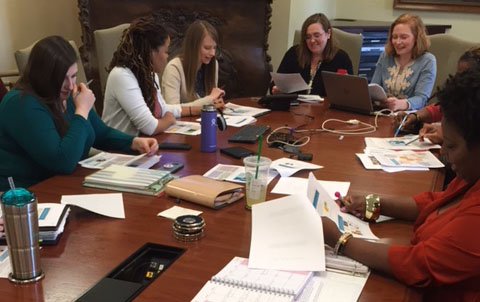
PRI Team (April 2018)
For instance, one of the Magic 8 is “reduce time spent in transition.” Transitioning from one activity to the next is often when teachers see a lot of behavior problems. Pre-K teachers want to maximize the time spent on instruction, but often do not know how to use transition time effectively. Transition time cannot completely be eliminated, but it is difficult to determine the exact amount of time that should be spent transitioning or what realistic goals should be. This is where the data come in. But as Christopher explained, “standard deviations are not helpful for teachers. They want something to compare their current practice to.” If classroom observations found that the average amount of time classrooms spend on transitions is 20 percent, for example, but one teacher spends just 5 percent of her time in transitions, then the researchers and coaches know it is possible for teachers to move closer to 5 percent. The goal is not necessarily to move every teacher to 5 percent, but to move in that direction.
PRI not only presents the data but also works with coaches to find strategies for improving instruction. For instance, PRI has identified ways that coaches can help teachers incorporate instructional content into transitions. When Wilson addressed transitions with her teachers she presented the data, timed how long they were spending on transitions, and then brought them together to brainstorm how to improve. With new information and tools, teachers went back to the classroom and implemented their ideas.
Coaches and teachers can also use a website PRI created that explains the Magic 8 in detail, with written explanations, pie charts, summaries of findings, and strategies and resources. PRI has posted one-pagers with questions and suggestions for what to do to improve. Coaches are encouraged to use these in their PLCs. The website also includes a “Partnership Portal” where PRI houses secure data on student assessments and teacher performance.
To promote buy-in and build expertise, the PRI team has identified teachers with specific strengths and asked them to write blog posts on the website with advice for other teachers. The researchers found that teachers prefer to hear from their peers about how to improve their practice instead of from researchers who are not in the classroom every day. While informal, blogging gives the teachers an opportunity to mentor their colleagues. The coaches report that on the whole, teachers have been receptive to the coaching. As they began working on the Magic 8, coaches noticed many teachers posted them on the walls of classrooms. In MNPS, all pre-K teachers participate in coaching, and unsurprisingly, coaches find that they “see the most growth from teachers who are eager.” Coach Wilson also reported that when “principals have had a vested interested in pre-K, [she’s] been able to move their teachers so much more.”
Broadening the Reach of the Research
While PRI continues to work with MNPS coaches and improve its model for professional learning, both groups envision this work going further. The Tennessee Department of Education developed a statewide definition for quality early education based on multiple sources of evidence, including national research and PRI’s findings from its work with MNPS on the “Magic 8.” Farran said that Tennessee now has “one of the best statewide visions [she’s] seen.” As she and her colleagues explained in the article outlining their work over the last few years, “the school district funded the pre-K centers [Early Learning Centers] with their 26 classrooms to be the Petri dish where a vision could grow, a vision the district wanted validated and exported to the rest of its more than 100 pre-K classrooms.”62
The ultimate goal is to develop a mobile website application with PRI’s observation tool that is “less research-y and more applicable to the real world,” as Christopher explained. PRI envisions coaches being able to go into a classroom with a tablet loaded with the app, choose what they are interested in observing based on the Magic 8, receive instructions on what to observe and for how long, quickly receive data to show where this teacher falls in comparison to others, and then have access to strategies and resources to improve. Farran says this is the “beginning of what I hope will be a different way of doing professional development.”
Farran explained, “the idea is that the dataset grows and grows, to include the entire district. As the app collects more data on more teachers, it can start to tell what is a typical range for certain behaviors. There’s always a huge range in teacher behavior.” While coaches will continue to have individualized data on their teachers, “the district can also notice when something is a district-wide issue and narrow [its] professional development accordingly.” As is often the case, funding is the primary barrier to this work. The PRI team is in the process of securing funding to make the app a reality.
Citations
- High-quality Start for All: A Roadmap for Strengthening Pre-K and Early Learning Opportunities for All (Nashville, TN: Office of Mayor Megan Barry, August 2017), https://www.nashville.gov/Portals/0/SiteContent/MayorsOffice/Education/docs/High%20Quality%20Start%20for%20All_Final_Web.pdf.
- 2016–17 Annual Diversity Report (Nashville, TN: Metro Nashville Public Schools, 2017), https://static1.squarespace.com/static/57752cbed1758e541bdeef6b/t/5a021961e4966bbbf2aa3d37/1510087010619/2016-17+Annual+Diversity+Report+110617+FINAL.PDF.
- Kids Count Data Center (website), “Free/Reduced-Price School Lunch Participation,” (2017), http://datacenter.kidscount.org/data/tables/2979-free-reduced-price-school-lunch-participation?loc=44&loct=5#detailed/5/6420-6514/false/870,573,869,36,868/any/13216,10109.
- Application for Grants Under the Preschool Development Grants–Expansion, (Washington, DC: U.S. Department of Education, 2015), https://www2.ed.gov/programs/preschooldevelopmentgrants/applications/tnapplicationpdg2015.pdf.
- U.S. Department of Education, “What Are Preschool Development Grants?” https://www2.ed.gov/programs/preschooldevelopmentgrants/pdgfactsheet81115.pdf.
- Mark W. Lipsey, Dale C. Farran, and Kerry G Hofer, A Randomized Control Trial of a Statewide Voluntary Prekindergarten Program on Children’s Skills and Behaviors through Third Grade (Nashville, TN: Peabody Research Institute, Vanderbilt University, 2015), https://peabody.vanderbilt.edu/research/pri/VPKthrough3rd_final_withcover.pdf.
- Mark W. Lipsey, Dale C. Farran, and Kerry G Hofer, A Randomized Control Trial of a Statewide Voluntary Prekindergarten Program on Children’s Skills and Behaviors through Third Grade (Nashville, TN: Peabody Research Institute, Vanderbilt University, 2015), https://peabody.vanderbilt.edu/research/pri/VPKthrough3rd_final_withcover.pdf.
- Pre-K Benefits: The Facts on Fade-Out (Atlanta, GA: Southern Regional Education Board, 2015), https://www.sreb.org/publication/pre-k-benefits-facts-fade-out.
- Hirokazu Yoshikawa, Christina Weiland, Jeanne Brooks-Gunn, Margaret R. Burchinal, Linda M. Espinosa, William T. Gormley, Jens Ludwig, Katherine A. Magnuson, Deborah Phillips, and Martha J. Zaslow, Investing in Our Future: The Evidence Base on Preschool (New York: Foundation for Child Development, 2013), http://fcd-us.org/sites/default/files/Evidence%20Base%20on%20Preschool%20Education%20FINAL.pdf.
- W. Steven Barnett, Allison H. Friedman-Krauss, G. G. Weisenfeld, Michelle Horowitz, Richard Kasmin, and James H. Squires, The State of Preschool 2016: State Preschool Yearbook (New Brunswick, NJ: National Institute for Early Education Research, 2017), http://nieer.org/wp-content/uploads/2017/08/Executive-Summary_8.21.17.pdf.
- Dale C. Farran, Child Observation in Preschools (COP) (Nashville, TN: Peabody Research Institute, Vanderbilt University, 2006), https://my.vanderbilt.edu/toolsofthemindevaluation/files/2012/01/Manual-COP-Tools-2011_October.24_web2.pdf; Carol Bilbrey, Elizabeth Vorhaus, and Dale C. Farran, Teacher Observation in Preschools (TOP) (Nashville, TN: Peabody Research Institute, Vanderbilt University, 2007), https://my.vanderbilt.edu/toolsofthemindevaluation/files/2012/01/Manual-TOP-Tools-2011_October.243.pdf.
- Dale C. Farran, Deanna Meador, Caroline Christopher, Kimberly T. Nesbitt, and Laura E. Bilbrey, “Data-Driven Improvement in Prekindergarten Classrooms: Report from a Partnership in an Urban District,” Child Development 88, no. 5 (2017): 1466–1479, http://onlinelibrary.wiley.com/doi/10.1111/cdev.12906/abstract.
- Marva Hinton, “Vanderbilt Researchers Develop 'Magic 8' Practices to Create an Effective Preschool,” Education Week, October 19, 2017, http://blogs.edweek.org/edweek/early_years/2017/10/researchers_develop_magic_8_practices_to_create_an_effective_preschool.html.
- Dale C. Farran, Deanna Meador, Caroline Christopher, Kimberly T. Nesbitt, and Laura E. Bilbrey, “Data-Driven Improvement in Prekindergarten Classrooms: Report from a Partnership in an Urban District,” Child Development 88, no. 5 (2017): 1466–1479, http://onlinelibrary.wiley.com/doi/10.1111/cdev.12906/abstract.
- Dale C. Farran, Deanna Meador, Caroline Christopher, Kimberly T. Nesbitt, and Laura E. Bilbrey, “Data-Driven Improvement in Prekindergarten Classrooms: Report from a Partnership in an Urban District,” Child Development 88, no. 5 (2017): 1466–1479, http://onlinelibrary.wiley.com/doi/10.1111/cdev.12906/abstract.
- Dale C. Farran, Deanna Meador, Caroline Christopher, Kimberly T. Nesbitt, and Laura E. Bilbrey, “Data-Driven Improvement in Prekindergarten Classrooms: Report from a Partnership in an Urban District,” Child Development 88, no. 5 (2017): 1466–1479, http://onlinelibrary.wiley.com/doi/10.1111/cdev.12906/abstract.
- Dale C. Farran, Deanna Meador, Caroline Christopher, Kimberly T. Nesbitt, and Laura E. Bilbrey, “Data-Driven Improvement in Prekindergarten Classrooms: Report from a Partnership in an Urban District,” Child Development 88, no. 5 (2017): 1466–1479, http://onlinelibrary.wiley.com/doi/10.1111/cdev.12906/abstract.
Explicitly Teaching Social and Emotional Skills in San Jose, California

Early Learning Social Emotional Engagement in the Franklin-McKinley School District serves public pre-K and kindergarten teachers. Some pre-K teachers are required by the state to have a bachelor’s degree and teacher certification. Teachers in the California State Preschool Program are required to have some early childhood education or child development coursework. Paraprofessionals, who usually have minimal or no formal higher education, also participate in the program. The Franklin-McKinley School District sits in the heart of Silicon Valley and serves recent immigrants from Mexico, Central America, and Asia. Eighty percent of students in the Franklin-McKinley School District qualify for free and reduced-price lunch.63 In the district, 98 percent of children in kindergarten through third grade are non-white.64
Maureen Casey is leading circle time at nine o’clock in the morning with a group of pre-kindergarteners in East San Jose, CA. After songs, she assigns students classroom jobs. Natalie will be the teacher’s assistant today. Next, Casey asks her students who they think should get today’s Super Friend Award. “Gustavo? Is Gustavo being a super friend today?” she asks. In Casey’s classroom children are acknowledged for friendship skills like using kind words, taking turns, and being safe and gentle with their peers. Casey has not always focused on explicitly teaching social-emotional skills, but through ongoing professional development and coaching, she has been able to incorporate these important skills in her classroom.
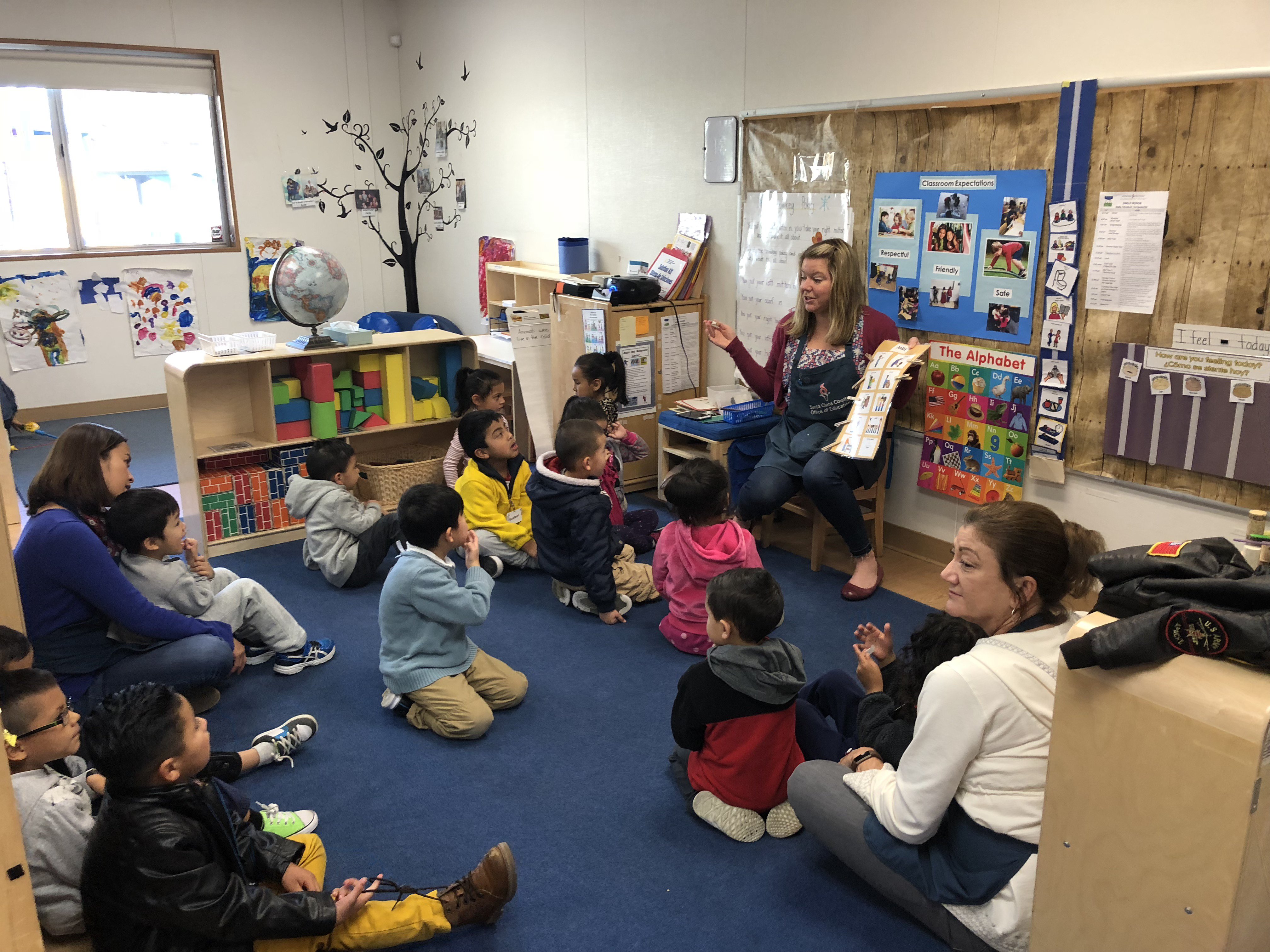
Sarah Jackson
Casey is a special education pre-K teacher in the Franklin-McKinley School District and also works as an inclusion specialist to support special education students in mainstream classrooms in the county’s Head Start program. Her classroom interactions to develop the children’s social-emotional skills are part of a district-wide effort to improve teaching practices in early childhood. Those efforts include professional development for teachers and principals, support in engaging families, the establishment of professional learning communities, coaching in early literacy and social-emotional learning strategies, and teacher leader programs.
The professional development model, called Early Learning Social Emotional Engagement, is part of the district’s larger efforts to invest in early learning programs both in the school district and throughout Santa Clara County. The model trains pre-K teachers, Transitional Kindergarten teachers, some kindergarten teachers, and paraprofessionals from the school district alongside Head Start teachers. The district recently adopted a strategic plan that recognizes that learning begins at birth and calls for additional investments in early education. This work is partially supported by the David and Lucile Packard Foundation, which is investing in three communities in California (Fresno, Oakland, and San Jose) over 10 years to help build kindergarten readiness.
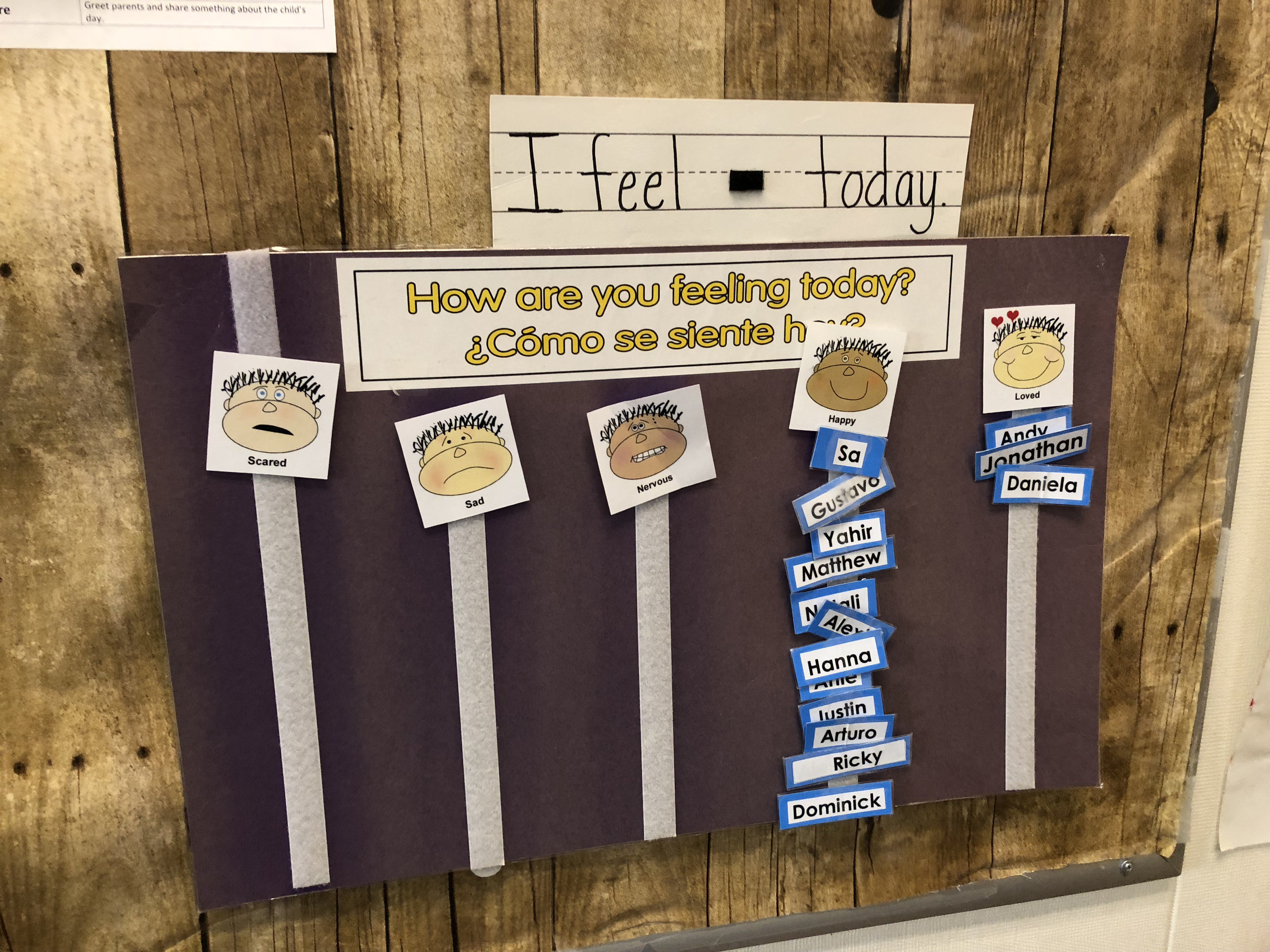
Sarah Jackson
Voice and Choice
A key feature of the professional development is what the district calls “voice and choice.” Training must have buy-in from the teachers, and it must be embedded in their jobs or the efforts will not be successful.
In Franklin-McKinley’s professional development program, teachers can choose whether they want to participate in follow-up coaching, for example, and they can choose what they want to focus on in their PLCs. Casey, for example, is in a PLC that focuses on teaching mathematics and how to pair social-emotional learning strategies with math. Other teachers are focused on literacy or family engagement. The district also changed schedules to better align release time across its system to create more opportunities for teachers to connect on a regular basis and to open up aligned time during the workday for professional development.
Casey is also part of the district’s Teacher Leader program. The program enables teachers who have become proficient in new models of teaching to attend national conferences on early learning and to help train and assess other teachers in the district, building the capacity of the district’s expert teaching force over time.
“This program has been probably the best one I’ve done in my educational career,” Casey said, “just because of the follow through. I feel like I’m really becoming proficient. In the past, I’ve had these sessions, and no one follows up. With this, you are cycling back all the time, and the coaches remind you of what you are doing, and help you make change.”
The district is using the Teaching Pyramid model65 from the Center on the Social and Emotional Foundations for Early Learning, which the district adapted to fit its needs with the help of its designers. The PLC, the training, and the coaching are all integrated. The district has maintained a focus on social-emotional learning over multiple years but changes the program design with each new cycle based on evaluation data and teacher feedback.
The school district partnered with California’s Early Learning Lab66 who worked with teachers and administrators in the district to co-design this model, and also with Tweety Yates, an expert facilitator and a research assistant professor in the Department of Special Education at the University of Illinois at Urbana-Champaign who was brought in to facilitate professional development sessions.
Teaching Social-Emotional Learning
The district is focusing on social-emotional learning because it knows these skills are fundamental to children’s school success. But district leaders were also responding to teachers’ requests for tools and extra support to help them cope with challenging behaviors in the classroom. As the Transforming the Workforce report lays out, social-emotional competence enables children to engage in academic tasks by increasing their ability to interact constructively with teachers, work with and learn from peers, and dedicate sustained attention to learning.67
The adapted Pyramid Model gives teachers strategies for responding to children’s social and emotional needs in the classroom and tools to create classrooms with strong and supportive relationships. Thuy Kropp, a teacher for four-year-olds, almost always has students in her classroom who have never been in school before. Kropp tells the story of one child who was bright and creative, but who was disrupting the classroom by hitting and throwing things. Her first stabs at helping him had been unsuccessful. But while participating in the training program, Kropp created a chart and story from the book Tucker Turtle Takes Time to Tuck and Think, one of the social stories used in the Pyramid curriculum to help children understand social interaction and expectations. She also provided a copy of the book to the boy’s family with suggestions for home use.
The book and chart helped the child understand the expectations for him in the classroom, which Kropp says made a big difference. “He started to say things like: ‘Ms. Kropp, today I did not hit anyone. Today I did not throw anything around.’ He actually internalized these concepts and the incidents were reduced,” she said.
This work is not without significant challenges, and leaders in Franklin-McKinley say that foremost among them is that change in teaching practice can take a long time. “It’s like designing the iPhone and waiting five years until the launch party,” said Melinda Waller, the district’s director of early learning, noting that children are so different from the beginning of the year to the end that it makes it hard for teachers to recognize change even when it is right in front of them. “They can often forget what it takes to get kids to that end-of-year place,” Waller said, “and that each year you are starting fresh.”
Leaders emphasize that even with expert professional development teachers are not easily able to move from knowledge to applied skills. Working to apply the strategies they have learned to every child in their classroom over time takes sustained effort, and for that teachers need support. That is one reason why ongoing coaching and aligned, evidence-based content is so important.
“Only You Know What is Happening in Your Classroom:” Empowering Teachers to Use Data
The district has also made a point of being intentional about the ways it is using data both to collect baseline information and document changes in teacher practice in the short- and long-term. In addition to the Desired Results Developmental Profile, a child progress tracking tool required by the state of California, the school district is using the Teaching Pyramid Observation Tool to measure how well teachers are implementing Pyramid Model practices.
What has made the work successful, district leaders say, is ongoing efforts to ensure teachers understand the goals of data collection. Although some teachers still feel that collecting this information is a waste of time, there is a growing recognition from teachers that it is important to collect and that they are partners in the process. Facilitators present the ongoing results to the group regularly and discuss what is going well and collective areas for improvement. For example, Chris Sciarrino, the director of early childhood practice and innovation at the Early Learning Lab, gave a presentation on helping students build curiosity and take initiative in their learning, an area of needed growth that a recent evaluation had uncovered.
“Principals and directors really talked with us about why we are doing this,” Casey said of the data collection. “They presented it not as an evaluation tool at all, but a tool to help us create classrooms that are enriching for kids. It took off some of the pressure.”
Teachers, with support from the Early Learning Lab, have also created a “data quick check,” a 10-minute online survey that teachers can fill out on their smartphones each day to help them keep track of the impact of their work. The survey helps them reflect on how they are integrating practices and tracking positive and challenging behaviors in the classroom. Teacher leaders worked with directors to develop the questions, so that “it meets their needs, but it also meets our needs,” Casey said. When teachers review their data, they can see that even though it may feel like there is no progress, things are actually improving in their classrooms, slowly but surely.
The facilitators also say that they try to integrate discussions of overall systems change into every session, so teachers understand what it is they are a part of and why they are taking part in this learning. They also try to build on and emphasize teachers’ existing expertise and ability to validate or dispute data about their own classroom. Sciarrino tells the group: “only you know the answer to what’s been happening in your classroom.”
Citations
- Sarah Jackson, California Communities Aiming for Quality in Early Learning: Focus: San Jose (Washington, DC: New America, 2016), 3, https://static.newamerica.org/attachments/12790-stronger-teaching-and-caregiving-for-californias-youngest/San%20Jose%203.14.4fb7ee0949294619a9e9eb6aab28c0b2.pdf.
- Sarah Jackson, California Communities Aiming for Quality in Early Learning: Focus: San Jose (Washington, DC: New America, March 2016), 3, https://static.newamerica.org/attachments/12790-stronger-teaching-and-caregiving-for-californias-youngest/San%20Jose%203.14.4fb7ee0949294619a9e9eb6aab28c0b2.pdf.
- Center on the Social and Emotional Foundations for Early Learning (website), Vanderbilt University, http://csefel.vanderbilt.edu/index.html.
- The Early Learning Lab, https://earlylearninglab.org/
- LaRue Allen and Bridget B. Kelly, eds., Transforming the Workforce for Children Birth Through Age 8: A Unifying Foundation (Washington, DC: National Academies Press, 2015), 139, http://www.nap.edu/catalog/19401/transforming-theworkforce-for-children-birth-throughage-8-a.
Improving Language and Literacy Across Texas
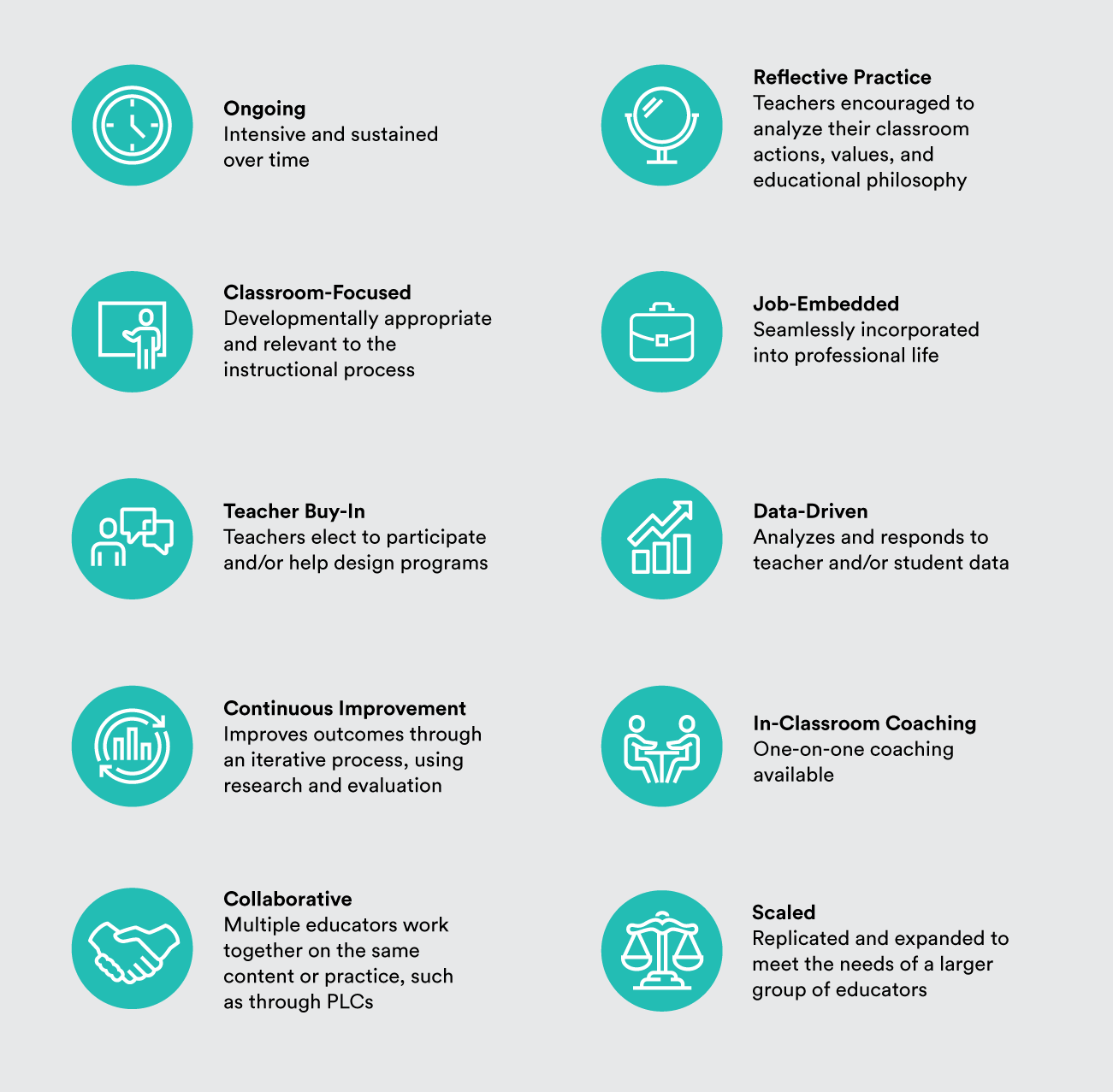
In partnership with the Texas Education Agency, the Children’s Learning Institute (CLI) manages the Texas School Ready (TSR) project and the CLI Engage technology platform, both of which serve pre-K, Head Start, charter school, and child care teachers in all settings across the state. Teachers have varying qualifications based on their program requirements. In Texas, 24 percent68 of children under five years old are in poverty and 68 percent69 of children under four years old are non-white.
Across the Lone Star State, early childhood teachers participate in professional learning through a set of online modules designed to help them become better teachers. When a teacher first opens the CLI Engage platform, she selects a module, such as Emergent Literacy–Reading or Beginning Education: Early Child Care at Home (Español). She can progress through the module at her own pace and receives a certificate upon completion. The modules consist of pre- and post-tests, videos of how to engage children in various lessons, videos of expert and exemplar teachers in English and Spanish, 350 curricular materials, content for coaches’ development, and a progress monitoring tool. The platform is free and available to all districts, Head Starts, and child care programs across the state that partner with CLI or are a part of the state’s QRIS program called Texas Rising Star.70
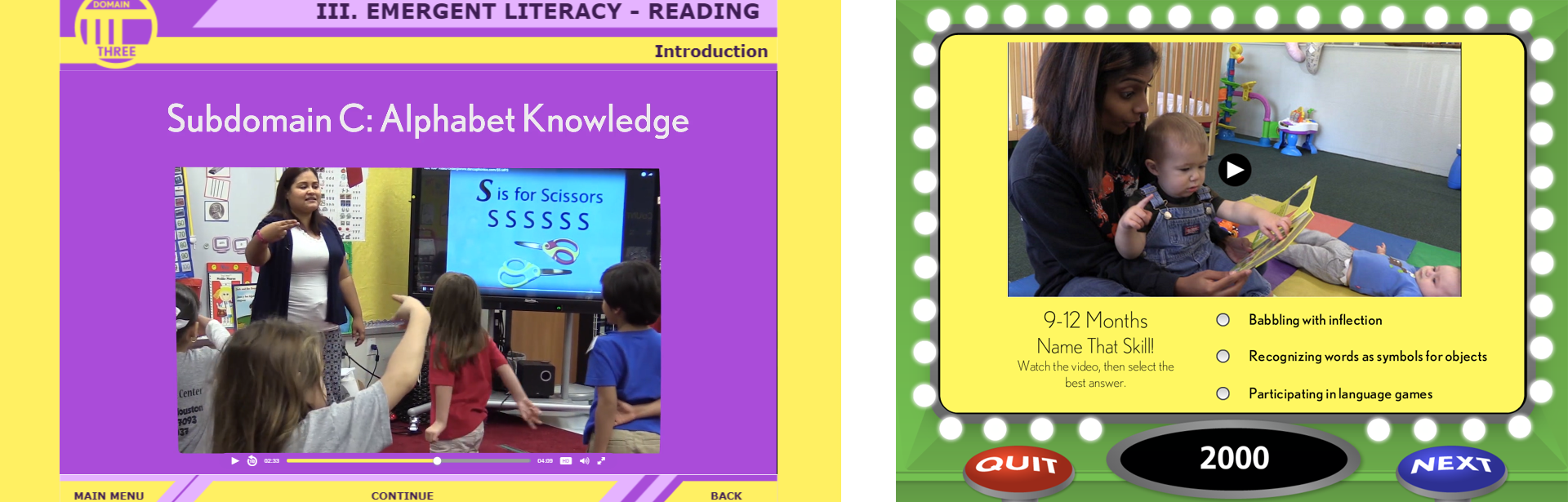
CLI Engage
How CLI Engage Evolved
In the mid-1990s, Texas First Lady Laura Bush wanted to implement a state-wide, evidence-based early literacy program for Texas students. At the time, Rod Paige, former U.S. Secretary of Education, was the superintendent of Houston Independent School District (HISD). As head of HISD, the largest school district in Texas, he was making reforms to teacher professional development in K–12 to improve literacy outcomes for children. Bush did not want early childhood to be left out of these reforms because many programs in the state were still trying to understand how best to teach young children early literacy skills. Bush asked researchers at the Children’s Learning Institute (CLI) at the University of Texas Health Science Center in Houston to take this on. One of those researchers was Susan Landry, the director of CLI. Landry and her team set out to develop a professional development training program.
With funding support from legislators, the program that Landry and her team developed was first delivered to Head Start teachers across the state. The goal of the training program was to develop a core of highly trained teachers who would teach Texas’s youngest learners in ways that aligned with the latest research. This training went through many iterations. Teachers and center directors were able to give feedback to the researchers to create a program that met their needs.
In 2003, the Texas state legislature requested that CLI develop another professional development program to promote early literacy and language skills that could continue to be used with Head Start teachers but would also reach public pre-K and child care teachers. With support from the state and a federal Education Innovation and Research grant, Landry’s team developed a program that could be used by teachers who had received diplomas or credentials at any education level, from high school to graduate school.
In the program’s early stages, Head Start teachers were given binders that addressed different components of high-quality early literacy and language skills. For example, teachers learned how to teach alphabetic knowledge and story comprehension skills to young children. Landry explains “this was the first time teachers had activities that built early literacy and language skills intentionally.” As Landry and her team discovered, high-quality content was only one piece of the puzzle. In the beginning, the research team had to build trust with teachers and Head Start’s leadership. Pushback was intense at first. Teachers thought that intentional literacy lessons could suck the joy out of their playful learning environment. Building on this feedback, Landry’s team ensured that the lessons and activities were “plan-ful and purposeful but also playful.” Eventually, teachers began to buy into the program. Landry recalls, “we were beginning to make progress.”
Using a study design that allows researchers to look at how multiple factors are affecting learning, Landry’s team tested the program in four places: Corpus Christi, Texas; Miami, Florida; Prince George’s County, Maryland; and Columbus, Ohio. At each site five groups of teachers were randomly assigned to receive different supports in addition to a control group.
This study, which was published in 2009 in the Journal of Educational Psychology, found that no matter the group, teachers and students in the supported groups performed better than the control.71 The best performing group had access to an online professional development platform, a job-embedded coach, and instructionally linked feedback through the use of a progress monitoring tool on a technology platform. Landry’s team determined the features of its professional development program based on the promising results from the study.
Overcoming Difficulties with Funding
From the mid-1990s through 2010, the CLI program received a biannual allocation of around $7.5 million from legislators through the Texas Education Agency. The CLI program also receives funding from the Texas Workforce Commission in Child Care Development Funds. However, in 2011, CLI experienced a loss to its public pre-K funding due to a statewide budget cut, forcing a change in the model for public schools.
Despite this setback, the program continued, with funding from the Texas Workforce Commission. In response to the decrease in state funds, CLI developed all of the integrated resources that were part of the Texas School Ready Program on an online, free, and accessible platform called Engage. However, now school districts had to pay for coaches. In the early 2000s, CLI secured funding from the state legislature to conduct a two-year study of Texas School Ready for pre-K teachers across 11 cities and communities.72 The comprehensive professional development program was evaluated in a new state program designed to bring child care, Head Start, and public school pre-K teachers together through partnerships. Throughout the study, Landry and her team worked to seamlessly embed the program into teachers’ jobs and made several adaptations to meet the needs of all of the teachers across settings.
After five months of using the program, researchers were able to document changes in teachers’ instruction, but not in child outcomes. By year two, the researchers found that teachers and children showed gains. Currently, in partnership with the Texas Education Agency and the Texas Workforce Commission, CLI’s programming is implemented in early learning programs across the entire state.
Professional Development Model for All
Landry and her colleagues created a program that would be effective for all teachers across the state, despite their educational attainment level. Throughout the school year, teachers and coaches use these tools to help them learn more about the specific instructional needs of their students. With these tools and curriculum, teachers develop engaging and playful learning activities to help their students develop early learning skills.
Depending on the program, teachers may receive their coaching remotely through CLI Engage, the online platform, or in person.73 On average, both in-person and remote coaches provide teachers with four hours of training per month.74
Coaches help improve the teachers’ lessons by using the Classroom Observation Tool (COT) to track the use of over 200 specific teacher behaviors that are known to advance children’s school readiness. Coaches also set goals for teacher improvement and use techniques such as modeling to align instruction with evidence-based practice.
Ensuring Sustainability
By 2015, CLI had a new and influential champion for the program. Governor Greg Abbott appointed Andres Alcantar as chair of the Texas Workforce Commission. Alcantar strongly supports raising the quality of early learning programs. In a Texas Education Agency (TEA) press release Alcantar spoke about the partnership between the Texas Workforce Commission and TEA saying, “this partnership with TEA reflects a strong commitment to increase the number of Texas children in high-quality early learning environments.”75 The CLI program is a component of this long-term goal of creating universal access to high-quality programs.
The CLI Engage online platform is constantly being improved upon. To date, the program, with funding from foundations such as the W. K. Kellogg Foundation, has added a birth-to-three extension that is publicly available and currently includes 15 hours of training and parent-linked activities, with the aim to expand. The pre-K Texas School Ready program has expanded to incorporate other content areas such as STEM and social-emotional learning.
Currently, the program serves over 800 school districts in Texas and over 2,500 child care and Head Start teachers. This online platform filled with resources for early educators is supported by the Texas Workforce Commission, which provides $11.7 million biannually for the program to maintain scale and continue to improve through an iterative process. When reflecting on the massive scale of the program, Landry says, “I’m proud of how the program has empowered teachers…Prior to the creation of this program, many did not have the tools to foster early learning development.”
Citations
- Kids Count Data Center, “Children in Poverty by Age Group,” (2017), http://datacenter.kidscount.org/data/tables/5650-children-in-poverty-by-age-group?loc=45&loct=2#detailed/2/45/false/870,573,869,36,868/17,18,36/12263,12264.
- Kids Count Data Center, “Child Population by Race and Age Group,” (2017), http://datacenter.kidscount.org/data/tables/8446-child-population-by-race-and-age-group?loc=45&loct=2#detailed/2/45/false/870,573,869,36,868/68,69,67,12,70,66,71,13|/17077,17078.
- Texas Rising Star, “TRS Program Quality Improvement,” https://texasrisingstar.org/providers/program-quality-improvement/.
- Susan H. Landry, Jason L. Anthony, Paul R. Swank, and Pauline Monseque-Bailey, “Effectiveness of Comprehensive Professional Development for Teachers of At-Risk Preschoolers,” Journal of Educational Psychology 101, no. 2 (May 2009):448–465, https://eric.ed.gov/?q=Effectiveness+of+Comprehensive+Professional+Development+for+Teachers+of+At-Risk+Preschoolers&id=EJ835029.
- Susan H. Landry, Paul R. Swank, Jason L. Anthony, and Michael A. Assel, “An Experimental Study Evaluating Professional Development Activities within a State Funded Pre-Kindergarten Program,” Reading and Writing: An Interdisciplinary Journal 24, no. 8 (September 2011): 971–1010, https://eric.ed.gov/?id=EJ935822.
- Bonnie O’Keefe, Primetime for Coaching Improving Instructional Coaching in Early Childhood Education, (Washington, DC: Bellwether Education Partners, 2017), https://bellwethereducation.org/sites/default/files/Bellwether_ECECoaching_GHS_Final.pdf.
- Susan Landry (Director of the Children’s Learning Institute), telephone interview with authors, March 22, 2018.
- KVUE, “TEA to Get Multimillion Dollar Grant to Expand Pre-K Programs,” September 21, 2016, http://www.kvue.com/article/news/local/tea-to-get-multimillion-dollar-grant-to-expand-pre-k-programs/323130221.
Five Lessons for Growing Strong Pre-K Teachers
High-quality teachers are an essential component of an effective pre-K program. Professional learning, when designed and implemented well, can help pre-K teachers develop the knowledge and competencies needed to best serve young children. These program profiles illustrate that offering high-quality professional learning requires planning and careful implementation. Programs need to create structures and content that align with the research about how both adults and children learn best. Below are five lessons for professional learning design and implementation that emerged from our research on these programs.
- Embrace that high-quality professional learning is an investment of time…Effective models should be sustained over time because even the best professional learning opportunities are unlikely to change teacher practice overnight. As Dale Farran at Vanderbilt’s Peabody Research Institute explained in an interview, “helping teachers change their behavior is a lot harder than helping children change theirs.” And even when teachers do change their practice, there is unlikely to be an instant change in student behavior and outcomes. For instance, teachers may spend one year in the TEC Mentor program and may slowly integrate technology into their classrooms as they become more comfortable using it throughout the year. By the time the program ends and they feel confident integrating technology into everyday instruction, the school year is ending and they will be starting fresh with a new class of pre-K students. It may take multiple years to see meaningful changes in student outcomes.
…And money. Many of the components of high-quality professional learning are expensive. An ongoing and sufficiently intensive program requires a significant commitment of staff time. One-on-one coaching and mentoring have substantial personnel costs, as does hiring substitute teachers or rearranging staff schedules to ensure that teachers can participate in professional learning during regular work hours. The technology and time needed for meaningful data collection can also be costly. When allocating funding, programs should also set aside adequate resources for program evaluation when possible. Because many programs that fit the bill for quality do not actually change teacher practice or impact student outcomes, an evaluation is needed to determine whether a program is effective. Sufficient funding for evaluation, which can be costly, is important to ensure that a program is meeting its goals. As the developers of CLI Engage discovered, when the program did not receive adequate funding it was difficult to conduct research on what was working and virtually impossible to scale the program.The federal government currently sets aside funding for professional learning in Head Start and through Title II of the Every Student Succeeds Act (ESSA). State and local governments can use ESSA funding to support instruction for children starting at birth. However, the Trump administration has recently proposed eliminating Title II.76 States and districts, often running on low budgets, depend on Title II funding to support educators. The federal government should continue to support states in providing high-quality professional learning that aligns with the research. Each of the programs we profile found inadequate funding to be a barrier to growth and sustainability.
- Help teachers and administrators see the value early on. All of the programs we profiled found that convincing school staff of the value of professional learning was a vital step in the implementation process. Even a well-designed program can experience challenges with implementation when teachers or their leaders are not on board. Creating a culture of professional learning in a program can be difficult, particularly when trusting relationships have not been established between teachers, coaches, administrators, and program developers. Teachers need to know that they can take risks and try out new techniques in a safe and supportive learning environment. When trust is established and good relationships are formed, professional learning programs are often filled with excitement and idea sharing.
One way to secure teacher buy-in is to make the program voluntary. In both the SciMath-DLL and TEC Mentors programs, for example, teachers chose to participate and were invested in their own learning and development. The relationships they formed with program staff allowed them to feel comfortable incorporating new ideas and techniques into their classroom practice. In San Jose, teachers were given choices about what components of the program they would like to participate in; follow-up coaching was voluntary, for example. So, teachers who did choose to have coaches were receptive and engaged in changing their practice, leaders there say. Conversely, in Nashville, where coaching is required, coaches said that some teachers were “less receptive and that it took more effort to reel them in.”
It is equally important to have administrator buy-in for a professional learning program to work effectively. When administrators support and understand what teachers are learning, teachers know that what they are learning is integral to achieving the early learning program’s goals for student outcomes. In the TEC Mentors program, school principals were updated about how teachers were learning to integrate of technology into classroom practices. Because principals were kept in the loop, teachers were encouraged to try new things out in their classrooms.
- Develop opportunities for teacher leadership and growth. Another way to foster investment in a professional learning program is to give teachers opportunities to take ownership of their own learning and assume leadership positions where they can share what they have learned with their colleagues. This is particularly important in order to integrate sustainability into a program. When teachers are empowered to take on leadership roles, they can influence the whole staff’s pedagogical approach by creating a shift in the school or program culture.
In SciMath-DLL and TEC Mentors, for example, teachers took the initiative to share what they learned in these programs with their colleagues who did not participate. When teacher leadership opportunities are built into a professional learning program, the program’s reach magnifies. PRI offered Nashville teachers who excelled in certain areas to share their expertise with their peers and teachers around the country through blogging. Franklin-McKinley realized that empowering teachers can also be a method of fostering sustainability. It invested in teachers by selecting teacher leaders, training them to be reliable observers, and allowing them to lead PLCs.
- Coach the coaches. Each of the professional learning programs that we profiled incorporated some form of coaching. While research has shown that personalized coaching can be an effective method for changing teacher practice, it has to be done well. Coaches of pre-K teachers not only need to be experts in how young children learn, but they also need to know how to teach adults. As Bellwether explains, “most evidence-based coaching approaches specify that coaches must have strong relationship-building skills, be able to teach adults as well as children, reliably document and track their work, and implement a coaching model with fidelity.”77
In the programs we profiled, coaches had varying backgrounds and levels of expertise. Nashville’s coaching program was developed rapidly to assign all pre-K teachers in the district a personal coach. Some MNPS coaches were former administrators, some had been coaching for many years, and others were simply identified as high-quality pre-K teachers the year before and had been asked to coach. While there are benefits to developing teacher leadership, teachers transitioning into a coaching role will need extensive professional learning of their own to know how to best serve teachers. This is especially important when coaches are given autonomy in deciding how to work with their teachers. SciMath-DLL had three workshops just for coaches during the two-year intervention with its first cohort and continues to work with coaches alongside teachers during each phase so that teachers and coaches are all learning STEM content together.
The field could benefit from more guidance and tools related to coaching competencies, support, and evaluation. Because strong coaching is individualized, it is difficult to evaluate. Bellwether explains that there is a dearth of research determining exactly when coaching is effective and what effective coaching looks like. Additionally, researchers can struggle to determine what benefits are attributable to coaching because other interventions are usually executed at the same time.
- Align the program model with the latest research on professional learning and use evaluation tools for continuous improvement. Each of the profiled programs incorporates research-based features of professional learning and measures program outcomes with evaluation tools. When programs are designed with teachers in mind they are more effective, particularly if they understand that teachers are adult learners. Professional learning that incorporates best practices will be able to change teacher practice for the better.
Programs with thoughtful evaluation methodology had a greater ability to adapt and improve through iteration. Among the programs that we profiled, program improvement almost always sought to meet the needs of teachers and create better outcomes for children. The CLI researchers used several randomized controlled trials to determine which features of their professional learning program led to positive student outcomes. When they discovered what program features worked best, they began to scale up their program based on this research. In Nashville, researchers collected extensive data and took practitioners’ feedback and experiences into account as they designed the program. In San Jose, with help from the Early Learning Lab, the Franklin-McKinley School District worked with teachers from the district and community partners to create its professional development model, using several tools to gather data and change program design with each new cycle based on that data and on teacher feedback.
Citations
- For more information on the implications of eliminating Title II of the Every Student Succeeds Act see Roxanne Garza, “A High-Stakes September for Teachers and Leaders,” EdCentral (blog), New America, August 29, 2017, https://www.newamerica.org/education-policy/edcentral/high-stakes-september-teachers-and-leaders/.
- Bonnie O’Keefe, Primetime for Coaching: Improving Instructional Coaching in Early Childhood Education, (Washington, DC: Bellwether Education Partners, December 2017), https://bellwethereducation.org/sites/default/files/Bellwether_ECECoaching_GHS_Final.pdf.
- Introduction
- Pre-K Teachers and In-Service Professional Learning
- Our Approach
- Strengthening STEM Instruction in Passaic, New Jersey
- Building a Cohort of Early Childhood Technology Leaders in Chicago, Illinois
- Partnering to Connect Research to Practice in Nashville, Tennessee
- Explicitly Teaching Social and Emotional Skills in San Jose, California
- Improving Language and Literacy Across Texas
- Five Lessons for Growing Strong Pre-K Teachers
More About the Authors

Shayna Cook
Policy Analyst, Early & Elementary Education

Sarah Jackson
Principal at SJackson LLC

Abbie Lieberman
Senior Policy Analyst, Early & Elementary Education
Issues
Programs/Projects/Initiatives
Related