Part 4: Unbuckling the Straitjacket
It’s time for the straitjacket, which has for too long constrained the nuclear field, to be removed. Diverse perspectives have a history of sparking innovation in the field and are what the field needs more of now. And yet, interviewees told us that individuals with new, nontraditional perspectives are not rare in the nuclear security field, but often are not heard if they do enter.
“The nuclear field is not one that values change,” Wormuth told us. “And maybe that’s part of the reason why it seemed harder to bring young people into the field, because I think it’s just sort of same old, same old, more of the same. You’re more likely to be taken seriously in my experience if you can rattle off things like the B61 Life Extension Program and the arguments for why we should or shouldn’t invest in the tail kit on this that and the other thing.”
Beyond the experience of sexism, discrimination, and harassment, women discussed another obstacle to moving into and up through the nuclear security field: the 24/7 nature of the job, and its impact on their personal lives.
The Work-Life Challenge
Women identified several overlapping dynamics—the long hours, the classified nature of the work, the need to be physically present in the office, unpredictable schedules, frequent international travel, and discriminatory attitudes towards women with family obligations—as contributing to decisions to find new work, go part time, or devote oneself full-time to the work and not get married and have kids. Notably, the persistent cultural expectation that women will be the primary caregivers seemed to go unchallenged from all sides.1
One woman recalled, while pregnant, her Pentagon boss at the time suggesting strongly that she should be home with her child and leave her job. She did not. Later, at the former Arms Control and Disarmament Agency (1961-1999), a senior official called her into his office, she thought, to go over a briefing book for an upcoming trip. “He wanted to know if I was married and if I had children,” she said. “When I [answered] affirmatively to both, he said, ‘who’s taking care of your children while you’re away?’” She told him that her husband was. “He then proceeded to tell me that when his daughter had children, she’d decided to quit her job to be home with them.” In the early 1980s, this interviewee saw another woman who went on maternity leave and was “read out”2 of, or told to surrender, her security clearances in the Office of the Secretary of Defense because she was not expected to return.
Travel, too, can pose major challenges while providing significant career development opportunities. “There’s a lot of international travel, and the men don’t have the same constraints about meeting, about making time, about having to balance family,” Farkas said. “Now, I don’t have a family and maybe that’s in part because I was always so impassioned about my work….But I will say it’s harder for women to get away for consecutive days.”
It is harder, too, for women to work in an environment, and plan for things like child care, when they are unable to predict their schedules. “There’s no ability to predict day in, day out whether you’re actually going to get off of work at five or six or seven or later,” Senior Vice President and Director of the International Security Program at the Center for Strategic and International Studies Kath Hicks said, noting the challenges that posed for her in managing child care with her husband. “The choices I’ve made in terms of coming to a think tank were driven by desire for more balanced lifestyle,” she said.
"The nuclear field is not one that values change."
In such a turbulent work environment, many women mentioned the importance of a supportive spouse in enabling their careers, acknowledging that even the strongest relationships could feel the strain of the long hours required by many nuclear jobs. “I’ve often reflected on how lucky I was to have a husband who was very supportive of my career,” Gottemoeller said. And yet, she said:
When I was in government, I did work very long and hard hours and that was not so good for family life. It was a difficult time, particularly in the early ‘90s when I worked for President Clinton in the White House. That was not an easy time for my family because the children were still pretty small and everything fell on my husband’s shoulders. Luckily, he bore up well and he was very supportive of me doing that job. But I always joke, we’ve had a very good marriage over 40 years, but that was the point when we came closest to divorce.
Women emphasized that the flexibility and culture of a work environment—and by extension the ability to combine work responsibilities with personal ones—is set by leadership at the top. Some also told us about their role in creating those environments and how it attracted top female talent.
“My first big lesson was if you want to be competitive to get the best talent, you have to create opportunities for people to see themselves,” Hersman told us.
They might not mind working for men, but they don’t want to work in male isolated environments….If you want to win, create the alternative environment. I had a higher proportion of women in my office. I had some of the best women in policy in my office. I had an extraordinary number of babies in my office. I had an office, where in many cases, we worked very, very hard, but work-life balance was better than it was in other policy offices. And so it became an attractive place for top female talent in the organization. And that was good for me and my mission space.
Sometimes, work needs to be done at odd hours, in the office or internationally, and there is no way around it. Although this reality is often cited to justify the status quo, the experience of Hersman, Flournoy, and others suggests that building more flexibility and balance in challenging environments will benefit staff, managers, and policy outcomes.
The observations of our interviewees point toward two tracks of actions that will increase innovative thought and practice in nuclear security and draw in and retain new voices. First, adopt research-backed strategies and policies that help women and other non-traditional entrants thrive and inspire them to stay in the field. Second, encourage practitioners and experts to engage with theoretical frameworks that are sparking innovation in other sectors of security policy.
Strategies and Policies that Support Diverse Teams
Just as there is no single cause for the dearth of women in nuclear security, there is no single solution that will bring more women into and up through the field. Indeed, improving gender parity is a complex challenge that the private sector has wrestled with for years, experimenting with a variety of different policies and practices and in some cases, tracking their impacts. As a result, a growing trove of research from public and private sector contexts has illuminated a set of policies and cultural practices that enable women and underrepresented groups to thrive in the workplace.
Crucially, the best workplaces combine new policies with changes in processes and systems in order to drive real behavior change, not just in theory but also in practice. Below are some of the most important policy and practice changes that a workplace can introduce. Though all of these policies and practices will take hard work to implement and introduce, they need not be implemented all at the same time, or in the same way for each agency, organization, or context. At the same time, none of them can be ignored or dismissed; they are each imperative to creating an equitable system for all, and a workplace experience that is less contingent on the variables of an individual’s gender, race, age, manager, or rank.
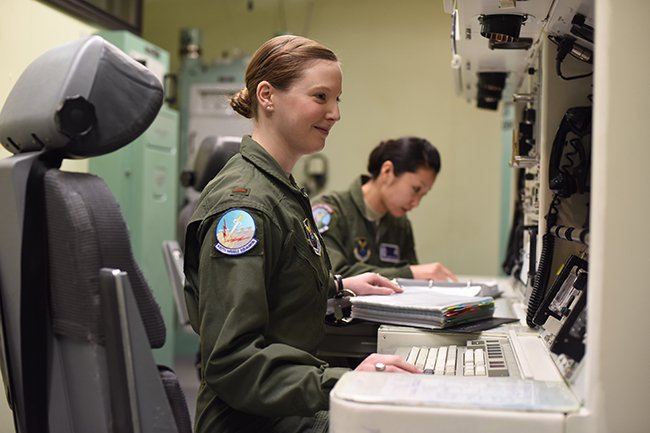
U.S. Air Force / Airman Collin Schmidt
In many cases, these policies already technically apply to federal government agencies and the military, and the topic of introducing or creating them anew may be more relevant to think tanks or other institutions that employ women in nuclear security. Some leaders have already made significant progress in introducing reforms. During Flournoy’s tenure in the Pentagon, for example, she launched a human capital initiative3 intended to give all employees greater access to a variety of flexible scheduling options and found it improved performance and work quality.
The prospect of overhauling federal workplace policies is daunting—so much so that many cabinet leaders make little or no effort to do so. The Obama White House only initiated a diversity in national security initiative in its second term. We heard from our interviewees and experts on personnel policies inside government that even when a policy is part of official Office of Personnel Management guidance, it is not necessarily implemented, or implemented properly. There is often a disconnect between the policy guidance and what behaviors are enforced or incentivized in practice.
This suggests there is enormous scope for leaders to make changes at the level at which they work and for advocates to insist that a plan for workplace improvement is central to any future leaders of nuclear security policy. The policies below offer a starting place for future conversation.
1) Provide paid family leave for all employees, regardless of gender.
Paid leave policies allow employees who need to take time off to care for new children or sick or aging relatives to do so without losing their jobs or having to take unpaid time. Currently, most federal employees have access to unpaid leave under the Family and Medical Leave Act. As one exception, the Department of Defense developed a 12-week paid maternity leave policy (for active-duty military and certain reservists, excluding civilians) in 2016, and the Navy recently introduced more flexibility into its policy, allowing couples to decide which individual in a couple receives “primary caregiver” versus “secondary caregiver” leave.4 Many agencies enable federal employees to donate their unused paid time off to other colleagues through Voluntary Leave Banks.5
Though these policies are a start, they can be significantly improved. New America’s Better Life Lab has done research to assess the optimum length of paid family leave,6 the state of paid leave domestically and around the world, and the impacts of paid leave policies on gender equality and economic metrics.7 One big change should come from expanding maternity leave into parental leave that can be used by both parents. Policies specifically oriented towards mothers can reproduce domestic inequality, re-enforcing the idea that women should have the bulk of caregiving responsibilities.
Our interviews bore out the observation that while these policies benefit all employees, they tend to particularly benefit women, who still bear the brunt of domestic caregiving responsibilities. Paid leave policies can improve retention rates, productivity, and well-being, and make it more likely that a woman will return to work if she leaves to care for a newborn. Leaders must make it clear that women and men will not be penalized for taking this time, since a policy on the books is relatively meaningless if employees feel that they cannot take advantage of it. Leaders, especially male supervisors, can begin to shift this paradigm by taking more leave themselves, helping to establish a new norm of what amount of leave is “acceptable” for employees.
2) Implement a flexible work policy.
Many flexible and alternative work schedules are already suggested in OPM guidelines.8 But our sources suggest that whether or not these flexible scheduling options are accessible depends largely on an individual’s manager, and that they are very limited and seen as career-harming in the security agencies.
In government, “there’s a culture of you’re only doing well if you’re on your butt in the desk,” Farkas told us. Research suggests this is a flawed heuristic to measure productivity and overall effectiveness. While cultural norms and security practices are deeply ingrained, employers who want to attract and retain younger workers, who expect flexibility in a way older workers do not always expect it, will want to reevaluate what a realistic balance between office and home time ought to look like and explore setting up secure access to email servers outside of the office.
3) Revamp performance reviews.
Research shows that performance reviews can be biased, reduce gender equality, and are an often ineffective way of evaluating employees. Negative performance reviews can make it harder for individuals to get promoted and can therefore be a contributing factor to still anemic numbers of women at the top of organizations. In one recent example, researchers analyzed the language being used in evaluations in the military and found that while performance metrics between men and women remained largely the same, what changed was the number of negative performance attributes versus positive ones they were assigned. As one might expect from other research, like the role congruity theory we discussed in the second section of this report, women received far more negative ones than men, and the ones they received (temperamental, inept, gossipy, for instance) send a pretty clear message: They are not leaders and should not be promoted.
As shifting the entire federal workforce review culture is not on the horizon, managers should try to adopt these evidence-based tips for changing performance reviews: Make sure that more than one person is conducting the evaluation, do not show reviewers previous ratings (especially how the individual has rated herself), and enforce the need for concrete, measurable examples of performance, rather than simply, “she’s abrasive” or “not a team player.”
4) Make promotion processes more transparent.
Although many promotion processes within government are transparent and standard, some could be improved, particularly those connected with mid-level managerial positions and political appointees. The practice of handpicking favorite colleagues and rewarding political loyalty may have the effect of ensuring talented women are not looked at, or are seen as token “diversity hires.” In some contexts, particularly for temporary and political appointees, it may be useful to make more clear and transparent the steps, certifications, and milestones necessary to reach the next step in a career progression. And it is always useful for hiring committees to challenge themselves to make criteria broader and less traditional.
5) Take steps to change behavior, not just beliefs.
Behavioral science research suggests that adjustments to processes and systems change outcomes more than attempts to change beliefs, such as unconscious bias training, do.9 For instance, creating incentives for managers to mentor or sponsor promising female talent, to promote women, or to take more vacation time, can encourage that behavior change more than simply encouraging those behaviors. So, too, can changing hiring processes so that hiring managers do not see gender information when reviewing resumes or standardizing interview questions so applicants have a fairer shot. Other social science research suggests that changing the environments that individuals work in—even the photos or posters on the walls—can have a significant impact on employees’ sense of belonging and behavior.
6) Create strong anti-sexual harassment policies and training programs.
Unfortunately, this is one area where the federal experience seems to be going in the wrong direction, given continued increases in rape and assault faced by military women, a series of accusations leveled at State Department officials and at the Department itself for mishandling reports, and a letter calling for improvement signed by more than 200 national security professionals.10 New America’s Better Life Lab recently published an assessment of sexual harassment across industries and a toolkit of sexual harassment solutions,11 laying out the elements of strong anti-sexual harassment policy and training programs. Counter-intuitively, some strategies—including zero tolerance policies and some anti-sexual harassment trainings—can sometimes have deleterious effects, and spark backlash.12 What can work are trainings that integrate cognitive insights about to best teach individuals about sensitive, controversial subject matter; a deep appreciation for and understanding of how contexts and environments can encourage harassing behavior; policies that are transparent and written without jargon; tiered, proportionate responses to harassing behaviors; and clear, swift consequences for perpetrators.
7) Develop a program that goes beyond mentorship to teach characteristics of sponsorship.
Many of the women interviewed reflected on the importance of their mentorship relationships to their ultimate career success, but some described experiences that were more suggestive of a sponsorship rather than a mentorship relationship. Whereas a mentorship relationship tends to be one-sided, the sponsorship relationship is mutually beneficial.13 A sponsor and protégé are professional allies who actively promote each others’ careers. Women especially have much to gain from these relationships, but often do not know that this kind of dynamic can exist in the first place. The burgeoning organizations offering professional support and mentoring outside government can do more along these lines—and transfer the experience to government as feasible.
8) Get past “tokenism” to ensure that all members of a team feel comfortable speaking up.
According to research, women and minorities feel more comfortable speaking up in a group when they make up at least 30 percent of that group, what is known as a critical mass.14 As our interviewees eloquently told us, in smaller numbers women sense (often correctly) that when they speak, they are speaking on behalf of their entire group; and if they blunder, they will hurt the chances for other individuals from their group to be able to participate in the future.
9) Subsidize child care and/or provide access to resources for other forms of caregiving support.
We heard from many of our interviewees that scheduling child care could be challenging, given unpredictable meeting scheduling and overseas travel. Often, women take on the task in a family of finding elder care options as well.15
While some government agencies offer emergency backup care options through a contract with Federal Occupational Health, some also subsidize or provide a limited amount of on-site child care. Families in the U.S. military can also access subsidized child care through Child Care Aware of America.16 These benefits vary greatly, and often make only a small dent in improving the affordability, quality, and availability of care. The landscape for care support in the private sector is similarly patchy:17 according to the Society for Human Resource Management, only 2 percent of American organizations help employees pay for child care with subsidies or vouchers, and only 5 percent offer emergency backup care.
And yet, investments in these services can have a crucial impact on productivity and stress reduction in both the public and private sector. According to Child Care Aware of America, the days that working parents miss due to child care breakdowns costs businesses $4.4 billion per year in lost productivity.18 One survey of a government agency found that providing such services improves productivity at work by over 86 percent and decreases stress by over 82 percent.19 The room for improvement here is vast, and again, the expectations of younger workers are high.
Updates to the Intellectual Status Quo
Over the past decade, the national security community has increasingly become aware of the ways in which gender influences and intersects with security outcomes. Since UN Security Council Resolution 1325 on women, peace, and security20 was passed in 2000, there have been significant research and proposed theoretical frameworks on the impact of gender equality and gender norms on national security that have influenced areas such as peacekeeping and countering violent extremism. Still, our interviews suggest that this body of work has not reached the nuclear security field. We asked interviewees about an influential body of research on the connection between gender equality indicators and security outcomes to gauge whether they saw it as relevant to nuclear security policymaking.
Only about one-third of interviewees said they were familiar with gender analysis,21 which is the process of assessing the possible impact of a policy or program on all genders. Persistent gender inequality around the world means that women, men, and gender non-conforming individuals still have unequal access to economic, political, social, and health resources and opportunities, and can therefore be affected differently by certain policies and programs. Research suggests these differential impacts can have an impact on overall policy effectiveness. This means that implementing a gender analysis can both contribute to a more egalitarian and secure society while also improving policy outcomes on the whole.
Though only a few of our interviewees were familiar with gender analysis, most seemed interested in thinking about its relevance and thought aloud about what that might look like. Inquiring about gendered policy impacts “would be an interesting question to ask,” said Mareena Snowden, a graduate fellow at the National Nuclear Security Administration from 2017 to 2018. “For me, it’s a question of uniqueness,” she said. “Are there unique effects that women experience from certain nuclear security policies, or national security policies? And if so, then what? I’m not sure I have the answer yet. But I think that, to me, would be what the key takeaway would be. What about this is uniquely affecting this subgroup or not?”
What is more clear, Snowden pointed out, is the answer to another question: What differential impact are nuclear policies having on indigenous communities and communities of color? Citing the example of the Pacific Proving Grounds tests, and mining for uranium in the Southwest, she asked:
Whose land was that? How much notice did we give these people about what was actually happening in their countries? It’s always struck me, as a person of color, that it’s often brown people and black people that are on the negative receiving end of a lot of our national security policies….We detonated some of our strongest weapons in Bikini Atoll and in Micronesia and the Marshall Islands. It wasn’t the suburbs of Montana that we were doing that in. Whether it’s criminal justice policy or national security policy, when we talk about who is a valuable life, black and brown people are the last in the line of that list.
Others emphasized the clearly differential health impact of weapons on women, noting that radiation impacts men and women differently, and that those changes can be passed on genetically to children. And yet, one interviewee noted, the “biggest tranche of research that was ever done on all of that” after the Hiroshima and Nagasaki bombings is largely still classified,22 in part because of fears that that research could arm those affected with the data to demand reparations.
Others expressed ambivalence as to the utility of this framework in the nuclear context, emphasizing that the consideration of differential group affects is often dismissed by policymakers who do not consider civilian impacts to be important or useful. Those who questioned the relevance of gender analysis to nuclear security suggested that the field is too theoretical to be used to talk about civilian impacts, and that the analysis of leadership and decision-making in nuclear proliferating states is more relevant to questions of impact. A couple of respondents characterized nukes as “equal-opportunity weapons” that impact all people equally. One woman said, half-jokingly, that policymakers might consider our nuclear policies to date as having had a positive impact on women because of the number of women that they have saved (because we haven’t had a nuclear war).
We also asked interviewees to comment on their knowledge of research linking gender equality indicators with the overall security and stability of states, which includes its GDP and propensity towards intrastate violence. This research, conducted by scholars like Valerie Hudson and Mary Caprioli,23 suggests that the greatest predictor of state stability and security is its level of gender equality, and that states with lower levels of gender equality are more likely to face instability, conflict, and violence.24 Only about one-third of respondents were familiar with this research. Though many were interested in considering how this research and theoretical framing could be relevant to nuclear security, most concluded that they could not quite see how it would be relevant, aside from considerations of women’s representation in nuclear security or arms control negotiations. This particular line of questioning brought up what social scientists would characterize as essentialist attitudes about women in security, with many interviewees sharing that they thought women’s participation was important in part because women tended to be more peace-oriented and suited to diplomatic negotiations.
Still others said that nuclear negotiations and decision-making were so specialized as to defy a simple gendered analysis. “It seems to me that each individual decision in the nuclear policy area is kind of sui generis, and why that decision was made has such diverse inputs that the gender of the people involved in the decision making seems to be not the most meaningful,” Laura Holgate, a former senior government official, said.
Flickr / Penn State
Snowden, however, thought that this research related back to a critical question for nuclear security policymakers who may feel threatened not only by new ideas but by new people who could possibly usurp some of their power and influence. She asked:
How much do [new policies proposed] maintain the status quo versus really challenge and move us forward? Are they serving the status quo in terms of the power dynamic, or are they really in the best interest of stability and global growth?
Removing the consensual straitjacket requires creating the space for these discussions and questions, not just around gender analysis and research but all kinds of new ideas, approaches, and perspectives. The strategy of stasis has never worked for any field that seeks to stay alive and relevant well into the future. For nuclear security practitioners, future growth and progress requires unbuckling the straitjacket, and moving freely into the future.

Citations
- Heather Hurlburt, Elizabeth Weingarten, and Elena Souris, National Security: What We Talk About When We Talk About Gender (Washington, DC: New America, 2018), source.
- The process of cutting off access to security clearances and reminding you of what you know that you cannot share.
- Council on Foreign Relations (website), “A Conversation with Michele Flournoy,” April 17, 2013, source.
- William Howard, “Navy Adds Flexibility to Parental Leave Policy,” Stars and Stripes, June 22, 2018, source.
- OPM.gov (website), “Pay & Leave: Leave Administration,” source.
- Brigid Schulte, Alieza Durana, Brian Stout, and Jonathan Moyer, Paid Family Leave: How Much Time Is Enough? (Washington, DC: New America, June 2017), source.
- “Economic Impact,” in Brigid Schulte, Alieza Durana, Brian Stout, and Jonathan Moyer, Paid Family Leave: How Much Time Is Enough? (Washington, DC: New America, June 2017), source.
- OPM.gov (website), “Pay & Leave: Work Schedules,” source.
- Iris Bohnet, What Works: Gender Equality by Design (Cambridge, MA: Harvard Univ. Press, 2016), source.
- See Robbie Gramer and Emily Tamkin, “State Department Watchdog Reviewing Sexual Harassment, Assault Policies,” Foreign Policy, April 13, 2018, source.
- Alieza Durana, Amanda Lenhart, Roselyn Miller, Brigid Schulte, and Elizabeth Weingarten, #NowWhat: The Sexual Harassment Solutions Toolkit (Washington, DC: New America, 2018), source.
- “Breaking into the Blue-Collar Boys’ Club: Male-Dominated, Low- and Middle-Wage Sectors,” in Alieza Durana, Amanda Lenhart, Roselyn Miller, Brigid Schulte, and Elizabeth Weingarten, Sexual Harassment: A Severe and Pervasive Problem (Washington, DC: New America, September 2018), source.
- Sylvia Ann Hewlett, Melinda Marshall, Laura Sherbin, and Barbara Adachi, Sponsor Effect 2.0: Road Maps for Sponsors and Protégés (New York: Center for Talent Innovation, 2012), source.
- Alison M. Konrad, Sumru Erkut, and Vicki Kramer. “Critical Mass: The Impact of Three or More WOmen on Corporate Boards.” Organizational Dynamics, 37 (April 2008): 145-164. University of Massachusetts Amherst (website). “Teams with a Critical Mass of Women Let Them ‘Lean in,’ Speak Up, and Aim for Science Careers,” April 6, 2015. source.
- Liz O’Donnell, “The Crisis Facing America's Working Daughters,” The Atlantic, February 9, 2016, source.
- ChildCare.gov (website), “Military Child Care Fee Assistance Programs,” source
- Brigid Schulte, “The Corporate Case for Child Care,” SLATE, February 8, 2018, source.
- Parents and the High Cost of Child Care: 2017 Report (Arlington, VA: Child Care Aware of America, 2017), source.
- Off-the-record interview and data.
- OSAGI (website), “Landmark Resolution on Women, Peace and Security,” source.
- European Institute for Gender Equality (website), “What is Gender Impact Assessment,” source.
- Susan Southard, Nagasaki: Life After Nuclear War (New York: Penguin, 2015).
- Valerie M. Hudson, Bonnie Ballif-Spanvill, Mary Caprioli, and Chad F. Emmett, Sex & World Peace (New York: Columbia Univ. Press, 2014), source.
- Caprioli, Mary, “Primed For Violence: The Role of Gender Inequality in Predicting Internal Conflict,” International Studies Quarterly, 49 (2005): 161-178.