A Chapter of: How Raqqa Became the Capital of ISIS
Raqqa: ISIS Capital
ISIS’ rule initially offered relief from the chaos and violence of Raqqa’s contested politics. Still, much of the cruelty Raqqawis suffered before ISIS took the city was generated by the group’s own deliberate strategy of provoking exactly that kind of violent uncertainty, allowing it to sweep in and rescue communities from the very fear it had itself created. Likewise, once in charge, ISIS maintained control through brutal repression, intimidation, and fear. That said, some locals held on to their initial hopes that ISIS might resolve Raqqa’s political and governance challenges.
ISIS Consolidates Control
Having pushed out challengers for control of Raqqa, ISIS began consolidating its rule from November 2013 onward. This process was enabled both by ISIS’ soon-to-be-proven false promise of bringing security and a rest from violence, and by ISIS’ fueling of that very violence and its application of brutal, coercive measures.
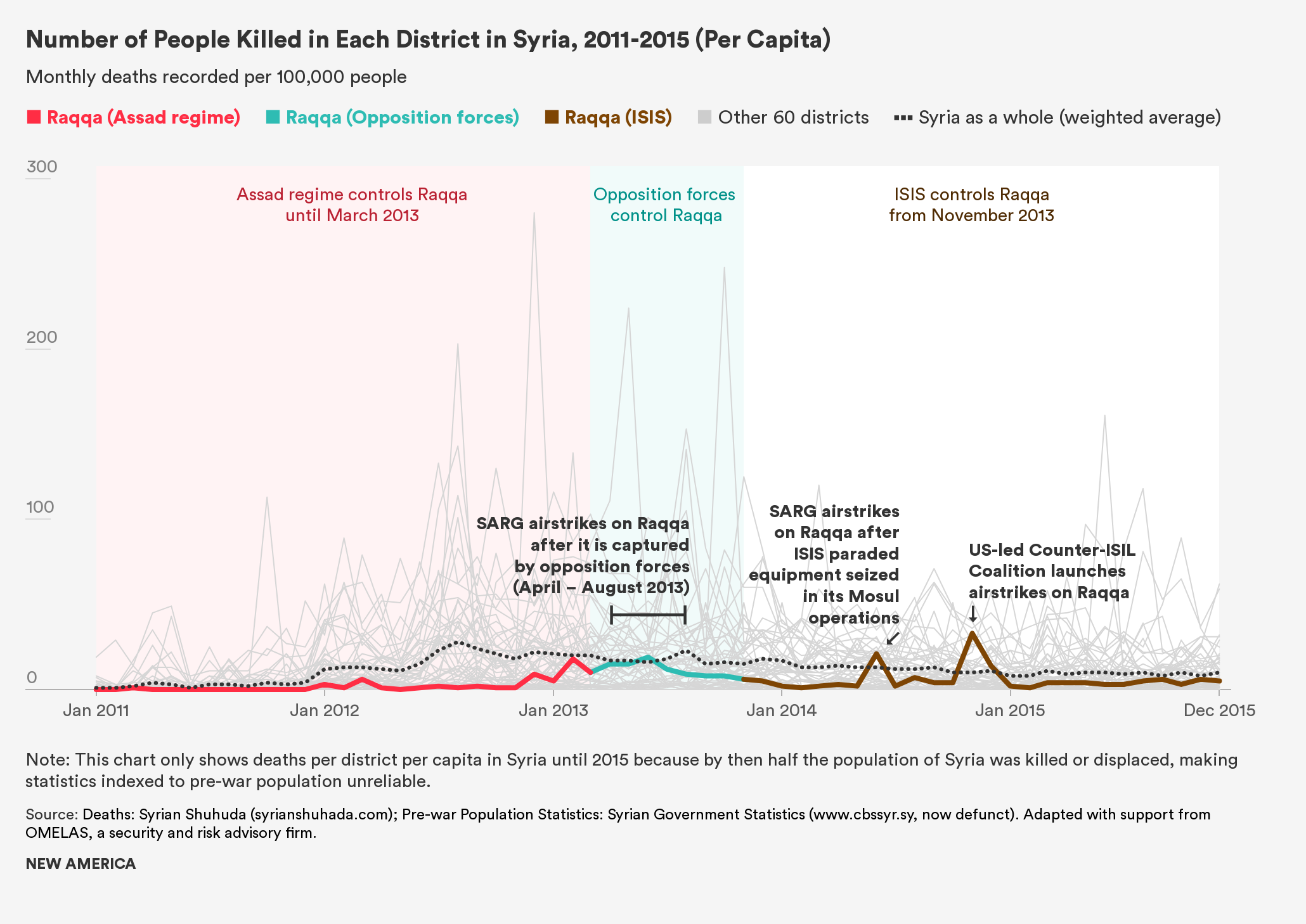
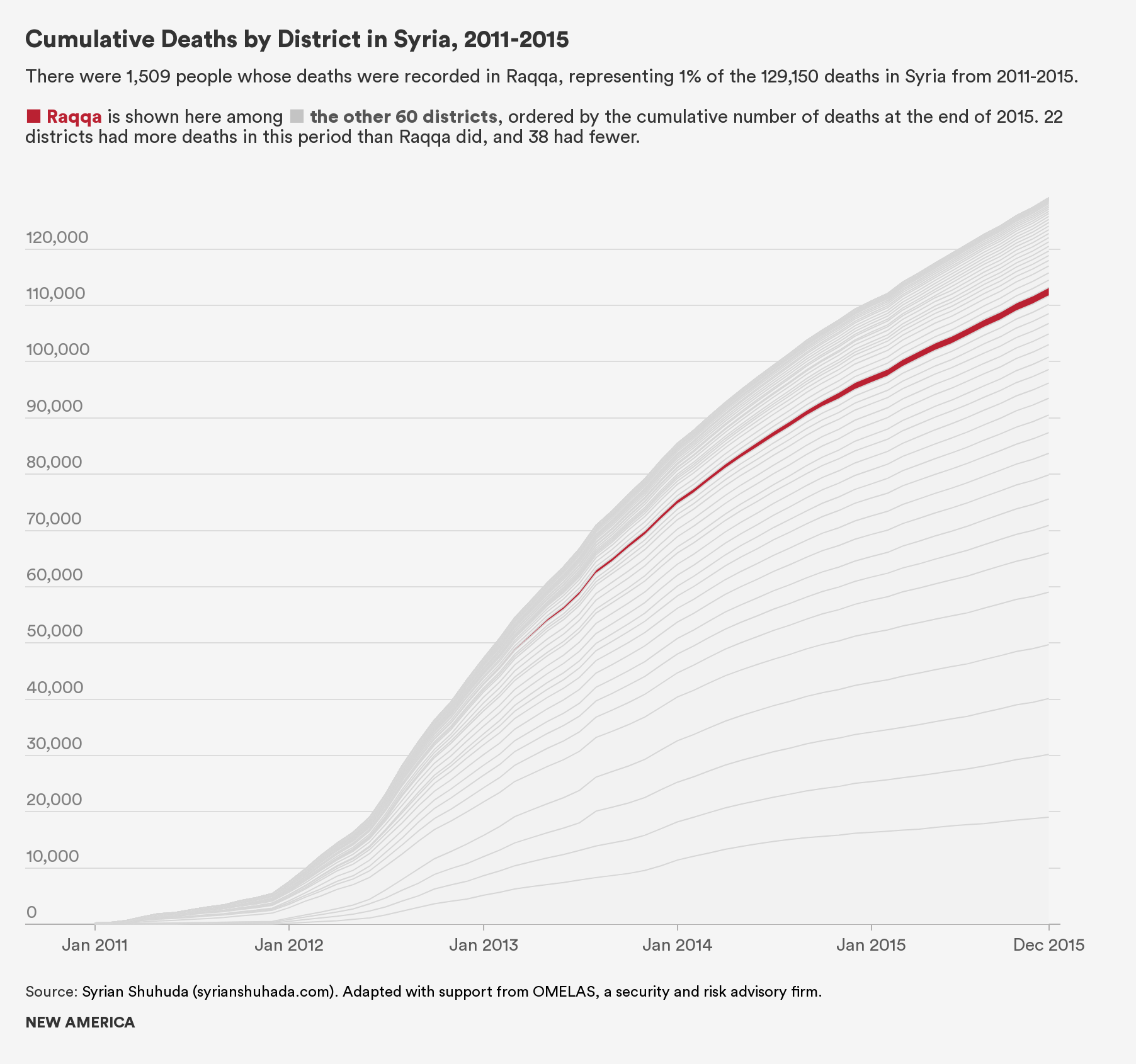
When ISIS began to consolidate its control over Raqqa, it gained support from people relieved by a reduction in violence in the city. As explained below, it is not easy to determine the reasons for this decline even as it provided a contrast with the dangers that preceded ISIS’ takeover. In writing this paper, we worked with Omelas, a security and risk advisory firm, to gather and analyze data on all deaths in Syria from 2011 to 2015 in all of Syria’s 61 districts.81 While deaths are an imperfect proxy for military confrontation, we can identify time periods in the data when violence spiked in Raqqa relative to other regions in the country.
The chart above shows that lethal violence first spiked when Raqqa was captured by the opposition at the beginning of March 2013. While Raqqa was under opposition control, there was a sustained period of several months during which the death toll was high for Raqqa but average relative to the rate of deaths across Syria. Some of this may be attributed to chaotic conditions in the city, but we suspect most deaths during this period were due to a sustained bombing campaign by SARG. As the International Crisis Group reported at the time, civilians “fled in droves” in March and April 2013 because they feared “regime retaliation and in particular ballistic missile attacks.”82 The chart also shows that deaths in Raqqa plummeted in the same period that ISIS gained total control of Raqqa. From January-May 2014, there were an average of 11 deaths per month, among the lowest death rate of any district in Syria (excluding pro-Assad Alawite regions). By contrast, during the period when opposition forces tried to govern Raqqa, March-July 2013, there had been an average of 77 deaths per month, a dramatically higher number.
Why did deaths initially decline so precipitously under ISIS? Our research, as well as mass graves discovered around Raqqa after ISIS was defeated in the city in 2017,83 demonstrates that the group did engage in systematic killing of opponents during this time. Part of the decline might be explained by the fact that ISIS deployed highly public acts of violence as a means of demonstrating its brutal monopoly on the use of force—as evidenced by videos of public executions—and thereby deterred other violent actors.84 Yet, there were also fewer deaths because other forms of killing—such as regime airstrikes—did not occur in Raqqa during this period. Many analysts at the time argued that the lack of Syrian government airstrikes was a sign that the two groups were, if not working together, at least working toward related goals of fighting the opposition. Our own observation suggests that allowing ISIS to grow in Syria supported a general regime narrative, whereby President Bashar al-Assad sought to paint all rebels as jihadists in an attempt to gain international credibility; at the same time, we found nothing beyond circumstantial evidence for direct regime-ISIS collaboration. In effect, Assad may have tolerated ISIS because it served his broader narrative (and because he lacked the troops or resources to do much about it), though he stopped short of directly collaborating with them.
Local Reactions and the Limits of ISIS Governance
Since ISIS operatives had been in Raqqa for months and had captured the city through careful strategy using subversion and intimidation, they were familiar with the community and its needs, and were thus better prepared to govern than their predecessors. As the dominant local armed actor, ISIS applied a combination of brutal repression, persuasive measures, and administrative services to create a system of competitive control—corralling the population and ensuring collaboration.85 Nevertheless, ISIS leaders turned out to be incompetent governors of Raqqa. Their failures were linked in part to over-emphasis on coercion and minimal commitment to substantive governance, rendering their control both fear-based and brittle. The initial promise of security appeared real, but was quickly lost as locals experienced ISIS’ predation and gang-like rule.
At first, ISIS’ control over Raqqa proved to be a boon for residents. ISIS fighters flooded the local economy with cash by overpaying at restaurants, spending extravagant amounts on basic goods from local markets, and purchasing equipment, mobile phones, and cars from local suppliers.86 They reopened flour mills in the countryside north of Raqqa, stabilizing bread prices in the area.87 They replaced imams at local mosques in most of Raqqa and issued four decrees demanding strict adherence to Islamic law—with a Shari’a court system to mete out harsh punishment.88 Yet, interestingly, they let the local council in Raqqa continue to operate and provide services to residents providing it did not challenge ISIS’ rule.89
ISIS’ control of Raqqa thus—at least initially—brought some measure of stability. This is important because, in war, civilian populations aim to maximize predictability and profit, broadly defined, while minimizing risk and uncertainty.90 As noted, there were also very few Syrian government airstrikes at the time, which made things much easier for residents than in March and April 2013, when the newly liberated city was subjected to regular aerial bombardment.
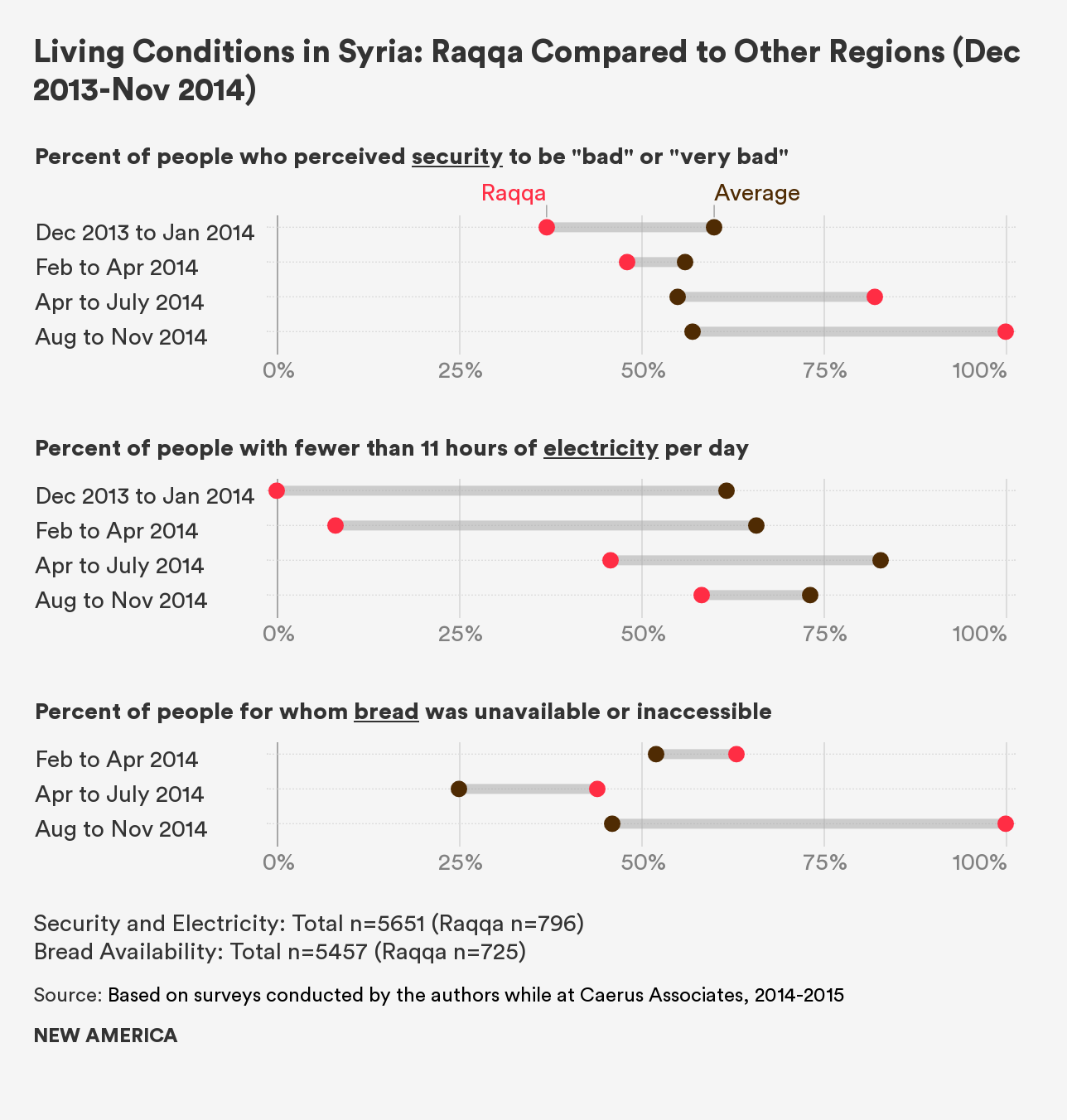
But the honeymoon period under ISIS did not last. According to surveys conducted by Caerus Associates from December 2013 until November 2014, the majority of residents in Raqqa said security was at least “moderate,” and nearly everyone had over 15 hours of electricity. (The three percent of survey respondents who did not have 15 or more hours per day had more than 11 hours per day.) By spring 2014, ISIS had started to stabilize bread distribution, yet most people said bread was inaccessible or unavailable. Meanwhile, electricity access had declined and perceptions of insecurity had started to rise, from 37 percent saying security was “very bad” or “bad” in January 2014 to 48 percent by April.
In July 2014, when Abu Bakr al-Baghdadi declared the ISIS Caliphate in Mosul, 82 percent of Raqqawis described security conditions as “very bad” or “bad,” the highest of any region surveyed at the time. In addition, 76 percent of residents surveyed feared crimes or kidnapping on a daily basis. In the same survey, none of the respondents from Raqqa trusted militia commanders in their city—a surrogate indicator for local support to ISIS since this was the only militia in the area—whereas 32 percent of residents in other parts of Syria did trust militia leaders. It is notable that 93 percent of Raqqa residents reported that Islamic groups “don’t protect or help me” or “don’t fight for the revolution.” In the other communities surveyed, only 20 percent of people reported that Islamic groups failed to protect them or advance the cause of the revolution.91
It is notable that 93 percent of Raqqa residents reported that Islamic groups “don’t protect or help me” or “don’t fight for the revolution.”
By the end of 2014, living conditions in Raqqa had plummeted, becoming some of the worst in all of Syria. Only 8 percent of residents in Raqqa reported more than 15 hours per day of electricity (down from 97 percent at the beginning of the year).92 The percentage of Raqqawis reporting fewer than 11 hours of electricity per day increased from zero percent at the beginning of the year to 58 percent. Everyone surveyed in the city reported that bread was unavailable or inaccessible. And every respondent expressed acute insecurity, not because of a lack of enforcement of security, but because, as conditions in Raqqa worsened, ISIS’ rule became more capricious.
ISIS controlled Raqqa for another three years. It remained the dominant armed group in the city until October 2017, when an offensive by U.S.-backed forces defeated the group and forced its last remnants from Raqqa. While some have argued that ISIS ran a “complex system of government,”93 in reality, our fieldwork—and our surveys of local opinion, which we continued to conduct in Raqqa even under ISIS rule—showed that the group governed poorly by creating a set of administrative mechanisms that, within the first half of 2014, largely failed to provide basic services to the city’s population.
ISIS controlled Raqqa for another three years. It remained the dominant armed group in the city until October 2017.
Raqqa has been historically known as Syria’s breadbasket.94 It is located on the Euphrates River and benefits from a nearby reservoir and hydroelectric dam, which has long provided residents easy access to clean drinking water and electricity. The areas around the city produce large amounts of crops, and Raqqa was the site of massive grain silos. Yet, despite ISIS’ complex bureaucracy, the group had few people with the technical skills to manage electrical and water systems or make necessary repairs. ISIS leaders became “desperate” when things broke down. As a U.S. official explained in December 2015, “[they don’t] have a whole lot of engineers and staff to run the cities.” A Syrian aid worker added, “They’re not smart, and they’re not capable. They have no expertise.”95 ISIS could capitalize on the chaos of Syria’s fragmented battlefield, but it was, in effect, little more than an organized criminal group trying to manage a state.
Citations
- This chart was built using Syrian government pre-war population statistics from 2004 via the Central Bureau of Statistics in Syria: http://cbssyr.sy/indicator/hp-m.htm (not accessible from the United States). Data on deaths in Syria from “Syria Shuhuda” (the most reliable database of deaths in Syria from 2011-2015). The chart only shows per capita deaths until 2015, because, by that time, pre-war population statistics would not be a reliable measurement of the number of people in a given area. By the beginning of 2015, approximately 50% of Syrians were deceased, internally displaced, or had fled as refugees, see: “Syria Emergency,” United National High Commissioner for Refugees (UNHCR), https://www.unhcr.org/en-us/syria-emergency.html.
- “Syria’s Metastasising Conflicts,” Middle East and North Africa (International Crisis Group, June 17, 2013): 7, https://www.crisisgroup.org/middle-east-north-africa/eastern-mediterranean/syria/syria-s-metastasising-conflicts.
- There have been eight mass graves (burial sites containing three or more victims of execution) found thus far in Raqqa. The largest contained approximately 2,500 bodies. Maya Gebeily, “Largest ISIS Mass Grave Found Outside Syria’s Raqqa,” AFP, February 21, 2019, http://www.rudaw.net/english/middleeast/syria/21022019.
- Public Execution of Three Syrians by Jihadist Group in Raqqa, 2013, https://www.youtube.com/watch?v=orIID6SGZR8.
- For a detailed description of this theoretical framework, see: David Kilcullen, Out of the Mountains: The Coming Age of the Urban Guerrilla, (New York: Oxford University Press, 2013): 114.
- Nate Rosenblatt, “ISIS’ Plan to Govern Syria - and What the US Should Do About It,” War on the Rocks, October 31, 2013, https://warontherocks.com/2013/10/isis-plan-to-govern-syria-and-what-the-us-should-do-about-it/.
- Emma Beals, “Wheat as a Weapon of War in Syria,” Vice, June 23, 2016, https://www.vice.com/en_us/article/jpka5k/wheat-as-a-weapon-of-war-in-syria.
- Al-Tamimi, “The Islamic State of Iraq and Ash-Sham Billboards in Raqqa.”
- Author’s interview with Assaad al-Achi, January 10, 2019.
- Kilcullen, Out of the Mountains.
- Caerus surveys (n=2282) in Aleppo, Rif Damascus, Deir Ezzor, Deraa, Hama, Hassakeh, Idlib, and Raqqa: April-July, 2014.
- A RAND-sponsored analysis of satellite imagery over Raqqa concluded that, by the end of the year, the abundant electricity which residents in Raqqa enjoyed in January 2014 had declined by almost 75 percent. Eric Robinson et al., When the Islamic State Comes to Town, (Santa Monica, CA: RAND, 2017), https://www.rand.org/nsrd/projects/when-isil-comes-to-town.html.
- Rukmini Callimachi, “The ISIS Files,” New York Times, April 4, 2018, https://www.nytimes.com/interactive/2018/04/04/world/middleeast/isis-documents-mosul-iraq.html.
- Robert F. Worth, “Earth Is Parched Where Syrian Farms Thrived,” New York Times, October 13, 2010, https://www.nytimes.com/2010/10/14/world/middleeast/14syria.html.
- Liz Sly, “The Islamic State Is Failing at Being a State,” Washington Post, December 25, 2014, https://www.washingtonpost.com/world/middle_east/the-islamic-state-is-failing-at-being-a-state/2014/12/24/bfbf8962-8092-11e4-b936-f3afab0155a7_story.html?noredirect=on&utm_term=.dacde2a4dd0c.