A Chapter of: Terrorism in America 18 Years After 9/11
What is the Threat to the United States?
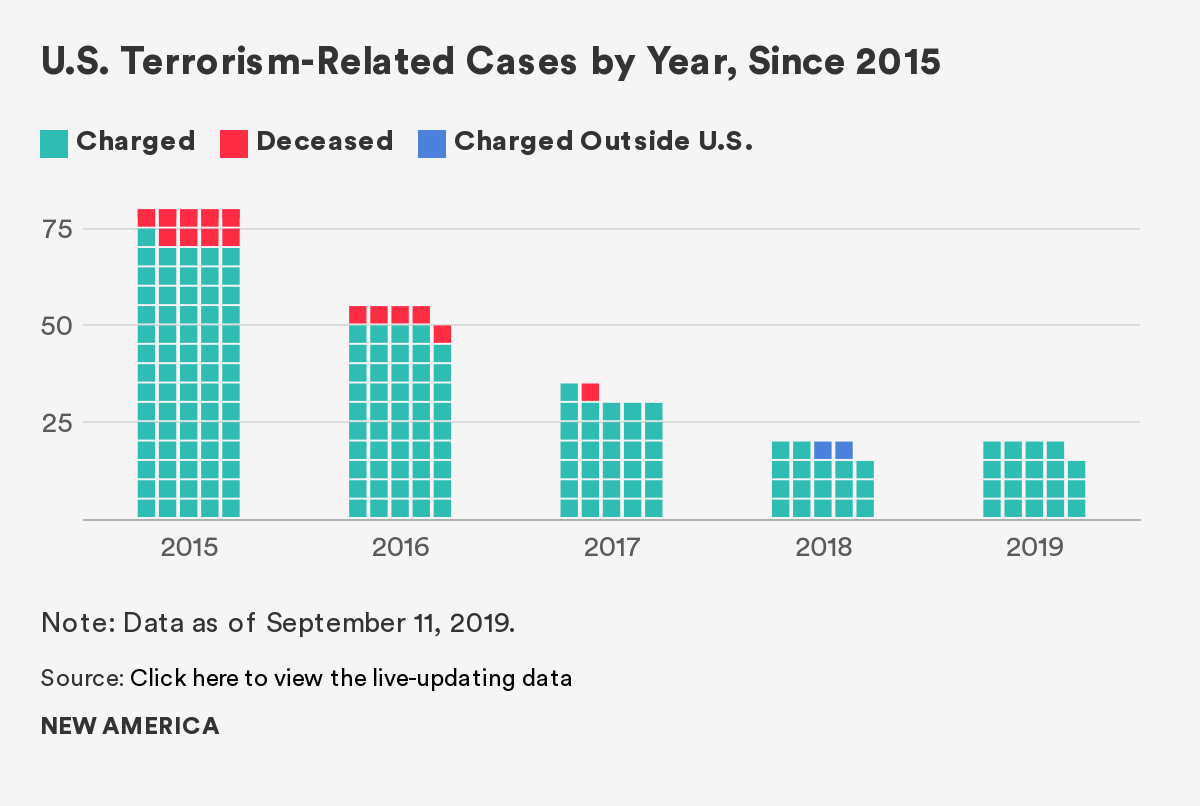
The jihadist terrorist threat to the United States is relatively limited. Since the 9/11 attacks, no foreign terrorist organization has successfully directed and carried out a deadly attack inside the United States. With ISIS’ territorial collapse, the threat posed by the group has receded. It has been more than a year since the last deadly jihadist terrorist attack, and the number of terrorism-related cases in the United States has declined substantially since its peak in 2015, though there will almost certainly be an uptick in cases this year.
However, “homegrown” jihadist terrorism, including that inspired by ISIS, is likely to remain a threat. As this threat is not inherently tied to ISIS’ possession of territory, policymakers should not expect a substantial shift in the nature or extent of the threat to the United States.
The most likely threat to the United States comes from terrorists inspired by a mixture of ideologies including jihadist, far-right, and idiosyncratic strains, radicalized on or via the internet, and taking advantage of the availability of weapons, particularly semi-automatic firearms, in the United States. While ISIS’ inspirational power has lessened in recent years, white supremacist extremism is increasingly inspiring deadly violence.
When it comes to the jihadist terrorist threat, the main threat remains terrorists inspired by ISIS as opposed to ISIS-directed attacks of the sort seen in Paris in 2015 and Brussels in 2016. The most typical jihadist threat to the United States remains homegrown rather than from foreign nationals infiltrating the country. The travel ban is not an effective response to this threat.
A Limited Threat
The threat to the United States from jihadist terrorism remains relatively limited. New America’s Terrorism in America After 9/11 project tracks the 479 cases of individuals who have been “charged” with jihadist terrorism-related activity in the United States since September 11, 2001.82
Author’s Note
The data in this report consists of individuals accused of jihadist terrorism-related crimes since 9/11 who are either American citizens or who engaged in jihadist activity in the United States. The data also includes a small number of individuals who died before being charged but were widely reported to have engaged in jihadist criminal activity, as well as a small number of Americans charged in foreign courts. Unless otherwise noted, “charged” refers to all of these cases in this report.
In the 18 years since the 9/11 attacks, individuals motivated by jihadist ideology have killed 104 people inside the United States. Every one of those deaths is a tragedy, but they are not national catastrophes as 9/11 was. The death toll from jihadist terrorism over the past 18 years is far lower than what even the most optimistic of analysts projected in the immediate aftermath of the 9/11 attacks. Al-Qaeda and its breakaway faction, ISIS, have failed to direct a successful attack in the United States since the 9/11 attacks. Indeed, no foreign terrorist organization has carried out a successful deadly attack in the United States since 9/11, and none of the perpetrators of the 13 lethal jihadist attacks in the United States received training from a foreign terrorist group.
The rise of ISIS caused many to fear that the threat had fundamentally changed. Yet five years after the declaration of the caliphate, ISIS has not managed to direct an attack inside the United States, and its territorial collapse makes it unlikely that it will do so in the future.
ISIS did manage to inspire an unprecedented number of Americans to conduct attacks and otherwise engage in jihadist activity. In 2015, 80 people were charged with jihadist terrorism activity, the highest number in the post-9/11 era. More than three-quarters of all deaths caused by jihadists in the United States since the 9/11 attacks occurred in 2014 or later, the period when ISIS came to prominence, despite those years accounting for only a third of the post-9/11 era. More than half of the deadly attacks since 9/11 were ISIS-inspired in some way.
However, there has not been a deadly jihadist terrorist attack in the United States in more than a year, with the last deadly attack being a March 2018 stabbing at a sleepover in Florida that killed one person. The perpetrator was a 17-year-old who admitted being inspired in part by ISIS.83 This is the longest pause in attacks inside the United States since 2014. Even in this case, the perpetrator appears to have been influenced by a range of extremist ideologies, including white supremacy, and other factors as well.84 The respite suggests that ISIS’ ability to inspire violence in the United States has suffered in the wake of its territorial losses.
Policymakers and analysts should not expect ISIS’ territorial collapse to remove the threat of ISIS-inspired or jihadist terrorism in the United States or even to fundamentally change the level of threat for a sustained time.
The continued threat was demonstrated by a March 26, 2019 incident in which Rondell Henry, a 28-year-old naturalized U.S. citizen from Trinidad and Tobago, allegedly stole a U-Haul truck and, inspired by ISIS, attempted to find a location to carry out a vehicular ramming attack similar to the ISIS-inspired attack in Nice, France.85 He failed to locate a suitable target and was eventually arrested as a result of the police reaction to the stolen truck, but he was not stopped prior to his initiation of the process for an attack, even though he failed to carry it out. The incident involving Rondell Henry occurred the same week that CENTCOM announced that U.S.-backed SDF liberated ISIS’ last piece of territory in Syria.86
Because the ISIS threat to the United States was homegrown and relatively limited even at the peak of ISIS’ strength, rather than being directed from Syria, the impact of ISIS’ territorial collapse on the threat is limited.87 Territory is not essential to ISIS’ ability to inspire attacks, as demonstrated by Rondell Henry’s attempted attack. This state of affairs was also demonstrated by Sayfullo Saipov’s truck ramming attack that killed eight people in Manhattan in October 2017, the same month that ISIS lost control of its capital in Raqqa.
The number of cases of individuals being charged with terrorism-related crimes has dramatically decreased since 2015 when it was at its peak with 80 cases. This trend of decline is almost certain to reverse this year with a slight uptick in charges. There have been 19 cases as of September 11, 2019, compared to 19 cases over the whole year in 2018. Policymakers should be wary of reading too much into the number of prosecutions. There may be cases that are not yet public but were charged in 2018, and the number of prosecutions can reflect prosecutorial decisions regarding how aggressive to be or the wrapping up of investigations where the bulk of the activity occurred in earlier years. However, the decline from the peak in 2015 is notable.
The limited threat to the United States is in large part the result of the enormous investment the country has made in strengthening its defenses against terrorism in the post-9/11 era. The United States spent $2.8 trillion on counterterrorism efforts from 2002 to 2017, constituting almost 15 percent of discretionary spending during that time frame.88 That effort has made the United States a hard target.89 On 9/11, there were 16 people on the U.S. “No Fly” list.90 In 2016, there were 81,000 people on the list.91 Before 9/11, there was no Department of Homeland Security, National Counterterrorism Center, or Transportation Security Administration.
The United States benefits from a layered series of defenses that help to limit the ability of jihadists to mount complex operations within the country. Of the 19 cases so far in 2019, all but seven involved individuals monitored by an informant or undercover officer. Two of the 18 cases involved tips from family or community members who would have personally known the accused extremist, and in one case there was a tip from a suspicious member of the public.
In January 2019, Director of National Intelligence Dan Coats testified that the United States is a “generally inhospitable operating environment” for homegrown violent extremists compared to most Western countries.92
By the beginning of the Trump administration, the jihadist threat inside the United States was overwhelmingly lone-actor, ISIS-inspired attacks such as Sayfullo Saipov’s 2017 vehicular ramming in Manhattan. This threat stressed law enforcement, given the diversity of the perpetrators and the lack of organization needed to conduct such attacks. However, it is still a far cry from the type of attack that al-Qaeda carried out on 9/11.
Law enforcement and intelligence services will of course still need to combat and monitor the threat to the homeland from foreign terrorist organizations. Plots such as the 2009 underwear bomb attempt, the 2009 case in which three Americans trained with al-Qaeda and returned with a plan to bomb the New York City subway, and the 2010 failed Times Square bombing by Faisal Shahzad, who trained with the Pakistani Taliban, are sufficient reminders of this fact.
The Most Likely Terrorist Threat: Individuals Inspired by a Range of Ideologies and White Supremacy
Today, the terrorist threat to the United States is best understood as emerging from across the political spectrum, as ubiquitous firearms, political polarization, images of the apocalyptic violence tearing apart societies across the Middle East and North Africa, racism, and the rise of populism have combined with the power of online communication and social media. This mixture has generated a complex and varied terrorist threat that crosses ideologies and is largely disconnected from traditional understandings of terrorist organizations.93
Since the 9/11 attacks, individuals inspired by jihadist ideology have killed 104 people in the United States. However, individuals inspired by far-right ideology (including white supremacist, anti-government, and anti-abortion views) have killed 109 people. On August 3, 2019, Patrick Crusius, a 21-year-old white man, allegedly shot and killed 22 people at a Walmart in El Paso after posting a manifesto that described his motive as a “Hispanic invasion” and expressed support for the deadly attacks against mosques in Christchurch, New Zealand.94 The attack is the deadliest far-right attack in the post-9/11 era.
Individuals inspired in part by black nationalist or separatist ideology killed eight people, and individuals inspired by forms of ideological misogyny also killed eight people. The diversity of political motivations warns against overly focusing on any single ideology at the risk of obscuring broader systemic factors that are relevant across ideologies.
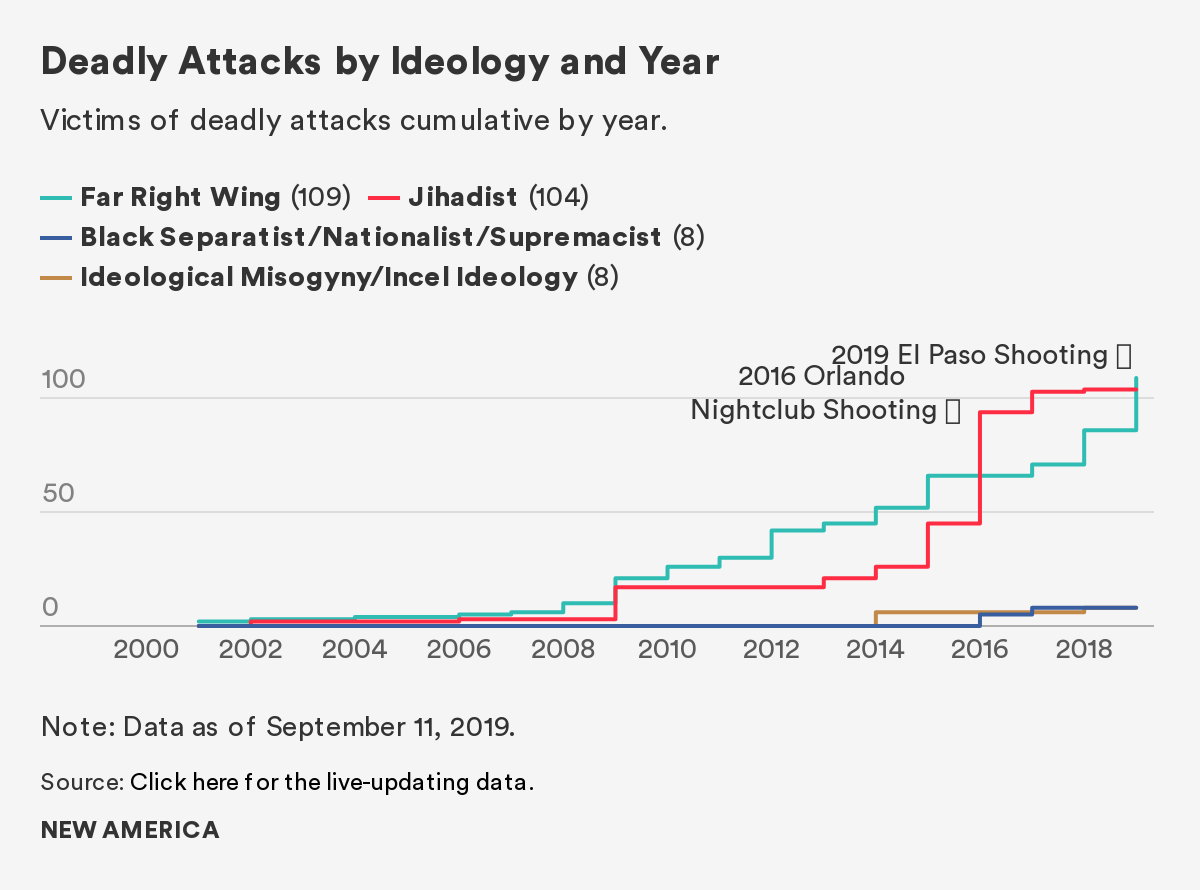
Though there are many ideological strands, and attackers’ ideological reference points are often in flux or complex, one particular ideological strand—white supremacy—stands out as a particular danger. Over the past three years, since the inauguration of President Donald Trump, the United States has seen a spate of deadly white supremacist terrorist attacks. Every deadly far-right attack in this period identified by New America had a nexus to white supremacy. Together these attacks killed 43 people, which is four times the number of people killed in jihadist terrorism in the same period. There were also more than three times as many deadly far-right attacks with connections to white supremacy in the same period as deadly jihadist attacks.
According to Michael McGarrity, assistant director of the FBI’s counterterrorism division, and Calvin Shivers, deputy assistant director of the criminal investigative division, “individuals adhering to racially motivated violent extremism ideology have been responsible for the most lethal incidents among domestic terrorists in recent years, and the FBI assesses the threat of violence and lethality posed by racially motivated violent extremists will continue.”95 They also testified before Congress that “there have been more domestic terrorism subjects disrupted by arrest and more deaths caused by domestic terrorists than international terrorists in recent years.”96
White supremacist terrorist attacks and violence more generally, appears to be increasingly interlinked and internationalized. A study by the New York Times determined that “at least a third of white extremist killers since 2011 were inspired by others who perpetrated similar attacks” and that the connections cross international borders.97 Several events illustrate this dynamic. On April 27, 2019, a man shot and killed one person in a white supremacist attack on a synagogue in Poway, Calif. The attack came six months to the day after the white supremacist attack on the Tree of Life Synagogue in Pittsburgh, which killed eleven people in the deadliest attack on Jews in American history. The attacker specifically referenced the Pittsburgh attack in an online manifesto as well as citing the attack on mosques in Christchurch, New Zealand that killed 51 people.98
The New Zealand attacker in turn cited a wide range of previous attackers and historical reference points with broad international range. He had financial interactions with the Austrian far-right, having donated money to the account of Martin Sellner, head of Austria's Identitarian Movement.99 The larger movement, of which the Austrian branch is part, extends across Europe and North America, including Identity Evropa, which participated in the Charlottesville rally, where a far-right attack killed a counterprotester.100
The attack in New Zealand is not a lone case of the internationalization of white supremacist and far-right terror. In June 2016, Thomas Mair, who was inspired by white supremacist ideology, assassinated British Member of Parliament Jo Cox in the midst of the contentious debates surrounding Brexit. Mair was influenced by Anders Brevik’s massacre in Norway, an attack cited by a range of white supremacist attackers and plotters including the New Zealand attacker and Coast Guard Lieutenant Christopher Hasoon, who gathered a cache of arms and was accused of plotting a mass casualty attack motivated by white supremacy.101 Mair had also purchased a range of neo-Nazi publications from the U.S. neo-Nazi movement, National Alliance.102 Mair also subscribed to a far-right South African paper (that had relocated to the United Kingdom) to which he sent letters expressing support for Apartheid.103 Similarly, Dylann Roof, who murdered nine people in a black church in Charleston, S.C. was also influenced by internationalized politics of nostalgia for Apartheid South Africa, and named his blog (where he posted his manifesto) “The Last Rhodesian,” a reference to the apartheid government of Rhodesia.104 Alexandre Bissonnette who killed six people at a mosque in Quebec, closely followed a range of American far-right and right-wing figures, and specifically looked up Roof before his attack.105 These ties should not be taken as evidence of an organized international far-right terrorist threat, but they do point to a mesh of interlinked movements, organizations, and ideologies drawn upon by right-wing terrorists.
The internationalization of far-right terrorism is cause for substantial concern, but white supremacy and far-right terrorism more generally pose a particular challenge for the United States. In part, this derives from this peculiar moment when the President of the United States has used the political influence of his office to promote conspiracies and other ideas embraced by and motivating those who are committing violence. For example, the white supremacist attacker who killed eleven people at the synagogue in Pittsburgh framed his attack in terms of the conspiracy theory that Jews through the Hebrew Immigrant Aid Society were orchestrating the Central American migrant caravan that included Muslims who he demonized as terrorists.106 The media focus on the caravan leading up to the attack was driven by President Trump’s false claims in which he alleged there to be a terrorist threat from the caravan.107
Trump’s influence on the synagogue attacker is not a lone case. Cesar Sayoc, who mailed bombs to a range of perceived liberals and political opponents of Trump was an avid Trump supporter who attended his rallies.108 One study has found evidence that Trump’s rallies may have increased hate crimes in the areas where they were hosted.109
The challenge cannot be reduced to Trump’s rhetoric. White supremacy has deep roots in American history. There is overlap not just with some right-wing politics but also broader societal views and ways of interpreting events that can make policies aimed at stopping the spread of the ideology on social media or the prosecution of cases difficult.110 This “proximity to political power” and the decentralized nature of far-right and white supremacist extremism has posed particularly difficult challenges for social media companies’ regulation of content, particularly when compared to the more easily identified and stigmatized jihadist online presence.111
The more developed white supremacist and far-right violent extremist movements should not lead policymakers to underestimate the threat from individuals motivated by other ideologies with less developed or no meaningful support networks. Doing so is a misunderstanding of the nature of the threat in a country where the ubiquity of firearms allows individuals to give violent expression to a range of ideological influences even without connection to a broader movement. That said, applying counterterrorism methods based in theories of dismantling organizational threats or ideological networks are also unlikely to impact individuals with more idiosyncratic ideological reference points who lack connection to a broader movement.
For example, in June 2017, 66-year-old James T. Hodgkinson, who held left-wing political views, shot Republican congressmen during a June 2017 baseball practice in Alexandria, Va., which did not kill anyone but injured multiple people including Rep. Steve Scalise (R-La.), the number three House Republican leader.112 Hodgkinson was a lone individual who lacked ties to organized violent groups. Yet if Hodkinson had successfully killed his targets it would have been a major political shock. As such, his attack illustrates the dangers of focusing solely on the ideological ecosystems when the availability of firearms and other dynamics enable more isolated individuals to have substantial impact.
Indeed, the El Paso attack occurred alongside two other major attacks, where the ideological roots are far from clear, but the actual activity looks like domestic terrorism. On July 28, 2019, Santino William Legan allegedly shot and killed three people at the Gilroy Garlic Festival in California. The FBI opened up a domestic terrorism investigation, having discovered a target list, but so far has not identified a motive, noting that Legan, who did not leave a manifesto, had materials from multiple violent ideologies.113 Similarly, hours after the terrorist attack in El Paso, a mass shooting in Dayton, Ohio killed nine people. According to the FBI, the perpetrator was also exploring multiple violent ideologies, although they have not determined that any one in particular motivated the attack.114 It is possible that it will turn out that these attacks have clear political motivations that will eventually come to light. However, these attacks do demonstrate that a fully thought out ideology is not necessary for a deadly attack, and that perpetrators may conduct attacks influenced by multiple, and even conflicting, ideologies. That, combined with the recent political violence across a wide range of ideologies and repeated mass shootings with no clear political motive, warns against focusing on only one ideology—be it jihadism, white supremacy, or something else.
The Jihadist Threat in the United States Is ISIS-Inspired and ISIS-Enabled, but Not ISIS-Directed
Since 2014, the year ISIS burst onto the global scene after seizing Mosul and declaring the caliphate, there have been eight deadly jihadist attacks in the United States. Eighty-three people were killed, accounting for more than three-quarters of all deaths caused by jihadists in the United States since the 9/11 attacks. Seven of the eight attacks were ISIS-inspired, the exception being Muhammad Youssef Abdulazeez’s 2015 attacks at a recruiting station and a U.S. Navy Reserve center in Chattanooga, Tenn. Abdulazeez was inspired by jihadist ideology in general.
In addition, since 2014, there have been 14 non-lethal attacks by individuals inspired by jihadist ideology in the United States. Of these attacks, none were directly carried out by ISIS, al Qaeda, or any other foreign terrorist organization. None of the attacks involved returnees from the Syrian conflict or any other conflict. Moreover, in only one case were the perpetrators known to have been in touch with ISIS operatives abroad with regards to the attack. That attack was the May 2015 shooting in Garland, Texas. There, two U.S.-born citizens, Elton Simpson, 30, and Nadir Soofi, 34, opened fire on an “art contest” organized by the American Freedom Defense Initiative that involved drawing cartoons of the Prophet Muhammad. Simpson had exchanged multiple messages with Mujahid Miski and Junaid Hussain, two well-known ISIS virtual recruiters who were based in Somalia and Syria, respectively, in the run-up to the attack.115 This was the only ISIS-enabled—as opposed to ISIS-inspired—attack in the United States and one person was injured before the gunmen were killed by police. New America defines an enabled attack as an attack in which a perpetrator has online communications regarding their activity with an ISIS militant based abroad. It is distinguished from inspired attacks, where an individual may interact with online ISIS propaganda but has not connected on specific matters with ISIS operatives, as well as from directed attacks, where ISIS provides material aid, such as training abroad, and organizes the plot beyond online encouragement.
While the incident in Garland has been the only ISIS-enabled attack in the United States, there have been several foiled plots in which ISIS’ virtual recruiters sought to encourage and aid attacks.116 These include a foiled plan by three men in Boston in June 2015 to attack Pamela Geller, the organizer of the Prophet Muhammad cartoon contest in Garland.
One case in particular that illustrates the danger of ISIS-enabled plots is that of Justin Sullivan. Before his arrest in June 2015, Sullivan plotted with Syria-based ISIS recruiter Junaid Hussain to conduct an attack.117 He agreed at Hussain’s behest to make a video of the attack that could be used by ISIS in its propaganda.118 The danger that Sullivan posed is emphasized by his conviction for a murder, in which he shot and killed his neighbor.119
The conclusion that the main threat to the United States is ISIS-inspired and ISIS-enabled, but not ISIS-directed, mirrors the statements of a variety of government officials. In January 2019, Director of National Intelligence Dan Coats testified: “Homegrown violent extremists (HVEs) are likely to present the most acute Sunni terrorist threat to the United States,” echoing his similar testimony in 2018 and 2017.120 In October 2018, FBI Director Christopher Wray testified: “The FBI assesses HVEs are the greatest terrorism threat to the Homeland.”121
The Threat in the U.S. Is Homegrown and Not Infiltration from Countries Affected by the Travel Ban
One of the most significant changes to American counterterrorism strategy implemented by the Trump administration is the new-found focus on border security and immigration control as a counterterrorism method. This strategy is clearest in the administration’s so-called travel ban,122 first promulgated on January 27, 2017, and then narrowed by court challenges before eventually having its revised version upheld in a 5-4 Supreme Court decision in June 2018. This strategy fundamentally misunderstands the terrorist threat in the United States, which is homegrown and not the result of foreign infiltrators.
The travel ban would not have prevented a single death from jihadist terrorists since 9/11. Nor would it have prevented the 9/11 attacks, which were perpetrated by 15 Saudis, two Emiratis, an Egyptian, and a Lebanese citizen—all originating from countries that are not on the travel ban list.
Eighty-four percent of the 479 individuals tracked by New America and accused of jihadist terrorism-related crimes in the United States since 9/11 were either U.S. citizens or U.S. legal residents.123 Just under half of them, 233, were born American citizens. Around three in ten were converts.
Syrian refugees who have settled in the United States have not posed a threat, either. No lethal act of jihadist terrorism since 9/11 has been carried out by a Syrian refugee. An ISIS terrorist with any sense is quite unlikely to try to infiltrate the United States as a Syrian refugee. Anne Richard, a senior U.S. State Department official, testified at a Senate Homeland Security Committee hearing in November 2015 that any Syrian refugee trying to get into the United States is scrutinized by officials from the National Counterterrorism Center, the FBI, the Department of Homeland Security, the State Department, and the Pentagon. Further, Leon Rodriguez, then the director of U.S. Citizenship and Immigration Services, who also testified at the November 2015 hearing, said that of the millions of people who try to get into the United States each year, “applicants for refugee status, and in particular refugees from Syria, are subjected to the most scrutiny of any traveler, of any kind, for any purpose, to the United States.”124 This process can take up to two years.
Every lethal attacker since 9/11 was either a citizen or permanent resident of the United States at the time of the attack, and none came from a country covered by the travel ban. Nine—more than half—of the 15 deadly attackers were born in the United States.
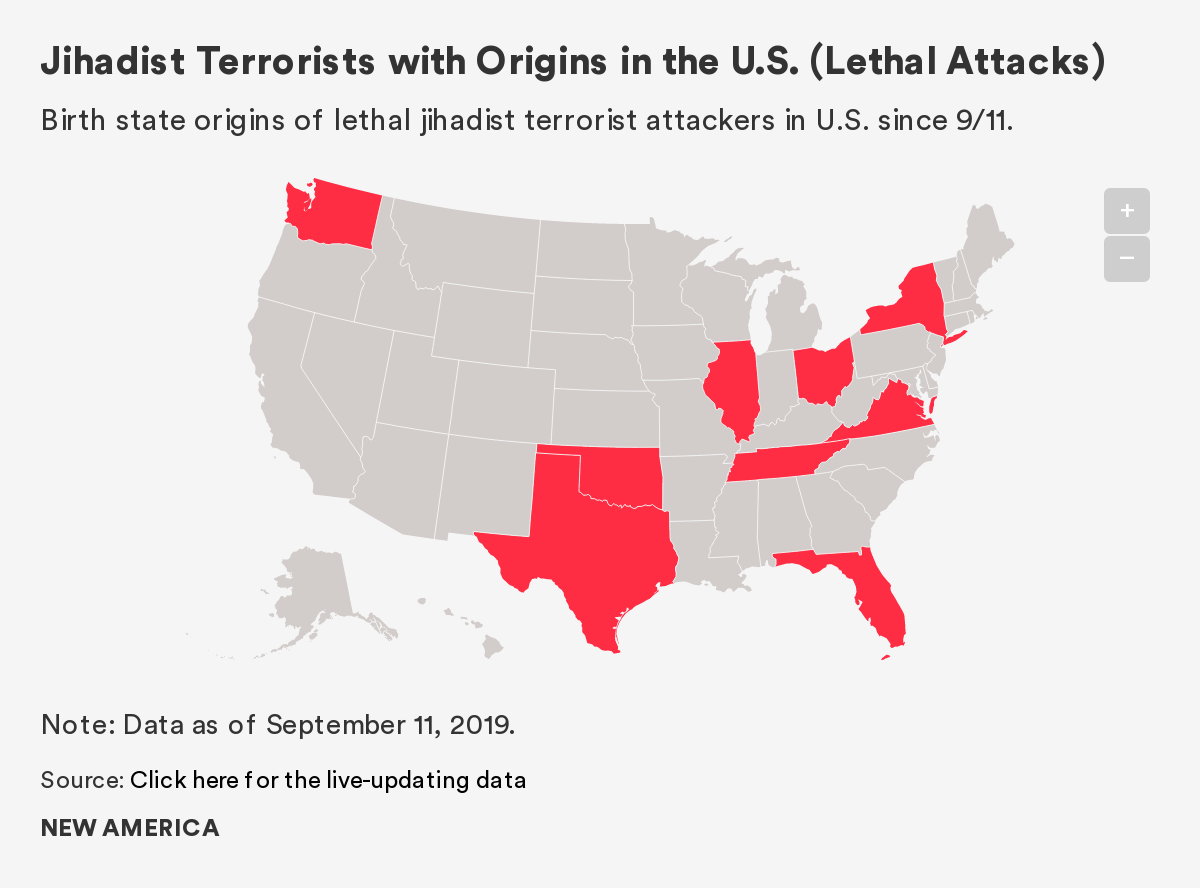
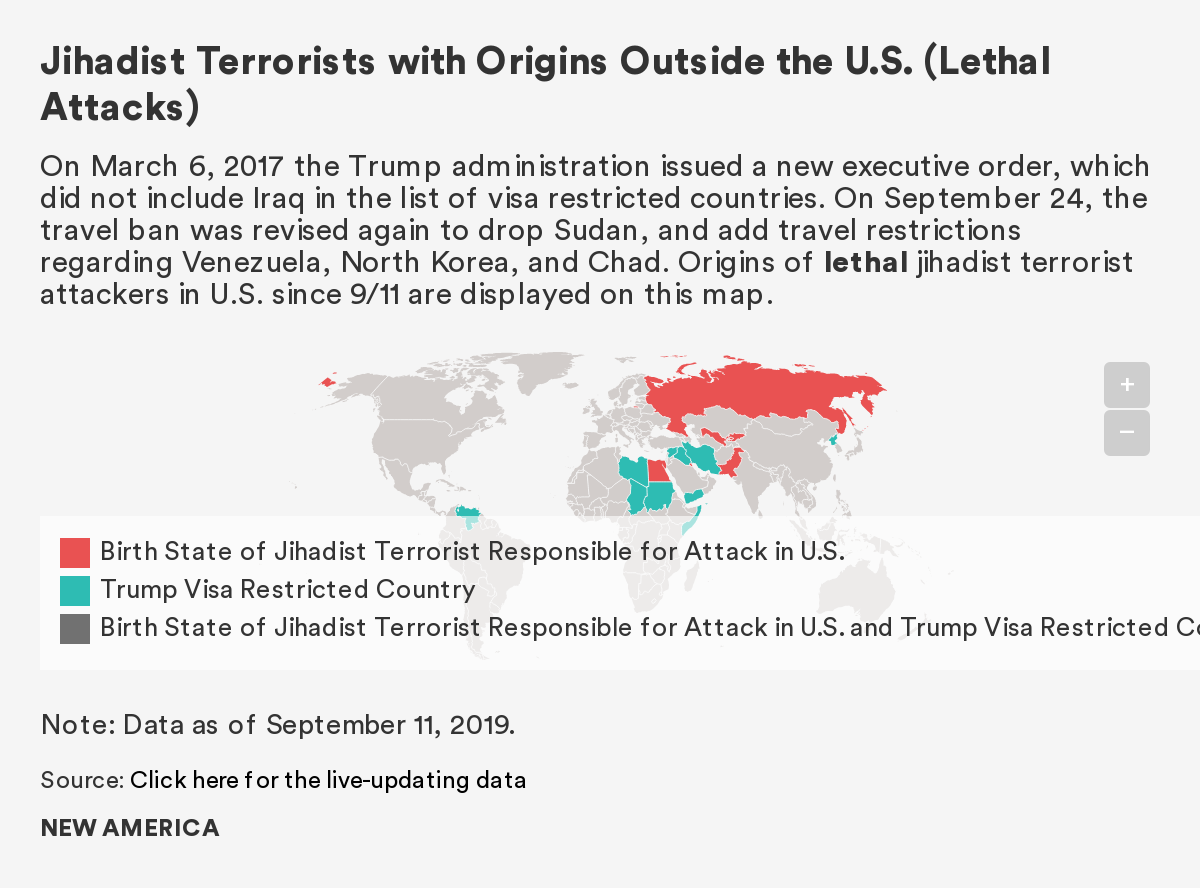
Among the individuals who conducted potentially lethal attacks inside the United States that were foiled or otherwise failed to kill anyone, there are only four cases that the travel ban could have applied to. None of these cases provides a convincing argument for the travel ban. In two of the cases, those of Taheri-Azar, a naturalized citizen from Iran who injured nine people in a 2006 vehicular ramming attack, and Dahir Adan, a 20-year-old naturalized citizen from Somalia, who injured ten people in a 2016 knife attack, the attackers entered the United States as young children and clearly radicalized within the United States. Taheri-Azar conducted his attack about two decades after he entered the United States. Abdul Razak Ali Artan, an 18-year-old legal permanent resident who came to the United States from Somalia as a refugee in 2014, injured 11 people in a 2016 attack at Ohio State University. He likely radicalized abroad—potentially in Pakistan—having left Somalia as a preteen, and was also inspired by online jihadist influences like Anwar al-Awlaki that have inspired many others, including U.S.-born citizens. The fourth, Mahad Abdirahman, a 20-year-old naturalized citizen from Somalia, who stabbed and injured two men at the Mall of America in November 2017, had been previously hospitalized for mental illness. In none of these cases is there any evidence that they radicalized in the travel ban countries or infiltrated the United States with the intent to conduct a terrorist attack.
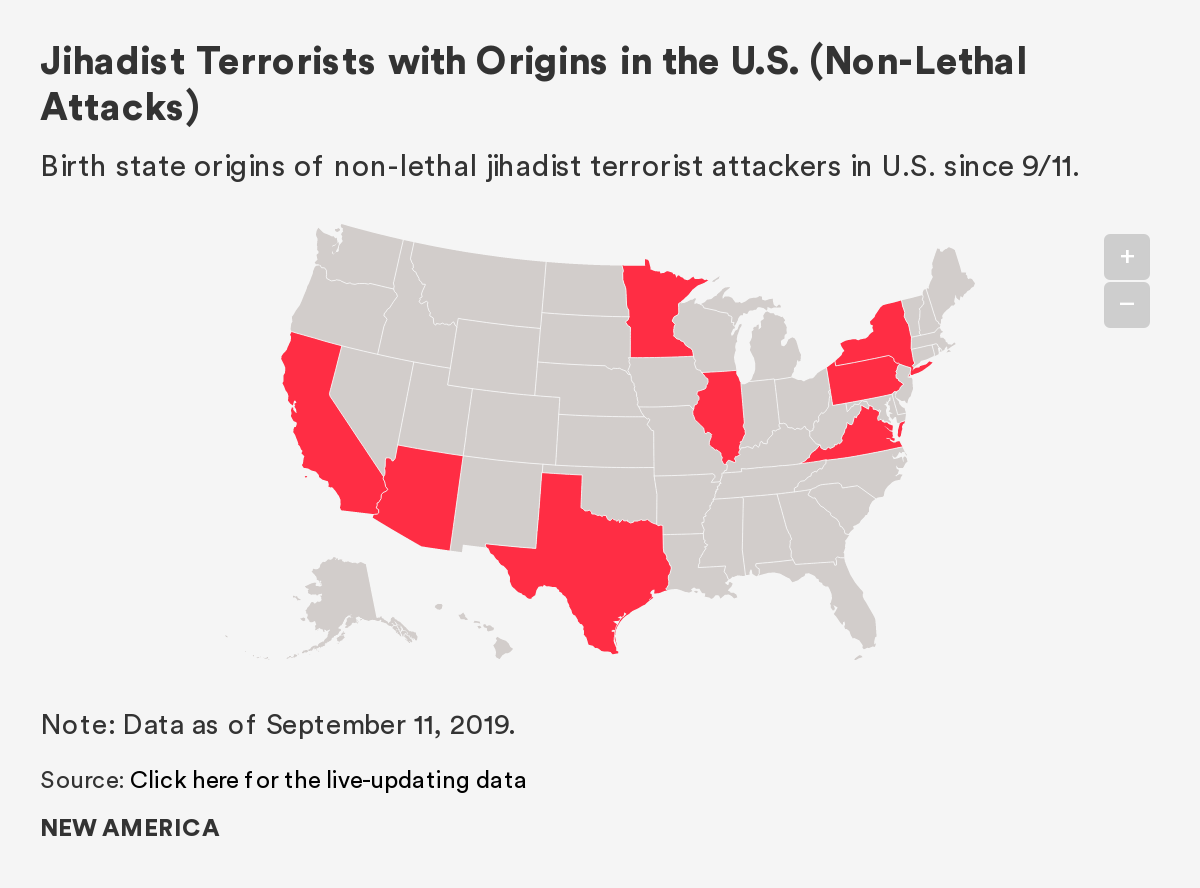
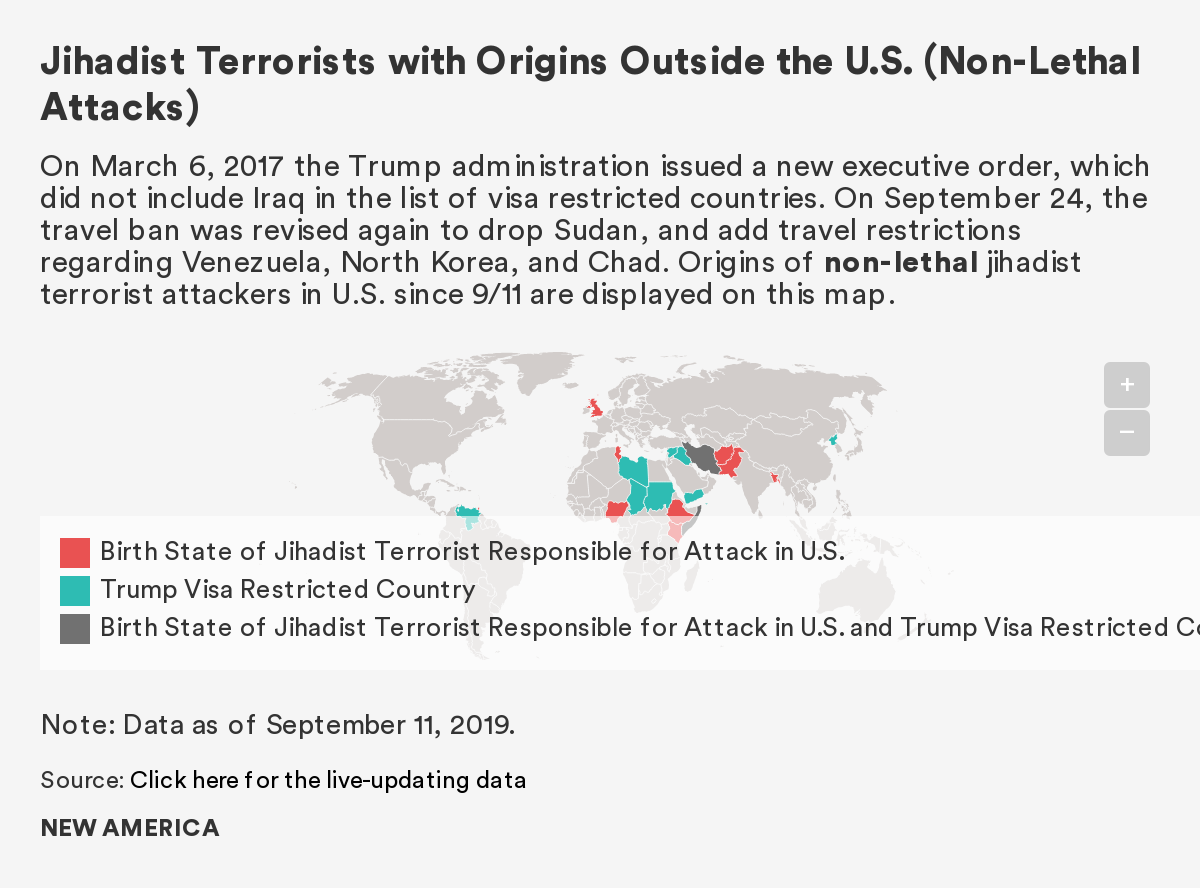
The Department of Homeland Security’s (DHS) own analyses from February and March 2017 undercuts the justification for the travel ban. One leaked DHS report assessed that the “country of citizenship is unlikely to be a reliable indicator of potential terrorist activity” and found that half of the 82 extremists it examined were native-born American citizens.125Another leaked DHS report assessed that “most foreign-born U.S.-based violent extremists likely radicalized several years after their entry to the United States, limiting the ability of screening and vetting officials to prevent their entry because of national security concerns.”126 The report also found that about half of foreign-born extremists were younger than 16 when they entered the country and the majority had lived in the United States for 10 years.127
A report authored by the Cato Institute’s David Bier found only 13 post-9/11 vetting failures in which an individual entered the United States and committed a terrorism-related crime after 9/11.128 The report also found that the rate of vetting failure was 99.5 percent lower following 9/11 and the resultant reforms to immigration security.
Only one vetting failure identified by the Cato study, which covered the period from 2002 through 2016, involved a deadly attack — a rate of one for every 379 million visa or status approvals.129 That failure was the entry of Tashfeen Malik, who killed 14 people in San Bernardino alongside her husband, a natural-born U.S. citizen who had already acquired the weapons used in the attack and had plotted violence before her entry to the United States. Further, Malik was born in Pakistan and would not have been covered by the travel ban.
This does not mean the system is perfect. In August 2018, the United States arrested Omar Ameen, a 45-year-old Iraqi who had come to the United States as a refugee, in order to extradite him to Iraq where he faced charges for a June 22, 2014 murder of a police officer on behalf of ISIS. According to court records, Ameen had been a member of ISIS and its precursor groups since 2004 and faced two prior warrants for arrest before he entered the United States.130 His entry represents a failure of the system that requires review. However, the court documents do not refer to any terrorist plotting within the United States, and the vetting failure in Ameen’s case is a rarity among the terrorism cases involving U.S. persons.
In addition, on June 18, 2019, the FBI arrested Mustafa Mousab Alowemer, a 21-year-old Syrian refugee who had entered the United States in 2016 accusing him of plotting an attack on a church in Pittsburgh, Pa.131 However, the complaint in the case does not provide any reason to believe that Alowemer was radicalized when he entered the United States or that he entered the country with the intent to commit terrorism. The complaint shows that Alowemer had to reach out to an FBI online covert employee posing as an ISIS supporter to seek help in getting to Syria, an approach that would not make sense if he had prior Syria-based contacts. Instead, it appears that Alowemer was active in online jihadist circles, a pathway that has appeared with regards to far more U.S.-born citizens than Syrian refugees since 9/11.132 Indeed, it is telling that Alowemer appears to have communicated with Waheba Dais (referred to as Person 1 in the complaint), a 45-year-old married woman and U.S. permanent resident of Israeli origin, who first entered the United States in 1992.133 Given that connection, it is misleading to spin Alowemer’s story as one of Syrian refugees rather than online radicalization.
The Trump administration has marshalled its own politicized and highly misleading data to justify the travel ban and its immigration and border security-centric counterterrorism effort. A joint report by the Justice and Homeland Security departments in January 2018 asserted that “three out of four individuals convicted of international terrorism and terrorism-related offenses were foreign-born.”134
This DOJ-DHS report is highly misleading.135 First, even taking the report at face value, it suggests that the threat is largely homegrown, with a majority of cases involving citizens and a quarter of the cases involving natural-born citizens. Second, the report includes among the international terrorism cases it examines numerous examples of individuals extradited to the United States from other countries, who are simply not immigrants. By some counts it may include as many as 100 cases of individuals who were extradited.136 In addition, by using international terrorism cases, the report excludes domestic terrorism cases—particularly those motivated by far-right and similar ideologies. Yet this exclusion cannot be justified by claiming the report focuses on the jihadist threat, as the report includes cases involving the Revolutionary Armed Forces of Colombia (FARC, from the initials in Spanish) and other non-jihadist groups. Third, the report assumes that naturalized citizens are meaningfully distinct from natural-born citizens and represent a border security issue, without providing evidence to substantiate this distinction. In fact, as the aforementioned leaked DHS reports show, this is at odds with DHS’ own findings in other reviews of the data. White House adviser Stephen Miller sought to explicitly include language emphasizing the threat from children of foreign-born citizens in the report, a goal that the DHS Secretary at the time, Kirstjen Nielsen, reportedly objected to because it was unsubstantiated.137 Fourth, the report looks only at federal convictions for terrorism-related crimes and thus misses multiple important cases of U.S.-born citizens, including Omar Mateen, who died conducting the Orlando attack that killed 49 people in 2016; Carlos Bledsoe, who was charged with murder in state court for his 2009 attack on a military recruiting station in Arkansas; and Nidal Hasan, an Army major and psychiatrist who was charged in military court for his attack on Fort Hood in Texas in 2009 that killed 13 people.
Today’s extremists in the United States radicalize online, and the internet knows no visa requirements. Just under half of the jihadists charged in the United States since 9/11 either maintained a social media account where they posted jihadist material or interacted with extremists via encrypted communications; in recent years, an active online presence has been almost universal among American jihadists.138
The attack in Garland, Texas, described above, is a case in point. Not only were the perpetrators both native-born American citizens who would not have been stopped by the travel ban, but their interlocutors from ISIS did not set foot in the United States, instead encouraging the plot through online communication. The travel ban does nothing to respond to the most likely threat today: ISIS-inspired and ISIS-enabled homegrown attacks.
What Is the Threat to the United States From Returning Foreign Fighters?
The threat posed by American “foreign fighters” returning to the United States is quite limited. To date, no one who fought for ISIS or other extremist groups in Iraq or Syria has committed an act of terrorism in the United States after returning, according to a review of cases conducted by New America.
Of the few Americans who have fought with militant groups in Syria and returned, only one, Abdirahman Sheik Mohamud, conspired to carry out an attack. Mohamud, a Somali-American, traveled to Syria to join the Nusra Front in April 2014, only three months after he became a naturalized citizen. He returned to the United States that June and shortly thereafter communicated with an unnamed individual about his desire to travel to a military base in Texas and kill three or four U.S. soldiers.139 Mohamud was arrested in February 2015—before attempting to carry out this plot—and pleaded guilty to material support charges in June 2017.
Prison Releases
The United States will also need to prepare for the higher numbers of people convicted of terrorism coming out of prison in coming years. At least 98 Americans who have been convicted of jihadist terrorism-related crimes since 9/11 have been released, according to New America’s research. An additional 76 are scheduled to be released by the end of 2025. In May 2019, John Walker Lindh, the first detainee in the war on terror, was released from prison, sparking concern on the part of some as government documents suggested he remained radicalized.140
Coming releases of terrorism ex-convicts should not be viewed as necessarily posing a substantial threat. Those being released have served their debt to society, and should and must be allowed to return to society—within the terms of their release conditions and sentences. There is little evidence of a major prison radicalization or recidivism problem so far, despite a substantial number of people having been released.141 However, with more people moving through the justice system in recent years, it is an issue of which to be aware.

Citations
- Peter Bergen, David Sterman, Albert Ford, and Alyssa Sims, “Terrorism in America After 9/11,” New America, Accessed September 11, 2019, https://www.newamerica.org/in-depth/terrorism-in-america
- “Incident/Investigation Report Case #17-000176” (Jupiter Police Department, January 12, 2017), https://htv-prod-media.s3.amazonaws.com/files/juvenile-report-deadly-stabbing-suspect-1520986286.pdf
- Paul Mueller, “Former Homeland Security Official Says Better Communication Needed in Wake of Stabbing,” CBS 12, March 14, 2018, https://cbs12.com/news/local/former-homeland-security-official-says-better-communication-needed-in-wake-of-stabbing
- Heather Murphy, “Maryland Man Planned to Run Down Pedestrians at National Harbor, U.S. Says,” The New York Times, April 8, 2019, https://www.nytimes.com/2019/04/08/us/national-harbor-rondell-henry.html
- “Coalition, Partner Forces Liberate Last Territory Held by Daesh,” CENTCOM, March 25, 2019, https://www.centcom.mil/MEDIA/PRESS-RELEASES/Press-Release-View/Article/1794821/coalition-partner-forces-liberate-last-territory-held-by-daesh
- David Sterman, “Why Terrorist Threats Will Survive ISIS Defeats,” CNN, October 23, 2017, https://www.cnn.com/2017/10/23/opinions/raqqa-impact-united-states-opinion-sterman/index.html
- “Counterterrorism Spending: Protecting America While Promoting Efficiencies and Accountability,” Stimson Center, May 2018, https://www.stimson.org/sites/default/files/file-attachments/CT_Spending_Report_0.pdf
- This draws on: Peter Bergen, Emily Schneider, David Sterman, Bailey Cahall, and Tim Maurer, 2014: Jihadist Terrorism and Other Unconventional Threats (Washington, DC: Bipartisan Policy Center, 2014), https://bipartisanpolicy.org/library/2014-jihadist-terrorism-and-other-unconventional-threats
- Steve Kroft, “Unlikely Terrorists on No Fly List,” CBS News, October 5, 2006, www.cbsnews.com/news/unlikely-terrorists-on-no-fly-list
- “Feinstein Statement on Collins Amendment,” Office of Senator Dianne Feinstein, June 23, 2016, https://bit.ly/2kczDuQ
- Daniel R. Coats, “Statement for the Record: Worldwide Threat Assessment of the US Intelligence Community,” § Senate Select Committee on Intelligence (2019), https://www.dni.gov/files/ODNI/documents/2019-ATA-SFR---SSCI.pdf
- Peter Bergen and David Sterman, “The Real Terrorist Threat in America,” Foreign Affairs, October 30, 2018, https://www.foreignaffairs.com/articles/united-states/2018-10-30/real-terrorist-threat-america
- Peter Bergen and David Sterman, “The Huge Threat to America That Trump Ignores,” CNN, August 4, 2019, https://www.cnn.com/2019/08/04/opinions/el-paso-dayton-far-right-threat-bergen-sterman/index.html
- Michael C. McGarrity and Calvin A. Shivers, “Confronting White Supremacy” (FBI, June 4, 2019), https://www.fbi.gov/news/testimony/confronting-white-supremacy
- McGarrity and Shivers.
- Weiyi Cai and Simone Landon, “Attacks by White Extremists Are Growing. So Are Their Connections,” New York Times, April 3, 2019, https://www.nytimes.com/interactive/2019/04/03/world/white-extremist-terrorism-christchurch.html
- Deanna Paul and Katie Mettler, “Authorities Identify Suspect in ‘Hate Crime’ Synagogue Shooting That Left 1 Dead, 3 Injured,” Washington Post, April 28, 2019, https://www.washingtonpost.com/nation/2019/04/27/california-synagogue-shooting-multiple-injuries
- Sheena McKenzie and Stephanie Halasz, “Christchurch Suspect Had Financial Links with Austrian Far-Right,” CNN, March 27, 2019, https://www.cnn.com/2019/03/27/europe/sebastian-kurz-christchurch-attacker-intl/index.html
- Jason Wilson, “With Links to the Christchurch Attacker, What Is the Identitarian Movement?,” Guardian, March 27, 2019, https://www.theguardian.com/world/2019/mar/28/with-links-to-the-christchurch-attacker-what-is-the-identitarian-movement
- J. M. Berger, “The Dangerous Spread of Extremist Manifestos,” The Atlantic, February 26, 2019, https://www.theatlantic.com/ideas/archive/2019/02/christopher-hasson-was-inspired-breivik-manifesto/583567/; Ian Cobain, Nazia Parveen, and Matthew Taylor, “The Slow-Burning Hatred That Led Thomas Mair to Murder Jo Cox,” Guardian, November 23, 2016, https://www.theguardian.com/uk-news/2016/nov/23/thomas-mair-slow-burning-hatred-led-to-jo-cox-murder
- Cobain, Parveen, and Taylor, “The Slow-Burning Hatred That Led Thomas Mair to Murder Jo Cox.”
- Alex Amend, “Here Are the Letters Thomas Mair Published in a Pro-Apartheid Magazine,” Southern Poverty Law Center (blog), June 20, 2016, https://www.splcenter.org/hatewatch/2016/06/20/here-are-letters-thomas-mair-published-pro-apartheid-magazine; Cobain, Parveen, and Taylor, “The Slow-Burning Hatred That Led Thomas Mair to Murder Jo Cox.”
- John Ismay, “Rhodesia’s Dead — but White Supremacists Have Given It New Life Online,” New York Times, April 10, 2018, https://www.nytimes.com/2018/04/10/magazine/rhodesia-zimbabwe-white-supremacists.html; Zack Beauchamp, “One Incredibly Revealing Line from Obama’s ISIS Speech,” Vox, September 10, 2014, https://www.vox.com/2014/9/10/6134087/obama-isis-speech-revealing
- Amanda Coletta, “Quebec City Mosque Shooter Scoured Twitter for Trump, Right-Wing Figures before Attack,” Washington Post, April 18, 2018, https://www.washingtonpost.com/news/worldviews/wp/2018/04/18/quebec-city-mosque-shooter-scoured-twitter-for-trump-right-wing-figures-before-attack
- Masha Gessen, “Why the Tree of Life Shooter Was Fixated on the Hebrew Immigrant Aid Society,” New Yorker, October 27, 2018, https://www.newyorker.com/news/our-columnists/why-the-tree-of-life-shooter-was-fixated-on-the-hebrew-immigrant-aid-society; Lois Beckett, “Pittsburgh Shooting: Suspect Railed against Jews and Muslims on Site Used by ‘Alt-Right,’” Guardian, October 27, 2018, https://www.theguardian.com/us-news/2018/oct/27/pittsburgh-shooting-suspect-antisemitism
- Adam Serwer, “Trump’s Caravan Hysteria Led to This,” The Atlantic, October 28, 2018, https://www.theatlantic.com/ideas/archive/2018/10/caravan-lie-sparked-massacre-american-jews/574213
- Faith Karimi, “Pipe Bomb Suspect Cesar Sayoc Describes Trump Rallies as ‘New Found Drug,’” CNN, April 24, 2019, https://www.cnn.com/2019/04/24/us/cesar-sayoc-letter-trump-rallies/index.html
- Ayal Feinberg, Regina Branton, and Valerie Martinez-Ebers, “Counties That Hosted a 2016 Trump Rally Saw a 226 Percent Increase in Hate Crimes,” Washington Post, March 22, 2019, https://www.washingtonpost.com/politics/2019/03/22/trumps-rhetoric-does-inspire-more-hate-crimes
- For a historical discussion of the difficulty that emerges from white supremacy’s connection to and use of broader societal views see: Kathleen Belew, Bring the War Home: The White Power Movement and Paramilitary America (Cambridge, Massachusetts: Harvard University Press, 2018), 157.
- Ryan Broderick and Ellie Hall, “Tech Platforms Obliterated ISIS Online. They Could Use The Same Tools On White Nationalism.,” BuzzFeed, March 20, 2019, https://www.buzzfeednews.com/article/ryanhatesthis/will-silicon-valley-treat-white-nationalism-as-terrorism; J. M. Berger, “The Alt-Right Twitter Census” (Vox-Pol, 2018), https://www.voxpol.eu/download/vox-pol_publication/AltRightTwitterCensus.pdf
- Peter Bergen and David Sterman, “The Return of Leftist Terrorism?,” CNN, June 15, 2017, https://www.cnn.com/2017/06/14/opinions/leftist-terrorism-bergen-sterman-opinion/index.html
- Eric Levenson and Cheri Mossburg, “Gilroy Festival Shooter Had a ‘target List’ with Religious and Political Groups,” CNN, August 6, 2019, https://www.cnn.com/2019/08/06/us/gilroy-festival-shooting/index.html
- “Dayton Shooter Expressed ‘Desire to Commit a Mass Shooting’ and Explored ‘Violent Ideologies,’” CBS, August 6, 2019, https://www.cbsnews.com/news/dayton-shooter-had-obsession-with-mass-shootings-fbi-investigation-ohio-today-2019-08-06
- Alexander Meleagrou-Hitchens and Seamus Hughes, “The Threat to the United States from the Islamic State’s Virtual Entrepreneurs,” CTC Sentinel 10, no. 3 (March 2017), https://ctc.usma.edu/the-threat-to-the-united-states-from-the-islamic-states-virtual-entrepreneurs
- Further analysis on virtual plotters from: Rukmini Callimachi, “Not ‘Lone Wolves’ After All: How ISIS Guides World’s Terror Plots From Afar,” The New York Times, February 4, 2017, https://www.nytimes.com/2017/02/04/world/asia/isis-messaging-app-terror-plot.html?mcubz=0); Daveed Gartenstein-Ross and Madeleine Blackman, “ISIS’s Virtual Planners: A Critical Terrorist Innovation,” War on the Rocks, January 4, 2017, https://warontherocks.com/2017/01/isils-virtual-planners-a-critical-terrorist-innovation
- Department of Justice, Office of Public Affairs, “North Carolina Man Sentenced to Life in Prison for Attempting to Commit an Act of Terrorism Transcending National Boundaries,” June 27, 2017, https://www.justice.gov/opa/pr/north-carolina-man-sentenced-life-prison-attempting-commit-act-terrorism-transcending
- Ibid.
- Sharon McBrayer, “Justin Sullivan Sentenced to Life for Clark Murder,” News Herald, July 17, 2017, http://www.morganton.com/news/justin-sullivan-sentenced-to-life-for-clark-murder/article_84d8edc2-6b16-11e7-946e-270ebc0e0684.html
- Coats, Statement for the Record: Worldwide Threat Assessment of the US Intelligence Community.; Daniel R. Coats, “Statement for the Record: Worldwide Threat Assessment of the US Intelligence Community,” presented before the Senate Select Committee on Intelligence, February 13, 2018, https://www.dni.gov/files/documents/Newsroom/Testimonies/2018-ATA---Unclassified-SSCI.pdf; Terence P. Jeffrey, “IC: U.S. Likely to See Homegrown Sunni Violent Extremist Attacks ‘With Little or No Warning,’” CNS News, May 11, 2017, https://www.cnsnews.com/news/article/terence-p-jeffrey/ic-us-likely-see-homegrown-sunni-violent-extremist-attacks-little-or
- Christopher A. Wray, “Statement of Christoher A. Wray Director of the Federal Bureau of Investigation Threats to the Homeland,” § U.S. Senate Committee on Homeland Security and Governmental Affairs (2018), https://www.hsgac.senate.gov/imo/media/doc/Testimony-Wray-2018-10-10.pdf
- The ban restricted entry by individuals from initially seven countries, capped the number of refugees admittable to the United States, and suspended the entry of Syrian refugees. The exact details of the restrictions and the countries targeted by them have changed over time.
- Bergen, Sterman, Ford, and Sims, “Terrorism in America.”
- This draws on: Peter Bergen, “Trump's Big Mistake on Syria Refugees,” CNN, January 28, 2017, http://www.cnn.com/2017/01/28/opinions/trumps-big-mistake-on-syrian-refugees-bergen/index.html; Leon Rodriguez, “The Impact of ISIS on the Homeland and Refugee Resettlement,” § Senate committee on Homeland Security and Governmental Affairs (2015), https://www.govinfo.gov/content/pkg/CHRG-114shrg22475/pdf/CHRG-114shrg22475.pdf
- Citizenship Likely an Unreliable Indicator of Terrorist Threat to the United States (Washington, DC: Department of Homeland Security, 2017), https://www.documentcloud.org/documents/3474730-DHS-intelligence-document-on-President-Donald.html
- “TRMS Exclusive: DHS document undermines Trump case for travel ban,” MSNBC, March 3, 2017, http://www.msnbc.com/rachel-maddow-show/trms-exclusive-dhs-document-undermines-trump-case-travel-ban
- Ibid.
- David J. Bier, “Extreme Vetting of Immigrants: Estimating Terrorism Vetting Failures,” Cato Institute, April 17, 2018, https://object.cato.org/sites/cato.org/files/pubs/pdf/pa-838.pdf
- Ibid.
- U.S. Department of Justice Office of Public Affairs, “Iraqi National Wanted for Murder in Iraq Arrested In California,” August 15, 2018, https://www.justice.gov/opa/pr/iraqi-national-wanted-murder-iraq-arrested-california
- “Syrian Man Arrested on Terrorism Charges After Planning Attack on Christian Church” (Department of Justice Office of Public Affairs, June 19, 2019), https://www.justice.gov/opa/pr/syrian-man-arrested-terrorism-charges-after-planning-attack-christian-church
- “Syrian Man Arrested on Terrorism Charges After Planning Attack on Christian Church.”
- “Wisconsin Resident Waheba Dais Pleads Guilty to Attempting to Provide Material Support to ISIS” (Department of Justice Office of Public Affairs, April 22, 2019), https://www.justice.gov/opa/pr/wisconsin-resident-waheba-dais-pleads-guilty-attempting-provide-material-support-isis; “Syrian Man Arrested on Terrorism Charges After Planning Attack on Christian Church.”
- U.S. Department of Justice, Office of Public Affairs, “DOJ, DHS Report: Three Out of Four Individuals Convicted of International Terrorism and Terrorism-Related Offenses were Foreign-Born,” January 16, 2018, https://www.justice.gov/opa/pr/doj-dhs-report-three-out-four-individuals-convicted-international-terrorism-and-terrorism
- This section draws upon David Sterman, “Five Problems with the DHS/DOJ Report on Foreign Terrorist Entry into the United States,” New America, January 16, 2018, https://www.newamerica.org/international-security/blog/five-problems-dhsdoj-report-foreign-terrorist-entry-united-states
- Lisa Daniels, Nora Ellingsen, and Benjamin Wittes, “Trump Repeats His Lies About Terrorism, Immigration and Justice Department Data,” Lawfare, January 16, 2018, https://www.lawfareblog.com/trump-repeats-his-lies-about-terrorism-immigration-and-justice-department-data
- Josh Dawsey and Nick Miroff, “The Hostile Border Between Trump and the Head of DHS,” Washington Post, May 25, 2018, https://www.washingtonpost.com/politics/were-closed-trump-directs-his-anger-over-immigration-at-homeland-security-secretary/2018/05/24/4bd686ec-5abc-11e8-8b92-45fdd7aaef3c_story.html
- Bergen, Sterman, Ford, and Sims, “Terrorism in America.”
- United States of America v. Abdirahman Sheik Mohamud, Case No. 2:15-cr-00095-JLG-EPD, Indictment (S.D. Ohio, 04/16/2015)
- Niraj Chokshi and Carol Rosenberg, “John Walker Lindh, the ‘American Taliban,’ Was Released. Trump Said He Tried to Stop It.,” New York Times, May 23, 2019, https://www.nytimes.com/2019/05/23/us/john-walker-lindh-american-taliban-released.html
- Peter Bergen and David Sterman, “Jihadist Terrorism 17 Years After 9/11” (New Ametrica, September 10, 2018), https://www.newamerica.org/international-security/reports/jihadist-terrorism-17-years-after-911