A Chapter of: Worker Voices: Technology and the Future for Workers
Obstacles to Obtaining Skills and Degrees

As technology changes jobs, workers’ ability to acquire new qualifications and in-demand skills can strengthen their resilience to job disruptions and help them connect to new opportunity. We set out to understand what kind of learning opportunities and new skills workers desire as they prepare for the future—and what limits their ability to acquire them. Their experiences indicate that their workplaces, the higher education system, and the overall training ecosystem often fail to meet their needs and preferences.
Workers value education and many are eager to continue learning and acquiring professionally relevant skills, but find it difficult to do so. Most young workers aspired to complete a degree and begin a new career, but setbacks and obstacles disrupted their education. Mid-career and older workers rarely wanted to go back to school for a formal degree or to study online. Instead, they expressed a desire for on-the-job training, employer-provided skill-development, apprenticeships, and affordable, short-duration training for professional credentials. Few had access to these opportunities. Our economic, education, and workforce development ecosystems must provide more of what adult workers want: affordable, quality, targeted skills training and work-based learning opportunities that suit their busy lives.
Many young workers aspire to a college degree but are undermined by setbacks and obstacles
Most young people we interviewed set out to earn a postsecondary degree when they finished high school. For nearly a dozen workers, a range of setbacks in four rough categories disrupted their studies in both community colleges and four-year schools:
1) Financial shocks and difficulties. Financial setbacks were the most frequent reason young workers cited for disrupted studies. A 29-year-old assistant gas station manager (described in Camila’s Profile) completed most of her training for an associate degree to be a medical assistant when her partner lost his job. This financial pressure added to what was already a difficult juggle managing full-time work, school, and child care. She dropped out of the course and was unable to pay the cost of her certification. If she returns to school, she thinks she will need to redo her coursework and field work. Right now, she is focused on paying off her debts. Similarly, a 20-year-old entry level retail stock clerk explained that he could not get to his college classes without a car: “I dropped out and waited until I had enough money to get a car. And I got a car, so now I'm planning to go back to school.…And yeah, I’m just following my goals in life and just step by step….I just tackled one with the car, so now I just got to do the next.”
2) School and financial aid challenges. Several interviewees faced setbacks due to problems at their schools. One retail worker attended a for-profit college that abruptly closed down, leaving her with “huge debt” and without a degree. Another young retail manager explained that the financial aid office messed up his aid. He was unable to take classes for nearly a year as a result.
3) Various school struggles. Others described struggling while in school, including mentally, financially, and academically. A young fast food worker, 18, described a very difficult first year of college without the support system he needs
Throughout school, it was really rough. I was struggling with depression and anxiety, and I’m not good at school in general. It was hard to motivate myself to do stuff. I need some kind of support—being around people I trust, like my family, or knowing I can talk to them if I need them and that they’ll help me or catch me if I fall hard. There was no one like that at school, so I fell hard. I learned from that and came back home and decided to get my stuff together and work.
4) Unclear academic and career direction. Not knowing what you want to study or what goals you are striving toward makes it difficult to pursue more education and see the value in finishing. Several interviewees were unsure of what they wanted to study, even as they took classes. They took classes for a semester or two and dropped out. One young grocery worker described switching majors twice and even changing schools before ultimately leaving altogether. An administrative assistant, 23, enrolled part-time in a community college after high school to take courses in psychology, but “it really didn't grab my attention. I didn't feel connected, so I immediately dropped it. Afterwards, I did some of my general classes the following semester. Eventually I left. For a good period of time I just stopped going to school until I decided to settle on something that I really wanted to do.” A cashier, 29, said something similar: “I'm not sure what I want to do. And that's probably why I haven't gone back to school yet, because I would like to go back…but I don't want to waste time…for something that I will come out of school and not be interested in doing.”
In each of these examples, the career dreams and education aspirations of young workers become the collateral damage of a higher education system that is failing too many people. These failures will have an outsize impact on the future of work for millions. Educational attainment is positively correlated to long-term earning potential and upward mobility. Less well known, education is inversely correlated to automation risk. According to the McKinsey Global Institute, workers with a high school degree or less face an automation risk four times as high as workers with a bachelor’s degree. When a degree remains out of reach, young workers are more likely to find lower quality jobs at high risk of automation not by choice, but by default. Much more work is needed for the higher education system to better meet the needs of students and workers with few financial resources and limited support, and especially for those workers balancing work with study.
Most mid-career and older adults expressed little interest in going back to school for a formal degree
While younger workers face hurdles to completing their degrees, mid-career and older workers described being consumed with the pressures of work and family and demonstrated little interest in going back to school. Interviewees cited a number of different factors limiting their demand for formal schooling, including time and resource constraints, aversion to debt, struggles with earlier education and a perception that additional training is for the benefit of their employer and not for them.
Several women with care responsibilities expressed reluctance to add additional demands to their schedule outside of their working hours. “I was thinking about going back to school, but maybe later on when my daughter’s older and I can. I’m thinking about sending her to an early start program, so that way I could go to school. I go to work and she goes to her babysitter, and I pick her up then when I’m off,” said a gas station assistant manager, 23. But “I don't want to leave my daughter alone a lot of time,” she said, “because I only see her like a little bit of hours in the morning, and then when I get home she is already sleeping.”
Many workers said they needed to rest and recover when they get home after a long day at work, before working again the next day. Frequently, grocery, retail, and fast food employees woke up as early as 2 or 3 in the morning. Often, they worked on their feet all day. Many workers described their days as long, tiring, and demanding. A 65-year-old administrative professional described her reluctance to take weekend classes in addition to her stressful job in the office. “A while ago, I actually did look into a training program” at a local college, she said. “They did offer classes but on Saturdays and Sundays, full time. And I thought, ‘I don't know if I could do that.’ You know, when I work full time here, I need a break on weekends. So unless I just rethink and revisit that, I'm not sure.”
Some workers expressed reluctance to go back to school and change careers because they did not complete their degree in the first place. A grocery manager, 45, told us that she asks herself, “what would you like to do?” He said, “my friends and I joke around because we're all big foodies and my friend says, ‘We need to start a catering truck.’ But honestly, I don't know what I would want to do. And then I didn't go to school. As far as education goes, it’s not that I can't, but I never did, so I would just kind of feel like, ‘OK, so….’” She admits that she “probably put limits on myself, too. I kind of feel like I don't have an education, so I'll just keep doing this.”
In addition, aversion to debt, often because workers were already struggling to free themselves from debt they have previously acquired, came up frequently as a deterrent to further studies.
Workers are lukewarm about online education and users give mixed reviews
We asked workers whether taking online classes appealed to them. The responses suggested tepid demand for online education, including from workers whose employers offered access to online classes for free or at a steep discount. All of the workers we spoke to who work for employers who offer online courses did not take advantage of this benefit, citing lack of time or interest, a sense that they did not know what they would study, or a lack of the computer infrastructure necessary to take the courses.
Younger workers who took online courses in the past offered mixed reviews of their experience. For example, a 22-year-old receptionist (described in Laura’s Profile), attempted to do an online degree in early childhood education while working full time. She found the online structure very challenging and she ultimately dropped out after a semester and a half. She said
You had to have a super strict schedule and that’s just something—I mean like, after I got home from work, I wanted to go to bed. I wanted to chill. And so it was really hard to get myself to do it. Really super hard. I had to take like one big test every two weeks and then we had a quiz every week. We never really had homework. We just had small things we had to fill out and then we had a quiz over all that. And it had to be done by Sunday at like 12 p.m. or something.…And I tried to dedicate Sundays to it but it’s hard. It’s so hard. And then I was like, this is not worth it. So I quit. I was really disappointed with myself.
An administrative assistant, 23 (described in Isabella’s Profile), cautioned that the online format will only work for certain people. She explained that online courses were initially difficult to navigate. To set herself up for success, she was able to leverage the organizational and professional skills she had developed in her administrative jobs but does not think her experience is applicable to all students.
When I first started taking them, the online classes were super confusing and I didn't know where to go or how to keep up. Eventually, I got it in my head that if I wanted to do it, I'd have to be on top of it and be very organized. Having those skills from work and knowing that things are pending without having someone to remind you helped me. As soon as I figured out that's how I had to work through those classes, I became more organized. I would set a specific schedule at home where I would need to sit down at my desk and have everything out and open. If I didn't have that schedule on my phone, I would just forget about it and it would be another Tuesday. I think online classes are very useful for those that are organized and want to get organized. I know if you're very independent and you like to work alone, it’s definitely a great thing to have. I do like to work alone and I don’t like working in groups…so whenever I had an assignment, it’s just me online.
Other workers we interviewed who had not taken online courses stated explicitly that they are not interested in them. A 25-year-old grocery manager minced no words: “I never wanted to take online classes. No. Nothing like that. I don't want to waste time going to take classes just to take classes.” The online format clashes with the social experience that many workers preferred with more traditional learning. A 20-year-old retail store stocker said he did not like the remote format and lack of engagement. “I wouldn’t take online classes if that were an opportunity for me, because it wouldn't be the same. You wouldn't be able to ask a question.…I think it would be a lot more interesting if you had your peers around you. And I'm more of a visual learner, so I would feel that would be better for me.”
Lack of access to computer hardware or robust internet access is a major barrier for some workers who want to take online classes, especially those who primarily access the internet through their smartphones. A 65-year old administrative assistant, said she "did look into a program that was offered through the local college. But I didn't have a laptop at the time. So I thought, well, because it's primarily offered that way, I couldn't do that.”
A handful of younger workers expressed interest in online classes if they were offered to them, especially if they were free. A gas station assistant manager, 23, “would be interested in online classes through my work. I hear that another fast food chain offers free classes,” she said. “My cousin works for that company, and they offered her scholarships and well, she gets good money to go to school, so I’m just like, ‘maybe I need to look for a company that does that too.’” A 25-year-old grocery clerk was actively exploring taking free online classes
I don't know if my employer offers online courses specifically, but the union does. I'm actively trying to apply through the union to get into healthcare management. That's one of the things that they offer and that's something that I look forward to getting it into.…I believe you just go to their website, you sign up online, and then you just type the courses. It's just as simple as that. It's supposed to be free through them as well. So that's a great perk. For me, personally, I think it's going to be a tremendous help. I kind of messed up going to these community colleges out here, and didn’t perform as well as I should have, and I didn't discipline myself enough. I think a decent and fresh start with something new to really get into it and start from scratch would be good for me.
Workers are interested in on-the-job training, credentials, and professional skills
The mid-career and mature workers we interviewed expressed a clear preference for professionally oriented skills and credentials that can be learned relatively quickly. They showed far less interest in pursuing formal academic training and degrees.
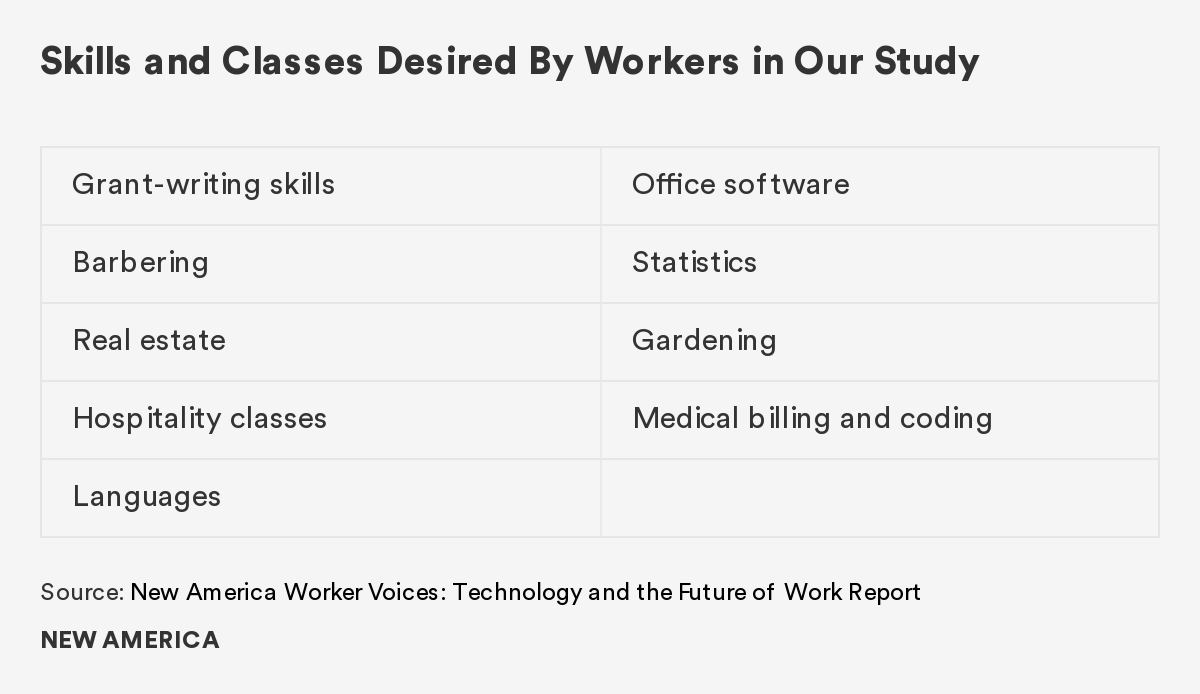
This preference for professionally-oriented training over academic study was explained by a 29-year-old former fast food worker (featured in Jasmin’s Profile) who is interested in a short course for a commercial drivers’ license certification: “I just want to take trades. Because in my opinion, people with master's degrees can get the same job we can get through the trades. So I'm not gonna waste all my time. The more trades I have, then I can secure a good position somewhere down the line. So I'm just working on getting trades.”
Interviewees often stated a desire to acquire skills that are relevant to their jobs and allow them to keep pace with new technologies or new job responsibilities. For instance, a 32-year-old administrative assistant in a medical office shared her desire to take classes in medical billing and coding, which she finds “hard” and that are an important part of her job. She has access to these courses for free through her employer. “I think it would be beneficial to take classes, just because I know it is hard,” she said. “I have to do tons of billing and coding. They have tons of stuff like that I can take."
Most often, interviewees desire new professional skills and credentials that position them for promotions, new jobs, or income generating opportunities—in their own workplace, or elsewhere. For instance, two separate grocery workers expressed an interest in a career change to real estate. They described the change as a relatively straightforward transition, requiring learning from personal networks and connections and taking short courses to become certified. A fast food hostess described her interest in taking hospitality courses, while a young retail manager said she would like to take language classes to become more marketable for the event planning career she aspires to. A young retail manager who makes money on the side as a barber indicated an interest in training in barbering.
Financial barriers can limit access to training and credentials. Employers can help
Workers identified cost as a barrier to earning credentials that can advance their careers. Several workers expressed a desire for employers to help finance the cost of training. For instance, the 29-year-old worker training as a truck driver (featured in Jasmin’s Profile) described her strong interest in obtaining a specific type of commercial driver’s license to qualify for higher paying positions. She aspires to a job similar to that of her boyfriend’s brother, who earns $25 an hour with his license—more than twice what she earned recently in the fast food industry. With little financial stability and no savings, she does not have the means to afford the $1,700 tuition. She is trying hard to get a job at a trucking company that offers tuition benefits to cover the costs of the license. “I’ve been trying to get a job with them forever,” she said. “I call them all the time and I keep on filling out applications for different positions.”
Tuition is just one type of financial barrier that limits the pursuit of credentials and skills training. The opportunity cost of not working while training can be an even bigger obstacle than the training fees. A 55-year-old administrative assistant and former teacher described facing financial barriers when she moved to another state: “I couldn't find a teaching job. I knew everybody wanted you state certified and I was not and that would mean going back to school. And it's like I need a job, I can't afford to go to school, I need a job. So I went back to doing secretarial work.”
Work-based apprenticeships offer workers training and economic security at the same time
Some workers accessed financial support through their employers for training through workplace-sponsored apprenticeships. The experience of two workers with a butcher apprenticeship program illustrates the benefits to workers of training full time in the workplace while maintaining financial stability by earning a salary (see box below).
Nathan and Tyler: A Tale of Two Apprenticeships
The draw of an apprenticeship opportunity: Nathan is a 25-year-old manager at a grocery store. He began at his store seven years ago, right after high school. Nathan is working with the HR department at his work in the hopes of entering a butcher apprenticeship program. For Nathan, becoming a butcher would be a promotion and would come with more money and responsibility, as well as the stability he desires. “There'll be a pay raise…because I'm topped out currently.…Also, it's a trade that isn't going to go anywhere anytime soon, hopefully. It’s just more security I guess.”
To become a butcher, Nathan first needs to train as an apprentice through a program organized by his employer. “It would require about 4,000 hours once I become an apprentice. Then I'll become a journeyman and I’d have a trade that I can take anywhere. If I need another job, I could go to any other grocery store or butcher shop…because it's such a trade job.” Once he finishes the apprenticeship program, he is interested in becoming a meat manager and running the department. “That's probably the next step.” He also considers moving to another store where butchers earn more money.
The apprenticeship route appeals to him more than other educational opportunities and online courses. “I never took online classes or anything like that.…I don't want to waste time going to take classes just to take classes.” With the apprenticeship training, he likes that he can learn new skills right on the job. “In a way, it’s because I'm already in the area where I can learn it. It's not like I have to go anywhere extra to learn. It's already in the job that I'm at, so it's just continuing up the ladder basically. They actually offer [that] they'll pay for the schooling and stuff and then I do all the training on the job.”
Nathan does not anticipate that the job will change much over the next 20 years. “From what I can tell, it's not going to change much. I keep seeing things online for buying prepackaged meat over the internet and having it sent to your house. That might be a thing in the future, but I hope not while I'm at the job. I also always hear about pre-packaged meat. It just comes in, you put a tag on it, and you put it out. That would eliminate the job, at least at the store level. Somebody still has to cut the meat down the line somewhere, but I don't see it changing all that much.”
From apprentice to manager on a path that no longer exists: Tyler is a 53-year-old meat manager at a different grocery store. He has been with his company for over two decades and hopes to retire in five years. When he started out with the company, he learned of a new meat cutting apprenticeship program that was just beginning. “I said, ‘well, that sounds interesting.’ And then he told me what the money was and I said, ‘yeah, that definitely sounds interesting.’ So I went onto the apprenticeship program for two years. I did that, became a journeyman meat cutter, stayed in that role for five years, and now have been a meat manager for over 12 years.”
When he was an apprentice, he learned under a trained journeyman. He would follow the day-to-day operations: “he would show you how to cut stuff. A whole hindquarter of meat would come in and you actually had to break it down right there in the shop.” The apprentices would move around to different stores filling in for journeymen and gaining experience. “Once you learn all of that, you have a block test at the end of two years. Once you do that, you are considered a journeyman meat cutter.” During the training, Tyler continued to earn a salary. He is grateful for the opportunities that his employer has given him. He pointed out that the company has also been good to his two children, who are now in college. He is proud of the example he has set of career success without having gone to college. He recently told students at his high school, “you don't have to go to college to be successful,’ and I just pointed to myself as a story.”
Tyler is dismayed that his company no longer provides the apprenticeship opportunity to young people coming up behind him. Several years ago, the company moved to precut meat, halted the apprenticeship program and stopped training a pipeline of skilled butchers. The younger clerks who work with him have no knowledge of meat. “They couldn't tell you a sirloin from a T-bone, what is tender, what comes from this part of the cow.” He doesn’t blame them. “They can say, here take somebody and in three days, he should know this. It took me three years to know what I know so how am I going to teach somebody in three days what it took me three years to know? Business now is, everything is, trying to get more with less. I think you end up paying for it in the long run.” In 20 years, Tyler isn’t convinced that his job will still exist. As the job is de-skilled with precut meat and labeled containers, he said, “I can see the management role in meat to be abolished in a few years just because it's so simplified.” If a customer comes in with a specific question, though, “then you're in trouble.”
Tyler wishes that young people starting out in grocery today could have the same opportunities he enjoyed. “I wish everybody underneath me could get the same thing that I have. It's different now. If I could change one thing, I would wish that all the other employees could get the same things I had, including the money and everything that I got when I started. Today, a new hire only gets a dollar more on Sunday, whereas I get time and a half on Sunday and some people still get double time. I just wish that a lot of people could make a career out of it, as I did. Unless you're in management—I think that's the only way that you could make a career out of it.”
Apprenticeships like the ones described by Nathan and Tyler offer a workforce approach with proven results that can simultaneously address workers’ need for economic stability and enhanced access to opportunity and skills. Combining paid, on-the-job training with structured learning, apprenticeships have been successfully deployed in skilled trades and are expanding to other industries.33 Our colleagues in the Center for Education and Skills have identified community colleges as especially well positioned to increase the number of high-quality apprenticeship opportunities and to scale them to growing industries like healthcare, IT, advanced manufacturing and business.34 But despite their proven benefits and strong bipartisan support for expanding their numbers,35 apprenticeships today bring opportunity to a small fraction of the workforce. In 2018, there were 585,000 apprenticeships.36
Workers reported uneven access to learning opportunities at work
Work-based learning and employer-funded training match many workers’ preference for convenient, affordable and quick learning opportunities. However, workers reported uneven access to learning opportunities at work.
The clerical and administrative workers we interviewed pointed to substantial training resources at their disposal while on the job that helps them learn and keep pace with new technology and software programs introduced at work. A 58-year-old administrative assistant said, “there’s lots of training. Every time they upgrade the system to something new, we get training. Everything is from video. They might have a half hour get together with everyone to explain things, but all the training is online.” A county information clerk, 40, said, “I’ve enjoyed our internal class offerings. They are web-based and we have some in person. If you complete a track you’ll get a certification.”
While many clerical and administrative workers described access to job-related trainings, fewer workers had access through their employer to training and studies for professional development that is not directly related to their jobs. An administrative assistant, 58, said, “they don’t provide us with anything for general or personal growth, but if you want to improve your skills on different software and it’s related to work, we get that for free.”
When fast food, grocery, and retail workers described training in their workplaces, they typically referred to training for new positions as they were moving into a different role. For instance, an employee might undergo training to start a job as a bookkeeper or become a manager or learn how to work the cash register or fulfill online orders. Few described resources for continuous learning and digital skill development. Several workers had access to inexpensive or free online classes through their employer, but none of the workers used them. They shared that this educational benefit did not match their needs or preferences.
Meeting the learning and training needs of workers will require fresh thinking
The preferences of many mid-career and older working adults are clear: they want more specific, job-relevant skills, and not a college degree. While workers say they want short-term training targeted toward specific employment, traditional higher education still captures the lion’s share of funding and resources. Short-term credentials and offerings have proliferated, but without consistent quality assurances and accountability, and less clear outcomes compared to traditional higher education.37
The question for policymakers is how to deliver the kind of training that meets the needs, preferences, and constraints of students, but also with sufficient quality to deliver learning and employment outcomes for the workers who need them. Also, how should this training be financed? Several states are experimenting with “lifelong learning accounts” to help workers fund training throughout their careers,38 where tax-free contributions from individuals are matched by government contributions and could also include employer contributions.
Meeting the learning and training needs of low-wage workers facing economic precarity and time constraints requires fresh thinking, systemic reform and more funding. Practitioners and policymakers should consider these constraints when designing training and learning opportunities. Policymakers should explore incentives for business to expand and improve training and learning opportunities for workers on the job, especially for lower-wage workers who often benefit least from investments in employer training.

Worker Voices: Technology and the Future for Workers
- Executive Summary
- Acknowledgements
- Introduction
- Economic Insecurity and the Future for Low-Wage Workers
- The Search for Stability While Work is Changing
- Workers Want to Feel Respected and That They Matter
- Technology on the Job Today
- How Workers Imagine Their Jobs in the Future
- Barriers to a Better Future for Workers, Especially Women
- Obstacles to Obtaining Skills and Degrees
- Career Transitions are Difficult and Often Out of Reach
- Conclusion and a Human-Centered Agenda for the Future of Work
- Appendix: Study Methodology
Citations
- Center for Education and Skills, “Building Strong and Inclusive Economies through Apprenticeship,” New America, updated February 27, 2019, https://www.newamerica.org/education-policy/reports/state-policy-agenda-2019/
- Lul Tesfai, “Creating Pathways to College Degrees Through Apprenticeships,” New America, updated September 19, 2019, https://www.newamerica.org/education-policy/reports/creating-pathways-postsecondary-credentials-through-apprenticeships/
- Alastair Fitzpayne, “Apprenticeships Serve as Model of Skills-Based Training for Jobs of the Future,” Opportunity & Development (blog), Aspen Institute, November 16, 2018, https://www.aspeninstitute.org/blog-posts/apprenticeships-as-model-of-skills-based-training/
- U.S. Department of Labor, Employment and Training Administration (website), “Registered Apprenticeship National Results: Fiscal Year (FY) 2018 (10/01/2017 to 9/30/2018),” updated September 3, 2019, https://www.doleta.gov/oa/data_statistics.cfm
- Testimony of Anthony Carnevale to the U.S. Senate Committee on Health, Education, Labor and Pensions (Washington, DC: Georgetown University Center on Education and the Workforce, January 30, 2018), https://cew.georgetown.edu/wp-content/uploads/hill-testimony.pdf
- Alastair Fitzpayne and Ethan Pollack, Lifelong Learning and Training Accounts: Helping Workers Adapt and Succeed in a Changing Economy (Washington, DC: Aspen Institute, May 2018), https://www.aspeninstitute.org/publications/lifelong-learning-and-training-accounts-2018/