Reported Strikes by International Belligerents
At least seven foreign countries have conducted airstrikes in Libya since 2012, highlighting the evolving proxy warfare nature of this conflict. However, the most recently active countries are the United Arab Emirates and Turkey, each fighting on behalf of local belligerents, the Libyan National Army or the Government of National Accord. The United States is absent from the list below, and is described in a later section of the report.
Strikes by the United Arab Emirates
In March 2011, the UAE joined a coalition of NATO countries and Arab nations that was supported by UN Security Council Resolution 1973 (March 2011)73 to overthrow the Gaddafi regime. As a result, the National Transitional Council (NTC) was established as an 18-month long temporary government for Libya in the aftermath of the removal of Gaddafi.74 The UAE is known for its regional interventions, as it continues to protest political Islam while promoting a version that supports its ideals, therefore “[politicizing] the secularization of politics” to justify its geopolitical actions.75 Leaders in the UAE were concerned with how instability in Libya would influence them in the region,76 so they decided to support Haftar in his campaign against what he perceived to be radical Islamists in 2014.77
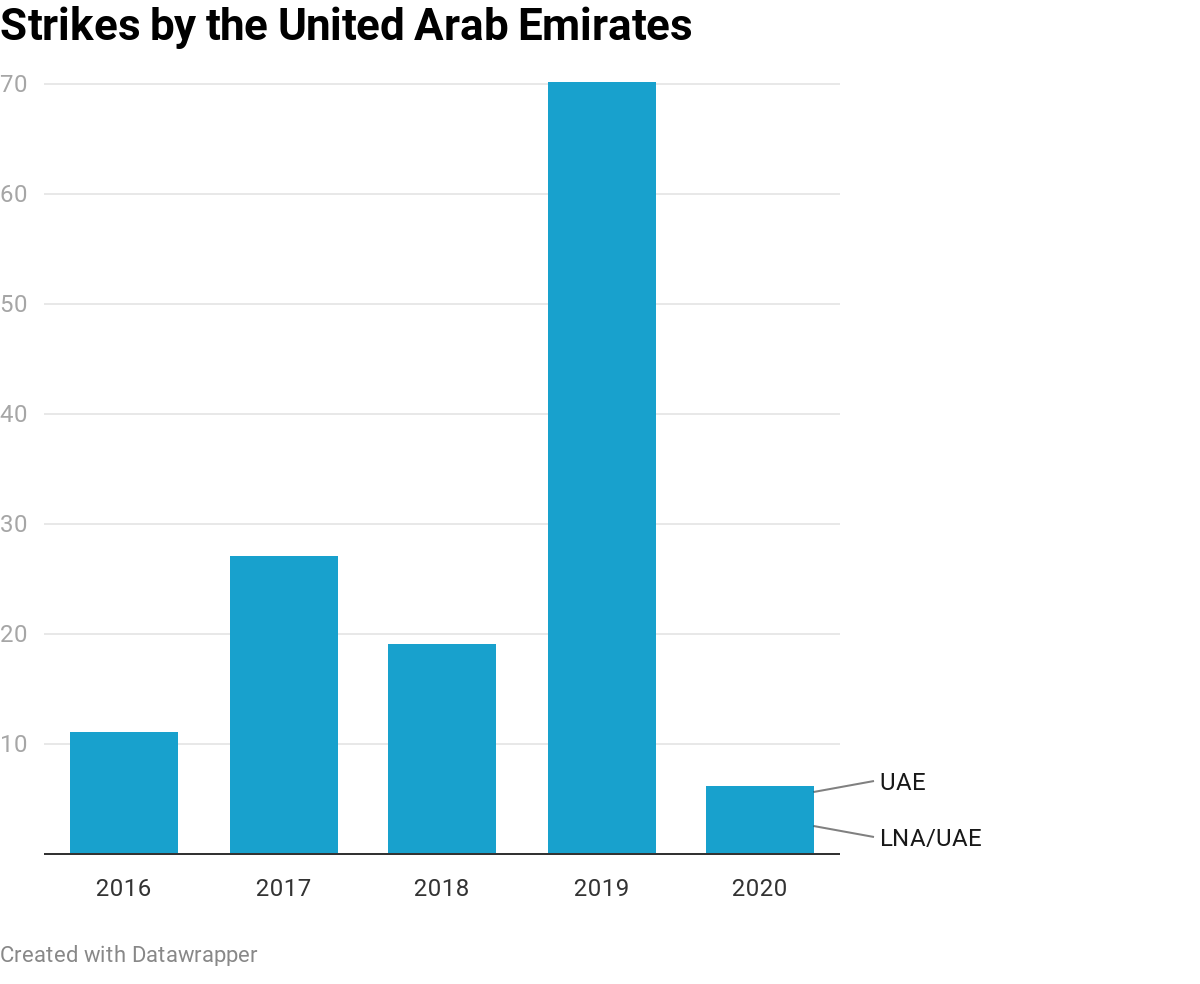
The first strikes by the UAE began in 2014, taking off from an Egyptian air base.78 Since June 2018, the UAE has reportedly conducted three individual airstrikes, but as many as 67 in coordination with the LNA. In some cases it is not discernible whether the UAE operated independently. When the UAE conducts drone strikes, it uses Chinese Wing Loong models,79 which were originally designed after the MQ-1 Predators in the United States.80 These 67 strikes account for as many as 124 civilian deaths, taking the lowest count, and as many as 167, taking the highest count. Up until February 5, 2020, the LNA and UAE have allegedly conducted three strikes together this year, causing three civilian deaths; the UAE has conducted one strike by itself. The UAE has breached the agreed-to arms embargo in Libya after the latest Libya Summits in January 2020.81 New America reached out to the government of the United Arab Emirates for comment before the report’s release, but did not receive a response. See Figure 4 and Appendices F and M for more on strikes by the UAE.
Figure 4:
Strikes by Turkey
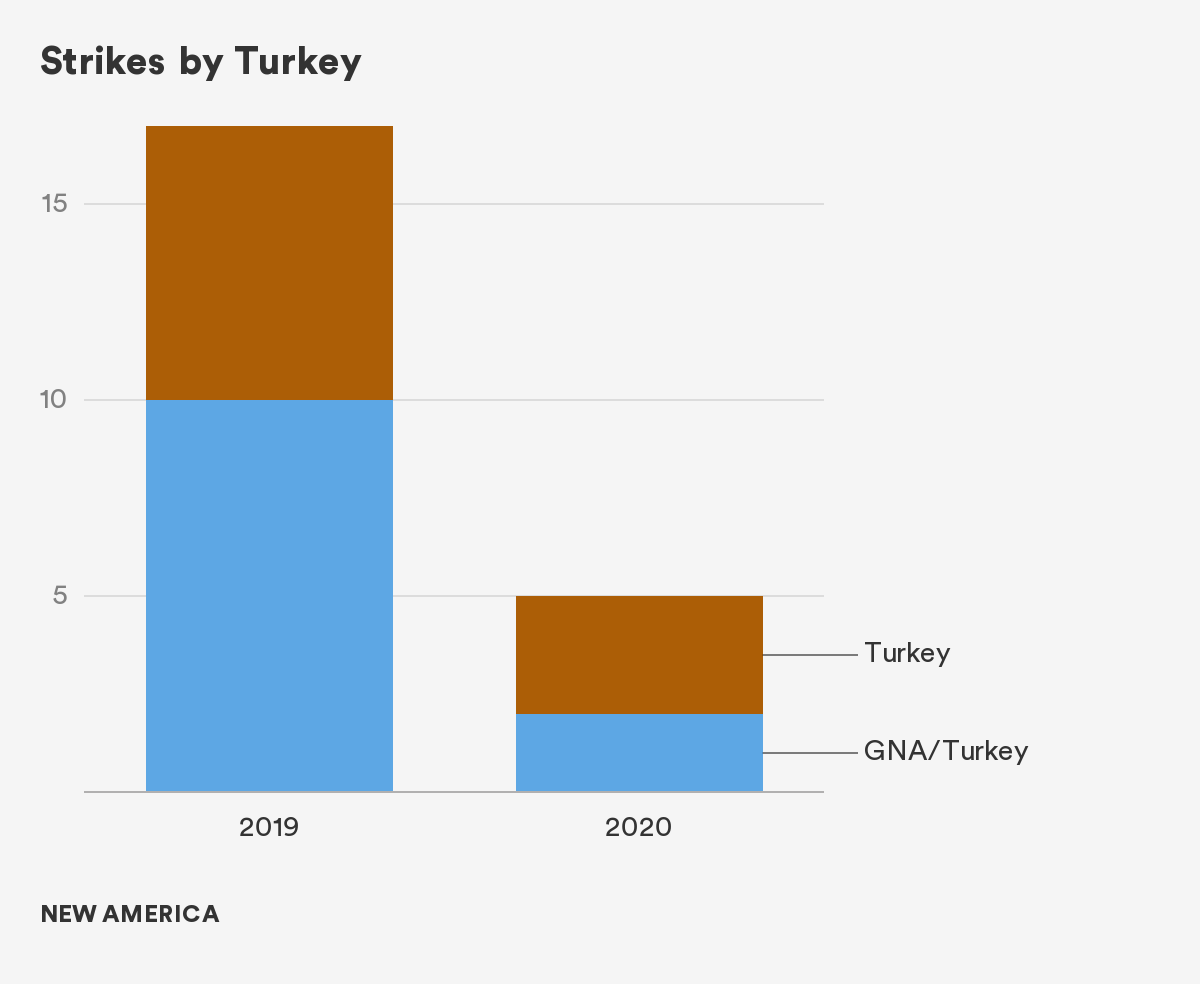
Turkey’s first alleged airstrike in Libya occurred on July 14, 2019 in Tripoli, and targeted a house82 that reportedly killed one civilian. Two weeks later, outside Sirte, a similar strike occurred, this time striking a civilian vehicle, killing two people and critically injuring one child.83 Two months earlier, Turkey allegedly began delivering drones and other equipment to Libya, totaling USD $350 million.84 Reports indicate Turkey’s air campaign continued for the rest of 2019, striking Libya 10 times, in addition to the seven times it has combined efforts with the GNA. Turkey deploys its own Bayraktar TB-2 drones in Libya, compared to the Chinese drones that the UAE uses.85 According to New America and Airwars data, these combined strikes killed between 10 and 12 civilians in 2019. Seven of those strikes occurred in Tripoli.
Turkey began sending troops to Libya in January 2020 after the Turkish Parliament voted to support and train GNA fighters and affiliates. This came after Turkey and Libya signed formal economic agreements at the end of 2019,86 one of which made official new maritime boundaries between the two countries.87 Turkey claims that because of these newly declared boundaries, it has access to natural gas that other neighboring states are also keen to get their hands on, especially since Egypt, Israel, Cyprus, and Greece left Turkey out of their newly formed Eastern Mediterranean Gas Forum. The EastMed deal, as it’s commonly referred to, may be worth over USD $6.7 billion .88
Turkey’s geopolitical motivations and actions are increasingly described, and criticized, as “neo-Ottoman”89 and expansionist, meaning Turkey may be looking to regain its sphere of influence that it claimed during the Ottoman Empire. Furthermore, many international law experts are calling into question the legality90 of Turkey’s maritime border move, especially its attempt to lay claim to waters that should be easily accessed by the EastMed cooperative. Before this report was published, New America corresponded via email with a government official from the Turkish Embassy/Defence Office in Washington, D.C. The government official told New America that Turkey’s main goal in Libya is to create a stable, independent and sovereign country, while respecting Libya’s territorial integrity.
The GNA entered into an agreement with Turkey to receive military support against the LNA and its backers. Some experts argued it would help balance out the support the LNA has received from the UAE.91 Two thousand Syrian troops were transported through Turkey to support the GNA in January 2020; however, they are not affiliated with the Turkish military, but are temporary contractors with the GNA.92 According to New America and Airwars data, from January 1, 2020 through February 5, 2020, Turkey conducted airstrikes by itself three times, and in coordination with the GNA twice. None of those strikes have resulted in civilian deaths. New America reached out to the government of Turkey for comment before the report’s release, but did not receive a response.
The Republic of Turkey government official also stated in email correspondence with New America that Turkey does not have any armed land, sea, or air force elements in Libya, and thus has not conducted any airstrikes. The Turkish personnel sent to Libya are at the request of Libya’s GNA, as indicated in their memorandum of understanding signed on November 27, 2019 for security and military cooperation. Further, Turkish personnel are there to provide advisory and training services to GNA troops, and thus has not conducted any airstrikes in Libya. All strikes are conducted by Libyans.
See Figure 5 and Appendices E and L for more on strikes by Turkey.
Figure 5:
Strikes by France
France publicly recognizes the GNA, and stated its support of a democratic process and constitution building during the Libya Summits it hosts, but its possible supplying of weapons and/or aircraft to the LNA conflicts with this public notion of letting local Libyans decide their future, or even supporting the UN-backed government. France reportedly provides military support to Haftar’s LNA.93 France provided Haftar with a reconnaissance aircraft,94 and French missiles sold to them by the United States were also found in an LNA camp.95
France’s support for both the LNA and GNA stems from its goals in Libya that directly impact its interests in the wider region.96 Concerned with minimizing the threat of jihadists in Libya, French President Emmanuel Macron has called for a unified national army and national government.97 France’s clandestine activities across the country show its preference for the LNA. France reportedly conducted seven strikes, likely in coordination with the LNA, in 2018, but New America and Airwars have not recorded any additional strikes since then. Members of French intelligence were arrested in April 2019 along the Libyan border with Tunisia, with communications devices allegedly interconnected with the LNA.98 New America reached out to the government of France for comment before the report’s release, but did not receive a response. See Appendix N for more strikes by France.
Strikes by Egypt
The Egyptian government first publicly acknowledged conducting airstrikes in Libya in February 2015. These initial strikes were in response to ISIS’s beheading of 21 Egyptian Coptic Christians.99 However, Egypt’s first role in the conflict began in August 2014. Egypt provided military bases for the UAE to launch armed planes to strike in Libya.100 On February 15, 2015, Egyptian airstrikes occurred in the Bab Shiha neighborhood and the headquarters of Jabal al-Akhdar Industrial Co. in east Derna. At least seven civilians were killed in those strikes, three or four were children.101 Egypt opted for striking Derna where ISIS had a stronghold instead of Tripolitania Province because the roundtrip distance was too far for its jets to travel without requiring refueling.102 Amnesty International reported that Egypt did not take proper precautions to protect civilians while conducting those two airstrikes.103
According to New America and Airwars data, Egypt’s most recent strike took place in February 2019 along the Libya-Egypt border, killing eight combatants. This is the most recent known recorded strike. New America reached out to the government of Egypt for comment before the report’s release, but did not receive a response. See Appendix D for more strikes by Egypt.
Strikes by Italy
Italy was a significant participant in the NATO intervention, in particular, because it permitted the use of its airbases, as well as conducted strikes early on.104 The United States launches drones from the Naval Air Station Sigonella in Sicily, Italy. Italy has argued with France over France’s backing of Haftar and the LNA,105 and has tried to engage in diplomatic talks with both sides, which frustrates the LNA and GNA.106 Italy may have conducted one airstrike with the GNA in August 2018, although it is contested, and in 2019, the LNA allegedly shot down an Italian drone, mistaking it for a Turkish model. New America reached out to the government of Italy before publishing this report and received a reply that more than 400 Italian soldiers are still on the ground in Libya, and the Italian military conducts activities from the Misrata hospital center to training and assisting missions in Tripoli. Italy also supports new European Union naval and training missions in Libya. Italy has not officially acknowledged any loss of soldiers or equipment in Libya. See Appendix J for more strikes by Italy.
Strikes by Chad
On September 1, 2018, Chad conducted a helicopter strike in Murzuq, killing two civilians.107 In February 2019, Haftar stated that the LNA had conducted airstrikes against three groups of Chadian combatants in Murzuq.108 France allegedly conducted strikes nearby, but it was indiscernible if the Chadian groups were the same targets for the LNA and France, or if they were located in different places. Chad is actively trying to prevent combatants in the Libya conflict from crossing into Chad,109 but numerous Chadian combatants are involved in the conflict, supporting either the GNA or LNA.110 According to a UN report at the end of 2019, there are over 1,000 Chadian combatants in Libya across the country, supporting at least four groups. Some of these individuals are linked to killing, kidnappings, and robberies against southern Libyans.111 New America reached out to the government of Chad for comment before the report’s release, but did not receive a response.
Citations
- Peter Bergen and Alyssa Sims, “Airstrikes and Civilian Casualties in Libya: Since the 2011 NATO Intervention,” New America, June 20, 2018. https://www.newamerica.org/international-security/reports/airstrikes-and-civilian-casualties-libya/the-us-counterterrorism-war-and-libya/
- Peter Bergen and Alyssa Sims, “Airstrikes and Civilian Casualties in Libya: Since the 2011 NATO Intervention,” New America, June 20, 2018. https://www.newamerica.org/international-security/reports/airstrikes-and-civilian-casualties-libya/the-us-counterterrorism-war-and-libya/
- Robert F. Worth, “Mohammed bin Zayed’s Dark Vision of the Middle East’s Future,” The New York Times Magazine, January 1, 2020. https://www.nytimes.com/2020/01/09/magazine/united-arab-emirates-mohammed-bin-zayed.html
- Peter Bergen and Alyssa Sims, “Airstrikes and Civilian Casualties in Libya: Since the 2011 NATO Intervention,” New America, June 20, 2018. https://www.newamerica.org/international-security/reports/airstrikes-and-civilian-casualties-libya/the-us-counterterrorism-war-and-libya/
- Peter Bergen and Alyssa Sims, “Airstrikes and Civilian Casualties in Libya: Since the 2011 NATO Intervention,” New America, June 20, 2018. https://www.newamerica.org/international-security/reports/airstrikes-and-civilian-casualties-libya/the-us-counterterrorism-war-and-libya/
- David D. Kirkpatrick and Eric Schmitt, “Arab Nations Strike in Libya, Surprising U.S.,” New York Times, Aug. 25, 2014, https:// www.nytimes.com/2014/08/26/world/africa/egypt-and-united-arab-emirates-said-to-have-secretly-carried-out-libya-airstrikes.html
- “World of Drones.” New America. Accessed March 4, 2020. https://www.newamerica.org/international-security/reports/world-drones/who-has-what-countries-that-have-conducted-drone-strikes
- Joanna Frew, “Drone Wars The Next Generation,” Drone Wars UK, May 2018. https://dronewarsuk.files.wordpress.com/2018/05/dw-nextgeneration-web.pdf
- Abdulkader Assad, “Libyan Ambassador to UN at Security Council: UAE, France Breached Libya's Arms Embargo,” Libya Observer, January 30, 2020. https://www.libyaobserver.ly/news/libyan-ambassador-un-security-council-uae-france-breached-libyas-arms-embargo
- Tarhuna 24. Facebook post. July 14, 2019, 12:15 http://archive.is/VRIiw#selection-1331.0-1331.6 ; State truce #TD. Facebook post. July 14, 2019, 16:53. http://archive.is/uoYPt
- “Africa News Portal/Followups,” Africa News Portal/Followups, August 5, 2019. http://archive.is/vOSBP.; “Libya News 24.” Libya News 24, August 5, 2019. http://archive.is/iHukN
- Raja Abdulrahim, “Foreign Backing Brings Militias in Libya to a Stalemate – and No Further,” The Wall Street Journal, October 1, 2019. https://www.wsj.com/articles/foreign-backing-brings-militias-in-libya-to-a-stalemateand-no-further-11569942469
- “World of Drones.” New America. Accessed March 4, 2020. https://www.newamerica.org/international-security/reports/world-drones/who-has-what-countries-that-have-conducted-drone-strikes; Emadeddin Badi, “Libya's War of the Many.” Carnegie Endowment for International Peace, December 17, 2019. https://carnegieendowment.org/sada/80628.; Jalel Harchaoui, “The Libyan Civil War Is About to Get Worse.” Foreign Policy, March 18, 2020. https://foreignpolicy.com/2020/03/18/libyan-civil-war-about-get-worse/.; Paul Iddon, “Turkey Is Fighting a Formidable Drone War in Libya.” Ahval, September 14, 2019. https://ahvalnews.com/libya/turkey-fighting-formidable-drone-war-libya.; Jason Pack and William Lawrence, “Turkey Doubles down on Libya.” Middle East Institute, April 9, 2020. https://www.mei.edu/publications/turkey-doubles-down-libya.
- Carlotta Gall, “Erdogan Announces First Turkish Troops Are Heading to Libya,” The New York Times, January 5, 2020. https://www.nytimes.com/2020/01/05/world/europe/erdogan-turkish-troops-libya.html
- Keith Johnson, “Newly Aggressive Turkey Forges Alliance With Libya,” Foreign Policy, December 23, 2019. https://foreignpolicy.com/2019/12/23/turkey-libya-alliance-aggressive-mideterranean/
- Ariel Cohen, “Turkey-Libya Maritime Deal Upsets Mediterranean Energy Plan,” Forbes Magazine, January 20, 2020. https://www.forbes.com/sites/arielcohen/2020/01/08/turkey-libya-maritime-deal-upsets-mediterranean-energy-plan/#ddd08fa6bee4
- Ariel Cohen, “Turkey-Libya Maritime Deal Upsets Mediterranean Energy Plan,” Forbes Magazine, January 20, 2020. https://www.forbes.com/sites/arielcohen/2020/01/08/turkey-libya-maritime-deal-upsets-mediterranean-energy-plan/#ddd08fa6bee4
- Jason Pack, “Turkey Doubles down on Libya,” Middle East Institute, February 19, 2020. https://www.mei.edu/publications/turkey-doubles-down-libya
- Aiden Lewis, Reuters, January 7, 2020. https://www.reuters.com/article/us-libya-security-turkey-analysis/turkish-support-for-tripoli-could-rebalance-forces-in-libya-idUSKBN1Z62HM ; Patrick Wintour, “Libyan Government Activates Cooperation Accord with Turkey,” The Guardian, December 20, 2019. https://www.theguardian.com/world/2019/dec/20/libyan-government-activates-cooperation-accord-with-turkey“Libya Conflict: Turkey Sends Troops to Shore up UN-Backed Government,” January 6, 2020. https://www.bbc.com/news/world-africa-51003034; Emadeddin Badi, “Libya's War of the Many.” Carnegie Endowment for International Peace, December 17, 2019. https://carnegieendowment.org/sada/80628.; Jalel Harchaoui, “The Libyan Civil War Is About to Get Worse.” Foreign Policy, March 18, 2020. https://foreignpolicy.com/2020/03/18/libyan-civil-war-about-get-worse/.; Paul Iddon, “Turkey Is Fighting a Formidable Drone War in Libya.” Ahval, September 14, 2019. https://ahvalnews.com/libya/turkey-fighting-formidable-drone-war-libya.; Jason Pack and William Lawrence, “Turkey Doubles down on Libya.” Middle East Institute, April 9, 2020. https://www.mei.edu/publications/turkey-doubles-down-libya.
- “2,000 Syria Fighters Arrive in Libya to Confront Haftar’s Forces,” Middle East Monitor, January 15, 2020. https://www.middleeastmonitor.com/20200115-2000-syria-fighters-arrive-in-libya-to-confront-haftars-forces/
- Karim Mezran and Elissa Miller, “France, Italy, and Libya’s Crisis,” Atlantic Council, July 28, 2017, http://www.atlanticcouncil.org/blogs/menasource/france-italy-and-libya-s-crisis
- Abdulkader Assad, “Report: Haftar Could Have the Upper Hand in Derna Fighting, Thanks to French Aircraft,” Libya Observer, June 3, 2018. https://www.libyaobserver.ly/news/report-haftar-could-have-upper-hand-derna-fighting-thanks-french-aircraft
- Eric Schmitt and Declan Walsh. “U.S. Missiles Found in Libyan Rebel Camp Were First Sold to France,” The New York Times, July 9, 2019. https://www.nytimes.com/2019/07/09/world/middleeast/us-missiles-libya-france.html
- Mikaïl, Barah. “From Gaddafi to Haftar: France Plays Both Sides in Libya.” Middle East Eye, June 11, 2019. https://www.middleeasteye.net/opinion/gaddafi-haftar-france-plays-both-sides-libya
- John Irish, “France’s Macron puts national security at heart of foreign policy,” Reuters, June 22, 2017, https://www.reuters.com/article/us-france-foreign-analysis-idUSKBN19D2OE
- Barah Mikaïl, “From Gaddafi to Haftar: France Plays Both Sides in Libya,” Middle East Eye, June 11, 2019. https://www.middleeasteye.net/opinion/gaddafi-haftar-france-plays-both-sides-libya
- Erin Cunningham and Heba Habib, “Egypt bombs Islamic State targets in Libya after beheading video,” Washington Post, Feb. 16, 2015, https://www.washingtonpost.com/world/egypt-bombs-islamic-state-targets-in-libya-after-brutal-beheading-video/2015/02/16/3b32c50c-b5b6-11e4-9423-f3d0a1ec335c_story.html
- David D. Kirkpatrick and Eric Schmitt, “Arab Nations Strike in Libya, Surprising U.S.,” New York Times, Aug. 25, 2014, https:// www.nytimes.com/2014/08/26/world/africa/egypt-and-united-arab-emirates-said-to-have-secretly-carried-out-libya-airstrikes.html
- Bergen, Peter, and Alyssa Sims. “Airstrikes and Civilian Casualties in Libya: Since the 2011 NATO Intervention.” New America, June 20, 2018. https://www.newamerica.org/international-security/reports/airstrikes-and-civilian-casualties-libya/the-us-counterterrorism-war-and-libya/
- Kirkpatrick, David D. “Egypt Launches Airstrike in Libya Against ISIS Branch.” The New York Times, The New York Times, 16 Feb. 2015, www.nytimes.com/2015/02/17/world/middleeast/isis-egypt-libya-airstrikes.html
- Libya: Mounting Evidence of War Crimes in the Wake of Egypt's Airstrikes. Amnesty International, 23 Feb. 2015, www.amnesty.org/en/latest/news/2015/02/libya-mounting-evidence-war-crimes-after-egypt-airstrikes/
- Ivo H. Daalder and James G. Stavridis. “NATO's Success in Libya.” October 31, 2011. https://www.nytimes.com/2011/10/31/opinion/31iht-eddaalder31.html
- Bloomberg.com., April 11, 2019. https://www.bloomberg.com/opinion/articles/2019-04-11/libya-conflict-france-and-italy-should-stop-squabbling-and-lead
- Crispian Balmer, “Italian Foreign Policy Flounders amidst Libyan Blunders,” Reuters, January 9, 2020. https://www.reuters.com/article/us-italy-libya-diplomacy/italian-foreign-policy-flounders-amidst-libyan-blunders-idUSKBN1Z821D
- Ross, Aaron. “Chad Army Kills Two Civilians near Libyan Border: Sources.” Reuters, September 15, 2018. Ross, Aaron. “Chad Army Kills Two Civilians near Libyan Border: Sources,” n.d.; “Militants Bombed the Libyan-Chadian Border.” 218TV, September 14, 2018. http://archive.fo/OxCDk
- “Haftar’s Libyan National Army Says It Hit Chad Rebels in New Airstrikes.” The Defense Post, February 8, 2019. https://thedefensepost.com/2019/02/08/libya-national-army-airstrikes-chad-rebels-haftar/
- Aaron Ross, “Fighters from New Rebel Group Attack Chad Soldiers at Libya Border.” Reuters. Thomson Reuters, August 24, 2018. https://www.reuters.com/article/us-chad-security/fighters-from-new-rebel-group-attack-chad-soldiers-at-libya-border-idUSKCN1L91UC
- “Letter Dated 29 November 2019 from the Panel of Experts on Libya Established Pursuant to Resolution 1973 (2011) Addressed to the President of the Security Council,” United Nations Security Council, December 9, 2019. https://www.securitycouncilreport.org/atf/cf/{65BFCF9B-6D27-4E9C-8CD3-CF6E4FF96FF9}/S_2019_914.pdf
- “Letter Dated 29 November 2019 from the Panel of Experts on Libya Established Pursuant to Resolution 1973 (2011) Addressed to the President of the Security Council,” United Nations Security Council, December 9, 2019. https://www.securitycouncilreport.org/atf/cf/{65BFCF9B-6D27-4E9C-8CD3-CF6E4FF96FF9}/S_2019_914.pdf