Glossary of Belligerents
Aerial Conflict Belligerents in Libya
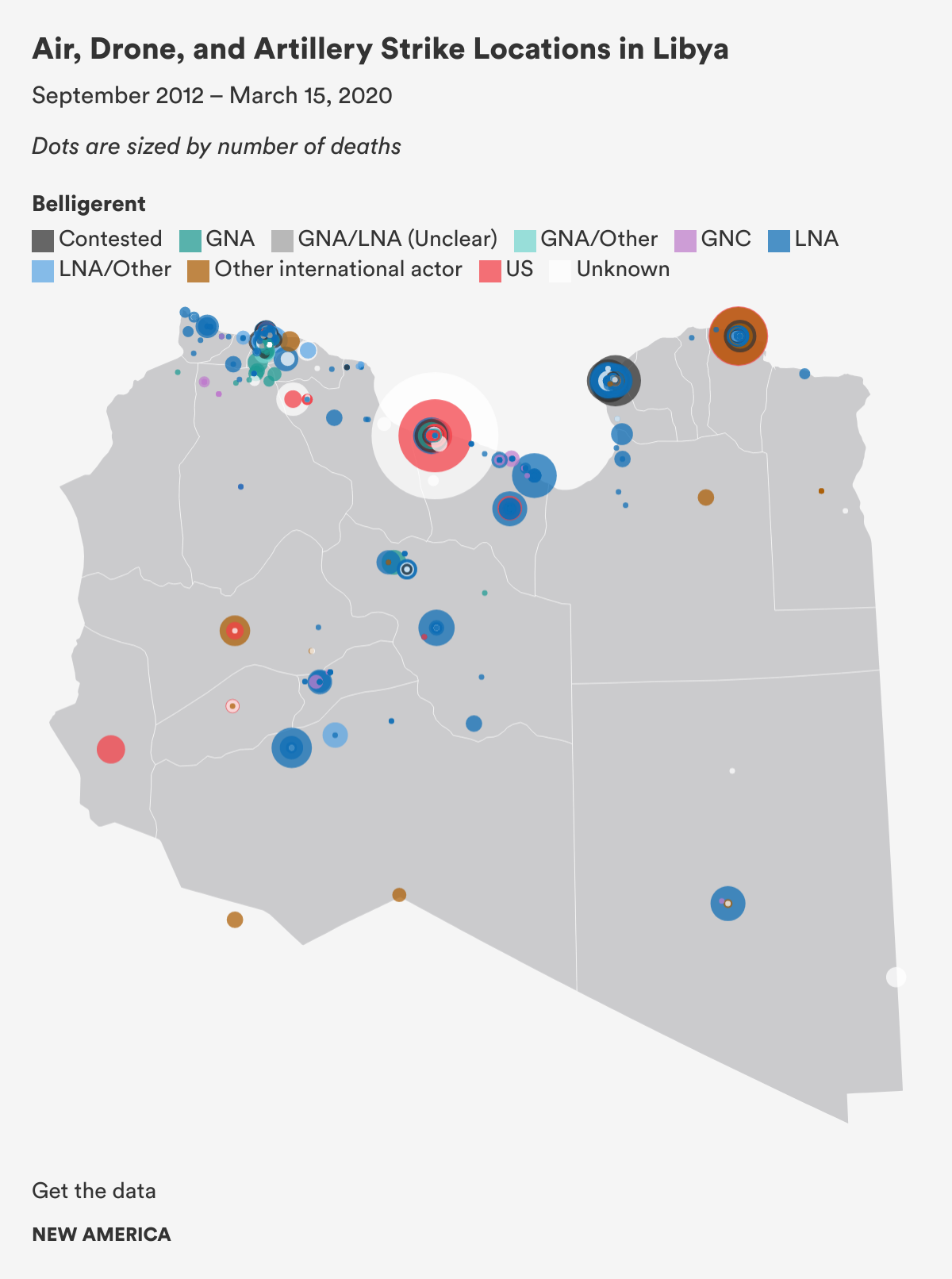
Foreign Belligerents Conduction Air/Drone/Artillery Strikes through February 2020
- The United Arab Emirates (UAE) and Egypt reportedly launched airstrikes during “Operation Dawn” in August 2014, and the UAE provides military support to General Khalifa Haftar’s LNA by conducting airstrikes in cooperation with them. The first strikes by the UAE took place in 2014 from an Egyptian air base.1 The UAE is known for its regional interventions that protest political Islam while promoting a version that supports its ideals. The UAE conducted three strikes in 2019 and one strike in 2020. Counting any additional strikes in accordance with the LNA, the UAE has had as many as 70 additional strikes between 2019 and 2020.
- Turkey’s first alleged airstrike in Libya occurred on July 14, 2019 in Tripoli. Reports indicate Turkey’s air campaign continued for the rest of 2019, striking Libya seven times. Turkey likely conducted an additional 10 strikes with the GNA. Seven of those total strikes occurred in Tripoli. Turkey began sending troops to Libya in January 2020 after the Turkish Parliament voted to support and train the GNA and affiliates. This came after Turkey and Libya signed formal economic agreements at the end of 2019. A government official from Turkey told New America via email that Turkish personnel are there to provide advisory and training services to GNA troops. Through February 5, 2020, Turkey has allegedly conducted airstrikes by itself three times and likely in coordination with the GNA twice.
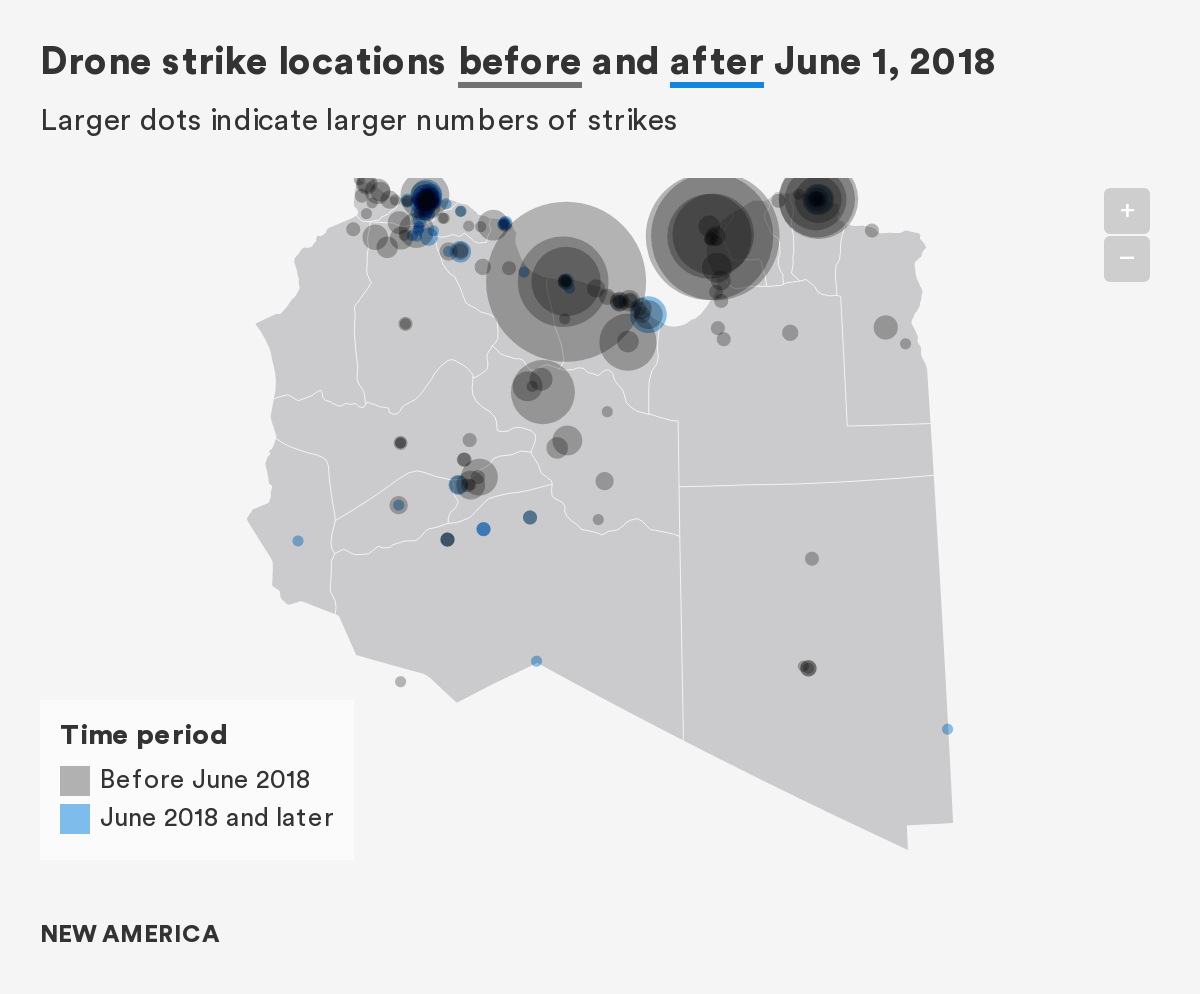
- The United States led the NATO intervention in 2011. The military participated in an aerial campaign against the Gaddafi regime, and conducted at least 550 airstrikes in Libya with the consent of the GNA since 2012. Since June 2018, the United States has conducted an additional 11 strikes. The United States continues to conduct airstrikes in Libya against ISIS and al-Qaeda.
- France was actively involved in the 2011 NATO intervention. At various points over the last several years, France publicly stated its support of a democratic process and constitution building, but it’s possible that supplying weapons and/or aircrafts to the LNA was antithetical to that process. France also hosted discussions at its Libya Summit in 2018, pushing for elections in Libya. Fast-forward to July 2019, the BBC reported that there were French missiles on a pro-Haftar military base. France reportedly conducted seven strikes likely in coordination with the LNA in 2018, but New America and Airwars have not recorded any additional strikes since then.
- Egypt became involved in the Libyan conflict in August 2014 by providing its military bases to the United Arab Emirates for launching strikes in Libya. Egypt first conducted its own strikes in neighboring Libya in February 2015 in response to ISIS’s beheading of Egyptian Coptic Christians.2 Egypt backs the LNA, and worked closely with the UAE in “Operation Dawn” in August 2014. Egypt’s latest strike was in February 2019, but had been more active in years prior.
- Chad conducted one helicopter strike along its border with Libya in 2018. No other strikes were reported. There are over 1,000 Chadian combatants in Libya across the country, supporting at least four groups. Some of these individuals are linked to killing, kidnappings, and robberies against southern Libyans.3
- Italy was a significant participant in the NATO intervention, in particular, because it permitted the use of its air bases, as well as conducted strikes early on.4 The United States launches drones from the Naval Air Station Sigonella in Sicily, Italy. Italy may have conducted one strike with the GNA in August 2018, although it is contested. The LNA shot down an Italian drone in 2019, mistaking it for a Turkish model.
Local Belligerents
- General National Congress (GNC) On July 7, 2012, Libya’s congressional elections took place, the first since 1969. These elections created the General National Congress (GNC), a government projected to oversee the country for 18 months while a new constitution and parliamentary elections were implemented. The GNC decided to extend their term, which frustrated Haftar to the point of declaring the dissolution of the GNC in February 2014. By May 2014, Haftar’s coup attempt called “Operation Dignity” began—with the intention of eradicating radical Islamists from Benghazi—leading to elections the following month, and Islamists who once ruled the government were sorely defeated. The conflict between the GNC and the House of Representatives began to spiral out of control, even after both sides agreed to end the conflict. By April 2016, the GNA took over as the new government.
- Government of National Accord (GNA) In April 2016, the GNA took over as the governing body in Libya, but remained contested by the opposing faction led by Haftar, the Libyan National Army (LNA). The GNA currently governs out of Tripoli, and is led by Prime Minister Fayez al-Sarraj. The GNA is backed by the United Nations (UN) as the sole legitimate government in Libya, as well as by a number of international supporters.
- Libyan National Army (LNA) The LNA is led by Haftar, and rules its House of Representatives in the eastern city of Tobruk. The LNA currently holds territory in more than two-thirds of Libya. The LNA is backed by numerous international belligerents, and is becoming increasingly aggressive in its attempts to take over western Libya.
Figure 1:
Citations
- David D. Kirkpatrick and Eric Schmitt, “Arab Nations Strike in Libya, Surprising U.S.,” New York Times, Aug. 25, 2014, https:// www.nytimes.com/2014/08/26/world/africa/egypt-and-united-arab-emirates-said-to-have-secretly-carried-out-libya-airstrikes.html
- Erin Cunningham and Heba Habib, “Egypt bombs Islamic State targets in Libya after beheading video,” Washington Post, Feb. 16, 2015, https://www.washingtonpost.com/world/egypt-bombs-islamic-state-targets-in-libya-after-brutal-beheading-video/2015/02/16/3b32c50c-b5b6-11e4-9423-f3d0a1ec335c_story.html
- “Letter Dated 29 November 2019 from the Panel of Experts on Libya Established Pursuant to Resolution 1973 (2011) Addressed to the President of the Security Council.” United Nations Security Council, December 9, 2019. https://www.securitycouncilreport.org/atf/cf/{65BFCF9B-6D27-4E9C-8CD3-CF6E4FF96FF9}/S_2019_914.pdf
- Ivo H. Daalder and James G. Stavridis, “NATO's Success in Libya,” New York Times, October 31, 2011. https://www.nytimes.com/2011/10/31/opinion/31iht-eddaalder31.html