Mississippi’s Multifaceted Approach to Tackling Teacher Shortages
Abstract
In a time of localized teacher shortages, declining interest in teaching, and calls to diversify the educator workforce, states across the country are innovating to transform teacher recruitment, preparation, and hiring. Mississippi stands out for taking a creative approach to addressing critical shortages by piloting three initiatives: Grow Your Own programs to develop local teachers, a state-run teacher residency program, and a pilot program exploring the possibility for teachers to earn a license based on their performance. Though still early, these initiatives provide four key lessons that may help other states create opportunities for growing and diversifying a teacher workforce.
Acknowledgments
We are grateful for the participation of faculty, administrators, and leaders from across Mississippi: Benjamin Burnett, Rachel Canter, Bonita Coleman, Amanda Johnson, Evelyn Jossell, Jeffrey Leffler, Cory Murphy, and Courtney Van Cleve. A special thank you to Phelton Cortez Moss, who helped coordinate our visit. Thanks to Tabitha Grossman and Keilani Goggins at the National Center for Teacher Residencies for providing helpful information and context. We appreciate our New America colleagues Sabrina Detlef, Abbie Lieberman, Melissa Tooley and Elena Silva for their critical feedback and edits, as well as Julie Brosnan, Fabio Murgia, Riker Pasterkiewicz and Joe Wilkes for graphics and communication support. New America’s PreK–12 team is generously supported by the Bill & Melinda Gates Foundation, the Heising-Simons Foundation, the Hewlett Foundation, the W.K. Kellogg Foundation and the McKnight Foundation. The views expressed in this report are those of the authors and do not necessarily reflect the views of these foundations.
Downloads
Introduction
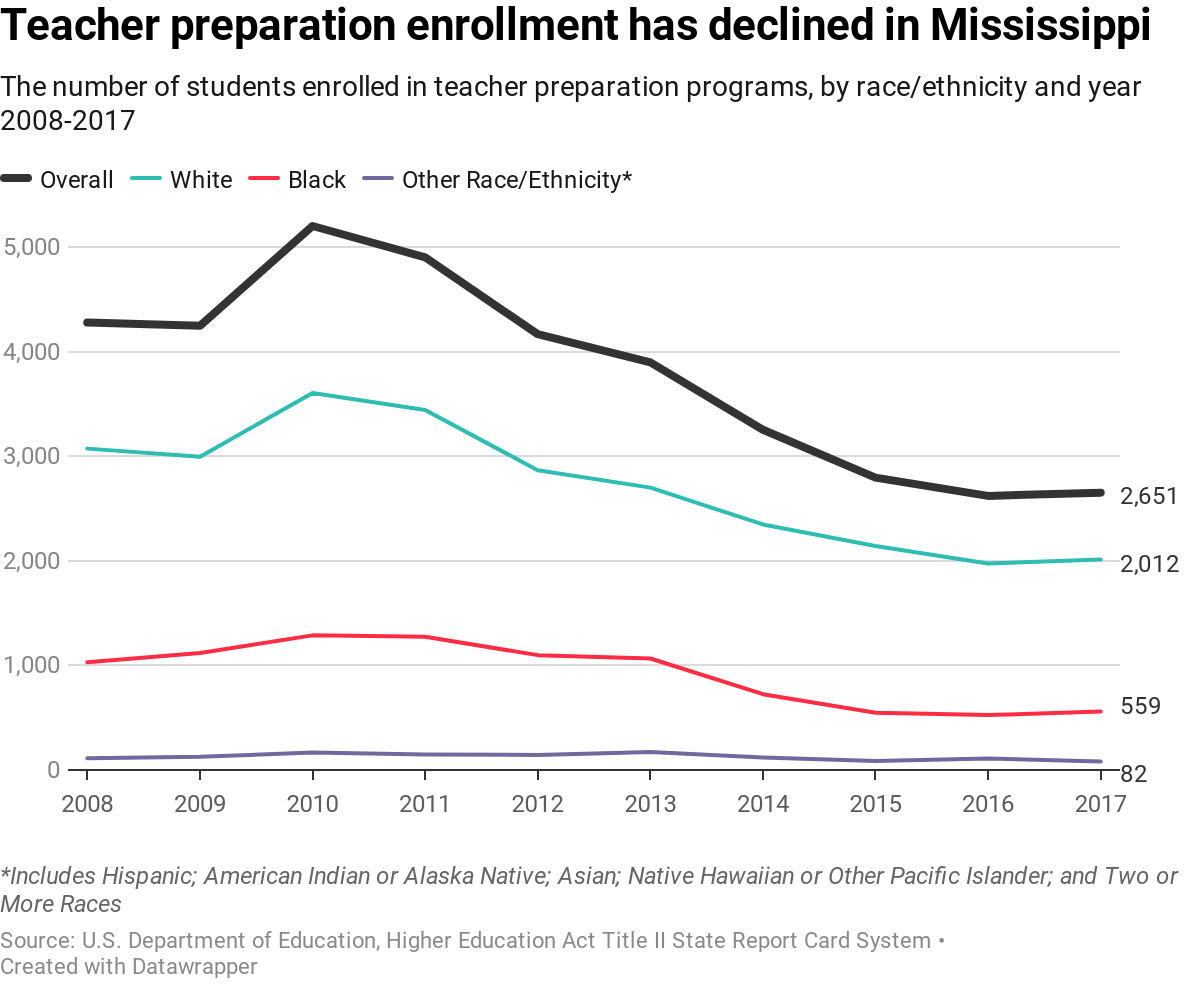
Across Mississippi, the majority of school districts are facing teacher shortages. The scope of this problem was documented across a three-part series by the Hechinger Report and Mississippi Today.1 That series noted sharp enrollment declines in teacher preparation programs—between 2011 and 2016 enrollment in teacher prep programs across the state dropped from over 5,000 students to 2,795—and little action by state legislators to address the issue.2 The state has also seen a nearly 50 percent decline in the number of initial teacher licenses issued between 2011 and 2018 (from 3,626 to 1,624).3
And while the cost of college attendance has risen, teacher salaries have remained relatively flat4 and low.5 These challenges are most acute in the Mississippi Delta, which a 2017 Mississippi State University study describes as “a nexus of poverty, isolation, and teacher shortage.”6 Of the 1,067 teacher vacancies reported in the state in 2018, close to half were in the Delta.7

Quitman County is an agrarian community located in the Mississippi Delta, flat and fertile land that lies between the Yazoo and Mississippi Rivers in the northwest part of the state. Fifty years after the Reverend Martin Luther King, Jr. led the Poor People’s Campaign from its county seat, Quitman County and its schools remain mostly poor and segregated. The school district enrolls 973 students across grades PreK–12, nearly all of whom (97 percent) are Black, and just over 50 percent of students live below the poverty line. Close to one-third of teachers in the district have a provisional license8 (a temporary license issued to teachers who have not met the requirements for a full license).9
Evelyn Jossell, superintendent of Quitman County School District, has experienced the challenges of attracting and retaining teachers to this area firsthand. “When I became superintendent, we had 30 vacancies at the end of the school term. Many teachers were not fully licensed and needed to pass the Praxis exam,” she told us.10
The Mississippi Department of Education (MDE) is helping to coordinate and lead three overlapping initiatives aimed at increasing teachers in the state by removing barriers to entry and providing support along the way: Grow Your Own (GYO) programs to develop local teachers, a state-run teacher residency program, and a pilot program exploring the possibility for teachers to earn a license based on their performance in the classroom.11 State Superintendent Carey Wright has framed this work as “part of a statewide strategy to diversify the teacher pipeline and ensure that all students have access to teachers who are well-prepared, appropriately licensed and serve as role models for success.”12
Profiled below, these initiatives individually serve as ways to bolster Mississippi’s teacher workforce. Collectively, they represent a collaborative approach to solving shortages and increasing teacher diversity that provides lessons for other states.
In a time of localized teacher shortages,13 declining interest in teaching,14 and calls to diversify the educator workforce,15 states across the country are innovating to transform teacher recruitment, preparation, and hiring. Mississippi stands out for taking a wide-reaching and creative approach to addressing critical shortages, including in the Delta.
Citations
- To read the full series, see https://mississippitoday.org/category/teacher-shortage/
- Aallyah Wright and Kelsey Davis, “After Years of Inaction, Delta Teacher Shortage Reaches ‘Crisis’ Levels,” Mississippi Today, February 18, 2019, https://mississippitoday.org/2019/02/18/after-years-of-inaction-delta-teacher-shortage-reaches-crisis-levels/
- Bracey Harris, “Mississippi’s Teacher Shortage: What We Know,” Clarion Ledger, January 30, 2019, https://www.clarionledger.com/story/news/politics/2019/01/30/mississippis-teacher-shortage-what-know/2709460002/
- Telephone interview with Rachel Canter, (executive director, Mississippi First) February 10, 2020.
- Starting teacher salaries range from $35,890 to $40,608. See Mississippi Department of Education, 2019-–2020 Salary Schedule, https://www.mdek12.org/sites/default/files/documents/OSF/TeacherSalarySchedule/salary-schedule-2019-2020.pdf
- Kenneth V. Anthony, Dana Franz, and Devon Brenner, “Understanding the Nature of Teacher Shortage in Mississippi,” Mississippi Economic Review 1 (2017): 24–31. http://www.mississippi.edu/urc/downloads/mer_volume1.pdf
- Mississippi Grow-Your-Own Teacher Task Force Report (Jackson: Mississippi Department of Education, 2019), https://www.mdek12.org/sites/default/files/Offices/MDE/OA/OTL/Teacher%20Center/mde_gyo_report_07.pdf
- Usage of the terms provisional and temporary vary by state. State by state licensure terms detailed here: https://s3.amazonaws.com/newamericadotorg/documents/Data_Supplement_Rethinking_Relicensure_FINAL.pdf
- Guidelines for Mississippi Educator Licensure K–12 (Jackson: Mississippi Department of Education, February 2020), https://www.mdek12.org/sites/default/files/Offices/MDE/OA/OTL/Teacher%20Center/guidelines_for_mississippi_educator_licensure_k-12_february_2020.pdf#page=39
- Interview with Evelyn Jossell, Jackson, MS, January 27, 2020.
- The terms "grow-your-own" and "teacher residency" are used for a variety of different approaches to preparing candidates to be fully-licensed teachers. Outside of the definition of teacher residencies for the Teacher Quality Partnership competitive grant program outlined in the federal Higher Education Act, there aren't nationally-agreed-upon definitions. Therefore, Mississippi’s chosen nomenclature for these specific models may not reflect that of other states or local education agencies
- Mississippi Department of Education, “MDE to Prepare Educators through Teacher-Residency and Performance-Based Licensure Pilot Programs,” News Release, October 31, 2018, https://www.mdek12.org/ocgr/news/2018/10/31/MDE-to-Prepare-Educators-for-Underserved-Students-through-Teacher-Residency-and-Performance-Based-Licensure-Pilot-Programs
- Jenny Muñiz, “States Consider Financial Incentives to Mitigate Teacher Shortages—But Will They Work?” EdCentral (blog), New America, October 3, 2018, https://www.newamerica.org/education-policy/edcentral/states-consider-financial-incentives-to-mitigate-teacher-shortagesbut-will-they-work/
- Lisette Partelow, What to Make of Declining Enrollment in Teacher Preparation Programs, (Washington, DC: Center for American Progress, 2019), https://www.americanprogress.org/issues/education-k-12/reports/2019/12/03/477311/make-declining-enrollment-teacher-preparation-programs/
- Roxanne Garza, “The Demographic Mismatch Between Students and Teachers Continues to Grow, Despite Increases in Teacher Diversity,” EdCentral (blog), New America, December 13, 2018, https://www.newamerica.org/education-policy/edcentral/demographic-mismatch-between-students-and-teachers-continues-grow-despite-rise-teacher-diversity/
Growing Their Own: Homegrown Solutions to Teacher Shortages
In 2016, the department of education at Mississippi State University-Meridian (MSU) faced a lack of students interested in majoring in elementary education. Nationally, shortages of elementary teachers are less common compared to other subject areas, with only 13 states and the District of Columbia reporting a shortage of elementary teachers in the 2017–18 school year.16 At the same time, many districts in the state were dealing with acute teacher shortages and looking for new approaches to developing the teachers they so desperately needed.
MSU-Meridian turned to partnerships with local districts to recruit and prepare paraeducators to become licensed teachers. The idea was driven by research demonstrating that paraeducators have significant instructional experience, linguistic and cultural competence, connections to the communities where they work, and higher rates of retention once they become licensed teachers.17
Developed by former head of the Division of Education Susie Burroughs and now run by assistant professor Jeff Leffler, the Professional Advancement Network for Teacher Assistants (PANTA) program targets paraeducators who are near completing or already have an associate degree and aims to increase access to the elementary education program at MSU-Meridian. To that end, the admissions process is tailored to each individual student. Leffler and his colleagues review each applicant’s transcript and devise a personalized plan that outlines any prerequisites and testing requirements (including test prep courses) he or she needs to complete.
Courses are offered through a modified hybrid approach that uses both online and in-person meetings. Program faculty devised a system for helping students take four classes a semester but only requiring them to come to campus one evening a week. Leffler described this as a “stacking” process whereby two classes are offered at the same time but alternate between in-person and online meetings. “The first class meeting is split between the two classes so [instructors] can do their overview and then the classes alternate live meetings for the rest of the semester. We adjusted the schedule to where we could schedule a class from 4:00 to 6:30, and a second class from 6:45 to 9:15,” said Leffler. These modifications were necessary given that PANTA participants are working full time and have family obligations. In addition, many program participants can complete their field experience in the classrooms they are already working in.
Quitman County School District has also turned to Grow Your Own (GYO) programs, which recruit and prepare educators from the community who are invested in staying in the community. “Our GYO work arose out of desperation,” said Jossell.18 In 2016, in partnership with William Carey University, a private institution located in the southeastern part of the state, the district launched an alternate route program for individuals who already held a bachelor’s degree. The university was a natural partner given that it had experience running alternate route programs and experience working with districts across the state. Quitman’s prospective teachers enrolled in the university’s Art of Teaching program, which requires that participants take and pass two courses (Classroom Management and Tests, Measurements and Evaluation) before applying for an initial license. These two courses were offered locally over the summer so that teachers could begin working that fall while completing the rest of their coursework online. While the program does provide a fast track into the classroom, participants are required to eventually pass required licensure exams; the district offers mentoring and support to help ensure teachers are able to do so.
PANTA and the program in Quitman County are just two examples of how Grow Your Own programs are being leveraged in Mississippi to ease teacher shortages. While GYO programs like PANTA and the Art of Teaching are local initiatives, the state is working to boost these efforts.19
Last year, the Mississippi Department of Education launched a GYO task force composed of stakeholders representing school districts, higher education, philanthropy, and business. As task force member Ben Burnett, dean of the School of Education at William Carey University, said, “our charge was to just ignite the idea and to start that culture throughout the state because it's going to take years for these ideas to come to practice.”20 These ideas culminated in a report that outlined key policy issues and solutions for how GYO could expand throughout the state.21
The task force offered recommendations for promoting GYO in three areas: high school teacher academies, paraeducator and classified staff pathways, and community colleges and postsecondary institutions. Previously, high school pathways were hampered by strict regulations on the credentials necessary to teach these courses but the MDE is currently proposing alternatives based on educator experience so that these programs might be implemented widely. The task force recommended that licensure regulations be amended and that Teacher Academies be designed to offer two pathways, one through career and technical education, where students can earn the credentials necessary to work in child care centers or as paraeducators; and another that would allow students to earn college credit via dual enrollment. Recommendations for tuition assistance and program flexibility in educator preparation programs would allow paraeducators to continue working while earning their teaching degrees. The task force recommended differential tuition rates for education majors and articulation agreements between Teacher Academy programs, community colleges, and education preparation programs to increase resources for programs and activities aiming to address teacher shortages.
What remains to be seen is whether these recommendations will be embraced by state lawmakers. In the 2019 legislative session, 19 teacher shortage bills were introduced and none of them passed,22 although the state did increase teacher pay by $1,500 and allocate $500,000 for forgivable loans for teachers working in shortage districts. This year, a bill to give teachers a $1,000 raise was passed out of committee in the senate and forwarded on to the house, but ended up not getting any traction.23 Similarly, a bill that would have revised the admissions requirements for educator preparation programs to help increase access also failed to get passed.24
Meanwhile, school districts like Quitman are not waiting for state lawmakers to act. They are using local and federal funds to develop strategies and approaches to recruiting, preparing, and ultimately retaining homegrown teachers.
For Jossell, the district’s investment in GYO is helping to create more continuity for students who have seen teachers come and go every couple of years by providing a pathway into the profession for teachers who are invested in staying there. Indeed, a handful of studies suggest that teachers prepared through GYO have higher rates of retention.25 She is also hopeful that these homegrown teachers will help the district sustain its upward momentum. Since 2016 its rating in the state accountability system has gone from an F to a C, with one school being rated as an A. “Teachers who came through GYO have bought into the vision,” she said.26
Citations
- To read the full series, see https://mississippitoday.org/category/teacher-shortage/
- Aallyah Wright and Kelsey Davis, “After Years of Inaction, Delta Teacher Shortage Reaches ‘Crisis’ Levels,” Mississippi Today, February 18, 2019, https://mississippitoday.org/2019/02/18/after-years-of-inaction-delta-teacher-shortage-reaches-crisis-levels/
- Bracey Harris, “Mississippi’s Teacher Shortage: What We Know,” Clarion Ledger, January 30, 2019, https://www.clarionledger.com/story/news/politics/2019/01/30/mississippis-teacher-shortage-what-know/2709460002/
- Telephone interview with Rachel Canter, (executive director, Mississippi First) February 10, 2020.
- Starting teacher salaries range from $35,890 to $40,608. See Mississippi Department of Education, 2019-–2020 Salary Schedule, https://www.mdek12.org/sites/default/files/documents/OSF/TeacherSalarySchedule/salary-schedule-2019-2020.pdf
- Kenneth V. Anthony, Dana Franz, and Devon Brenner, “Understanding the Nature of Teacher Shortage in Mississippi,” Mississippi Economic Review 1 (2017): 24–31. http://www.mississippi.edu/urc/downloads/mer_volume1.pdf
- Mississippi Grow-Your-Own Teacher Task Force Report (Jackson: Mississippi Department of Education, 2019), https://www.mdek12.org/sites/default/files/Offices/MDE/OA/OTL/Teacher%20Center/mde_gyo_report_07.pdf
- Usage of the terms provisional and temporary vary by state. State by state licensure terms detailed here: https://s3.amazonaws.com/newamericadotorg/documents/Data_Supplement_Rethinking_Relicensure_FINAL.pdf
- Guidelines for Mississippi Educator Licensure K–12 (Jackson: Mississippi Department of Education, February 2020), https://www.mdek12.org/sites/default/files/Offices/MDE/OA/OTL/Teacher%20Center/guidelines_for_mississippi_educator_licensure_k-12_february_2020.pdf#page=39
- Interview with Evelyn Jossell, Jackson, MS, January 27, 2020.
- The terms "grow-your-own" and "teacher residency" are used for a variety of different approaches to preparing candidates to be fully-licensed teachers. Outside of the definition of teacher residencies for the Teacher Quality Partnership competitive grant program outlined in the federal Higher Education Act, there aren't nationally-agreed-upon definitions. Therefore, Mississippi’s chosen nomenclature for these specific models may not reflect that of other states or local education agencies
- Mississippi Department of Education, “MDE to Prepare Educators through Teacher-Residency and Performance-Based Licensure Pilot Programs,” News Release, October 31, 2018, https://www.mdek12.org/ocgr/news/2018/10/31/MDE-to-Prepare-Educators-for-Underserved-Students-through-Teacher-Residency-and-Performance-Based-Licensure-Pilot-Programs
- Jenny Muñiz, “States Consider Financial Incentives to Mitigate Teacher Shortages—But Will They Work?” EdCentral (blog), New America, October 3, 2018, https://www.newamerica.org/education-policy/edcentral/states-consider-financial-incentives-to-mitigate-teacher-shortagesbut-will-they-work/
- Lisette Partelow, What to Make of Declining Enrollment in Teacher Preparation Programs, (Washington, DC: Center for American Progress, 2019), https://www.americanprogress.org/issues/education-k-12/reports/2019/12/03/477311/make-declining-enrollment-teacher-preparation-programs/
- Roxanne Garza, “The Demographic Mismatch Between Students and Teachers Continues to Grow, Despite Increases in Teacher Diversity,” EdCentral (blog), New America, December 13, 2018, https://www.newamerica.org/education-policy/edcentral/demographic-mismatch-between-students-and-teachers-continues-grow-despite-rise-teacher-diversity/
- Freddie Cross, Teacher Shortage Areas: Nationwide Listing 1990–1991 through 2017–2018 (Washington, DC: U.S. Department of Education, June 2017), https://www2.ed.gov/about/offices/list/ope/pol/bteachershortageareasreport201718.pdf
- Conor P. Williams, Amaya Garcia, Kaylan Connally, Shayna Cook, and Kim Dancy, Multilingual Paraprofessionals: An Untapped Resource for Supporting American Pluralism (Washington, DC: New America, 2016); Amaya Garcia, Building a Bilingual Teacher Pipeline: Bilingual Teacher Fellows at Highline Public Schools (Washington, DC: New America, 2017); and Conra D. Gist, Margarita Bianco, and Marvin Lynn, “Examining Grow Your Own Programs Across the Teacher Development Continuum: Mining Research on Teachers of Color and NontraditionalEducator Pipelines,” Journal of Teacher Education 70, no. 1 (2019): 13–25.
- Interview, Jackson, MS, January 27, 2020.
- For more, see Mississippi Department of Education (website), “Mississippi’s Grow-Your-Own Teacher Initiative,” https://www.mdek12.org/OETA/Mississippis-Grow-Your-Own-Teacher-Initiative
- Interview with Ben Burnett, Jackson, MS, January 27, 2020.
- Mississippi Grow-Your-Own Teacher Task Force Report.
- Kelsey Davis, Aallyah Wright, Kayleigh Skinner, “With Teacher Shortage at All-time High, Legislature Passes No Bills to Address Issue Plaguing Districts,” Mississippi Today, April 2, 2019, https://mississippitoday.org/2019/04/02/with-teacher-shortage-at-all-time-high-legislature-passes-no-bills-to-address-issue-plaguing-districts/
- Mississippi Legislature, Senate Bill No. 2001, http://billstatus.ls.state.ms.us/documents/2020/pdf/SB/2001-2099/SB2001IN.pdf
- Mississippi Legislature, House Bill No. 994, http://billstatus.ls.state.ms.us/documents/2020/pdf/HB/0900-0999/HB0994PS.pdf
- For a review of these studies, see Conra D. Gist, Margarita Bianco, and Marvin Lynn, “Examining Grow Your Own Programs Across the Teacher Development Continuum: Mining Research on Teachers of Color and NontraditionalEducator Pipelines,” Journal of Teacher Education 70, no. 1 (2019): 13–25.
- Interview.
Mississippi Teacher Residency: Enhancing Teacher Preparation
In addition to widespread teacher shortages, a lack of teacher diversity is a core concern in Mississippi. Tackling this problem is a critical part of the state’s efforts to improve the learning experiences of students of color, who represent almost half of the students enrolled in public schools.27 Indeed, a recent state report contends that teachers of color could help address disparities in graduation rates, attendance, and advanced-level course participation, among other areas.28 Mississippi’s goal is to increase the number of teachers of color from 27 percent to 32 percent by 2025. And leaders intend to focus efforts on recruiting male teachers of color, who currently make up only 6 percent of all teachers in the state.29
To help meet these ambitious goals, state leaders have turned to residency programs. In 2018, the Mississippi Department of Education secured $4.1 million in philanthropic support to expand and diversify their teacher pipeline. These funds helped to jumpstart the Mississippi Teacher Residency (MTR), a pilot program that aims to recruit, train, and place over 100 new teachers through the residency model over three years.30
In Mississippi, teacher residencies are a pathway to certification that blends two years of coursework, mentorship, and in-classroom experience.31 While most residency programs help candidates earn a master’s degree, the MTR program is an undergraduate program open to prospective teachers with an associate degree or roughly two years of credit toward a degree program. During the two years of the program, MTR residents divide their time between bachelor’s level coursework and at least 15 hours per week of on-the-job training where they gradually take on more responsibilities in a classroom under the supervision of a mentor teacher. Upon completing the program, residents must commit to teach for at least three years in their residency district.
A hallmark of the residency model is an active partnership between a school district and a university. In Mississippi, each of three universities—spanning urban and rural areas—received a three-year grant from MDE to deploy this model in concert with a district. Pilot partners include William Carey University, working with Ocean Springs and Gulfport public school districts; Mississippi State University-Meridian, working with Jackson Public School District; and Delta State University, working with the Sunflower County Consolidated School District.32 Beginning in the fall of 2019, each university partners will enroll three consecutive cohorts of 12 residents each, or 36 candidates total.
While small, the MTR pilot is selective and in demand. Program applicants must answer application questions, submit a resume and Praxis scores, and undergo panel interviews with district leaders, teachers, university professors, and MDE staff. Still, the first pool of applicants exceeded 300.33 A range of generous financial and academic supports contribute to the program’s appeal: residents receive full tuition scholarships, one-on-one teacher mentors, ongoing professional development, licensure examination preparation support, and testing vouchers to cover the cost of exams.
The first MTR cohort already shows promise for helping to diversity Mississippi’s teaching workforce. Seventy-six percent of residents in this cohort identify as people of color, compared to 27 percent of the state’s teaching workforce today.34 Residency programs have a track record of bringing greater racial diversity into the workforce: nationally, they enrolled 45 percent candidates of color in 2015–16, compared to the 19 percent national average of teachers of color entering the profession.35
Evidence also backs the residency model as a strategy for producing high-quality teachers who stay in the profession. One recent nationwide analysis by the Learning Policy Institute found that 82 percent of residents were still teaching four years after completing their program, a rate 10 percent higher than their non-residency counterparts.36 Other research shows that school leaders believe residents are more effective than other new teachers.37 And, while fewer studies have gauged the impact of residencies on student achievement, early evidence shows that former residents have a positive impact on students’ scores on statewide assessments.38
Partly, these outcomes have been credited to the careful combination of high-quality coursework and guided clinical experience that the residency model requires. Traditional preparation pathways have been criticized for offering limited field experiences that are disconnected from coursework, while alternative pathways have been critiqued for offering field experiences that are not only sporadic and disconnected but also unsupervised.39 In contrast, beginning in their first year, the MTR program requires candidates to complete a minimum of 15 hours clinical experience each week, where they have opportunities to practice and demonstrate what they are learning under the close supervision of experienced mentors who have been identified by their districts as effective and high-quality.
To be sure, achieving this balance of clinical experience, coursework, and mentorship can be logistically challenging. Residents at MSU-Meridian work as full-time teaching assistants at Jackson Public Schools so they easily exceed the program’s 15 hours per week in-service requirement. Still, Leffler said the program had to arrange for residents to participate in five hours of observation, five hours of mentoring, and five hours of small group instruction each week. Additionally, the program had to ensure that the course load was feasible in light of mentoring requirements and a 40-hour-per-week work arrangement. Residents complete less coursework in year two but get more responsibilities in the classroom, as they gradually transition from providing small group instruction to co-teaching with their mentor teacher.40
Program leaders have also had to ensure that coursework and mentoring was integrated into the field experience. “Anything we're teaching and modeling in the classroom—they should have a practical application of it in the field experience component, because ultimately engaging as a teacher is what's going to make them ready when they finish the program,” said Leffler.
The National Center for Teacher Residencies (NCTR), which has been providing support to teacher residency programs since 2007, has been a major player in launching the MTR pilot program. To that end, NCTR is providing MDE and participating universities with guidance and support to refine their residency models to meet their needs and context.41 Through a series of multi-day retreats, call check-ins, and site visits (which allow partners to visit exemplary residency sites), NCTR has helped MTR partners strengthen their understanding of essential elements of high-quality residencies in the areas of financial sustainability, candidate recruitment and selection, partnerships, high-quality curriculum, and more.42
Residency programs are usually developed at the local level,43 occasionally with state-level financial support.44 As a result, states often feature a patchwork of independent programs. MTR programs, on the other hand, resemble more of a network. Keilani Goggins, an associate director at NCTR who provides technical assistance to Mississippi, said that the unique state-lead nature of MTR has offered residency programs a rare opportunity to “come together and talk across the table.” Programs have in-person check-ins where, among other things, they help each other solve problems of practice. Participating universities also know who to reach out to at MDE or NCTR for support. “Having a centralized hub in order to disseminate information can be valuable,” Goggins said.
To make the state-led initiative run smoothly, residents, universities, districts, and MDE have agreed to fulfill a clear set of commitments.45 Crucially, MDE has committed to support candidate selection, provide costs for professional development, tuition, books, and testing, and support residents in the credentialing process. It has also served as the connective tissue between the programs and NCTR.
Additionally, state leaders are collecting data to evaluate and refine their residency model. The state hopes the pilot will help to clarify “the connection between a high-quality residency and future teacher effectiveness,” said Courtney Van Cleve, Director of Innovative Programs at the MDE. Van Cleve says Mississippi also aims to refine its residency model so that it is ready to scale key insights across the state, provided their evaluation finds that teacher residency is an effective pathway into the profession. Their goal is that more district and university partnerships across the state have opportunities to run their own residencies.
Before the grant ends, developing a model for funding will be critical to expanding the MTR pilot. If evaluation shows positive results, MDE can push for legislative funding. Another strategy is to promote cost-sharing. According to Tabitha Grossman, director of development and partnerships at NCTR, putting thoughtful effort into sharing costs has long helped stakeholders forge lasting, mutually beneficial partnerships. “One of the hallmarks of a really strong residency is when the district and the IHE are sharing financial responsibility,” said Grossman. “When you’re willing to share costs, it sends a really strong message in a partnership that you are committed.”
MTR offers a useful lesson for others seeking to adopt the residency model: it takes investments and commitments from all players—from state to district to university—to create sustainable, high-quality programs that help prepare a high-quality and representative teaching workforce.
Citations
- To read the full series, see https://mississippitoday.org/category/teacher-shortage/
- Aallyah Wright and Kelsey Davis, “After Years of Inaction, Delta Teacher Shortage Reaches ‘Crisis’ Levels,” Mississippi Today, February 18, 2019, https://mississippitoday.org/2019/02/18/after-years-of-inaction-delta-teacher-shortage-reaches-crisis-levels/
- Bracey Harris, “Mississippi’s Teacher Shortage: What We Know,” Clarion Ledger, January 30, 2019, https://www.clarionledger.com/story/news/politics/2019/01/30/mississippis-teacher-shortage-what-know/2709460002/
- Telephone interview with Rachel Canter, (executive director, Mississippi First) February 10, 2020.
- Starting teacher salaries range from $35,890 to $40,608. See Mississippi Department of Education, 2019-–2020 Salary Schedule, https://www.mdek12.org/sites/default/files/documents/OSF/TeacherSalarySchedule/salary-schedule-2019-2020.pdf
- Kenneth V. Anthony, Dana Franz, and Devon Brenner, “Understanding the Nature of Teacher Shortage in Mississippi,” Mississippi Economic Review 1 (2017): 24–31. http://www.mississippi.edu/urc/downloads/mer_volume1.pdf
- Mississippi Grow-Your-Own Teacher Task Force Report (Jackson: Mississippi Department of Education, 2019), https://www.mdek12.org/sites/default/files/Offices/MDE/OA/OTL/Teacher%20Center/mde_gyo_report_07.pdf
- Usage of the terms provisional and temporary vary by state. State by state licensure terms detailed here: https://s3.amazonaws.com/newamericadotorg/documents/Data_Supplement_Rethinking_Relicensure_FINAL.pdf
- Guidelines for Mississippi Educator Licensure K–12 (Jackson: Mississippi Department of Education, February 2020), https://www.mdek12.org/sites/default/files/Offices/MDE/OA/OTL/Teacher%20Center/guidelines_for_mississippi_educator_licensure_k-12_february_2020.pdf#page=39
- Interview with Evelyn Jossell, Jackson, MS, January 27, 2020.
- The terms "grow-your-own" and "teacher residency" are used for a variety of different approaches to preparing candidates to be fully-licensed teachers. Outside of the definition of teacher residencies for the Teacher Quality Partnership competitive grant program outlined in the federal Higher Education Act, there aren't nationally-agreed-upon definitions. Therefore, Mississippi’s chosen nomenclature for these specific models may not reflect that of other states or local education agencies
- Mississippi Department of Education, “MDE to Prepare Educators through Teacher-Residency and Performance-Based Licensure Pilot Programs,” News Release, October 31, 2018, https://www.mdek12.org/ocgr/news/2018/10/31/MDE-to-Prepare-Educators-for-Underserved-Students-through-Teacher-Residency-and-Performance-Based-Licensure-Pilot-Programs
- Jenny Muñiz, “States Consider Financial Incentives to Mitigate Teacher Shortages—But Will They Work?” EdCentral (blog), New America, October 3, 2018, https://www.newamerica.org/education-policy/edcentral/states-consider-financial-incentives-to-mitigate-teacher-shortagesbut-will-they-work/
- Lisette Partelow, What to Make of Declining Enrollment in Teacher Preparation Programs, (Washington, DC: Center for American Progress, 2019), https://www.americanprogress.org/issues/education-k-12/reports/2019/12/03/477311/make-declining-enrollment-teacher-preparation-programs/
- Roxanne Garza, “The Demographic Mismatch Between Students and Teachers Continues to Grow, Despite Increases in Teacher Diversity,” EdCentral (blog), New America, December 13, 2018, https://www.newamerica.org/education-policy/edcentral/demographic-mismatch-between-students-and-teachers-continues-grow-despite-rise-teacher-diversity/
- Freddie Cross, Teacher Shortage Areas: Nationwide Listing 1990–1991 through 2017–2018 (Washington, DC: U.S. Department of Education, June 2017), https://www2.ed.gov/about/offices/list/ope/pol/bteachershortageareasreport201718.pdf
- Conor P. Williams, Amaya Garcia, Kaylan Connally, Shayna Cook, and Kim Dancy, Multilingual Paraprofessionals: An Untapped Resource for Supporting American Pluralism (Washington, DC: New America, 2016); Amaya Garcia, Building a Bilingual Teacher Pipeline: Bilingual Teacher Fellows at Highline Public Schools (Washington, DC: New America, 2017); and Conra D. Gist, Margarita Bianco, and Marvin Lynn, “Examining Grow Your Own Programs Across the Teacher Development Continuum: Mining Research on Teachers of Color and NontraditionalEducator Pipelines,” Journal of Teacher Education 70, no. 1 (2019): 13–25.
- Interview, Jackson, MS, January 27, 2020.
- For more, see Mississippi Department of Education (website), “Mississippi’s Grow-Your-Own Teacher Initiative,” https://www.mdek12.org/OETA/Mississippis-Grow-Your-Own-Teacher-Initiative
- Interview with Ben Burnett, Jackson, MS, January 27, 2020.
- Mississippi Grow-Your-Own Teacher Task Force Report.
- Kelsey Davis, Aallyah Wright, Kayleigh Skinner, “With Teacher Shortage at All-time High, Legislature Passes No Bills to Address Issue Plaguing Districts,” Mississippi Today, April 2, 2019, https://mississippitoday.org/2019/04/02/with-teacher-shortage-at-all-time-high-legislature-passes-no-bills-to-address-issue-plaguing-districts/
- Mississippi Legislature, Senate Bill No. 2001, http://billstatus.ls.state.ms.us/documents/2020/pdf/SB/2001-2099/SB2001IN.pdf
- Mississippi Legislature, House Bill No. 994, http://billstatus.ls.state.ms.us/documents/2020/pdf/HB/0900-0999/HB0994PS.pdf
- For a review of these studies, see Conra D. Gist, Margarita Bianco, and Marvin Lynn, “Examining Grow Your Own Programs Across the Teacher Development Continuum: Mining Research on Teachers of Color and NontraditionalEducator Pipelines,” Journal of Teacher Education 70, no. 1 (2019): 13–25.
- Interview.
- Mississippi Grow-Your-Own Teacher Task Force Report.
- Mississippi Grow-Your-Own Teacher Task Force Report.
- Mississippi Department of Education, “Minority Male Educators Convene to Discuss Role in Impacting Student Outcomes,” news release, August 21, 2018, https://www.mdek12.org/ocgr/news/2018/08/21/Minority-Male-Educators-Convene-to-Discuss-Role-in-Impacting-Student-Outcomes
- Mississippi Department of Education (website), “Mississippi Teacher Residency,” https://www.mdek12.org/OTL/MTR
- National Center for Teacher Residencies (website), “About: The Residency Model,” https://nctresidencies.org/about/residency-model-teacher-mentor-programs/
- Delta State University, “Delta State University Earns Three-Year $600,000 Grant to Train Elementary Schoolteachers for Sunflower County,” news release, July 16, 2019, http://www.deltastate.edu/news-and-events/2019/07/delta-state-university-earns-three-year-600000-grant-to-train-elementary-schoolteachers-for-sunflower-county/; and William Carey University, “WCU Pilots New ‘Teacher Residency’ Program,” news release, July 3, 2019, https://wmcarey.edu/news/2019-07-03/wcu-pilots-new-teacher-residency-program
- Mississippi Department of Education, “The National Center for Teacher Residencies, Mississippi to Develop the Nation’s First State-Operated Teacher Residency,” news release, April 30, 2019, https://www.mdek12.org/news/2019/4/30/The-National-Center-for-Teacher-Residencies-Mississippi-to-Develop-the-Nations-First-State-Operated-Teacher-Residency_20190430
- Kaleigh Skinner, “Who’s Teaching Mississippi’s Children? A Deep Dive into Race, Gender of State’s Educators,” Mississippi Today, September 6, 2019, https://www.chicagomanualofstyle.org/book/ed17/part3/ch15/psec049.html
- Roneeta Guha, Maria E. Hyler, and Linda Darling-Hammond, Teacher Residencies: Building a High-Quality, Sustainable Workforce (Palo Alto, CA: Learning Policy Institute, 2016), https://learningpolicyinstitute.org/sites/default/files/product-files/Teacher_Residency_Innovative_Model_Preparing_Teachers_REPORT.pdf
- Guha, Hyler, and Darling-Hammond, Teacher Residences.
- Roneeta Guha, Maria E. Hyler, and Linda Darling-Hammond, "The Power and Potential of Teacher Residencies," Phi Delta Kappan 98 (2017): 31–37, https://www.pdkmembers.org/members_online/publications/archive/pdf/PDK_98_8/31pdk_98_8.pdf
- Guha, Hyler, and Darling-Hammond, “The Power and Potential.”
- Roneeta Guha, Maria E. Hyler, and Linda Darling-Hammond, "The Teacher Residency: A Practical Path to Recruitment and Retention," American Educator 41 (Spring 2017): 31–44, https://files.eric.ed.gov/fulltext/EJ1137804.pdf
- Interview with Jeffrey Leffler.
- The National Center for Teacher Residencies, “The National Center for Teacher Residencies, Mississippi to Develop the Nation’s First State-Operated Teacher Residency,” news release, April 19, 2019, https://nctresidencies.org/wp-content/uploads/2019/04/Mississippi-_-Kellogg-Release-4_11_19-rjr.pdf
- Interview with Keilani Goggins and Tabitha Grossman, March 17, 2020.
- Amaya Garcia and Roxanne Garza, Chicago’s Bilingual Teacher Residency: A Partnership to Strengthen the Teacher Pipeline (Washington, DC: New America, 2019), https://www.newamerica.org/education-policy/reports/chicagos-bilingual-teacher-residency-a-partnership-to-strengthen-the-teacher-pipeline/
- Education Commission of the States (website), “50-State Comparison: Does the State Create Opportunities for Teacher Residency Programs through Statute or Regulation?” October 2019, http://ecs.force.com/mbdata/MBQuest2rtanw?Rep=TRR1907
- Mississippi Department of Education, “Mississippi Teacher Residency 2020 Program Commitments,” https://www.mdek12.org/sites/default/files/Offices/MDE/OA/OTL/Teacher%20Center/2020_mississippi_department_of_education_commitments.pdf
Piloting Performance-Based Licensure to Ease Testing Disparities
A key part of preparing a high-quality workforce is ensuring that all teachers possess a baseline level of knowledge, skills, and competencies. Every state requires that prospective teachers pass a series of exams in order to obtain licensure. In 26 states, including Mississippi, they are also required to pass a basic skills test to be admitted into an educator preparation program.46 Research on the relationship between teacher certification exams and student achievement is mixed.47 But several studies48 have concluded that teacher effectiveness in the classroom is not strongly associated with performance on certification exams.49 Intended to set a high bar for entrance into the profession, these exams have had the unintended consequence of preventing and discouraging entry into teaching. Multiple studies document disparate pass rates between candidates of color and their white peers.50 These discrepancies mean that some candidates have to take tests multiple times, which is a cost burden, and may be another factor that discourages candidates from entering the profession.
Gaps in PreK–12 and postsecondary education are contributing to disparate pass rates on licensure exams in Mississippi. While the state’s PreK–12 education system has made progress in recent years in raising student achievement and closing racial achievement gaps, large inequities remain. As reported in the Hechinger Report, recent data from the National Assessment of Educational Progress show that “white fourth graders were twice as likely to score proficient on their reading test as their black peers. The state’s overall scores also hide deep disparities in its poorest, most isolated districts… and the gulf in academic outcomes is indisputable.”51 In addition, the state ranks near the bottom of all 50 states in terms of early education spending and the percentage of children served, with only 5 percent of four-year-olds enrolled in public preschool.52
Analysis from Mississippi Today notes that gaps in postsecondary education are also contributing to disparate pass rates on licensure exams in the state.53 Using data and research by the National Council for Teacher Quality (NCTQ), the article details how the content offered in elementary education programs is often poorly aligned with the content on licensure exams. In Mississippi, the majority of educator preparation programs studied “require students to take less than half of the classes recommended” by NCTQ to help ensure candidates are able to pass the licensure exam. MDE has started to offer test preparation sessions to help boost passing rates, while a non-profit in the state, Regional Initiatives for Sustainable Education, is also working to help fill these holes by providing tutoring support for the exam.
With 2015’s Every Student Succeeds Act, the federal government eliminated its mandate for licensure exams54 and left it up to states to define and determine the criteria for teacher effectiveness. States have used that flexibility to study gaps in testing outcomes55 and to devise solutions to testing barriers such as eliminating some required exams.56 A handful of states are allowing subject-area teachers to use micro-credentials to demonstrate necessary competencies to attain new teaching endorsements,57 and one state has left the door open for the potential of initial teacher licensure.
Mississippi is taking a novel approach by exploring the potential for teachers to earn licensure based on their impact and effectiveness in the classroom. In the fall of 2019, MDE launched a performance-based licensure (PBL) pilot58 that aims to develop standard licensure policy recommendations for the State Board of Education based on student achievement and evaluation data collected during the three-year study.59 The three-year program is being funded by the same grant as the state’s teacher residency program. (See Box: Changes In Testing Requirements Due to COVID-19)
Changes in Testing Requirements Due to COVID-19
The COVID-19 pandemic has led to temporary changes in Mississippi’s testing policies. In March 2020, the Mississippi State Board of Education suspended the testing requirements for entry into a teacher preparation program and for earning a teaching license through December 2021. Testing centers were closed as part of the state’s response to the public health crisis, rendering it impossible for candidates to take the exam. These changes are not anticipated to have an impact on the state’s PBL pilot.
Currently, school districts are employing a large number of teachers with emergency credentials to fill staffing gaps—nearly 12 percent of teachers working in high-poverty schools.60 Many of these teachers have struggled to pass the state’s teacher licensure exam,61 which has placed them at risk of being pushed out of the profession. Consider: in the summer of 2019, Jackson Public Schools stood to lose over 200 teachers because they had not been able to pass the required Praxis Core exam.62
Courtney Van Cleve, who worked as a principal in Clarksdale before starting at MDE, saw these struggles first hand, “Any number of phenomenal teachers that I encountered in the Delta experienced challenges with licensure exam passage and yet were getting incredible results with their students while leading really positive and culturally affirming classrooms,” she told us.63
Van Cleve’s observation was not a one-off. District stakeholder interviews found that teachers with temporary credentials were both highly experienced and positively impacting student learning, as measured by state and local assessment data. Given these findings, there was urgency at MDE to develop strategies to remove these barriers and expand pathways to licensure. According to Dr. Cory Murphy, Executive Director of the Office of Teaching and Leading at MDE, licensure exams are designed to determine whether someone has gained the knowledge deemed necessary to be able to safely practice in the content area they will be teaching. Yet, given the realities in Mississippi, he wondered whether the current system of relying on exams was the only way to confirm that teachers possess those knowledge and skills.64
In 2018, MDE began holding focus groups and interviews with stakeholders across the state to learn more about the opportunities and barriers facing the teacher workforce. Teacher entry and licensure exams were consistently raised as a barrier, which confirmed the need to create alternate methods for determining the qualifications and skills needed to enter the profession.65 However, creating alternatives does not mean that the state is trying to lower the bar, but rather trying to develop more expansive pathways that still hold candidates to high expectations.
As it was developing the performance-based licensure (PBL) pilot, MDE convened more focus groups with parents, students, teachers, prospective PBL candidates, superintendents, and principals in interested school districts. The goal of these sessions was to go through the different prototypes of PBL and identify elements that worked or that needed to be changed. “We were flexible on the design until we got the model right for districts in Mississippi,” said Van Cleve.66
The three-year PBL pilot includes 73 teachers working in districts across the state. While districts have autonomy to select candidates for the program, the state has set baseline criteria for candidate eligibility. Candidates must have a bachelor’s degree, evidence of their effectiveness in the classroom, and three years of lead teaching experience (e.g., long term substitute or provisional license) or five years of experience as a teaching assistant. In each year of the pilot, PBL districts must submit data showing candidates’ effectiveness and impact on student learning. While standard licensure will be pending policy recommendations for the State Board of Education based on student achievement and evaluation data collected during the study, candidates are offered a teacher salary by their district and the opportunity to engage in intense Praxis and/or ACT assessment preparation sessions. Districts have flexibility to determine what combination of measures they will use to document teacher effectiveness, but it must include a measure of student growth over the year. “There are certain assessments like STAR, MKAS, MAAP and so the districts select whatever product they are utilizing as the measure,” said Murphy.
Amanda Johnson, principal and founder of Clarksdale Collegiate Public Charter School, expressed enthusiasm about the pilot and its potential. She said, “I have one teacher in the program,” working in kindergarten, “who has been teaching for a number of years on an emergency license and she gets our best results.”67 The results used to determine this teacher’s effectiveness include student growth targets on NWEA MAP and on kindergarten readiness assessments from the beginning and end of the year.
In reflecting on the initial phase of the pilot, Van Cleve emphasized the importance of working closely with districts and engaging them as co-creators of the model to ensure that it fits their needs. The pilot has helped affirm the state’s commitment to increasing both teacher diversity and effectiveness. All PBL candidates in the first cohort are Black, compared to only 27 percent of the overall teacher workforce (47 percent of students are Black).
The PBL pilot has already caught the attention of other states who are exploring alternate pathways to licensure, according to staff at MDE. Additionally, Massachusetts’s Commissioner of Education Jeffrey Riley wants to pilot alternative assessments68 to provide teacher candidates with more options for demonstrating the competencies and skills necessary to earn licensure.69 Like in Mississippi, these include comprehensive performance reviews to assess a teacher’s pedagogical knowledge and skills in practice. The proposal would also allow teacher preparation programs to assess a candidate’s subject-matter knowledge and submit documentation to the state department of education.
Citations
- To read the full series, see https://mississippitoday.org/category/teacher-shortage/
- Aallyah Wright and Kelsey Davis, “After Years of Inaction, Delta Teacher Shortage Reaches ‘Crisis’ Levels,” Mississippi Today, February 18, 2019, https://mississippitoday.org/2019/02/18/after-years-of-inaction-delta-teacher-shortage-reaches-crisis-levels/
- Bracey Harris, “Mississippi’s Teacher Shortage: What We Know,” Clarion Ledger, January 30, 2019, https://www.clarionledger.com/story/news/politics/2019/01/30/mississippis-teacher-shortage-what-know/2709460002/
- Telephone interview with Rachel Canter, (executive director, Mississippi First) February 10, 2020.
- Starting teacher salaries range from $35,890 to $40,608. See Mississippi Department of Education, 2019-–2020 Salary Schedule, https://www.mdek12.org/sites/default/files/documents/OSF/TeacherSalarySchedule/salary-schedule-2019-2020.pdf
- Kenneth V. Anthony, Dana Franz, and Devon Brenner, “Understanding the Nature of Teacher Shortage in Mississippi,” Mississippi Economic Review 1 (2017): 24–31. http://www.mississippi.edu/urc/downloads/mer_volume1.pdf
- Mississippi Grow-Your-Own Teacher Task Force Report (Jackson: Mississippi Department of Education, 2019), https://www.mdek12.org/sites/default/files/Offices/MDE/OA/OTL/Teacher%20Center/mde_gyo_report_07.pdf
- Usage of the terms provisional and temporary vary by state. State by state licensure terms detailed here: https://s3.amazonaws.com/newamericadotorg/documents/Data_Supplement_Rethinking_Relicensure_FINAL.pdf
- Guidelines for Mississippi Educator Licensure K–12 (Jackson: Mississippi Department of Education, February 2020), https://www.mdek12.org/sites/default/files/Offices/MDE/OA/OTL/Teacher%20Center/guidelines_for_mississippi_educator_licensure_k-12_february_2020.pdf#page=39
- Interview with Evelyn Jossell, Jackson, MS, January 27, 2020.
- The terms "grow-your-own" and "teacher residency" are used for a variety of different approaches to preparing candidates to be fully-licensed teachers. Outside of the definition of teacher residencies for the Teacher Quality Partnership competitive grant program outlined in the federal Higher Education Act, there aren't nationally-agreed-upon definitions. Therefore, Mississippi’s chosen nomenclature for these specific models may not reflect that of other states or local education agencies
- Mississippi Department of Education, “MDE to Prepare Educators through Teacher-Residency and Performance-Based Licensure Pilot Programs,” News Release, October 31, 2018, https://www.mdek12.org/ocgr/news/2018/10/31/MDE-to-Prepare-Educators-for-Underserved-Students-through-Teacher-Residency-and-Performance-Based-Licensure-Pilot-Programs
- Jenny Muñiz, “States Consider Financial Incentives to Mitigate Teacher Shortages—But Will They Work?” EdCentral (blog), New America, October 3, 2018, https://www.newamerica.org/education-policy/edcentral/states-consider-financial-incentives-to-mitigate-teacher-shortagesbut-will-they-work/
- Lisette Partelow, What to Make of Declining Enrollment in Teacher Preparation Programs, (Washington, DC: Center for American Progress, 2019), https://www.americanprogress.org/issues/education-k-12/reports/2019/12/03/477311/make-declining-enrollment-teacher-preparation-programs/
- Roxanne Garza, “The Demographic Mismatch Between Students and Teachers Continues to Grow, Despite Increases in Teacher Diversity,” EdCentral (blog), New America, December 13, 2018, https://www.newamerica.org/education-policy/edcentral/demographic-mismatch-between-students-and-teachers-continues-grow-despite-rise-teacher-diversity/
- Freddie Cross, Teacher Shortage Areas: Nationwide Listing 1990–1991 through 2017–2018 (Washington, DC: U.S. Department of Education, June 2017), https://www2.ed.gov/about/offices/list/ope/pol/bteachershortageareasreport201718.pdf
- Conor P. Williams, Amaya Garcia, Kaylan Connally, Shayna Cook, and Kim Dancy, Multilingual Paraprofessionals: An Untapped Resource for Supporting American Pluralism (Washington, DC: New America, 2016); Amaya Garcia, Building a Bilingual Teacher Pipeline: Bilingual Teacher Fellows at Highline Public Schools (Washington, DC: New America, 2017); and Conra D. Gist, Margarita Bianco, and Marvin Lynn, “Examining Grow Your Own Programs Across the Teacher Development Continuum: Mining Research on Teachers of Color and NontraditionalEducator Pipelines,” Journal of Teacher Education 70, no. 1 (2019): 13–25.
- Interview, Jackson, MS, January 27, 2020.
- For more, see Mississippi Department of Education (website), “Mississippi’s Grow-Your-Own Teacher Initiative,” https://www.mdek12.org/OETA/Mississippis-Grow-Your-Own-Teacher-Initiative
- Interview with Ben Burnett, Jackson, MS, January 27, 2020.
- Mississippi Grow-Your-Own Teacher Task Force Report.
- Kelsey Davis, Aallyah Wright, Kayleigh Skinner, “With Teacher Shortage at All-time High, Legislature Passes No Bills to Address Issue Plaguing Districts,” Mississippi Today, April 2, 2019, https://mississippitoday.org/2019/04/02/with-teacher-shortage-at-all-time-high-legislature-passes-no-bills-to-address-issue-plaguing-districts/
- Mississippi Legislature, Senate Bill No. 2001, http://billstatus.ls.state.ms.us/documents/2020/pdf/SB/2001-2099/SB2001IN.pdf
- Mississippi Legislature, House Bill No. 994, http://billstatus.ls.state.ms.us/documents/2020/pdf/HB/0900-0999/HB0994PS.pdf
- For a review of these studies, see Conra D. Gist, Margarita Bianco, and Marvin Lynn, “Examining Grow Your Own Programs Across the Teacher Development Continuum: Mining Research on Teachers of Color and NontraditionalEducator Pipelines,” Journal of Teacher Education 70, no. 1 (2019): 13–25.
- Interview.
- Mississippi Grow-Your-Own Teacher Task Force Report.
- Mississippi Grow-Your-Own Teacher Task Force Report.
- Mississippi Department of Education, “Minority Male Educators Convene to Discuss Role in Impacting Student Outcomes,” news release, August 21, 2018, https://www.mdek12.org/ocgr/news/2018/08/21/Minority-Male-Educators-Convene-to-Discuss-Role-in-Impacting-Student-Outcomes
- Mississippi Department of Education (website), “Mississippi Teacher Residency,” https://www.mdek12.org/OTL/MTR
- National Center for Teacher Residencies (website), “About: The Residency Model,” https://nctresidencies.org/about/residency-model-teacher-mentor-programs/
- Delta State University, “Delta State University Earns Three-Year $600,000 Grant to Train Elementary Schoolteachers for Sunflower County,” news release, July 16, 2019, http://www.deltastate.edu/news-and-events/2019/07/delta-state-university-earns-three-year-600000-grant-to-train-elementary-schoolteachers-for-sunflower-county/; and William Carey University, “WCU Pilots New ‘Teacher Residency’ Program,” news release, July 3, 2019, https://wmcarey.edu/news/2019-07-03/wcu-pilots-new-teacher-residency-program
- Mississippi Department of Education, “The National Center for Teacher Residencies, Mississippi to Develop the Nation’s First State-Operated Teacher Residency,” news release, April 30, 2019, https://www.mdek12.org/news/2019/4/30/The-National-Center-for-Teacher-Residencies-Mississippi-to-Develop-the-Nations-First-State-Operated-Teacher-Residency_20190430
- Kaleigh Skinner, “Who’s Teaching Mississippi’s Children? A Deep Dive into Race, Gender of State’s Educators,” Mississippi Today, September 6, 2019, https://www.chicagomanualofstyle.org/book/ed17/part3/ch15/psec049.html
- Roneeta Guha, Maria E. Hyler, and Linda Darling-Hammond, Teacher Residencies: Building a High-Quality, Sustainable Workforce (Palo Alto, CA: Learning Policy Institute, 2016), https://learningpolicyinstitute.org/sites/default/files/product-files/Teacher_Residency_Innovative_Model_Preparing_Teachers_REPORT.pdf
- Guha, Hyler, and Darling-Hammond, Teacher Residences.
- Roneeta Guha, Maria E. Hyler, and Linda Darling-Hammond, "The Power and Potential of Teacher Residencies," Phi Delta Kappan 98 (2017): 31–37, https://www.pdkmembers.org/members_online/publications/archive/pdf/PDK_98_8/31pdk_98_8.pdf
- Guha, Hyler, and Darling-Hammond, “The Power and Potential.”
- Roneeta Guha, Maria E. Hyler, and Linda Darling-Hammond, "The Teacher Residency: A Practical Path to Recruitment and Retention," American Educator 41 (Spring 2017): 31–44, https://files.eric.ed.gov/fulltext/EJ1137804.pdf
- Interview with Jeffrey Leffler.
- The National Center for Teacher Residencies, “The National Center for Teacher Residencies, Mississippi to Develop the Nation’s First State-Operated Teacher Residency,” news release, April 19, 2019, https://nctresidencies.org/wp-content/uploads/2019/04/Mississippi-_-Kellogg-Release-4_11_19-rjr.pdf
- Interview with Keilani Goggins and Tabitha Grossman, March 17, 2020.
- Amaya Garcia and Roxanne Garza, Chicago’s Bilingual Teacher Residency: A Partnership to Strengthen the Teacher Pipeline (Washington, DC: New America, 2019), https://www.newamerica.org/education-policy/reports/chicagos-bilingual-teacher-residency-a-partnership-to-strengthen-the-teacher-pipeline/
- Education Commission of the States (website), “50-State Comparison: Does the State Create Opportunities for Teacher Residency Programs through Statute or Regulation?” October 2019, http://ecs.force.com/mbdata/MBQuest2rtanw?Rep=TRR1907
- Mississippi Department of Education, “Mississippi Teacher Residency 2020 Program Commitments,” https://www.mdek12.org/sites/default/files/Offices/MDE/OA/OTL/Teacher%20Center/2020_mississippi_department_of_education_commitments.pdf
- National Council on Teacher Quality (website), “Program Entry: 2017 General Teacher Preparation Policy,” updated July 2018. https://www.nctq.org/yearbook/national/Program-Entry-81
- Charles T. Clotfelter, Helen F. Ladd, and Jacob L. Vigdor, Teacher Credentials and Student Achievement in High School: A Cross-Subject Analysis with Student Fixed Effects, NBER working paper 13617 (Cambridge, MA: National Bureau of Economic Research, 2007), https://www.nber.org/papers/w13617.pdf
- Jason Greenberg Motamedi, Melinda Leong, and Havala Hanson, Potential Testing Barriers for Teacher Candidates of Color (Portland, OR: Education Northwest, May 2018). https://ies.ed.gov/ncee/edlabs/regions/northwest/pdf/potential-testing-barriers.pdf
- Richard Buddin and Gemma Zemarro, Teacher Quality, Teacher Licensure Tests, and Student Achievement, Education working paper (Santa Monica, CA: RAND, 2008), https://pdfs.semanticscholar.org/b1cf/78514770a3b73926fed44be75515d244e2b3.pdf
- Farah Z. Ahmad and Ulrich Boser, America’s Leaky Pipeline for Teachers of Color: Getting More Teachers of Color into the Classroom (Washington, DC: Center for American Progress, 2014), https://files.eric.ed.gov/fulltext/ED561065.pdf#page=15; and Roxanne Garza, Paving the Way for Latinx Teachers: Recruitment and Preparation to Promote Educator Diversity (Washington, DC: New America, 2019), https://www.newamerica.org/education-policy/reports/paving-way-latinx-teachers/barriers-along-the-pathway-into-teaching/
- Bracey Harris, “‘You Can’t Help but to Wonder’: Crumbling Schools, Less Money, and Dismal Outcomes in the County that was Supposed to Change Everything for Black Children in the South,” Hechinger Report, February 10, 2020, https://hechingerreport.org/you-cant-help-but-to-wonder-crumbling-schools-less-money-and-dismal-outcomes-in-the-county-that-was-supposed-to-change-everything-for-black-children-in-the-south/
- Allison H. Friedman-Krauss, W. Steven Barnett, Karin A. Garver, Katherine S. Hodges, G. G. Weisenfeld, and Beth Ann Gardiner, The State of Preschool 2019 (New Brunswick, NJ: National Institute for Early Education Research, 2020), http://nieer.org/wp-content/uploads/2020/04/YB2019_Full_Report.pdf
- Aallyah Wright, “Would-be Teachers in Mississippi Struggle to Pass Certification Exams, Advocates Call for Evaluation of Prep Programs,” Mississippi Today, April 1, 2019, https://mississippitoday.org/2019/04/01/would-be-teachers-in-mississippi-struggle-to-pass-certification-exams-advocates-call-for-evaluation-of-prep-programs/
- Alyson Klein, “Does ESSA Require Teachers to Be Highly-Qualified?” Education Week, July 16, 2018, http://blogs.edweek.org/edweek/campaign-k-12/2018/07/essa_highly_qualified_teacher_effective_evaluation.html
- For an example, see the work of the Washington State Professional Educator Standards Board, which convened a workgroup to examine the extent of testing barriers and devise solutions, https://www.pesb.wa.gov/innovation-policy/innovation-archive/work-groups/testing-barriers/
- Yana Kunichoff, “Illinois Says Goodbye to the Basic Skills Test, Long a Barrier for Teacher Candidates of Color,” Chalkbeat, August 8, 2019, https://chalkbeat.org/posts/chicago/2019/08/08/illinois-says-goodbye-to-the-basic-skills-test-long-a-barrier-for-teacher-candidates-of-color/
- State policy on educator micro-credentials is relatively new and still evolving. For more details, see Melissa Tooley, “Teacher Micro-credentials: State Considerations for Professional Development and License Renewal,” EdCentral (blog), New America, June 11, 2019, https://www.newamerica.org/education-policy/edcentral/teacher-micro-credentials-state-considerations-professional-development-and-license-renewal/.
- Bracey Harris, “Mississippi Teacher Shortage Sparks a New Change in Licensing Some Educators, Clarion Ledger, November 13, 2018, https://www.clarionledger.com/story/news/politics/2018/11/13/mississippi-nix-licensure-exams-some-educators/1932386002/
- In addition to passing a licensure exam, teacher candidates are also required to have a bachelor’s degree and complete a teacher training program.
- States of Mississippi, 2017 Report Card Data, https://msrc.mdek12.org/downloads/2017/2017ReportCardData.xlsx
- Aallyah Wright, “Would-Be Teachers in Mississippi Struggle to Pass Certification Exams, Advocates Call for Evaluation of Prep Programs,” Mississippi Today, April 1, 2019, https://mississippitoday.org/2019/04/01/would-be-teachers-in-mississippi-struggle-to-pass-certification-exams-advocates-call-for-evaluation-of-prep-programs/
- Phil McCausland, “Mississippi Loses Hundreds of Teachers Due to Licensing Issue, Underscoring National Problem,” NBC News, June 25, 2019, https://www.nbcnews.com/news/us-news/mississippi-loses-hundreds-teachers-due-licensing-issue-underscoring-national-problem-n1020676
- Telephone interview with Courtney Van Cleve, February 14, 2020.
- Interview with Cory Murphy, Jackson, MS, January 28, 2020.
- Teacher candidates are also required to either pass the Praxis Core exam or have an ACT score of 21 (or equivalent score on the SAT) in order to be admitted into a teacher preparation program. The average ACT score in the state is 18 and so this requirement has also been seen as a barrier to entry. Legislation has been proposed to add a minimum GPA of 2.75 on pre-major courses to the list of criteria, as an alternative to the Praxis/ACT/SAT score requirements. The proposed legislation, House Bill No. 994, is here: http://billstatus.ls.state.ms.us/documents/2020/pdf/HB/0900-0999/HB0994PS.pdf
- Interview with Courtney Van Cleve.
- Zoom interview with Amanda Johnson, January 28, 2020.
- James Vaznis, “State Eyes Plan to Improve Diversity Among Teachers,” Boston Globe, January 27, 2020, https://www.bostonglobe.com/metro/2020/01/27/state-eyes-plan-improve-diversity-among-teachers/9AhbFNLZ5rn7JDKrGJLteI/story.html
- To see the full proposal go to Riley’s January 17, 2020 memo to Members of the Board of Elementary and Secondary Education, http://www.doe.mass.edu/bese/docs/fy2020/2020-01/item3.docx
Conclusion and Early Lessons
Over the last few decades, a wide range of factors has exacerbated teacher shortages across Mississippi. It is clear from our research that leaders there understand that solutions to this crisis must be as varied and robust as its causes. State leaders are working to identify and circumvent the various, common barriers candidates face along the path toward becoming a teacher by piloting three initiatives: Grow Your Own programs to develop local teachers, a state-run teacher residency program, and a pilot program exploring the possibility for teachers to earn a license based on their performance. Though still early, these initiatives provide four key lessons that may help other states create opportunities for growing and diversifying a teacher workforce.
Pilot and evaluate initiatives before expansion. In Mississippi, state leadership and philanthropic funding have created a rare opportunity to test the impact of innovations aimed at recruiting diverse teachers who will stay in the profession and the community. The state’s PBL pilot will ideally determine if teachers’ performance in the classroom can serve as an alternative to traditional assessments. A central goal of the pilot is also to catch any potential problems with the model before the MDE develops recommendations for the State Board of Education on PBL as a statewide alternative to licensure exams.
The MTR pilot will help gauge whether residency programs are an effective tool for recruiting and placing diverse teachers in high-needs districts in Mississippi. Based on candidate completion, placement data, and retention data reported to MDE by district and IHE partners, the state will determine whether this model is worth investing in. MDE’s pilot efforts underscore the importance of testing initiatives at a smaller scale, refining the model, and evaluating outcomes before scaling. One question that remains is how the state will share insights, including what characteristics made pilots successful, in ways that will strengthen existing initiatives and help to forge new ones.
Adopt a data-informed strategy. While Mississippi is collecting data on its MTR and PBL pilot, a critical question it faces is how it will improve its collection and use of teacher workforce data more broadly. MDE is working with Mississippi First, an education policy nonprofit, on a study of the teacher pipeline to help identify leaks and solutions. Currently, MDE uses multiple metrics to track teacher shortages including voluntary district surveys and the number of emergency credentials issued, but it does not publicly report these numbers.70 Ideally, all states should endeavor to report teacher shortage data to help inform the public and drive decisions around how to best target resources.
Additionally, any state should be able to determine whether GYO and residency candidates not only graduated, received their certification, and obtained teaching positions, but also how long they stay in the profession and what impact they have on students’ college and career readiness. This requires an extensive data collection and sharing effort on the part of IHEs, LEAs, and SEAs. Unfortunately, this effort is hampered by Mississippi’s current data infrastructure.71 Like in other states, teacher workforce data collected in the state reside in different agencies (chiefly IHEs and LEAs) and are not readily available to the SEA or the public, making it challenging to tell where innovations are needed and where they are making an impact.
Establish a plan for short- and long-term funding. As Mississippi’s work shows, innovations in testing aimed at recruiting more teachers of color require resources. An influx of grant funding is allowing MDE to pilot new approaches to attracting and preparing more teachers and to gauge the impact of those efforts. However, the state will need to plan how to sustain these new programs, including by exploring strategies for compelling lawmakers to finance initiatives aimed at strengthening and diversifying the educator workforce.
The performance-based licensure pilot has been found to be a relatively low-cost strategy, with the majority of spending going towards staffing at MDE to help oversee and refine the program and professional development series for teachers in the program. On the other hand, Grow Your Own programs and residencies require more substantial and consistent funds to provide adequate financial support to candidates such as tuition assistance, scholarships, living stipends, and the cost of testing. They also need funds to hire specialized personnel who can provide the full array of wraparound supports including advising, coaching, and mentoring, as well as staff who can contribute to program operations.
Cost-sharing between partners has emerged as a strategy for sustainability of GYO programs and teacher residency programs.72 For example, districts may tap into federal and local funds, universities may discount tuition, and legislators may allocate funding for full or partial scholarships. These types of cost-sharing strategies can be facilitated through formal partnerships that designate what each entity will contribute. Residency programs are estimated to have an average cost of $50,000 per candidate, but range from $37,000 to $84,000.73 The cost of GYO programs has not been calculated in recent years, but a 2001 study estimated the cost to prepare paraeducators to become teachers ranged from $14,814 to $22,855 at a public institution and from $41,736 to $49,350 at a private institution.74
More research is needed to examine how GYO programs and residencies are diversifying funding sources at the district, university, and state levels and the role of federal funding in supporting these programs. And now there is also the looming question of whether budget cuts that may result from the current COVID-19 crisis will impact the ability of stakeholders to participate in GYO and residencies.
Promote collaboration and coordination. Strong collaboration and coordination were common and essential elements across all three of Mississippi's initiatives. To ensure the success of the PBL pilot, MDE worked closely with districts to co-create a model that could be adapted to local needs. To this end, it also employed the expertise of a wide range of stakeholders—including students, teachers, and parents—in the early stages of the development process.
The MTR pilot similarly hinged on the collaboration of various partners, including higher education institutions, districts, MDE, candidates, mentors, and the pilot funder. This collaboration was achieved by clearly articulating the roles and responsibility of each of the partners at the outset of the initiative. The MTR pilot also made it clear that meaningful connections across programs are critical. Residency programs in Mississippi, by attending common meetings organized by MDE and NCTR, have established a network to share best practices, creative approaches, and solutions to problems of practice.
When it comes to GYO efforts, the state brought together a task force of district stakeholders to propose helpful recommendations for promoting programs across the state. These efforts are still taking root and local programs continue to operate in relative isolation and with limited state support. Still, local districts and institutions of higher education are working to develop meaningful and formalized partnerships to implement and sustain these programs. What will need additional attention is how Mississippi and other states are working to incentivize partnerships and forge statewide networks between local programs.
Citations
- To read the full series, see https://mississippitoday.org/category/teacher-shortage/
- Aallyah Wright and Kelsey Davis, “After Years of Inaction, Delta Teacher Shortage Reaches ‘Crisis’ Levels,” Mississippi Today, February 18, 2019, https://mississippitoday.org/2019/02/18/after-years-of-inaction-delta-teacher-shortage-reaches-crisis-levels/
- Bracey Harris, “Mississippi’s Teacher Shortage: What We Know,” Clarion Ledger, January 30, 2019, https://www.clarionledger.com/story/news/politics/2019/01/30/mississippis-teacher-shortage-what-know/2709460002/
- Telephone interview with Rachel Canter, (executive director, Mississippi First) February 10, 2020.
- Starting teacher salaries range from $35,890 to $40,608. See Mississippi Department of Education, 2019-–2020 Salary Schedule, https://www.mdek12.org/sites/default/files/documents/OSF/TeacherSalarySchedule/salary-schedule-2019-2020.pdf
- Kenneth V. Anthony, Dana Franz, and Devon Brenner, “Understanding the Nature of Teacher Shortage in Mississippi,” Mississippi Economic Review 1 (2017): 24–31. http://www.mississippi.edu/urc/downloads/mer_volume1.pdf
- Mississippi Grow-Your-Own Teacher Task Force Report (Jackson: Mississippi Department of Education, 2019), https://www.mdek12.org/sites/default/files/Offices/MDE/OA/OTL/Teacher%20Center/mde_gyo_report_07.pdf
- Usage of the terms provisional and temporary vary by state. State by state licensure terms detailed here: https://s3.amazonaws.com/newamericadotorg/documents/Data_Supplement_Rethinking_Relicensure_FINAL.pdf
- Guidelines for Mississippi Educator Licensure K–12 (Jackson: Mississippi Department of Education, February 2020), https://www.mdek12.org/sites/default/files/Offices/MDE/OA/OTL/Teacher%20Center/guidelines_for_mississippi_educator_licensure_k-12_february_2020.pdf#page=39
- Interview with Evelyn Jossell, Jackson, MS, January 27, 2020.
- The terms "grow-your-own" and "teacher residency" are used for a variety of different approaches to preparing candidates to be fully-licensed teachers. Outside of the definition of teacher residencies for the Teacher Quality Partnership competitive grant program outlined in the federal Higher Education Act, there aren't nationally-agreed-upon definitions. Therefore, Mississippi’s chosen nomenclature for these specific models may not reflect that of other states or local education agencies
- Mississippi Department of Education, “MDE to Prepare Educators through Teacher-Residency and Performance-Based Licensure Pilot Programs,” News Release, October 31, 2018, https://www.mdek12.org/ocgr/news/2018/10/31/MDE-to-Prepare-Educators-for-Underserved-Students-through-Teacher-Residency-and-Performance-Based-Licensure-Pilot-Programs
- Jenny Muñiz, “States Consider Financial Incentives to Mitigate Teacher Shortages—But Will They Work?” EdCentral (blog), New America, October 3, 2018, https://www.newamerica.org/education-policy/edcentral/states-consider-financial-incentives-to-mitigate-teacher-shortagesbut-will-they-work/
- Lisette Partelow, What to Make of Declining Enrollment in Teacher Preparation Programs, (Washington, DC: Center for American Progress, 2019), https://www.americanprogress.org/issues/education-k-12/reports/2019/12/03/477311/make-declining-enrollment-teacher-preparation-programs/
- Roxanne Garza, “The Demographic Mismatch Between Students and Teachers Continues to Grow, Despite Increases in Teacher Diversity,” EdCentral (blog), New America, December 13, 2018, https://www.newamerica.org/education-policy/edcentral/demographic-mismatch-between-students-and-teachers-continues-grow-despite-rise-teacher-diversity/
- Freddie Cross, Teacher Shortage Areas: Nationwide Listing 1990–1991 through 2017–2018 (Washington, DC: U.S. Department of Education, June 2017), https://www2.ed.gov/about/offices/list/ope/pol/bteachershortageareasreport201718.pdf
- Conor P. Williams, Amaya Garcia, Kaylan Connally, Shayna Cook, and Kim Dancy, Multilingual Paraprofessionals: An Untapped Resource for Supporting American Pluralism (Washington, DC: New America, 2016); Amaya Garcia, Building a Bilingual Teacher Pipeline: Bilingual Teacher Fellows at Highline Public Schools (Washington, DC: New America, 2017); and Conra D. Gist, Margarita Bianco, and Marvin Lynn, “Examining Grow Your Own Programs Across the Teacher Development Continuum: Mining Research on Teachers of Color and NontraditionalEducator Pipelines,” Journal of Teacher Education 70, no. 1 (2019): 13–25.
- Interview, Jackson, MS, January 27, 2020.
- For more, see Mississippi Department of Education (website), “Mississippi’s Grow-Your-Own Teacher Initiative,” https://www.mdek12.org/OETA/Mississippis-Grow-Your-Own-Teacher-Initiative
- Interview with Ben Burnett, Jackson, MS, January 27, 2020.
- Mississippi Grow-Your-Own Teacher Task Force Report.
- Kelsey Davis, Aallyah Wright, Kayleigh Skinner, “With Teacher Shortage at All-time High, Legislature Passes No Bills to Address Issue Plaguing Districts,” Mississippi Today, April 2, 2019, https://mississippitoday.org/2019/04/02/with-teacher-shortage-at-all-time-high-legislature-passes-no-bills-to-address-issue-plaguing-districts/
- Mississippi Legislature, Senate Bill No. 2001, http://billstatus.ls.state.ms.us/documents/2020/pdf/SB/2001-2099/SB2001IN.pdf
- Mississippi Legislature, House Bill No. 994, http://billstatus.ls.state.ms.us/documents/2020/pdf/HB/0900-0999/HB0994PS.pdf
- For a review of these studies, see Conra D. Gist, Margarita Bianco, and Marvin Lynn, “Examining Grow Your Own Programs Across the Teacher Development Continuum: Mining Research on Teachers of Color and NontraditionalEducator Pipelines,” Journal of Teacher Education 70, no. 1 (2019): 13–25.
- Interview.
- Mississippi Grow-Your-Own Teacher Task Force Report.
- Mississippi Grow-Your-Own Teacher Task Force Report.
- Mississippi Department of Education, “Minority Male Educators Convene to Discuss Role in Impacting Student Outcomes,” news release, August 21, 2018, https://www.mdek12.org/ocgr/news/2018/08/21/Minority-Male-Educators-Convene-to-Discuss-Role-in-Impacting-Student-Outcomes
- Mississippi Department of Education (website), “Mississippi Teacher Residency,” https://www.mdek12.org/OTL/MTR
- National Center for Teacher Residencies (website), “About: The Residency Model,” https://nctresidencies.org/about/residency-model-teacher-mentor-programs/
- Delta State University, “Delta State University Earns Three-Year $600,000 Grant to Train Elementary Schoolteachers for Sunflower County,” news release, July 16, 2019, http://www.deltastate.edu/news-and-events/2019/07/delta-state-university-earns-three-year-600000-grant-to-train-elementary-schoolteachers-for-sunflower-county/; and William Carey University, “WCU Pilots New ‘Teacher Residency’ Program,” news release, July 3, 2019, https://wmcarey.edu/news/2019-07-03/wcu-pilots-new-teacher-residency-program
- Mississippi Department of Education, “The National Center for Teacher Residencies, Mississippi to Develop the Nation’s First State-Operated Teacher Residency,” news release, April 30, 2019, https://www.mdek12.org/news/2019/4/30/The-National-Center-for-Teacher-Residencies-Mississippi-to-Develop-the-Nations-First-State-Operated-Teacher-Residency_20190430
- Kaleigh Skinner, “Who’s Teaching Mississippi’s Children? A Deep Dive into Race, Gender of State’s Educators,” Mississippi Today, September 6, 2019, https://www.chicagomanualofstyle.org/book/ed17/part3/ch15/psec049.html
- Roneeta Guha, Maria E. Hyler, and Linda Darling-Hammond, Teacher Residencies: Building a High-Quality, Sustainable Workforce (Palo Alto, CA: Learning Policy Institute, 2016), https://learningpolicyinstitute.org/sites/default/files/product-files/Teacher_Residency_Innovative_Model_Preparing_Teachers_REPORT.pdf
- Guha, Hyler, and Darling-Hammond, Teacher Residences.
- Roneeta Guha, Maria E. Hyler, and Linda Darling-Hammond, "The Power and Potential of Teacher Residencies," Phi Delta Kappan 98 (2017): 31–37, https://www.pdkmembers.org/members_online/publications/archive/pdf/PDK_98_8/31pdk_98_8.pdf
- Guha, Hyler, and Darling-Hammond, “The Power and Potential.”
- Roneeta Guha, Maria E. Hyler, and Linda Darling-Hammond, "The Teacher Residency: A Practical Path to Recruitment and Retention," American Educator 41 (Spring 2017): 31–44, https://files.eric.ed.gov/fulltext/EJ1137804.pdf
- Interview with Jeffrey Leffler.
- The National Center for Teacher Residencies, “The National Center for Teacher Residencies, Mississippi to Develop the Nation’s First State-Operated Teacher Residency,” news release, April 19, 2019, https://nctresidencies.org/wp-content/uploads/2019/04/Mississippi-_-Kellogg-Release-4_11_19-rjr.pdf
- Interview with Keilani Goggins and Tabitha Grossman, March 17, 2020.
- Amaya Garcia and Roxanne Garza, Chicago’s Bilingual Teacher Residency: A Partnership to Strengthen the Teacher Pipeline (Washington, DC: New America, 2019), https://www.newamerica.org/education-policy/reports/chicagos-bilingual-teacher-residency-a-partnership-to-strengthen-the-teacher-pipeline/
- Education Commission of the States (website), “50-State Comparison: Does the State Create Opportunities for Teacher Residency Programs through Statute or Regulation?” October 2019, http://ecs.force.com/mbdata/MBQuest2rtanw?Rep=TRR1907
- Mississippi Department of Education, “Mississippi Teacher Residency 2020 Program Commitments,” https://www.mdek12.org/sites/default/files/Offices/MDE/OA/OTL/Teacher%20Center/2020_mississippi_department_of_education_commitments.pdf
- National Council on Teacher Quality (website), “Program Entry: 2017 General Teacher Preparation Policy,” updated July 2018. https://www.nctq.org/yearbook/national/Program-Entry-81
- Charles T. Clotfelter, Helen F. Ladd, and Jacob L. Vigdor, Teacher Credentials and Student Achievement in High School: A Cross-Subject Analysis with Student Fixed Effects, NBER working paper 13617 (Cambridge, MA: National Bureau of Economic Research, 2007), https://www.nber.org/papers/w13617.pdf
- Jason Greenberg Motamedi, Melinda Leong, and Havala Hanson, Potential Testing Barriers for Teacher Candidates of Color (Portland, OR: Education Northwest, May 2018). https://ies.ed.gov/ncee/edlabs/regions/northwest/pdf/potential-testing-barriers.pdf
- Richard Buddin and Gemma Zemarro, Teacher Quality, Teacher Licensure Tests, and Student Achievement, Education working paper (Santa Monica, CA: RAND, 2008), https://pdfs.semanticscholar.org/b1cf/78514770a3b73926fed44be75515d244e2b3.pdf
- Farah Z. Ahmad and Ulrich Boser, America’s Leaky Pipeline for Teachers of Color: Getting More Teachers of Color into the Classroom (Washington, DC: Center for American Progress, 2014), https://files.eric.ed.gov/fulltext/ED561065.pdf#page=15; and Roxanne Garza, Paving the Way for Latinx Teachers: Recruitment and Preparation to Promote Educator Diversity (Washington, DC: New America, 2019), https://www.newamerica.org/education-policy/reports/paving-way-latinx-teachers/barriers-along-the-pathway-into-teaching/
- Bracey Harris, “‘You Can’t Help but to Wonder’: Crumbling Schools, Less Money, and Dismal Outcomes in the County that was Supposed to Change Everything for Black Children in the South,” Hechinger Report, February 10, 2020, https://hechingerreport.org/you-cant-help-but-to-wonder-crumbling-schools-less-money-and-dismal-outcomes-in-the-county-that-was-supposed-to-change-everything-for-black-children-in-the-south/
- Allison H. Friedman-Krauss, W. Steven Barnett, Karin A. Garver, Katherine S. Hodges, G. G. Weisenfeld, and Beth Ann Gardiner, The State of Preschool 2019 (New Brunswick, NJ: National Institute for Early Education Research, 2020), http://nieer.org/wp-content/uploads/2020/04/YB2019_Full_Report.pdf
- Aallyah Wright, “Would-be Teachers in Mississippi Struggle to Pass Certification Exams, Advocates Call for Evaluation of Prep Programs,” Mississippi Today, April 1, 2019, https://mississippitoday.org/2019/04/01/would-be-teachers-in-mississippi-struggle-to-pass-certification-exams-advocates-call-for-evaluation-of-prep-programs/
- Alyson Klein, “Does ESSA Require Teachers to Be Highly-Qualified?” Education Week, July 16, 2018, http://blogs.edweek.org/edweek/campaign-k-12/2018/07/essa_highly_qualified_teacher_effective_evaluation.html
- For an example, see the work of the Washington State Professional Educator Standards Board, which convened a workgroup to examine the extent of testing barriers and devise solutions, https://www.pesb.wa.gov/innovation-policy/innovation-archive/work-groups/testing-barriers/
- Yana Kunichoff, “Illinois Says Goodbye to the Basic Skills Test, Long a Barrier for Teacher Candidates of Color,” Chalkbeat, August 8, 2019, https://chalkbeat.org/posts/chicago/2019/08/08/illinois-says-goodbye-to-the-basic-skills-test-long-a-barrier-for-teacher-candidates-of-color/
- State policy on educator micro-credentials is relatively new and still evolving. For more details, see Melissa Tooley, “Teacher Micro-credentials: State Considerations for Professional Development and License Renewal,” EdCentral (blog), New America, June 11, 2019, https://www.newamerica.org/education-policy/edcentral/teacher-micro-credentials-state-considerations-professional-development-and-license-renewal/.
- Bracey Harris, “Mississippi Teacher Shortage Sparks a New Change in Licensing Some Educators, Clarion Ledger, November 13, 2018, https://www.clarionledger.com/story/news/politics/2018/11/13/mississippi-nix-licensure-exams-some-educators/1932386002/
- In addition to passing a licensure exam, teacher candidates are also required to have a bachelor’s degree and complete a teacher training program.
- States of Mississippi, 2017 Report Card Data, https://msrc.mdek12.org/downloads/2017/2017ReportCardData.xlsx
- Aallyah Wright, “Would-Be Teachers in Mississippi Struggle to Pass Certification Exams, Advocates Call for Evaluation of Prep Programs,” Mississippi Today, April 1, 2019, https://mississippitoday.org/2019/04/01/would-be-teachers-in-mississippi-struggle-to-pass-certification-exams-advocates-call-for-evaluation-of-prep-programs/
- Phil McCausland, “Mississippi Loses Hundreds of Teachers Due to Licensing Issue, Underscoring National Problem,” NBC News, June 25, 2019, https://www.nbcnews.com/news/us-news/mississippi-loses-hundreds-teachers-due-licensing-issue-underscoring-national-problem-n1020676
- Telephone interview with Courtney Van Cleve, February 14, 2020.
- Interview with Cory Murphy, Jackson, MS, January 28, 2020.
- Teacher candidates are also required to either pass the Praxis Core exam or have an ACT score of 21 (or equivalent score on the SAT) in order to be admitted into a teacher preparation program. The average ACT score in the state is 18 and so this requirement has also been seen as a barrier to entry. Legislation has been proposed to add a minimum GPA of 2.75 on pre-major courses to the list of criteria, as an alternative to the Praxis/ACT/SAT score requirements. The proposed legislation, House Bill No. 994, is here: http://billstatus.ls.state.ms.us/documents/2020/pdf/HB/0900-0999/HB0994PS.pdf
- Interview with Courtney Van Cleve.
- Zoom interview with Amanda Johnson, January 28, 2020.
- James Vaznis, “State Eyes Plan to Improve Diversity Among Teachers,” Boston Globe, January 27, 2020, https://www.bostonglobe.com/metro/2020/01/27/state-eyes-plan-improve-diversity-among-teachers/9AhbFNLZ5rn7JDKrGJLteI/story.html
- To see the full proposal go to Riley’s January 17, 2020 memo to Members of the Board of Elementary and Secondary Education, http://www.doe.mass.edu/bese/docs/fy2020/2020-01/item3.docx
- Kelsey Davis Betz, “Teacher Shortage: State Education Officials, Citing Lack of Data, Don’t Know True Teaching Vacancy Numbers,” Mississippi Today, December 23, 2019,“https://mississippitoday.org/2019/12/23/teacher-shortage-state-education-officials-citing-lack-of-data-dont-know-true-teaching-vacancy-numbers/I a
- Telephone interview with Rachel Canter, February 10, 2020.
- Design for Impact: Designing a Residency Program for Long-Term Financial Sustainability (Chicago, IL: National Center for Teacher Residencies and Chapel Hill, NC: Public Impact, 2018), https://files.eric.ed.gov/fulltext/ED589378.pdf; Bank Street College of Education, Making Teacher Preparation Policy Work, (New York, NY: Bank Street College of Education, 2020). https://educate.bankstreet.edu/pt/2
- Sara Morris and Marisa Bier, “This May Be the Best Way to Train Teachers—And Yes, We Can Afford It,” Hechinger Report, June 28, 2016, https://hechingerreport.org/may-best-way-train-teachers-yes-can-afford/
- Jennifer King Rice and Brian O. Brent, “Costs and Budgeting for Success,” in Ahead of the Class: A Handbook for Preparing New Teachers from New Sources, ed. Beatriz Chu Clewell and Anna María Villegas (Washington, DC: The Urban Institute, 2001), 37–40, https://www.wallacefoundation.org/knowledge-center/Documents/Handbook-For-Preparing-New-Teachers-From-New-Sources.pdf
More About the Authors
Amaya Garcia
Director, PreK–12 Research and Practice

Jenny Muñiz
Strategic Advisor and Policy Analyst, PreK–12 Education