A Chapter of: The 5.9 GHz Band
Background: The Auto Industry’s 20-Year Failure to Deploy in 5.9 GHz
The past 20 years have yielded unprecedented advances in wireless technologies and automotive safety. Wi-Fi has become an essential pillar of our broadband ecosystem as it enables affordable connectivity in homes, workplaces, schools, and public spaces. Wi-Fi is now central to the productivity of a broad and diverse set of industries. More recently, automotive and technology companies have developed semi-autonomous and autonomous “driver assist” safety features such as lane departure warnings, lane keeping assist, auto pilot, cameras, and sophisticated sensor technology—called LiDAR—that operate on high-frequency spectrum bands the Federal Communications Commission (FCC) has made available for vehicular radars.1 Like Wi-Fi, these “driver assist” wireless safety technologies have flourished even as the band of frequencies designated specifically for auto safety, the 5.9 GHz band, has remained almost entirely unused.
The government initially allocated this band for intelligent transportation systems (ITS) in 1999 to allow for vehicle-to-vehicle radio communications that, at the time, were envisioned as a critical advancement in road safety. Technical rules adopted by the FCC required the use of Dedicated Short-Range Communications (DSRC), a specific technology that enables real-time safety-signaling among nearby vehicles and, potentially, roadside infrastructure. Although spectrum has historically been allocated for specific services (mobile, broadcast, satellite, public safety, etc.), the FCC has since 1999 adopted policy principles that explicitly seek to avoid mandating specific technologies—a relic of command-and-control spectrum policy that lingers in today’s generally unused 5.9 GHz band.
While Wi-Fi is saturating the band immediately below 5.9 GHz and generating hundreds of billions of dollars in consumer welfare annually, the set-aside of 5.9 GHz for a specific auto industry use case and technology has proven an abject failure. The FCC acknowledges this bluntly in the fresh look Notice of Proposed Rulemaking (NPRM) it adopted on a 5-0 vote in December 2019: “Although the commission had high expectations, DSRC has not lived up to its promise of achieving the ITS goals, leaving valuable mid-band spectrum largely fallow.”2 DSRC has not been deployed commercially or at scale, leaving the 5.9 GHz band unused nearly everywhere. And in recent years an alternative safety-signaling technology (cellular vehicle-to-everything) designed to be compatible with general-purpose mobile carrier 5G networks is emerging, as is LiDAR and other automotive safety technologies relying on spectrum outside the 5.9 GHz band.
Meanwhile, as the 5.9 GHz band remains stuck in idle, Wi-Fi’s use of the neighboring 5 GHz band has accelerated to the point that the unlicensed bands on which nearly all Americans rely for affordable connectivity, particularly indoors, have become increasingly congested due to more devices, more high-bandwidth applications, and more off-loading of mobile carrier traffic onto fixed networks. To keep up with current uses of fixed and mobile broadband, and to head off what will be dramatically increased levels of congestion in the 5G wireless era, policymakers are likely to reallocate at least a portion of the 5.9 GHz band for unlicensed use.
The FCC is currently considering a proposal to reallocate the lower portion of the 5.9 GHz band for unlicensed use. The commission’s proposal would open 45 megahertz of the band for Wi-Fi and other unlicensed technologies and dedicate the upper 30 megahertz of the band exclusively for auto safety operations. The FCC’s proposal reflects the reality that vehicle safety signaling is a narrow-band application. Globally, 30 megahertz is understood to be sufficient for critical auto safety services. Most importantly, the commission’s band segmentation proposal—or, even more so, our proposal below to move ITS safety to an alternative public safety band—would be a win-win for American consumers who have a vital interest in both auto safety and faster and more affordable wireless broadband connectivity.
The Failure of DSRC and the Principles of Modern Spectrum Management
DSRC is a technology without a future in our emerging 5G wireless world. DSRC is outdated, costly to implement, and at this point the amount of spectrum allocated two decades ago for ITS is not being used, nor is it necessary to achieve the critical vehicle safety communications functions that justify the allocation.
In 1991, Congress passed the Intermodal Surface Transportation Efficiency Act, which included an obligation for the Department of Transportation (DOT) to begin researching and testing “intelligent vehicle-highway systems” that could improve auto safety.3 This led to the development of DSRC, a wireless standard based on the Wi-Fi 802.11 protocol that was intended to facilitate ubiquitous and real-time wireless communication on both a vehicle-to-vehicle (V2V) and vehicle-to-infrastructure (V2I) basis. At the time, and over the course of nearly 20 years of research and pilot deployments, DSRC was considered a promising way to avoid a number of vehicle accident scenarios on America’s roads, a purpose reinforced as a national priority by Congress in the Transportation Equity Act for the 21st Century of 1998.4 This act led the FCC to allocate 75 megahertz (5850 to 5925 MHz, the 5.9 GHz band) for shared use by DSRC technology on a licensed basis in 1999.5
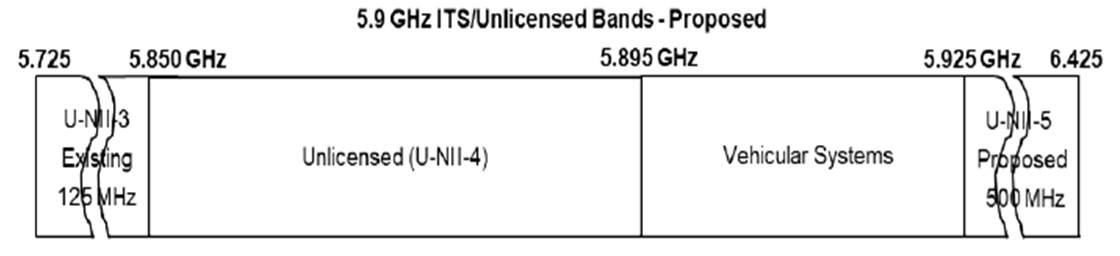
Two decades later, the 5.9 GHz band contributes little to auto safety, particularly since the current DOT has shelved a proposal that would have required a DSRC radio system in every new vehicle. Over those same 20 years, however, the spectrum ecosystem has shifted markedly. In 1999, the 5.9 GHz band was not considered valuable for personal communication. But today the band sits immediately between the current and future most valuable and used bands for high-capacity Wi-Fi: the U-NII-3 band (5725-5850 MHz) and the U-NII-5 band (5925-6425 MHz). The location of ITS spectrum is the reason the FCC, in its initial 2013 notice of rulemaking that proposed Wi-Fi sharing in the 5.9 GHz band, designated it the U-NII-4 band. In short, the vacant 5.9 GHz band is a roadblock on a potential next-generation Wi-Fi superhighway.
During the same two decades that the 5.9 GHz band has lain fallow, Wi-Fi has evolved into an essential and nearly ubiquitous means of connecting to the internet for business, education, health care, and for most Americans at home and at work. Auto safety technology also has advanced in leaps and bounds—albeit completely divorced from the 5.9 GHz band and using revolutionary technologies such as LiDAR. And while the vehicle-to-vehicle communication networks promised for the 5.9 GHz band were never actually deployed, the 20 year old exclusive allocation of 75 megahertz for auto industry use is now an obstacle to the gigabit-fast next generation of Wi-Fi necessary to meet the nation’s 5G wireless needs.
While technology and spectrum usage evolved over those two decades, so did the FCC’s principles of spectrum management.6 Shortly after granting the automakers their own technology-specific spectrum allocation in 1999, the FCC abandoned the approach of creating industry-specific silos of spectrum and locking in technology and service rules that constrain innovation, acknowledging that it is not compatible with the rapidly changing landscape of technology and the wireless ecosystem. The FCC issued a Statement of Spectrum Policy Principles, concluding that “[f]lexible allocations may result in more efficient spectrum markets.”7 In recent years the commission has allocated flexible use spectrum for general purpose networks—such as cellular 4G and emerging 5G networks—that meet a wide variety of needs. The agency has abandoned the less efficient approach of requiring separate allocations of spectrum and the deployment of separate networks and infrastructure for particular use cases.
In its 1999 Statement of Spectrum Policy Principles, the FCC expressed a strong preference for flexible and general purpose spectrum allocations. At the same time, it acknowledged that exceptions could be made for public safety and other public interest priorities “where market forces would fail to provide for the operation of important services.”8 Building on this approach, both the FCC‘s 2002 Spectrum Policy Task Force Report and the FCC‘s 2010 National Broadband Plan emphasized that exceptions made for public safety or other public interest allocations should be narrowly defined “and the amount of spectrum . . . limited to that which ensures that those [compelling public interest] objectives are achieved.”9 The Spectrum Policy Task Force Report also called for the FCC to “seek to designate additional bands for unlicensed spectrum use to better optimize spectrum access and provide room for expansion in the fast-growing market for unlicensed devices and networks,” whenever possible.10
The commission reiterated its preference for flexible-use rules for spectrum management more emphatically in the years ahead. The commission‘s 2010 National Broadband Plan noted that “where there is no overriding public interest in maintaining a specific use, flexibility should be the norm” and that “the failure to revisit historical allocations can leave spectrum handcuffed to particular use cases and outmoded services, and less valuable and less transferable to innovators who seek to use it for new services.”11 In 2014, Julius Knapp, until recently chief of the FCC‘s Office of Engineering and Technology, stated, “The days of service-specific spectrum allocations are over—the commission‘s flexible rules in both unlicensed and licensed bands obviate the need for allocations narrowly tailored to specific uses.”12
The reason the FCC changed its approach to spectrum management is perfectly reflected in the failure of DSRC. Although 20 years ago policymakers believed DSRC would be the technology used for real-time vehicle safety signaling, that never happened. DSRC has since been outpaced by other, newer technologies. Republican FCC Commissioner Michael O’Rielly has observed that “DSRC, as it is currently in our rules, is an outdated technology” compared to what automakers actually want to offer.13 Democratic FCC Commissioner Jessica Rosenworcel elaborated on that same point, arguing that the time has come to acknowledge that DSRC is not going to happen:
It turns out that the FCC was not so great at predicting exactly how auto safety would evolve, because 20 years after these airwaves were set aside, we have just a few cars on the road that have [DSRC] in them for auto safety out of the 260 million cars on U.S. roadways. So it is totally appropriate and reasonable to not strand our spectrum policy and ideas from two decades ago… The demands for Wi-Fi and updated spectrum policy are real.14
5GAA, the coalition representing the mobile and auto industry companies supporting cellular vehicle-to-everything (C-V2X), has filed detailed reports and filings at the FCC that all reflect the current focus on using 5G-based C-V2X technology for the functions that DSRC would have accomplished.15 By integrating C-V2X with general purpose mobile carrier 5G networks, additional connected car applications, including safety-related (but not real-time) data applications, can evolve more cost effectively.
And even if DSRC was viable, or mandated by DOT, it would impose high costs on consumers, mostly due to the fact that it would operate separately from the nation’s burgeoning 5G mobile networks. The National Highway Traffic Safety Administration (NHTSA) estimated that mandating DSRC would cost an extra $5 billion each year and that by 2060 the total costs would be $108 billion.16 The high costs associated with the DSRC mandate were detailed in reports from the Brattle Group and the Government Accountability Office as well.17
The Department of Transportation’s Course Correction
Because V2V safety communication will not be effective unless and until virtually all vehicles are equipped with the technology, the Obama administration’s DOT concluded that it must mandate DSRC radios in every new vehicle sold. DOT acknowledged that without a mandate, interoperable deployment of the technology on American roads would simply not happen: Unless and until nearly all vehicles are equipped with interoperable V2V radios, no vehicles could rely on the technology.
Even with a government mandate, the technology was not expected to permeate the U.S vehicle fleet for decades. In 2014, the National Highway Traffic Safety Administration (NHTSA) released a report that concluded, “Even if the market drives faster uptake by consumers of aftermarket devices (if, for example, auto insurance companies offer discounts for installing the devices), which would increase the ability of V2V devices to find each other earlier on, it will still take 37 years before we would expect the technology to fully penetrate the fleet.”18
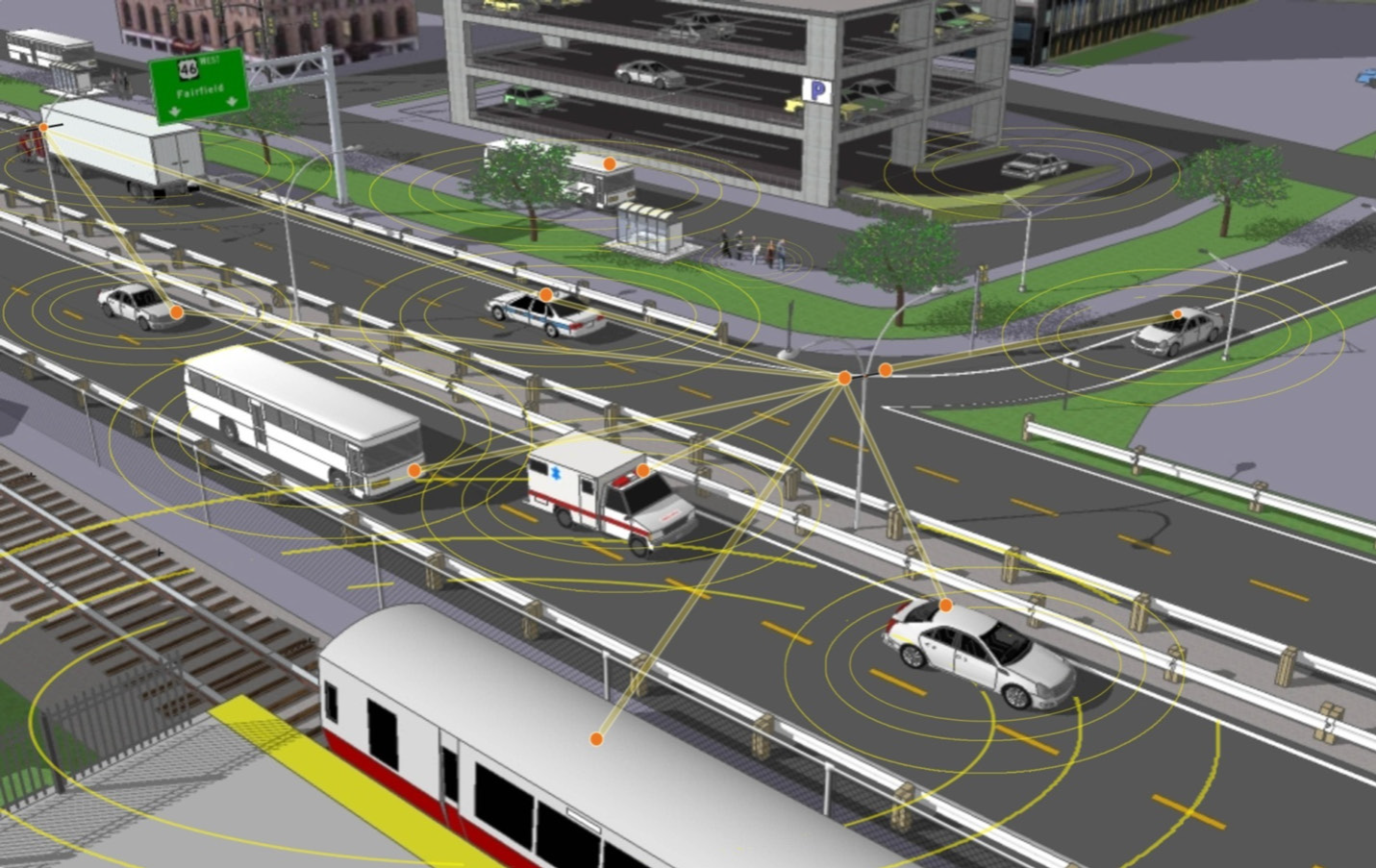
The burden and uncertainty of a lengthy and costly adoption period would not fall solely on automakers, but on state and local governments as well. The auto safety operations powered by DSRC will require roadside vehicle-to-infrastructure (V2I) equipment as well. Even if Congress had the authority to mandate massive V2I expenditures by municipal and county governments, a V2I mandate would squeeze local governments that typically have tight budgets for transportation services. The Government Accountability Office detailed this in a 2015 report to Congress on V2I and DSRC: “40 percent of all traffic signals have either no backhaul or will require new systems, according to AASHTO [the American Association of State Highway and Transportation Officials]. The difference in cost between tying into an existing fiber-optic backhaul and installing a new fiber-optic backhaul for the sites is significant." According to the GAO: “The total potential average, non-recurring costs of deploying connected vehicle infrastructure per site, according to DOT and AASHTO, are $51,650.”19
The GAO report highlighted another problem with the DOT’s proposed mandate. While V2V technology would be required in vehicles, V2I technology (and the equipment that powers it) would not be, leaving the decision to commit money toward building this infrastructure to individual states and localities. The GAO report noted: “Many states and localities may lack resources for funding both V2I equipment and the personnel to install, operate and maintain the technologies. … state budgets are the leanest they have been in years. Furthermore, traditional funding sources, such as the Highway Trust Fund, are eroding, and funding is further complicated by the federal government’s current financial condition and fiscal outlook.”20 This fiscal constraint is even more true given the deep downturn triggered by the COVID-19 pandemic. Essentially, the DOT’s mandate would have offloaded the cost of the actual deployment of auto safety operations—the infrastructure on the sides of the roads that allows the coordination of V2V and V2I services—onto local governments that would find it difficult, if not infeasible, to finance the added costs.
As discussed above, cementing spectrum policy to one specific technology is ill-advised in an ever-changing environment. The Trump administration’s DOT, in a nod to the high costs, the decades-long delay that would accompany a mandate of V2X auto safety, and the uncertainty occasioned by the emergence of autonomous vehicles, decided not to pursue the DSRC mandate the Obama administration had set in motion.21 Although the DOT has not officially stated that the DSRC mandate is dead, it has not moved forward on that proposal and is still reviewing comments on what the future of the ITS band should be.
Complicating matters is DOT’s resistance to the FCC’s proposal to segment the band to ensure that the lower portion not needed for real-time V2X can fuel Wi-Fi and more affordable broadband connectivity. Initially, the FCC’s plans to unveil the proposal were stalled by requests from Transportation Secretary Elaine Chao.22 Even after the FCC announced the proposal to open up part of the 5.9 GHz band for unlicensed use, the DOT has continued to urge retaining the full band for transportation safety.23 So while the DOT took an initial strong step in the right direction (away from mandating V2X), it is now seeking to forestall FCC action on utilizing this currently unused band of spectrum to strengthen Wi-Fi, even as the FCC proposes maintaining the necessary amount of spectrum—30 megahertz—exclusively for auto safety operations.
Despite DOT’s continuing defense of DSRC’s viability, the agency has made a commitment to “remain technologically neutral and avoid interfering with the many innovations in transportation and telecommunication technologies.”24 The Department listed this commitment as the second of three priorities in its 2018 Automated Vehicles 3.0 report, and also specified the importance of implementing “market-driven, technology-neutral policies that encourage innovation in the transportation system.”25 DOT emphasized that this market-driven approach would advance its goals to “fuel economic growth and support job creation and workforce development.”26 These stated commitments offer some reason for hope that the DOT will not insist that the expert spectrum agency—the FCC—specify the technology that should drive spectrum policy and auto safety innovation, as the DSRC mandate threatened to do.
The FCC’s Response to the Challenge
DOT’s decision not to mandate DSRC, coupled with the emergence of a new C-V2X alternative compatible with the general purpose 5G mobile networks of the future, has given the FCC the opportunity to take a fresh look at how the 5.9 GHz band can best serve the overall public interest. In December 2019, a unanimous FCC adopted a notice of proposed rulemaking (NPRM) seeking to balance the critical public interest in both auto safety and in fueling the next generation of 5G-capable Wi-Fi technology. The NPRM proposes to segment the band, reallocating the lower 45 megahertz to add a key increment of capacity to the current 5 GHz allocation of unlicensed spectrum for Wi-Fi, while also retaining the upper 30 megahertz of the band exclusively to support auto safety and ITS.27
The 5.9 GHz proposal is a somewhat uncommon example of complete bipartisan consensus at the FCC. Chairman Ajit Pai, in announcing the NPRM in November, stated that the 5.9 GHz spectrum was clearly not being “put to its best use.” Adding, “After 20 years of seeing these prime airwaves go largely unused, the time has come for the FCC to take a fresh look at the 5.9 GHz band.”28 O‘Rielly concurred, stating recently that “if DSRC no longer makes sense, the commission could combine the 5.9 and 6 GHz bands to expand current unlicensed operations and promote continued growth.”29 Rosenworcel similarly noted that the United States is unique in allocating so much spectrum to V2X, and that it is hindering our wireless future. She stated that “we need to support automobile safety. However, our spectrum policies supporting safety need to be current. … [L]et’s acknowledge that other countries are doing this using less spectrum than the 75 megahertz that the United States has set aside.”30
Public safety is always critical, but as Rosenworcel and O’Rielly have noted, the technologies that power auto safety today have little need for 5.9 GHz spectrum at this point. Rosenworcel noted recently, “What is interesting about the newer auto safety technologies is they are cellular technologies, which have co-existed with Wi-Fi for a long time, so I have some optimism we can find a way forward.”31 O’Rielly similarly rejected the argument that there is a zero sum trade-off between public safety and Wi-Fi. He observed that “[o]ne thing we have to keep in mind is that a lot of the safety features that were envisioned in DSRC many years ago have been accomplished, they’re just not done in 5.9 [GHz].” O’Rielly added that these technologies, such as LiDAR, use different bands of spectrum and are believed to represent the future of autonomous driving. “A number of different technologies that are implemented in cars today are not done in 5.9, and so we can take them off the list,” he said.32
The FCC has proposed authorizing Wi-Fi in at least the lower portion of the unused 5.9 GHz band in large part because the unlicensed 5 GHz band that sits immediately below 5.9 GHz is increasingly the most intensively used—and increasingly congested—unlicensed spectrum relied on by Wi-Fi in offices, homes, schools, and other high-use locations. The FCC’s proposal to greatly expand access to wide and contiguous channels for Wi-Fi in the upper 5 GHz band began in 2013 with a focus on Wi-Fi potentially sharing the ITS band. In 2018, after lengthy laboratory testing sponsored jointly by the FCC and DOT, the testing report found that Wi-Fi can share with DSRC in the 5.9 GHz band.33 Now however, in 2020, the FCC has proposed that band segmentation is the best balance between the public’s dual interest in auto safety and next generation Wi-Fi.
The FCC’s proposal to allocate 30 megahertz for V2X communication on an exclusive basis reflects a consensus among regulators worldwide that this amount of spectrum is what is needed for auto safety applications. Japan has allocated one single channel of 10 megahertz for DSRC that, as the FCC states, is “successfully and actively used for collision avoidance around intersections.”34 The European Union has had 30 megahertz allocated for ITS safety channels for many years and more recently determined that 30 megahertz can accommodate the critical safety signaling applications of both CV2X and DSRC.35 More recently, EU regulators concluded that 30 MHz is all that is required for real-time auto safety operations even if DSRC and C-V2X deployments coexist in the same spectrum band.36 A 2019 EU report that considered a possible expansion of frequencies to support both auto and rail ITS applications, concluded that “[t]here is no evidence that spectrum availability is currently a constraint on the development of ITS.”37
As the FCC receives public comment on its proposal to segment the 5.9 GHz band between unlicensed and ITS operations, the commission adopted a report and order that authorizes unlicensed use of the 6 GHz band immediately above 5.9 GHz for Wi-Fi and other technologies.38 The move to authorize shared, unlicensed use of the 6 GHz band, while a significant step forward to bringing added capacity to Wi-Fi for gigabit internet services (both home/business and 5G services), brings with it an interesting challenge for the FCC. Very soon the two primary bands for 5G-quality Wi-Fi 6 connectivity will be immediately adjacent to the 5.9 GHz band (one above and one below). The chart (just below) shows where the 5.9 GHz sits in relation to current and near-future Wi-Fi operations.39
If at least the lower 45 megahertz of the 5.9 GHz is not opened up for unlicensed use, the ITS band will block the creation of the only unencumbered and gigabit-fast 160 megahertz channel for Wi-Fi below 6 GHz. And if V2X auto safety communication is not relocated to a new and more appropriate spectrum (see Section III below), the remaining ITS band will still be a roadblock to an immensely valuable Wi-Fi superhighway comprised of wide contiguous channels extending from 5725 MHz (the starting point for the current U-NII-3 unlicensed band) as far as 7125 MHz (the furthest reach of the FCC’s pending proposal to open the entire 6 GHz band for secondary unlicensed use). It is imperative the FCC work to ensure that the 5.9 GHz band serves as a key link to a large Wi-Fi band, as the U.S. economy and wireless future increasingly rely on unlicensed spectrum.
Citations
- Paul Pickering, “The Radar Technology Behind Autonomous Vehicles,” EE World Online (Dec. 7, 2017) https://www.ecnmag.com/article/2017/12/radar-technology-behind-autonomous-vehicles ; See also Continental AG, “Continental’s Next Generation Radar Technology Enables New Safety Features” (Aug. 19, 2019), https://www.continental.com/en-us/press-/press-releases/next-gen-short-range-radar-181454 (announcing a new 77 GHz short-range radar that offers improved performance over a prior 24 GHz model and describing radar sensors as “a fundamental tool for advanced driver assistance systems” that “enable more advanced features for the vehicle of the future”).
- Notice of Proposed Rulemaking, Use of the 5.850 – 5.925 GHz Band, ET Docket No. 19-138, at ¶ 18 (rel. Dec. 17, 2019) (“5.9 GHz NPRM”).
- Intermodal Surface Transportation Efficiency Act, Pub. L. 102-240, at § 6052.
- See Transportation Equity Act for the 21st Century, Pub. L. 105-178, at § 5207 (1998) (“TEA-21”).
- See Amendment of Parts 2 and 90 of the Commission’s Rules to Allocate the 5.850-5.925 GHz Band to the Mobile Service for Dedicated Short Range Communications of Intelligent Transportation Services, ET Docket No. 98-95 (Oct. 22, 1999), available at http://transition.fcc.gov/oet/dockets/et98-95/
- For a fuller discussion of this evolution, see Michael Calabrese, Spectrum Silos to Gigabit Wi-Fi: Sharing the 5.9 GHz ‘Car Band’, Open Technology Institute at New America, at 30-34 (Jan. 2016), available at https://www.newamerica.org/oti/policy-papers/spectrum-silos-to-gigabit-wi-fi/
- Policy Statement, “Principles for Reallocation of Spectrum to Encourage the Development of Telecommunications Technologies for the New Millennium,” 14 FCC Rcd 19868, at ¶¶ 9, 11 (rel. Nov. 22, 1999), available at https://transition.fcc.gov/Bureaus/Engineering Technology/Orders/1999/ fcc99354.txt
- Ibid.
- Report of the Spectrum Policy Task Force, ET Docket No. 02-135, at 41 (Nov. 2002), available at http://sites.nationalacademies.org/cs/groups/bpasite/documents/webpage/bpa_048826.pdf
- Id. at 6.
- Federal Communications Commission, “Chapter 5: Spectrum,” National Broadband Plan: Connecting America, at 75 (2010), available at http://download.broadband.gov/plan/nationalbroadband-plan.pdf
- Alton Burton Jr., “Winnik Forum: U.S. Federal Communications Commission‘s chief engineer explains that flexible use spectrum policy will readily accommodate the Internet of Things,” Hogan Lovells Blog (Nov. 18, 2014), http://www.lexology.com/library/detail.aspx?g=0b64c821-c219-4d0d-8229- 8b4a887dc7f7
- FCC February Open Meeting, Press Conference with Commissioners O’Rielly and Carr (Feb. 2019), https://www.youtube.com/watch?v=1dCW8jiM7xc
- “Next Generation Wi-Fi: Accelerating 5G for All Americans,” New America Event (June 3, 2019), https://www.newamerica.org/oti/events/next-generation-wi-fi-accelerating-5g-all-americans/
- FCC Public Notice, “Office of Engineering and Technology and Wireless Telecommunications Bureau Seek Comment on 5GAA Petition for Waiver to Allow Deployment of Cellular Vehicle-to-Everything (CV2X) Technology in the 5.9 GHz Band,” DA 18-1231 (rel. Dec. 6, 2018).
- National Highway Traffic Safety Administration (NHTSA), Department of Transportation (DOT) NPRM, Docket No. NHTSA-2016-0126, at 4000 (Jan. 12, 2017), available at https://www.federalregister.gov/documents/2017/01/12/2016-31059/federal-motor-vehiclesafetystandards-v2v-communications ; Letter of Competitive Enterprise Institute, American Commitment, Niskanen Center, Reason Foundation, and R St. Institute to Transportation Secretary Elaine Chao (April 3, 2017), https://cei.org/sites/default/files/Letter%20to%20USDOT%20on%20V2V%20April032017.pdf
- The Brattle Group, “The Economic Costs and Benefits of a Federal Mandate that All Light Vehicles Employ 5.9 GHz DSRC Technology” (May 2, 2016), available at http://files.brattle.com/system/publications/pdfs/000/005/284/original/brattle_costs_benefits_of_v2v_man date_may_2_2016.pdf ; Government Accountability Office, “Vehicle-to-Infrastructure Technologies Expected to Offer Benefits, but Deployment Challenges Exist” (Sep. 2015), available at https://www.gao.gov/assets/680/672548.pdf
- Harding, J. et al., Vehicle-to-vehicle communications: Readiness of V2V Technology for Application, National Highway Traffic Safety Administration, Report No. DOT HS 812 014, at 24 (Aug. 2014) (“V2V Readiness Report”) (emphasis added).
- U.S. Government Accountability Office, “Intelligent Transportation Systems: Vehicle-to-Infrastructure Technologies Expected to Offer Benefits, but Deployment Challenges Exist,” Report to Congressional Requesters (September 2015), at 21-22, 39 (emphasis added) (“2015 GAO Report”).
- Id. at 21-22.
- Joan Lowy, “APNewsBreak: Gov’t Won’t Pursue Talking Car Mandate,” The Associated Press (Nov. 1, 2017), https://apnews.com/9a605019eeba4ad2934741091105de42
- David Shepardson, “FCC Delays Review of Spectrum Assigned to Vehicle Communication,” Reuters (May 15, 2019), available at https://www.reuters.com/article/us-usa-spectrum-fcc/fcc-delays-review-of-spectrum-assigned-to-vehicle-communication-idUSKCN1SL2N8
- @Research_USDOT, Tweet: “@USDOT has clearly stated in testimony and correspondence that the 75 MHz allocated in the 5.9 GHz, what we call the “Safety Band”, must be preserved for transportation safety purposes. https://transportation.gov/content/safety-band”, (Nov. 20, 2019), available at https://twitter.com/Research_USDOT/status/1197228615982813185
- Department of Transportation Request for Comment, Docket No. DOT-OST-2018-0210, at 6 (Dec. 26, 2018), available at https://www.regulations.gov/docket?D=DOT-OST-2018-0210
- Ibid.
- U.S. Department of Transportation, “Automated Vehicles 3.0,” at 5 (Oct. 2018), available at https://www.transportation.gov/sites/dot.gov/files/docs/policy-initiatives/automated-vehicles/320711/preparing-future-transportation-automated-vehicle-30.pdf
- 5.9 GHz NPRM.
- Remarks of FCC Chairman Ajit Pai at the National Union Building (Nov. 20, 2019), available at https://docs.fcc.gov/public/attachments/DOC-360918A1.pdf
- Remarks of FCC Commissioner Michael O‘Rielly before the 6th Annual Americas Spectrum Management Conference, at 5 (Oct. 13, 2017), available at https://apps.fcc.gov/edocs_public/ attachmatch/DOC-347222A1.pdf
- Remarks of FCC Commissioner Jessica Rosenworcel, Silicon Flatirons Conference (Sep. 6, 2018), https://docs.fcc.gov/public/attachments/DOC-353982A1.pdf
- “Next Generation Wi-Fi: Accelerating 5G for All Americans,” New America Event (June 3, 2019), https://www.newamerica.org/oti/events/next-generation-wi-fi-accelerating-5g-all-americans/
- Ibid.
- Monica Alleven, “FCC tests show Wi-Fi can share with DSRC in 5.9 GHz band,” FierceWireless (Oct. 31, 2018), https://www.fiercewireless.com/wireless/fcc-tests-show-wi-fi-can-share-dsrc-5-9-ghz-band See Public Notice, “The Commission Seeks to Update and Refresh the Record in the Unlicensed National Information Infrastructure (U-NII) Devices in The 5 GHz Band Proceeding,” ET Docket No. 13-49, 31 FCC Rcd 6130 (2016).
- 5.9 GHz NPRM at ¶ 21.
- Ibid. See “2008/671/EC: Commission Decision of 5 August 2008 on the harmonised use of radio spectrum in the 5875-5905 MHz frequency band for safety-related applications of Intelligent Transport Systems (ITS),” Document 32008D0671 (2008), https://www.ecodocdb.dk/download/03f9ec4f-27f0/2008671EC.PDF
- See European Conference of Postal and Telecommunications Administrations, CEPT Report 71, at 7 (2019), available at https://www.ecodocdb.dk/download/19a361a9-d547/CEPTRep071.pdf
- Ibid.
- Report and Order and Further Notice of Proposed Rulemaking, Unlicensed Use of the 6 GHz Band, ET Docket No. 18-295 (April 23, 2020), https://docs.fcc.gov/public/attachments/FCC-20-51A1.pdf
- “A Fresh Look at the 5.9 GHz Band,” NCTA Blog (Oct. 16, 2018), available at https://www.ncta.com/whats-new/a-fresh-look-at-the-59-ghz-band