The 5.9 GHz Band
Abstract
Twenty years ago, policymakers set aside the 5.9 GHz band of frequencies specifically for auto safety and vehicle-to-vehicle radio communications. Unfortunately, the band remains almost completely unused. While Wi-Fi is saturating the band immediately below 5.9 GHz and generating hundreds of billions of dollars in consumer welfare annually, the set-aside of 5.9 GHz for a specific auto industry use case and technology has proven an abject failure. It’s time to recognize that both auto safety and wireless technologies have changed markedly, justifying a fresh look at the highest and best use of the 75 megahertz allocated to intelligent transportation systems at 5.9 GHz.
Downloads
Background: The Auto Industry’s 20-Year Failure to Deploy in 5.9 GHz
The past 20 years have yielded unprecedented advances in wireless technologies and automotive safety. Wi-Fi has become an essential pillar of our broadband ecosystem as it enables affordable connectivity in homes, workplaces, schools, and public spaces. Wi-Fi is now central to the productivity of a broad and diverse set of industries. More recently, automotive and technology companies have developed semi-autonomous and autonomous “driver assist” safety features such as lane departure warnings, lane keeping assist, auto pilot, cameras, and sophisticated sensor technology—called LiDAR—that operate on high-frequency spectrum bands the Federal Communications Commission (FCC) has made available for vehicular radars.1 Like Wi-Fi, these “driver assist” wireless safety technologies have flourished even as the band of frequencies designated specifically for auto safety, the 5.9 GHz band, has remained almost entirely unused.
The government initially allocated this band for intelligent transportation systems (ITS) in 1999 to allow for vehicle-to-vehicle radio communications that, at the time, were envisioned as a critical advancement in road safety. Technical rules adopted by the FCC required the use of Dedicated Short-Range Communications (DSRC), a specific technology that enables real-time safety-signaling among nearby vehicles and, potentially, roadside infrastructure. Although spectrum has historically been allocated for specific services (mobile, broadcast, satellite, public safety, etc.), the FCC has since 1999 adopted policy principles that explicitly seek to avoid mandating specific technologies—a relic of command-and-control spectrum policy that lingers in today’s generally unused 5.9 GHz band.
While Wi-Fi is saturating the band immediately below 5.9 GHz and generating hundreds of billions of dollars in consumer welfare annually, the set-aside of 5.9 GHz for a specific auto industry use case and technology has proven an abject failure. The FCC acknowledges this bluntly in the fresh look Notice of Proposed Rulemaking (NPRM) it adopted on a 5-0 vote in December 2019: “Although the commission had high expectations, DSRC has not lived up to its promise of achieving the ITS goals, leaving valuable mid-band spectrum largely fallow.”2 DSRC has not been deployed commercially or at scale, leaving the 5.9 GHz band unused nearly everywhere. And in recent years an alternative safety-signaling technology (cellular vehicle-to-everything) designed to be compatible with general-purpose mobile carrier 5G networks is emerging, as is LiDAR and other automotive safety technologies relying on spectrum outside the 5.9 GHz band.
Meanwhile, as the 5.9 GHz band remains stuck in idle, Wi-Fi’s use of the neighboring 5 GHz band has accelerated to the point that the unlicensed bands on which nearly all Americans rely for affordable connectivity, particularly indoors, have become increasingly congested due to more devices, more high-bandwidth applications, and more off-loading of mobile carrier traffic onto fixed networks. To keep up with current uses of fixed and mobile broadband, and to head off what will be dramatically increased levels of congestion in the 5G wireless era, policymakers are likely to reallocate at least a portion of the 5.9 GHz band for unlicensed use.
The FCC is currently considering a proposal to reallocate the lower portion of the 5.9 GHz band for unlicensed use. The commission’s proposal would open 45 megahertz of the band for Wi-Fi and other unlicensed technologies and dedicate the upper 30 megahertz of the band exclusively for auto safety operations. The FCC’s proposal reflects the reality that vehicle safety signaling is a narrow-band application. Globally, 30 megahertz is understood to be sufficient for critical auto safety services. Most importantly, the commission’s band segmentation proposal—or, even more so, our proposal below to move ITS safety to an alternative public safety band—would be a win-win for American consumers who have a vital interest in both auto safety and faster and more affordable wireless broadband connectivity.
The Failure of DSRC and the Principles of Modern Spectrum Management
DSRC is a technology without a future in our emerging 5G wireless world. DSRC is outdated, costly to implement, and at this point the amount of spectrum allocated two decades ago for ITS is not being used, nor is it necessary to achieve the critical vehicle safety communications functions that justify the allocation.
In 1991, Congress passed the Intermodal Surface Transportation Efficiency Act, which included an obligation for the Department of Transportation (DOT) to begin researching and testing “intelligent vehicle-highway systems” that could improve auto safety.3 This led to the development of DSRC, a wireless standard based on the Wi-Fi 802.11 protocol that was intended to facilitate ubiquitous and real-time wireless communication on both a vehicle-to-vehicle (V2V) and vehicle-to-infrastructure (V2I) basis. At the time, and over the course of nearly 20 years of research and pilot deployments, DSRC was considered a promising way to avoid a number of vehicle accident scenarios on America’s roads, a purpose reinforced as a national priority by Congress in the Transportation Equity Act for the 21st Century of 1998.4 This act led the FCC to allocate 75 megahertz (5850 to 5925 MHz, the 5.9 GHz band) for shared use by DSRC technology on a licensed basis in 1999.5
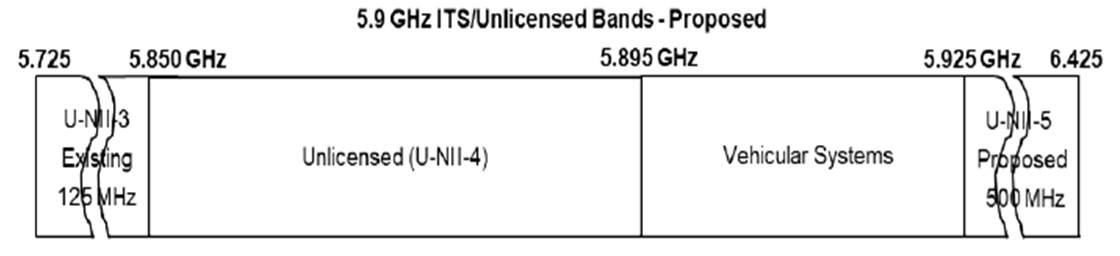
Two decades later, the 5.9 GHz band contributes little to auto safety, particularly since the current DOT has shelved a proposal that would have required a DSRC radio system in every new vehicle. Over those same 20 years, however, the spectrum ecosystem has shifted markedly. In 1999, the 5.9 GHz band was not considered valuable for personal communication. But today the band sits immediately between the current and future most valuable and used bands for high-capacity Wi-Fi: the U-NII-3 band (5725-5850 MHz) and the U-NII-5 band (5925-6425 MHz). The location of ITS spectrum is the reason the FCC, in its initial 2013 notice of rulemaking that proposed Wi-Fi sharing in the 5.9 GHz band, designated it the U-NII-4 band. In short, the vacant 5.9 GHz band is a roadblock on a potential next-generation Wi-Fi superhighway.
During the same two decades that the 5.9 GHz band has lain fallow, Wi-Fi has evolved into an essential and nearly ubiquitous means of connecting to the internet for business, education, health care, and for most Americans at home and at work. Auto safety technology also has advanced in leaps and bounds—albeit completely divorced from the 5.9 GHz band and using revolutionary technologies such as LiDAR. And while the vehicle-to-vehicle communication networks promised for the 5.9 GHz band were never actually deployed, the 20 year old exclusive allocation of 75 megahertz for auto industry use is now an obstacle to the gigabit-fast next generation of Wi-Fi necessary to meet the nation’s 5G wireless needs.
While technology and spectrum usage evolved over those two decades, so did the FCC’s principles of spectrum management.6 Shortly after granting the automakers their own technology-specific spectrum allocation in 1999, the FCC abandoned the approach of creating industry-specific silos of spectrum and locking in technology and service rules that constrain innovation, acknowledging that it is not compatible with the rapidly changing landscape of technology and the wireless ecosystem. The FCC issued a Statement of Spectrum Policy Principles, concluding that “[f]lexible allocations may result in more efficient spectrum markets.”7 In recent years the commission has allocated flexible use spectrum for general purpose networks—such as cellular 4G and emerging 5G networks—that meet a wide variety of needs. The agency has abandoned the less efficient approach of requiring separate allocations of spectrum and the deployment of separate networks and infrastructure for particular use cases.
In its 1999 Statement of Spectrum Policy Principles, the FCC expressed a strong preference for flexible and general purpose spectrum allocations. At the same time, it acknowledged that exceptions could be made for public safety and other public interest priorities “where market forces would fail to provide for the operation of important services.”8 Building on this approach, both the FCC‘s 2002 Spectrum Policy Task Force Report and the FCC‘s 2010 National Broadband Plan emphasized that exceptions made for public safety or other public interest allocations should be narrowly defined “and the amount of spectrum . . . limited to that which ensures that those [compelling public interest] objectives are achieved.”9 The Spectrum Policy Task Force Report also called for the FCC to “seek to designate additional bands for unlicensed spectrum use to better optimize spectrum access and provide room for expansion in the fast-growing market for unlicensed devices and networks,” whenever possible.10
The commission reiterated its preference for flexible-use rules for spectrum management more emphatically in the years ahead. The commission‘s 2010 National Broadband Plan noted that “where there is no overriding public interest in maintaining a specific use, flexibility should be the norm” and that “the failure to revisit historical allocations can leave spectrum handcuffed to particular use cases and outmoded services, and less valuable and less transferable to innovators who seek to use it for new services.”11 In 2014, Julius Knapp, until recently chief of the FCC‘s Office of Engineering and Technology, stated, “The days of service-specific spectrum allocations are over—the commission‘s flexible rules in both unlicensed and licensed bands obviate the need for allocations narrowly tailored to specific uses.”12
The reason the FCC changed its approach to spectrum management is perfectly reflected in the failure of DSRC. Although 20 years ago policymakers believed DSRC would be the technology used for real-time vehicle safety signaling, that never happened. DSRC has since been outpaced by other, newer technologies. Republican FCC Commissioner Michael O’Rielly has observed that “DSRC, as it is currently in our rules, is an outdated technology” compared to what automakers actually want to offer.13 Democratic FCC Commissioner Jessica Rosenworcel elaborated on that same point, arguing that the time has come to acknowledge that DSRC is not going to happen:
It turns out that the FCC was not so great at predicting exactly how auto safety would evolve, because 20 years after these airwaves were set aside, we have just a few cars on the road that have [DSRC] in them for auto safety out of the 260 million cars on U.S. roadways. So it is totally appropriate and reasonable to not strand our spectrum policy and ideas from two decades ago… The demands for Wi-Fi and updated spectrum policy are real.14
5GAA, the coalition representing the mobile and auto industry companies supporting cellular vehicle-to-everything (C-V2X), has filed detailed reports and filings at the FCC that all reflect the current focus on using 5G-based C-V2X technology for the functions that DSRC would have accomplished.15 By integrating C-V2X with general purpose mobile carrier 5G networks, additional connected car applications, including safety-related (but not real-time) data applications, can evolve more cost effectively.
And even if DSRC was viable, or mandated by DOT, it would impose high costs on consumers, mostly due to the fact that it would operate separately from the nation’s burgeoning 5G mobile networks. The National Highway Traffic Safety Administration (NHTSA) estimated that mandating DSRC would cost an extra $5 billion each year and that by 2060 the total costs would be $108 billion.16 The high costs associated with the DSRC mandate were detailed in reports from the Brattle Group and the Government Accountability Office as well.17
The Department of Transportation’s Course Correction
Because V2V safety communication will not be effective unless and until virtually all vehicles are equipped with the technology, the Obama administration’s DOT concluded that it must mandate DSRC radios in every new vehicle sold. DOT acknowledged that without a mandate, interoperable deployment of the technology on American roads would simply not happen: Unless and until nearly all vehicles are equipped with interoperable V2V radios, no vehicles could rely on the technology.
Even with a government mandate, the technology was not expected to permeate the U.S vehicle fleet for decades. In 2014, the National Highway Traffic Safety Administration (NHTSA) released a report that concluded, “Even if the market drives faster uptake by consumers of aftermarket devices (if, for example, auto insurance companies offer discounts for installing the devices), which would increase the ability of V2V devices to find each other earlier on, it will still take 37 years before we would expect the technology to fully penetrate the fleet.”18
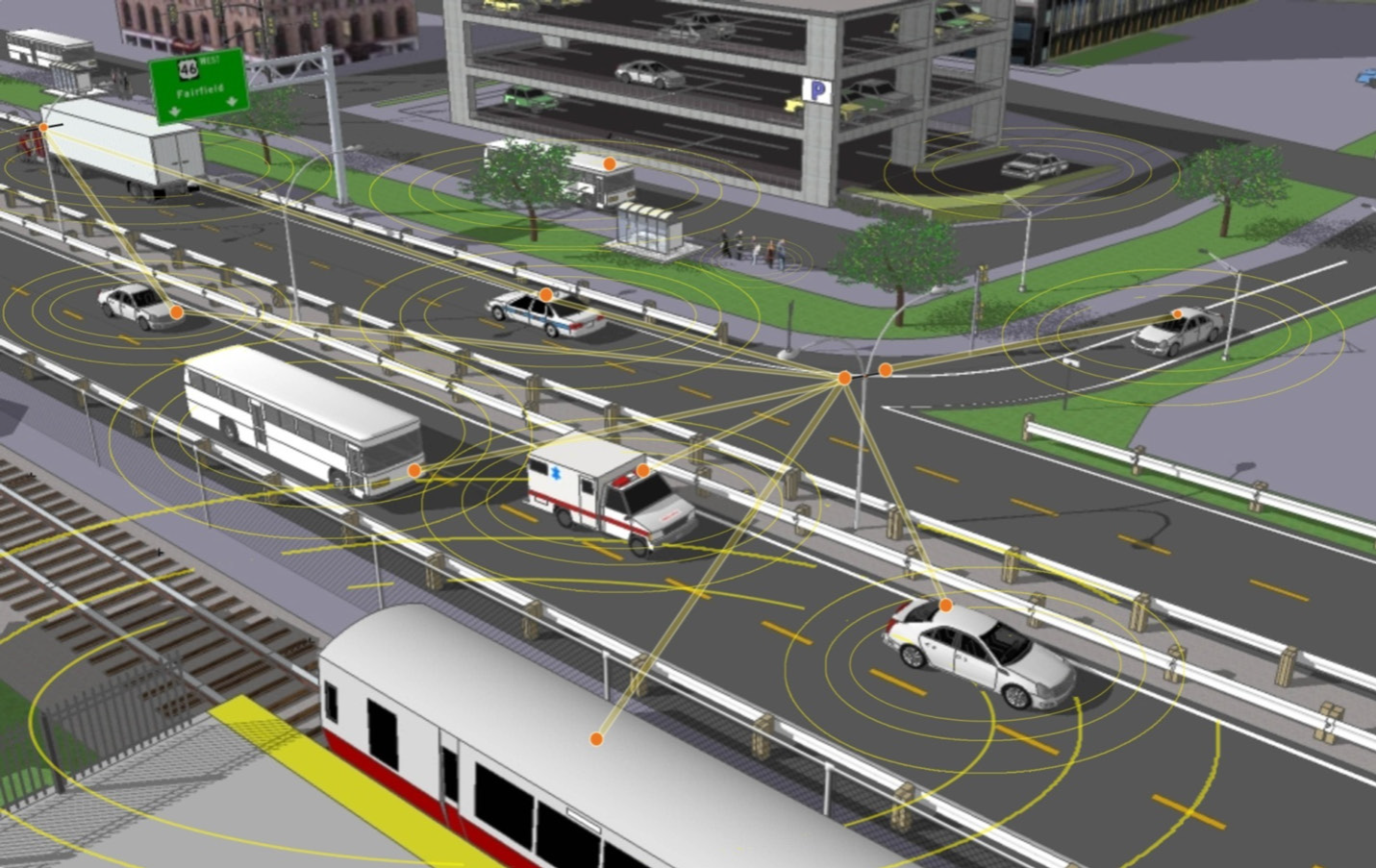
The burden and uncertainty of a lengthy and costly adoption period would not fall solely on automakers, but on state and local governments as well. The auto safety operations powered by DSRC will require roadside vehicle-to-infrastructure (V2I) equipment as well. Even if Congress had the authority to mandate massive V2I expenditures by municipal and county governments, a V2I mandate would squeeze local governments that typically have tight budgets for transportation services. The Government Accountability Office detailed this in a 2015 report to Congress on V2I and DSRC: “40 percent of all traffic signals have either no backhaul or will require new systems, according to AASHTO [the American Association of State Highway and Transportation Officials]. The difference in cost between tying into an existing fiber-optic backhaul and installing a new fiber-optic backhaul for the sites is significant." According to the GAO: “The total potential average, non-recurring costs of deploying connected vehicle infrastructure per site, according to DOT and AASHTO, are $51,650.”19
The GAO report highlighted another problem with the DOT’s proposed mandate. While V2V technology would be required in vehicles, V2I technology (and the equipment that powers it) would not be, leaving the decision to commit money toward building this infrastructure to individual states and localities. The GAO report noted: “Many states and localities may lack resources for funding both V2I equipment and the personnel to install, operate and maintain the technologies. … state budgets are the leanest they have been in years. Furthermore, traditional funding sources, such as the Highway Trust Fund, are eroding, and funding is further complicated by the federal government’s current financial condition and fiscal outlook.”20 This fiscal constraint is even more true given the deep downturn triggered by the COVID-19 pandemic. Essentially, the DOT’s mandate would have offloaded the cost of the actual deployment of auto safety operations—the infrastructure on the sides of the roads that allows the coordination of V2V and V2I services—onto local governments that would find it difficult, if not infeasible, to finance the added costs.
As discussed above, cementing spectrum policy to one specific technology is ill-advised in an ever-changing environment. The Trump administration’s DOT, in a nod to the high costs, the decades-long delay that would accompany a mandate of V2X auto safety, and the uncertainty occasioned by the emergence of autonomous vehicles, decided not to pursue the DSRC mandate the Obama administration had set in motion.21 Although the DOT has not officially stated that the DSRC mandate is dead, it has not moved forward on that proposal and is still reviewing comments on what the future of the ITS band should be.
Complicating matters is DOT’s resistance to the FCC’s proposal to segment the band to ensure that the lower portion not needed for real-time V2X can fuel Wi-Fi and more affordable broadband connectivity. Initially, the FCC’s plans to unveil the proposal were stalled by requests from Transportation Secretary Elaine Chao.22 Even after the FCC announced the proposal to open up part of the 5.9 GHz band for unlicensed use, the DOT has continued to urge retaining the full band for transportation safety.23 So while the DOT took an initial strong step in the right direction (away from mandating V2X), it is now seeking to forestall FCC action on utilizing this currently unused band of spectrum to strengthen Wi-Fi, even as the FCC proposes maintaining the necessary amount of spectrum—30 megahertz—exclusively for auto safety operations.
Despite DOT’s continuing defense of DSRC’s viability, the agency has made a commitment to “remain technologically neutral and avoid interfering with the many innovations in transportation and telecommunication technologies.”24 The Department listed this commitment as the second of three priorities in its 2018 Automated Vehicles 3.0 report, and also specified the importance of implementing “market-driven, technology-neutral policies that encourage innovation in the transportation system.”25 DOT emphasized that this market-driven approach would advance its goals to “fuel economic growth and support job creation and workforce development.”26 These stated commitments offer some reason for hope that the DOT will not insist that the expert spectrum agency—the FCC—specify the technology that should drive spectrum policy and auto safety innovation, as the DSRC mandate threatened to do.
The FCC’s Response to the Challenge
DOT’s decision not to mandate DSRC, coupled with the emergence of a new C-V2X alternative compatible with the general purpose 5G mobile networks of the future, has given the FCC the opportunity to take a fresh look at how the 5.9 GHz band can best serve the overall public interest. In December 2019, a unanimous FCC adopted a notice of proposed rulemaking (NPRM) seeking to balance the critical public interest in both auto safety and in fueling the next generation of 5G-capable Wi-Fi technology. The NPRM proposes to segment the band, reallocating the lower 45 megahertz to add a key increment of capacity to the current 5 GHz allocation of unlicensed spectrum for Wi-Fi, while also retaining the upper 30 megahertz of the band exclusively to support auto safety and ITS.27
The 5.9 GHz proposal is a somewhat uncommon example of complete bipartisan consensus at the FCC. Chairman Ajit Pai, in announcing the NPRM in November, stated that the 5.9 GHz spectrum was clearly not being “put to its best use.” Adding, “After 20 years of seeing these prime airwaves go largely unused, the time has come for the FCC to take a fresh look at the 5.9 GHz band.”28 O‘Rielly concurred, stating recently that “if DSRC no longer makes sense, the commission could combine the 5.9 and 6 GHz bands to expand current unlicensed operations and promote continued growth.”29 Rosenworcel similarly noted that the United States is unique in allocating so much spectrum to V2X, and that it is hindering our wireless future. She stated that “we need to support automobile safety. However, our spectrum policies supporting safety need to be current. … [L]et’s acknowledge that other countries are doing this using less spectrum than the 75 megahertz that the United States has set aside.”30
Public safety is always critical, but as Rosenworcel and O’Rielly have noted, the technologies that power auto safety today have little need for 5.9 GHz spectrum at this point. Rosenworcel noted recently, “What is interesting about the newer auto safety technologies is they are cellular technologies, which have co-existed with Wi-Fi for a long time, so I have some optimism we can find a way forward.”31 O’Rielly similarly rejected the argument that there is a zero sum trade-off between public safety and Wi-Fi. He observed that “[o]ne thing we have to keep in mind is that a lot of the safety features that were envisioned in DSRC many years ago have been accomplished, they’re just not done in 5.9 [GHz].” O’Rielly added that these technologies, such as LiDAR, use different bands of spectrum and are believed to represent the future of autonomous driving. “A number of different technologies that are implemented in cars today are not done in 5.9, and so we can take them off the list,” he said.32
The FCC has proposed authorizing Wi-Fi in at least the lower portion of the unused 5.9 GHz band in large part because the unlicensed 5 GHz band that sits immediately below 5.9 GHz is increasingly the most intensively used—and increasingly congested—unlicensed spectrum relied on by Wi-Fi in offices, homes, schools, and other high-use locations. The FCC’s proposal to greatly expand access to wide and contiguous channels for Wi-Fi in the upper 5 GHz band began in 2013 with a focus on Wi-Fi potentially sharing the ITS band. In 2018, after lengthy laboratory testing sponsored jointly by the FCC and DOT, the testing report found that Wi-Fi can share with DSRC in the 5.9 GHz band.33 Now however, in 2020, the FCC has proposed that band segmentation is the best balance between the public’s dual interest in auto safety and next generation Wi-Fi.
The FCC’s proposal to allocate 30 megahertz for V2X communication on an exclusive basis reflects a consensus among regulators worldwide that this amount of spectrum is what is needed for auto safety applications. Japan has allocated one single channel of 10 megahertz for DSRC that, as the FCC states, is “successfully and actively used for collision avoidance around intersections.”34 The European Union has had 30 megahertz allocated for ITS safety channels for many years and more recently determined that 30 megahertz can accommodate the critical safety signaling applications of both CV2X and DSRC.35 More recently, EU regulators concluded that 30 MHz is all that is required for real-time auto safety operations even if DSRC and C-V2X deployments coexist in the same spectrum band.36 A 2019 EU report that considered a possible expansion of frequencies to support both auto and rail ITS applications, concluded that “[t]here is no evidence that spectrum availability is currently a constraint on the development of ITS.”37
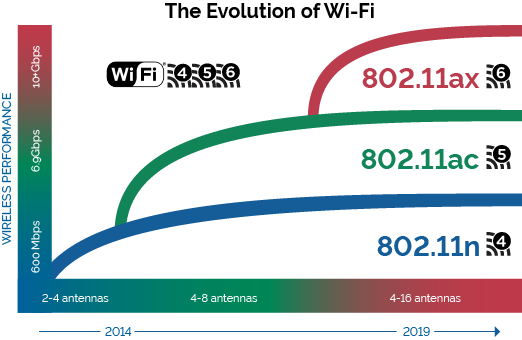
As the FCC receives public comment on its proposal to segment the 5.9 GHz band between unlicensed and ITS operations, the commission adopted a report and order that authorizes unlicensed use of the 6 GHz band immediately above 5.9 GHz for Wi-Fi and other technologies.38 The move to authorize shared, unlicensed use of the 6 GHz band, while a significant step forward to bringing added capacity to Wi-Fi for gigabit internet services (both home/business and 5G services), brings with it an interesting challenge for the FCC. Very soon the two primary bands for 5G-quality Wi-Fi 6 connectivity will be immediately adjacent to the 5.9 GHz band (one above and one below). The chart (just below) shows where the 5.9 GHz sits in relation to current and near-future Wi-Fi operations.39
If at least the lower 45 megahertz of the 5.9 GHz is not opened up for unlicensed use, the ITS band will block the creation of the only unencumbered and gigabit-fast 160 megahertz channel for Wi-Fi below 6 GHz. And if V2X auto safety communication is not relocated to a new and more appropriate spectrum (see Section III below), the remaining ITS band will still be a roadblock to an immensely valuable Wi-Fi superhighway comprised of wide contiguous channels extending from 5725 MHz (the starting point for the current U-NII-3 unlicensed band) as far as 7125 MHz (the furthest reach of the FCC’s pending proposal to open the entire 6 GHz band for secondary unlicensed use). It is imperative the FCC work to ensure that the 5.9 GHz band serves as a key link to a large Wi-Fi band, as the U.S. economy and wireless future increasingly rely on unlicensed spectrum.
Citations
- Paul Pickering, “The Radar Technology Behind Autonomous Vehicles,” EE World Online (Dec. 7, 2017) https://www.ecnmag.com/article/2017/12/radar-technology-behind-autonomous-vehicles ; See also Continental AG, “Continental’s Next Generation Radar Technology Enables New Safety Features” (Aug. 19, 2019), https://www.continental.com/en-us/press-/press-releases/next-gen-short-range-radar-181454 (announcing a new 77 GHz short-range radar that offers improved performance over a prior 24 GHz model and describing radar sensors as “a fundamental tool for advanced driver assistance systems” that “enable more advanced features for the vehicle of the future”).
- Notice of Proposed Rulemaking, Use of the 5.850 – 5.925 GHz Band, ET Docket No. 19-138, at ¶ 18 (rel. Dec. 17, 2019) (“5.9 GHz NPRM”).
- Intermodal Surface Transportation Efficiency Act, Pub. L. 102-240, at § 6052.
- See Transportation Equity Act for the 21st Century, Pub. L. 105-178, at § 5207 (1998) (“TEA-21”).
- See Amendment of Parts 2 and 90 of the Commission’s Rules to Allocate the 5.850-5.925 GHz Band to the Mobile Service for Dedicated Short Range Communications of Intelligent Transportation Services, ET Docket No. 98-95 (Oct. 22, 1999), available at http://transition.fcc.gov/oet/dockets/et98-95/
- For a fuller discussion of this evolution, see Michael Calabrese, Spectrum Silos to Gigabit Wi-Fi: Sharing the 5.9 GHz ‘Car Band’, Open Technology Institute at New America, at 30-34 (Jan. 2016), available at https://www.newamerica.org/oti/policy-papers/spectrum-silos-to-gigabit-wi-fi/
- Policy Statement, “Principles for Reallocation of Spectrum to Encourage the Development of Telecommunications Technologies for the New Millennium,” 14 FCC Rcd 19868, at ¶¶ 9, 11 (rel. Nov. 22, 1999), available at https://transition.fcc.gov/Bureaus/Engineering Technology/Orders/1999/ fcc99354.txt
- Ibid.
- Report of the Spectrum Policy Task Force, ET Docket No. 02-135, at 41 (Nov. 2002), available at http://sites.nationalacademies.org/cs/groups/bpasite/documents/webpage/bpa_048826.pdf
- Id. at 6.
- Federal Communications Commission, “Chapter 5: Spectrum,” National Broadband Plan: Connecting America, at 75 (2010), available at http://download.broadband.gov/plan/nationalbroadband-plan.pdf
- Alton Burton Jr., “Winnik Forum: U.S. Federal Communications Commission‘s chief engineer explains that flexible use spectrum policy will readily accommodate the Internet of Things,” Hogan Lovells Blog (Nov. 18, 2014), http://www.lexology.com/library/detail.aspx?g=0b64c821-c219-4d0d-8229- 8b4a887dc7f7
- FCC February Open Meeting, Press Conference with Commissioners O’Rielly and Carr (Feb. 2019), https://www.youtube.com/watch?v=1dCW8jiM7xc
- “Next Generation Wi-Fi: Accelerating 5G for All Americans,” New America Event (June 3, 2019), https://www.newamerica.org/oti/events/next-generation-wi-fi-accelerating-5g-all-americans/
- FCC Public Notice, “Office of Engineering and Technology and Wireless Telecommunications Bureau Seek Comment on 5GAA Petition for Waiver to Allow Deployment of Cellular Vehicle-to-Everything (CV2X) Technology in the 5.9 GHz Band,” DA 18-1231 (rel. Dec. 6, 2018).
- National Highway Traffic Safety Administration (NHTSA), Department of Transportation (DOT) NPRM, Docket No. NHTSA-2016-0126, at 4000 (Jan. 12, 2017), available at https://www.federalregister.gov/documents/2017/01/12/2016-31059/federal-motor-vehiclesafetystandards-v2v-communications ; Letter of Competitive Enterprise Institute, American Commitment, Niskanen Center, Reason Foundation, and R St. Institute to Transportation Secretary Elaine Chao (April 3, 2017), https://cei.org/sites/default/files/Letter%20to%20USDOT%20on%20V2V%20April032017.pdf
- The Brattle Group, “The Economic Costs and Benefits of a Federal Mandate that All Light Vehicles Employ 5.9 GHz DSRC Technology” (May 2, 2016), available at http://files.brattle.com/system/publications/pdfs/000/005/284/original/brattle_costs_benefits_of_v2v_man date_may_2_2016.pdf ; Government Accountability Office, “Vehicle-to-Infrastructure Technologies Expected to Offer Benefits, but Deployment Challenges Exist” (Sep. 2015), available at https://www.gao.gov/assets/680/672548.pdf
- Harding, J. et al., Vehicle-to-vehicle communications: Readiness of V2V Technology for Application, National Highway Traffic Safety Administration, Report No. DOT HS 812 014, at 24 (Aug. 2014) (“V2V Readiness Report”) (emphasis added).
- U.S. Government Accountability Office, “Intelligent Transportation Systems: Vehicle-to-Infrastructure Technologies Expected to Offer Benefits, but Deployment Challenges Exist,” Report to Congressional Requesters (September 2015), at 21-22, 39 (emphasis added) (“2015 GAO Report”).
- Id. at 21-22.
- Joan Lowy, “APNewsBreak: Gov’t Won’t Pursue Talking Car Mandate,” The Associated Press (Nov. 1, 2017), https://apnews.com/9a605019eeba4ad2934741091105de42
- David Shepardson, “FCC Delays Review of Spectrum Assigned to Vehicle Communication,” Reuters (May 15, 2019), available at https://www.reuters.com/article/us-usa-spectrum-fcc/fcc-delays-review-of-spectrum-assigned-to-vehicle-communication-idUSKCN1SL2N8
- @Research_USDOT, Tweet: “@USDOT has clearly stated in testimony and correspondence that the 75 MHz allocated in the 5.9 GHz, what we call the “Safety Band”, must be preserved for transportation safety purposes. https://transportation.gov/content/safety-band”, (Nov. 20, 2019), available at https://twitter.com/Research_USDOT/status/1197228615982813185
- Department of Transportation Request for Comment, Docket No. DOT-OST-2018-0210, at 6 (Dec. 26, 2018), available at https://www.regulations.gov/docket?D=DOT-OST-2018-0210
- Ibid.
- U.S. Department of Transportation, “Automated Vehicles 3.0,” at 5 (Oct. 2018), available at https://www.transportation.gov/sites/dot.gov/files/docs/policy-initiatives/automated-vehicles/320711/preparing-future-transportation-automated-vehicle-30.pdf
- 5.9 GHz NPRM.
- Remarks of FCC Chairman Ajit Pai at the National Union Building (Nov. 20, 2019), available at https://docs.fcc.gov/public/attachments/DOC-360918A1.pdf
- Remarks of FCC Commissioner Michael O‘Rielly before the 6th Annual Americas Spectrum Management Conference, at 5 (Oct. 13, 2017), available at https://apps.fcc.gov/edocs_public/ attachmatch/DOC-347222A1.pdf
- Remarks of FCC Commissioner Jessica Rosenworcel, Silicon Flatirons Conference (Sep. 6, 2018), https://docs.fcc.gov/public/attachments/DOC-353982A1.pdf
- “Next Generation Wi-Fi: Accelerating 5G for All Americans,” New America Event (June 3, 2019), https://www.newamerica.org/oti/events/next-generation-wi-fi-accelerating-5g-all-americans/
- Ibid.
- Monica Alleven, “FCC tests show Wi-Fi can share with DSRC in 5.9 GHz band,” FierceWireless (Oct. 31, 2018), https://www.fiercewireless.com/wireless/fcc-tests-show-wi-fi-can-share-dsrc-5-9-ghz-band See Public Notice, “The Commission Seeks to Update and Refresh the Record in the Unlicensed National Information Infrastructure (U-NII) Devices in The 5 GHz Band Proceeding,” ET Docket No. 13-49, 31 FCC Rcd 6130 (2016).
- 5.9 GHz NPRM at ¶ 21.
- Ibid. See “2008/671/EC: Commission Decision of 5 August 2008 on the harmonised use of radio spectrum in the 5875-5905 MHz frequency band for safety-related applications of Intelligent Transport Systems (ITS),” Document 32008D0671 (2008), https://www.ecodocdb.dk/download/03f9ec4f-27f0/2008671EC.PDF
- See European Conference of Postal and Telecommunications Administrations, CEPT Report 71, at 7 (2019), available at https://www.ecodocdb.dk/download/19a361a9-d547/CEPTRep071.pdf
- Ibid.
- Report and Order and Further Notice of Proposed Rulemaking, Unlicensed Use of the 6 GHz Band, ET Docket No. 18-295 (April 23, 2020), https://docs.fcc.gov/public/attachments/FCC-20-51A1.pdf
- “A Fresh Look at the 5.9 GHz Band,” NCTA Blog (Oct. 16, 2018), available at https://www.ncta.com/whats-new/a-fresh-look-at-the-59-ghz-band
The Rise of 5G and the Imperative of Gigabit-Fast Wi-Fi at 5 and 6 GHz
During the two decades that the 5.9 GHz band has sat idling, Wi-Fi has emerged as an essential pillar of our wireless ecosystem and an essential enabler of affordable connectivity in homes, workplaces, and schools, and for the productivity of a broad and diverse set of industries. The FCC acknowledged Wi-Fi’s critical role in the economy in its 6 GHz NPRM, stating: Wi-Fi “has become indispensable for providing high data rate local area network connections for smart phones, tablets, mobile computers, and other devices to interconnect and access the Internet. Wi-Fi has also enabled the offloading of data from commercial wireless networks… and it has provided a means for devices throughout the home to wirelessly interconnect.”40
The 5.9 GHz band is increasingly a key part of the potential solution to the “spectrum crunch” in unlicensed bands, and as a means of accelerating both the availability and affordability of 5G-capable connectivity to all Americans. Because mobile carrier 5G networks will be built out first in mostly urban, high-traffic and high-return areas, next-generation Wi-Fi will be essential to heading off a new 5G digital divide if rural, small-town, exurban, and even lower-income urban neighborhoods lack mobile carrier 5G.
5.9 GHz: A Roadblock on the FCC’s Wi-Fi Superhighway
The virtually unused 5.9 GHz band has become a roadblock to an immensely valuable Wi-Fi superhighway comprised of contiguous wide channels capable of delivering gigabit-fast and affordable wireless connectivity to all of America’s homes, workplaces, enterprises, schools, and public spaces. Very soon the two primary bands for 5G-quality Wi-Fi 6 connectivity will be immediately adjacent to the 5.9 GHz band (one above and one below). The auto industry has let the band lay fallow for 20 years while both vehicle safety technology and the enormous social and economic importance of Wi-Fi in 5 GHz has passed it by.
Over that same 20-year period, Wi-Fi has become critical to broadband connectivity and to the U.S. economy more broadly. Unlicensed technologies—principally Wi-Fi—contributed $525 billion in economic value to the United States alone in 2017, an impact expected to surge to more than $834 billion this year.41 Wi-Fi alone is projected to generate nearly $1 trillion in economic benefit for the U.S. economy by 2023.42 Wi-Fi also generates complementary economic benefits due to the mobile industry’s reliance on the technology for offloading mobile data. Wi-Fi cellular offloading by itself produced an estimated $25.2 billion in economic value in the United States in 2017.43

The 5.9 GHz band, if repurposed for Wi-Fi, could provide added “gains to economic welfare in the form of consumer and producer surplus of $82.2 billion to $189.9 billion,” according to research from the RAND Corporation.44 A 2020 study by New York University economist Raul Katz concluded that “[o]pening 45 MHz of the 5.9 GHz band to unlicensed use will generate economic value of $23.042 billion in terms of GDP contribution, and $5.098 billion in consumer surplus between 2020 and 2025.”45
Wi-Fi is particularly important for the role it plays in making mobile device connectivity faster and more affordable, notably indoors where more than 80 percent of mobile device data is consumed and where mobile carrier signals are often weak or unavailable.46 According to Cisco, 59 percent of all mobile device data traffic will be offloaded onto fixed networks through Wi-Fi by 2022.47 In January, Verizon’s Executive VP and Consumer Group CEO Ronan Dunne told a Citibank investor conference that Wi-Fi is believed to be offloading between 70 and 75 percent of mobile device data traffic.48 Charter has reported that its cable network currently supports over 300 million devices and that 80 percent of the wireless data its customers use flow over Wi-Fi directly onto Charter’s cable network.49
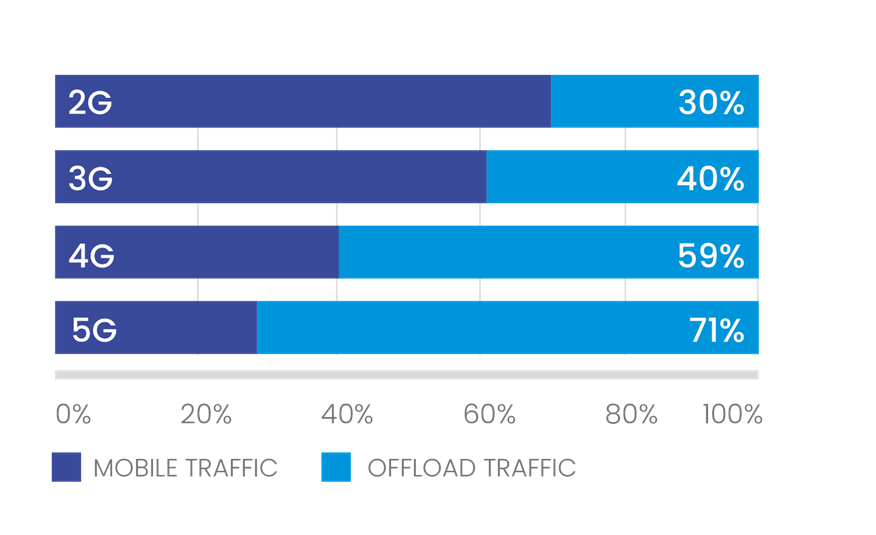
Wi-Fi’s value for mobile offloading will only increase as 5G applications become more bandwidth intensive.50 Cisco predicts that 71 percent of global 5G data traffic will be offloaded onto Wi-Fi by 2022.51 The emerging Internet of Things (IoT) will similarly make higher-capacity Wi-Fi more critical. Machine-to-machine data transfer and IoT networks are mostly dependent on unlicensed spectrum. These networks support, among many other functions, energy and environmental monitoring, mobile healthcare applications, industrial automation, and smart city operations such as intelligent transportation, smart meters, vehicle tolling, and inventory tracking. These use cases are already seeing dramatic growth with declining costs to consumers thanks to the connectivity fueled by unlicensed spectrum.52
The Surging Consumer and Business Benefits of Gigabit Wi-Fi
Wi-Fi also enables use cases that meet the critical needs of community anchor institutions and businesses of all types. Thanks to the specific characteristics of Wi-Fi and its ability to spread high-speed broadband connectivity across a wide space indoors (and outdoors), it empowers innovative applications to boost education, work, farming, office automation and many specific industry use cases.
Farming and Ranching
Wi-Fi already plays a large role in the burgeoning smart agriculture space, which is already being adopted across the country. For smart farming operations, Wi-Fi networks are preferable to LTE and 4G networks because, once deployed, they are more cost-effective to sustain, customize, and operate.53 Using Wi-Fi-enabled smart agriculture, farmers and ranchers can check data and weather conditions, as well as monitor crops, soil conditions, and animals.54 Microsoft’s FarmBeats program—which provides complex data analytics to the farming industry—is a prime example of how unlicensed technologies such as Wi-Fi and TV white spaces can offer revolutionary advances in efficient farming techniques.55
Another example is the farm Wi-Fi network built by the company BlueTown, in partnership with the University of California’s Kearney Agricultural Research and Education Center (KARE). Each Wi-Fi access point delivers 250 Mbps throughput and provides coverage over a 250-meter radius.56 KARE’s solution collected data from sensors distributed throughout an alfalfa field that detect and review subsurface irrigation in comparison to flood irrigation.57 “One of the nice things about the W-Fi is we can move to real-time evaluation of the data that is coming off this field,” Dr. Jeffery A. Dahlberg, director of KARE, told RCR Wireless.58
Equipment manufacturers expect IoT connectivity to play a large role in the future of farming. Deere & Company has told the commission: “As these machine populations continue to grow… the ability of farmers using Deere’s agricultural equipment and systems to improve efficiency, yield, and smart resource use will depend on their ability to leverage high speed broadband connections capable of enabling real-time M2M and machine to farm (M2F) interaction. The IoT in rural America will include not only smart meters and smart appliances, but also smart farming equipment and systems needed to drive local economies.”59 Wi-Fi helps power precision farming, which in turn catalyzes cost-effective agriculture. This outcome helps small farms in particular, as these entities are more likely to be struggling for higher yields and labor efficiencies compared to their larger competitors.
Factory and Warehouse Automation
Wi-Fi and Bluetooth, another unlicensed technology, increasingly add value to factory automation and are becoming a key input to the manufacturing and goods distribution sectors more generally. Entire warehouses and production lines are equipped with customized Wi-Fi networks that monitor and administer the synchronized movements of robots, sensors, inventory tracking, and other efficiency gains.
Amazon, for example, uses unlicensed spectrum to control the robots in their enormous warehouse fulfillment centers (more than 100,000 robots as of 2017), through the use of a customized indoor network based on variations of the Wi-Fi 802.11 standard.60 Amazon relies on a secure, customized Wi-Fi network to control the robots in its warehouses.61 The robots increase efficiency. Prior to the adoption of the robot networks, warehouse workers had to individually search the shelves for a specific item and then carry it to the packing and shipping area before sending it out. Thanks to the Wi-Fi-enabled communication, robots guide warehouse employees to find packages and then transport it if the package is too heavy.62 The scurrying robots avoid employees by reading unlicensed transmissions from their Bluetooth badge.
Smaller companies have been harnessing the ability of Wi-Fi to orchestrate robots in manufacturing as well. Robotic startup, 6 River Systems (6RS), builds robots similar to Amazon’s that lead employees to shelves to find particular items, calculating the most efficient path and carrying up to 160 pounds.63 All of these functions are requiring more and more Wi-Fi capacity.64 "All they need is Wi-Fi in the warehouse," Jerome Dubois, 6RS co-founder and co-CEO, said in an interview with Forbes. "It makes it easier to implement because there's no tearing out stuff or retrofitting the facility."65
Hospitals, Schools, and Libraries
Hospitals are critical community anchor institutions that support an increasing number of applications that require higher bandwidth and strong Wi-Fi for reliability. Next-generation Wi-Fi technologies (Wi-Fi 6) will bring these internet-connected benefits (as well as telehealth), only as long as there is enough contiguous, wide-channel spectrum available. The Wi-Fi Alliance has underscored the importance of Wi-Fi for health care: “Hospitals are a perfect example of congested, high traffic, constantly changing environments that would benefit from Wi-Fi 6. Wi-Fi is common in hospitals given the many benefits it provides.”66 Doctors and nurses are able to remotely monitor patients and devices, they can use interconnected devices to communicate accurate patient records and real-time data analysis, and they can send and receive real-time alerts and observation data—all through Wi-Fi networks.67
Schools, libraries, and other educational institutions are increasingly reliant on robust Wi-Fi connectivity. Schools can only take advantage of gigabit internet connections and make simultaneous use of hundreds of laptops and other devices in a school if the Wi-Fi network has the capacity to distribute that bandwidth to every classroom and individual student. Students use Wi-Fi in school to enable individualized lesson plans, which addresses learner variability. Interactive video, virtual reality, multi-user educational gaming, and other bandwidth-intense applications will only add to this challenge. The broader public also uses Wi-Fi services in libraries to conduct research, search for jobs, and connect to services they may need internet access to use (healthcare, financial, and government services). That’s why the contiguous and wide channels at the top of the 5 GHz band and across the 6 GHz band are essential to actually realize the potential of the gigabit-fast fiber connections that nearly all local school districts are deploying with subsidies from the commission’s E-Rate program.
The evolution of the FCC’s E-Rate program, which subsidizes high-speed broadband connections at qualifying schools and libraries, shows how the educational use of internet access is changing. The high participation rate of schools and libraries in the program’s category two funding for internal connections (which most of the time refers to Wi-Fi) reflects the reality that schools have shifted from designated computer labs to an expectation that every student and teacher in every classroom has high-speed connectivity. Since the FCC modernized the E-Rate program, expanding category two funding, participation has skyrocketed. According to the FCC Wireline Competition Bureau’s 2019 report on E-Rate’s category two budget, the average number of schools receiving category two funding (or pending requests) is about 45,000 per year—a 525 percent increase from the time period of Fiscal Year 2008 and Fiscal Year 2012.68 Libraries went through a similar increase in participation; about 2,700 libraries per year receive category two commitments or pending requests—an 865 percent increase.69
The E-Rate program’s increasing expenditures on Wi-Fi networks are producing results. Since the FCC’s 2014 reforms of the E-Rate program, 83 percent of school districts have invested in Wi-Fi upgrades, a staggering increase from 14 percent for the 2011-2014 period.70 Nearly 200 school and district leaders and over 50 education organizations stated in a FCC filing: “Category two services that support high-speed internet access, including reliable Wi-Fi, are vital for providing all students with a quality education to prepare them for today‘s modern economy.”71 Wi-Fi is also seen as crucial for libraries, as evidenced by the American Library Association’s long standing advocacy for Wi-Fi as central to supporting the expanding role of libraries as community technology centers in communities across the country.72
Using Wi-Fi to distribute a fast broadband connection to every classroom and individual student enables teachers to vary their lesson plans and meet the learning needs of individual students. According to a teacher survey of Alexandria City Public Schools in Virginia conducted by New America, 80 percent of teachers reported that two of the most common student uses for internet-connected devices (Chromebooks, iPads, and desktop computers) are to bring a variety of instructional methods to daily lessons, and to tailor learning experiences to individual student needs.73 Three-quarters of the teachers also reported that internet-connected devices allow teachers to offer more self-directed learning and independent practice.74
Schools also deploy Wi-Fi networks outside of the classroom for teachers and students to access in football fields, theaters, gymnasiums, and all over the school’s grounds, just as most colleges and universities do today. As Zeus Kerravala, founder and principal analyst at ZK Research, said in an interview with EdTech Magazine, “The most important reason for it is being able to expand learning capabilities outside the traditional classroom.”75
The availability of Wi-Fi in libraries, coffee shops, and other public spaces such as restaurants is another essential use of Wi-Fi to advance educational needs. The availability of Wi-Fi in public spaces, particularly for students without internet access at home, is absolutely essential, as 70 percent of teachers in the United States assign homework that requires internet access to complete, a share that is substantially higher in high schools.76 Twelve percent of U.S. teenagers surveyed by the Pew Research Center reported having to use public Wi-Fi to do homework due to a lack of broadband access at home—a share that is even higher among low-income teenagers, where 21 percent of respondents said the same.77 Stories of students using free Wi-Fi at local McDonald’s locations and even on school buses due to a lack of internet service at home are a common feature of the homework gap.78
Dr. Nicol Turner Lee recently wrote of an ice cream parlor near a school that offered free Wi-Fi so that students had the internet access they needed to complete their homework. The owner wrote of the need to provide safe hotspot locations to local communities: “‘We sometimes have more white people here [at The Social] because [the Black students] have no transportation… I really wish that I could figure that problem out because we are here to offer a safe space for the kids to do their homework.’ From this statement and the general case study findings, it was also clear that there were not too many places that offered Wi-Fi or fixed broadband services to community residents.”79
Citations
- Notice of Proposed Rulemaking, Unlicensed Use of the 6 GHz Band; Expanding Flexible Use in Mid-Band Spectrum Between 3.7 and 24 GHz, ET Docket No. 18-295 and GN Docket No. 17-183 (rel. Oct. 24, 2018).
- Raul Katz, Telecom Advisory Services LLC, “A 2017 Assessment of the Current & Future Economic Value of Unlicensed Spectrum in the United States,” WifiForward (April 2018), available at http://wififorward.org/wp-content/uploads/2018/05/Katz-Study-Summary.pdf
- In a global comparative study, Dr. Katz estimated that Wi-Fi alone generated $500 billion in economic value for the U.S. in 2018, an impact that would rise to nearly $1 trillion ($993 billion) by 2023. Raul Katz & Fernando Callorda, Telecom Advisory Services, LLC, The Economic Value of Wi-Fi: A Global View (2018 and 2023), at 6-7, 33-34 (Oct. 2018), available at https://morningconsult.com/wp-content/uploads/2018/10/Economic_Value_of_Wi-Fi_2018.pdf
- “Economic Value of Unlicensed Spectrum in the U.S. Tops $525 Billion,” WifiForward (May 17, 2018), http://wififorward.org/2018/05/17/new-report-economic-value-of-unlicensedspectrum-in-the-u-stops-525-billion/
- Diana Gehlhaus Carew, et al., “The Potential Economic Value of Unlicensed Spectrum in the 5.9 GHz Frequency Band,” RAND Corporation (2018), https://www.rand.org/pubs/research_reports/RR2720.html
- Dr. Raul Katz, “Assessing the Economic Value of Unlicensed Use in the 5.9 GHz and 6 GHz Bands,” WifiForward, at 4 (April 2020), http://wififorward.org/wp-content/uploads/2020/04/5.9-6.0-FINAL-for-distribution.pdf
- See Comments of the Open Technology Institute at New America, American Library Association, et al., GN Docket Nos. 17-258, 15-319, 17-183, 14-177 (Sept. 11, 2018), at 22-23 https://ecfsapi.fcc.gov/file/1091216959118/PISC_Comments_SpectrumPipelineAct_FINAL_AsFiled_09 1118.pdf (“The mobile device data traffic transported over Wi-Fi networks – rather than over mobile carrier networks -- is increasing and vastly exceeds all other wireless technologies, making more spectrum capacity for Wi-Fi critical…”).
- Cisco Visual Networking Index: Global Mobile Data Traffic Forecast Update, 2017–2022, Cisco White Paper (Feb. 2019) (“Cisco 2019 VNI”), available at https://www.cisco.com/c/en/us/solutions/collateral/service-provider/visualnetworking-index-vni/white-paper-c11-738429.pdf
- Verizon, Citi 2020 Global TMT West Conference, Webcast (Jan. 7, 2020), available https://www.verizon.com/about/investors/citi-2020-global-tmt-west-conference ; Monica Alleven, “Verizon Anticipates Indoor 5G Without Wi-Fi,” Fierce Wireless (Jan. 7, 2020), https://www.fiercewireless.com/wireless/verizon-anticipates-indoor-5g-without-wi-fi
- Notice of Ex Parte Presentation of Charter Communications and CableLabs, ET Docket No. 18-295, GN Docket No. 17-183, at 1 (Feb. 21, 2020).
- David Nield, “Why You'll Still Need Wifi When 5G Is Everywhere, According to the Wi-Fi Alliance,” Gizmodo (Dec. 18, 2018), available at https://gizmodo.com/why-youll-still-need-wifi-when-5g-is-everywhere-accord1831167997
- Cisco 2019 VNI, supra note 47.
- See Richard Thanki, “The Economic Significance of License-Exempt Spectrum to the Future of the Internet,” at 65 (June 2012).
- Stephanie Bergeron Kinch, “Agriculture: A Cash Cow for Wi-Fi-based IoT?,” Wi-Fi NOW (June 2, 2018), available at https://wifinowevents.com/news-and-blog/agriculture-a-cash-cow-for-wi-fi-based-iot/ Agnov8‘s CEO Andrew Cameron “says that Wi-Fi has a competitive advantage over LTE and 4G networks because it is more economically feasible to maintain and operate once it is installed. Farmers can check data and conditions on their smartphones and tablets, and the system is compatible with other Wi-Fi-enabled technology. Wi-Fi works especially well for smaller farms, he says.” Ibid.
- Ibid.
- Kyle Wiggers, “With FarmBeats, Microsoft makes a play for the agriculture market,” VentureBeat (Nov. 4, 2019), available at https://venturebeat.com/2019/11/04/with-farmbeats-microsoft-makes-a-play-for-the-agriculture-market/ “FarmBeats leverages unlicensed TV white spaces — the radio frequencies allocated to broadcasting services — to establish a high-bandwidth link from a farmer’s home internet connection to a base station, sometimes supplemented by the open source long-range IoT protocol LoRa. Sensors, drones, and the like connect to the base station, which draws power from a battery-backed solar panel pack. The base station has three components: a TV white space transmission device, a Wi-Fi connectivity module, and a controller. The Wi-Fi module lets farmers connect off-the-shelf soil temperature, pH, carbon dioxide, and moisture sensors with their phones to access farming productivity apps. As for the controller, it’s responsible for caching collected data when the TV white space device is switched on, and for planning and enforcing power cycle rates, depending on the current battery status.” Ibid.
- Susan Rambo, “High-speed Wi-Fi at ag research center may be blueprint for rural communities,” RCR Wireless (July 20, 2018), available at https://www.rcrwireless.com/20180719/internet-of-things/high-speed-wifi-atag-research-center-may-be-blueprint-for-rural-communities-tag41
- Ibid.
- Ibid.
- Comments of Deere & Company, GN Docket No. 17-199 (Sep. 21, 2017), available at https://ecfsapi.fcc.gov/file/109212496527376/FINAL_Deere%20Comments%20on%20Section%20706% 20NOI.pdf
- Nick Wingfield, “As Amazon Pushes Forward With Robots, Workers Find New Roles,” The New York Times (Sep. 10, 2017), https://www.nytimes.com/2017/09/10/technology/amazon-robots-workers.html
- Pablo Valerio, “Amazon Robotics: IoT in the Warehouse,” Information Week (Sept. 28, 2015), https://www.informationweek.com/strategic-cio/amazon-robotics-iot-in-the-warehouse/d/d-id/1322366
- Will Knight, “Inside Amazon‘s Warehouse, Human-Robot Symbiosis,” MIT Technology Review (July 7, 2015), https://www.technologyreview.com/s/538601/inside-amazons-warehouse-human-robotsymbiosis/
- Alex Knapp, “This Robot Startup Just Raised $25 Million to Make Warehouse Fulfillment Easier,” Forbes (April 4, 2018), available at https://www.forbes.com/sites/alexknapp/2018/04/04/this-robot-startup-justraised-25-million-to-make-warehouse-fulfillment-easier/#18d3693d6ffe
- Ibid.
- Ibid.
- Jay White, “Wi-Fi 6 and Healthcare,” Wi-Fi Alliance (Jan. 15, 2019),available at https://www.wi-fi.org/beacon/jaywhite/wi-fi-6-and-healthcare
- Ibid.
- Wireline Competition Bureau Report, WC Docket No. 13-184, at ⁋⁋ 17-18 (Feb. 11, 2019), https://docs.fcc.gov/public/attachments/DA-19-71A1.pdf
- Ibid.
- EducationSuperHighway, “2018 State of the States” (Oct. 2018), available at https://s3-us-west1.amazonaws.com/esh-sots-pdfs/2018%20State%20of%20the%20States.pdf School districts are increasingly investing their own budgets in Wi-Fi as well. $2.9 billion went to deploying Wi-Fi networks from 2015 to 2018, compared to $1.5 billion between 2011 and 2014.
- Reply Comments in the Form of a Letter From 191 School and District Leaders from 38 States Requesting that the Federal Communications Commission Support High-Speed Broadband and Wi-Fi through E-Rate Category Two Services, WC Docket No. 13-184 (Nov. 7, 2017), available at https://all4ed.org/wpcontent/uploads/2017/11/school-and-district-leader-support-letter-for-e-rate.pdf
- Comments of American Library Association, WC Docket No. 13-184 (Oct. 23, 2017), available at https://ecfsapi.fcc.gov/file/102330495230/ALA_E-rate_Comments_10_23_2017.pdf (“High-speed internet connections and robust Wi-Fi are essential for all libraries and underpin services on which communities across the country depend.”).
- Lindsey Tepe and Chris Ritzo, “Measuring Broadband in Alexandria City Schools,” New America (June 6, 2017), https://www.newamerica.org/in-depth/measuring-broadband-alexandrias-schools/iiiteacher-survey-and-discussions/
- Ibid.
- Dan Tynan, “Schools Expand Wi-Fi Beyond the Classroom” (Jan. 11, 2018), https://edtechmagazine.com/k12/article/2018/01/schools-expand-wi-fi-beyond-classroom
- Alia Wong, “Why Millions of Teens Can’t Finish Their Homework,” The Atlantic (Oct. 30, 2018) https://www.theatlantic.com/education/archive/2018/10/lacking-internet-millions-teens-cant-do-homework/574402/
- Monica Anderson and Andrew Perrin, “Nearly one-in-five teens can’t always finish their homework because of the digital divide,” Pew Research Center (Oct. 26, 2018), http://www.pewresearch.org/facttank/2018/10/26/nearly-one-in-five-teens-cant-always-finish-their-homework-because-of-the-digitaldivide/
- Anton Troianovski, “The Web-Deprived Study at McDonald's,” The Wall Street Journal (Jan. 28, 2013), https://www.wsj.com/articles/SB10001424127887324731304578189794161056954 ; Alia Wong, “Why Millions of Teens Can’t Finish Their Homework,” The Atlantic (Oct. 30, 2018) https://www.theatlantic.com/education/archive/2018/10/lacking-internet-millions-teens-cant-do-homework/574402/ ; Cecilia Kang, “Bridging a Digital Divide That Leaves Schoolchildren Behind,” The New York Times (Feb. 22, 2016) https://www.nytimes.com/2016/02/23/technology/fcc-internet-access-school.html
- Nicol Turner Lee, “Bridging digital divides between schools and communities,” The Brookings Institution (March 2, 2020), available at https://www.brookings.edu/research/bridging-digital-divides-between-schools-and-communities/
Relocating V2X to Better Spectrum Will Benefit Consumers
The FCC has proposed reallocating the lower 45 megahertz of the 5.9 GHz band for unlicensed use and retaining 30 megahertz exclusively for auto safety use. A 20 megahertz channel would be assigned for C-V2X operations and, tentatively, a 10 megahertz channel would remain for DSRC. Segmenting the band in this manner would add exactly the spectrum that Wi-Fi needs, when combined with adjacent unlicensed spectrum (the U-NII-3 sub-band), to provision the first and only unencumbered, gigabit-fast Wi-Fi channel. As beneficial as this single 160 megahertz channel would be, there is an option that could benefit consumers more: The commission could open all 75 megahertz of the 5.9 GHz band for unlicensed use and move the allocation of 30 megahertz for ITS auto safety operations to another band better suited for long-term automotive and public safety communications services.
If an alternative band is available, it could provide C-V2X with more spectrum, better propagation, and a less intensively-used spectrum environment in adjacent bands, making the relocation of the ITS safety band an even more robust win-win for consumers and the U.S. economy. Moving C-V2X operations to another band could also better harmonize C-V2X services with mobile 5G networks and the development of future connected car applications, both commercial and safety-related. We discuss below the very underutilized 4.9 GHz public safety band—50 megahertz of prime mid-band spectrum—as a leading candidate in this regard.
C-V2X Is Evolving as Applications Integrated with 5G General Purpose Networks
A critical aspect of the debate over the future of the 5.9 GHz band is public safety and specifically: How much of what type of spectrum is required for real-time vehicle safety communication? Although it’s understandable that the auto industry and DOT would prefer to maintain the “option value” of 75 megahertz at 5.9 GHz, in reality V2X technology for critical auto safety communications does not need even half of the 75 megahertz currently allocated for ITS at 5.9 GHz. This is clear from the conclusions of regulators in Europe, Japan, and even from the rationale for the DOT’s abandoned proposal for a DSRC mandate.
As noted above, regulatory agencies around the world have concluded that 30 megahertz or less is sufficient for V2X safety communications. Japan has allocated one single channel of 10 megahertz for DSRC that, as the commission notes in its NPRM, has “successfully and actively used for collision avoidance around intersections.”80 The European Union long ago allocated 30 megahertz for one harmonized ITS channel.81 More recently, as the commission’s 5.9 GHz NPRM also notes, the EU concluded that 30 megahertz is all that is required for real-time auto safety operations even if DSRC and C-V2X deployments coexist in the same spectrum band.82 A 2019 EU report that considered a possible expansion of frequencies to support both auto and rail ITS applications, concluded that “[t]here is no evidence that spectrum availability is currently a constraint on the development of ITS.”83
In its Europe-based advocacy, 5GAA (the coalition of auto and mobile industry supporters of C-V2X) acknowledged the ability of the two V2X technologies to both achieve real-time V2V safety signaling and coexist within a 30 megahertz allocation (in Europe, 5875-5905 MHz), initially relying on exclusive 10 MHz channels, and later sharing the total of 30 megahertz the EU has allocated for V2X safety. The group‘s 2018 whitepaper touts the ability of ITS-G5 (the 802.11-based equivalent of DSRC) and C-V2X to eventually share the entire 30 megahertz the EU has decided to allocate using detect-and-avoid. 5GAA proposed a spectrum sharing solution based on technology detection and dynamic frequency/channel selection—to be agreed among the stakeholders—to be implemented in up to three steps.”84 5GAA described a two-step evolution to band sharing on 30 megahertz:
In all steps, each of C-V2X and ITS-G5 can operate safety-related ITS services free from co-channel interference from the other technology. The difference between the distinct steps lies in the overall usage of the spectrum resource: In the short-term first step, we propose to specify preferred 10 MHz channels at 5875-5905 MHz to each of the two technologies, while in the longer term third step, the solution will allow full sharing of all available channels [30 MHz] by the two technologies.85
5GAA has also told the commission that its testing “demonstrate[s] C-V2X’s ability to deliver important safety messages over a 20 MHz channel.”86 This is twice the bandwidth that NHTSA proposed in its 2016 NPRM for a V2V mandate relying on DSRC.
NHTSA itself essentially acknowledged that only 20 or 30 megahertz is needed. The DOT mandate for DSRC, since abandoned, would have required all V2V crash-avoidance signaling (Basic Safety Messages, or BSMs) to be transmitted on a single 10 MHz channel and on a radio separate from other non-critical ITS communications. As NHTSA explained:
Testing for DSRC will likely require procedures to establish both that the DSRC unit itself is able to receive and transmit the needed messages as timely as needed and without being compromised (recognizing that in the current design, one radio will be used exclusively for sending and receiving BSMs, while the other will be used to communicate with infrastructure and the security system), and that the BSM elements are accurate.87
Moreover, the auto industry has now essentially conceded it will not voluntarily commit to the sort of ubiquitous deployment of C-V2X that NHTSA has previously found would be necessary to even determine if the technology will be effective. For example, the Alliance for Automotive Innovation, in an April 2020 letter to the DOT and FCC, committed to deploy at least 5 million radios on “vehicles and roadway infrastructure” within 5 years if the FCC preserves all 75 megahertz of the 5.9 GHz band for safety.88 WifiForward observed that if the industry met this goal, “less than 2 percent of all cars on the road would be equipped with one of two competing V2X technologies, which means a motorist’s chance of encountering another car equipped with a compatible V2X device in a crash-imminent situation is less than one in a hundred.”89 That is exactly why NHTSA concluded that without a mandate, not even the single 10 megahertz channel it proposed to dedicate to basic V2V signaling would be put to effective use.
Although the auto industry understandably would like additional free, exclusive-use spectrum for non-critical driving and commercial applications, it would be more consistent with a path to 5G network convergence and the broader public interest to use a combination of unlicensed spectrum and bands other than 5.9 GHz, as we explain in the next section.
Finding an Alternative Public Safety Band: 4.9 GHz, 3.4 GHz
As part of the FCC’s fresh look NPRM, there remains the possibility of moving ITS auto safety operations—and particularly C-V2X—to a different and potentially superior band of spectrum. As Pai has previously noted: “As we evaluate the future of the 5.9 GHz band, we’ll need to consider what the future of automotive safety technology is likely to look like and the spectrum needs of such technologies, including whether they will require specifically dedicated airwaves.”90 The consideration of the future of automotive safety technology should include the potential relocation of these operations to a new spectrum band.
As noted just above, the FCC acknowledges there is a global consensus that 30 megahertz is the amount of spectrum needed to protect auto safety. Finding a location for this auto safety communications—including a band that will promote the ultimate integration of C-V2X with 5G connected car capabilities and general purpose mobile 5G networks more generally—will require detailed review, coordination and testing. We are not in a position to say with certainty what alternative spectrum could work as well or better for C-V2X when it is ready for deployment. However, the 4.9 GHz public safety band appears to offer a viable alternative as a new, dedicated home for C-V2X and transportation safety more broadly that should be seriously considered by industry, DOT and the commission.
If DSRC did not already occupy the 5.9 GHz band, there is little likelihood that the commission in 2020 would even seriously consider allocating the 30 megahertz from 5895 to 5925 MHz to an exclusive public safety vehicle communication system. The spectrum ecosystem has shifted markedly since the commission first allocated the 5.9 GHz band for auto safety communication and DSRC. In 1999, the 5.9 GHz band was not considered valuable for personal communication. But today the band sits immediately between the current and future most valuable and intensely used bands for high-capacity Wi-Fi: the U-NII-3 band (5725-5850 MHz) and the U-NII-5 band (5925-6425 MHz).
An additional consideration, noted in the previous section, is the extreme uncertainty that even C-V2X will be deployed in every new vehicle and added to roadside infrastructure at a scale that will make it reliable as an automated safety communication system. The deployment of a ubiquitous V2V or V2X safety signaling system is by all accounts unlikely and at least two decades away. This is not our opinion, but rather the logical conclusion of findings by DOT and NHTSA in the run-up to the proposed DSRC mandate that is no longer planned.
First, as the NHTSA has acknowledged, DSRC (and, presumably, C-V2X) will not be reliable as an automated safety signaling network in the absence of a regulatory mandate, a proposal the DOT has abandoned.91 NHTSA itself estimated that mandating DSRC would cost an extra $5 billion each year and that by 2060 the total costs would be $108 billion.92 Will every vehicle manufacturer voluntarily add this to the cost of every new vehicle? Extending this system to roadside infrastructure (V2I) entails an additional and enormous unfunded mandate on local governments with limited resources and basic roadway maintenance deficits, as the Government Accountability Office reported to Congress.93 Will thousands of local jurisdictions deploy the interoperable roadside infrastructure that characterizes a true V2X ecosystem?
Second, even with a government mandate, the technology was not expected to permeate the broader market for decades. In 2014, NHTSA released a comprehensive report on the viability of V2V that concluded: “Even if the market drives faster uptake by consumers of aftermarket devices (if, for example, auto insurance companies offer discounts for installing the devices), which would increase the ability of V2V devices to find each other earlier on, it will still take 37 years before we would expect the technology to fully penetrate the fleet.”94
C-V2X, which is still under development, is a particularly good candidate for different and ideally better spectrum. C-V2X technology is not compatible with DSRC services and is in no way tethered to the 5.9 GHz band, as the commission itself acknowledges.95 In fact, as the 5GAA coalition of mobile carriers and automotive companies have pointed out, one goal of C-V2X technology is eventual integration with general purpose 5G mobile networks, which can also extend its functionality with a wide range of connected car applications and services.96 The set of applications that come with C-V2X are being developed for eventual integration with mobile 5G networks and commercial connected car applications and services. 5GAA maintains that the “C-V2X protocol provides an evolutionary path to 5G and subsequent wireless generations that will amplify and expand upon the safety and other driving applications.”97 This would serve the public interest, if it ever happens. Nonetheless, the rapid emergence of C-V2X technology as a slice of 5G mobile networks that will rely on hundreds of megahertz of licensed and unlicensed spectrum in other bands suggests that an exclusive allocation at 5.9 GHz is not necessary.
One option for an alternative and potentially better band of spectrum for ITS operations, and C-V2X specifically, is the 4.9 GHz band, an extremely underutilized band already allocated for public safety operations. The commission noted in its 2018 Further Notice of Proposed Rulemaking on underutilization of the 4.9 GHz band that at most 3.5 percent of potential licensees use the band: “Although nearly 90,000 public safety entities are eligible under our rules to obtain licenses in the band, there were only 2,442 licenses in use in 2012 and only 3,174 licenses in use nearly six years later in 2018.”98 Active use of the band may be considerably less than even the number of licensees suggest. In his 2018 statement marking the adoption of the most recent 4.9 GHz FNPRM, O’Rielly lamented that the band is “woefully underutilized” and “it is way past time to take a fresh look at this 50 megahertz of spectrum.”99
Under current FCC rules, public safety agencies receive a geographic “jurisdictional license” that authorizes them to deploy a wide range of applications, including both fixed and mobile applications, without filing separate applications or information on deployments. Fixed point-to-point links (for data backhaul), temporary fixed links (e.g., for incident management), meshed networks (primarily for wide area video surveillance), local hotspot use, air-to-ground communication, and mobile broadband operations are all allowed on a co-primary basis and with no requirement for frequency coordination.
Reports on the band by both the National Public Safety Telecommunications Council (2013) and by APCO International (2015) recommended a more formal process for frequency coordination, stating that many agencies were reluctant to deploy in the band because of the lack of information about what other agencies had deployed that might cause interference.100 While some jurisdictions, including Los Angeles and New York City, voluntarily coordinate among agencies, most do not. The NPSTC report stated: “Given the jurisdictional licensing, there is a lack of clarity on where channels in the 4.9 GHz band are actually being used and where they could be assigned to additional eligible licensees who may need to use the spectrum.”101 The FCC’s proceeding to consider changes to the band remains pending.102
The gross underutilization of the 4.9 GHz public safety band creates an opportunity to consider whether the spectrum could be more intensively used in whole or part for V2X operations, as the Dynamic Spectrum Alliance, a coalition of large high-tech companies, explained in a recent filing.103 The band plan could possibly accommodate a consolidation of incumbent public safety use, particularly fixed wireless uses. The 4.9 GHz band is divided into ten one-megahertz channels and eight five-megahertz channels, and the commission rules limit channel aggregation bandwidth to 20 megahertz.104 Moreover, as the APCO Task Force Report stated, it is “important to note that at present over 90 percent of the utilization is for point-to-point applications.”105 If this remains true, it could be possible to coordinate those links locally to coexist on a particular 20 megahertz segment of the band. There are also several other very large licensed bands (e.g., in the 6 GHz and 11 GHz bands) where fixed point-to-point links can receive exclusive rights and interference protection.106 This would address the complaint of public safety associations that because the 4.9 GHz band today is uncoordinated and subject to mixed fixed and mobile use cases, it is unreliable with respect to interference protection.
In contrast to proposals that limit ITS to the 5.9 GHz band, the consideration of 4.9 GHz (or other bands) would give the commission additional options to optimize the overall public interest outcome with respect to both auto safety and wireless broadband connectivity. For example, the commission might authorize the DSRC basic safety messaging channel to operate in 5.905- 5.915 GHz (Channel 184) and authorize new C-V2X operations in the lightly-used 4.9 GHz band. As the NPRM proposes, C-V2X systems in 4.9 GHz might initially be limited to the 20 megahertz that the 5GAA has stated they need for critical safety communications. And once C-V2X safety signaling is actually deployed and viable on its requested 20 megahertz channel, the commission could decide to expand 5G-interoperable ITS, either at 4.9 GHz or in another band, thereby allowing C-V2X to evolve toward its eventual integration with general purpose mobile 5G networks.
Another band that could be considered as a superior location for C-V2X auto safety communications is 3450-3550 MHz, a federal radar band currently being studied for potential clearing or sharing for commercial mobile use. As former National Telecommunications and Information Administration Administrator David Redl has noted, the NTIA and Department of Defense identified this 100 MHz of spectrum as a potential new band for wireless broadband.107 The FCC advanced a proposal in December 2019 to review making this spectrum available for expanded mobile wireless use.108 If eventual studies and tests of this spectrum find that the band can be cleared or even shared, then this band could merit further study for auto safety and V2X purposes, even if just a portion of it. Moving C-V2X services, which are based on 5G technology, to the 3450-3550 MHz band could also benefit the wireless industry, as it would place C-V2X deployments in a band immediately adjacent to another 5G mobile band.
Citations
- 5.9 GHz NPRM at ¶ 21.
- Ibid. See “2008/671/EC: Commission Decision of 5 August 2008 on the harmonised use of radio spectrum in the 5875-5905 MHz frequency band for safety-related applications of Intelligent Transport Systems (ITS) (notified under document number C(2008) 4145),” Document 32008D0671 (2008), https://www.ecodocdb.dk/download/03f9ec4f-27f0/2008671EC.PDF
- See European Conference of Postal and Telecommunications Administrations, CEPT Report 71, at 7 (2019) https://www.ecodocdb.dk/download/19a361a9-d547/CEPTRep071.pdf
- Ibid.
- 5GAA, “Coexistence of C-V2X and ITS-G5 at 5.9 GHz,” at 1 (April 5, 2018), http://5gaa.org/wpcontent/uploads/2018/10/Position-Paper-ITG5.pdf
- Ibid. (emphasis added).
- Letter from Sean T. Conway, Counsel, 5G Automotive Association, to Marlene H. Dortch, Secretary, FCC, GN Docket No. 18-357, ET Docket No. 13-49, at 2 (filed July 8, 2019).
- V2V Readiness Report, at 56 (emphasis added). In the report’s section discussing three potential V2I applications – real-time traffic information, weather updates and Applications for the Environment (AERIS) – NHTSA cautions that other DSRC applications must not congest the BSM channel. “It is critical that safety messaging not be compromised due to broadcasting more data for V2I.” See also Rob Alderfer, Dirk Grunwald and Kenneth Baker, “Optimizing DSRC Safety Efficacy and Spectrum Utility in the 5.9 GHz Band,” CableLabs and University of Colorado/Boulder (2016) (explaining NHTSA requirement to separate the BSM channel from other V2X applications and why 20 or 30 megahertz is sufficient in light of the policy objectives of NHTSA’s goals and V2V Readiness Report).
- Letter from John Bozella, Alliance for Automotive Innovation, to FCC Chairman Ajit Pai and DOT Secretary Elaine Chao, ET Docket 19-138 (April 23, 2020).
- Howard Buskirk, “Auto Alliance Promising 5M V2X Radios if FCC Drops 5.9 GHz Plan Meets Skepticism,” Communications Daily (April 24, 2020). A commitment to equip 5 million vehicles over 5 years also represents less than 30 percent of the average 17 million new vehicles currently sold in the U.S. in a single year.
- Remarks of FCC Chairman Ajit Pai at the Wi-Fi World Congress 2019 (May 14, 2019), https://docs.fcc.gov/public/attachments/DOC-357456A1.pdf
- Department of Transportation, National Highway Traffic Safety Administration, 79 Fed. Reg. 49,270, at 6 (proposed Aug. 20, 2014; to be codified at 49 C. F. R. pt. 9701) (“… if V2V were not mandated by the government, it would fail to develop or would develop slowly.”)
- National Highway Traffic Safety Administration (NHTSA), Department of Transportation (DOT) NPRM, Docket No. NHTSA-2016-0126, at 4000 (Jan. 12, 2017), https://www.federalregister.gov/documents/2017/01/12/2016-31059/federal-motor-vehiclesafetystandards-v2v-communications ; Letter of Competitive Enterprise Institute, American Commitment, Niskanen Center, Reason Foundation, and R St. Institute to Transportation Secretary Elaine Chao (April 3, 2017), https://cei.org/sites/default/files/Letter%20to%20USDOT%20on%20V2V%20April032017.pdf
- The Brattle Group, “The Economic Costs and Benefits of a Federal Mandate that All Light Vehicles Employ 5.9 GHz DSRC Technology” (May 2, 2016), available at http://files.brattle.com/system/publications/pdfs/000/005/284/original/brattle_costs_benefits_of_v2v_man date_may_2_2016.pdf; Government Accountability Office, “Vehicle-to-Infrastructure Technologies Expected to Offer Benefits, but Deployment Challenges Exist” (Sep. 2015), available at https://www.gao.gov/assets/680/672548.pdf.
- Harding, J. et al., Vehicle-to-vehicle communications: Readiness of V2V Technology for Application, National Highway Traffic Safety Administration, Report No. DOT HS 812 014 (Aug. 2014) (“V2V Readiness Report”), at 24.
- 5.9 GHz NPRM at ¶ 5.
- Id. at ¶ 8, note 25 (“5GAA contends that C-V2X represents a significant advancement in connected vehicle technology and would constitute an important first step toward leveraging 5G to increase road safety and to maximize the myriad other benefits of connected vehicles”).
- Id. at ¶ 30.
- FCC, Sixth Further Notice of Proposed Rulemaking, WP Docket No. 07-100, at ¶ 1 (March 22, 2018) (“4.9 GHz 6th FNPRM”), https://www.fcc.gov/document/fcc-seeks-expand-use-and-investment-49-ghz-band-0
- Statement of Commissioner Michael O’Rielly, Further Notice of Proposed Rulemaking, Amendment of Part 90 of the Commission’s Rules, WP Docket No. 07-100 (March 22, 2018) (“4.9 GHz FNPRM), available at https://www.fcc.gov/document/fcc-seeks-expand-use-and-investment-49-ghz-band-0 . He further stated that the 4.9 GHz band’s gross underutilization for public safety “is not sustainable in an environment in which every megahertz of spectrum, especially below 6 GHz, needs to be fully scrutinized and maximized in quick order.”
- National Public Safety Telecommunications Council, “4.9 GHz National Plan Recommendations, Final Report” (Oct. 24, 2013)(“NPSTC 4.9 GHz Report”), http://www.npstc.org/download.jsp?tableId=37&column=217&id=3222&file=4_9_GHz_National_Plan_Report_131024.pdf ; “4.9 GHz Task Force Report,” APCO International (Sept. 28, 2015)(“APCO Task Force Report”), https://ecfsapi.fcc.gov/file/60001325364.pdf
- NPSTC 4.9 GHz Report at 3-4.
- See 4.9 GHz 6th FNPRM, supra note 99.
- Ex Parte Filing of the Dynamic Spectrum Alliance, Amendment of Part 90 of the Commission’s Rules, WP Docket No. 07-100, ET Docket No. 19-138 (June 11, 2020) (the Commission should “seek[] comment on relocating one or both of the [ITS] technologies contemplated for the upper portion of the 5.9 GHz band to a portion (20 megahertz or more) of the 4.9 GHz public safety band”).
- 4.9 GHz FNPRM at ¶ 8.
- APCO Task Force Report at 3.
- See, e.g., FCC Wireless Telecommunications Bureau, Point-to-Point Microwave Services, https://www.fcc.gov/wireless/bureau-divisions/broadband-division/point-point-microwave
- David Redl, “NTIA Identifies 3450-3550 MHz for Study as Potential Band for Wireless Broadband Use,” NTIA Blog (Feb. 26, 2018), https://www.ntia.doc.gov/blog/2018/ntia-identifies-3450-3550-mhzstudy-potential-band-wireless-broadband-use
- Notice of Proposed Rulemaking, WT Docket No. 19-348, at ¶ 1 (rel. Dec. 16, 2019).
Conclusion and Policy Recommendations
Twenty years ago, policymakers set aside the 5.9 GHz band for auto safety. Unfortunately, the band remains almost completely unused. The FCC later opened the 5 GHz band for unlicensed use, spurring the growth of Wi-Fi, one of the most important innovations of the internet era. Wi-Fi networks are congested as consumers and businesses rely increasingly on Wi-Fi to offload massive amounts of data to and from mobile devices. It’s time to recognize that both auto safety and wireless technologies have changed markedly, justifying a fresh look at the highest and best use of the 75 megahertz allocated to ITS at 5.9 GHz.
The FCC should adopt its pending proposal to reallocate at least 45 megahertz of the 5.9 GHz band for unlicensed use. This increment of unlicensed spectrum is particularly critical for consumers and the economy to the extent that it creates the first unencumbered 160 megahertz channel to support the next generation of Wi-Fi technology that will help Americans everywhere to access gigabit-fast and affordable 5G-capable applications and services. The commission’s proposal to reallocate 45 megahertz for unlicensed use, creating the first and only unencumbered 160 megahertz Wi-Fi channel at full Part 15 power levels, while designating 30 megahertz exclusively for V2X, strikes an appropriate balance between adding necessary spectrum for Wi-Fi and improving vehicle safety.
The commission should also consider moving V2X services to another band, particularly the 4.9 GHz band, to better harmonize V2X services with 5G networks and to ideally remove the current allocation of ITS as a roadblock to a contiguous and gigabit-fast Wi-Fi superhighway across the upper 5 GHz and 6 GHz bands. There is no need for a zero-sum trade-off between next generation Wi-Fi and auto safety. Consumers need both 5G-capable, next generation Wi-Fi and reliable auto safety communication. Reallocating 5.9 GHz and authorizing C-V2X in a new public safety band can achieve the optimal win-win for consumers and the U.S. economy.
More About the Authors

Amir Nasr
Policy Analyst, Open Technology Institute

Michael Calabrese
Director, Wireless Future, New America; Senior Advisor, Technology & Democracy, New America
Issues
Programs/Projects/Initiatives
Topics
Related