
Youth Apprenticeship in Early Childhood Education
Introduction
Youth apprenticeship has emerged as a potential strategy to recruit and train a new generation of early childhood educators.1 Many in the field hope it will help address teacher shortages, promote the recruitment and retention of diverse candidates, and provide the training and experience needed both to enter the profession and grow into higher-wage management and leadership roles. Beyond merely exposing students to the profession, youth apprenticeships are preparing them for full-time roles through structured, paid, work-based learning. But there are challenges to designing apprenticeships that provide equitable, high-quality learning opportunities for both the high school students and the young children with whom they would work. The following report takes a close look at how the youth apprenticeship pathway is working to support high school youth and meet the growing needs of the early educator workforce. Spotlighting a program in Oakland, California, it examines both lessons and possibilities.
Solving Two Problems at Once
The United States faces a severe child care shortage.2 Fifty-one percent of Americans live in an area with little to no licensed child care.3 For families who qualify for child care subsidies, access is even scarcer. Only one in seven children eligible for child care subsidies is able to enroll.4 Very few have access to the level of high-quality care that yields both short- and long-term benefits.5 The extent of the benefit of early learning hinges on the quality of care provided, and the quality of care is largely dependent on how well the educator is prepared and supported.6 Recognizing this, some states impose high professional standards requiring early childhood lead teachers to have a Child Development Associate (CDA) credential, associate or bachelor’s degree, or a state license.7 Despite how important and skilled early childhood education (ECE) is, these educators earn among the lowest wages in any profession; some earn less than parking lot attendants.8 Even educators with a bachelor’s or master’s degree earn up to $6 less per hour than similarly educated peers in other industries.9 This economically distressed workforce is almost exclusively female. Women of color, who make up 40 percent of the workforce, are more likely to hold the lowest paying assistant jobs.10 High professional standards and low compensation levels make it difficult for child care providers to find qualified staff. With staff turnover rates reaching up to 40 percent11 and growing market demand, ECE programs need effective methods for recruiting and retaining skilled personnel, as well as personnel who reflect the families being served.
ECE needs pipelines of well-trained educators and, at the same time, high school age youth need good pathways to careers. Too many students are disengaged and have difficulty navigating their options after graduation.12 Young people, particularly those who face persistent inequities in school and in the workplace, need more pathways to success. One promising earn-while-you-learn model is youth apprenticeship which is a structured, work-based learning program designed to start in high school. Built on partnerships that include employers, high schools, and providers of postsecondary education, most often a community college, high-quality youth apprenticeship programs include four core elements:13
- paid, on-the-job learning under the supervision of skilled employee mentors
- related, classroom-based instruction
- ongoing assessment against established skills and competency standards
- a portable, industry-recognized credential and postsecondary credit at the end
Youth apprenticeship allows students to complete high school, start their postsecondary education at no cost, get paid work experience alongside a mentor, and start along a path that broadens their options for the future.
Fueled by renewed investment in career and technical education and a growing consensus that students need more and better postsecondary options, interest in youth apprenticeship is on the rise. In July 2020, the U.S. Department of Labor invested $42.5 million to support efforts to expand Registered youth apprenticeship opportunities in 13 states and Washington, DC. Whereas U.S. apprenticeship has typically been concentrated in the building and construction trades, contemporary efforts to grow youth apprenticeship, including this recent federal investment, have focused instead on creating youth apprenticeship opportunities in fields like information technology, cybersecurity, health care, and, increasingly, education.
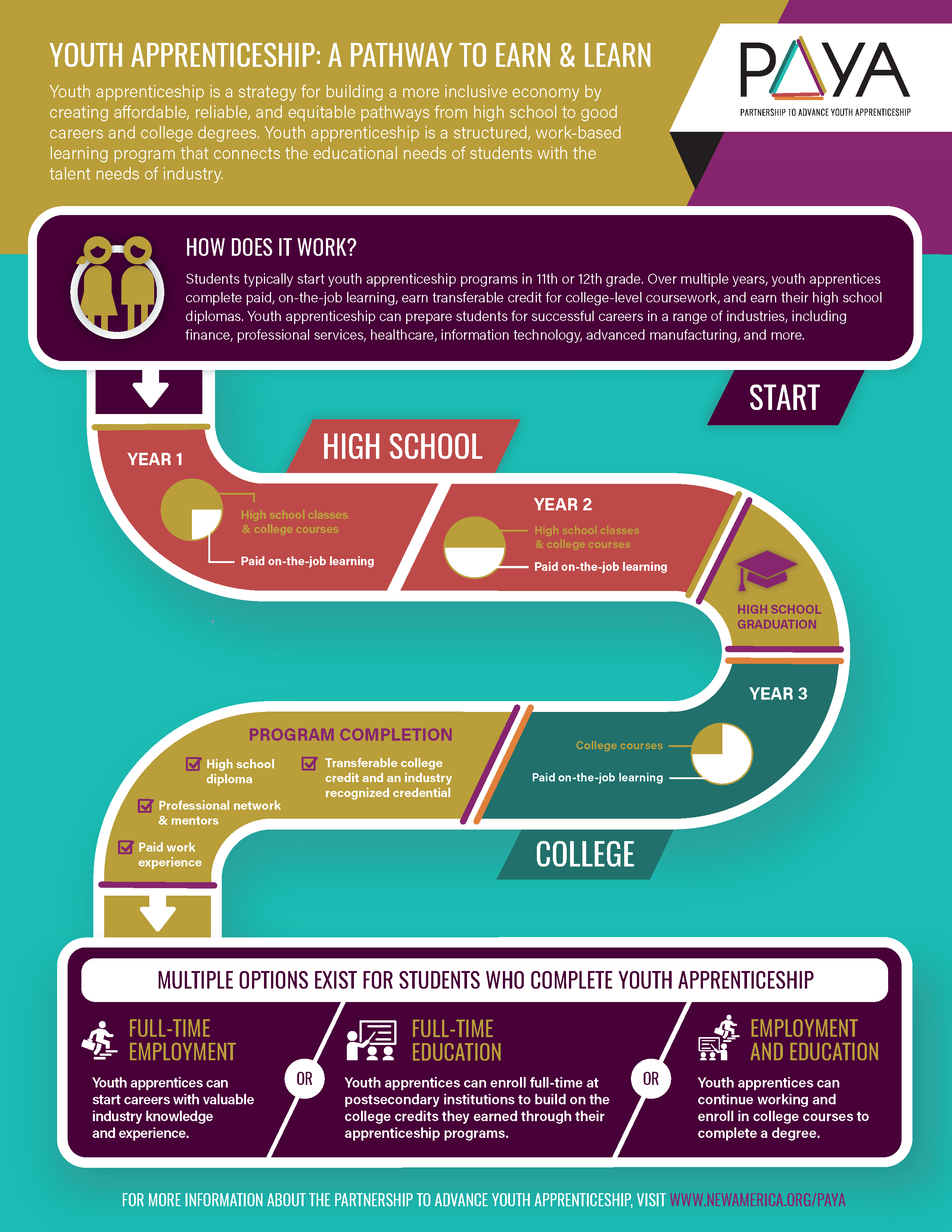
While youth apprenticeship is a new concept within the field of ECE, apprenticeship is not.14 West Virginia’s Child Development Specialist apprenticeship program launched in 1989, and, as of 2020, at least eight states have an early childhood educator apprenticeship.15 The Philadelphia District 1199c Training and Upgrading Fund utilizes a Registered Apprenticeship model,16 and SEIU California Early Educator Apprenticeship program17 developed multiple apprenticeship models designed to accommodate the settings (center, Head Start, or family child care) in which the educator works.18 These apprenticeships have proven to be effective strategies for removing barriers to credentials and starting educators on a path to earning a degree. Programs serving adults like these can be adapted or extended into high schools to prepare new cohorts of educators to enter the field, and interest in adapting them for high school students is growing. There are questions, however, as to how best to benefit both high school students and the young children served by ECE.
Promising Pilot
In 2019, Early Care and Education Pathways to Success (ECEPTS), a sector intermediary focused on the ECE workforce, launched a small youth apprenticeship pilot in Oakland, California to provide “accessible, vital education and career pathways to young people who might otherwise slip through the cracks of an inequitable education system and labor market,” in the words of ECEPTS Executive Director Randi Wolfe. The pilot is based at Castlemont High School which has a child care center on campus and serves a student population that is 70 percent Latinx and 25 percent Black and where 87.6 percent of students qualify for free or reduced-price meals.19 ECEPTS is building on the success of three apprenticeship models that have trained nearly 400 adult apprentices for early childhood educator positions in California since 2015. The youth apprenticeship model is designed to address existing training gaps by offering structured on-the-job learning, dual credit college coursework, and related student support services, without placing the financial burden on students. Ultimately, ECEPTS’ apprenticeship models—including the youth model—seek to recast entry-level ECE positions as springboards to well-paid careers in ECE and other related fields.
The significant early childhood education shortage in California makes it a prime location for a workforce development strategy like apprenticeship. California is home to nearly three million children five years old and younger.20 Only 33 percent of children under five who are eligible for services are enrolled in a program.21 Of those lucky enough to gain access to care, many only receive part-time care, which is insufficient for meeting their developmental needs or the needs of their working families. The shortage is due, in part, to limited funding and difficulty in finding qualified teachers.
Just as early childhood programs need new methods of preparing well-trained educators, Oakland high schools are working hard to prepare young people for graduation, college, and success in today’s economy. Youth apprenticeships offer the opportunity to increase the training and qualifications of candidates for early learning teaching jobs while simultaneously providing a structured, hands-on pathway into the field of education for high school youth. Oakland’s Early Care and Education Youth Apprenticeship program enables students to earn 12 transferable college credits, learn from college professors while still in high school, gain valuable on-the-job experience, and graduate from high school with an industry-recognized certification. Youth apprentices complete a four-course sequence through Berkeley City College. The courses are interdisciplinary, creating a broad pathway into related careers. Significantly, they fulfill general education requirements for the California State University and University of California systems, giving apprentices a debt-free head start on future degree attainment. Youth apprentices complete 150 on-the-job training hours at Kidango, the co-located child care center. Students work alongside a mentor teacher, receive support from the site supervisor, and earn stipends in lieu of wages. The apprenticeship culminates in a California Child Development Associate Teacher Permit, qualifying them for employment as a teacher in a child care program. The permit enables the apprentice to continue working in ECE while they are in college working toward a degree and preparing to move into more senior roles.22
ECEPTS coordinates various partners and provides supports to ensure students complete program requirements. Students have academic tutors to help them with college-level coursework. Success coordinators facilitate access to comprehensive services for the students and their families.23 And a coordinator at the high school ensures students are attending class and completing assignments.
Students benefit from the program in both tangible and intangible ways. It makes high school more enjoyable. Apprentice Darianna Bruzell told participants at a statewide meeting about ECE apprenticeship, “the best thing about the apprenticeship is just working one on one with the kids and building bonds with not only them but their families.”24 Students interested in ECE often have a strong justice focus, and they are attracted to a profession that can change the lives of children and families.25 Apprentice Taylor Sou explained at the same meeting, “I’ve been interested in working with kids since middle school. Because growing up, kids around the community don’t really have access and are deprived of many resources and obtaining rigorous academics. So working with kids gave me the opportunity to be a role model.”26 It also helps students feel engaged in their learning and can serve as a solid foundation for their careers. Bruzell said, “having these opportunities to just get these skills and better myself, apply it and take it with me, and show my sisters they can do it as well….This program is definitely important.”27
Early Lessons
Evaluation data are not yet available to determine if the program in Oakland has been a success. The components of the model are theoretically very strong: it is a supportive, structured pathway for youth to earn no-cost college credits while gaining work experience, a credential, and a jumpstart to a career. It also has the potential to create a new pipeline of talent entering the ECE profession with more training and more classroom experience than typical new entrants to the field receive.28 As efforts to pilot youth apprenticeship in the field continue, questions remain about how to achieve the dual goal of providing high-quality learning opportunities for young children while expanding, rather than narrowing, opportunities for high school students. There are concerns about the equity implications of creating career pathways for high school students, particularly for young women of color from families with low incomes and also immigrant youth, to work in the undervalued and low-paying field of early education. Crossing policy and practice, these concerns surface in early lessons that are emerging from the Oakland pilot and the field as a whole.
1) Mentorship matters.
Educating young children requires specialized knowledge, competencies, and skills.29 Children enrolled in early childhood programs deserve high-quality early learning experiences, since these will form a foundation for all future learning and development. Without proper training and mentorship, placing a teenager who lacks skills, knowledge, or maturity into an early learning setting with vulnerable children runs the risk of squandering important opportunities for young children during critical periods of development. Mentorship and supervision are necessary to ensure the quality of instruction for young children under youth apprentices’ care is not compromised. However, due to limited resources and human capital constraints, child care providers rarely have mentors or instructional coaches on staff. They have limited ability to provide scholarships for their own employees to obtain credentials or degrees, let alone to devote additional resources to a temporary apprentice. Apprenticeship requires an already overstretched mentor teacher and supervisor to supervise, train, and co-teach with a novice who is also an adolescent. Supervisors often have training as either a manager or an educator, but not both.30 Teachers are hired for their knowledge of and ability to work with young children, not teens.
Mentorship and supervision are important for preparing future educators and ensuring work experience is of value. Providing management and coaching support to supervisors and teachers could strengthen the impact of on-the-job training as well as provide opportunities for professional growth for incumbent staff. Apprenticeships should seek employer partners with a record of high-quality care, a commitment to training staff, and a willingness to partner with a high school and an institution of higher education. And those sponsoring youth apprenticeships should invest in instructional coaches to strengthen the quality of care apprentices learn to provide. The goal is for apprentices to learn best practices. If apprenticeships place youth in early learning classrooms of mediocre or poor quality, they risk creating pipelines of ill-prepared future teachers.
2) Learning must be transferable and recognized by the field.
For youth apprenticeship to provide a useful technical foundation and be a launchpad for future credentials and career options, coursework must be credit-bearing, transferable to other programs and institutions, and relevant for and connected to on-the-job learning. Apprenticeship program sponsors should carefully select coursework and course sequencing to ensure apprentices are gaining a deep understanding of child development and instructional practice. Institutions of higher education must be able to identify instructors willing to adapt their teaching for high school students, while maintaining college-level rigor. And, the program of study should be aligned with state or national professional standards and competencies for early childhood educators.31 To support students who will continue in the field, apprenticeships should seek higher education partners with articulation agreements so that coursework, credits, and degrees transfer between institutions.32 They should ensure that degrees or credentials are portable between jurisdictions and qualify the recipients for employment in various child care settings. And it is critically important to provide financial support for tuition, fees, and books.
One current strategy to support high schoolers in gaining training and skills valued by employers is career and technical education (CTE). A seamless pathway that includes a mix of high school and postsecondary CTE courses could also provide the training students need to be technically proficient to succeed in entry-level ECE roles. But there is reason to doubt high school CTE courses have the same rigor as courses taught by professors from institutions of higher education with specialized knowledge of child development or ECE. While there are some exceptions, high school CTE courses in education are also unlikely to be connected via dual enrollment or articulation agreements to an institution of higher education or feed directly into high-quality ECE degree programs or career pathways. It is important that youth apprentices earn some college credit through their program. Exposure to college-level work may increase the likelihood they earn additional credits and credentials in the future. No-cost or low-cost credits give them a head start and may be especially beneficial for high school students from under-resourced communities or first-generation college students.
3) Pathways must lead to higher wages.
Apprenticeship providers seek to create pathways for high school youth into jobs with family-sustaining wages. With a median annual wage of $30,520, ECE does not meet the mark.33 Given this reality, it is important to construct pathways that guard against and confront the field’s compensation and career advancement limitations. Even if the credential a high school graduate earns in an apprenticeship does not qualify him or her for a family-sustaining wage, it should stack to another credential or degree that will.34 The credential, permit, or license should be recognized at the state or national level and be portable across employers, whether child care, pre-K, Head Start, or school district. Higher education courses should articulate to a degree that would be a valuable foundation in several related professions.
However, this is easier in theory than in practice. Designing a clear career path in early education can be difficult due to the fragmented nature of the profession. There is not a standard career pathway to a common goal with which all youth apprenticeships can align. Staff qualification requirements are largely set at the state level and vary by funding stream, age of children served, setting (whether the program is center-based or home-based), program size, and quality ranking.35 A movement is underway in the ECE field to create a national, unified framework which requires licensure and standardizes three designations (ECE I, ECE II, ECE III), credential or degree requirements for each designation, and which jobs each of the three should apply to.36 Youth apprenticeships, especially those in states with minimal educator qualification requirements, can align their career pathways with these proposed designations or existing industry-recognized credentials.37 Further, these standardized designations may make it easier for apprenticeship programs to pursue Registration with the U.S. Department of Labor or relevant State Apprenticeship Agencies. The process of registering programs can support the portability of skills and competencies across employers.
As important as it is to create pathways with clear trajectories for youth apprentices, doing so comes with risks for the field of early childhood education. Designing apprenticeships so that high schoolers are not meant to stay in the job systematizes inherent churn in entry-level positions. Systemic churn could inadvertently complicate important efforts to professionalize the ECE workforce, improve job quality, and increase compensation. Here too, Registration can offer benefits. Registered Apprenticeship programs guarantee wage progression,38 minimum training hours, minimum mentorship hours, and apprentice-to-skilled employee ratios. These legal requirements ensure apprenticeship is being used as a true training and development investment.
4) Coordination is crucial.
Decades of underinvestment and fragmentation have left ECE providers without many of the resources needed to independently operate quality youth apprenticeship programs. Intermediaries contribute necessary capacity and expertise to ensure programs lead to positive outcomes both for young children and youth apprentices. The intermediary is critical for organizing a coherent, packaged program for youth with a clear pathway to a diploma, job, and postsecondary credits. The intermediary plays an important role navigating the different requirements of the apprenticeship, high school graduation, and college enrollment. A networked team is needed to provide tutoring, case management, and access to comprehensive services.39 There must be coordination between high school teachers, college instructors, mentors, and job site supervisors to ensure the theory learned in the courses is linked with and applied to practices in the classroom.40 Without additional resources and support from a strong intermediary organization, it is unlikely a typical early childhood program could independently provide the coordination, strong mentorship, and postsecondary opportunities that define a high-quality youth apprenticeship.
For an apprenticeship in ECE, the intermediary must take on the additional task of ensuring the educator preparation program is of high quality. Youth apprenticeships must include experts in ECE in their design and execution. To ensure the quality of the apprenticeship program itself, it should seek program accreditation.41 And, opportunities to evaluate and improve each component of the apprenticeship program should be built into program design. Partners in youth apprenticeship have inherently different, and sometimes competing, objectives. An intermediary is important for holding the program accountable for results. In ECE youth apprenticeship, that means the intermediary must monitor success for both young children and youth apprentices.
Looking Ahead
A year into the Oakland pilot program, ECEPTS is making significant changes to its approach and launching programs in two additional parts of the state—Southern California and the Central Valley. In the revamped model, community colleges will lead the program so it is embedded within a postsecondary degree pathway. Apprentices will begin taking courses and completing on-the-job hours while in high school and, once they graduate, move directly into postsecondary degree programs while they continue to gain work experience. The revamped program, which will be registered with the U.S. Department of Labor, will span four years. After high school, apprentices will continue their studies and on-the-job training through the SEIU California Early Educator Apprenticeship program, earning an associate degree and a California Master Teacher Permit. The partnerships will include multiple high schools and school districts. The partnerships will also add a new career strand in social services and increase the types of employers to include not only child care providers, but also social services employers like the Los Angeles County Department of Children and Family Services.
High-quality programs that manage to address the lessons identified above have the potential to deliver positive change for youth and the field of ECE. Apprentices gain exposure, experience, and credits toward a degree in ECE or related field. The field of early childhood gains the chance to cultivate new entrants to the field with more education, training, and teaching experience than a typical novice teaching assistant. Apprenticeships also create stronger linkages between the early childhood sector and other public education and training institutions like high schools, community colleges, and universities. ECE programs have very limited resources and may benefit from new funding from labor or workforce sources to support apprenticeships. Adding cohorts of youth apprentices can create the economies of scale that enable institutions of higher education to hire ECE faculty and develop and sustain ECE majors with coursework aligned with state standards for early childhood educators and permit or licensure requirements.
Investing in youth apprentices may garner returns for ECE employers as well. The training apprentices receive can help providers meet benchmarks set by a state to allow them to receive higher levels of payments per child.42 New revenue may enable a provider to hire an instructional coach to support not only the apprentice but the whole staff. Creating new coach and mentor positions offers opportunities for career advancement for incumbent staff. Adding apprentices to the staff enables employers to increase their adult to child ratios and provide more individualized support to children. For employers able to pay a decent wage, it could serve as an incentive for the apprentice to continue working in ECE while they are in college.43 Apprentices who have a positive experience may elect to stay with an employer, which would benefit young children, who thrive on continuity, and employers, who would retain qualified staff trained in their model.44
The COVID-19 pandemic and related economic recession are hitting ECE educators and young people, especially people of color, hard: 20 percent of child care workers lost their jobs45 and youth unemployment significantly outpaced unemployment for more experienced and educated workers.46 Youth apprenticeship in ECE may offer a near-term solution with long-term benefits. In the short-term, high school students may benefit from intermediary organizations supporting them to stay connected to school, college, jobs, and support services. In the long-term, by obtaining training and working toward a credential, they will be more competitive when the job market improves. With COVID-19 knocking out nearly half of the nation’s child care supply,47 economic recovery will require child care providers to have access to pipelines of well-trained early childhood educators. Oakland is one community attempting to solve its early childhood educator shortage by cultivating pipelines of well-prepared early educators that start in high school. Now, more than ever, the nation needs to test strategies like youth apprenticeship to find new ways to respond to teacher shortages and reopen child care to support economic recovery.
Abstract
Youth apprenticeship has emerged as a potential strategy to recruit and train a new generation of early childhood educators. But there are challenges to designing apprenticeships that provide equitable, high-quality learning opportunities for both the high school students and the young children with whom they would work. This report takes a close look at how the youth apprenticeship pathway is working to support high school youth and meet the growing needs of the early educator workforce.
Acknowledgments
I am grateful to Randi Wolfe, president of Early Care and Education Pathways to Success (ECEPTS), for sharing how the Oakland Early Care and Education Youth Apprenticeship program developed and for reviewing an early draft of the program profile. Thank you to Joya Chavarin, Tasha Henneman, and Lisa Cook of Berkeley City College for their participation in interviews. We appreciate Tasha Henneman and students of Castlemont High School participating in the youth apprenticeship program for welcoming us into their class and sharing their perspectives. Thank you to Pamm Shaw and Daryl Bright of the YMCA of East Bay and Meaghan Sullivan of CareerWise Colorado for participating in interviews. This report benefitted from the expertise and feedback of Elena Silva, Taylor White, Laura Bornfreund, and Brent Parton. Sabrina Detlef, Riker Pasterkiewicz, Joe Wilkes, Hana Hancock, and Fabio Murgia provided editing, layout, and communication support. Joyce Hwang provided research support. Sources of information for this report include grant proposals, interviews, meeting notes, site visits, and correspondence with the Oakland Early Care and Education Youth Apprenticeship program leaders. The youth apprenticeship definition and graphic were originally published by the Partnership to Advance Youth Apprenticeship. This report was funded by the Carnegie Corporation of New York. The views expressed in this report are those of the author and do not necessarily reflect the view of the foundation.
Downloads
Citations
- In the field of education, apprenticeship is considered a Grow Your Own (GYO) workforce development strategy. New America defines GYO as partnerships between educator preparation programs, school districts, and community organizations that recruit and prepare local community members to enter the teaching profession and teach in their communities. For more on this teacher preparation model, see our Grow Your Own Educators resource collection, https://www.newamerica.org/education-policy/grow-your-own-educators/
- The U.S. spends less than half the average of what other industrialized countries pay for quality ECE. On average, OECD countries spend about 0.8 percent of GDP on ECE. In contrast, the U.S. spends 0.5 percent of GDP. To learn more about how ECE is funded, visit Transforming the Financing of Early Care and Education: A Multimedia Guidebook., https://www.newamerica.org/education-policy/reports/transforming-financing/putting-it-into-context
- Rasheed Malik, Katie Hamm, Leila Schochet, Cristina Novoa, Simon Workman, and Steven Jessen-Howard, America’s Child Care Deserts in 2018 (Washington, DC: Center for American Progress, 2018), https://www.americanprogress.org/issues/early-childhood/reports/2018/12/06/461643/americas-child-care-deserts-2018/
- Linda Giannarelli, Gina Adams, Sarah Minton, and Kelly Dwyer, What If We Expanded Child Care Subsidies? A National and State Perspective (Washington, DC: Urban Institute, 2019), https://www.urban.org/sites/default/files/publication/100284/what_if_we_expanded_child_care_subsidies_3.pdf
- One study estimates that most American children are enrolled in programs of poor to fair quality, with less than 10 percent in programs of very high quality. National Institute of Child Health and Human Development, The NICHD Study of Early Child Care and Youth Development: Finding for Children up to Age 4.5 Years (Washington, DC: National Institutes of Health, 2006), https://www.nichd.nih.gov/sites/default/files/publications/pubs/documents/seccyd_06.pdf
- Power to the Profession Task Force, Unifying Framework for the Early Childhood Education Profession (Washington, DC: NAEYC, 2020), http://powertotheprofession.org/unifying-framework/
- LaRue Allen and Bridget B. Kelly, eds., Transforming the Workforce for Children Birth through Age 8: A Unifying Foundation (Washington, DC: The National Academies Press, 2015), https://www.nap.edu/read/19401/chapter/17#423
- Lindsay Oncken, “The First Pillar of Care: Cost,” in The Care Report, ed. Brigid Schulte and Alieza Durana (Washington, DC: New America, 2016), https://www.newamerica.org/in-depth/care-report/first-pillar-care-cost/
- Marcy Whitebook, Caitlin McLean, Lea J. E. Austin, and Bethany Edwards, Early Childhood Workforce Index 2018 (Berkeley, CA: Center for the Study of Child Care Employment, 2018), https://cscce.berkeley.edu/files/2018/06/2018-Index-Executive-Summary.pdf
- Whitebook, McLean, Austin, and Edwards, Index.
- Casey J. Totenhagen, Stacy Ann Hawkins, Deborah M. Casper, Leslie A. Bosch, Kyle R. Hawkey, and Lynn M. Borden, “Retaining Early Childhood Education Workers: A Review of the Empirical Literature,” Journal of Research in Childhood Education 30, no. 4 (September 2016): 585–599, in Amy M. Roberts, Kathleen C. Gallagher, Susan L. Sarver, and Alexandra M. Daro, Early Childhood Teacher Turnover in Nebraska (Nebraska: Buffett Early Childhood Institute at the University of Nebraska, 2018), https://buffettinstitute.nebraska.edu/-/media/beci/docs/early-childhood-teacher-turnover-in-nebraska-new.pdf?la=en
- Center on Education & Skills at New America (CESNA), Partnership to Advance Youth Apprenticeship (Washington, DC: New America, 2018), https://s3.amazonaws.com/newamericadotorg/documents/PAYA_11x17_v6b-pages3.pdf
- CESNA, Partnership.
- Emily Workman, Earning While Learning with Early Educator Apprenticeship Programs (Washington, DC: New America, 2019), https://www.newamerica.org/education-policy/reports/earning-while-learning-with-early-educator-apprenticeship-programs/
- Alison Lutton, Apprenticeship as a Degree Attainment Strategy for the Early Childhood Workforce (Philadelphia, PA: District 1199c Training and Upgrading Fund, 2018), https://1199ctraining.org/docs/AllisonLutton_ApprenticeshipWhitePaper_formatted090418.pdf
- A Registered Apprenticeship is defined as a proven model of apprenticeship that has been validated by the U.S. Department of Labor or a State Apprenticeship Agency. For more information see the U.S. Department of Labor (website), “What is Registered Apprenticeship?” https://www.apprenticeship.gov/employers/registered-apprenticeship-program
- As of publication, the SEIU California Early Educator Apprenticeship program has suspended some program strands.
- Abby Copeman Petig, Raúl Chávez, and Lea J. E. Austin, Strengthening the Knowledge, Skills, and Professional Identity of Early Educators: The Impact of the California SEIU Early Educator Apprenticeship Program (Berkeley, CA: Center for the Study of Child Care Employment, 2019), https://cscce.berkeley.edu/strengthening-the-knowledge-skills-and-professional-identity-of-early-educators/
- Ed-Data, Education Data Partnership (website), “School Summary: Castlemont High,” http://www.ed-data.org/school/Alameda/Oakland-Unified/Castlemont-High
- Whitebook, McLean, Austin, and Edwards, Index.
- Hanna Melnick, Titilayo Tinubu Ali, Madelyn Gardner, Anna Maier, and Marjorie Wechsler, Understanding California’s Early Care and Education System (Palo Alto, CA: Learning Policy Institute, 2017), https://learningpolicyinstitute.org/product/understanding-californias-early-care-education-system-report
- Interview via Zoom with Pamm Shaw (vice president of Strategic Funding and Partnerships for the YMCA of the East Bay) and Daryl Bright (workforce development success manager for the YMCA of the East Bay), March 18, 2020.
- Interview with Shaw and Bright.
- Darianna Bruzell, “Panel Presentation: Learning from Critical Stakeholders” at Expanding ECE Apprenticeships: A Statewide Convening, Sacramento, CA, February 28, 2020.
- Telephone interview with Lisa Cook (dean of Liberal Arts for Berkeley City College), March 11, 2020.
- Taylor Sou, “Panel Presentation: Learning from Critical Stakeholders” at Expanding ECE Apprenticeships: A Statewide Convening, Sacramento, CA, February 28, 2020.
- Bruzell.
- The unfortunate reality is that 31 states require a high school diploma or less to be a teacher in a center-based setting. For a table with staff qualification requirements, see Table 10-1 on page 424 of Transforming the Workforce for Children Birth Through Age 8: A Unifying Foundation https://www.nap.edu/read/19401/chapter/17#424
- Allen and Kelly, Transforming the Workforce.
- Michael B. Abel, Teri N. Talan, and Marina Magid, Closing the Leadership Gap: 2018 Status Report on Early Childhood Program Leadership in the United States (Wheeling, IL: McCormick Center for Early Childhood Leadership at National Louis University, 2018), https://mccormick-assets.floodlight.design/wp-content/uploads/2019/02/2018-LEAD-Clearinghouse-webbook_04.pdf
- Currently, each state sets professional standards and competencies for early childhood educators. Power to the Profession is a movement led by the National Association for the Education of Young Children to create a single set of standards used nationally. Those standards can be found here: https://www.naeyc.org/sites/default/files/globally-shared/downloads/PDFs/resources/position-statements/professional_standards_and_competencies_for_early_childhood_educators.pdf
- Aaron Loewenberg, Ensuring a Smooth Pathway: Using Articulation Agreements to Help Early Childhood Educators Pursue a BA (Washington, DC: New America, 2018), https://www.newamerica.org/education-policy/reports/ensuring-smooth-pathway/
- U.S. Bureau of Labor Statistics (website), Occupational Outlook Handbook: Preschool Teachers, https://www.bls.gov/ooh/education-training-and-library/preschool-teachers.htm#tab-5
- Apprenticeship programs in nursing follow a similar logic. They offer a nursing assistant credential, which only qualifies a person for a low-wage job, but are built on the logic that the credential stacks to allow the student to become a licensed nurse, a high-wage and high-demand occupation.
- Staff qualifications for Head Start and Military Child Care are set at the federal level.
- Power to the Profession Task Force, Unifying Framework.
- Like the Child Development Associate (CDA).
- As an apprentice builds new skills through training, their wages must increase as they work toward the status of fully skilled employee.
- Interview with Shaw and Bright.
- Interview via Zoom with Joya Chaverin and Tasha Henneman (instructors from Berkeley City College) March 17, 2020.
- The National Association for the Education of Young Children awards accreditation to early childhood degree programs that demonstrate evidence of excellence. For more information, visit https://www.naeyc.org/accreditation/higher-ed/accreditation
- Presentation from Brenda Hagan (project specialist with Kentucky Governor's Office of Early Childhood), at PAYA Educator Pathway Working Group Meeting #1 held virtually on March 4, 2020.
- Interview with Shaw and Bright.
- Hagan presentation, March 4, 2020.
- U.S. Bureau of Labor Statistics (website), Table B-1. Employees on Nonfarm Payrolls By Industry Sector and Selected Industry Detail, https://www.bls.gov/news.release/empsit.t17.htm
- Taylor White, “Young Adults Need Targeted Support in Recovery Efforts,” EdCentral, April 10, 2020, https://www.newamerica.org/education-policy/edcentral/young-adults-recovery-efforts/
- Steven Jessen-Howard and Simon Workman, “Coronavirus Pandemic Could Lead to Permanent Loss of Nearly 4.5 Million Child Care Slots,” Center for American Progress, April 24, 2018, https://www.americanprogress.org/issues/early-childhood/news/2020/04/24/483817/coronavirus-pandemic-lead-permanent-loss-nearly-4-5-million-child-care-slots/
More About the Author

Cara Sklar
Director, Early & Elementary Education
Issues
Programs/Projects/Initiatives
Topics
Related


Ten Education and Work Issues at Stake in the 2024 Election