A Chapter of: Use It or Share It
II. Major Recent Precedents for “Use-it-or-Share-it”
In recent years the FCC has adopted several important precedents that explicitly or implicitly incorporate a use-it-or-share-it approach. These innovative rulemakings and the evolution of automated frequency coordination databases demonstrate the enormous potential for a more widespread application of a use-it-or-share-it authorization to enhance spectrum access, efficiency, and innovation. The commission has adopted use-or-share rules twice since 2014 in flexible use bands: The CBRS rules for the 3.5 GHz band, which coordinates licensed-by-rule use of locally-unused licensed (PAL) spectrum, and continued unlicensed use of unused spectrum in the 600 MHz band following the TV incentive auction. These use-it-or-share-it rules are operational and coordinated by automated frequency coordination systems that have not in any way impeded the deployment of CBRS or 600 MHz networks by the primary licensees.
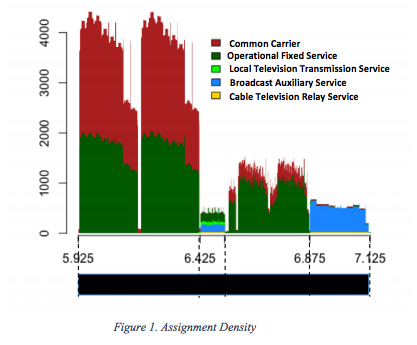
In April 2020 the FCC’s historic order opening 1,200 megahertz of spectrum across the entire 6 GHz band (5925-7125 MHz) marked a third unique advance in applying the principle of use-it-or share it. Unlike both TVWS and CBRS—and also unlike the generally dedicated unlicensed bands at 2.4 and 5 GHz—unlicensed sharing in 6 GHz is effectively an underlay that takes advantage of the fact that although the entire band is occupied by tens of thousands of users, the vast majority of the spectrum capacity lies fallow. Unlicensed use on a shared basis is premised on protecting incumbents by requiring devices operating at standard power to be controlled by an automated frequency coordination (AFC) system certified by the FCC.
Advances in geolocation database coordination have been foundational to the FCC’s willingness to adopt dynamic use-or-share rules that have unlocked enormous spectrum capacity—particularly in rural and underserved areas—while simultaneously protecting incumbent licensees from harmful interference. Database coordination of spectrum is nothing new. For example, the manual coordination of band sharing between fixed terrestrial links and Fixed Satellite Service (FSS) earth stations has gone on for decades. What is new are the significant improvements in the algorithms and computational power needed to efficiently and rapidly complete propagation analysis and coordinate users in near-real time. The evolution in database coordination from manual and static frequency coordination to automated and dynamic geolocation that takes terrain, power level, antenna directionality, and other factors into account creates the potential to authorize at least temporary access to virtually any unused spectrum on a very granular, localized level.8
The automation of coordination won’t always be worth the cost, but that’s a decision best left to the aspiring band entrants based on market factors. Moreover, the feasibility of employing database coordination to enable more intensive sharing of additional bands is steadily increasing as the cost is decreasing. To the extent that an infrastructure of AFC systems is already in operation (e.g., in CBRS and in 6 GHz), this makes its application to new bands more of a marginal cost. In addition, as described in the final subsection below, FCC authorization of opportunistic or temporary use of available spectrum does not require a database mechanism, or sensing technology, to enable it on a large scale. AFCs simply automate manual coordination, but depending on the band, scale, and costs, manual coordination is also an option. As it did repeatedly during 2020 in response to the pandemic increasing demand for mobile and fixed wireless capacity, the FCC can issue a Special Temporary Access or waiver authorization in response to requests from individual ISPs or other entities. And, as the First Amendment section below maintains, the commission is obligated to do so unless it articulates a substantial and important reason why doing so, on balance, does not serve the public interest.
A. TV White Space and Post-Auction 600 MHz: The First Automated Coordination of Use-or-Share
In 2014 the FCC adopted a use-it-or-share-it approach to authorize continued unlicensed use of the post-auction 600 MHz band following the TV incentive auction. This built on the TVWS rules adopted unanimously by the commission in 2010, under which both fixed and mobile broadband devices are authorized to operate on an unlicensed basis on unoccupied TV channels provided that the devices have GPS and the capability to periodically check an online geolocation database of available channels or frequencies in that discrete geographic location. 9 TV Bands Databases (TVDBs) are certified by the commission to coordinate unlicensed use with the primary licensees, a FCC innovation that is spreading worldwide.10 By applying algorithms to inputs (e.g., geolocation, power level, incumbent channel assignments) the TVDB can manage opportunistic access to ensure no interference to the primary licensed services. For example, low-power TVWS devices are able to operate closer in frequency to incumbent TV stations than higher-power, wide area devices that pose a greater risk of interference.
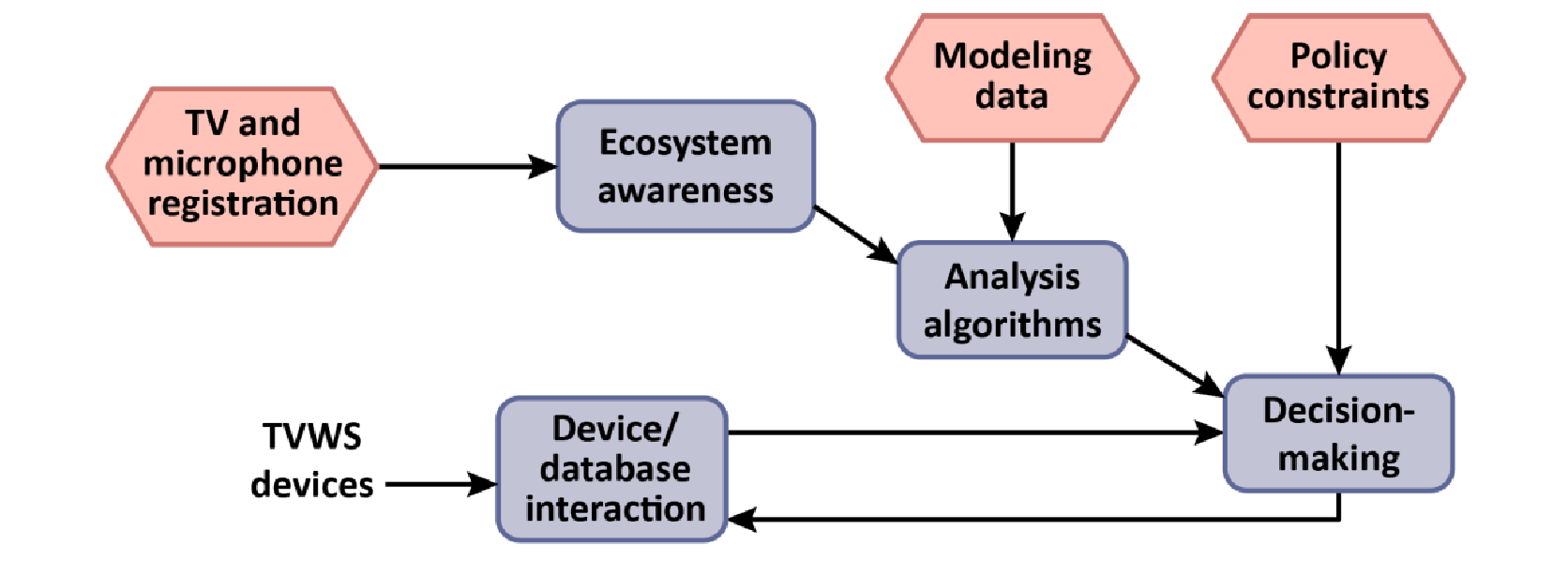
Simplified admission control system architecture for Television Whitespace Database (TVDB).11
As part of the innovative incentive auction framework that reallocated 14 TV channels (84 megahertz) for mobile and flexible use, the commission in 2014 authorized the continued operation of unlicensed TVWS devices in any locally unused 600 MHz spectrum following the auction.12 In effect, this use-or-share rule expanded the scope of opportunistic sharing in the former TV spectrum. The original TVWS rules limited unlicensed users to the vacant channels between occupied TV channels.13 On a localized basis, unlicensed TVWS devices can now operate indefinitely in any unused portions of the exclusively-licensed 600 MHz band until the licensee notifies a certified TVDB that it is ready to commence service in that specific area. Since TVWS devices must renew their permission to transmit by checking the TVDB at least every 24 hours, the new mobile carrier licensees are guaranteed that the spectrum will always be available when they are ready to actually use it.
In adopting opportunistic access to unused 600 MHz spectrum post-auction, the FCC in its 2014 TV band incentive auction Report & Order stated:
We will permit the continued operation of TVWS devices on repurposed spectrum except in those areas in which a 600 MHz Band licensee commences operations. . . . TV bands databases . . . can serve to ensure that unlicensed operations will no longer occur on a channel on which a licensee has commenced service. When a 600 MHz Band licensee plans to commence operations . . . that licensee can notify any of the TV bands database administrators when and where it plans to commence operations.14
The Incentive Auction Order noted that AT&T did not oppose continued TVWS operations on a use-or-share basis provided it is “subject to strict enforcement mechanisms, and any unlicensed user would have to commit unequivocally to clear the spectrum immediately once the licensed operator is ready to make use of it.”15
B. Citizens Broadband Radio Service: Dynamic, Three-tier Spectrum Sharing
The most unique and innovative advance in dynamic spectrum sharing arose from the FCC’s 2015 Citizens Broadband Radio Service (CBRS) spectrum sharing framework, a landmark initiative in spectrum policy. The commission adopted CBRS rules on a bipartisan basis, establishing a unique three-tier sharing framework of licensed and opportunistic (unlicensed) access to unused U.S. Navy spectrum in the 3550–3700 MHz band.16 Multiple and competing geolocation database systems—known as Spectrum Access Systems (SAS)—coordinate dynamic spectrum sharing by a three-tier hierarchy of users made up of incumbent licensees (U.S. Navy radar services), Priority Access Licenses (PALs), and opportunistic (effectively unlicensed) General Authorized Access (GAA) users. Incumbent services are fully protected by the SAS, which ensures that GAA use causes no harmful interference to incumbent licensees (Navy radar and some FSS earth stations).17
The CBRS rules marked the second time the FCC authorized opportunistic access to unused flexible use spectrum, in this case both before and indefinitely after the PAL auctions that concluded in August 2020. GAA use of unused PAL spectrum in a local area must be granted by a SAS, ensuring the opportunistic use will not interfere with the priority access licensee. The SAS database thereby facilitates—on an automated basis at low cost—the spectrum sharing needed to ensure that all the spectrum in the 3.5 GHz band is available for use. The FCC retained the use-it-or-share-it rules when it changed the CBRS auction rules in 2018, stating in the Report and Order that “[t]argeted use cases are already encouraged by the ‘use-or-share’ nature of the band and the GAA tier.”18 A conceptual diagram of the SAS, its inputs and how it synchronizes with other certified SASs is below.
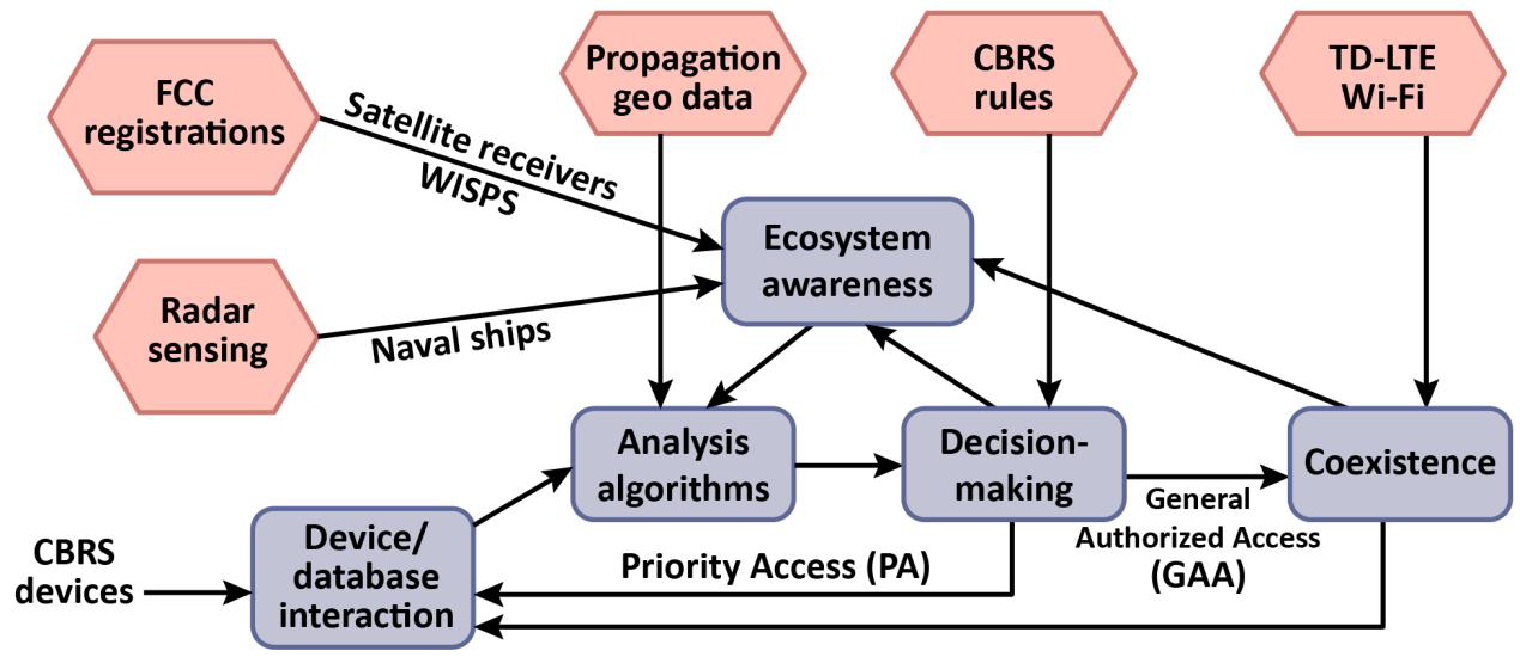
Control system architecture for three-tier, FCC-certified Spectrum Access System.
The commission stated that opportunistic access to PAL channels served the public interest by providing spectrum directly to “a wide variety of users, deployment models, and business cases, including some solutions to market needs not adequately served by our conventional licensed or unlicensed rules,” including small rural providers as well as enterprise, campus, and industrial users.19 The CBRS framework, and specifically the SAS, facilitates more intensive use of the 3.5 GHz band currently without imposing any costs on licensees, especially in the rural areas that are generally the last to experience licensed deployments. Under the rules, both large and small ISPs, entertainment venues, enterprise users, utilities, schools, and other new market entrants can gain competitive access to spectrum in the band whether or not they acquire one or more PALs.
To date, the FCC has certified five competing SAS systems.20 Since initial commercial deployments began in late 2019, the SAS has proven to be effective at coordinating GAA and PAL use of the band, while protecting U.S. Navy operations. The PAL auction included by far the largest and most diverse field of bidders for any FCC auction: 271 qualified bidders and 228 different winning bidders took part.21 The auction generated $4.6 billion, which reflected an amount directly in the expected range of revenue.22
As suggested by the diagram above, the SAS implements near-real-time automated frequency coordination, relying on inputs from both users and incumbents to grant and renew permission to operate in a given location:
Because each SAS has a ‘map’ of all deployments on the seven PAL channels, it can facilitate opportunistic GAA use of vacant PAL spectrum in discrete geographic areas on a ‘use-it-or-share-it’ basis. In the CBRS band, licenses (PALs) ensure interference protection for deployed nodes, but confer no right to exclude opportunistic users (GAA) when and where the spectrum is not in use. This discourages spectrum warehousing and ensures the band is used as intensively as possible, which is particularly important for rural and other less densely-populated areas where PALs may not be fully built out.23
C. The 6 GHz Band: An Unlicensed, Use-or-Share Underlay Across 1,200 Megahertz
In April 2020, the FCC unanimously adopted rules which marked the largest expansion of unlicensed spectrum access, as well as by far the largest authorization of opportunistic spectrum sharing. Overall, the commission opened up a total of 1,200 megahertz for unlicensed use across the four 6 GHz sub-bands (U-NII-5 to U-NII-8) that span 5925 to 7125 MHz.24 The entire 6 GHz is used by licensed services that include fixed point-to-point microwave links (nearly 50,000 links are licensed) and the Broadcast Auxiliary Service. The 6 GHz Order nonetheless authorized massive new capacity for the next generation of Wi-Fi and other unlicensed uses in two distinct ways:
First, all 1,200 megahertz are available for use everywhere on a low-power and indoor-only basis (LPI) without the need for database control or coordination. Because the maximum power level for LPI is roughly one-fourth the maximum standard power for Wi-Fi (which is 4 watts EIRP), the FCC agreed with studies showing that at an even higher power (i.e., a power spectral density of 8 dBm), the indoor-only requirement makes harmful interference to high-powered fixed links and other incumbent both extremely unlikely and likely fleeting.
Second, the 850 megahertz licensed for fixed microwave links (the U-NII-5 and U-NII-7 sub-bands) is authorized for both indoor and outdoor use at standard power, but only if devices are registered and operated under the control of an Automated Frequency Coordination (AFC) system. Like the competing SAS systems in CBRS, the FCC expects to certify multiple AFCs, some of which may be operated by device manufacturers. The AFCs are expected to be far simpler than SAS systems that need to protect shipborne radar, primarily because the incumbents are licensed for fixed locations that rarely change, the location data can be downloaded from the FCC’s Universal Licensing System, and there is no need for the various AFCs to synchronize their data. The AFCs are essentially a real-time look-up database: Either a particular frequency at a particular location is allowed, or it is not.
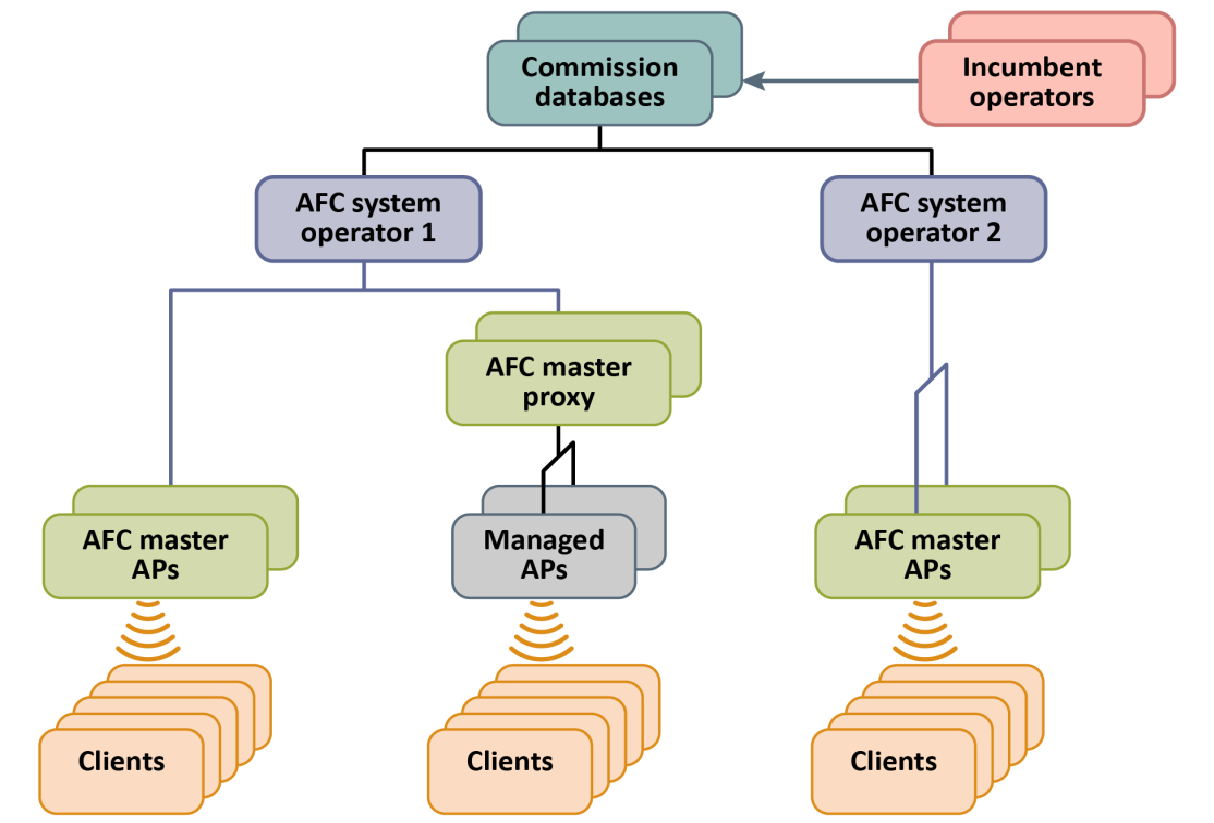
Simplified architecture for Automated Frequency Coordination in 6 GHz band.
Under this more intensive sharing framework, the 6 GHz band will be home to high-power, standard-power, and low-power operations. Low-power devices will be able to operate on an unlicensed basis indoors across the entire 6 GHz band without AFC system coordination,25 while higher powered and standard powered operations can exist in the band subject to permission from an AFC. The AFC systems work in a manner similar to that of TVDBs for TVWS by enforcing protection zones around licensed microwave links that vary depending on the power (and hence the interference risk) of the user. The commission noted:
Because the minimum required separation distance from a fixed service receiver, among other factors, is a function of the access point power, lower power devices do not have to meet as large a separation distance to provide the same level of protection as higher power devices. This means that more spectrum may be available for access points that operate with power levels below the maximum, especially in congested areas where spectrum is more heavily used by the fixed microwave services.26
Notably, the commission requires the incumbent users to ensure the licensing information they report to the Universal Licensing System is accurate and up to date:
… [L]icensees have the responsibility, as well as significant incentive, to maintain the continued accuracy of data in the Universal Licensing System to ensure that they are protected from harmful interference not only from new unlicensed devices, but also from new fixed microwave links that may access the band…. we will require the operators of temporary fixed stations to register the details of their operations . . . in the [ULS] prior to transmission if they desire to be protected from potentially receiving harmful interference from standard-power access points in the U-NII5 and U-NII-7 bands.27
D. 5.9 GHz and 1.7 GHz: Grants of Special Temporary Authorization in Response to Covid-19
In rapid response to the initial pandemic-induced shutdowns, in March 2020 the FCC used its authority to grant STAs to both large mobile and small fixed-wireless broadband providers to help them meet the surging demand for the high-capacity internet access needed for remote work and learning. Although STAs are temporary by definition, they are sometimes renewed over virtually indefinite periods and represent a means by which the FCC, at the staff level, can respond nimbly and affirmatively to individual requests for opportunistic access to unused or underutilized spectrum.
At the very outset of the pandemic, in March 2020, the FCC granted four mobile carriers STAs to unassigned 1.7 GHz spectrum returned to the FCC inventory after they were auctioned.28 The carriers received a renewable 60-day STA and were able to put the spectrum to use immediately because their networks were already using AWS-3 spectrum. The FCC also rapidly approved STAs to use licensed but unused 600 MHz and AWS-4 spectrum, although this occurred with the permission of licensees seeking to assist Covid-19 connectivity efforts.29
Between March and May 2020, the FCC similarly granted STAs to more than 100 wireless internet service providers (WISPs) that authorized secondary, non-interfering use of 45 megahertz of unused spectrum in the lower 5.9 GHz to “provide relief during the state of emergency caused by the spread of COVID-19 throughout the United States.”30 The WISPs were already using the adjacent 5.8 GHz unlicensed (U-NII-3) band to provide fixed wireless service, primarily in rural areas, and reported a 35 percent increase in data traffic during peak hours due to COVID-19.31 The spectrum in that band had been allocated in 1999 for vehicle-to-vehicle safety signaling technology that never deployed at scale and is now outdated.32 And while there are dozens of incumbent deployments, the band has been mostly unused for two decades.
The STAs allowed the WISPs to boost the capacity of fixed wireless deployments that rely on the adjacent unlicensed band (U-NII-3) in mostly rural, small town and historically underserved areas.33 The STAs require WISPs to coordinate with incumbent users to ensure that any base station using 5.9 GHz band is a safe distance away from any incumbent Intelligent Transportation Service (ITS) deployment, which are relatively few and fixed, and therefore easy to protect. The WISPs rely on manual coordination, subject to a minimum 2 kilometer separation distance:
[A STA user] is responsible for ensuring that it does not cause interference to existing licensees. It must review existing DSRC licenses . . . [and] contact each of these affected licensees before beginning operation . . . . It may then begin operation; it need not await a response or approval. If a complaint of interference cannot be timely resolved, operation under this STA must cease. It may not operate within 2 kilometers of any site license, regardless of notification or actual interference.34
If AFC systems had already been certified for the neighboring 6 GHz band, it would have been feasible for the FCC to either require or allow the WISPs to rely on an AFC for automated coordination. In fact, as more bands are designated for automated coordination by agency-certified mechanisms—such as the AFC, SAS, and TVDB systems described above—the easier and more reliable it will be to coordinate use-or-share access to unused spectrum in additional bands.
Use It or Share It
- Executive Summary
- I. Introduction
- II. Major Recent Precedents for “Use-it-or-Share-it”
- III. Major Benefits of a Use-it-or-Share-it Policy
- IV. The First Amendment Imposes Limitations on the Government’s Power to Limit Non-Interfering Use of Spectrum
- V. Operationalizing Harmful Interference: The FCC’s Balancing Approach
- VI. Scarcity to Abundance: Opportunities to Expand Shared Access
- VII. Conclusion
Citations
- For an in-depth overview of the evolution of geolocation database coordination, see Automated Frequency Coordination: An Established Tool for Modern Spectrum Management, Dynamic Spectrum Alliance, at 33 (March 2019) (“DSA, Automated Frequency Coordination”), available at http://dynamicspectrumalliance.org/wp-content/uploads/2019/03/DSA_DB-Report_Final_03122019.pdf. “Regulators can choose to create or authorize an [AFC] system to do any or all of the following functions at scale and at low or no cost to the agency itself: Collect, ingest and regularly update incumbent information from agency licensing records or as provided by NRA rules; Calculate protection contours and other algorithms by applying NRA rules; Verify that all registered device are certified in compliance with NRA rules; Register verified devices and networks, recording any required data on user identity, location, device type, operating parameters; Calculation engine: apply objective algorithms to grant or deny requests for permission to operate for whatever period of time is provided in NRA rules; Optimize coexistence among secondary users, if relevant, based on NRA rules; Collect any usage or regulatory fees authorized or required by the NRA; Capture data and report on actual use of the band, as well as any anomalies that may inform future regulatory action; Maintain the ability to identify and shut down a device or provider in cases of harmful interference or emergency; Dynamically adjust the device admission or operating parameters (in response, for example, to exceeding an aggregate interference threshold in a geographic area). Provide a portal for incumbents and/or users to report corrections or updates to licensing data, operating parameters, or to report incidents of interference.”
- Unlicensed Operation in the TV Broadcast Bands, Additional Spectrum for Unlicensed Devices Below 900 MHz and in the 3 GHz Band, ET Docket Nos. 04-186, 02-380, Second Memorandum Opinion and Order (2010); see also Unlicensed Operation in the TV Broadcast Bands, Second Report and Order and Memorandum Opinion and Order, ET Docket Nos. 04-186, 02-380, (2008).
- Unlicensed access to TVWS, managed by an automated database, has been adopted by the United Kingdom and by an increasing number of countries. See DSA Database Management Report at 21 (“The UK, South Korea and Singapore have working systems managed, as in the U.S., by one or more automated geolocation database operators. South Africa adopted rules in March 2018 and is in the implementation process. Malawi, Ghana and Mozambique had draft TVWS regulations under review as of mid-2018. And more than a dozen other countries have hosted successful TVWS pilots, most enhancing broadband connectivity to schools and in rural areas, including in Colombia, Taiwan, Jamaica, Namibia, Kenya, Tanzania, Trinidad and Tobago, and the Philippines.”).
- This diagram and the two following (in relation to AFCs for CBRS and 6 GHz band sharing) are taken from the Dynamic Spectrum Alliance report, Automated Frequency Coordination, supra note 8, which provides a detailed history of the evolution of database coordination as a tool for spectrum management.
- See Report and Order, GN Docket No. 12-268, at ¶ 680 (rel. June 2, 2014) (“2014 Incentive Auction Order”)
- Even today, TVWS operations are not allowed to operate co-channel to a TV station unless they are located well outside the station’s licensed contour whether or not a TV signal is actually received in a particular area.
- 2014 Incentive Auction Order, supra, at ¶ 680.
- Ibid.
- First Report and Order, Amendment of the Commission’s Rules with Regard to Commercial Operations in the 3550-3650 MHz Band, WT Docket No. 12-354, 30 FCC Rcd 3959 (2015), at 3962 (“2015 CBRS Order”). In its final order in 2016, the FCC summarized the unique purpose of three-tier sharing: “The Citizens Broadband Radio Service takes advantage of advances in technology and spectrum policy to dissolve age-old regulatory divisions between commercial and federal users, exclusive and non-exclusive authorizations, and private and carrier networks.” Order on Reconsideration and Second Report and Order, Amendment of the Commission’s Rules with Regard to Commerical Operation in the 3550-3650 MHz Band, GN Docket 12-354 (2016), available at https://apps.fcc.gov/edocs_attachmatch/FCC-16-55A1.pdf.
- For a general overview of CBRS and the role of the SAS, see, e.g., Commscope, “Spectrum Access System (SAS), Frequently Asked Questions,” available at https://www.commscope.com/solutions/5g-mobile/spectrum-management-solutions/spectrum-access-system-faqs/; FCC, “3.5 GHz Band Overview,” https://www.fcc.gov/wireless/bureau-divisions/mobility-division/35-ghz-band/35-ghz-band-overview.
- Report and Order, GN Docket No. 17-258, at ¶ 37 (Oct. 23, 2018).
- 2015 CBRS Order, 30 FCC Rcd 3959, at 3962. The Order further stated that “permitting opportunistic access to unused Priority Access channels would maximize the flexibility and utility of the 3.5 GHz Band for the widest range of potential users” and “ensure that the band will be in consistent and productive use.” Id. at ¶ 72.
- See WinnForum, “FCC Spectrum Access System (SAS) Administrators,” available at https://cbrs.wirelessinnovation.org/sas-administrators.
- Public Notice, Auction of Priority Access Licenses in the 3550-3650 MHz Band Closes, AU Docket No. 19-244 (Sep. 2, 2020), https://docs.fcc.gov/public/attachments/DA-20-1009A1.pdf.
- Kelly Hill, PALs Auction Wraps Up, Raises More than $4.58 Billion, RCR Wireless News (Aug. 25, 2020), https://www.rcrwireless.com/20200825/spectrum/pals-auction-wraps-up-raisesmore-than-4-58-billion; Joan Engebretson, CBRS Auction Closes After Just 24 Bidding Days, Raising Over $4.5 Billion, Telecompetitor (Aug. 25, 2020), https://www.telecompetitor.com/cbrs-auction-closesafter-just-24-bidding-days-raising-over-4-5-billion/.
- DSA, Automated Frequency Coordination, at 27.
- Report and Order and Further Notice of Proposed Rulemaking, ET Docket No. 18-295, GN Docket No. 17-183 (Rel. April 24, 2020), https://docs.fcc.gov/public/attachments/FCC-20-51A1.pdf (“6 GHz Order”).
- Id. ¶ 97.
- Id. ¶ 36.
- 6 GHz Report and Order at ¶¶ 31-32.
- See FCC, “FCC Grants AT&T and Verizon Special Temporary Access During Pandemic,” News Release and Authorizations (March 20, 2020), available at https://www.fcc.gov/document/fcc-grants-att-and-verizon-temporary-spectrum-access-during-pandemic; Bevin Fletcher, “Verizon Gets Spectrum Boost Via DISH Connections,” Fierce Wireless (March 19, 2020), available at https://www.fiercewireless.com/wireless/verizon-latest-carrier-to-get-spectrum-boost.
- See Press Release, “FCC Provides T-Mobile Temporary Access to Additional Spectrum to Keep Americans Connected During Coronavirus Pandemic” (March 15, 2020), available at https://docs.fcc.gov/public/attachments/DOC-363051A1.pdf; Press Release, “5.9 GHz Band Boosts Consumer Internet Access During Covid-19 Pandemic” (May 4, 2020), available at https://docs.fcc.gov/public/attachments/DOC-364138A1.pdf.
- FCC, Approval of Emergency Request for Special Temporary Authority (March 27, 2020) (“WISP 5.9 GHz STA Grant”), available at https://docs.fcc.gov/public/attachments/DOC-363358A2.pdf. The STAs permitted 33 WISPs to harness the lower 45 megahertz of spectrum in the 5.9 GHz band for 60 days to provide service in the 29 states they serve—primarily rural areas. Press Release, “FCC Grants Wireless ISPs Temporary Access to Spectrum in 5.9 GHz Band to Meet Increase in Rural Broadband Demand During Pandemic” (March 27, 2020), available at https://docs.fcc.gov/public/attachments/DOC-363358A1.pdf.
- Claude Aiken, “FCC 5.9 GHz STA Helps WISPs Serve Through COVID-19 Pandemic,” Claude’s Blog, Wireless Internet Service Providers Association (WISPA) (“WISPA Blog”), available at http://wispa.org/news_manager.php?page=21979.
- Michael Calabrese and Amir Nasr, “The 5.9 GHz Band: Removing the Roadblock to Gigabit Wi-Fi,” New America (July 9, 2020), https://www.newamerica.org/oti/reports/59-ghz-band/.
- WISPA Blog, supra.
- WISP 5.9 GHz STA Grant, supra.