
A Primer on Cash Transfers and Health Equity
This piece features contributions from Lauren Hall, scholar in residence at New America Indianapolis
In the midst of a pandemic, political upheaval, rapid industrial change, and an unraveling social contract between employers and employees, some advocates have begun to argue that measures to stabilize income outside of employment could protect individuals and families. Research has demonstrated clear connections between economic precarity and poor health for both children and adults, often leading to serious challenges to mental and physical well-being for people living in poverty. One innovation that may address this connection between income and health is strengthening the social safety net through guaranteed income.
While most acknowledge that guaranteed income—also known as cash transfers—are not a silver bullet, more and more communities are experimenting with this tool against chronic poverty, and potentially, its worst health implications.
This introduction to cash transfers focuses on developments in guaranteed income in California and the impacts of cash transfers on health. It is intended to be a broad overview of the current state of the movement to implement cash transfers, including the history of cash transfers in the United States, differences in philosophies and practices within the field, what research tells us about the impact of cash on health, and notable current pilot programs in California.
History of Cash Transfers in the United States
While the bulk of the country’s safety net programs currently provide in-kind resources—such as food stamps and public housing—early government-sponsored welfare initiatives in the United States gave people cash. The Mothers Pension Program, which was adopted in most states between 1911 and 1935, acknowledged the public good that mothers provide through caregiving. Scholar Adriana Lleras-Muney writes, “The typical family in the Mother’s Pension Program had about four children and received cash equivalent to about 30 percent of its total income for about three years.” Outcomes for children whose mothers received the payments included longer lives, less likelihood of being underweight, and higher educational and income attainment.
Since then, the cash transfers movement has at times brought together unlikely allies. Famous for his advocacy of free market capitalism, Milton Friedman was a proponent of the idea, in the form of a negative income tax. Alongside Friedman, in their support for similar types of welfare reform were antiracist, feminist activists of the Civil Rights era. As the Stanford Basic Income Lab reports:
Under the anti-poverty programs of the Great Society of the 1960s and 1970s, the elderly, the disabled, and the widowed were deemed worthy of governmental financial assistance, while single mothers and the unemployed poor were blamed for their own poverty. African Americans were often deemed unworthy of assistance and routinely restricted from accessing benefits even when they were eligible. In order to transform the welfare system, many [Black women activists] pushed for a guaranteed income: an income-support that was unconditional, provided generous levels of benefits, and would be granted to all those in need, including unemployed fathers, the working poor, childless couples, and single individuals.
Martin Luther King, Jr. also became an advocate for guaranteed income, helping build enough momentum that President Richard Nixon proposed a guaranteed income init. This project never got off the ground, in part because, as the Stanford Basic Income Lab writes, “Politicians would go on to use the trope of the welfare queen, as well as other racialized stereotypes, to decrease overall support for public assistance and to enforce policies that systematically excluded African-American citizens.” However, interest in the intervention remained, and there were notable place-based experiments from the 1960s through the 1980s, largely to test whether cash impacted recipients’ participation in the labor market. Since then cash transfer projects have taken place from Alaska to New York City, (and, outside of the United States, on every continent except Antarctica). Notable examples measuring health impacts include:
- 1996: Eastern Band of Cherokee Indians Casino Dividend, giving ongoing disbursements to tribe members, with measurable improvements in childrens’ life outcomes and psychological health
- 2007: Opportunity NYC Family Rewards Demonstration, which transferred an average of almost $9,000 to New York families over three years, conditioned on their meeting requirements related to employment, education and preventive health care
- 2016: Dolly Parton's My People Fund, which provided $1,000/month for six months to survivors of wildfires in Tennessee
- 2019: Baby’s First Years, providing $333/month for three years to low-income mothers of young children in New York City, New Orleans, Minneapolis/St. Paul and Omaha, and collecting information about child health and development
- 2020: The Magnolia Mothers Trust, currently providing $1,000/month for a year to Black mothers living in poverty in Jackson, Mississippi, and collecting data on health and family well-being
Recent, high-profile supporters of various forms of cash transfers have included the Economic Security Project, the Movement for Black Lives, former Stockton Mayor Michael Tubbs and the leaders engaged in his Mayor initiative, and presidential and mayoral candidate Andrew Yang.
Differing Perspectives and Models
The topic of guaranteed income tends to elicit strong feelings from both proponents and opponents (Gentilini et. al 2020; Calnitsky 2018). Some opposed to guaranteed income policies worry that cash could lead to decreased labor market participation, could provide workers with an undue advantage in brokering with employers, or that guaranteed income is simply morally misaligned with the idea that one should have to work to earn money. Other opponents argue that payments would not make a real difference in the lived experiences and outcomes of families experiencing poverty, or that the income floor provided by cash transfers could cause inflation due to increased demand, thereby not actually leading to an improved standard of living Some question the level of choice provided to recipients, and whether it could lead to the money being spent on items they do not consider necessities (Economist 2020; Gentilini et. al 2020; Calnitsky 2018; Steensland 2018), which highlights the historical and present trend in American social, political, and cultural life which distinguishes between a “deserving” and “undeserving” poor (Steensland 2018).
In contrast, advocates argue that individuals are the experts on how to best spend their money and that—with the increased choice provided by guaranteed income—recipients can make the highest impact decisions for their own lives, such as opting for better educational and career development opportunities that will improve their longer-term well-being and economic stability. This, in turn, could lead to a better trained and more entrepreneurial workforce, could ensure that adults can care for children and elders without having to sacrifice the wages needed to meet their families’ basic needs, and could enable greater autonomy for workers to advocate for fair pay and equitable conditions. Many also suggest that guaranteed income would decrease bureaucracy, allowing governments to spend less money on administering benefits (Gentilini et. al 2020; Calnitsky 2018). They argue that, instead of causing inflation, guaranteed income policies could help stabilize the economy in times of recession (Gentilini et. al 2020; Calnitsky 2018) and could be used to address racial wealth gaps (Economist 2020). The economic and racial reckonings prompted by COVID-19 has spurred a noticeable increase in the number of individuals who support GI programs, particularly among politically conservative individuals (Economist 2020).
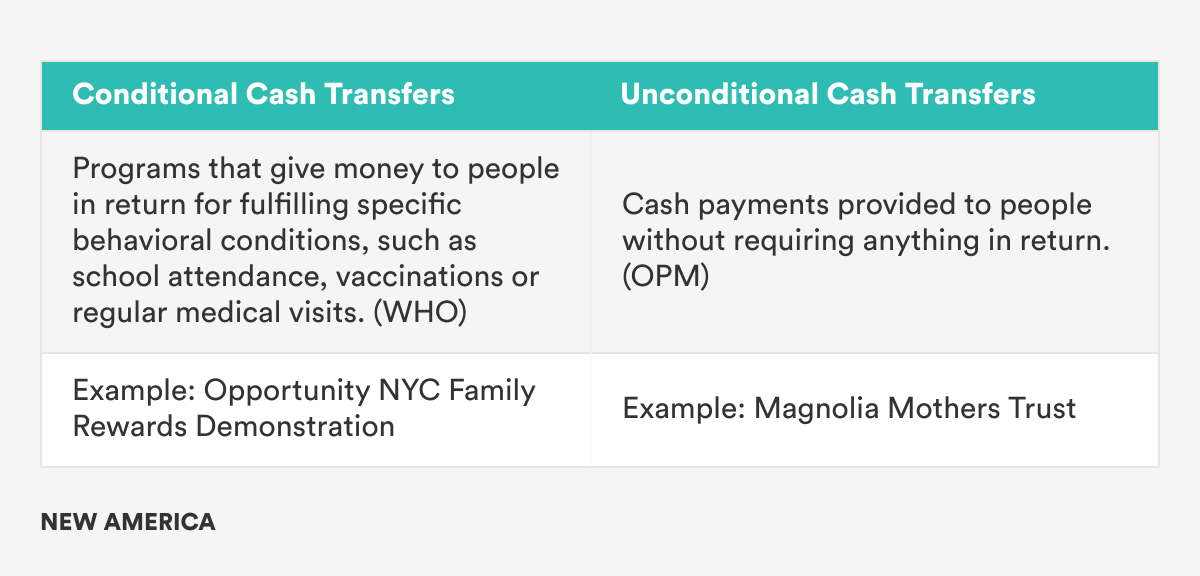
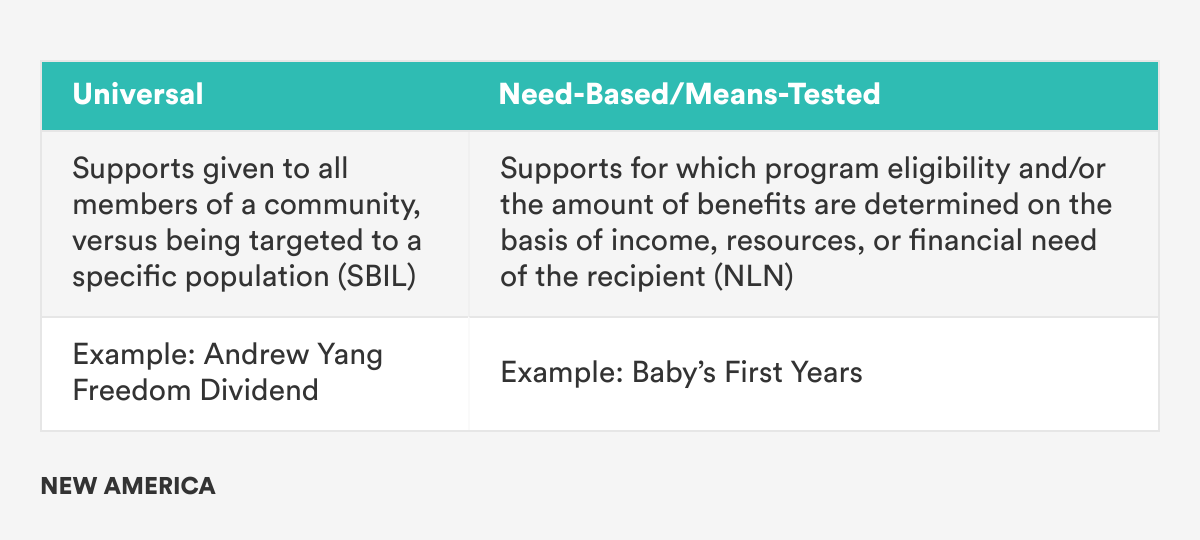
However, even among cash transfer supporters there is a broad range of philosophies about how the intervention should work. There are many models for who should receive cash support and for how long. Some common approaches are outline below:
Conditionality
Targeting
Duration
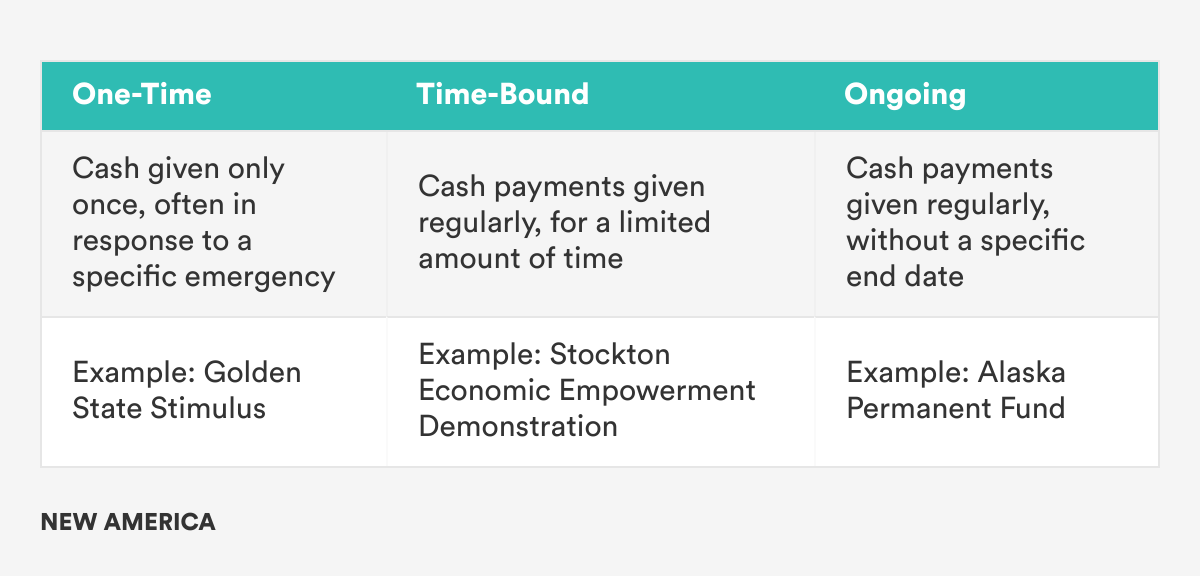
Universal basic income (UBI), possibly the most well-known concept in cash intervention, in some ways represents an extreme within cash transfers models, in that it is unconditional, universal, and ongoing. However, while the COVID-19 pandemic has provided new momentum to the cash transfers movement, much of this development has veered away from a truly universal basic income, focusing instead on one-time, time-bound, and targeted approaches. Some one-time efforts spearheaded by California-based leaders include Gov. Newsom’s (D-Calif.) Golden State Stimulus, FreeFrom’s Safety Fund, The Workers Lab’s The Workers Fund, and SaverLife’s Emergency Response Fund.
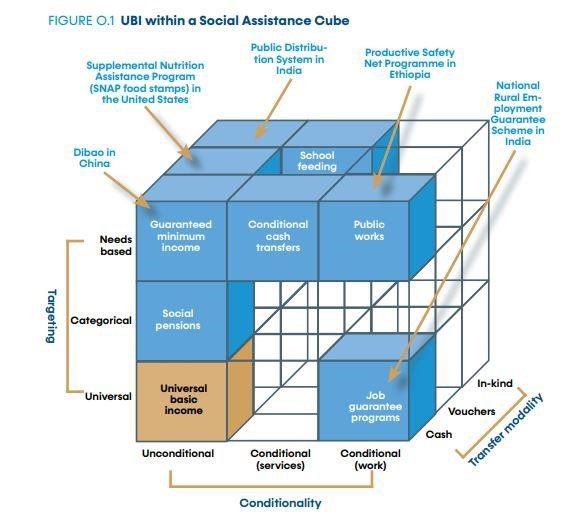
http://documents1.worldbank.org/curated/en/993911574784667955/pdf/Exploring-Universal-Basic-Income-A-Guide-to-Navigating-Concepts-Evidence-and-Practices.
Current Guaranteed Income Programs in California
California was at the forefront of the guaranteed income movement even before the pandemic ushered in a wave of new cash transfers efforts.
California policy context for guaranteed income includes two notable pieces of legislation, AB 2712 and AB 65, both put forth by Assemblyman Evan Low (Calif.-28). AB 2712, introduced in February 2020, proposed that every California resident over the age of 18 receives $1,000 a month. The California Universal Basic Income Program (CalUBI) was to be funded by a 10 percent value-added tax (VAT) on goods and services that are not medical or education based.
Residents receiving Medi-Cal, CalFresh, CalWORKs, or Unemployment Insurance would not have been eligible. Many UBI advocates, including Michael Tubbs, then-mayor of Stockton, opposed AB 2712 because of its exclusion of those currently on state benefit programs.
AB 65, proposed in December 2020 and co-authored by state Sen. Scott Wiener (D-Calif.-11), pulls back from the specific details and instead focuses on establishing a California universal basic income program to “ensure economic security for all Californians.” The bill does not yet specify recipient guidelines, but once it reaches committee, differences between this and the previous CalUBI proposal will be detailed. Findings from existing local California programs will likely be influential.
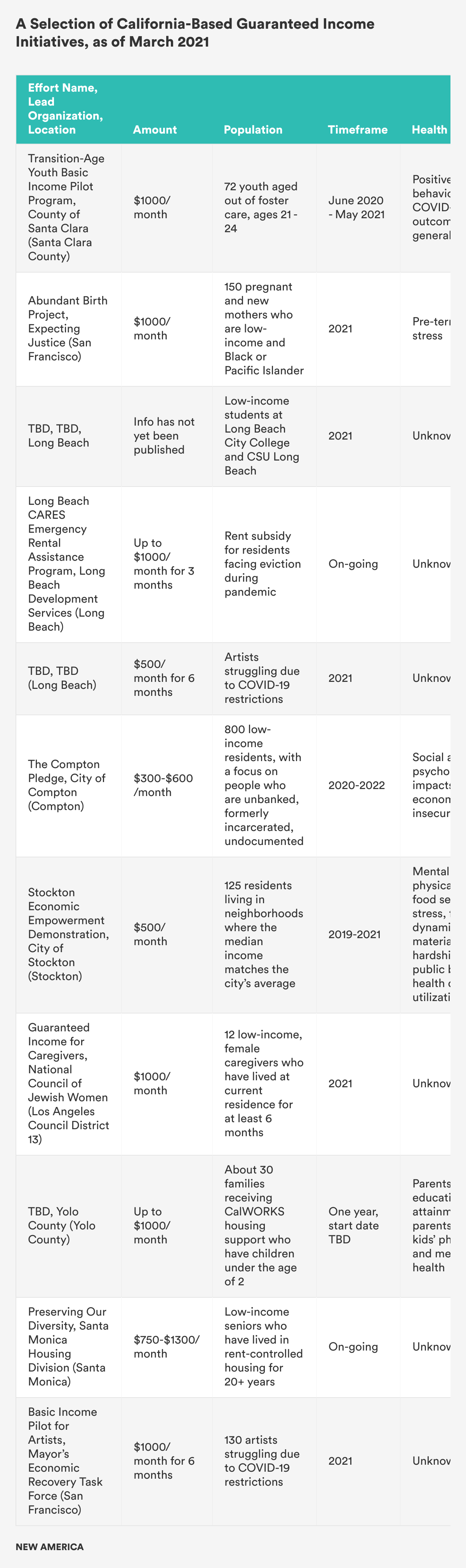
California-based guaranteed income projects are diverse, spanning goals from preventing evictions and displacement, to supporting college students, to preserving cities’ cultural workforces. While few of these aim to directly support health outcomes, more are measuring health impacts at some level and/or reference hoped-for health benefits in their promotional materials.
Note: The programs below are all time-bound or ongoing efforts; they do not reflect one-time cash support initiatives, such as those referenced in the section above.
The Research: Cash Transfers and Health Equity
According to the Mayors for a Guaranteed Income Learning Agenda and others who study cash transfers, more research is needed into programs’ impacts, including “experimental evaluation of a long term, truly universal UBI, disparate impacts based on demographics, how guaranteed income may interface with existing benefits programs, individual and community level mediators of guaranteed income effects, and both economic and social spillover effects.”
However, the impact of cash transfers on public health is one area where more data is available. Two strong sources for data on guaranteed income and health include:
- The Stanford Basic Income Lab has a data visualization tool that has compiled national and international literature on health and cash transfers to date.
- This month, researchers from the Stockton Economic Empowerment Demonstration (SEED) shared initial outcomes from the two-year pilot. This information includes early learnings about health impacts, including metrics around physical health, food security, depression, stress, and anxiety. Some SEED learnings are already available on the SEED Data Dashboard, including both anecdotal and quantitative data on topics such as nutrition and mental health.
Below is a summary of some of the health-related impacts tracked over recent decades of cash transfer experiments:
Mental Health
There is evidence that cash transfers can address the health repercussions of economic insecurity, such as stress, substance use, PTSD, and chronic illness. For example, in both the Eastern Band of Cherokee Indians disbursements as well as in reports from participants in the SEED and Magnolia Mothers’ Trust pilots, recipients reported less stress, were able to spend more time with their families, and experienced an overall improvement in their relationships and self-worth.1 More research is needed, but some theorize that the reduction in stress comes from reducing dependence on insecure employment, allowing families to move to safer neighborhoods, and generally reducing financial anxiety.
Some theorize that this anxiety-lowering connection is particularly true for unconditional cash transfers, particularly when the bureaucratic requirements of conditional support in themselves cause new stressors for recipients. Other theoretical mental health impacts, where more research is needed, include:
- whether, in reducing dependence on the types of insecure employment that have been tied to negative mental health outcomes, cash might improve both stress and recipients’ ability to access more stable work, such as starting their own businesses;
- whether cash transfers help families move to safer neighborhoods; and
- whether and how the frequency of payments makes a difference in reducing financial anxiety.
Physical Health
Studies of the impact of guaranteed income on physical health have shown:
- Declines in hospitalizations related to accidents and injuries, including those associated with stress and/or work, such as car accidents and children getting hurt while their parents are at work (Stanford Basic Income Lab).
- Positive impacts for pregnant mothers and children when mothers receive income supplements, including reductions of low birth weight and preterm birth, and improvements in preventative care behaviors, child growth, and nutrition (Expecting Justice). There is some evidence that this could have an even greater impact for Black mothers (Economic Security Project).
- Declines in substance use, including less cigarette and alcohol use associated with tax credits in the United States and Canada, partially due to less financial stress reducing the desire for substance-based stress relief (Economic Security Project).
Caregiving and Gender
Women are often paid less than men in the workforce, yet shoulder a greater burden of caregiving at home than their male partners. This can make women financially dependent on their relationship, even in cases when those relationships are unsafe and unhealthy. FreeFrom has found that most situations of intimate partner violence include financial abuse, including, recently, harm-doers taking their partners’ COVID-19 stimulus checks. Many such public benefits are distributed at a household level; individual basic income benefits could give dependent partners access to money needed to establish independence when necessary. Indeed, a recent study of FreeFrom’s emergency cash relief project found that cash was the number one need reported by survivors, who on average told researchers that they needed an immediate infusion of $730 to stay safe (FreeFrom). In addition, the Stanford Basic Income Lab has compiled evidence supporting women’s empowerment in the household through universal basic income, with impacts including increased education and nutrition for girls.
While more research is needed on the impacts of guaranteed income for caregivers, some theorize that by lessening the financial risk of exiting the workforce to care for family members, cash transfers allow those who take pleasure in care work to focus on it, instead of on other low-wage and/or unstable work. Many current public benefits are dependent on income-earning activities, resulting in family caregiving not being treated like real work, and forcing many families to choose between income—and its associated government benefits—and providing quality care for loved ones. By disconnecting work from income, cash transfers might allow critical family caregiving to happen without increasing family precarity.
Basic income for caregivers could potentially be a lever for improving the formal care economy, jobs that often pay poverty-level wages and that are disproportionately filled by women and people of color. “If the UBI were high enough to provide genuine exit options, it would give care-workers more bargaining power, which could result in improved wages and work conditions,” writes the Stanford Basic Income Lab.
Upcoming Challenges and Our Opportunities for the Field
As popular understanding of cash transfers grows in California and across the country, the field is looking to its next set of challenges. Some of these include:
Social and political stigmas about poverty: People opposed to guaranteed income often raise concerns rooted in stigmas about poverty—that the money will be used on drugs, that it will disincentivize work, and that their hard-earned money will be given to someone who hasn’t worked as hard. But there are also signs that these perspectives are changing. Cash stimulus was a winning element of the Democrats’ 2020 Senate campaigns in Georgia, and Andrew Yang’s universal basic income platform helped propel him to national prominence. Some hints about how the public narrative will evolve could come from the Mayors for a Guaranteed Income initiative, with shifts in local support for MGI mayors a potential bellwether.
Implementation: Early guaranteed income initiatives hit stumbling blocks on implementation. Addressing details like how to mitigate recipients’ potential loss of other public benefits remains complicated. But the recent proliferation of guaranteed income initiatives indicates that practitioners are not seeing this challenge as insurmountable.
Benefits loss mitigation: Despite the fact that many guaranteed income proponents advocate for a guaranteed income as an addition to existing safety net systems, as opposed to a replacement for them, there is serious concern that giving people cash will hinder their eligibility for other critical public programs. As the MGI Learning Agenda states:
Early implementation data from SEED and Magnolia Mothers Trust have revealed how guaranteed income interacts with the safety net and benefits cliff in two locations. Yet the US’ decentralized model of safety net services means that we know very little about how guaranteed income will operate across states and counties. In some locations, guaranteed income payments may lead to reductions in SNAP benefits, or an increase in rent for those receiving a Section 8 voucher. In others, a guaranteed income payment may not impact existing safety net benefits at all. This key question, how guaranteed income payments impact different benefits based on location, is largely unanswered.
The MGI researchers have published a case study of how Stockton attempted to mitigate benefits loss, and the Compton Pledge team is also attempting to further this work, creating a Hold Harmless Fund that will support any recipients facing financial losses from pilot participation.
Research: Major questions remain about the impact of cash transfers programs and how best to target and implement them The Compton Pledge, for instance, has baked research into its framework, aiming to “inform the design of future guaranteed income policies at local, state, and federal levels.”
- Guaranteed income is picking up steam and showing promise at the national and local levels
- Many states are experimenting with different cash transfer projects, and as they do they should be baking in research and data collection
- California is leading the way with some promising pilots
New America CA will explore many of the above issues in upcoming posts, as part of our 2021 series on guaranteed income and health.
Acknowledgments
Developed with the generous support of:
Blue Shield of California Foundation
Downloads
Citations
- “Mayors for a Guaranteed Income Communications Guide” (Unpublished), 2020
More About the Authors