Exploring SEED: A Guaranteed Income Demonstration’s Health Equity Implications
Introduction
Understanding the impact of cash payments on community health and well-being begins with a study of how these programs have been implemented in the field. Hypotheses, opinions, and even fears and hopes related to guaranteed income are theoretical until the concept is put to the test via a pilot. The Stockton Economic Empowerment Demonstration (SEED), while not the first, provides a recent, relatively large, California-based case study. It is also the first mayor-led guaranteed income initiative.
This report analyzes SEED as an example of how cash payments can affect individual, family, and community health and well-being, and explores how individual cash payments both mitigate and highlight systemic barriers recipients face in their pursuit of health and well-being.
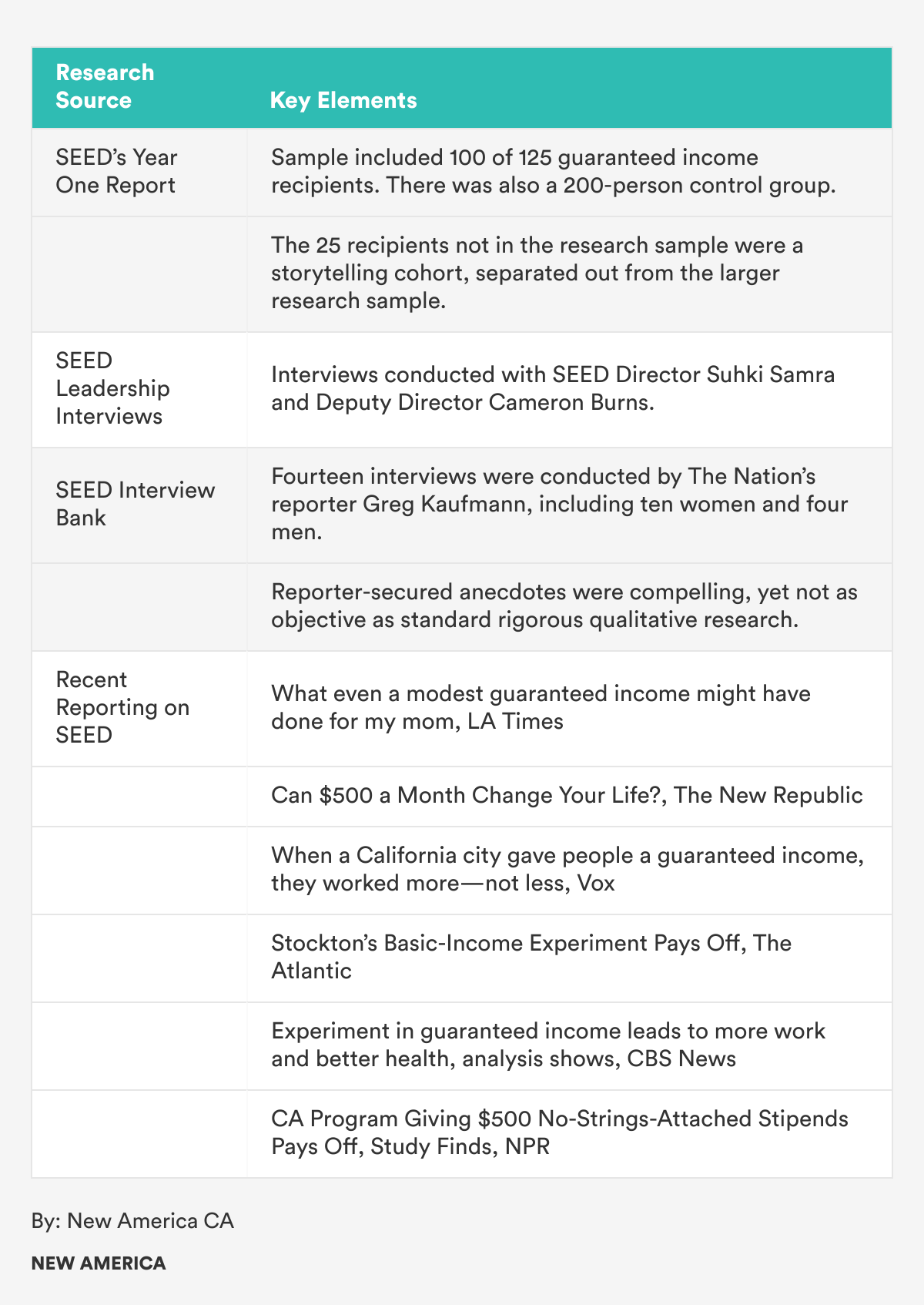
We honed in on the health equity-related elements from the Stockton guaranteed income pilot using the 1) reporting from SEED’s first year (pre-pandemic) data; 2) interview responses from the program’s leadership, and 3) 14 interviews with recipients of unrestricted cash featured in the program storybank.
Our SEED Research Scope and Definitions
What is Guaranteed Income?
A guaranteed income is a monthly cash payment given directly to individuals for a set (guaranteed) period of time. It is both unconditional and unrestricted, and is meant to supplement, rather than replace, the existing social safety net. Guaranteed income payments provide support to targeted communities and can be a tool for racial and gender equity.
What is Universal Basic Income?
Universal Basic Income (UBI) proposals support an unrestricted cash payment that every adult would receive. The intention of the payments is to provide enough to cover the basic cost of living and sustain recipients at a standard of living above the poverty line.
What are Cash Transfers?
The different forms by which people are given cash often fall under the larger umbrella term of "cash transfers." They can be conditional or unconditional direct payments paid by the government or from other sources. The term is more often used in the international context, whereas guaranteed income and UBI are more frequently used in the United States.
Guaranteed Income Made Clear by SEED Director, Sukhi Samra
“Guaranteed income is unconditional cash given directly to recipients. It is targeted, timely (especially in these times) and rooted in a history of social justice. Civil rights leaders seeking equity—such as Dr. Martin Luther King Jr., the Black Panther Party, and the National Authorized Organization, called for a guaranteed income as the simplest and most effective solution to poverty. Guaranteed income is a tool to make sure that the economy is working for everyone.”
SEED is unique in that it 1) was mayorly led 2) kickstarted a movement with other mayors interested in pilots and 3) is modern and targeted by median income.
High-level Indications of the Seed Report
Why is this a Question of Health?
Early reporting from Stockton’s SEED experiment suggests that guaranteed income reduced income volatility which had positive impacts on health, well-being, and agency in goal-setting and risk-taking.
Participants’ largest spending category was food, suggesting guaranteed income helped people access better nutrition. The $500 a month not only improved outcomes for individuals, but had positive network effects on participants’ friends, families, and neighbors, particularly on food quality and access to unpaid care work. People did not have to compromise the quality of their food or borrow from others who also were likely to have limited financial resources. Participants had more time, improved their relationships, and women in particular said they had less financial stress, more time to catch up on health needs like dental work and medical care, and also take leisure time for themselves. The financial freedom guaranteed income gave in decision-making allowed for reduced psychological distress and improved physical health.
The health equity factors listed here also had positive implications for long-term health. Particularly, guaranteed income recipients saw a significant increase in full-time employment. Some participants were able to reduce their part-time shifts to more manageable hours and rely less on low-paying gig and platform work. As a result, their employment rates jumped from 28 percent in 2019 to 40 percent a year later, pre-pandemic (compared to the control group which only saw a 5 percent increase in full-time employment, pre-pandemic). With more time, participants were also able to focus on training and coursework that could potentially lead to better career prospects.
"As reflected in the spending data, financial scarcity generates time scarcity. Simply put, when every dollar of wage work is allocated for bills before it is earned, most cannot afford to skip work or take necessary steps toward better employment structurally trapping them regardless of individual effort." SEED’s First Year
Overview
Economic precarity impacts health in multiple interrelated ways. A family’s ability to focus on safety, leisure, and healthy relationships is predicated on access to resources to meet and exceed basic needs. Family health impacts individuals’ (self) ability to pursue and preserve physical and mental health when individuals become caught in cycles of economic strain and time poverty. A community’s health is both driven by and a driver of family and self health as lived environments and support systems impact how residents access local resources and build trust in local government. Family, self, and community health are indicators of systems gaps as lack of federal investment in education, caregiving, and workforce development has outsized impacts on overall worker health.
A flexible and stable cash benefit like guaranteed income could provide broader stability across all health equity impact categories, creating an ecosystem with the potential to catalyze even greater health outcomes.
Health Equity Impact (HEI) Categories
Overall, the SEED pilot affected participants’ health positively across a range of health equity impact categories. While participants conveyed how a stable cash payment helped improve their health overall or set them up for positive long-term health outcomes—individuals still lacked access to larger policy resources that could supplement cash payments and allow for greater stability.
In each HEI category we saw recurring themes:
- Self – long-term planning and decision-making, stress, personal physical, emotional, and mental health
- Family – nutrition, caregiving, relationship health or strain, role-modelling
- Community – social stigma, privacy, access to transportation, affordable and safe housing
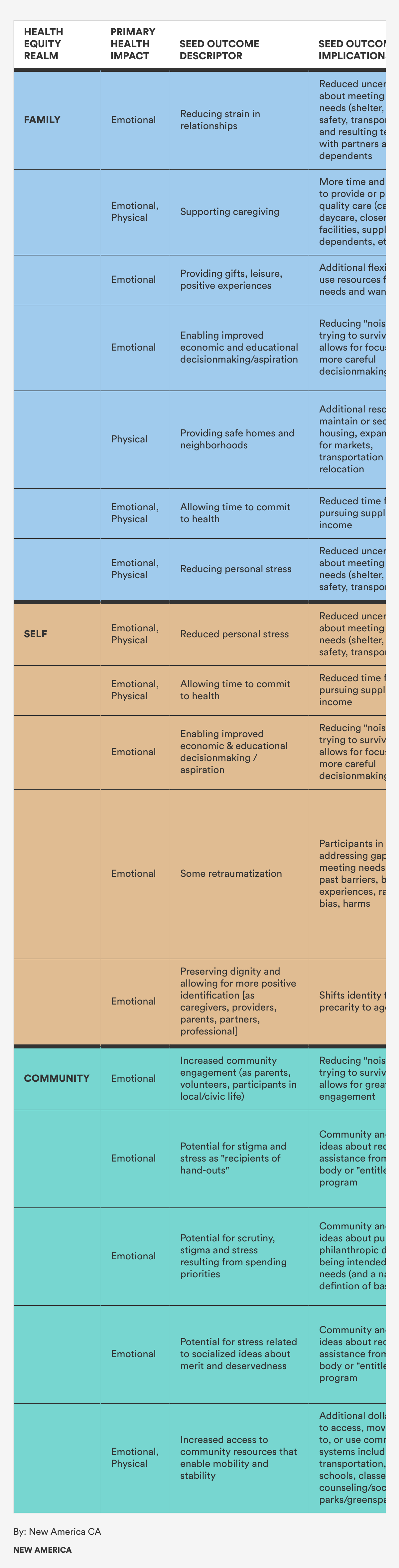
The systems issues we’ve highlighted were both drivers of inequity in other categories and opportunities for action and, therefore, are represented as cross-cutting in the summary table below.
Observations Across Categories
Self
Participants shared personal details of how participation in the SEED pilot improved their own physical, emotional, and mental health. Stable cash payments allowed individuals to meet basic needs for shelter, food, safety, and transportation which lowered stress levels. The cash helped people focus on thriving rather than surviving, and allowed participants to commit to their personal health rather than risk overextending themselves in pursuit of supplemental income through unstable gig work or overtime. With more free time, individuals focused more on longer-term plans, showed confidence in decision-making, and began to pursue career and educational aspirations. Cash allowances also allowed participants to preserve agency in financial decision-making which had positive effects on people’s identities as caregivers, partners, and professionals, by relieving the shame and guilt associated with feeling unable to consistently provide for or support one’s self or others.
It is important to note that participation in the pilot could have retraumatized some participants who have faced socioeconomic barriers or experienced racism, bias, and past harms. To improve trust in community and policy resources, supplementary work could focus on mobilizing local conversations around economic justice and health, passing livable wages, and increasing public awareness and access to mental health supports, subsidies, and counseling.
Falaviena on privacy and agency: “[SEED] did a lot for me, as far as confidence and knowing that trust is there, and I don’t have to do extra or go through the obstacles, jumping hoops, just to get this. So it’s been a great experience and as far as myself, just knowing that I have that there and not them on my back or neck about stuff, and I’m able to do what I want and need with the money. So, it feels good.”
Tomas on positive personal changes: “A lot of people have noticed a positive change [in me]. Like I said before, I would never be around…. I celebrate the Fourth of July because it’s when my daughter passed away. So, usually I stay away or that’s what I did before and this year…. I actually had a smile on my face… not so worried or having that stress or pain still. So that’s what the SEED program opened my eyes to because if not, I’ll be stressing out for that, and I would just take it to a dark place. Now since I’m able to be around my kids more it wasn’t as hard. It wasn’t as hard to accept it and she would have been 11.”
Cassandra on stress: "Before SEED I was super anxious…stressing [over] every single penny."
Danielle on decision-making and long term planning: “It lit a fire under my husband and I. He started requesting every Saturday he could get…we found ways to spend better, to flip some of our cards around so we could get interest-free on our credit cards…I said, 'we have this gift, let's totally take advantage of it and wipe this thing out…it really motivated us to save every dollar."
Family
Within participants’ family systems, SEED cash allowances had beneficial impacts on interpersonal relationships, leisure, and overall safety. With less worry and uncertainty about meeting basic needs, participants were able to improve their relationships with their partners, dependents, and family members which mitigated relationship strain. Caregivers reported more capacity to spend time with family and pay for daycare, closer care facilities, and increased access to supplies for their families’ medical, education, and sometimes recreational needs. The flexibility of the cash resource allowed people to cover emergency bills, transportation costs, and utilities, but also to cover gifts, leisure, and create more positive family experiences improving relational health. Rest and positive experiences are critical to overall health. However, some participants shared concern over how others might negatively interpret their choice to support and prioritize their families’ happiness and leisure.
Participants’ renewed capacity for planning and reduced stress had ripple effects on their families, allowing more room for economic and educational decision-making and role-modeling behaviors. The long-term impact of reducing stress and improving positive risk-taking, like leaving a low-quality job for a better one, could help break poverty cycles and encourage economic mobility. Participants were better able to manage rent or secure housing, and some expressed interest in moving their families to safer neighborhoods.
Jovan on more family-time outside and treats: “Kids can ride their bikes and are happier. My two older kids know about the program (SEED). My 4 year old doesn't know, she just know if she wants ice cream we can go get ice cream…I can pick up kids from school, help them with homework, and go on excursions.”
Tomas on time to bond with family: "[Before] I didn't ever get to see how funny [my son] is, how talented he is. He draws, it's amazing. He's really on top of it. He wants to be like me, I guess, and now I can say I can be somebody he can look up to. I'm a father to him. I didn't get to see that before…I just ran in and out, in and out."
Sheila on improving relationships: “I’m just being honest, it’s a lot less yelling going on. I’m calmer in my communication. I don’t sound as frustrated, you know even if I have to remind them you know, turn off the lights, shut the door, I got the air conditioner on. And I’m speaking of recently. It took me a minute getting the 500 to get up to the point where I am now.”
Community
SEED participants reported, implicitly and explicitly, that their ability to fully participate as parents and community members is negatively impacted when money and time are tight. By supplementing recipients’ income, participants were sometimes able to:
- Reduce work hours and workload to more reasonable levels;
- Be more selective in choosing housing in neighborhoods or communities that were welcoming and safe; and
- Support maintenance, payments, fares, and fuel cost to enable them to travel across the community more easily, for work or to access public services including greenspaces.
This increased access to and opportunity for engagement in their communities will likely net an increased sense of belonging and investment in place. A strong sense of belonging and community has been shown to increase feelings of self-worth and safety, both of which contribute to lower stress and improved health.
Many participants reported their ability to go to and enjoy parks and other green spaces with their children and partners as a positive outcome. Access to green space—because of the ability to afford neighborhoods near parks, the ability to access and use transportation, and the time to pursue leisure activities—is associated with improved mental and physical health.
However, not all health-related outcomes of SEED were positive. One health-related outcome that varied across SEED was the potential stress recipients felt as a result of negative comments from community members who disapproved of SEED and other such public programs. Some SEED recipients perceived a persistent and judgmental framing of “deserving and undeserving” stigmas from the community regarding public assistance. They also heard many opinions on how recipients should spend that money. Recipients in the SEED pilot reported feeling stress and emotional drain over real or anticipated stigma in their community.
Phyllis on providing for many with few resources: "When you're self-employed, you know, I have a good income, but I have a lot of expenses. I have three peoples' lives that I'm responsible for providing, besides my own. So, four families that are dependent on my income, so it's making sure that I am as productive as possible, and where are the resources coming from if I can't be productive."
Lorrine on community stigma: “I owe a lot to my son because he helps take care of my daughter while I work…I was getting some backlash from people, who were saying, “She’s gonna go get your nails done or she’s gonna spend it on drugs—you know she’s not going to spend it on what she should spend it on and stuff.” I got backlash for a video game. “Oh she’s buying her kid a video game,” but they don’t know my situation. They don’t know what my son does, you know. Video games make teenage boys happy!”
Systems
Poverty and instability (health, work, family, housing, food) are known stressors and can directly impact physical health and safety. Systems to access stability are complex and tend not to be designed to best serve marginalized populations. The minimum wage is inadequate to support working individuals and families. Workplaces, schools, and financial systems are generally not aligned to prioritize multiple caregiving responsibilities without individuals sacrificing income and free time. U.S. economic and educational pathways are generally designed with able-bodied people in mind. Financial and housing systems are reliant on multigenerational stability and success (needing to have a higher credit score, needing to have a bank account, being charged higher fees to secure smaller loans). With all of these barriers to stability, people with limited assets and incomes are more prone to compromised health, based on access and income.
Virginia on balancing multiple jobs and still not having enough: "It was frustrating to know that you were working full-time and still struggling. I don't have to worry now, 'Oh Jeez, do I have enough money to order the medicine, and it's not going to make my account bounce”… and not worry about gas in my car. It's made it a lot easier. I can breathe. You don't have to say 'OK this is just the 15th and I have $20 for the rest of the month."
Zohna on feeding her family: “[Before SEED] when I went to the food bank I wouldn’t tell my husband because that’s not what he was used to either. I would just go and bring the stuff home and I put the stuff away…My mother just didn’t feel like I needed to do that, that I needed to find a job. And I’m like well, you know there’s just only so many things that I can do right now [due to health challenges and lack of job opportunities].”
Cassandra on postponing education to provide care: “I couldn't make grades for financial aid because it's so hard to try to maintain having a new baby in my life and trying to balance that schedule, his doctor's appointments, and then even my own, to try to go to classes on campus. And then books were just ridiculous. So I had to drop out for a couple semesters."
Policy Implications and Questions for Consideration
Impact of Guaranteed Income on Health and Social Programs
While early anecdotes show positive impacts of guaranteed income on health, SEED researchers concluded that cash allowances alone are insufficient to make up for market-driven obstacles to stability and health. As a supplement to guaranteed income, some policy actions that could have the most impact on improving health include: providing protection against predatory financial actors and their targeting practices, reducing fines from the criminal justice system, passing paid family leave legislation and investing in child care, improving housing assistance, and raising the minimum wage.
The potential for benefit loss: Stockton’s SEED pilot modeled a deliberate approach to benefits loss mitigation, but is only one model in one community in an ecosystem of disconnected safety nets supports from which one can seemingly easily be disqualified. Cash transfer programs need to be created with a context-specific understanding of what can disqualify individuals from accessing other social services so that they do not cut off participants' access to other resources and supports. Proponents of guaranteed income advocate for the unrestricted support as a supplemental income that builds on existing supports for many already near the income floor. The Stockton SEED pilot leaders took proactive steps to ensure that participants would not lose access to other safety net benefits, and SEED established a “Hold Harmless Fund” to provide additional financial resources for participants who might face unanticipated benefits loss. Through a partnership with the local housing authority, 13 households received $35,100 in funds to make up for the decrease in voucher and public housing rental assistance those households experienced as a result of receiving SEED funding. That said, since safety net policies differ across the United States, it is unclear how guaranteed income might impact other health and social programs like reducing SNAP benefits, or increasing rent for Section 8 voucher recipients.
Question for Consideration: What health and social programs would be positively impacted by the stabilizing effects of guaranteed income? Could guaranteed income reduce spending or increase efficient service and resource delivery in other areas, including: food security, mental health and addiction treatment, or emergency room visits?
Reimagining Health Incentives
In the United States, employer-dependent health benefits limit who has access to important resources to those who are physically able, available, or healthy enough to work. This health policy system gives people inconsistent access to necessary health resources, which could have kept them well and in the workforce longer. While California is one of the few states with paid sick leave and paid family and medical leave policies, lack of education and outreach make accessing these benefits more difficult for people. And, California’s paid family leave policy offers eligible workers only 60 to 70 percent of their wage while they are on leave, but many lower income workers need their entire paycheck to sustain themselves and their families and the low wage-replacement rate could disincentivize benefit utilization.
Question for Consideration: Health incentives in this country are built on an assumption of stability, access, and mobility (e.g. quit smoking, exercise more, eat differently, buy a pedometer). How might we reimagine these programs?
Conclusion
Guaranteed income appears to both improve health outcomes and highlight barriers to healthier outcomes for people from historically marginalized communities with limited assets and income.
Across the axes of influence—family, self, community, and system—there was a throughline of trust, privacy, and dignity. Respondents spoke of frustration with being treated like children and asked patronizing and invasive questions. Many valued a sense of dignity, they found missing in some previous supports, and deeply appreciated in their interactions with SEED.
Cash payments can catalyze stability by reducing uncertainty about meeting basic human needs, allowing time to be reallocated from extra work hours to time with family, leisure, health, and educational or other self-improvement activities. Stability and reasonable work-hours can decrease emotional stress and physical strain.
Interestingly, SEED findings illustrate how participants leveraged access to consistent cash payments to both take care of their families’ basic health/well-being needs and to increase their labor market participation.
It is important to consider that political and cultural perceptions influence policies. In the case of guaranteed income programs, the main ideological and cultural differences revolve around a key question: Where does the responsibility lay with regard to ensuring needs are met? Is it through the government’s policy and social service programs, or solely on the shoulders of the individual, regardless of external and, at times, systemic obstacles? Answering that question will be the key to creating stability for the most marginalized among us.
Abstract
The topic of guaranteed income tends to elicit strong feelings from both proponents and opponents. Some opponents worry that cash could lead to decreased labor market participation, provide workers with an undue brokering advantage with employers, or believe that guaranteed income is simply morally misaligned with the idea that one should have to work to earn money. Others argue that payments would not make a real difference in the lived experiences and outcomes of families experiencing poverty, or question the level of choice provided to recipients. The fear that recipients would spend money on items not considered necessities highlights the persistent belief in American social, political, and cultural life that frames people living in poverty as "deserving” or “undeserving” of aid.
In contrast, advocates argue that individuals are the experts on how to best spend their money and that—with the increased choice provided by guaranteed income—recipients can make the highest impact decisions for their own lives. Many also suggest that guaranteed income would decrease bureaucracy, allowing governments to spend less money on administering benefits and instead of causing inflation, could help stabilize the economy in times of recession. They also note the potential of guaranteed income policies to address racial wealth gaps.
Acknowledgments
Developed with the generous support of:
Blue Shield of California Foundation
Downloads
More About the Authors

Molly G. Martin
Vice President, Development & Strategy

Autumn McDonald

Roselyn Miller Champion
Grant Analyst, City of Portland