The data used for this report do not include districts where either 75 percent or more of the students are Native or where at least 75 percent of the geographic area overlaps with reservation land. This is not because the challenges faced by Native students are unimportant—far from it—but because the nature of demographic divides and school funding inequalities are so distinct in Native communities.
With respect to school funding, the land dispossession of Native peoples and tribal ownership of reservation land create unique relationships with property generally and property taxation in particular; school finance in districts on tribal land simply cannot be built on the same foundation of local revenue that exists in nearly every other school district. Federal funding also looms far larger in school districts educating many Native students than it does in most other districts, changing the overall picture.With respect to student demographics, though the National Center for Education Statistics considers “American Indian/Alaska Native” to be a racial or ethnic category,1 Native students belong not just to a defined racial group, but to their own sovereign nations. Educational self-determination is both an exercise of that sovereignty and an important corrective to America’s long history of anti-Native education policies, including the banning of Native languages in schools and the forcible placement of Native children in assimilationist schools where Native culture was erased and they were often subject to abuse.2 Given this context, it is important to understand the ways in which racial integration carries different implications for Native communities than for other student populations.
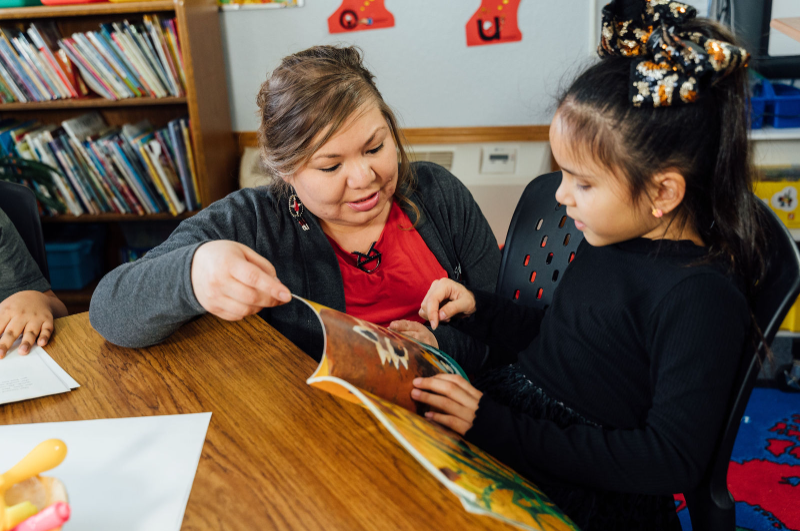
photo from gallery shared by NIEA; get from https://agencymabu.pixieset.com/tjes/p/NjY1NzQxMzMwMg==-MjU1NTE0NTIyOQ/; to go alongside headnote under "Divided Districts and Native Students," above the bylined essay
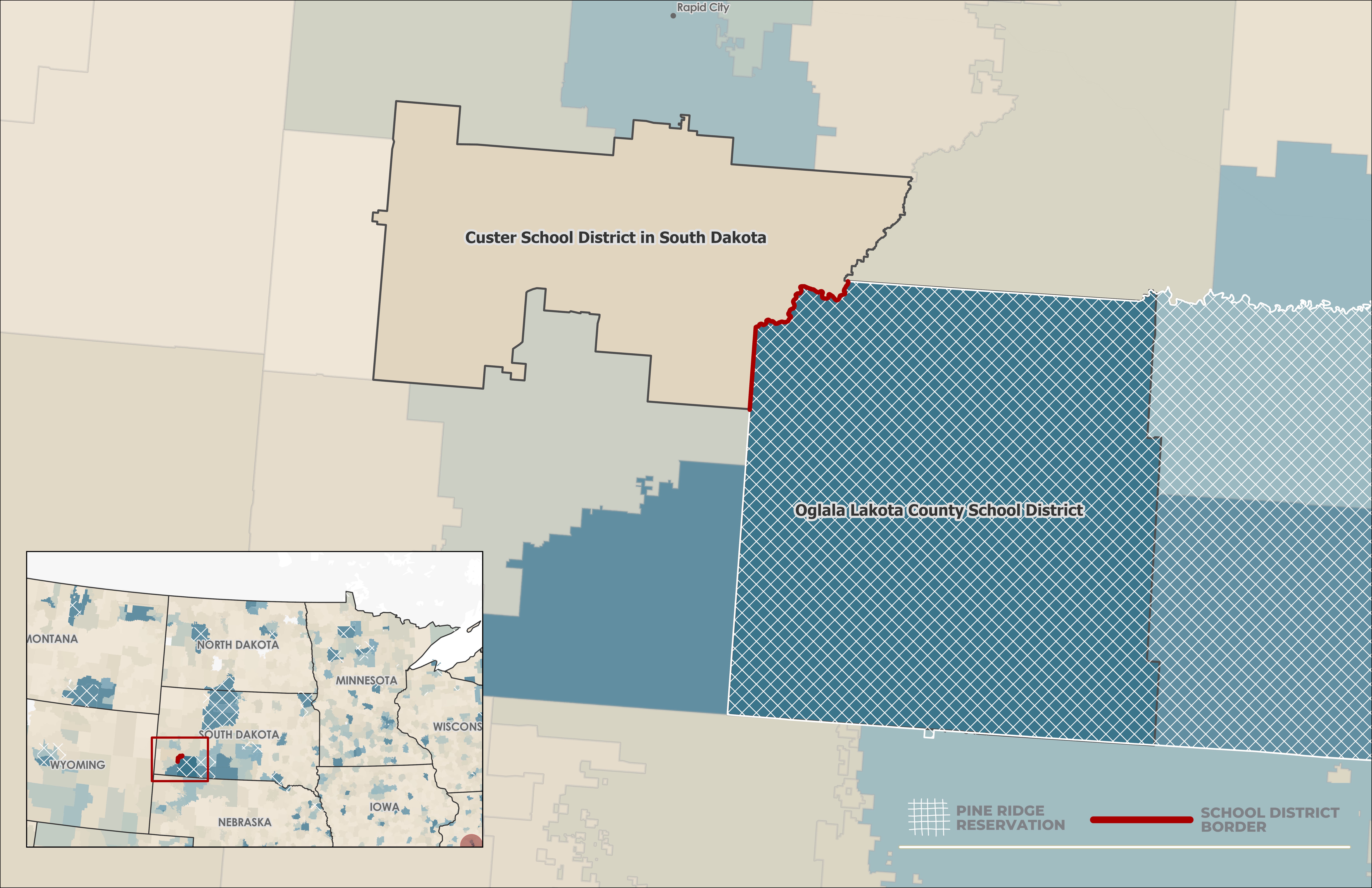
Oglala Lakota County School District and Custer School District, South Dakota
By Diana Cournoyer, Executive Director of the National Indian Education Association
Public academic and finance data present the story that Oglala Lakota County Schools (OLCS) are among the highest-funded in South Dakota, but one of the lowest-performing. It is time for critical dialogue about this story. The equity challenges of remoteness and rurality intersect here at a depth that resurfaces a call for civil rights. As a member of this community, I know to look beyond the initial interpretation of the data. Our nominally high levels of funding do not ensure our children a rich education.
My community holds the juxtaposition of a dark political history and a rich ancestral culture. I am a citizen of Oglala Lakota Nation, and an educator and national advocate. My identity is steeped in the culture and language of my people, but my professional background reflects the practices of westernized education. I dream of a day that Oglala Lakota students can learn in a system that reflects the values, language, and identity of our people, with an emphasis on growing our tribal economy. We are a strong people who are working to reclaim education sovereignty and the future of our kids. However, my community holds the scars of a traumatic history; our homelands were taken and we were confined to a reservation. Boarding schools attempted to take away our language and culture through stripping our children’s identities. The right to teach our children our ways was gone, and in its place—a colonized education system that has failed us.
On the Pine Ridge Indian Reservation, our parents have a range of school choices. The perspectives of families regarding these choices are shaped by historical context, cultural factors, and socioeconomic considerations.
If you visit Pine Ridge, you will find that our schools become the center of each community. Often, the school buildings are the most updated or welcoming structure in the area. Our people depend on the schools, though the difficulty finding jobs on the reservation also decreases the motivation to graduate. Across the reservation, students can choose among a Bureau of Indian Education (BIE)-operated school, six tribal grant schools, the Oglala Lakota County School district (six schools throughout the reservation), and three border public schools from outside districts, as well as two parochial schools and three private schools. About 6,000 Native students are enrolled across these institutions, ranging from pre-K to 12th grade. Many of the Native students attend one of the six tribal grant schools. An estimated 1,800 attend OLCS.
Pine Ridge’s multiple school systems each have their own leadership structure, funding formula, and data management system. Students typically hop between schools searching for a stronger cultural environment, better academic options, or easier access by transportation. The schools vary in their degrees of cultural programming, quality of instruction, community engagement, and consistency of leadership. Rarely do these systems share data to produce a more accurate story of graduation rates and academic progress. The lack of data sharing also impedes efforts to improve learning systems and share resources.
Our reservation faces unique educational challenges, including limited resources, historical trauma, and cultural and language preservation concerns. The reservation land base is the size of Connecticut and is rural and remote. Even though OLCS receives more funding than surrounding districts, the limited economic resources on the reservation means access to culturally supportive and sustaining instruction and student services are slim. And when district partners can muster offerings like after-school programs, often families do not have the transportation or the ability to drive over an hour for services.
As an advocate for Native education nationally and as a member of this community, I know that more funding does not automatically translate into more access. The OLCS’s school funding presents numerous complexities that can significantly impact education outcomes. When there is little funding from local property taxes but a heavy reliance on federal and state funding, money is much less flexible. The complexities and restrictions of state and, especially, federal funding, combined with the limited access to services in our community, enhance and even perpetuate the disparities between the districts. It is difficult for the schools to understand and navigate the complex allocation process, and federal and state regulations and reporting requirements create barriers and administrative burdens. The school district is limited in how it can use funds to address the unique needs of Native students, which results in inequitable access to opportunities.
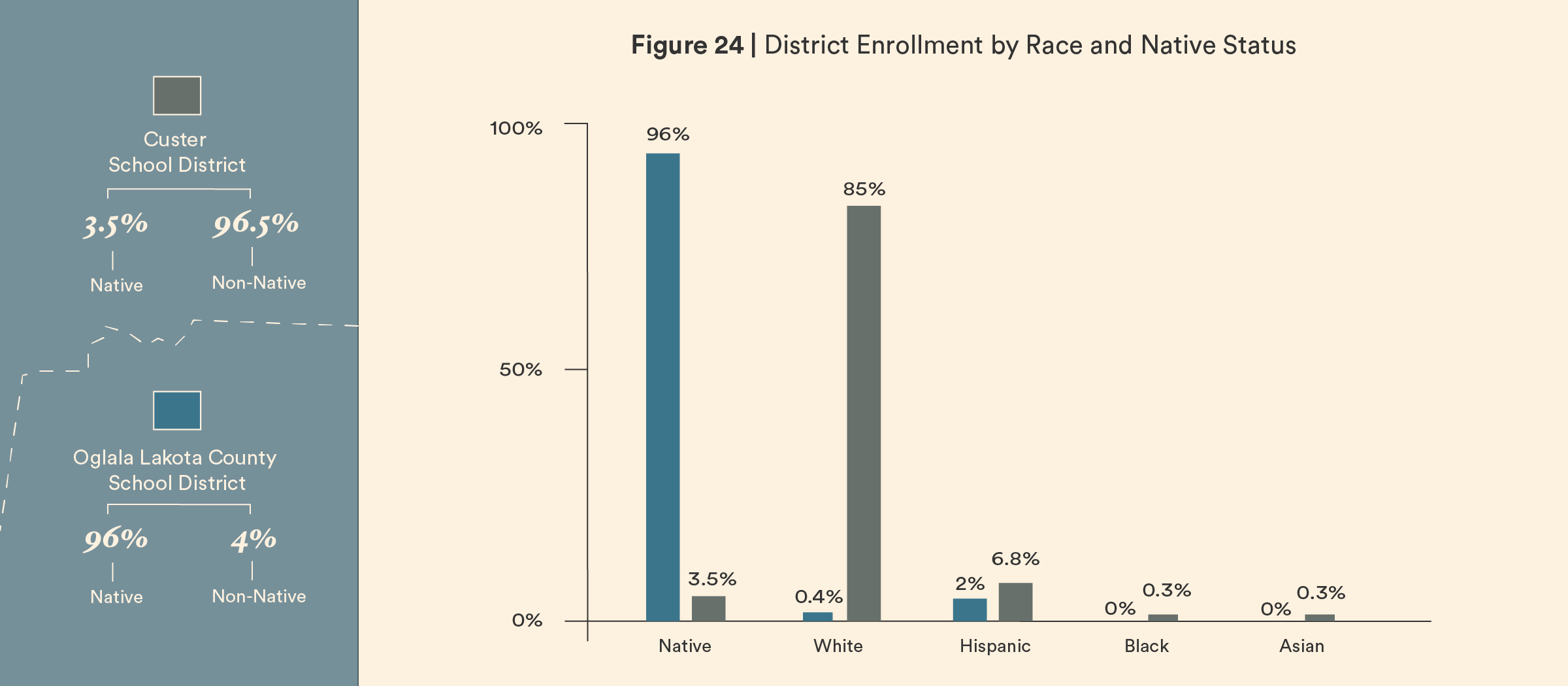
The data sources relied on for this report show disparities between the student populations of OLCS, on the reservation, and Custer Schools District (CSD), which is off-reservation but borders it. We can take a closer look at two schools that are just across the northwest reservation border from each other. Red Shirt Table School, an OLCS school, serves primarily Native students, while CSD schools are majority-white. In other communities, such a divide might be viewed as an equity issue, but in fact, this the result of Pine Ridge community preferences. The border of Pine Ridge is more than a district border; it is a political border, separating one nation from another. Despite the infrastructure and facilities challenges or limited extracurricular activities, Native students at Red Shirt have access to culture and language support, the safety of Native peers and some Native teachers, and the support of the local community. Across the political border, Native students attending CSD may have nicer facilities and more advanced technology, but they would not be in a school environment that reflects or values their Native culture. They would be isolated, away from the protection of their family and tribal leadership. They would be more likely to encounter racism and stereotyping, making them less comfortable with expressing their Native identity. This paradox is still at heart an equity issue.
But the issue is more than funding. The issue is education sovereignty. Like many Native American communities, the Oglala Lakota Nation has long advocated for greater control over education within our reservation. This push for sovereignty led to establishing the tribal education codes that govern many of the schools on the Pine Ridge Indian Reservation. The political and cultural history of Oglala Lakota County Schools being public on the Pine Ridge Indian Reservation reflects a complex journey of tribal sovereignty, educational autonomy, and advocacy for culturally relevant education.
Citations
- National Center for Education Statistics, “Definitions for New Race and Ethnicity Categories,” developed in 1997, https://nces.ed.gov/ipeds/report-your-data/race-ethnicity-definitions.
- U.S. Department of the Interior, Indian Affairs, “Federal Indian Boarding School Initiative,” https://www.bia.gov/service/federal-indian-boarding-school-initiative.