Introduction: You Can’t Fix What You Don’t Measure
More than 10 million Americans lose their homes each year due to eviction and mortgage foreclosure.1 Evictions and foreclosures lead to homelessness, job loss, adverse mental and physical health impacts, educational attainment gaps for children, and downward economic mobility. They disproportionately impact Black and Latino communities and families with small children.2
And yet, these devastating events happen in the shadows. The federal government does not collect and share data on evictions or foreclosures. In 2021, a survey from the National League of Cities found that 38 percent of rural officials, 30 percent of suburban officials, and 22 percent of urban officials didn’t know whether evictions had increased or decreased in the prior year,3 let alone where within their cities evictions were most acute, how rates changed over the course of the year, or who was most at risk.
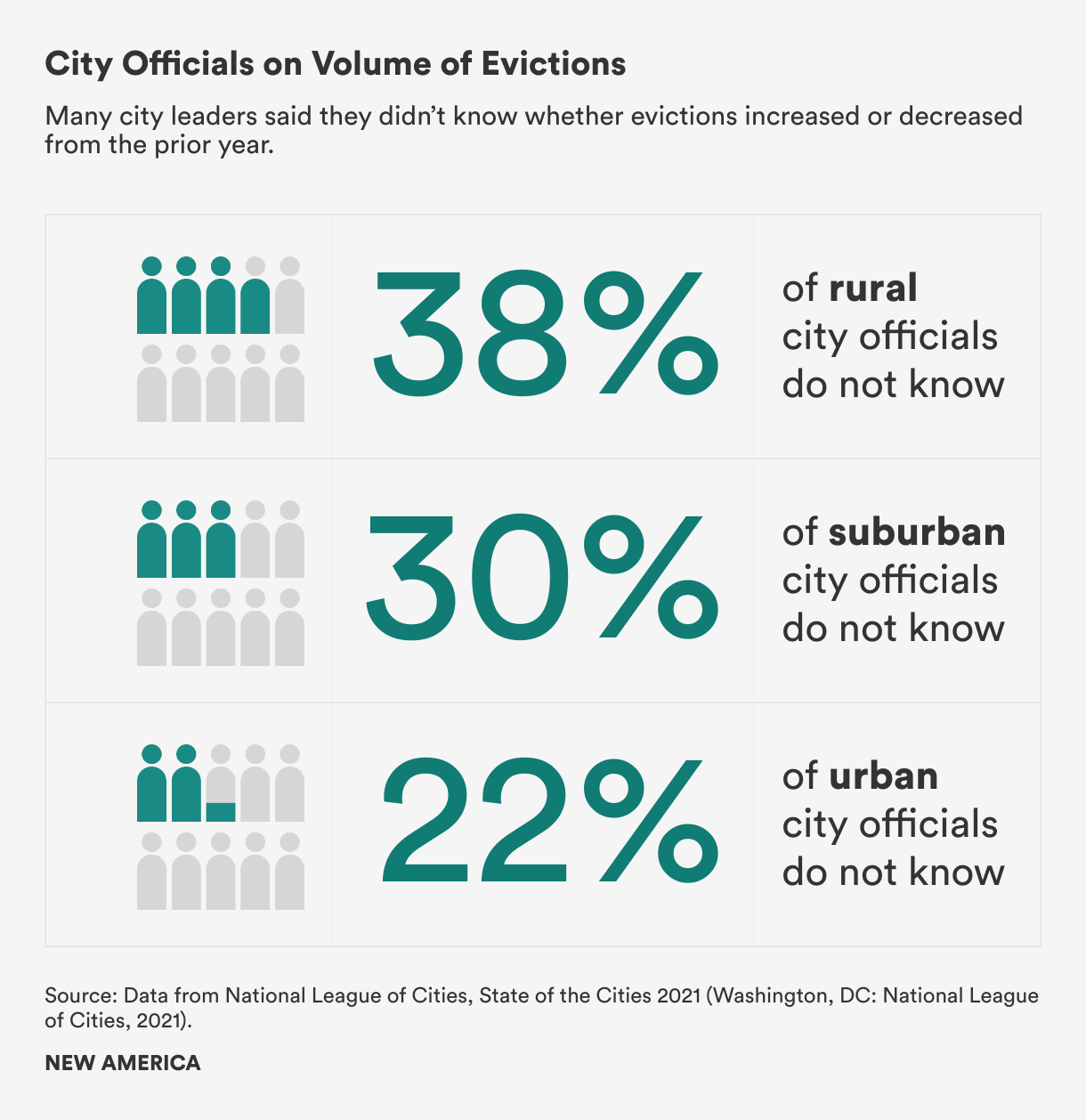
Further, the federal government collects almost no data on evictions, and a New America report found that one-third of U.S. counties do not have access to their topline annual eviction and foreclosure rates.4 The Eviction Lab and the Legal Services Corporation have undertaken substantial work to develop partial eviction databases, and enterprising local researchers and legal aid providers have managed to gather detailed eviction and foreclosure (EF) data in their jurisdictions. Notwithstanding these efforts, we know very little about where evictions and foreclosures are most acute, how rates change over the course of the year, or who is most at risk.
This is an unacceptable state of affairs.
If America is serious about making sure people have a roof over their heads and ending the affordable housing and homelessness crises that voters list as a top concern5 heading into the 2024 election, then we must start tracking the number of people who lose their homes each year. Every governor, mayor, and city council in the United States should have comprehensive and real time information about evictions and foreclosures in their communities, just like they have comprehensive information about crime, education, and jobs.
When local decision makers—including but not limited to elected officials, court staff, legal aid providers, and advocates—can access eviction and foreclosure data, and have the tools to analyze that data, they can use the insights to target programs and policies to keep more people housed. But currently, the subset of local decision makers who can access and use data in this way is small and self-selecting.
Who Are the Local Decision Makers Using Eviction and Foreclosure Data?
Local decision makers use eviction and foreclosure data for program and policy decisions, advocacy, budgeting, research, and direct legal support. These stakeholders include but are not limited to:
- State and local elected officials (e.g., governors, mayors, city councilmembers, county board of commissioners, etc.);
- Court staff;
- Social service agencies;
- Community and faith-based service providers;
- Legal aid providers;
- Researchers;
- Journalists; and
- Tenant organizers and other advocates.
Over the last five years, the Future of Land and Housing program at New America has worked at the federal and local level to help local decision makers access EF data and equip them with the tools to understand it. This has included policy and advocacy efforts to develop a national EF data infrastructure, as well as hands-on work with local partners to build their capacity to access and understand this data.
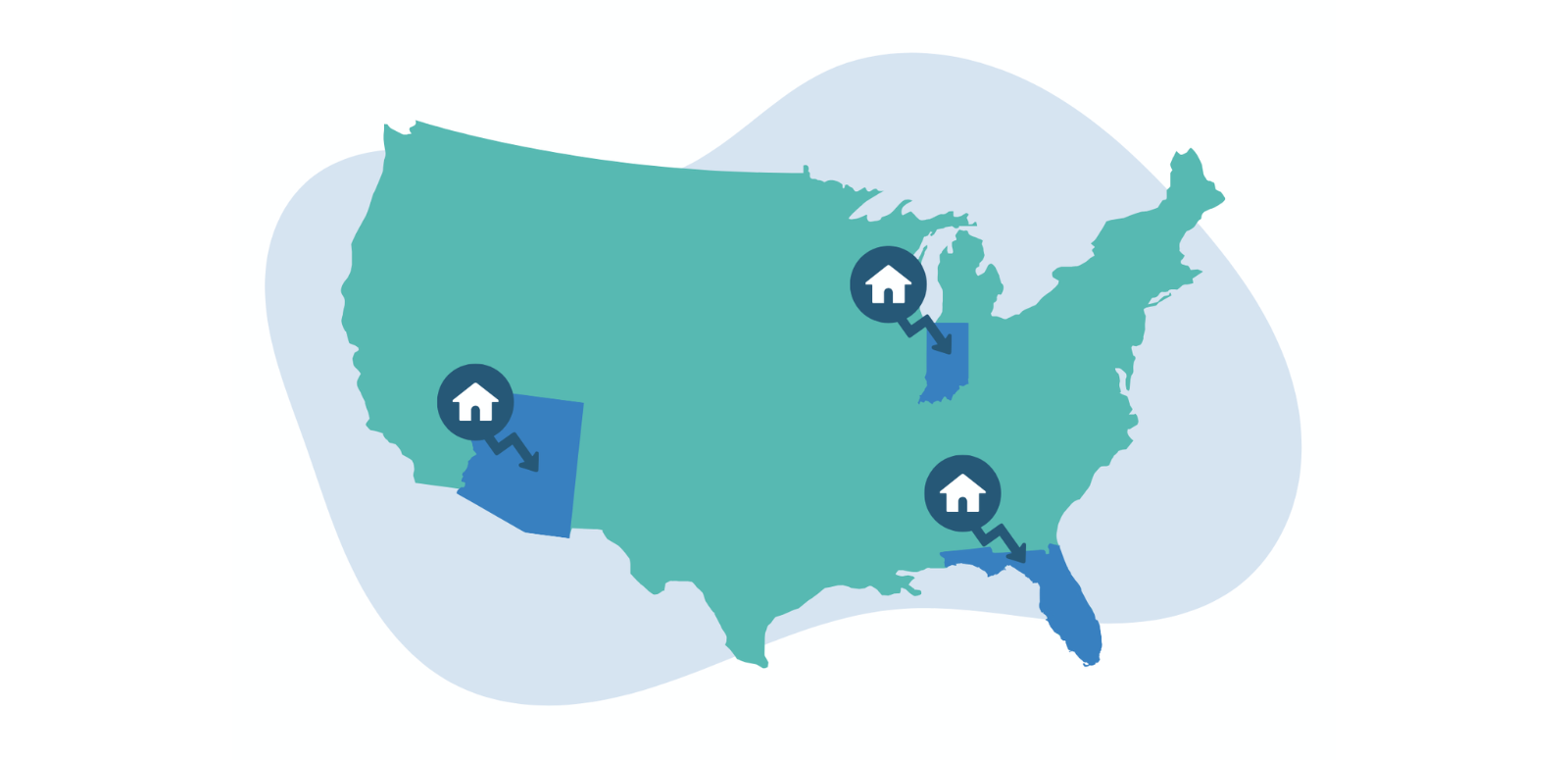
This report provides a brief overview of these efforts to date, starting with the development and rollout of the Foreclosure and Eviction Analysis Tool (FEAT), a first-of-its-kind web application that allows users to understand where housing loss is most acute, when during the year housing loss is occurring, and who is most impacted. This report also focuses on partnerships in three states—Arizona, Florida, and Indiana—to collect statewide EF data and use FEAT to establish public dashboards displaying useful insights.
Citations
- Yuliya Panfil, “America Needs A National Housing Loss Rate,” Social Innovation (blog), Federation of American Scientists, February 22, 2024, https://fas.org/publication/america-needs-a-national-housing-loss-rate/.
- Julia Craven, “Eviction Is One Of The Biggest Health Risks Facing Black Children,” New America, December 7, 2024, https://www.newamerica.org/better-life-lab/articles/eviction-health-risks-black-children/.
- Christiana K. McFarland, Brooks Rainwater, Erica Grabowski, Joshua Pine, and Anita Yadavalli, State of the Cities 2021 (Washington, DC: National League of Cities: 2021), https://www.nlc.org/resource/state-of-the-cities-2021/.
- Tim Robustelli, Yuliya Panfil, Katie Oran, Chenab Navalkha, and Emily Yelverton, Displaced in America: Mapping Housing Loss Across the United States (Washington, DC: New America, 2020), https://www.newamerica.org/future-land-housing/reports/displaced-america/.
- Leigh Ann Caldwell, “Skyrocketing rents and home prices may be pivotal in the 2024 election,” Washington Post, May 28, 2024, https://www.washingtonpost.com/politics/2024/05/28/housing-nevada-biden-trump-election/.