
Who Applied?: Class of 2025 Fellows Program Applicants
Every year, New America’s Fellows Program invests in bold thinkers—journalists, scholars, filmmakers, and public policy analysts—who generate big ideas to make an impact and spark new conversations about today’s most pressing challenges.
The program selects the 15 New America Fellows through a rigorous and competitive selection process and seeks to support individuals who put forward far-reaching ideas through projects that draw on in-depth research, keen reporting, nuanced analysis, and a thoughtful storytelling approach.
Over the past 25 years, nearly 300 Fellows have contributed to a deeper understanding of trends around timely topics, from climate change to criminal justice reform. New America Fellows have written bestsellers, produced feature-length films, and have been awarded Pulitzer Prizes, MacArthur Fellowships, Emmy Awards, Carnegie Fellowships, and National Magazine Awards.
Visit the Fellows Archive to browse the catalog of the more than 200 works produced by the New America Fellows.
Meet the Class of 2025 New America Fellows
Learn more about the 15 Class of 2024 National Fellows and sign up to receive The Fifth Draft newsletter to keep up with our fellows along their journey.
Keyword Mapping
Upon submitting an application, candidates are asked to include keywords or phrases that best describe their proposed project.
An analysis of the keywords submitted with each application yielded the following word cloud of the top 28 words used this year. The size of the word represents the frequency of use, and the color-coding of the word aligns broadly with the issue areas they represent.
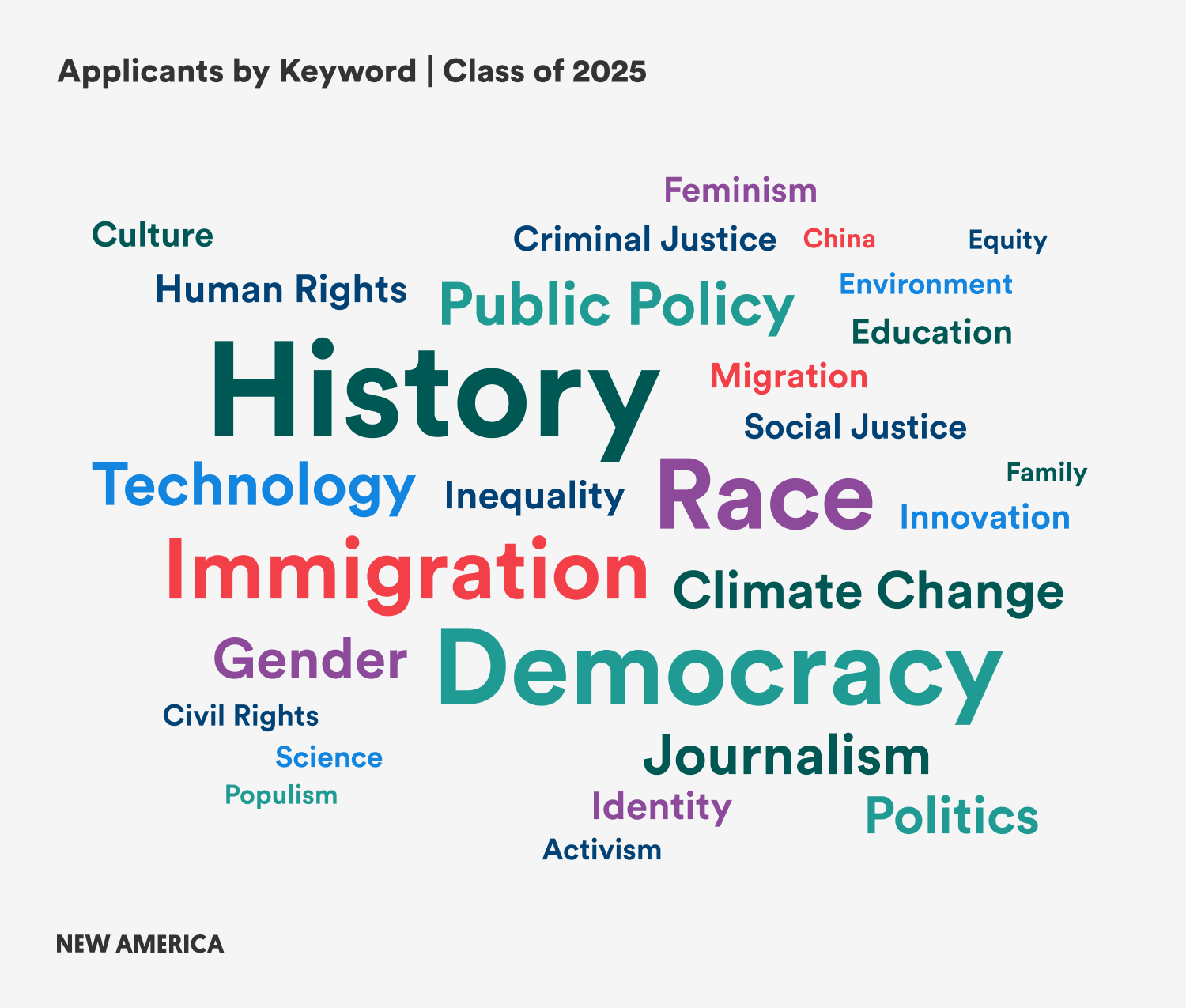
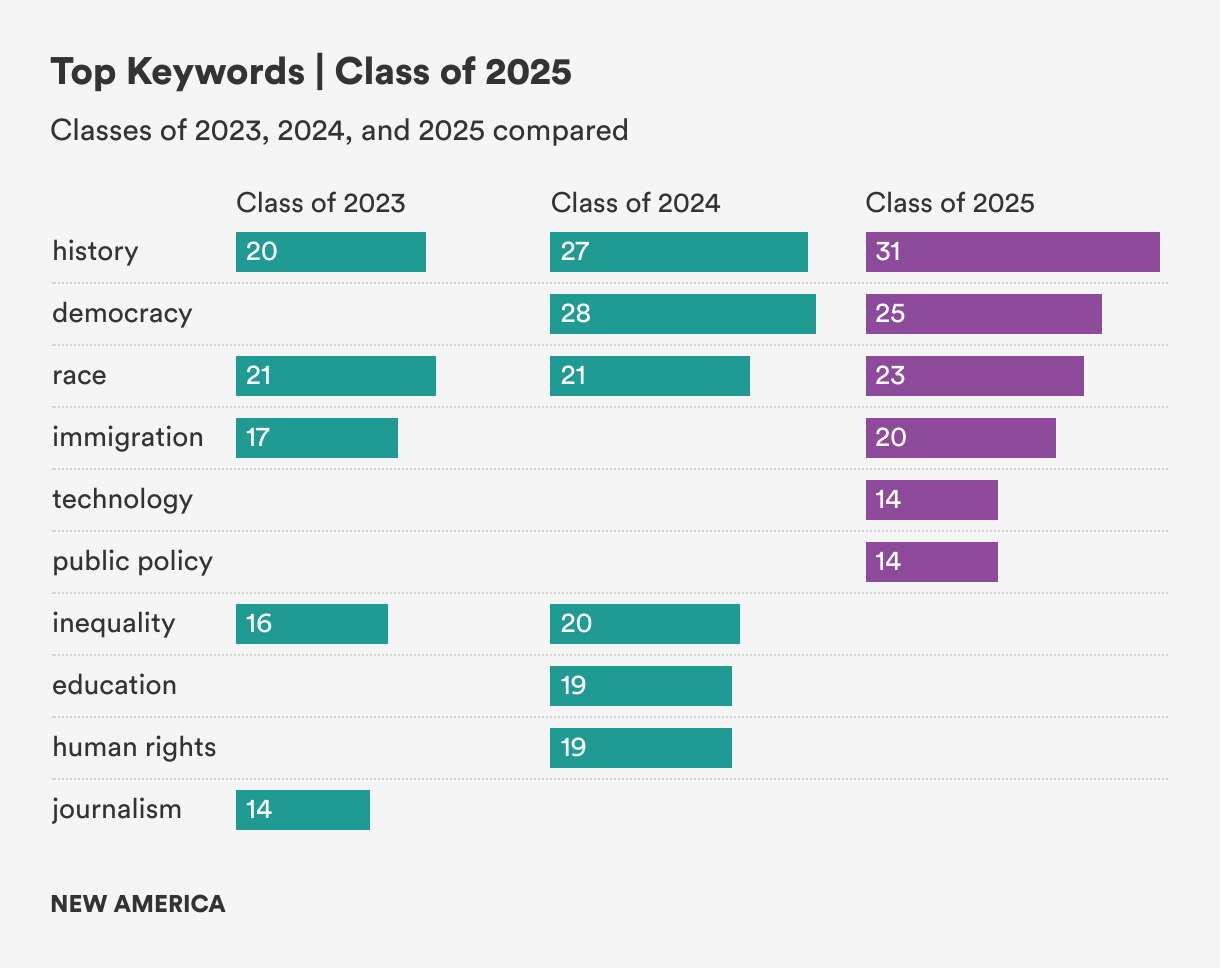
This year, the top six keywords based on the frequency of use are history (31), democracy (25), race (23), immigration (20), technology, and public policy (14). Technology and public policy are newly represented as top keywords this year.
The Class of 2025 top words compared to the Classes of 2023 and 2024 as follows.
Class of 2025 by Issue Area
Each year, candidates submit applications that address a wide array of pressing global and domestic issues, providing unique insights into the concerns and priorities of journalists, academics, and thought leaders for that year.
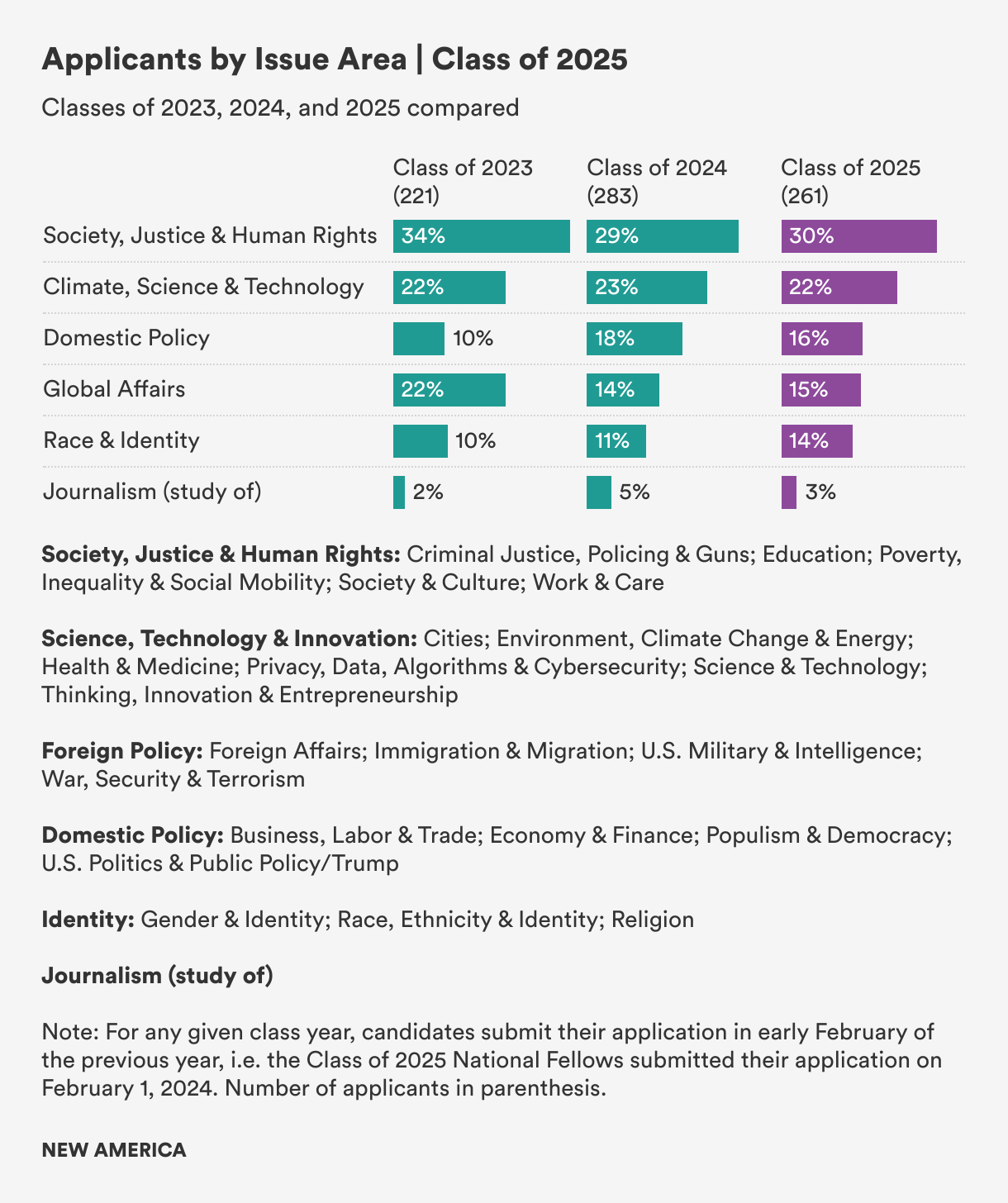
Over the past three years, the New America Fellows Program has seen varying levels of interest among applicants across a range of issue areas. The most popular category for projects across all three classes—2023, 2024, and 2025—has consistently been society, justice & human rights, with roughly a third of the applicants each year selecting this category. In 2023, this issue area represented 34 percent of the applications, though this number slightly dipped to 29 percent in 2024 before rising again to 30 percent in 2025.
Climate, science & technology has also maintained strong appeal as a topic for applicants, holding steady at around 22–23 percent across the three years. Domestic policy experienced a notable increase from 10 percent in 2023 to 18 percent in 2024, though it slightly declined to 16 percent in 2025.
Global affairs has seen a more significant decline. In 2023, 22 percent of applicants submitted project proposals focused on this area, which dropped to 14 percent in 2024 before a modest recovery to 15 percent in 2025. On the other hand, the issue area of race & identity has steadily gained traction. Starting at 10 percent in 2023, it saw a slight rise to 11 percent in 2024 and reached 14 percent in 2025.
The study of journalism remains the least pursued area, though there has been a minor fluctuation in interest. It accounted for only 2 percent of applications in 2023, grew to 5 percent in 2024, and settled at 3 percent in 2025.
These trends highlight the evolving priorities among New America Fellows Program applicants. The chart below visually captures this evolving focus among applicants over the past three years.
Class of 2025 by Project Type
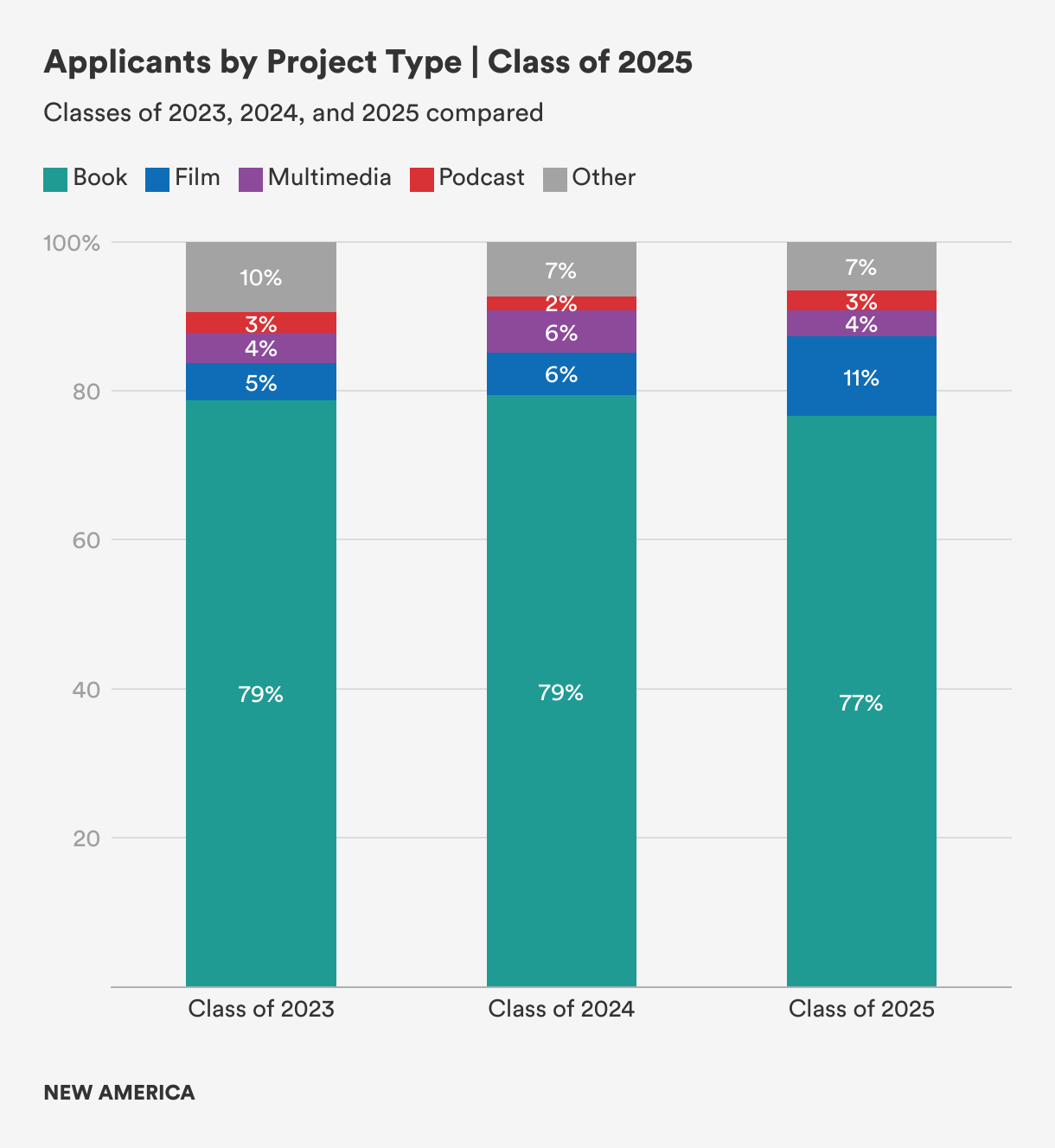
To date, the Fellows Program has supported the publication of more than 150 books, 16 feature-length documentary films, and several award-winning long-form reporting projects. While the program has an established reputation as a premier fellowship for nonfiction writers, it continues to receive a range of new project types that vary in form and approach every year. With the acceptance of the Class of 2025, in addition to 12 books, the program is supporting two film projects and one narrative video game project.
Approximately 77 percent of the Class of 2025 applicants submitted book projects, and 11 percent submitted a film project, nearly doubling the proportion of applications compared to 2024, which was 6 percent, and 2023, which was 5 percent. Additionally, for the Class of 2025, approximately 3 percent proposed a podcast project, and 4 percent presented a multimedia approach for their proposed project.
Class of 2025 by Location
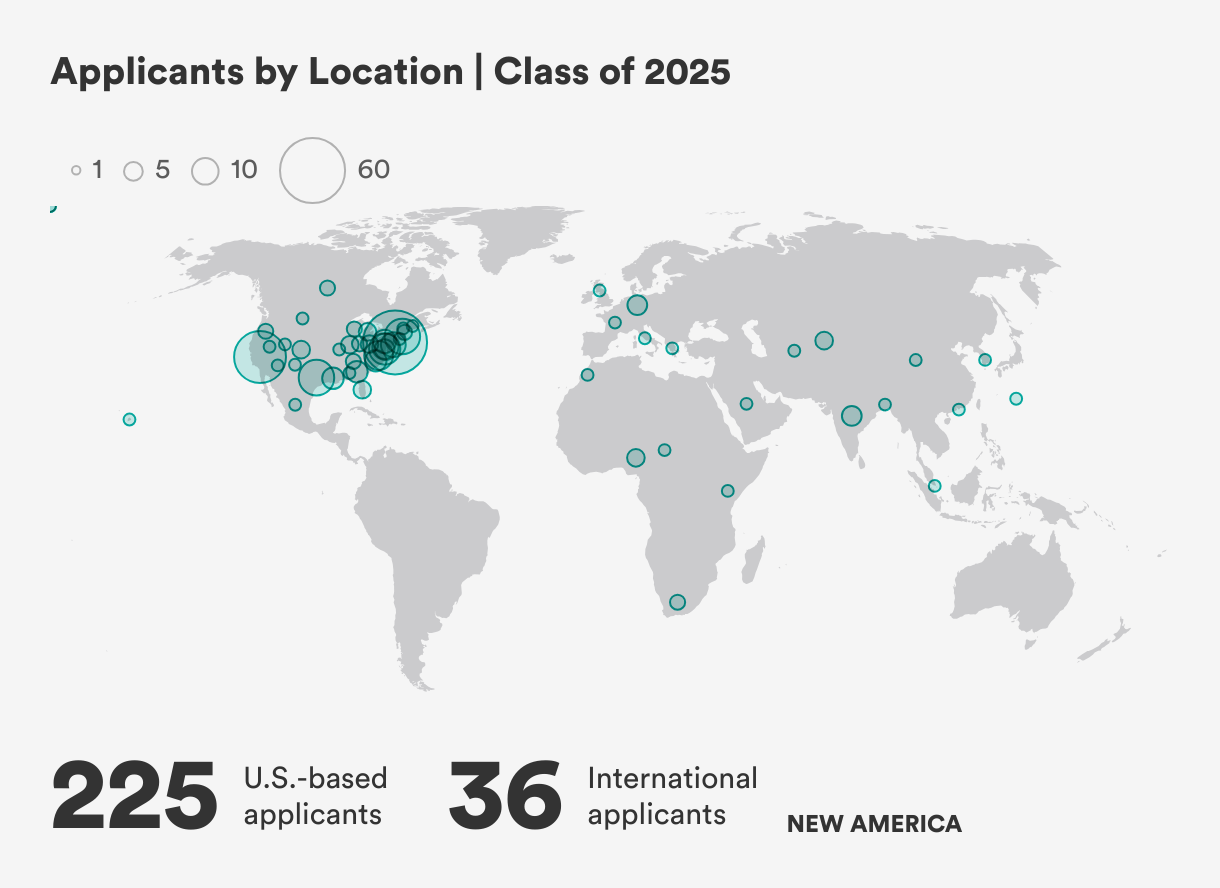
Of the broader candidate pool of 261, 225 applicants are based in the United States across 33 states and the District of Columbia, and 36 are based abroad across 24 countries.
The U.S.-based applicants are concentrated in New York (58), California (37), Texas (16), Massachusetts (16), the District of Columbia (12), and Virginia (10). Internationally, applicants based in Germany (4), India (4), Nigeria (3), and Kyrgyzstan (3) made up nearly 39 percent of the international candidate pool.
Applications were distributed across states and countries as follows.
Class of 2025 by Profession
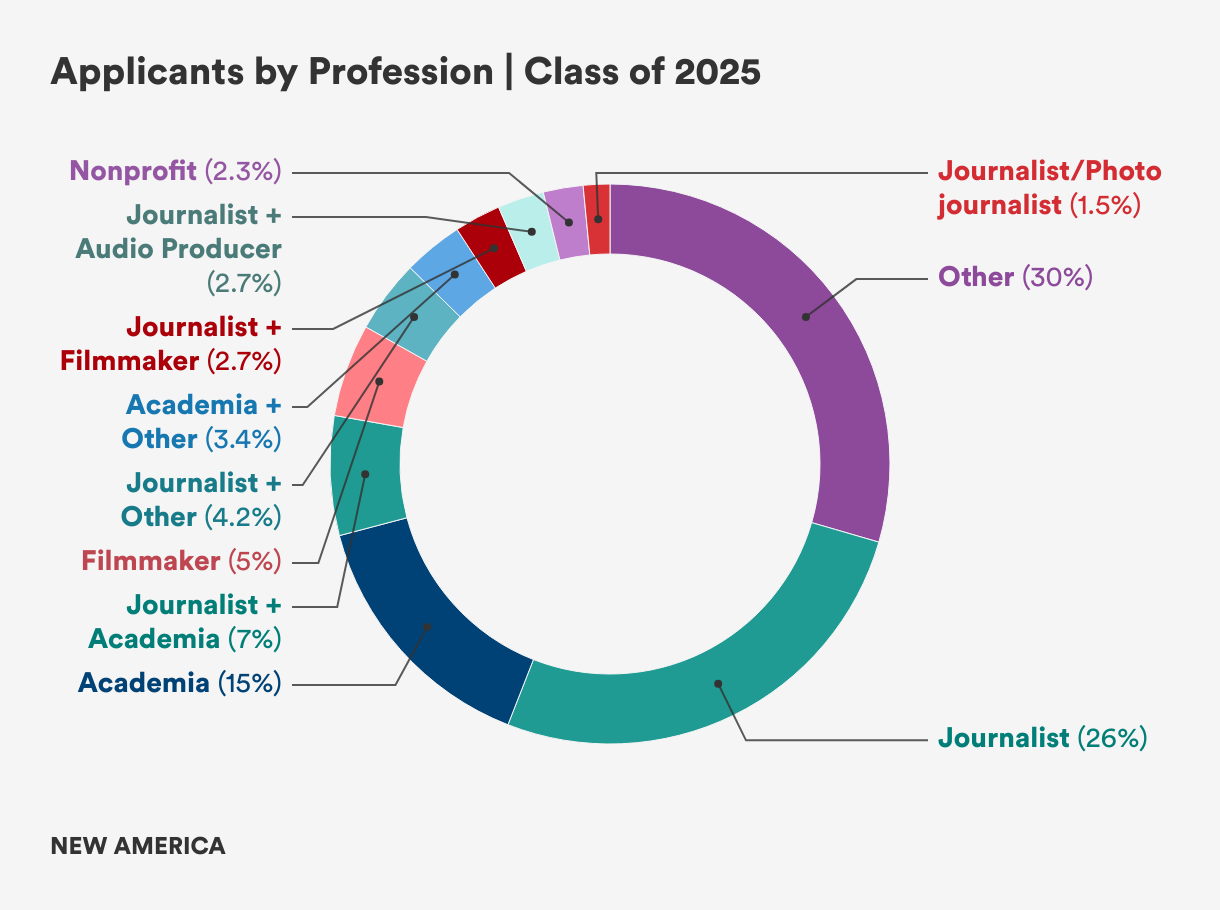
While the Fellows Program attracts applicants from a diverse range of professions and industries, most applicants are journalists (26 percent), followed by those working in academia (15 percent). The applicants by profession are as follows.
Class of 2025 by Gender and Age
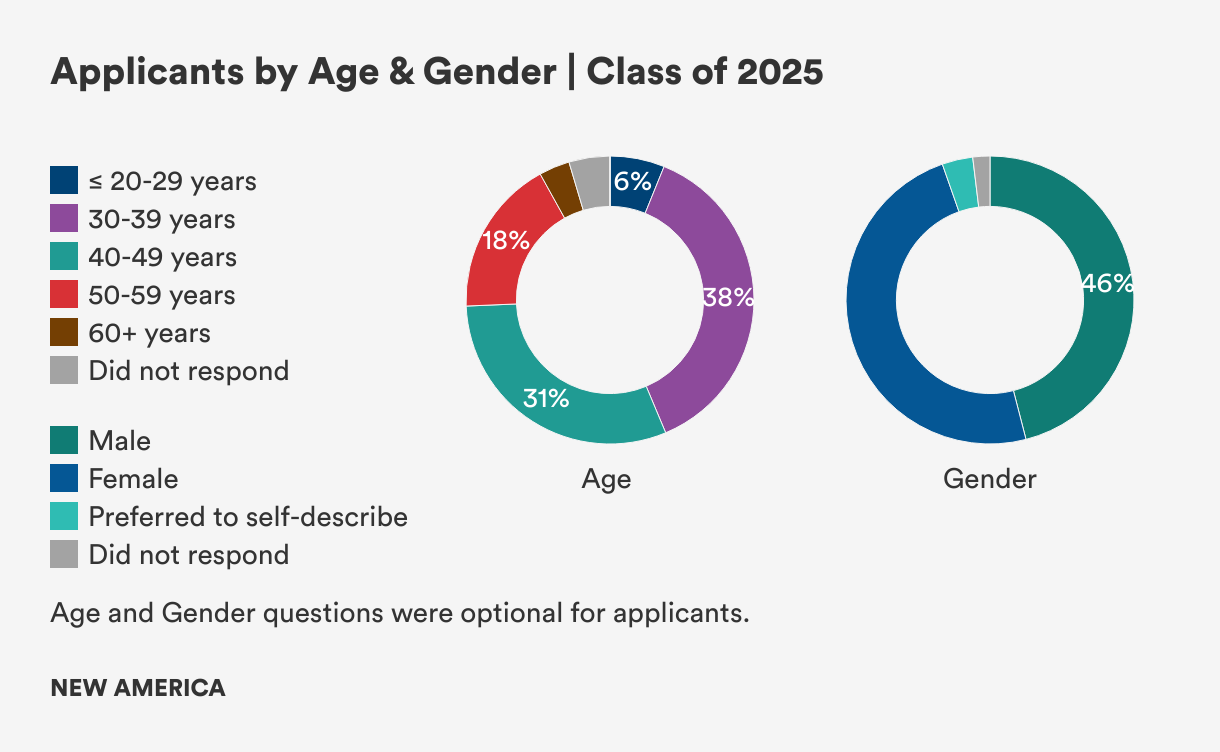
Regarding age distribution, the largest group of applicants (38 percent) falls within the 30–39 age range, followed by the 40–49 age group at 31 percent. Applicants aged 50–59 comprise 18 percent of the pool, while those under 30 account for 6 percent. The smallest age group is those over 60, at 5 percent. Additionally, 6 percent of applicants did not respond to the age question.
With regard to gender, the applicant pool is almost evenly split between males and females, with 49 percent self-identifying as female and 46 percent self-identifying as male. A small percentage, 1 percent, preferred to self-describe, and 4 percent did not respond to the gender question.
It’s important to note that age and gender questions were optional for applicants.
Acknowledgments
New America’s Fellows Program thanks its board of directors, Emerson Collective, the Jonathan Logan Family Foundation, ASU’s Center on the Future of War, ASU’s Media Enterprise, the Shourie Family Trust, and New America’s Digital Impact and Governance Initiative for their support this year.
We would also like to thank Sarah Baline, Naomi Morduch Toubman, Alex Briñas, and Kelley Gardner for supporting the design and preparation of this report.
Downloads
More About the Author

Awista Ayub
Senior Director, New America Fellows Program


