Overall Findings
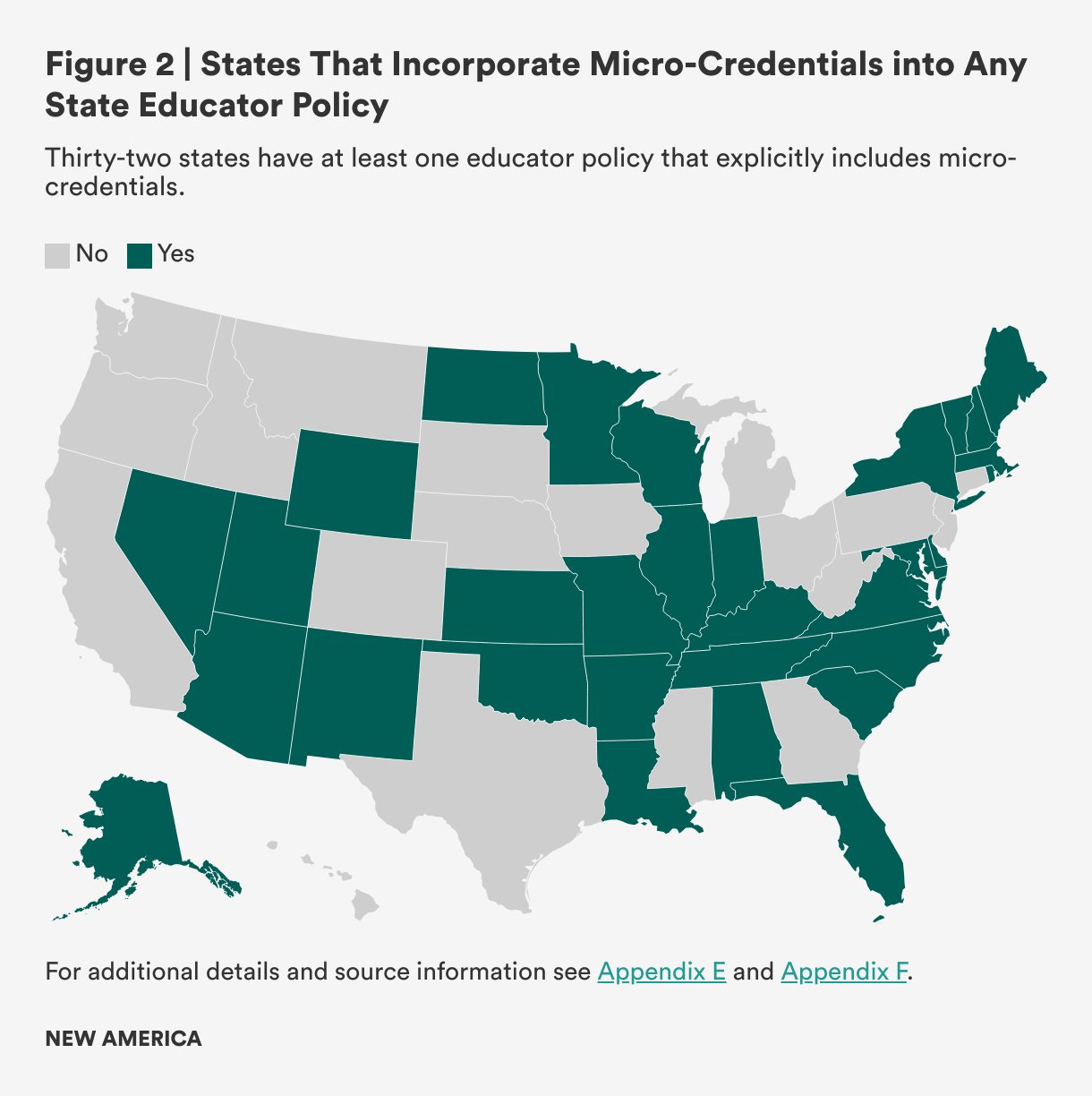
As the map in Figure 2 shows, the majority of states (32, including the District of Columbia) now explicitly allow or encourage the use of micro-credentials in at least one of the six types of educator policy examined—up from 26 in 2020, a 23 percent increase.1
A little less than half (14) of the 32 states with any type of educator micro-credential policy are incorporating micro-credentials in two or more policy areas. Figure 3 shows how many of the following six categories of educator policies each state incorporates micro-credentials within:
- Complying with state pre-service educator preparation program approval guidelines.
- Fulfilling requirements for initial or first-time professional educator credentials.
- Providing curated professional development.
- Fulfilling professional learning requirements for educator license renewal.
- Fulfilling requirements for additional endorsements for current educators.
- Fulfilling requirements for an advanced license or endorsement for current educators.
See Appendix C for a glossary and examples for each of these six policy categories, Appendix E for a state-by-state summary of results, and Appendix F for more details on each state’s policies.
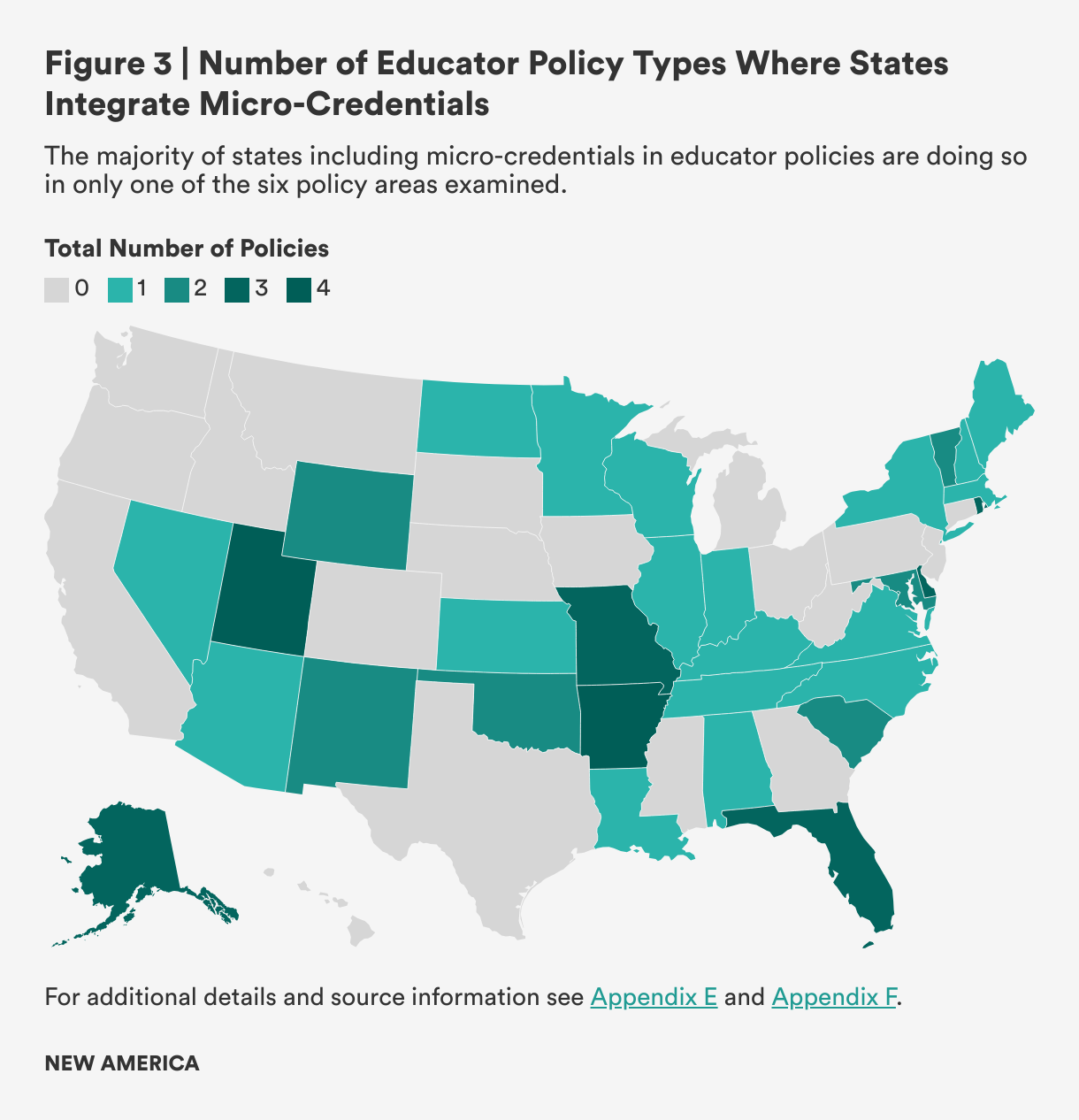
Most states that are incorporating educator micro-credentials are doing so in one (18 states) or two (7 states) of the six policy areas examined. Five states—Delaware, Alaska, Florida, Missouri, and Rhode Island—are each leveraging micro-credentials in three policy areas, while Arkansas and Utah explicitly allow them to be used in four.
While a greater number of policies indicates how widespread state adoption of educator micro-credentials is, it does not imply that a state is making better decisions about using educator micro-credentials. How policies are designed, how many educators are being reached with the policies, and how educator micro-credentials are vetted and implemented are more important than the number of ways they are integrated into the educator pipeline. See the final section of this report for more discussion of educator micro-credential quality and implementation.

When Micro Goes Macro: A Nationwide Review of States’ Educator Micro-Credential Policies
- Executive Summary
- Introduction
- State Policy Scan Methodology
- Overall Findings
- Detailed Policy Category Findings
- Comparison to 2020 Findings
- Discussion
- Conclusions and Recommendations
- Appendix A: Understanding the High-Quality Micro-Credentialing Process and Ecosystem
- Appendix B: Interviews Conducted by Authors, Chronologically
- Appendix C: Definitions and Examples for Six Educator Policy Areas
- Appendix D: Policy Categorization Methodology Differences from 2020 to 2025
- Appendix E: Summary of State Educator Micro-Credential Policies, by Category
- Appendix F: Additional Insights on Individual State Educator Micro-Credential Policies
Citations
- Even in states with no explicit policy, some local education agencies are opting to incorporate micro-credentials for educators in their approaches to professional learning and advancement.