
Maximizing Impact Under Any Structure: Governance Lessons from Local Early Childhood Programs
Abstract
More and more cities and counties fund and run their own early childhood programs, but each seems to operate them in its own unique way. While the opportunity to design and build a new program can be inspiring, the process itself can be painstaking and fraught with second guesses. Unfortunately, there are few resources to help policymakers and administrators decide how to set up a new early childhood program. This resource provides foundational information about the design and governance of existing early childhood programs and will help guide the field toward more efficient, effective governance designs. For existing program leaders, this resource offers insight on how to more effectively navigate and advocate within the constraints of their own governance structure.
The New Practice Lab convenes the Early Care and Education Implementation Working Group, a group of early care and education leaders from across the country. They are committed to delivering high-quality early childhood services to families—and know that implementation is everything. This report is based on lessons from this working group; see our previous briefs on Family Outreach, Centralized Enrollment, and Participatory Planning for a deep dive into more of the group’s findings.
Acknowledgments
The authors would like to thank members of the ECE Implementation Working Group for sharing lessons about their local governance structures, how they have evolved, and the successes and challenges they have faced.
Editorial disclosure: The views expressed in this report are solely those of the author(s) and do not reflect the views of New America, its staff, fellows, funders, or board of directors.
Downloads
Introduction: Many Sources Fund Public Early Childhood Programs
Many programs exist to help young children get the best start in life—so many, in fact, that it can be difficult for even seasoned policymakers to understand the different programs and funding streams that support them. A recent federal early childhood systems-building effort cataloged 35 such at the federal level that are designed to help families with child care, preschool, home visitation, early intervention, and more. Established by different statutes over time, these programs are administered across multiple federal agencies, but are largely implemented and delivered by state and local governments.
The result is a well-intentioned quagmire of funding streams and programs that require careful braiding and blending to deliver more seamless programs to children and families. Observers of a typical pre-K class might note two teachers, 18 students, and hopefully items like books, toys, interesting materials, and learning centers to support an enriching environment. Fueling that classroom could be a mix of funds coming from an alphabet soup of programs: Child Care and Development Fund (CCDF), Temporary Assistance for Needy Families (TANF), Title I, Individuals with Disabilities Education Act (IDEA) Part B, Preschool Development Grant Birth Through Five (PDG-B5), state universal pre-K, and Head Start. It takes an acronym to fund a classroom—sometimes four or five.
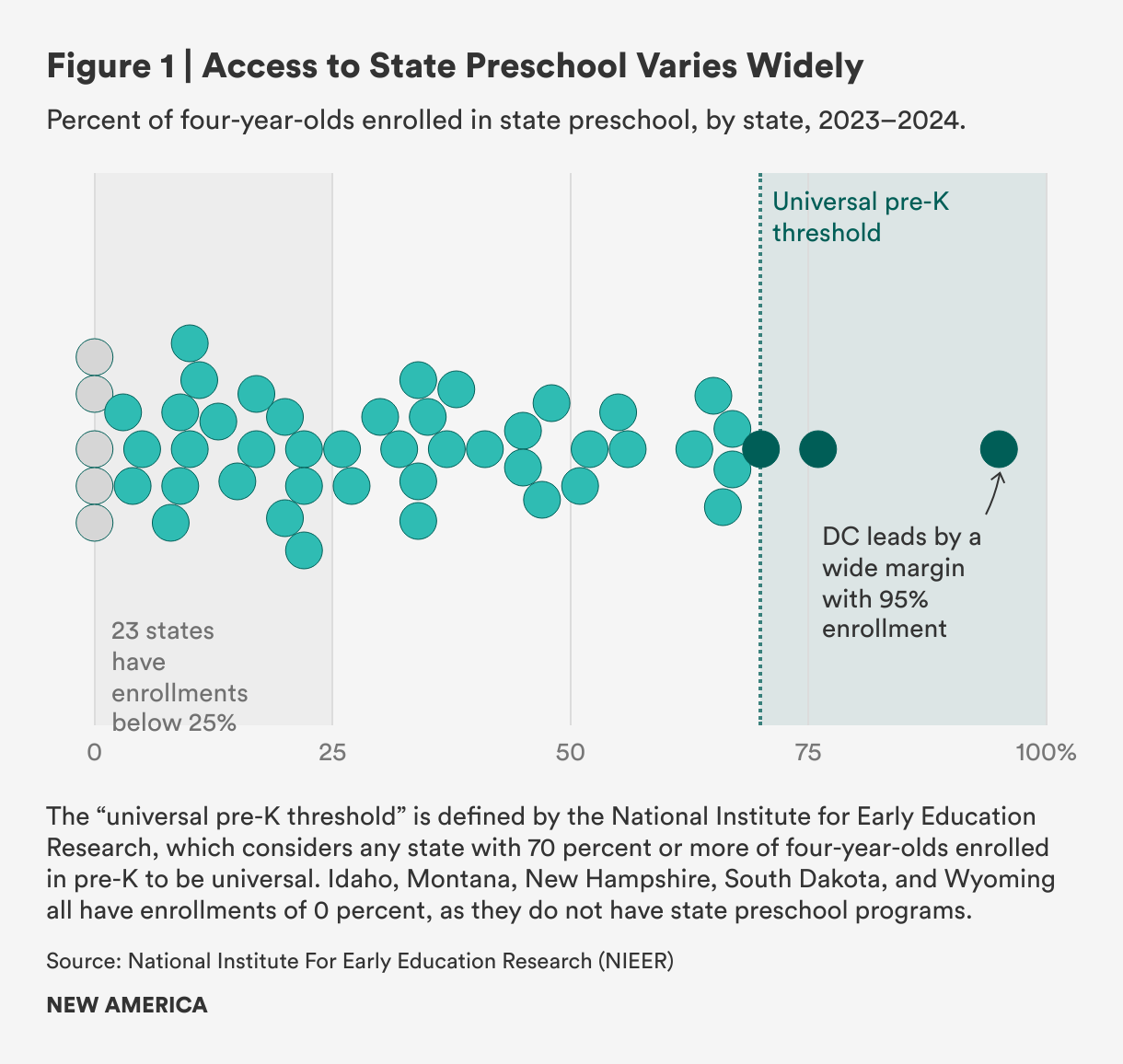
Most of these federal programs are targeted towards children from families with low incomes, and delivering more “universal” early childhood programs—sometimes defined as serving 75 percent or more of a target age group—requires additional funding.1 Free pre-K is popular, but current federal investments won’t fund enough seats for all children. Just under half of all four-year-olds and less than 20 percent of three-year-olds have access to some sort of publicly funded preschool; this means the rest pay out of pocket or do not participate at all. State and local governments have responded by launching their own early education programs with some of the most “universal” and full-time programs operating at the municipal level. Most states (44, plus Washington, DC) operate some publicly funded pre-K, but enrollment varies widely from place to place, with state pre-K enrollment of four-year-olds ranging from zero all the way up to 95 percent (see Figure 1).
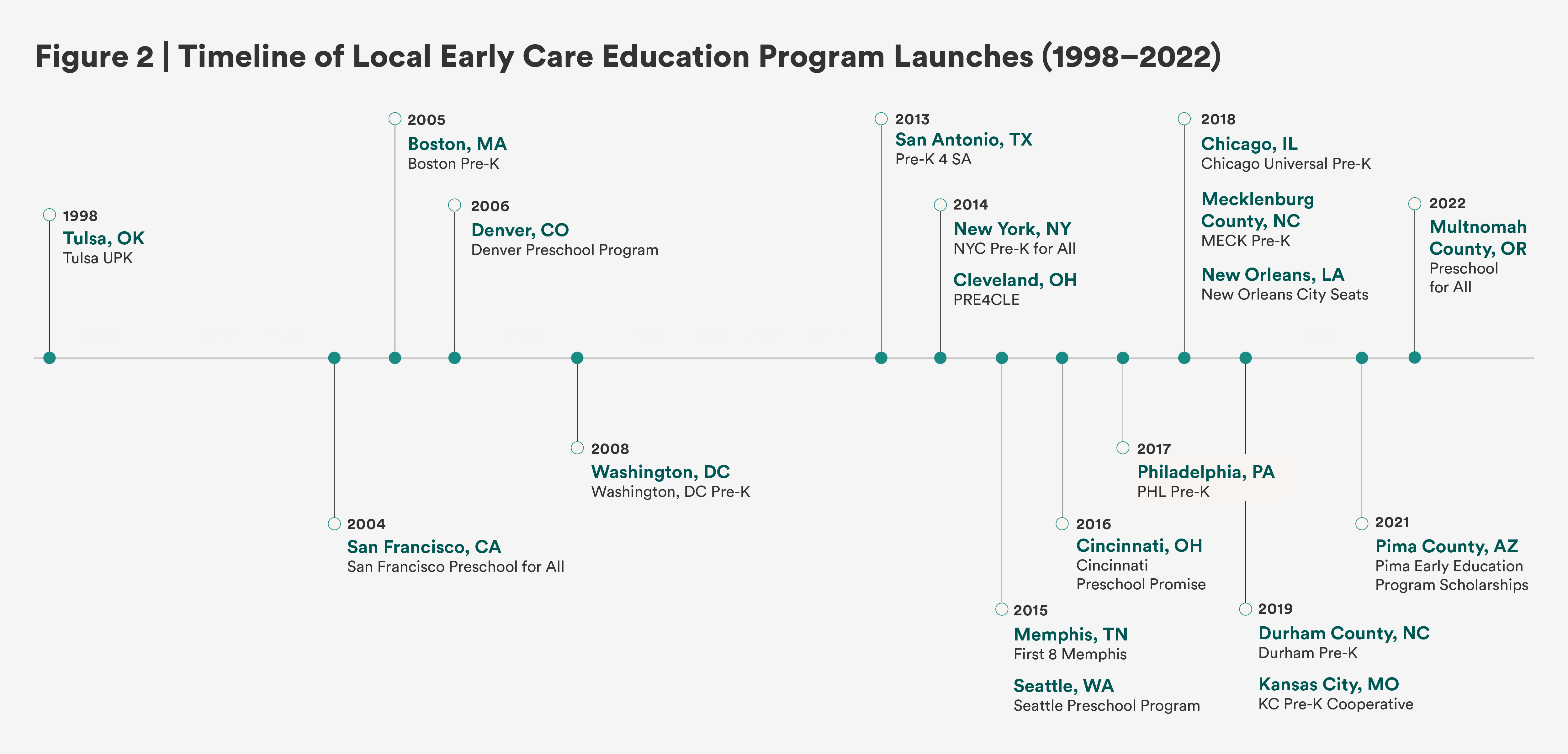
To meet demand for high-quality and affordable early learning opportunities, dozens of cities and counties have launched their own publicly funded and administered early childhood programs over the past two decades (see Figure 2 for a noncomprehensive list of local program launches).
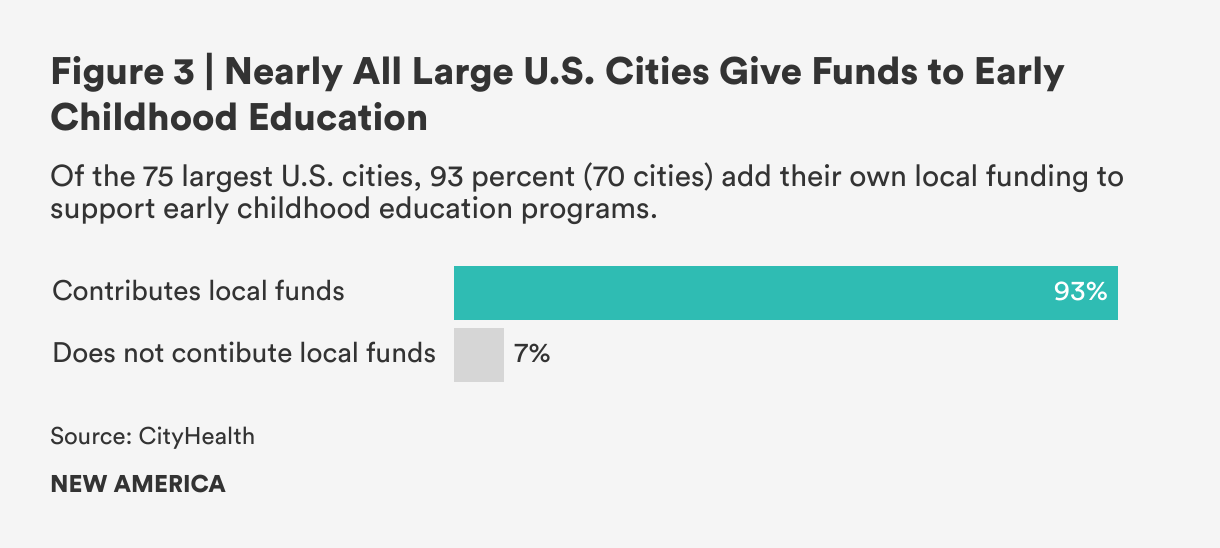
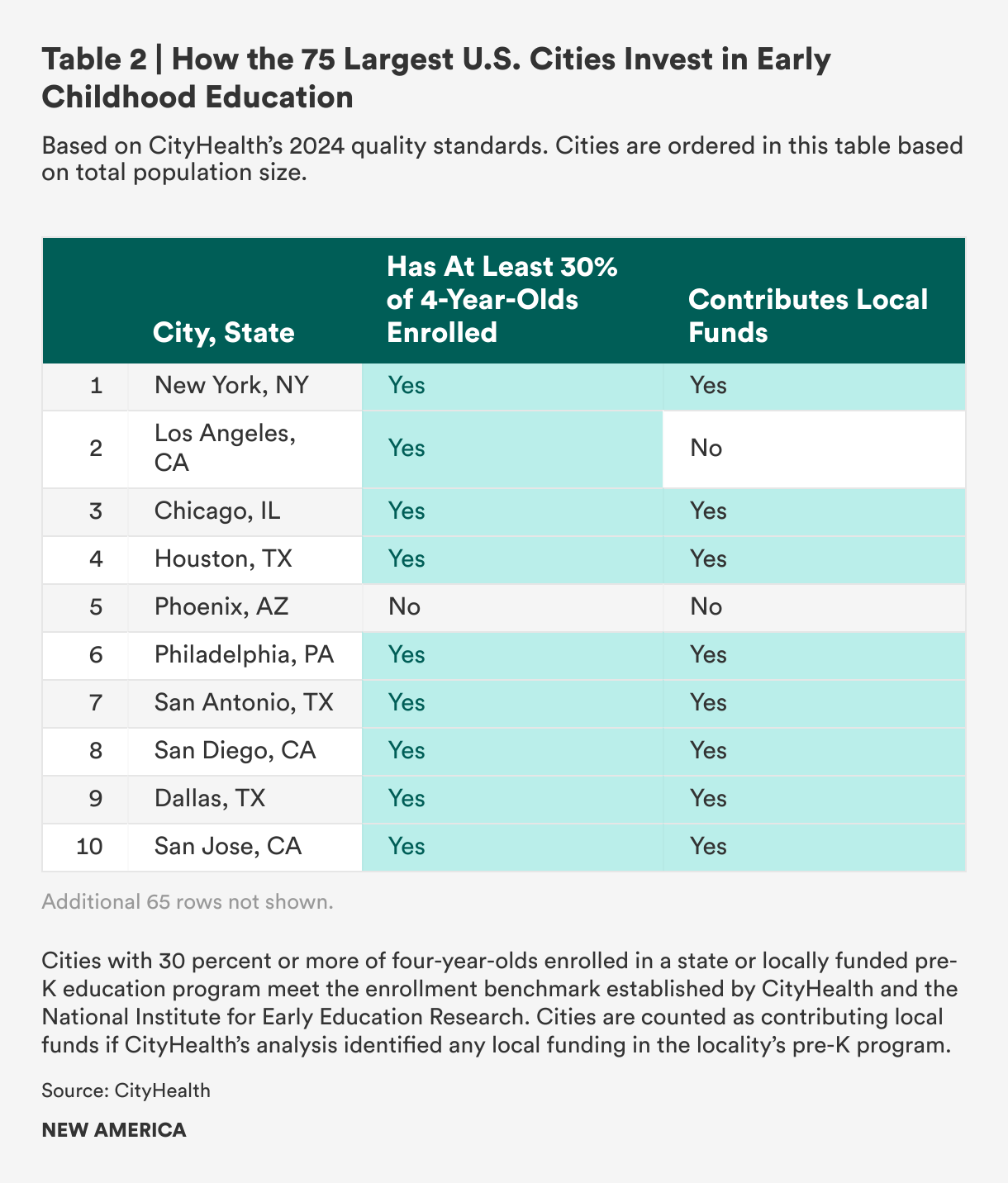
According to CityHealth, 70 of the 75 largest cities contribute local funding to preschool services as of 2024 (see Figure 3). In some cases, local funding is a prerequisite to run any programs at all; according to the National Institute for Early Education Research (NIEER), 12 state preschool programs require a local match. In many states that have robust statewide pre-K programs, localities often opt to augment state investments even if a local match is not required. For example, in Texas, every school district must offer state-funded pre-K services. Many school districts invest their own funds on top of the state dollars to increase the number of children they can serve or expand services like offering longer hours.
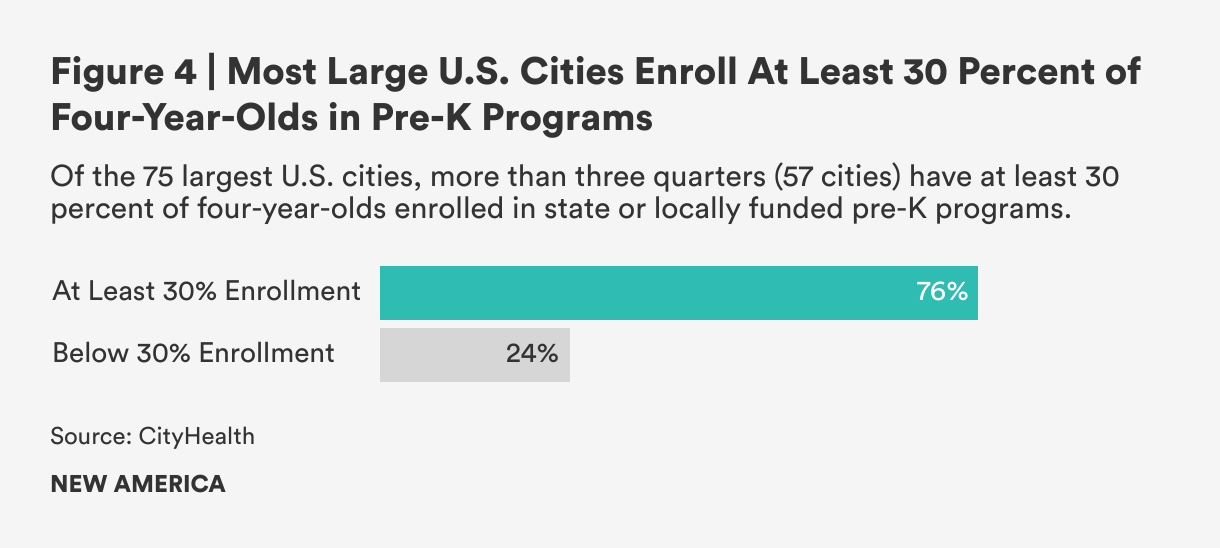
Just as early childhood enrollment rates vary widely from state to state, there is also wide variation from city to city and county to county. But unlike NIEER’s enrollment data for states, there is no single nationwide source for local early childhood enrollment data. However, CityHealth estimates that 30 percent or more of four-year-olds are enrolled in pre-K in 57 of the 75 largest cities (see Figure 4). For a list of which of the 75 largest U.S. cities invest in early childhood education, please see the additional resources section of this report.
The strong investments in and growth of local early childhood initiatives might imply a highly developed playbook to help facilitate the design and structure of emerging programs, but in fact, local early childhood governance is not well documented or understood.
Citations
- Even “universal” programs may not be full day, and even “full day” programs may not align with a full day work schedule for many parents. This requires additional hours of care to be arranged, typically at the expense of families.
Local Governance Needs More Attention
When new early childhood programs are launched, decisions need to be made about how to run them and who will do it. There are many ways to structure early childhood programs within city, county, and state governments, and this structure is referred to as “governance.” Prenatal-to-3 Policy Impact Center defines early childhood governance as “the organization of government entities and the distribution of authority and accountability for administering programs and services that support young children and their families.” Early childhood governance is a lofty term with real impacts on the kinds of care families and children can get, because it helps define who participates in the system, where services are delivered, how connected they feel to local school systems, and more. Most families and many providers might not be fully engaged with the behind-the-scenes mechanics of governance, but they will be aware of the system performance and the way that the interacting pieces work together—or don’t.
“Early childhood governance is a lofty term with real impacts on the kinds of care families and children can get, because it helps define who participates in the system, where services are delivered, how connected they feel to local school systems, and more.”
State-level early childhood governance is well documented, with thorough state-by-state analysis of different models and interagency relationships from the Education Commission of the States. In recent years, more states have begun consolidating early childhood governance under one agency or entity, a trend that has been analyzed by New America, the Center for American Progress, and others.
However, this body of research offers limited insight into how states interact with local systems and what the implications are for local leaders who are designing and launching new early childhood programs. The National Institute for Early Education Research publishes a detailed annual report examining the inner workings of every state pre-K program, but there is no parallel resource for municipal pre-K programs. CityHealth has named high-quality pre-K as an indicator of overall health for a city and examines pre-K systems in the 75 largest cities, but their research does not address governance details. And Children’s Funding Project, which works with local governments as they raise new funds for children’s initiatives, has profiled the governance structures that some cities and counties have pursued—like New Orleans and Denver—but these are standalone case studies.
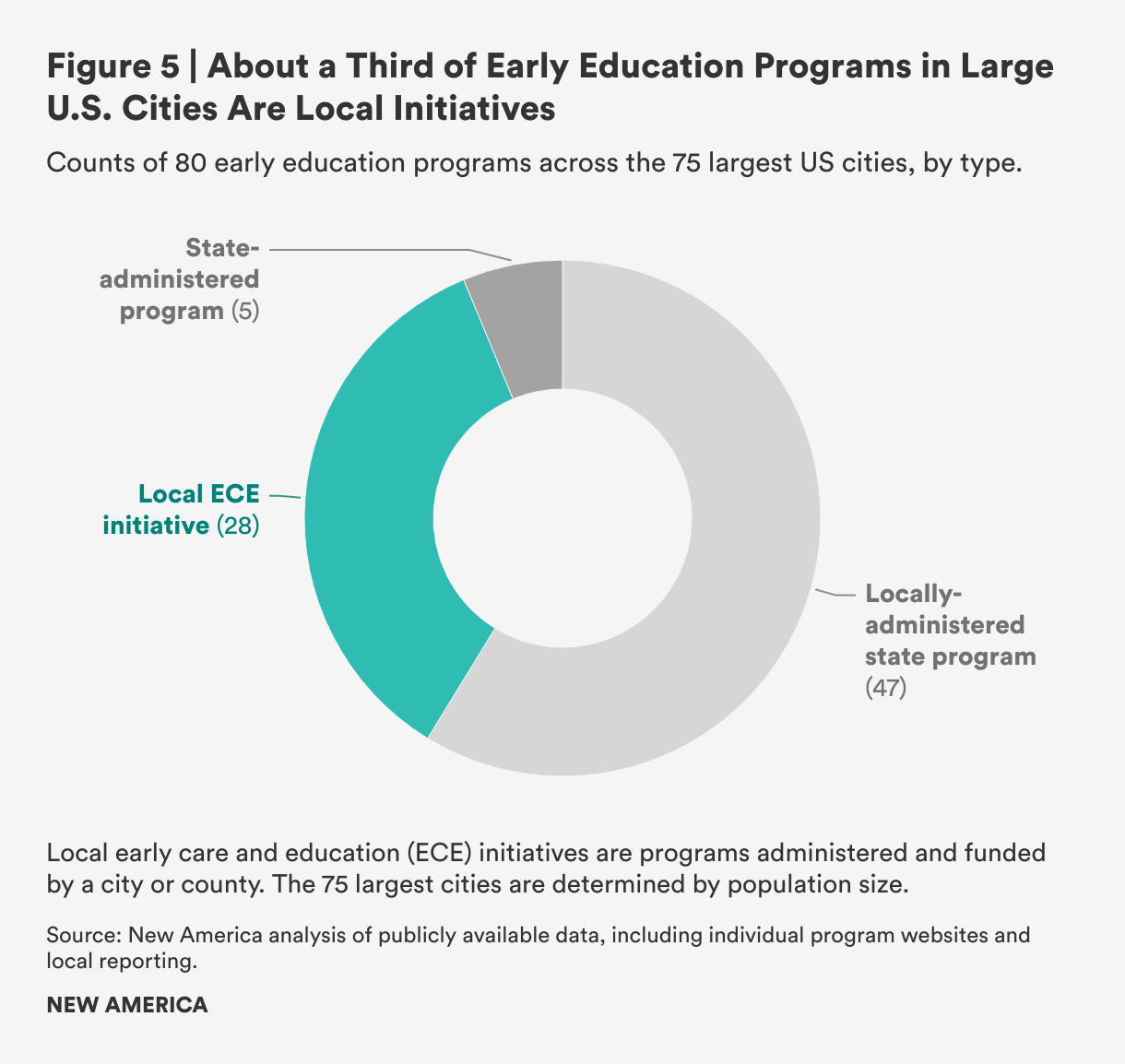
Analysis of public program data for 80 early education programs across the 75 largest cities revealed that while many of the programs were state-funded and administered or locally administered state programs (i.e., state preschool programs administered by the local school district), about one third (28 programs) were funded and administered locally, either at the city or county level (see Figure 5). This demonstrates the extent to which local early education programs are distinct from state-led or funded counterparts, and the need for more guidance on how such programs can be structured and stood up for local leaders.
The lack of overarching guidance at the local level leaves policymakers in the difficult position of designing systems without guidance documents or a compilation of best practices. This is not to suggest that there is one “best” governance structure—it is unlikely research would lead us to a clear answer, nor would that answer be helpful across contexts. Even when starting a system from scratch, few local leaders can just design the governance structure of their dreams. There are many constraining factors determining where a program will “sit” and who will run it. Within the ECE Implementation Working Group, there are members from mayor’s offices, county executive’s offices, county agencies, independent nonprofits, school districts, and local collective impact organizations. This is not some haphazard accident—it’s because in their respective city or county each of these groups plays a pivotal role in implementing publicly funded programs.
Still, experience from the group teaches us that when local leaders can learn from each other, it improves the efficacy of implementation, and documenting lessons from different approaches to local early childhood governance will help future champions and leaders design programs that are well suited to their operating environments.
“Documenting lessons from different approaches to local early childhood governance will help future champions and leaders design programs that are well suited to their operating environments.”
This report defines different local early childhood governance archetypes and describes where and how they are used. Understanding the strengths and drawbacks of different archetypes will support local leaders, across all governance structures, in decision-making and design. For municipalities just starting out, why pick one governance approach over another, to the extent there is a choice? What are some important design considerations to fight for? For municipalities already locked into a governance structure, what are some lessons on maximizing impact that apply to your particular approach?
A Framework for Different Local Models
For the purposes of this report, we focus on explicitly local early childhood initiatives (i.e., those with dedicated local revenue sources) and their governance structures. In this context, ‘governance’ refers to what entity or entities administer the overall program and bear fiscal responsibility for it. The governing body is sometimes, but not always, a direct operator of services. The models we looked at are mostly, though not exclusively, pre-K programs.
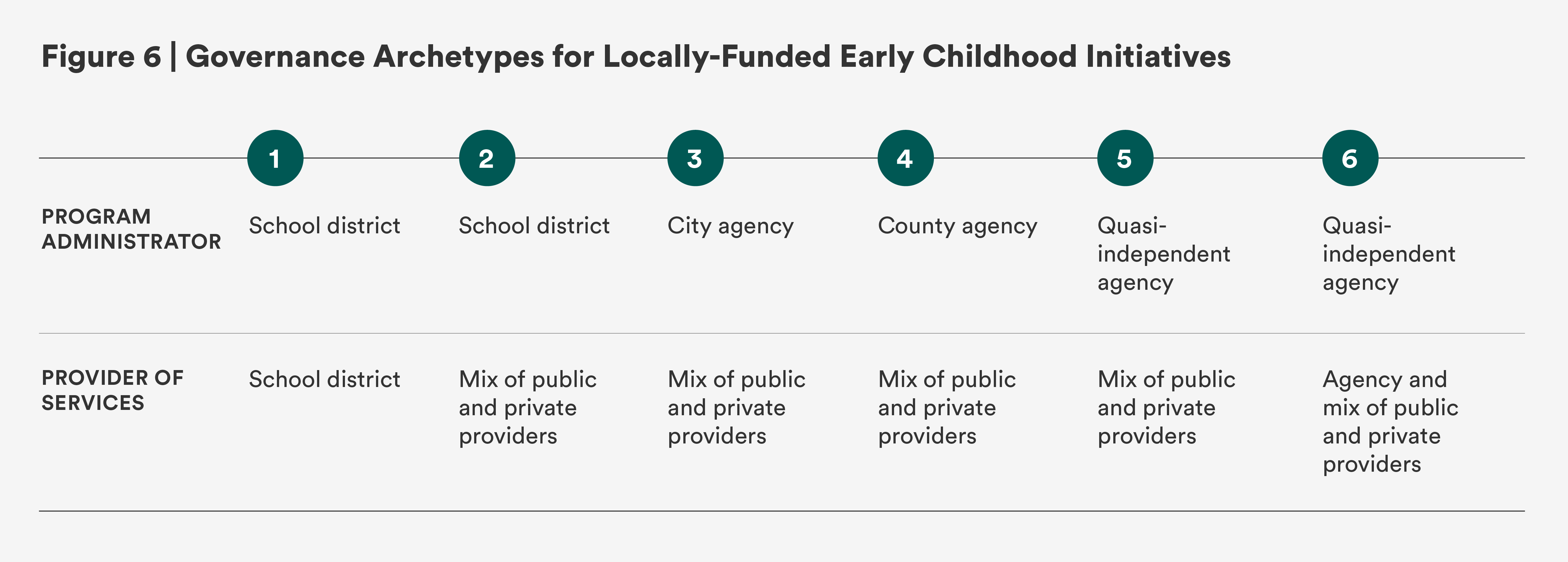
Across locally funded early childhood initiatives, there are at least six archetypes for governance (see Figure 6 above):
- The school district administers the program and directly operates all services. This approach is becoming less common as more systems move toward mixed delivery models where services are offered both through public schools as well as contracted, private partners like center-based programs, Head Start programs, family child care homes, and others. This archetype reflects how Boston’s preschool program was managed for many years, though they have recently begun incorporating some contracted partners. Similarly, Baltimore City Public Schools administered and operated all preschool services until recent state legislation pushed for mixed delivery. California’s statewide Transitional Kindergarten program—which is on a path to serve all four-year-olds in the state—is administered and operated by school districts almost exclusively.
- The school district administers the program, directly operating some services and contracting with a mix of providers for others. New York City’s Pre-K for All program is run by the city’s public school system, though more than half of the preschool slots are operated by contracted partners. In Chicago, the city’s Chicago Early Learning initiative, which includes services for children from birth through age five, is a partnership between the mayor’s office, the city’s Department of Family and Support Services, Chicago Public Schools, and privately operated Head Start programs. Fiscal and administrative controls for the city’s preschool program fall under the auspices of Chicago Public Schools, which operates most, but not all, of the city’s pre-K seats.
- A city agency administers the program and works with a mix of public and private providers. In Philadelphia, the Office of Children and Families sits within the mayor’s office and has oversight of the PHLpreK initiative. The city partners with over 300 preschool sites, including many public schools, and the School District of Philadelphia is a core partner. The San Francisco Department of Early Childhood—a standalone city agency—administers the city’s Early Learning for All initiative, which offers free or low-cost child care to most families in San Francisco. Over 500 child care centers and family child care providers participate in Early Learning for All programs, and services are also provided through the San Francisco Unified School District.
- A county agency administers the program and works with a mix of public and private providers. In Multnomah County, Oregon, the countywide Preschool for All initiative is implemented by the Preschool and Early Learning Division in Multnomah County’s Department of County Human Services. The county works directly with private child care centers and family child care providers, as well as Portland Public Schools and some smaller school districts.
- A quasi-independent agency administers the program and works with a mix of public and private providers. These organizations are operated as independent nonprofits and have their own boards of directors, though some board members may be appointed by the mayor or other public agencies. Public funds are directed to the nonprofit for distribution to preschool providers and to support administrative services. Denver and Cincinnati have similarly structured preschool initiatives—the Denver Preschool Program and Cincinnati Preschool Promise both administer funds and work with their local school district and with private child care providers to offer services, but neither organization directly provides preschool services.
- A quasi-independent agency administers the program, provides direct services, and works with a mix of public and private providers. Like in the model above, these organizations operate as independent nonprofits, but with some oversight from the city or county government. In San Antonio, Pre-K 4 SA is a standalone entity administering the city-funded preschool program; Pre-K 4 SA directly operates four centers, serving 4,000 children annually. Pre-K 4 SA also works with private providers and school districts throughout San Antonio to provide additional services and support.
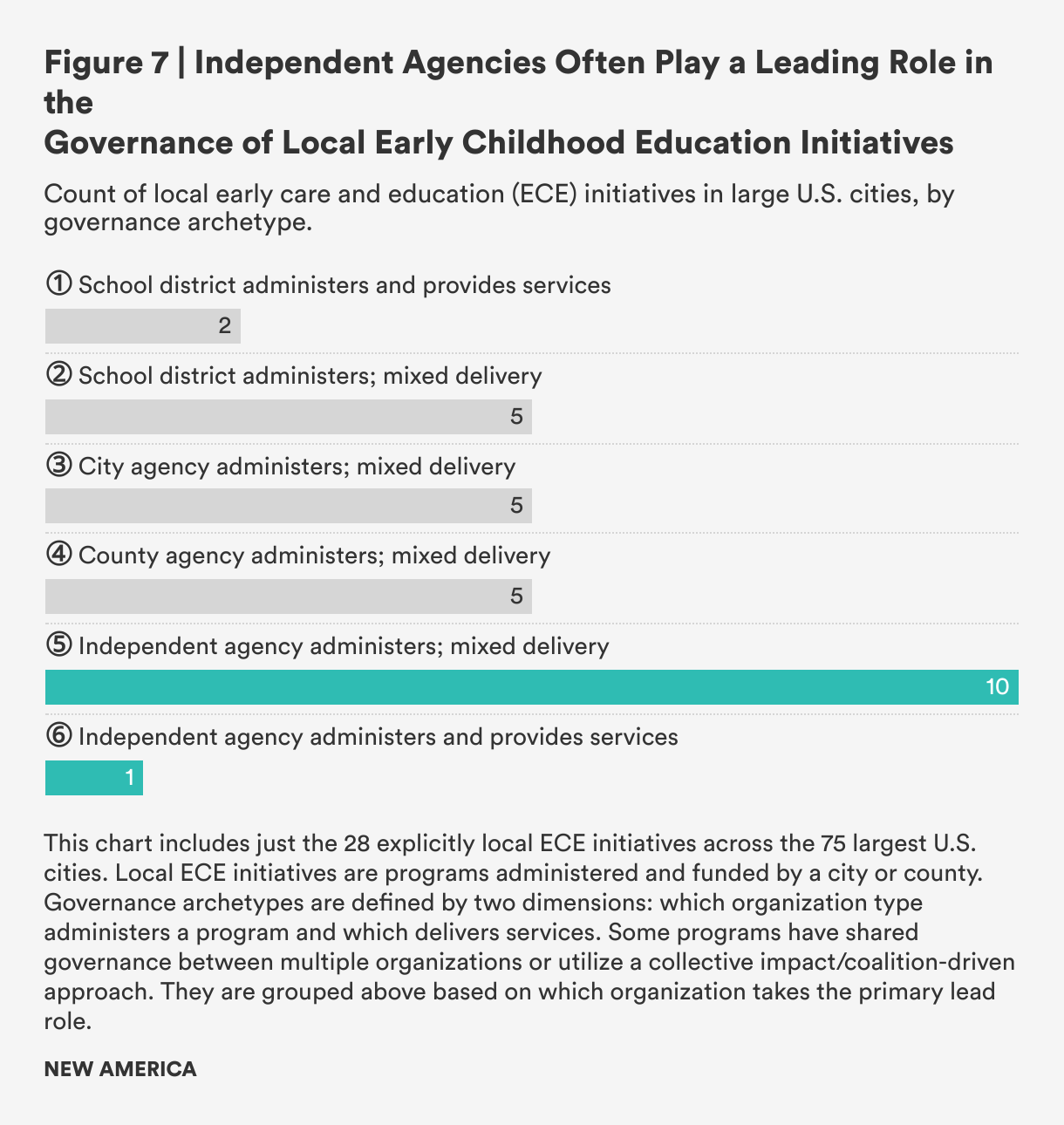
Across local early care and education programs in the 75 largest cities, the most common governance model includes an independent or quasi-independent agency; almost 40 percent of the 28 local governance systems analyzed here are administered by an independent agency (see Figure 7).
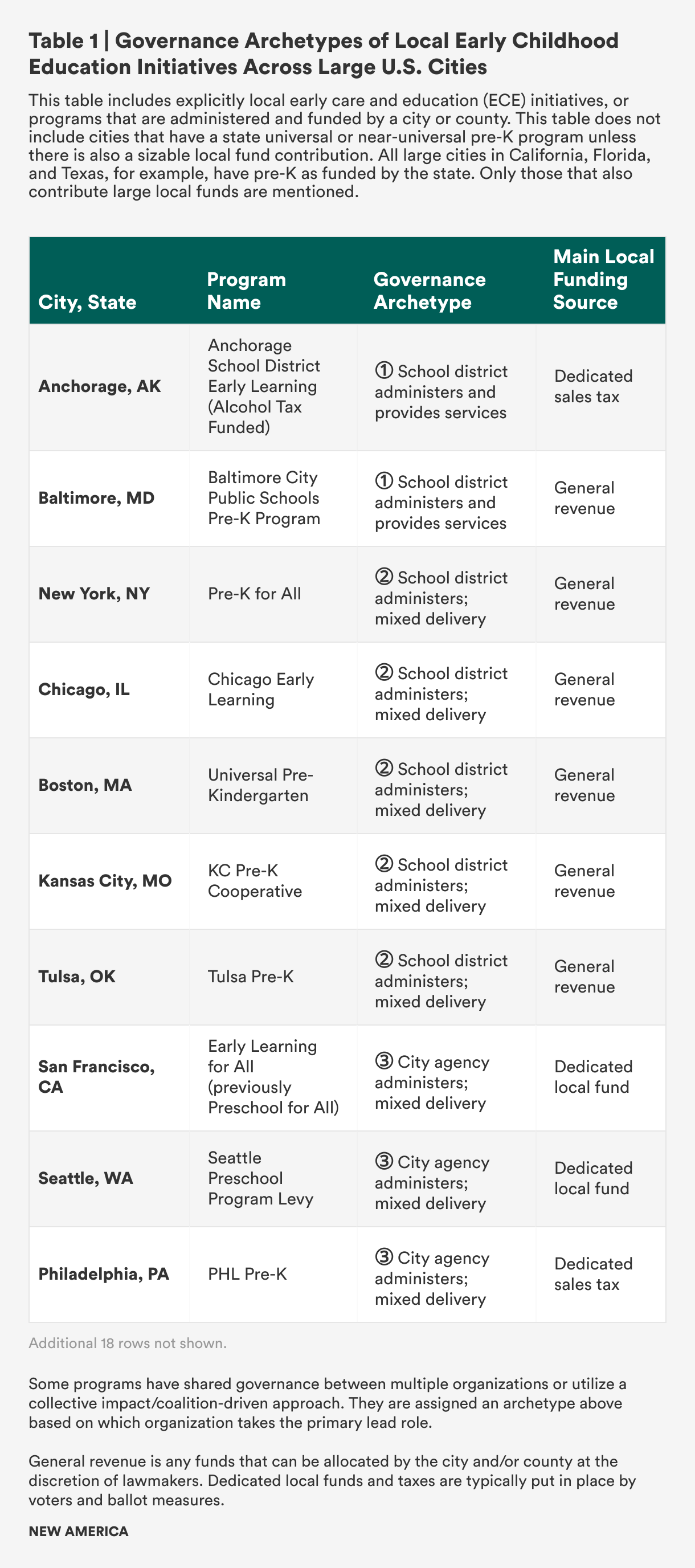
This is not a wholly comprehensive list of every possible local governance structure. Some places have a shared governance model, in which multiple organizations hold responsibilities for program oversight. For example, in New Orleans, the city’s early childhood program is jointly administered by a local nonprofit, Agenda for Children, and New Orleans Public Schools. Many large cities take a collective impact approach, in which multiple organizations hold different responsibilities and come together as a coalition. Washington, DC, is another outlier; the Office of the State Superintendent of Education oversees the city’s early childhood program. Still, this framework can help us understand some of the most common approaches and sort local programs accordingly (see Table 1).2
Citations
- Program archetypes were determined through the authors’ analysis of programs’ websites, local news reporting, and other reputable public sources. Not all programs fit neatly into one archetype. In cases with shared governance or collective impact approach, the archetypes are based on which organization takes the lead role. We welcome feedback on this analysis; please contact us at [email protected] with questions or if you believe a program has been misidentified.
Factors Influencing Local Governance Choices
State governance and funding structures play an outsized role in determining local early childhood governance structures. No two local early childhood programs are exactly the same—each is a creature of circumstances and context, and their governance structures reflect the realities of their operating environments.
Ten questions can help leaders think about governance models that could best serve their community:
- How do state funds for early childhood education flow to localities? In many localities, there are structures in place to administer state pre-K and child care funds, as mandated by state law. Sometimes, municipalities build their governance structure on top of the one mandated by the state; in other cases, the local program is run entirely separately. In many cases, there are multiple parallel structures. This governance complexity is the direct result of funding fragmentation; in many cities and counties, there are multiple different early childhood programs with different oversight bodies, different goals, and different eligibility requirements. State funding structures matter to local governance because they empower—or disempower—specific local systems and organizations. In a state where the local school district has a mandated role to administer pre-K funds, the district will play a broader role in program administration. Where local school districts are bypassed, or treated as just a provider and not an administrator, other types of organizations will take the lead.
- Who is championing the introduction of a new early childhood initiative? Newly elected officials who campaigned on early childhood may want to administer new programs in an agency under their direct control, as in New York City’s Pre-K for All. In Oregon, Multnomah County’s political capital to fund and launch Preschool for All was largely driven by a county executive; this, combined with a strong county government system, led to the recommendation that the program be managed at the county level. In Harris County, Texas, the Commissioner’s Court Offices strategically allocated approximately $149 million in federal American Rescue Plan Act (ARPA) funds to expand access to publicly funded early care, education, family, and workforce supports. This investment led to the creation of the Department of Economic Equity and Opportunity, Early Childhood Initiatives Division, to oversee and manage the implementation of these programs.
- Is there a strategic advantage to city or county government leadership? Whenever new funds need to be raised, there will be political, budgetary, and impact implications built into governance decisions. In Travis County, Texas, where a recently passed ballot measure will raise $75 million annually for early childhood education and afterschool programs, there was a strategic decision to advance the measure at the county level and not just in the city of Austin. Even though early coalition-building work had been focused on the city, local leaders felt the impact would be greatest with a county-wide program. Further, the state child care subsidy program is administered at the county level by the Workforce Investment Board, providing some potential synergies.
- How do the city, county, and school district boundaries overlap? Contiguous boundaries—like in Denver and Philadelphia, where there is one city, one county, and one school district—simplify some of the decision-making. In some cities, particularly in the South and Southwest, there may be a dozen or more school districts within a city’s boundaries. In San Antonio, it would not have been possible for a school district to lead the local preschool initiative given this dynamic; the program, which was championed by the mayor, was intended from the outset to be citywide and therefore stretched across multiple district boundaries. Some of the city’s 16 school districts opted out of participating when the program launched; then-mayor Julian Castro felt strongly about the best approach: “excellent full-day pre-K that wasn’t bound by these district lines.”There are several examples of places where both the city and county have their own early childhood initiatives, administered by different agencies, and serving slightly different areas. Seattle Preschool Promise, administered by the city’s Department of Education and Early Learning, is funded by a city tax levy and serves three- and four-year-olds across the city. Seattle sits within King County, Washington, which has raised its own levy to operate a comprehensive suite of programs for children and youth, including some targeted early care and education investments. The program, known as Best Start for Kids, is operated by and serves the entire county.
- Does the municipal government have oversight of the school district? In places where the school district is under mayoral control, like New York City and Chicago, placing an early childhood program may be an easier bet: The program gets the instructional and institutional benefits of stronger alignment to K–12 education, while also effectively reporting to the mayor. There are places where the school district plays a strong leadership role in administering the local early childhood education initiative, even where the mayor has a reduced management role. However, it just may mean the mayor has less direct influence in shaping the program.
- If there are existing funding streams that can and will be leveraged, which entities locally have control over them? As described above, many state pre-K programs are prescriptive about what entity manages the program locally. Some localities are able to layer their funding on top of state dollars; if the same agency is managing both the state and local programs, that blending and braiding of funds may be more manageable. In Oklahoma, funds from the state’s universal pre-K program go directly to school districts. Tulsa has run a strong early childhood program for decades, building on the state’s investment, and much of this work is driven out of Tulsa Public Schools.
- Is there an opportunity to shift how state dollars flow to localities to streamline governance? Sometimes, localities can successfully influence how the state dollars flow to create these stronger local synergies. In Denver, the local early childhood program—the Denver Preschool Program—predates Colorado’s universal pre-K program. Advocates in Denver pushed for the Denver Preschool Program to be a local intermediary for the state program to enable that kind of strategic funds management. (Read more about this in our conversation with the leaders of the Denver Preschool Program and the Colorado Department of Early Childhood.) In New York City, the universal pre-K program was managed from its launch by the Department of Education; at the time, the city’s means-tested child care programs were run by another city agency. Over time, the city worked with the state to enable the Department of Education to manage some child care funding to better integrate the city’s early care and education programs.
- If new local funds are being raised, are there limits on which entity can have fiduciary responsibility for the new revenue? Many cities and counties have introduced ballot measures to raise new revenue for their early childhood programs. State and local laws about where those funds can be managed may impact whether the funds must be administered from within the government or whether they can be allocated to a non-governmental entity. In some states, there are restrictions as to whether funds can be raised at the city or county level. For communities considering ballot measures to raise new revenue, the Children’s Funding Project can be a tremendous resource to navigate these decisions.
- What governmental or non-governmental entity has existing capacity to manage the program or can scale up capacity on the appropriate timeline? When there are options for who can implement a local early childhood program, it may be prudent to consider which management structure will facilitate effective—and potentially rapid—implementation. In some communities, choosing a non-governmental or quasi-governmental entity to manage the program enabled program administrators to bypass some procurement requirements or fast-track hiring key staff, for example, and move faster than they would be able to from within a government agency. In New Orleans, the early childhood system is jointly managed by Agenda for Children, a local nonprofit, and New Orleans Public Schools (NOLA-PS). NOLA-PS was already running a K–12 unified enrollment system in 2012 when state legislation required localities to implement a similar system for early childhood education. Because NOLA-PS had the economy of scale and experience running a unified enrollment system, they took it on and closely adapted K–12 system rules to early care and education. As New Orleans has continued to expand its early childhood services, including through a 2022 property tax millage that supports infant and toddler care and education, Agenda for Children and NOLA-PS have continued to collaborate: Agenda for Children administers the services, including oversight of seats and partner management for wraparound services, while NOLA-PS supports with enrollment.
- If there is no logical existing agency within the local government to manage the program, is there room to create a new one? It is typical for many city or county agencies to do work that touches on early care and education. Sometimes, no one of those agencies is the right fit to oversee a new initiative because there is insufficient capacity or misaligned priorities, or because the work will not be sufficiently elevated within the existing agency. In a few cases, this had led the local government to create a new office altogether. For example, in Pennsylvania, Allegheny County created its new Department of Children Initiatives in 2021 to drive an enhanced focus in the county on early care and education and out-of-school time services.
Lessons For Local Governance
There are ways to maximize the efficacy across all governance models, and there are lessons that are more specific to particular approaches. Below, we identify broadly applicable principles that can be implemented across any governance archetype and more specific principles for programs led by either school districts, city or county agencies, or independent organizations.
Broadly Applicable Principles
Enlist a champion who can marshal resources for the program.
Implementing a large-scale early childhood education program—particularly on a short timeline—requires an all-of-government approach. The entity managing the program rarely has control over all the necessary functions. If new early childhood centers need permits and licenses, there will likely be a role for city or county health departments, building departments, fire departments, and others. Early childhood programs are unlikely to rise to the top of their list of priorities, not out of malice or any disrespect, but because those agencies are typically capacity-strapped and juggling competing requests. If a mayor, city council member, or county leader can compel those agencies to prioritize early childhood education, it will lead to smoother implementation.
Create genuine avenues for community voice and participation.
As outlined in a prior brief, creating authentic opportunities for community members—especially parents and educators—to inform policymaking is critical to designing programs that meet the needs of the people using them. Depending on the governance structure, the options for involving family and provider voices might look somewhat different. If there is a formal board with oversight responsibilities for the program, parents and providers could be given seats. An advisory board specifically for parents and providers could be another option, so long as the group is truly given visibility and opportunity to influence the program.
Consolidate as much of the funding and decision-making as possible.
In most jurisdictions, a complex process map is necessary to even attempt to understand how all the different early care and education funding streams flow. Often, local executive leaders do not look at the overall picture of early care and education services and supports, defaulting instead to viewing each as a separate program. This fragmented management can negatively impact service delivery because each agency may be operating within its own silo, motivated by different goals and priorities. The agency administering child care funds has, by statute, an orientation toward enabling parents to work, even over prioritizing the developmental needs of children. A public school district will have a natural lean toward looking at early childhood education as an on-ramp for K–12 education. (See the box below for a tale of two Bay Area consolidations.)
Early Childhood Governance in the Bay Area
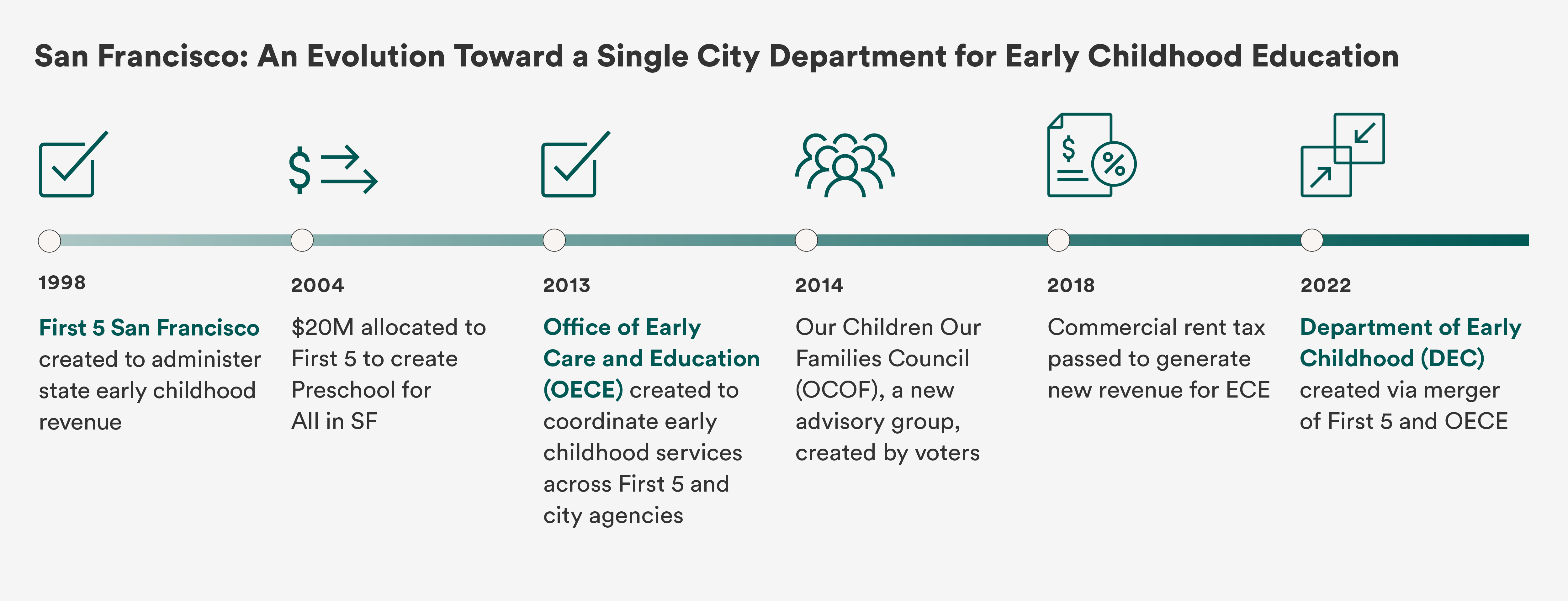
San Francisco’s Department of Early Learning represents the somewhat rare and successful attempt to fully consolidate management of early care and education at the city level. Over 20 years, the city has evolved its governance structure, first by putting systems in place to coordinate across offices, and later, by formally merging them. San Francisco is both a city and a county, which supported this consolidation: The county-level First 5 San Francisco, an entity created by the state to administer revenue for early childhood education, was merged with what had been the city-level Office of Early Care and Education to create the now-unified department.
Just across the San Francisco Bay, there are multiple structures within California’s Alameda County involved in the administration of early childhood education services. Oakland is the largest city within Alameda County, but the county extends well beyond Oakland’s borders. First 5 Alameda, a county commission created under the same state law as First 5 San Francisco, plays a critical role in coordinating services and has driven recent efforts to raise new revenue for publicly funded services. Within Oakland, the mayor’s office and the public school district have been active leaders, and the city of Oakland also raised new revenue in the last several years for early care and education. First 5 Alameda administers both the Children’s Health and Child Care Initiative for Alameda County (Measure C) and the Oakland Children’s Initiative (Measure AA). With oversight of both funding sources and a clear role in countywide system-building, First 5 Alameda is able to drive coordination and collaboration across an otherwise fragmented landscape.
The first step is for local leaders to map out where different services are located and how they are managed. Then, consider where there are opportunities to streamline management to enable greater coordination in service delivery and eliminate redundancies or confusion. That’s easier said than done: Public agencies are typically loath to give up the programs they manage, and state or federal rules may restrict a locality’s ability to move around large grant programs. If—as is the case in most places—it is inevitable that multiple agencies are in charge of different pieces of the early childhood care and education system, someone should be empowered to lead, set priorities, coordinate across agencies, and create some sense of accountability.
Be thoughtful about what can and should be done in-house and where there are meaningful opportunities for partnership.
Administering a mixed-delivery early education program requires a wide range of functions: contracting, payment, enrollment, programmatic and instructional oversight, student support services, data, research and evaluation, and more. Governance does not always have to be synonymous with direct management. In some organizations, it may be feasible to scale up the staff, systems, and infrastructure to manage all functions of a publicly funded early childhood program. In others, it may be too costly or time-consuming; implementation may be more efficient and impactful with the support of outside partners. Within the ECE Implementation Working Group, there are teams running large-scale preschool programs with a staff of fewer than a dozen people and a large roster of contracted partners. There are other teams with dozens or even hundreds of staff members who do everything from the core back-office functions of the organization to the front-line coaching and social work support in early childhood classrooms. Neither model is inherently better. As part of the planning process for any early childhood system, it is important for local leaders to map out all of the functions and services required for their program, to assess where the organization administering the program has the skills and capabilities to run the program (or can build them), and to identify where there may be functions that require outside partners.
Outsourcing some functions, particularly more technical ones, can be a good thing: It can allow the organization running the program to focus on its strengths and to bring experts to the table who know their area of work well. Some program administrators also appreciate the accountability, both actual and perceived, of employing external vendors. There are also some risks to outsourcing core functions, including concerns about who owns and manages sensitive data, where the controls are for key decisions, and questions about accountability to voters and the general public. These risks can be mitigated through careful, strategic management and by making thoughtful choices about which partners to bring on. This question is explored in more detail, specifically as it relates to centralized enrollment systems, in a prior brief in this series.
Principles in Systems Where the School District is Leading
Create the conditions so that everyone feels like they are on the same team.
In mixed-delivery early childhood systems, there is an inherent mismatch between small child care providers and public schools. Public schools are like the Amazon of preschool education: They have scale that child care providers do not, their economic models are less precarious, and they wield more influence and power. When the public school district is the competition, the one making the rules, and the one paying the bills, it can leave smaller child care providers feeling that they are set up for failure.
Districts have taken different strategies to mitigate this dynamic. Some have created formal roles for private providers within their governance structure, giving child care providers more visibility into internal data and a voice in major policy decisions. It can also be important to ask providers what they need to feel more secure, rather than just assuming or deciding on their behalf. This has led some districts to create marketing materials that child care providers can use, and spurred the creation of new shared services models that provide administrative support for all providers, but that may especially benefit smaller operations. In New York City, there is a dedicated team within the Department of Education’s teacher recruitment office focused on identifying and screening teaching candidates for contracted child care centers, and the district hosts hiring fairs specifically for private early childhood centers.
Creating genuine and authentic partnerships requires real investment, and equity has to be more than just a promise. There are systemic policy levers that can also make it clear that equity within the system matters, like investments in teacher salaries to create a more level playing field across contracted child care providers and public schools. In West Virginia, the state’s universal pre-K program is managed by school districts, which are required to contract with private providers for at least 50 percent of slots. Salary decisions are left up to districts, but the state has provided guidance on how they can move toward parity in compensation across schools and contracted programs, and some funding to enable the shifts.
Seek opportunities to meaningfully integrate early childhood and early elementary education.
This can be one of the biggest benefits of a school district-led approach. As there is greater recognition that learning from early childhood through the early elementary years should be treated as a continuum, some districts are reorganizing their work to reflect this. In Chicago, the Office of Early Childhood Education within Chicago Public Schools now has oversight of programming from birth to second grade—a shift from the team’s prior role focused primarily on pre-K. In Boston, the research-backed “Focus on Pre-K” developed by Boston Public Schools has been built out as an aligned pre-K through second-grade curriculum.
Distinguish early childhood education from K–12 where it matters.
When school districts lead early education programs, there is often a concern that three- and four-year-olds will just be treated as mini kindergarteners (and in turn, that kindergarteners will be treated as mini first graders). In reality, the needs of preschoolers are different—instructionally, logistically, and operationally. Districts need to create the systems and processes to communicate differently with early childhood providers and families, and the infrastructure to serve them differently. When the COVID-19 pandemic hit New York City, the Department of Education was able to mobilize supplies and guidance to public schools relatively quickly, but the strategy for pre-K would have to be different than K–12. The Department had to build different distribution systems to get personal protective equipment, or PPE, to the city’s 1000+ contracted child care center partners, who were not linked into the same systems as public schools, while also developing adapted health and safety guidance that was developmentally appropriate for children under five.
Principles in Systems Where a City or County Agency Leads
Make sure people in charge understand the programmatic side of the work.
City and county agencies with contracting experience, systems to manage payment and track key data inputs and outputs, and connections to broader health and human services functions can often be a good fit to manage local early childhood programs. But, it’s less common to find early childhood instructional and programmatic experience within a broader municipal agency that has not managed this type of program before. To ensure a focus on program quality during implementation, it is also critical to ensure these agencies bring in relevant expertise. This could come in the form of new hires in roles with oversight of programmatic decisions, as well as expert advisors, so long as those advisors have sufficient access and influence.
In some cities or counties, there may be an opportunity to create a new department focused on early learning and related topics. This provides a platform to elevate personnel with relevant expertise, and just as critically, ties to the early childhood community. In Allegheny County, Pennsylvania, county leadership launched the Department of Children Initiatives in 2021 to drive a new focus on access to early care and education and afterschool programs. The department’s inaugural director, Becky Mercatoris, had spent her career working in early care and education systems in Pennsylvania and had deep first-hand experience with the relevant policies and funding streams. Her appointment built immediate credibility for the new agency with the local early childhood sector.
Be visible in communities and on the ground.
Programs housed within large government agencies may feel inherently inaccessible to families and providers. Agency leaders can take proactive steps to break down barriers between communities and administrators to ensure that the program feels responsive to community needs, to build public confidence and participation in the program, and to drive authentic two-way communication and feedback. PHLpreK, administered by the City of Philadelphia’s Office of Children and Families, hosts frequent events around the city to build awareness about the program and connect with families, including an annual “citywide play date” in a public park.
Principles in Systems Where an Independent Organization Leads
Independence is good until you need something; put mechanisms in place in advance for clear, ongoing communication.
Independent or quasi-independent organizations may have the flexibility and freedom to operate without some of the red tape that slows government agencies down. However, no organization can do it all, and there will be moments when the city or county government needs to step in. Build systems and relationships in advance so the lines of communication are open well before an emergency strikes, and then keep them open to account for the frequency with which elected or agency leaders might cycle in and out of roles. This could include regularly scheduled conversations between program leaders and local government leaders, proactive relationship-building with local elected officials, and standing committees that include staff from critical city and county agencies.
Leverage your board wisely.
Nonprofit organizations are required by law to have boards. The organizations administering local early childhood programs typically have a specific board structure mandated by law or charter; many have board members appointed by city officials. For example, 10 members of the Denver Preschool Program Board of Directors are appointed by the Mayor and approved by the City Council, and the City Council appoints one of its members to serve on the board. The Cincinnati Preschool Promise Board of Managers is jointly appointed by Promise Forward, a coalition of early education groups; Cincinnati Public Schools; and the United Way of Greater Cincinnati; each of the three organizations can nominate board observers. In San Antonio, the Pre-K 4 SA Board of Directors has 11 members: one appointed by the Mayor and the rest appointed by a member of the City Council; the Mayor’s appointee is the chair.
Across all these organizations, the organizational leader works with the nominating bodies to identify the types of people who would be a good fit for the board. The board can be one opportunity to elevate parents and providers into leadership positions, giving them a greater voice in decision-making. The board can also be a strategic lever to support the program’s sustainability. Pre-K 4 SA has been built on relationships with San Antonio’s business community, which has championed the program; the organization’s board has been one avenue to solidify and strengthen those ties.
The board can also take on activities that the organization values, but may not have the bandwidth to take on in-house. Cincinnati Preschool Promise’s board has a standing communications committee that takes on some of the work to engage community members, bolstering the capacity of the organization to do this work. This allows the organization to gather more comprehensive public input ahead of major decisions.
Conclusion
There is no one-size-fits-all approach to local early childhood governance, and early learning programs can thrive in a variety of governance structures. Many decisions about governance options will evolve naturally out of the process of advocating for a new program, building public support, and getting political buy-in. The pragmatic choice will often follow existing capacity and funding streams. Even when the die is cast, there are ways to redistribute power and authority to organizations and people who might not be central to decision-making, but whose voices and energy help sustain a healthy, functional system. In this way, early childhood governance plays a critical role in providing a high-quality experience for families and children who use services, but in a variety of shapes and sizes.
Additional Resources
For additional information on the way state early care and education governance impacts the flow of federal and state pre-K funds to local systems, see our supplementary blog.
To read more about the origin stories of some of the programs mentioned in this brief and their governance structures, the following pieces provide additional insight:
- Bryce Covert, “The Miracle of Bill de Blasio’s Universal Pre-K,” New York Magazine, December 26, 2024.
- Erick Trickey, “How Julián Castro Bet on 4-Year-Olds to Transform San Antonio,” Politico Magazine, August 17, 2017.
- Anna North, “What This Oregon County’s ‘Preschool for All’ Victory Means for Child Care in America,” Vox, November 4, 2020.
- “Founding Story: From An Innovative Concept to a National Model,” Denver Preschool Program, September 6, 2024.
- Greg Landsman, “Where Every Kid Has Access to a High-Quality Preschool” interview by Reginald Harris of Children’s Funding Project, November 15, 2022.
- Conor Williams, “Laboratories of Democracy: Washington, DC, Showed How to Do Universal Pre-K Right,” Vox, August 12, 2019.
Table 2 below tracks which of the 75 largest U.S. cities either enroll at least 30 percent of four-year-olds or contribute local funds to early childhood education based on CityHealth’s 2024 quality standards.
About the ECE Implementation Working Group
The ECE Implementation Working Group is a group of early childhood education leaders from cities and counties across the country. These leaders gather to share best practices from their experience working with families and local communities, and their work aligns with the New Practice Lab’s theory of change: that implementation lessons should inform policy design from the start. More information about the Working Group can be found here. You can reach out to us with questions about the group and its work at [email protected].
More About the Authors

Emmy Liss
Independent Researcher and Policy Consultant

Sarah Gilliland
Senior Policy Manager, New Practice Lab
Issues
Programs/Projects/Initiatives
Related