The Power and Reach of Stories About Work, Family, and Care
The Power of Stories About Work, Family, and Care on Screen
Key Findings of a Survey of 1,310 U.S. Streaming Viewers and Real-Time Social Media Analytics About Television and Film Storytelling

Introduction
In 2025, millions of people and families in the United States are struggling to navigate intersecting obstacles: the rising costs of living and difficulties saving for the future, a shifting landscape of work, physical and mental health issues, and the challenge of finding affordable, high-quality care for children and loved ones.
Women tend to spend more time—and face greater challenges—managing competing demands of work, family, and caregiving because they are more often the primary caregivers to children and loved ones. At the same time, many men want to take on more active roles in caregiving but often face workplace and societal barriers, as well as internalized expectations about being a “provider,” that may hold them back. In short, people—regardless of their gender—are struggling to manage it all.
Against this backdrop, many people are searching for understanding and a path forward. People turn to entertainment media not just for enjoyment, but for connection, validation, and guidance on navigating work and family life. Just as Leave It To Beaver and Father Knows Best shaped public perceptions of nuclear families—and shows like Will and Grace and Modern Family helped shift views on the LGBTQ community—today’s hit shows like High Potential, Matlock, and The Bear can help redefine how audiences think about work, family, care, and gender roles.
To assess how American audiences perceive the stories of working families on screen and gauge their interest in seeing more work, family, and care content in television and film, New America commissioned media research firm MarketCast to conduct a study of 1,310 U.S. streaming viewers and analyze social media trends in April 2025. The full study methodology is included at the end of this report.
Overall, we found that storytellers, media companies, and advertisers have a clear opportunity to grow their brands and connect with viewers by weaving work, family, and caregiving into their stories. Specifically, this research shows:
- A strong business case for media companies to produce and show more work, family, and care content based on its potential to engage audiences across demographics and ideologies, including viewers who are most active online and in fandoms.
- A compelling creative case for authentic, relatable storytelling about work, family, caregiving, and gender roles across genre, tone, and context.
- A strong social impact case for incorporating work, family, and caregiving content into television and film stories to help build understanding across differences and catalyze action.
Based on survey data, we identified clusters of viewers whose ideological views tend to differ but who share a strong interest in stories about work, family, and caregiving:
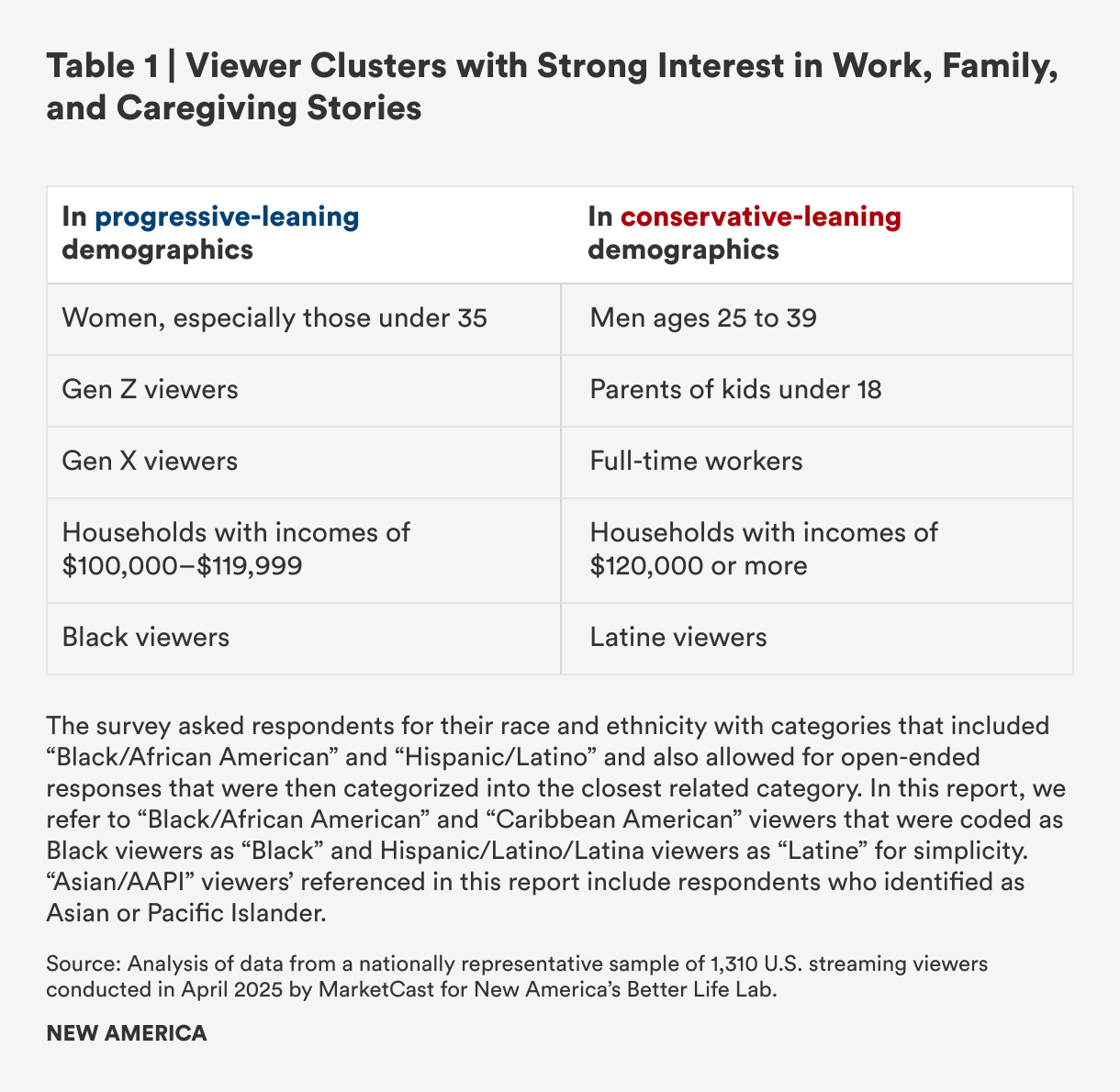
Viewers in the progressive-leaning demographics are key groups for all work, family, and care content, and Gen X viewers are especially interested in stories that reflect care realities. Meanwhile, viewers in the conservative-leaning demographics, each of which skewed more male than the distribution of survey respondent viewers overall, are especially interested in stories showing people navigating conflict and finding solutions.
Key Findings
This report provides an overview of five key audience-focused insights for storytellers, media executives, and streaming services:
- Viewers overwhelmingly want to see more content with authentic stories about work, family, and caregiving.
- TV shows and films with relatable work, family, and care themes drive engagement and impact.
- Viewers are hungry for stories and characters they rarely see on screen.
- Work, family, and caregiving themes can be integrated into any genre, and viewers value humor and levity to help soften treatments of tough, real-life topics.
- Studios and streaming services can gain loyalty with shows and films featuring work, family, and care themes.
Future publications from New America—and customized briefings or presentations—will offer deeper insights into viewers’ preferences for story type, theme, tone, and topic by demographics, ideological views, and more.
Throughout this report, we include select verbatim responses from survey respondents to expand on the quantitative survey data. For each quote, we share the respondents’ gender and the age range they fall into for further context.
Key Finding #1: Viewers overwhelmingly want to see more content with authentic stories about work, family, and caregiving.
Realistic work, family, and caregiving stories are important and relatable to the streaming-viewer audience we surveyed—and understanding what makes a story “realistic” and “relatable” is key.
Nine in 10 viewers (92 percent) say it is important to see stories depicting realistic scenarios around work and family woven into characters’ everyday lives. This builds on our earlier research conducted in a different national environment in late 2023, which found that 84 percent of streaming viewers expressed interest in more realistic depictions of work, family, and care stories on screen.
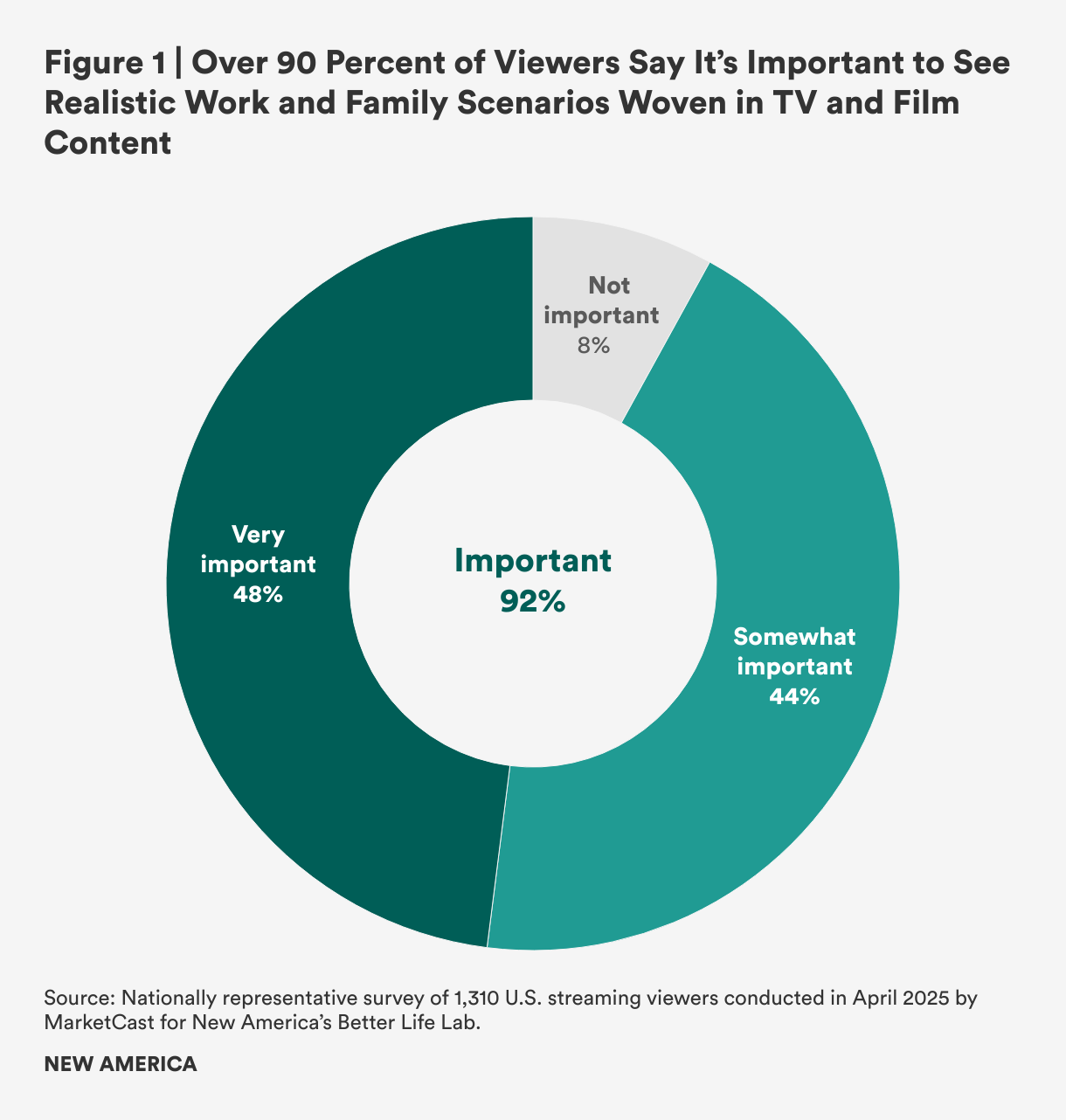
Male and female viewers aged 25 to 39, Black and Latine viewers, parents, full-time workers, and people in households with $100,000 or more in income are more likely than viewers overall to say that it is “very important” to see realistic work-family stories. Between 56 and 63 percent of viewers in these groups, compared to 48 percent of viewers overall, express heightened importance.
Half of all viewers surveyed say affirmatively that they are interested in seeing more of this content (50 percent), and just under half praise the current amount (46 percent). Only 4 percent say they want to see less. Many of the groups that place heightened importance on seeing these stories also express stronger interest in seeing more work and family content featured or included in television and films.
“I’d be interested in seeing characters navigate work-life balance struggles, like managing parenting while meeting job demands, and financial stress within families, such as budgeting, job loss, or career changes: real, relatable challenges many face daily.”—Woman, age 25–39
“I would like to see the real-life scenario of a working adult having to take care of his dementia-inflicted parent, [who] is slowly progressing into Alzheimer’s disease, while still having to focus on the work at his job.”—Man, age 25–39
Viewers who are active online and participate in fandoms are especially interested in work, family, and caregiving stories. Enthusiast viewers—defined as those who interact with shows or films through fanworks, real-time discussions, events, or online fan communities—place more importance than viewers overall in seeing more work, family, and care stories (60 percent say it is “very important” to them, 96 percent say “very” or “somewhat” important). Nearly two-thirds are interested in seeing more. Engaged fans help to create buzz about shows—meaning that more work, family, and care content on screen could translate into broader and deeper audience promotion of these stories.
Nearly eight in 10 viewers (79 percent) say that characters and stories are more relatable when they reflect challenges similar to their own. Gen Z viewers and all viewers under 35, people who work full time or part time, parents, Black viewers, and Latine viewers are especially likely to say it is easier to connect with characters when they face challenges similar to a viewers’ own. Relatability can lead to parasocial engagement with characters, which is a crucial component of media’s prosocial effects.
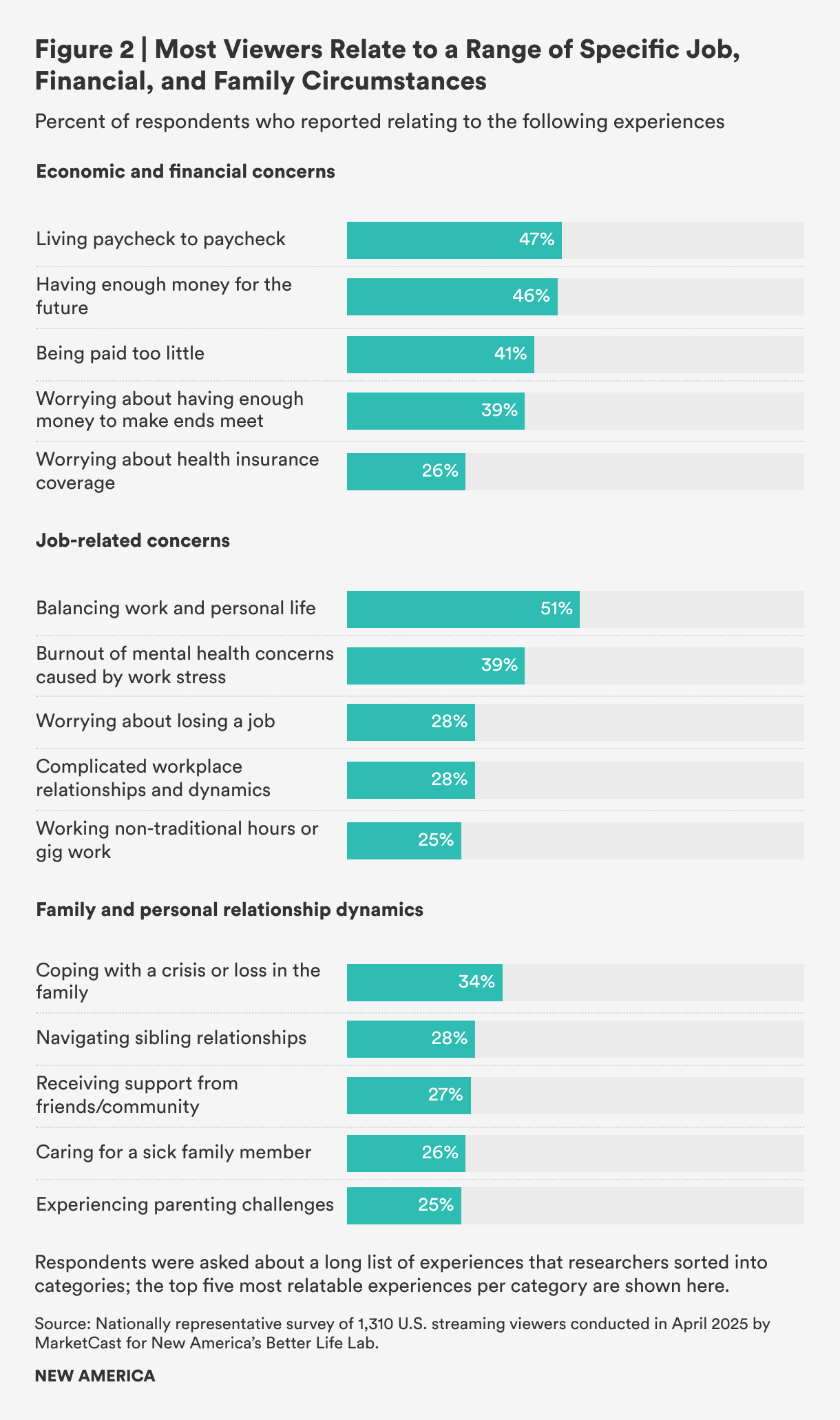
What do “realistic” and “relatable” mean in viewers’ lives and experiences?
- 71 percent of viewers report experiencing one or more work, family, or care challenges personally or through a family member. For most, this was a recent or ongoing experience. In addition to challenges managing work and personal life, the most common specific experiences viewers report are:
- managing work and child care;
- being a main caregiver to an older family member;
- leaving a job to care for themselves, a child, or a loved one; and
- taking a weeks- or months-long workplace leave for a personal health issue.
- 75 percent of viewers who have experienced a work, family, or caregiving challenge report consequences that are work-related, finance-related, or both.
- 58 percent of viewers expect to personally experience work-family challenges within the next five years. Expectations about managing work and a loved ones’ elder or disability care, managing work and child care, and leaving a job are most common.
- 51 percent of viewers say that stories depicting people balancing work and personal life are relatable. Economic and financial concerns, job-related concerns, and complicated family and personal dynamics are also very relatable.
- Higher shares of women than men find nearly every concern to be relatable, especially concerns about having enough money, being paid fairly, burnout caused by work or stress, navigating a number of different types of family challenges, parenting, caregiving, and the intersection of work and family responsibilities.
How do viewers across ideologies see the value of systemic solutions to work-family challenges?
- 82 percent believe families and communities would be more stable if the United States had national policies like paid family and medical leave and affordable child and elder care that make it easier for Americans to work and care for their loved ones (94 percent of Democrats, 80 percent of Republicans, and 74 percent of independents). The same percentage of viewers (82 percent) also say the U.S. economy would be more stable with these policies in place (84 percent of Democrats, 79 percent of Republicans, and 81 percent of independents).
- 70 percent say the government needs to do more to address family caregivers’ stress and financial challenges—including 75 percent of Gen Z and 73 percent of Gen X. Just 5 percent say the government should do less. Support for more government intervention crosses party lines: 82 percent of Democrats, 65 percent of Republicans, 66 percent of independents.
- 60 percent say the government needs to do more to help families with children, including 69 percent of Gen Z. Support crosses party lines: 74 percent of Democrats, 57 percent of Republicans, 52 percent of independents.
Key Finding #2: TV shows and films with relatable work, family, and care themes drive engagement and impact.
Shows with work, family, and care content are well-positioned to prompt viewer discussion and engagement. Most viewers surveyed say that a show or film with a relatable work, family, or care theme has affected their outlook on themselves and others.
Stories featuring caregiving, people seeking care, and women navigating complex workplace dynamics draw higher-than-average online viewer engagement. In social media analysis, shows like Man on the Inside, High Potential, Matlock, and The Diplomat rose to the top for engaging viewers in advocacy, intent, and urgency—metrics used to reflect how viewers speak about and encourage others to watch television content. Overall, 67 percent of drama genre titles with work, family, and care content rated above the median of all drama shows in terms of the volume of discussion, with a 26 percent advantage over other titles in posts recommending others watch shows, and a 16 percent advantage in social media mentions.
Survey respondents shared a mix of well-known, popular comedies and dramas that memorably depict work, family, and care issues. Frequently mentioned shows include newer hits like The Pitt and Severance, longer-running shows like Grey’s Anatomy and Abbott Elementary, and off-the-air titles that continue to resonate with audiences, such as Modern Family, Shameless, The Conners, The Office, This Is Us, and Working Moms. A number of respondents also mentioned shows from across genres like science fiction, fantasy, prestige drama, and procedurals, including Black Mirror, Family Guy, Law & Order SVU, The Morning Show, Stranger Things, and The Last of Us, among many others.
Nearly nine in 10 viewers surveyed (87 percent) say a show or film with relatable work or family storylines prompted them to recommend the show to others, impacted how they viewed other people’s lives, or helped them feel seen or understood in their own lives. For example, about one-third say a show or film helped them understand what others are going through and made them more understanding of others; an equal share say they felt less alone or shifted perspectives on their own lives. Media also helped them start conversations with others. The true impact of these stories may be even larger, as people tend to underestimate the impact of media on their own decision-making compared to others, a concept known as the “third-person effect.”
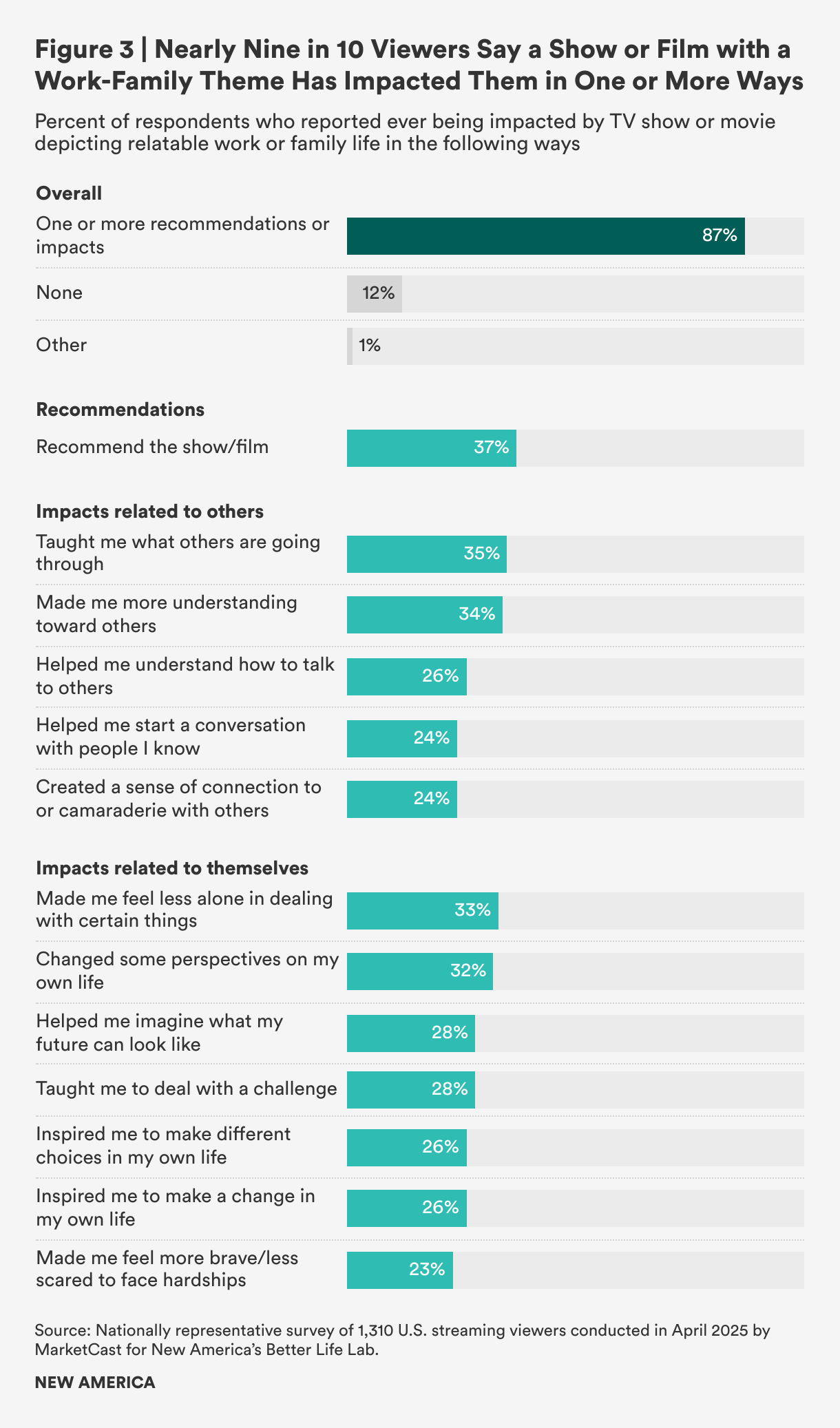
Viewers in the 25- to 39-year-old age range, full-time workers, and parents (especially parents of infants and toddlers, who may be more isolated) are more likely than viewers overall to say they have responded to work and family themes in these ways, as are Black and Latine viewers on certain dimensions. Women are more likely than viewers overall to say that a show or film has given them a better understanding of others; men are more likely to say a show or film helped them imagine their future. Women and parents of young children are also the most likely to report recommending a film or show with a work-family theme to others.
In Viewers’ Own Words: Shows and Films Impact How They Understand and Act Toward Others…
“This [caregiving under pressure at work] is such a difficult dynamic as it is, let alone if you have a job that isn’t understanding of your situation. I would love to see how it could be done and honor those who do it.”—Woman, age 25–39
“I’d love to see more empowering stories where characters face real challenges like being sidelined or underestimated at work due to pregnancy or becoming a new parent—and then assert themselves with strength and grace. For example, a pregnant employee who’s denied a promotion…but who gathers evidence, confronts leadership, and helps rewrite company policy for future parents. Or a caregiver juggling a demanding job and a sick parent, who gets penalized for taking time off, yet speaks out and sparks a conversation about flexible leave policies. These stories are powerful when they show not just the struggle, but also the resilience and change that comes from standing up for dignity and fairness in the workplace.”—Man, age 40–54
“Living in a society with wealthy families who don’t understand those who struggle from paycheck to paycheck, it would be good to see a more in-depth reality of them swapping with families who go through financial struggles as well as racial struggles.”—Woman, age 55–59
…And How They See and Understand Themselves
“This [a loving, fair partnership where caregiving and household duties are shared] is the kind of lifestyle I want. Being able to see it on TV makes me feel even better, and I can also learn things from it.”—Man, age 25–39
“I don’t see [gig work] a lot and it is a struggle I am facing as a freelance artist who cannot work [a traditional job], but instead I stay home and care for my disabled mother. People don’t consider freelancing a real job when truly we have to work twice as hard.…[T]his concept hits close to home for me and I’m sure many others.”—Woman, age 25–39
“I think it would be interesting to see someone’s interpretation of modern child care and paid family leave, because my child is in her twenties and I want to have a better understanding of how these policies affect parenting.”—Man, age 40–54
“I have experienced health issues at work and didn’t know how to advocate for myself. I would like to get some insight on what I could have done.”—Woman, age 55–59
Entertainment media can also help spur conversations across differences. Regardless of political beliefs, viewers report being moved by stories that depict real-life struggles with work, family, and caregiving. Perhaps surprisingly, people with traditional views of gender roles are more likely than viewers overall to say that a show or film focused on work and family inspired them to make a change in their lives (37 percent), taught them to deal with a challenge (35 percent), helped them understand how to talk to others about an issue (34 percent), and helped them start a useful conversation with people they know (34 percent).
Those with more progressive views of gender roles are more likely to say that a show or film taught them more about what other people are going through (42 percent), made them more understanding of others (40 percent), made them feel less alone (39 percent), and changed some perspectives or outlook on their own life (37 percent).
Key Finding #3: Viewers are hungry for stories and characters they rarely see on screen.
Viewers across ages, life experiences, and political beliefs want to see stories that reflect their own work, family, and caregiving experiences. Viewers surveyed are also eager to see people from their own backgrounds as well as those of others, especially when it comes to characters of a different race or ethnicity, income level, or household type. They’re also eager to see people resolving conflicts, receiving support from people in their lives, and finding concrete solutions related to work, family, and care.
For viewers who have personally faced complex work, family, and caregiving challenges, they want to see these specific experiences reflected on screen. This is especially true for storylines related to workplace leave and family caregiving.
Viewers with specific lived experience see clear gaps in programming related to two key areas: (1) short-term workplace leave to provide caring to a loved one or receive care themselves; and (2) family caregiving stories, such as caring for a sick, older, disabled, or mentally ill family member. Majorities are interested in seeing more programming that integrates these topics and do not believe they are shown in storytelling often.
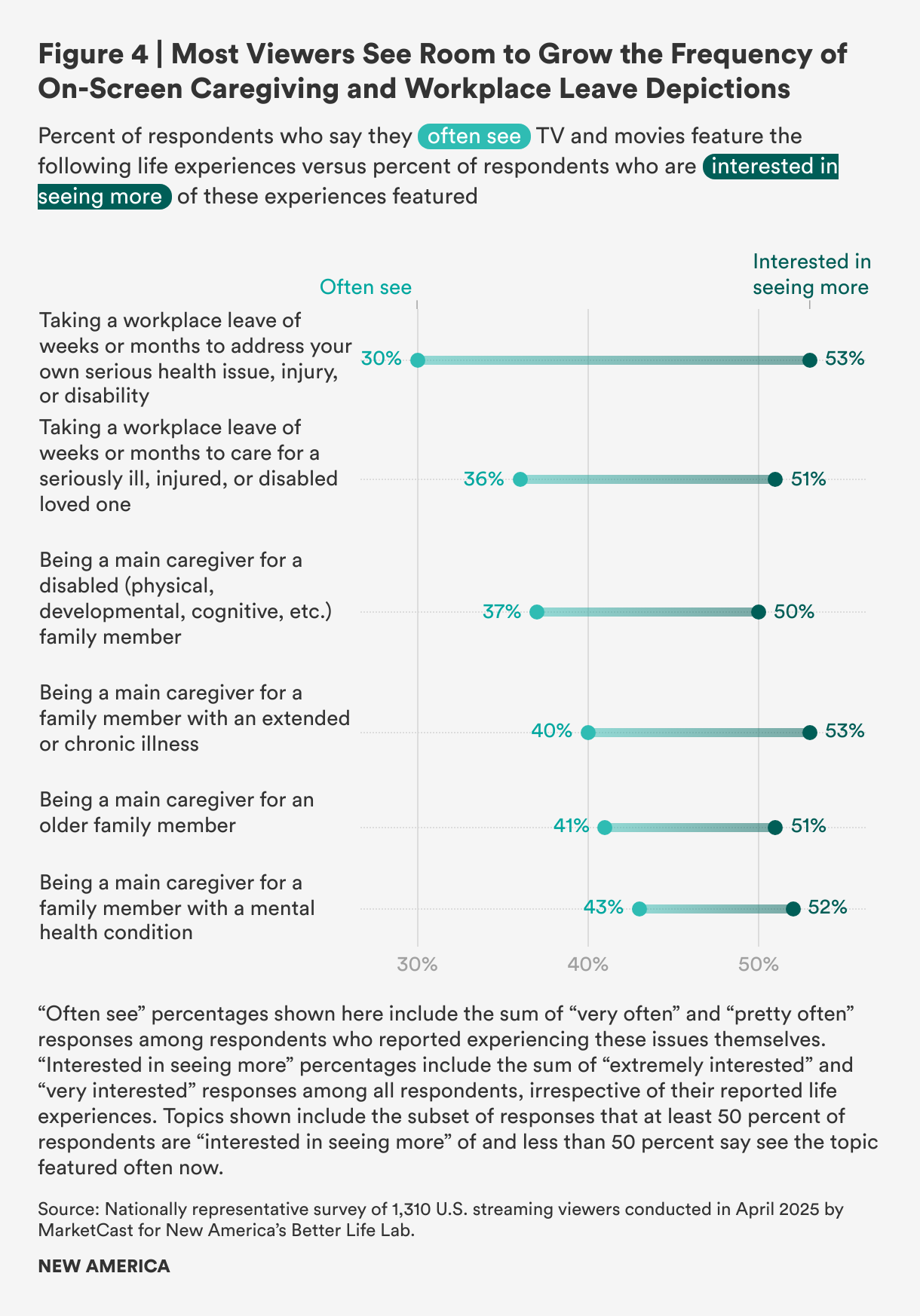
Leaving a job entirely to provide care was also resonant for nearly half of viewers (48 percent want to see more); just 33 percent who personally left a job believe they see this on screen often.
Despite conventional wisdom that audiences just want escapist content, our data show the opposite. Viewers surveyed who relate to parenting challenges report being more eager than viewers overall to see every kind of life experience reflected on screen. Survey respondents who relate to caregiving challenges are more eager to see caregiving stories related to age and disability, workplace leave, and job loss. Perhaps most telling, the story topics that viewers express the most interest in seeing more on screen are also the same circumstances that they most commonly expect to experience in the next five years.
Our analysis of social media conversation, particularly related to shows with high online viewer engagement like A Man on the Inside, reinforces the finding about viewers’ interest in more diverse caregiving storytelling. Viewers on social media expressed strong empathy with on-screen caregivers who navigate their older parents’ experiences of loneliness, dementia, or other major health issues.
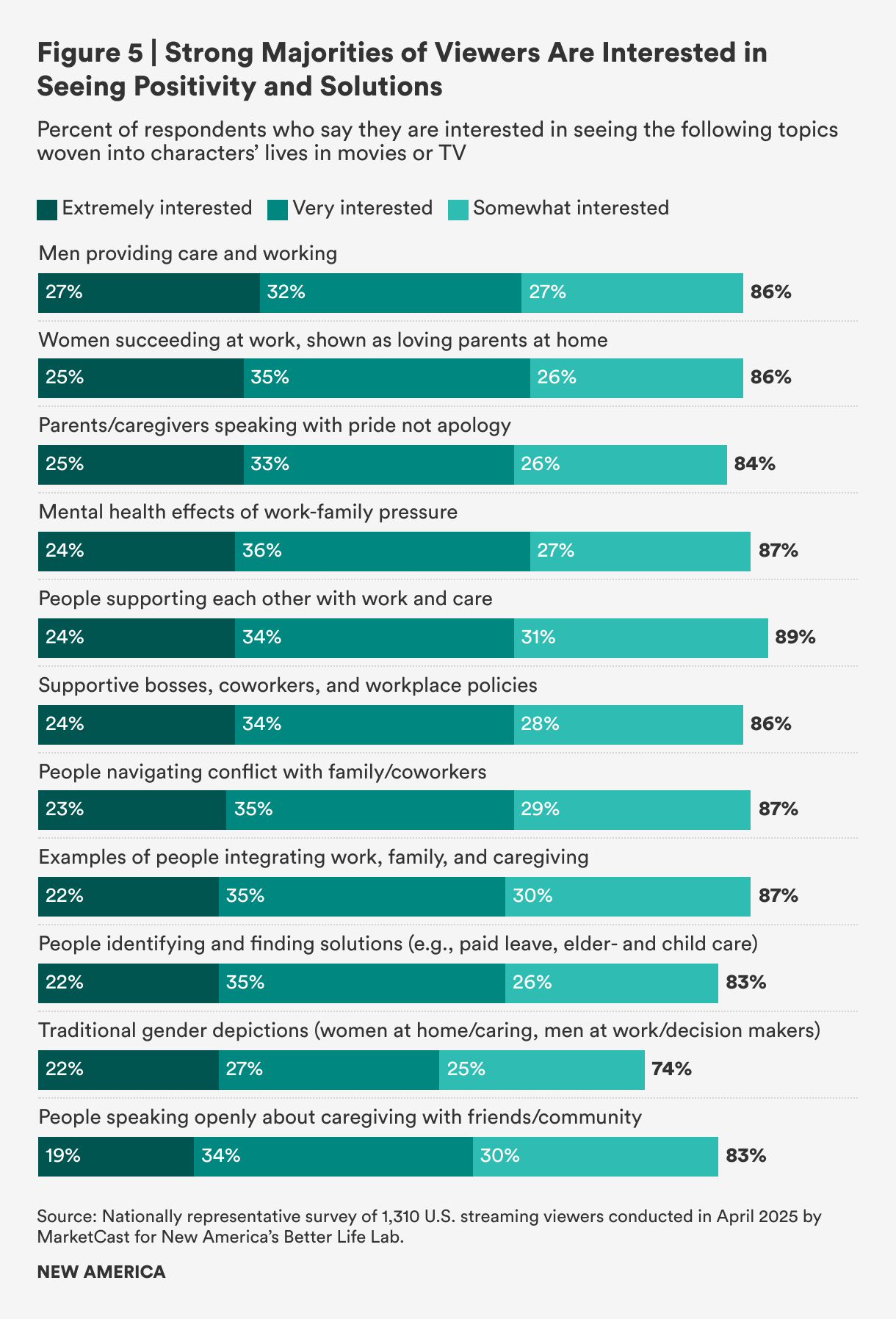
Viewers respond to topics and themes that acknowledge common stresses and gravitate toward scenarios that reflect solutions. Overall, more than eight in 10 viewers surveyed express interest—and about six in 10 say they are “extremely” or “very” interested—in seeing topics or themes that focus on the impact of work and family pressure on mental health, how both women and men manage work and care, finding support in communities and workplaces, working through conflicts, and finding supportive resources through systems and policies.
Mental health challenges, the toll of chronic personal and family illnesses, unpredictable child care arrangements or the absence of child care, and the necessity of integrating work and family life loom large in many viewers’ lives—and in their interests in on-screen content.
One woman (age 25 to 39) described her interests in stories she doesn’t see enough of: “[What] it is like really taking care of a person with Alzheimer’s and autism and bipolar, and how it’s hard to…focus [at work] when you always have to run home when you have a situation.”
Some respondents painted vivid pictures of what stories that combine these themes could look like:
“I’d like to see more characters balancing demanding jobs like construction or shift work while raising young children…It would be great to see stories that show both the struggles and pride of working-class families.”—Man, age 25–39
“I would like to see more storylines about working mothers balancing their IT careers with raising multiple children while maintaining a successful marriage and managing household responsibilities in a hybrid work environment.”—Woman, 25–39
“I’d be interested in seeing more characters navigate the complexities of work-life balance, especially in dual-income households or single-parent situations. Scenarios like managing remote work while parenting young children, dealing with burnout in high-pressure careers, or negotiating roles and responsibilities within a household would feel very relatable. I’d also love to see more authentic portrayals of things like career transitions later in life, supporting aging parents, or the emotional impact of layoffs—not just the financial. These real-life challenges often go underrepresented or are oversimplified on screen.”—Man, age 40–54
While traditional gender roles appeal to some viewers, more want to see common modern circumstances, where workers regardless of gender are navigating both work and care. In this year’s research and in our prior study, two of the story scenarios that garner among the highest and most intense viewer interest involve modern gender roles: women who succeed at work and are shown as loving parents at home (59 percent “extremely” or “very” interested, including 25 percent “extremely” interested) and men who are shown as competent parents and caregivers while also holding a paid job (60 percent “extremely” or “very” interested, including 27 percent “extremely” interested).
Both of these scenarios take on common television tropes, where women are either shown primarily at home or at work (but not both), and where men are seen as absent, abusive, or clueless, or as male nanny, or “manny,” characters. In contrast, just under half of our respondents express heightened interest in storylines that are more traditional, where women take care of children and home life and men provide for families and are families’ primary decision makers (just 49 percent “extremely” or “very” interested, including only 22 percent “extremely” interested).
Even viewers with more traditional views on gender roles expressed more interest in stories where all parents are working and caring rather than in a mom at home and a dad at work. This may be a reflection of contemporary life, where finances for most people are tight and where, in most families with children, all parents work for pay. One woman (age 25 to 39) wrote that she would love to see content that includes “a woman who strives to be a stay-at-home mom/homemaker, but struggles to make that dream a reality due to the societal pressures [on] a woman to work and the economic necessity for dual incomes.”
Viewers are eager for a variety of representation of people from different income brackets, racial or ethnic backgrounds, and family structures. In the survey data, 87 percent of viewers say there is a need for more inclusive representation of race, ethnicity, income, and household or family structure in at least one genre. Among that large share of viewers, there is equal interest in seeing stories about people and families that are the same as theirs and people who are different.
Viewers want in equal measure to see characters from their same income level and from different ones (71 percent extremely/very interested, and 70 percent extremely/very interested, respectively). An exception is that viewers in households making under $60K—whose life experiences are less often reflected on screen—are more eager to see people of their same income level than people of higher income levels.
“I would like to see more realistic depictions of working-class, blue-collar families and the struggles they go through, instead of the ‘Hollywood’ version of it.”—Woman, age 40–54
Viewers of all backgrounds report being interested in seeing characters from their same and different racial/ethnic backgrounds (64 percent and 66 percent, respectively). Black, Latine, and Asian/AAPI audiences express roughly even levels of interest in seeing their own backgrounds (76 percent) and others’ backgrounds (74 percent), whereas a higher share of white people favor seeing backgrounds different than theirs by a larger margin (61 percent others’ backgrounds, 56 percent their own background). In addition, 60 percent of viewers are interested in stories about immigrant or mixed-status families, including 70 percent of Latine viewers and 67 percent of all non-white viewers. The quotes below from a Latine, Asian, and Black viewer, respectively, are illustrative:
“I would like to see a teenager in a Hispanic family navigate life.”—Woman, age 18–24
“[I want to see] more Asian family–related struggles—the pressure growing up to always perform well and the anxiety that comes along with it and manifests into everyday life.”—Woman, age 25–39
“I would be interested in seeing…a young Black man growing up and changing his life for the better of his family.”—Man, age 18–24
Two-thirds of viewers are interested in stories involving a range of household structures. Sixty-six percent are interested in seeing multigenerational households; 64 percent are interested in parents or caregivers who aren’t biologically related; 64 percent are interested in blended families or stepfamilies; and 59 percent are interested in seeing single-parent households. Viewers who live in traditional family households show even stronger interest than viewers overall in each of these alternative household structures.
“I would like to see more of single mothers raising their children alone. This was/is my life. It was a struggle being the only parent of four kids. I had support from my family but it was still hard. I had to live on public assistance while I raised them.”—Woman, age 40–54
“Finally [show] the real struggles working dads face without making us look like clueless sitcom characters.”—Man, age 40–54
“I think it’s a common thing these days in America for people to live in multigenerational homes and a lot of people will relate to it. And if they don’t have personal experience, they will still find it interesting.”—Woman, age 40–54
More than six in 10 viewers (63 percent) express interest in seeing families on screen where someone has a disability or chronic health condition. Viewer interest in depictions of characters with chronic health issues or a disability are equally interesting to people across demographic groups. Recall that few viewers say family members and caregiving situations related to illness or disability are shown often—and media content analysis indicates the same.
When presented with facts about how current on-screen representation falls short of reflecting people’s lived realities, majorities of viewers want greater accuracy. Media studies on current television depictions of parenting, family breadwinners, household chores, the provision of elder care and child care, and the role of systemic factors in individuals’ financial and health circumstances have all shown a lack of accurate representation.1
Most viewers say they want television to do better at reflecting each of these realities; just 16 percent or fewer are okay with the status quo. Women, Gen X viewers, and people with progressive views of gender roles are most interested in more accurate programming. For those interested in media accountability, this presents an opportunity to engage viewers in both carrot and stick campaigns.
Key Finding #4: Work, family, and caregiving themes can be integrated into any genre, and viewers value humor and levity to help soften treatments of tough, real-life topics.
More than half of viewers surveyed identify “authenticity” as flowing from characters facing challenges that happen to everyday people, believable dialogue, and real-world settings or environments. But this does not mean that work, family, and caregiving topics are limited by genre, confined to a primary or “A” storyline, or must be heavy.
Viewers are interested in seeing work, family, and care themes embedded into a wide range of shows and films “about” other things—they need not be the main story to be entertaining and impactful. Viewers expressed the highest level of interest in seeing work, family, and care integrated into stories about friendships and other relationships (63 percent “extremely” or “very” interested) and stories about learning to trust one’s self and achieving one’s dreams (62 percent), contexts well-suited to these themes.
Close behind, however, are other less expected “A,” or main, stories:
- Nearly six in 10 viewers (59 percent) express strong interest in seeing work/family themes in shows focused on scientific and technological advancements and their impacts.
- Fifty-four percent express intense interest in these themes integrated into shows about extinction-level/apocalyptic events.
- Fifty-one percent are highly interested in seeing these themes in stories about extreme weather and climate.
Men, younger people, and parents are especially interested in these. Viewers praised depictions of these themes in current shows focused on science, tech, and catastrophes, like Black Mirror and The Last of Us.
“In most of the shows I watch, which [are] sci-fi fantasy type of stuff [like] Percy Jackson, Blood of Zeus, Devil May Cry, a Black-Mexican teen’s [point of view] is rarely seen in general. But if any of my personal struggles can relate to any TV watching, the physical and mental decline of someone who you saw as a warrior is heart wrenching—diseases like Alzheimer’s and dementia or the fantasy version of such illnesses.”—Man, age 18–24
Shows focused on political and business leadership—where work, family, and care themes may be more common now—are appealing to a smaller share of viewers overall as an avenue for storyline integration (40 percent), but are more appealing to Gen Z and Millennial viewers, especially men.
“I like the Severance-style shows where it’s an ordinary corporate job ‘feel’ until something deep and thrilling comes into play. My corporate job is very boring, so there needs to be something intense to draw in the audience.”—Man, age 25–39
Tone-wise in storytelling overall, viewers—including the demographic groups that are most interested in and engaged by work, family, and caregiving stories—say they prefer reality to fantasy, idealism to cynicism, and optimism to tragedy; they slightly prefer upbeat to moody and gritty to whimsical. They lean more toward comedic than serious and narrowly prefer relaxing to tense.
Work-family stories told with humor and levity appeal to nearly six in 10 viewers (58 percent). Elements related to realism are also very important to a majority or near-majority of viewers: authentic portrayals of real-life situations (54 percent), inspiring story themes (52 percent), and characters looking for and finding solutions to relatable challenges (51 percent). Stories that combine humor and emotional depth with real-life circumstances are resonant.
“[I’d like] to see in the most realistic but humorous way the problems one sees at the beginning of parenthood and how their loved ones support them.”—Man, age 25–39
“Funny military spouse situations. Every show I’ve watched where it’s a military family, it’s stressful and sad. I’d like to see a more lighthearted approach to that life.”—Woman, age 40–54
For our respondents, realism in terms of characters, situations, and overall relevance to viewers’ own lives is more appealing than pure escapism. Notably, though, many genres like highly popular medical and legal dramas, historical dramas, and comedies employ both—and these are among the genres where people are most interested in seeing more work, family, and caregiving content.
Key Finding #5: Studios and streaming services can gain loyalty with shows and films featuring work, family, and care themes.
Platforms seeking to attract subscribers can lean into work, family, and caregiving stories to draw in viewers. Right now, according to surveyed viewers’ assessments, no platform distinguishes itself as “best” in providing authentic work, family, and care stories, which means there’s an opportunity for growth and distinction.
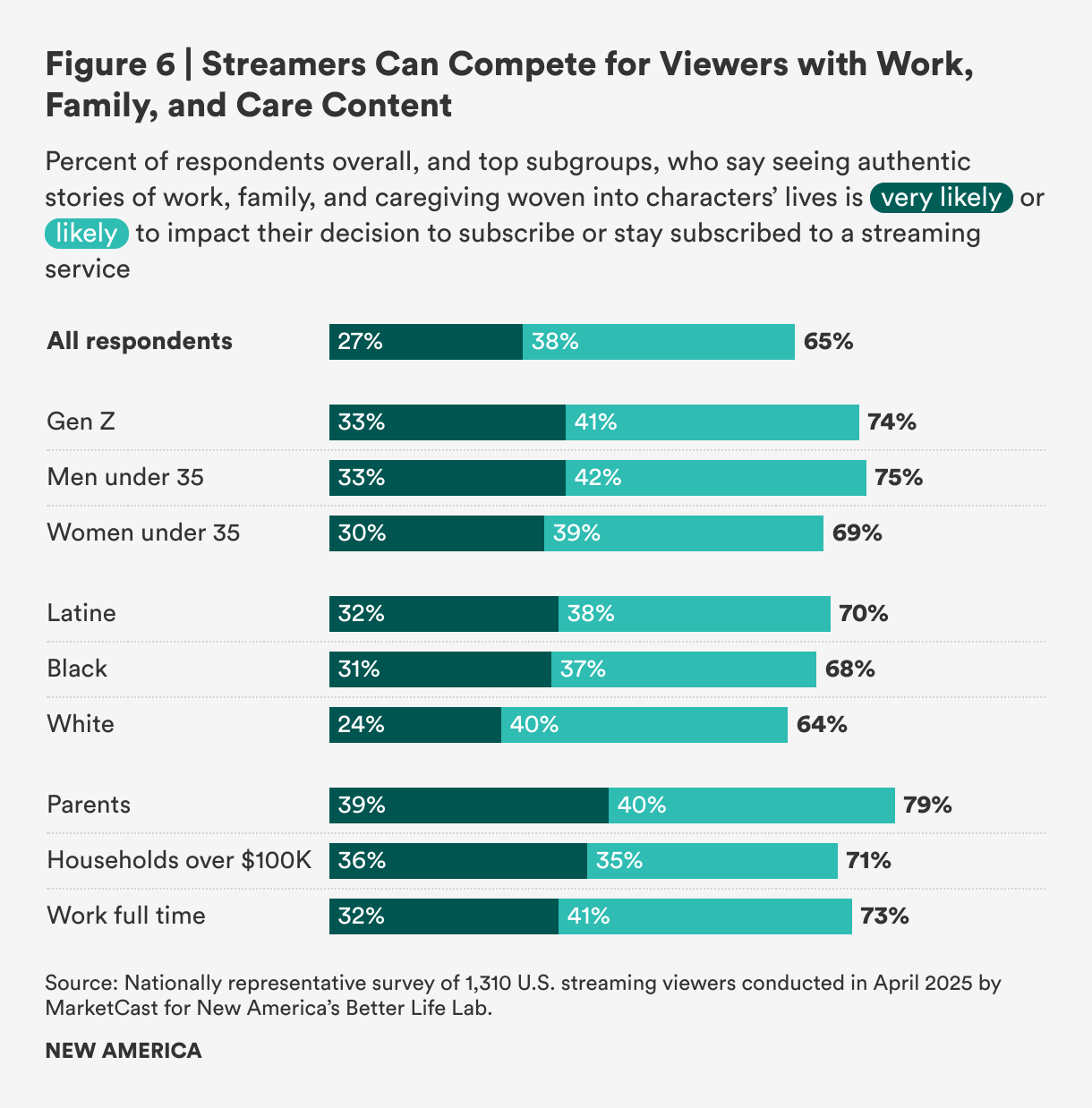
Sixty-five percent of viewers—translating to an estimated 61 million people—say they are more likely to subscribe or stay subscribed to a streaming service that features authentic stories about work, family, and caregiving. A whopping 85 percent of viewers who say realistic work, family, and care scenarios are very important to them say this content is likely to affect their subscription decisions, and nearly half (46 percent) say it is very likely to affect the services they will subscribe to or stay subscribed to. Viewers who engage in fan activities are also more likely to say they will use this as a factor in decision-making (79 percent “likely” to affect decision, including 39 percent “very likely”).
Demographically, Gen Z viewers, all people under 35, Black viewers, Latine viewers, people who work full-time, viewers in households with $100,000 or more in income, and parents, especially those in nuclear family households with a spouse/partner and kids, are among the most likely to say that work and family content would affect their likelihood of subscribing to a streaming service.
Every network, specialty channel, and streaming service has the chance to compete for viewers interested in stories that include work, family, and care themes. There is currently no genre—from comedy and action to late night—where most viewers are satisfied with the amount of work, family, and care content integrated into programming.
Viewers of nearly every specific genre say they want more content rather than believing the status quo is enough. This includes watchers of late-night talk and comedy shows (by +20 percentage points want more work, family, and care content), historical drama (+17), kids and family shows (+15), war and biographical programming (+15), western (+13), legal drama (+13), reality (+12), romance (+11), horror (+11), and medical drama (+10). Viewers of thrillers (+8), drama overall (+7), and crime drama (+7) are more satisfied with current content, but there is still room to grow.
“I would like to see…everyday life but set in a sci-fi scene.”—Man, age 40–54
Across every genre, viewers desire a greater range of income, race, and family structure depictions. Prior content analyses have shown that Black, Latine, Asian, and Middle Eastern people are underrepresented or misrepresented on screen. The same is true of women, people with lower incomes, LGBTQ people, people with disabilities, and older people.
Our research shows that viewers perceive shortcomings and want to see more diversity represented on screen. Between half and two-thirds of viewers who consume the following genres want to see more stories that represent racial, income, and family structure diversity in the programming they watch, including:
- Six in 10 viewers or more want to see more diversity of racial and ethnic identities, income levels, and household structures in romance (67 percent), drama (64 percent), comedy (62 percent), and reality (62 percent);
- More than half want to see more racial, economic, and household structure diversity in crime drama (59 percent), kids and family programming (59 percent), medical drama (59 percent), legal drama (58 percent), action (53 percent), late-night talk and comedy shows (53 percent), and horror (51 percent); and
- About half want to see more diversity in westerns (50 percent), thrillers (49 percent), historical drama (49 percent), sci-fi (49 percent), and war and biography (49 percent).
Separate research shows that more diverse content attracts more viewers and higher financial returns for media companies, suggesting that an increased range of representation will lead to increased viewership and subscriptions, especially as the United States continues to become even more racially and ethnically diverse.
Updated at 1:52 p.m. on December 4, 2025: This section has been changed to include an updated estimate of U.S. streaming viewers who say they are likely to subscribe or stay subscribed to a streaming service that carries authentic work, family, and caregiving content. The updated estimate of 61 million (which, at the time of publication, was 58 million) is a more accurate calculation from MarketCast in new crosstabs provided to New America.
Conclusion: Recommendations and Further Reading
This first-of-its-kind full study demonstrating streaming viewers’ strong interest in work, family, and care on-screen shows that:
- There is a business imperative to expand the authenticity, realism, and solutions-orientation of content that embeds or focuses on people’s lived circumstances managing work, family, and care. This content is not controversial or risky, and in fact, people are more united than divided even on hot-button topics like the role of government when it comes to support for families. Compelling, relatable content is well-suited to building larger audiences through word-of-mouth, online buzz, and fan activities.
- There are creative, innovative directions for storytellers seeking to fill current perceived gaps in content, more accurately portray people’s lived experiences, and upend outdated stereotypes and tropes about working families. Stories with emotionally resonant, relatable themes and authentic characters across a range of tones and genres are well-positioned to have an impact on viewers’ understanding of themselves and may even influence their beliefs and actions. Viewers are hungry to gain visibility into others’ lived experiences and solutions that people may have found for managing common work-family situations.
- The range of audiences with heightened interest and engagement in work, family, and care topics is broad and diverse, spanning generations, life experiences, and ideologies. Entertainment-based storytelling may help build understanding and connection across groups that are too often pitted against one another in public discourse at a time when common ground is badly needed.
For storytellers seeking writing guidance and background research on topics of work, family, and care, and the people and communities who most need or are affected by America’s precarious work, family, and care landscape, we recommend:
- New America’s entertainment initiative resource library, which includes writers’ guides, tip sheets, and explainers on a range of work, family, caregiving, gender equity, reproductive health, and public policy topics, and the Better Life Lab’s policy, research, and journalism resources;
- Caring Across Generations’ Care Inclusion Playbook and Cost of Caregiving tip sheet (with Hollywood Health & Society);
- Equimundo’s tip sheet on writing about men and boys, families, and caregiving;
- Geena Davis Institute/MomsFirst toolkit on re-writing motherhood;
- Mental Health Storytelling Initiative’s mental health media guide; and
- Storyline Partners’ resource library on a range of topics that implicate work, family, and care.
Methodology Note
New America’s Better Life Lab Entertainment Initiative commissioned the media research firm MarketCast to conduct a nationally representative study of U.S. media consumers, including both a nationally representative online survey and a social media analysis. The research was conducted in April 2025. The online survey reached 1,310 U.S. viewers aged 18 to 59 years, including extra interviews with oversamples of Black, Hispanic, and Asian respondents to ensure robust sample sizes for analysis. The data were weighted to reflect U.S. census demographics by gender, age, and race/ethnicity. The margin of error for the full sample is +/- 2.7 percentage points at a 95-percent confidence level; the margin of error is higher for subgroups. To be eligible for this survey, respondents must have indicated that they watch at least five hours of programming per week and live in a household subscribed to at least one streaming service.
Social media analysis insights are drawn from MarketCast’s real-time analytics analysis of Twitter/X conversation based on 24 TV series from the 2024 to 2025 season that depict authentic stories surrounding caregiving, balancing work/family issues, etc., on screen. The social media analysis looked at:
- Social volume: The total number of posts on Twitter/X in the three months post-premiere of the 2024 season(s);
- Intent: Conversation coming from audiences expressing intent to see/watch the show;
- Advocacy: Conversation coming from audiences encouraging others to watch the show; and
- Urgency: A combined metric of advocacy and intent.
Data analysis was conducted by MarketCast and the Better Life Lab at New America. OpenAI’s GPT-4o, GPT-4.1, GPT-4.5-preview, ChatGPT 4o, and ChatGPT o4-mini-high models were used to support initial data processing and categorization of open-ended responses. The outputs were reviewed and verified by New America’s researchers, and they were not copied directly into this report or any related research products.
A full deck of findings created by MarketCast is here. For more information or a deeper data dive, contact Vicki Shabo, founder and director of the Entertainment Initiative at New America’s Better Life Lab at [email protected].
MarketCast, the MarketCast logo, and logotypes are either a registered trademark or a trademark of MarketCast, Inc. in the United States and/or other countries.
Downloads
More About the Authors

Vicki Shabo
Senior Fellow for Gender Equity, Paid Leave & Care Policy and Strategy, Better Life Lab

Jasmine Heyward
Research & Communications Officer, Entertainment Initiative
Issues
Programs/Projects/Initiatives
Related

Rural, Midwestern, and Southern U.S. Viewers Want to See Work and Family Issues on Screen

Putting Pregnancy, Abortion, and Care into Context on Screen


Citations
- The facts about current media representation presented to survey respondents were drawn from multiple research studies conducted by the Geena Davis Institute for Caring Across Generations https://geenadavisinstitute.org/research/making-care-pop-what-we-see-and-dont-see-about-caregiving-on-tv/, Equimundo https://www.equimundo.org/wp-content/uploads/2022/06/This-is-Us-TV-and-Masculinities-Report.pdf, and Moms First https://geenadavisinstitute.org/research/rewriting-motherhood-how-tv-represents-moms-and-what-we-want-to-see-next/; the Norman Lear Center https://learcenter.s3.us-west-1.amazonaws.com/povertynarratives_interimreport.pdf for the Bill and Melinda Gates Foundation and Advancing New Standards in Reproductive Health and New America https://newamerica.org/rescriptingabortion. Facts about Americans’ current lives were drawn from U.S. Census data, AARP and the National Alliance for Caregiving, the Centers for Disease Control and Prevention, and the American Council on Education.