
Who Applied?: Class of 2026 Fellows Program Applicants
New America’s Fellows Program invests in bold thinkers—journalists, scholars, filmmakers, and public policy analysts—who generate bold ideas that spark new public conversations about today’s most urgent challenges.
Every year, New America carefully selects its Fellows through a rigorous and competitive process. The fellowship supports individuals as they develop ambitious projects grounded in in-depth research, sharp reporting, nuanced analysis, and thoughtful storytelling.
Since 1999, over 300 New America Fellows have highlighted the big issues shaping America’s future—from climate change to cybersecurity to criminal justice reform. New America Fellows have authored bestsellers, produced feature-length films, and earned some of the world’s most prestigious honors, including Pulitzer Prizes, Emmy Awards, National Magazine Awards, MacArthur and Carnegie Fellowships, and, this year, an Oscar nomination.
Visit the Fellows Archive to browse over 200 groundbreaking works created by New America Fellows and learn more about their stories of impact.
Meet the Class of 2026 New America Fellows
Learn more about the 10 Class of 2026 New America Fellows and sign up to receive The Fifth Draft newsletter to keep up with our fellows along their journey.
Keywords Mapping
As part of their application process, candidates submit keywords or phrases that best describe their proposed project.
We analyzed these entries and visualized the results in a word cloud, which revealed the 24 themes that appeared most frequently.
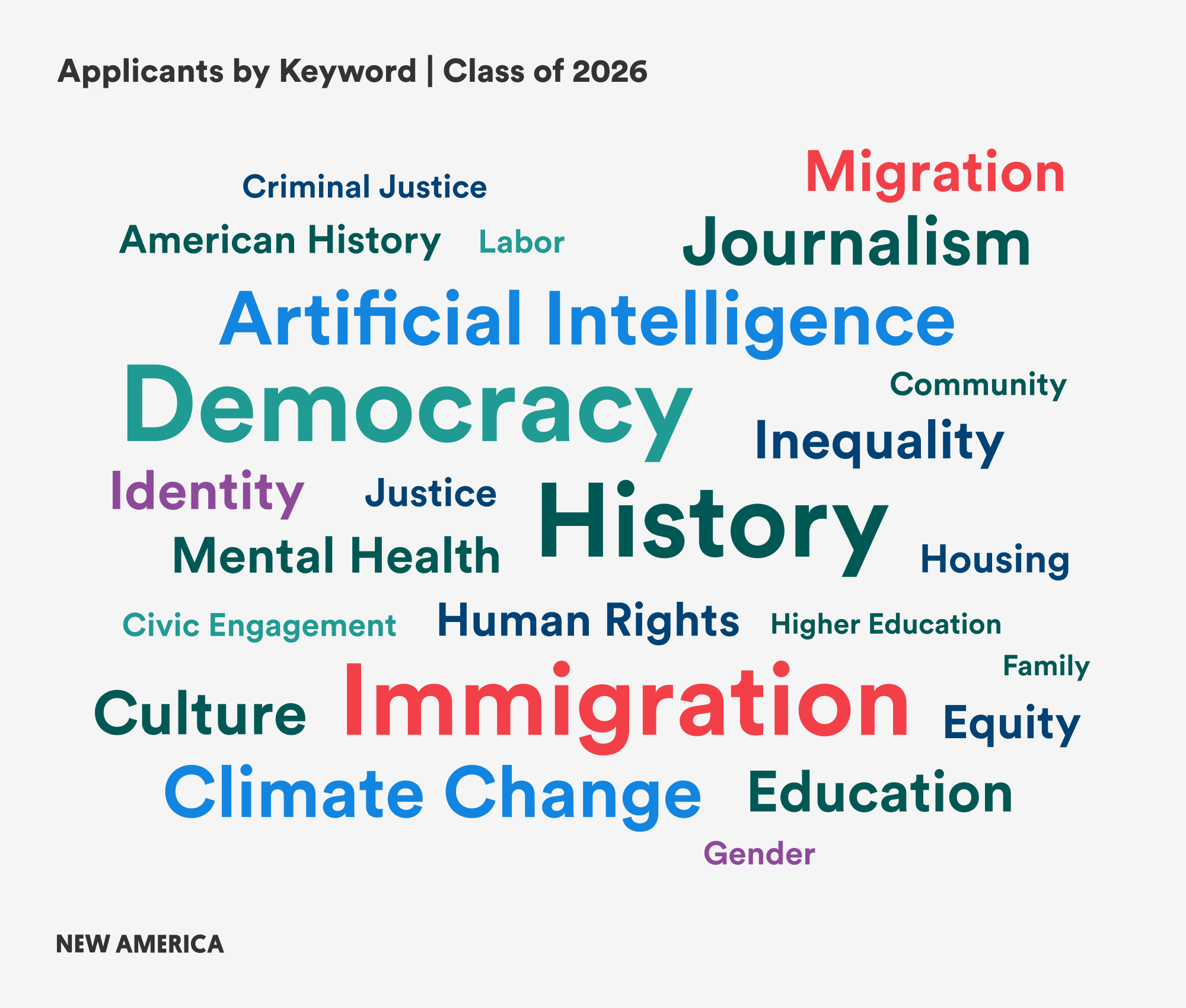
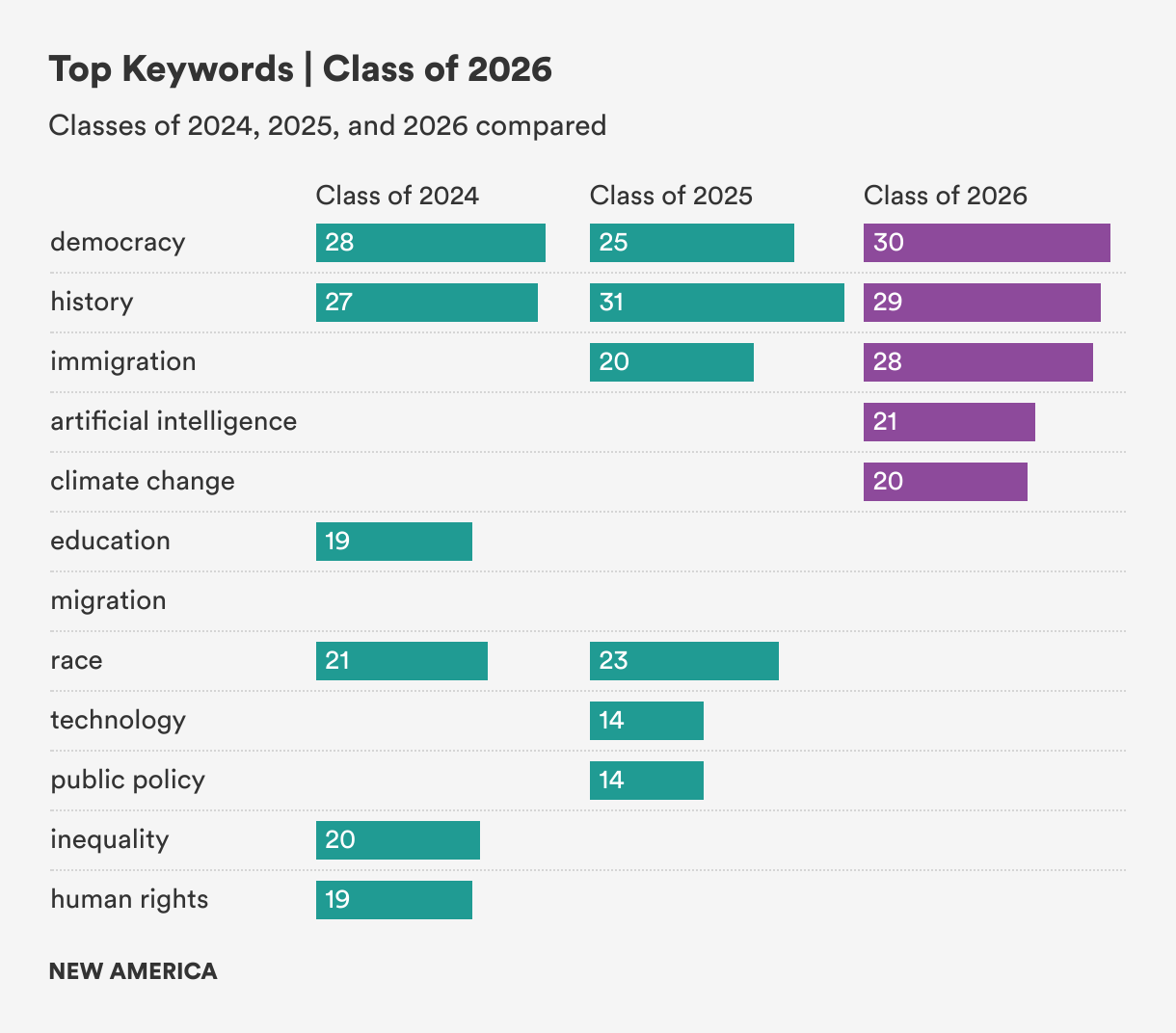
This year, the top five words and phrases by usage frequency are democracy (30), history (29), immigration (28), race (23), artificial intelligence (21), and climate change (20). Artificial intelligence appears among the top keywords for the first time, while climate change returns as a priority.
The Class of 2026’s top words compared to the Classes of 2024 and 2025 are as follows.
Class of 2026 by Issue Area
Each year, candidates submit applications that explore a wide range of pressing issues, offering unique insights into the current concerns and priorities of journalists, academics, and thought leaders.
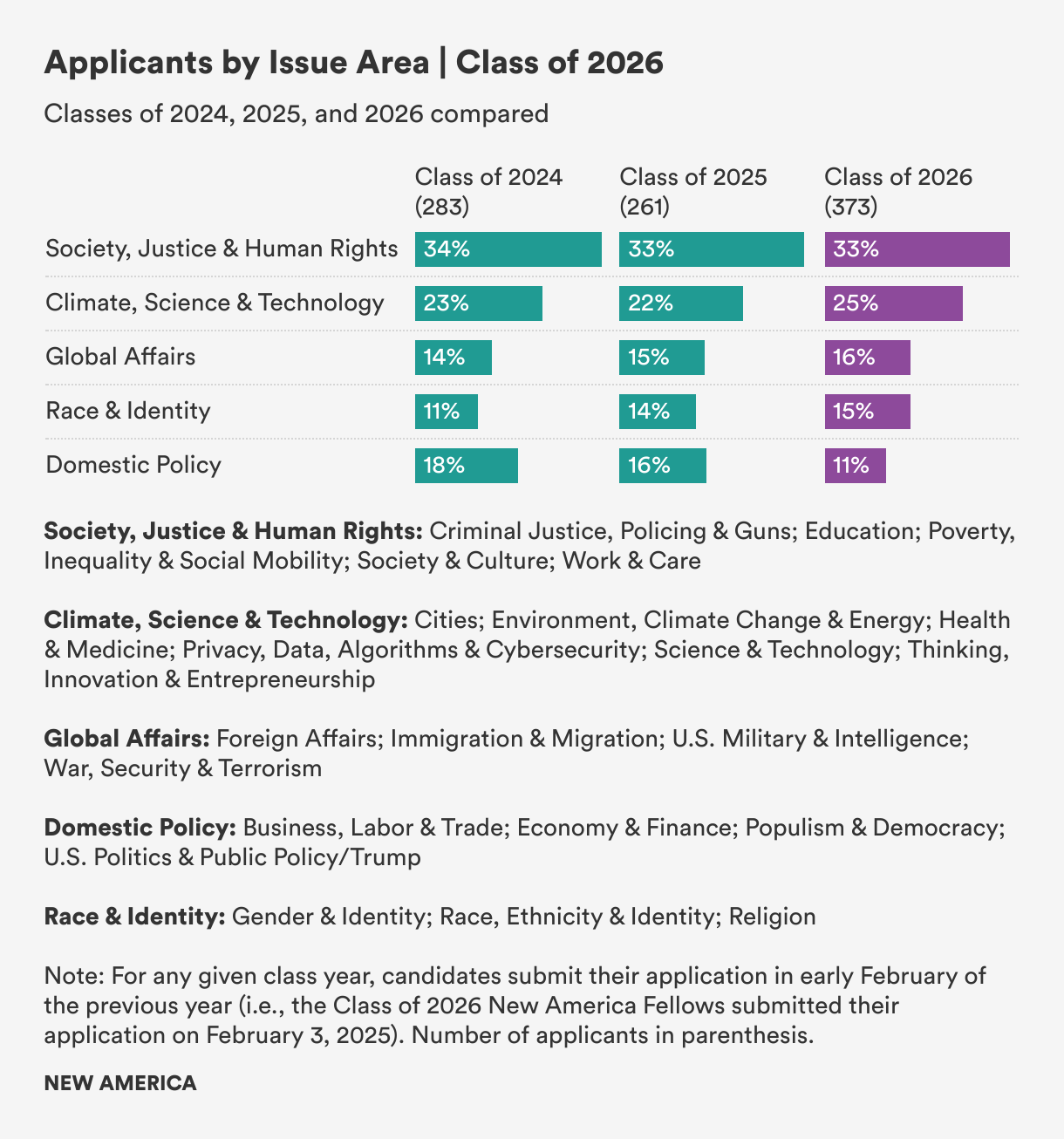
Over the course of three years, Society, Justice & Human Rights as a cross-cutting topic remains the most popular issue area, consistently attracting about a third of applicants (34 percent in 2024; 33 percent in both 2025 and 2026). This stability indicates ongoing interest in themes like history, criminal justice reform, education, inequality, and social mobility—topics that continue to dominate national conversations amid ongoing debates about systemic inequities and social injustices.
Climate, Science & Technology also maintains strong appeal as key topics for applicants, holding steady with a slight increase to 25 percent this year. Domestic Policy experienced a decline from 16 percent for the Class of 2025 to 11 percent for the Class of 2026, though democracy remains a popular topic.
Interest in both Global Affairs and Race & Identity is on the rise. Between the Classes of 2024 and 2026, Global Affairs grew from 14 to 16 percent, while Race & Identity climbed from 11 to 15 percent. The surge in Race & Identity may reflect national discussions on racial justice, gender identity, and religion, while the uptick in Global Affairs likely stems from mounting geopolitical tensions, migration policy crises, and questions about America’s role in the world.
This three-year trend suggests a shifting landscape of priorities among public thinkers and policy influencers: While concerns about justice and rights remain central, we are seeing rising interest in global issues, questions of identity, and science-driven topics.
The chart below visually captures this evolving focus among applicants over the past three years.
Class of 2026 by Project Type
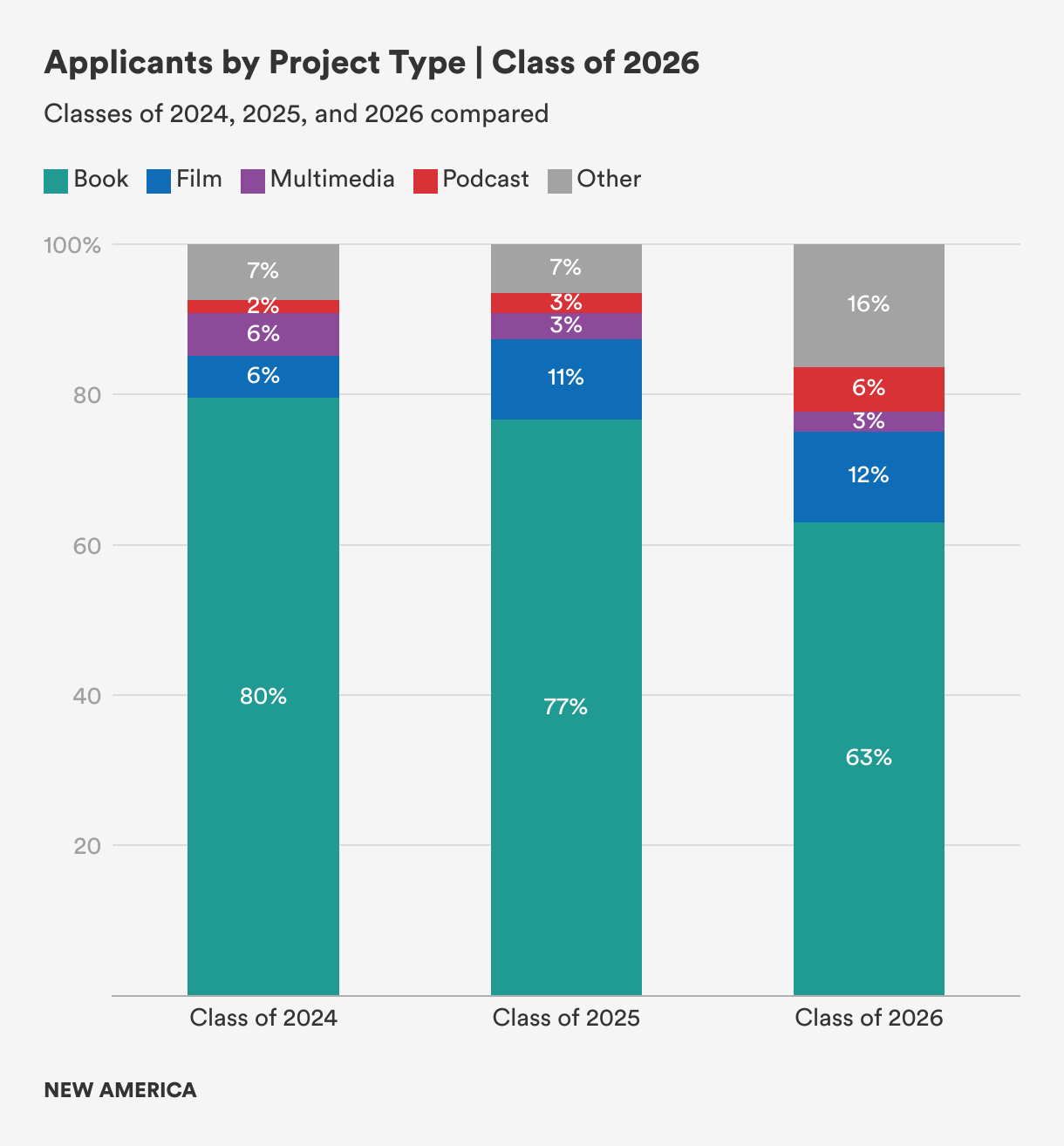
To date, the New America Fellows Program has supported the publication of 165 books, numerous award-winning longform reporting projects, and the production of 18 feature-length documentary films. Though widely recognized as a top fellowship for nonfiction writers, the program draws an increasingly diverse mix of projects each year, spanning a variety of forms and approaches. With the Class of 2026, the program supports two film projects alongside eight books.
About 63 percent of the applicants for the Class of 2026 submitted book projects, and 12 percent submitted film projects. Additionally, about 6 percent of this year’s applicants proposed a podcast project—doubling last year’s share—and 3 percent proposed a multimedia approach for their project.
Class of 2026 by Location
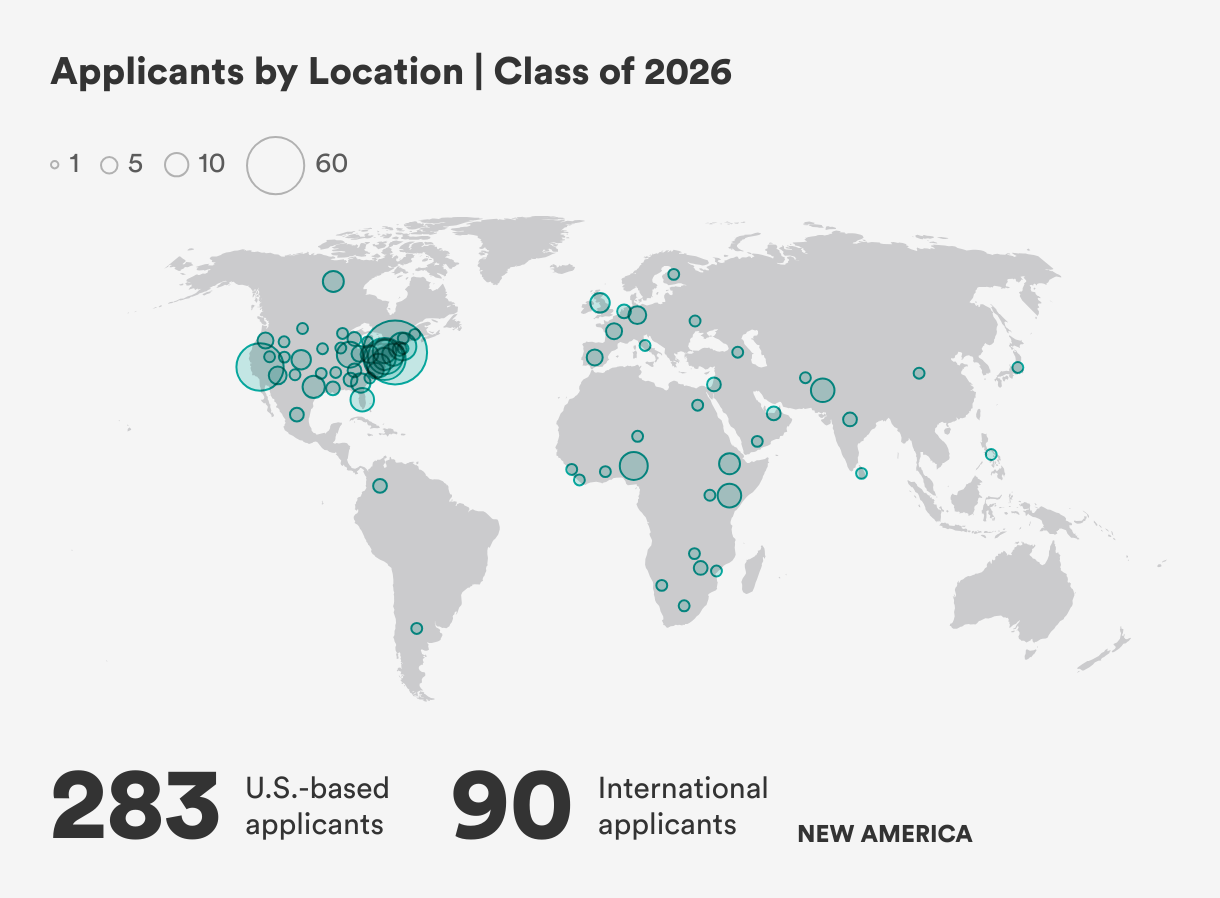
Of the broader candidate pool of 373 applicants, 283 are based in the United States across 38 states and the District of Columbia, while 90 applied from abroad, representing 37 countries.
The most applications from U.S.-based candidates come from New York (75), California (39), the District of Columbia (30), and Maryland (20). The most common countries of origin for international candidates were Nigeria (12), Kenya (8), Pakistan (8), Canada (6), and Ethiopia (6).
Applications for the Class of 2026 were distributed across states and countries as follows:
Class of 2026 by Profession
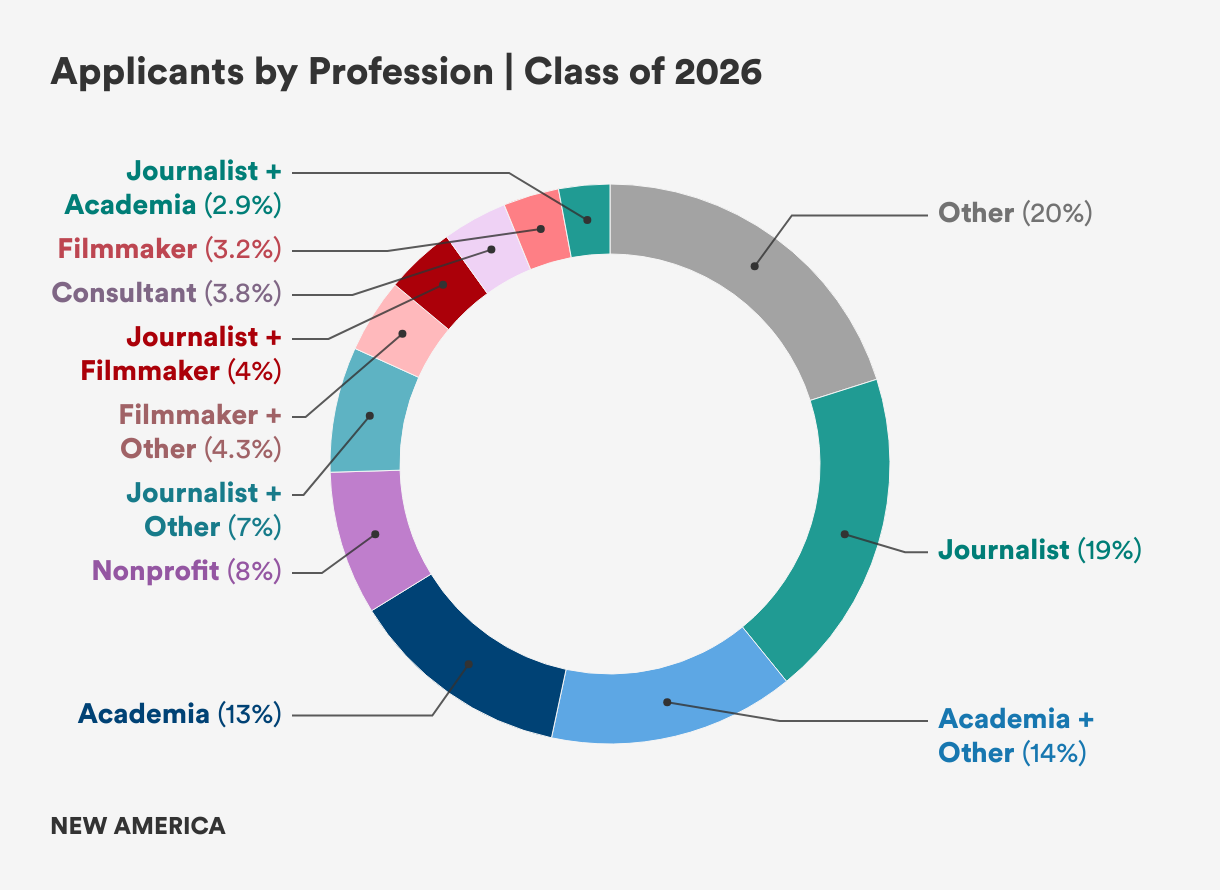
While the Fellows Program attracts applicants from a wide range of professions and industries, most are journalists (19 percent), followed by those in academia (14 percent). The applicants by profession are as follows:
Class of 2026 by Gender and Age
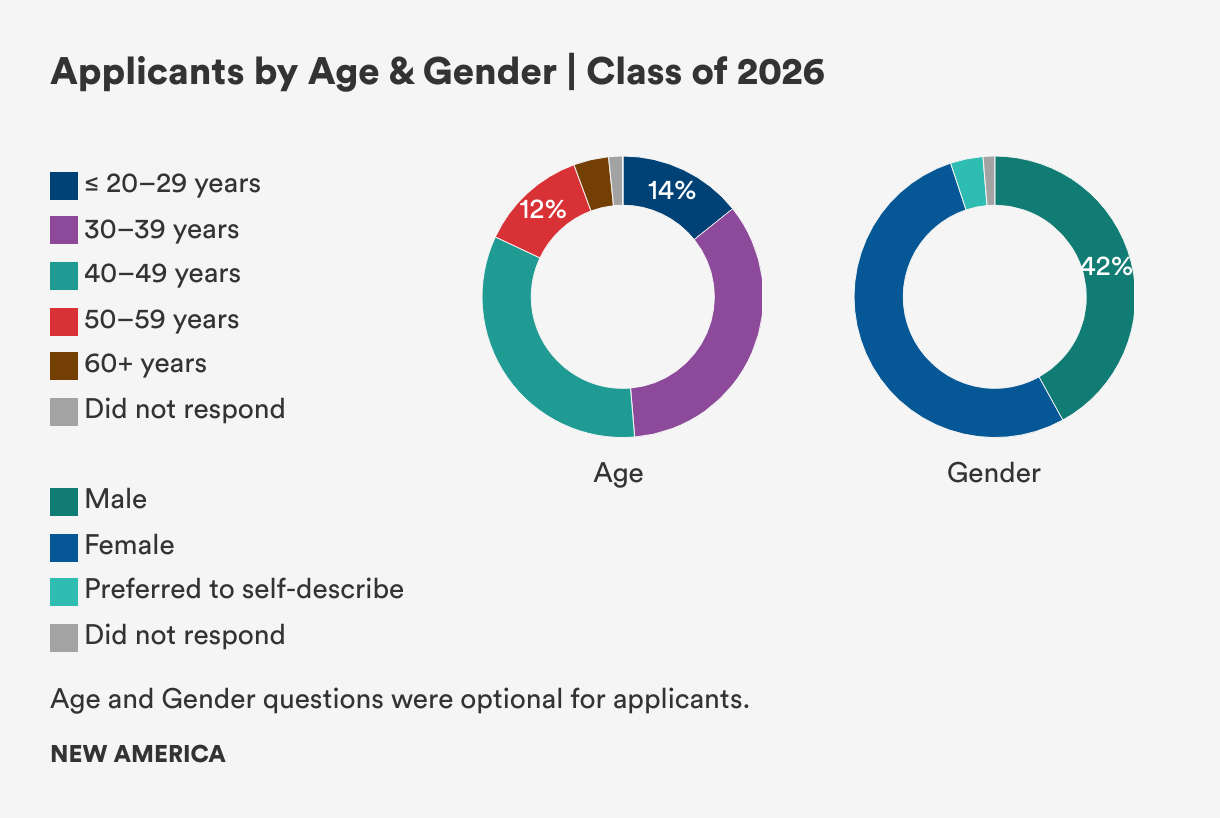
Regarding age distribution, the largest group of applicants (34 percent) falls within the 30–39 age range, followed by the 40–49 age group at 33 percent. Applicants aged 50–59 make up 12 percent of the pool, while those under 30 account for 14 percent. The smallest age group is over 60, at 4 percent. Approximately 2 percent of applicants did not provide their age.
Regarding gender, the applicant pool is split closely between self-identifying male (42 percent) and female (53 percent) candidates. Only 3 percent chose to self-describe, and 1 percent did not share their gender. Disclosure of age and gender was optional for all applicants.
Acknowledgments
New America’s Fellows Program thanks its board of directors, ASU’s Center on the Future of War, and New America’s Center on Education and Labor for their support this year.
We would also like to thank Sarah Baline, Johannes Lukas Gartner, Alex Briñas, Jodi Narde, Elena Gooray, and Kelley Gardner for supporting the design and preparation of this report.
Downloads
More About the Author

Awista Ayub
Senior Director, New America Fellows Program


