Threat Complacency and Nuclear Risk: Addressing Old Threats in a New Era
Abstract
Many have noted that, while public awareness of nuclear danger remains high, meaningful public action to reduce that danger is increasingly rare. This report explores why through a decision-theory lens, identifying 13 psychological and structural dynamics—or reasons—that explain the persistent gap between recognition and mobilization. These include cognitive habits that make nuclear risk feel stable, remote, or too complex to grasp; emotional defenses that turn fear into avoidance; and social patterns that delegate responsibility to experts while diffusing public agency.
The result is a self-reinforcing cycle: Nuclear weapons are seen as dangerous but necessary, the system that sustains them as flawed but functional. Crises trigger brief spikes of concern, but attention quickly fades as other, more immediate issues crowd the agenda. Decades without nuclear use have further dulled urgency, while declining trust in government, media, and institutions has weakened the credibility of those warning about the threat.
Breaking this cycle will require more than better messaging. It means building visible channels for engagement connecting nuclear policy to people’s lived experience, and rebuilding trust between experts and citizens. Understanding the psychological and structural roots of public disengagement is the first step toward renewing democratic pressure for serious nuclear risk reduction.
Acknowledgments
This report was supported by Ploughshares. I am grateful to Mariam Kvaratskhelia, research associate at the Future Security Scenarios Lab, for her research and analytical contributions, and to reviewers for their thoughtful feedback and constructive comments, which greatly strengthened the report.
Editorial disclosure: The views expressed in this report are solely those of the author and do not reflect the views of New America, its staff, fellows, funders, or board of directors.
Downloads
Executive Summary
Overview
The American public remains strikingly disengaged from resurgent nuclear dangers. While most citizens recognize nuclear weapons as destructive, they rank them far below climate change, pandemics, or cyberattacks as urgent threats. This paradox—widespread awareness without mobilization—defines today’s nuclear complacency. This report explains why recognition fails to translate into action and how nuclear risk can be reframed to regain salience in a crowded threat environment.
Drawing on polling, decision theory, and comparative risk research, the study develops a cognitive account of nuclear inattention. It argues that public disengagement arises not from ignorance but from predictable psychological and structural mechanisms that shape how people process uncertainty, probability, and agency. Understanding these mechanisms is essential for revitalizing civic engagement and policy legitimacy in the nuclear domain.
From Activism to Apathy
During the Cold War, nuclear fear was visible and mobilizing. Grass-roots activism—from the Nuclear Freeze movement, professional networks, and religious coalitions—converted public anxiety into political influence, helping secure the 1963 Limited Test Ban Treaty and shaping bipartisan arms-control momentum through the 1980s.
Today, that infrastructure has eroded. Nuclear issues have become technocratic and episodic, surfacing mainly during crises. The result is a field rich in expertise but poor in civic power. Ironically, this decline in engagement coincides with a period of heightened nuclear danger: renewed great-power rivalry, accelerating arsenal modernization, erosion of treaties, and destabilizing technologies such as AI-assisted command systems.
Understanding Complacency
This report identifies a set of 13 decision theory–derived reasons for nuclear inaction, which reflect ways in which Americans register nuclear danger yet rarely translate awareness into mobilization. These 13 reasons include:
- Reason 1: Deterrence as Proof of Safety (Status Quo Perception)
- Reason 2: “It Feels Unlikely” (Rarity and Imaginability)
- Reason 3: Overwhelming Complexity
- Reason 4: Overwhelming Fear
- Reason 5: Desensitization
- Reason 6: Warning Fatigue
- Reason 7: Attention Scarcity and the Salience Hierarchy
- Reason 8: Reliance on Elites
- Reason 9: Abstractness of Consequences
- Reason 10: Cognitive Dissonance (Motivated Ambivalence)
- Reason 11: Diffusion of Futility (Collective Action Problem)
- Reason 12: Information Decay and Issue Attention Cycles
- Reason 13: Trust Erosion and Epistemic Fatigue
These results emerge from overlapping cognitive and behavioral biases that shape how individuals process risk and allocate attention (“mechansisms”). Together, these effects generate recognition without mobilization. The relevant tendencies include status quo bias, normalcy bias, rarity neglect, ambiguity aversion, cognitive overload, fear avoidance, psychic numbing, desensitization, warning fatigue, delegation bias, diffusion of responsibility, issue attention cycling, and perceived futility. These cognitive and behavioral biases—amplified by partisanship, media saturation, and eroding trust in institutions—produce what this report terms “recognition without mobilization.” Americans acknowledge nuclear danger but experience it as background noise rather than a call to action.
Public Opinion Patterns
Survey data reveal consistent trends:
- Americans overwhelmingly view nuclear weapons as dangerous but remain divided on their moral and strategic value.
- Support for deterrence endures, while only 13 percent of Americans say these weapons make the world safer according to recent polls.
- Generational and gender gaps persist: older adults are desensitized but prepared; younger ones are detached; women express higher concern but lower perceptions of efficacy for nuclear weapons.
- Across parties, citizens externalize risk—locating danger in adversaries’ arsenals rather than in U.S. possession—and defer to elites for management.
Internationally, complacency is not the default. Majorities in many countries support joining the Treaty on the Prohibition of Nuclear Weapons, while the United States and other nuclear powers have rejected the treaty.
Cognitive and Policy Implications
By reframing nuclear inattention as a cognitive response, this report links behavioral science to security policy. It argues that successful warning-to-action transitions—seen today in climate and public-health domains—share three traits:
- Concreteness: Translate abstract risks into visible, local, and human consequences.
- Efficacy: Pair fear with credible, achievable actions.
- Connection: Link individual experience to collective outcomes.
Applying these principles to nuclear communication means designing engagement that works with human cognition—emphasizing agency, transparency, and moral coherence rather than fear alone.
Pathways to Re-Engagement
This report proposes six behavioral strategies for renewing nuclear salience:
- Shift Fear Toward Agency: Replace catastrophe framing with tangible indicators of progress: disarmament metrics, spending trade-offs, and interactive transparency dashboards.
- Translate Abstraction into Immediacy: Use foresight tools, immersive media, and local storytelling to connect nuclear risk to near-term social and economic concerns.
- Transform Secrecy into Transparency: Treat openness as a strategic asset; expand unclassified reporting and public data on arsenals and budgets.
- Integrate the Isolated: Embed nuclear risk within broader existential-risk agendas (such as artificial intelligence, climate change, and biosecurity) to share salience and resources.
- Convert Awareness into Participation: Create participatory mechanisms—including citizen forecasting, veterans’ partnerships, and community preparedness—to rebuild efficacy.
- Evolve Information into Design: Craft communications that couple analytic clarity with emotional and moral resonance.
These interventions form a theory of change that aligns policy, narrative, and civic engagement with the realities of modern cognition and attention.
The goal is no longer simply to warn, but to reconnect awareness to action—to replace resignation with participation and to imagine, once again, a future in which nuclear weapons no longer define what it means to feel secure.
Introduction
This report asks why Americans’ awareness of catastrophic risk so seldom translates into political or civic engagement, and how nuclear danger might be reframed to regain salience in a crowded risk environment. To address this question, it traces the trajectory of U.S. public opinion on nuclear weapons—especially across generational, gender, and partisan lines—and compares American perceptions of nuclear danger with attitudes toward other global catastrophic risks and with international trends. Drawing on polling data, behavioral research, and decision theory, the analysis investigates how ordinary reasoning processes filter, discount, and normalize nuclear threats. It situates public inattention not as ignorance but as an understandable—if perilous—adaptation to uncertainty: a psychological accommodation to risks that feel abstract, remote, and beyond individual control.
Seen through this lens, the question is not simply why Americans appear indifferent, but how that indifference takes shape. By integrating empirical data with insights from cognitive science, this report explains why recognition of nuclear danger so rarely becomes mobilization. It concludes with recommendations for reframing nuclear communication and policy engagement to make risk visible, actionable, and shared once again.
Activism of Yesteryear
During the Cold War, public engagement with nuclear issues reached a remarkable scale.1 Grassroots protests, women-led movements, and civic organizations mobilized millions around the shared goal of reducing nuclear danger.2 The 1963 Limited Test Ban Treaty, which prohibited nuclear test explosions in the atmosphere, outer space, and underwater, illustrates how public sentiment once decisively shaped U.S. nuclear policy.3 Revelations from the Baby Tooth Survey—showing radioactive strontium-90 from atmospheric tests accumulating in children’s teeth—transformed abstract fears into an intimate health concern.4 By 1963, roughly four in five Americans supported the treaty, giving President Kennedy a strong mandate; the Senate ratified it by a bipartisan vote of 80-14, signaling rare alignment between public pressure and political action.5
The Limited Test Ban Treaty was not an isolated case. Across the 1970s and 1980s, mass mobilization again influenced policy through the Nuclear Freeze campaign, where nearly 70 percent of Americans favored a bilateral halt to testing, production, and deployment.6 Local ballot measures, congressional resolutions, and high-profile advocacy by civic, religious, and professional groups turned technical issues into moral imperatives and visible demands for restraint.7 Public opinion shaped the tone of U.S.-Soviet negotiations and helped legitimize later arms control initiatives, including the Intermediate-Range Nuclear Forces Treaty and Strategic Arms Reduction Treaty.
These movements succeeded not only because nuclear danger felt urgent and imaginable, but also because there were clear pathways for action. Fear translated into participation: marching, voting, lobbying. The media was less fragmented, civil society more organized, and political trust higher—allowing momentum to build from local activism to national policy.
By contrast, today’s risk environment lacks the connective tissue that once linked sentiment to strategy. Nuclear threats remain, but the feedback loops between public concern and political response have weakened, leaving a field rich in expertise but short on civic power.
Heightened Nuclear Risk Today
Recent assessments across policy, scientific, and technical communities are converging on the judgment that nuclear dangers are acute and worsening. The 2025 Stockholm International Peace Research Institute Yearbook warns that “a dangerous new nuclear arms race is emerging at a time when arms control regimes are severely weakened,” noting that nearly all nine nuclear-armed states are actively modernizing their arsenals.8 Similarly, a 2023 National Academy of Sciences study estimates that roughly 12,500 to 13,000 nuclear weapons remain globally, after decades of arms control, and emphasizes that renewed political tensions, particularly between the United States and China, are heightening risks.9
Recent technical analyses underscore that the danger is no longer limited to the prospect of full-scale nuclear exchange, as it may have been at the height of the Cold War. A 2022 report from the Johns Hopkins Applied Physics Laboratory argues that nuclear risk must now be understood more broadly, from limited nuclear use to catastrophic exchanges, because even small detonations can trigger cascading humanitarian, economic, and geopolitical consequences.10
Furthermore, today these dangers are compounded by the emergence of new technologies. Joshua A. Schwartz and Michael C. Horowitz, for example, raise concerns that automated or AI-assisted systems could make nuclear threats appear more credible in coercive situations, thereby increasing the risk of misperception and miscalculation. The addition of an AI dimension makes the nuclear danger feel more immediate and potentially less controllable.11
Finally, a new stream of scientific work brings greater precision to our understanding of the humanitarian and environmental consequences of nuclear use. Writing in The Lancet, medical experts have urged the World Health Organization to expand its role in reporting nuclear risks for public health, stressing that “with a new nuclear arms race underway, authoritative current information…has never been more vital.”12 Complementing this work, Sebastian Phillipe has combined simulations of nuclear war consequences—including silo-field fallout, atmospheric transport models, and population data—with environmental, ethnographic, and journalistic research. His work estimates fatalities resulting from U.S. intercontinental ballistic missile modernization and examines the broader risks associated with future deployments.13
All told, we see a risk environment in which nuclear dangers are not only persistent but accelerating, intensified by technological change, geopolitical rivalry, and renewed attention to cascading human and environmental effects. Against this backdrop, public awareness and activism have waned—just when engagement is most needed.
Reawakening and the Limits of Fear Appeals
Across U.S. media and culture, nuclear risk has reentered public discourse with striking intensity in recent years. News coverage, fiction, and film now depict nuclear war, accidents, and near-miss crises with unprecedented realism. A Washington Post opinion series produced with the Federation of American Scientists and a New York Times opinion series led by W.J. Hennigan vividly chronicle renewed nuclear dangers—from close calls in deterrence signaling to the fragility of command-and-control systems—reflecting a broader reawakening of concern about how near catastrophe might be.14
This resurgence extends across popular culture. Christopher Nolan’s 2023 film Oppenheimer revives nuclear history as a moral and political drama; Kathryn Bigelow’s A House of Dynamite, released in 2025, dramatizes a launch scenario with technical precision. Annie Jacobson’s 2024 book Nuclear War: A Scenario translates classified processes into a minute-by-minute nonfiction narrative.15 Together with predecessors like Jeffrey Lewis’s 2018 speculative novel, these works represent a wave of realist portrayals—part of a growing trend in “useful fiction” that treats narrative realism as a tool for strategic foresight.16
Yet this cultural reawakening reflects a theory of change long familiar to funders and advocates, from the Rockefeller and Ford Foundations in the 1980s to contemporary philanthropic initiatives: the belief that vivid, emotionally powerful depictions of nuclear danger can mobilize public opinion and drive reform.17 Yet, despite their sophistication and reach, such efforts have produced only fleeting engagement. Public concern spikes but rarely endures, even when depictions avoid overt alarmism.
The limitation lies not in artistic failure or ignorance, but in deeper psychological and structural factors: Warning fatigue, desensitization, and competing priorities dull the response even when awareness is high. Decision theory helps explain why. When threats are diffuse, probabilistic, and temporally distant, even credible warnings fail to sustain attention or motivate collective action. The challenge, then, is not simply to render nuclear danger more realistic, but to transform awareness into agency—reframing communication, media, and policy outreach to engage people as capable actors rather than passive witnesses.
Citations
- History.com editors, “One Million People Demonstrate in New York City Against Nuclear Weapons,” HISTORY, updated March 2, 2025, https://www.history.com/this-day-in-history/June-12/nuclear-disarmament-rally-new-york-central-park.
- J. Michael Hogan and Ted J. Smith, “Polling on the Issues: Public Opinion and the Nuclear Freeze,” Public Opinion Quarterly 55, no. 4 (1991): 534–69, https://www.jstor.org/stable/2749406.
- “Current ‘Mini-Nukes’ Debate Echoes Test Ban Failure 40 Years Ago,” National Security Archive, August 8, 2003, https://www2.gwu.edu/~nsarchiv/NSAEBB/NSAEBB94/press.htm.
- Hogan and Smith, “Polling on the Issues,” https://www.jstor.org/stable/2749406.
- Richard H. Rovere, “Letter from Washington,” New Yorker, September 28, 1963, https://www.newyorker.com/magazine/1963/10/05/letter-from-washington-116.
- American Archive of Public Broadcasting, MacNeil/Lehrer Report: Nuclear Freeze Issue, aired October 27, 1982, https://americanarchive.org/catalog/cpb-aacip_507-v40js9j460.
- Hogan and Smith, “Polling on the Issues,” https://www.jstor.org/stable/2749406; U.S. Congress, House, A Joint Resolution Calling for a Mutual and Verifiable Freeze on and Reductions in Nuclear Weapons, H.J. Res. 13, 98th Cong., 1st sess., introduced January 3, 1983, https://www.congress.gov/bill/98th-congress/house-joint-resolution/13.
- Stockholm International Peace Research Institute, Yearbook 2025: Armaments, Disarmament, and International Security (Oxford University Press, 2025), https://www.sipri.org/yearbook/2025.
- National Academies of Sciences, Engineering, and Medicine, Risk Analysis Methods for Nuclear War and Nuclear Terrorism (National Academies Press, 2023), 44–45, https://nap.nationalacademies.org/read/26609/chapter/6.
- Michael Frankel, James Scouras, and George Ullrich, The Uncertain Consequences of Nuclear Weapons Use (Johns Hopkins University Applied Physics Laboratory, December 2022), https://www.jhuapl.edu/sites/default/files/2022-12/UncertainConsequencesofNuclearWeapons.pdf.
- Joshua A. Schwartz and Michael C. Horowitz, “Out of the Loop Again: How Dangerous is Weaponizing Automated Nuclear Systems?,” arXiv preprint, May 1, 2025, https://arxiv.org/abs/2505.00496.
- International Physicians for the Prevention of Nuclear War, “Reducing the Risks of Nuclear War—The Role of Health Professionals,” The Lancet 399 (2022): 1097–1098, https://pmc.ncbi.nlm.nih.gov/articles/PMC10556261/.
- Adam Malecek, “Focus on New Faculty: Sébastien Philippe Aims to Reduce the Risk of Nuclear War,” College of Engineering, University of Wisconsin–Madison, September 8, 2025, https://engineering.wisc.edu/news/focus-on-new-faculty-sebastien-philippe-aims-to-reduce-the-risk-of-nuclear-war/.
- Federation of American Scientists and The Washington Post opinion, “The Next Nuclear Age” series, 2025, https://www.washingtonpost.com/opinions/interactive/2025/nuclear-threat-again-fas/; W.J. Hennigan and New York Times opinion, “At the Brink: A Series About the Threat of Nuclear Weapons in an Unstable World,” 2024, https://www.nytimes.com/interactive/2024/10/10/opinion/nuclear-weapons-nytimes.html.
- Christopher Nolan, Oppenheimer (Universal Pictures, 2024); Kathryn Bigelow, A House of Dynamite (Netflix, 2025); Annie Jacobsen, Nuclear War: A Scenario (St. Martin’s Press, 2024).
- Jeffrey Lewis, The 2020 Commission Report on the North Korean Nuclear Attacks Against the United States: A Speculative Novel (Mariner Books, 2018); August Cole and P. W. Singer, Thinking the Unthinkable with Useful Fiction (Centre for International and Defence Policy, Queen’s University, 2018), https://www.queensu.ca/psychology/sites/psycwww/files/uploaded_files/Graduate/OnlineJournal/Issue_2-Singer.pd.
- Roger E. Kasperson et al., “The Social Amplification of Risk: A Conceptual Framework,” Risk Analysis 8, no. 2 (June 1988): 177–187, https://doi.org/10.1111/j.1539-6924.1988.tb01168.x.
Public Opinion and Threat Hierarchies
Changing Threat Hierarchies
Since the Cold War, Americans have consistently regarded nuclear weapons as dangerous but have not consistently viewed them with urgency.18 Concern has spiked during crises—such as the Cuban Missile Crisis, the early 1980s arms race, and post-9/11 fears of nuclear terrorism—but each surge faded as immediacy declined.19 Today, polling shows that while most Americans acknowledge nuclear risk, they rarely rank it among the nation’s most pressing concerns.
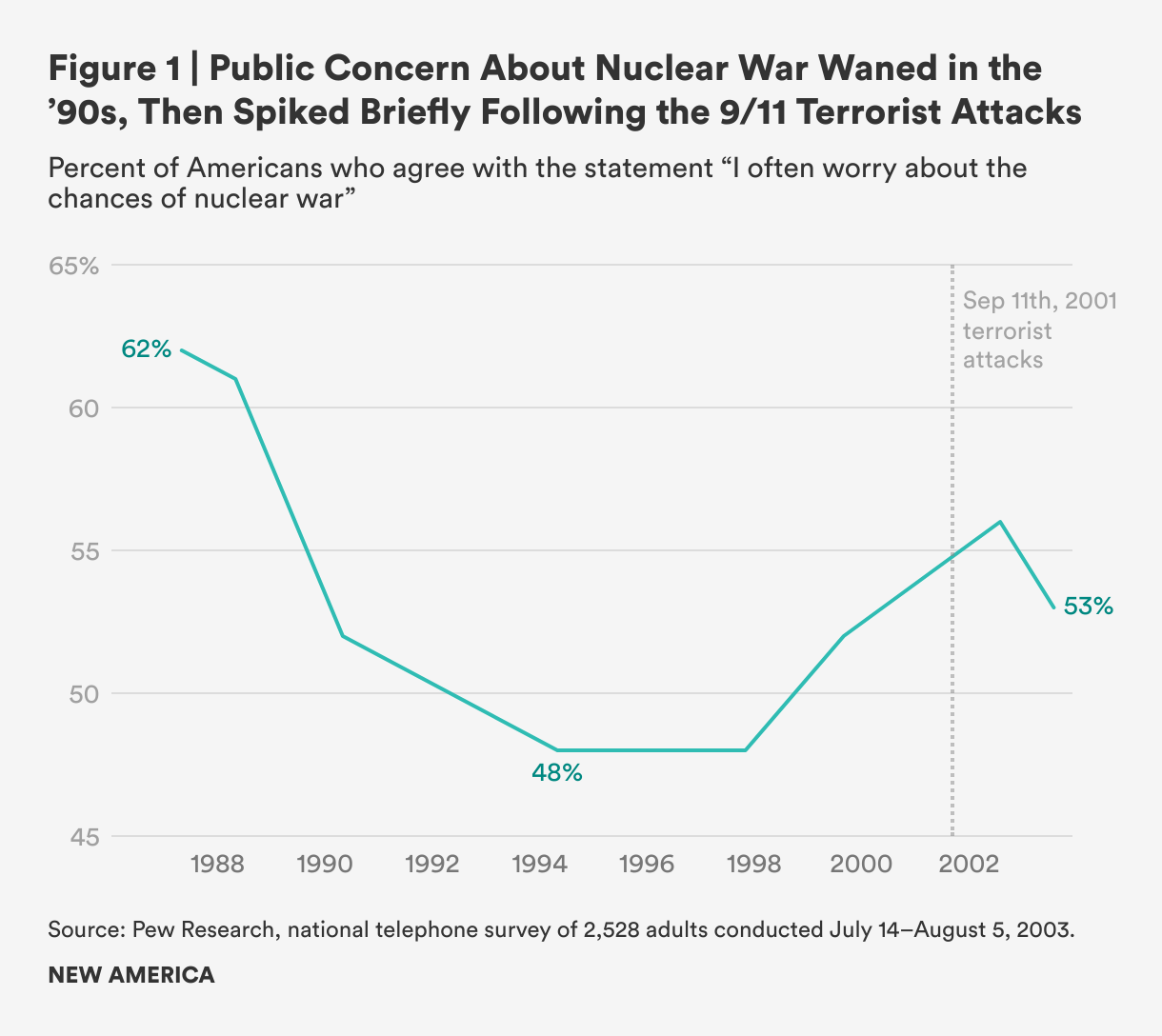
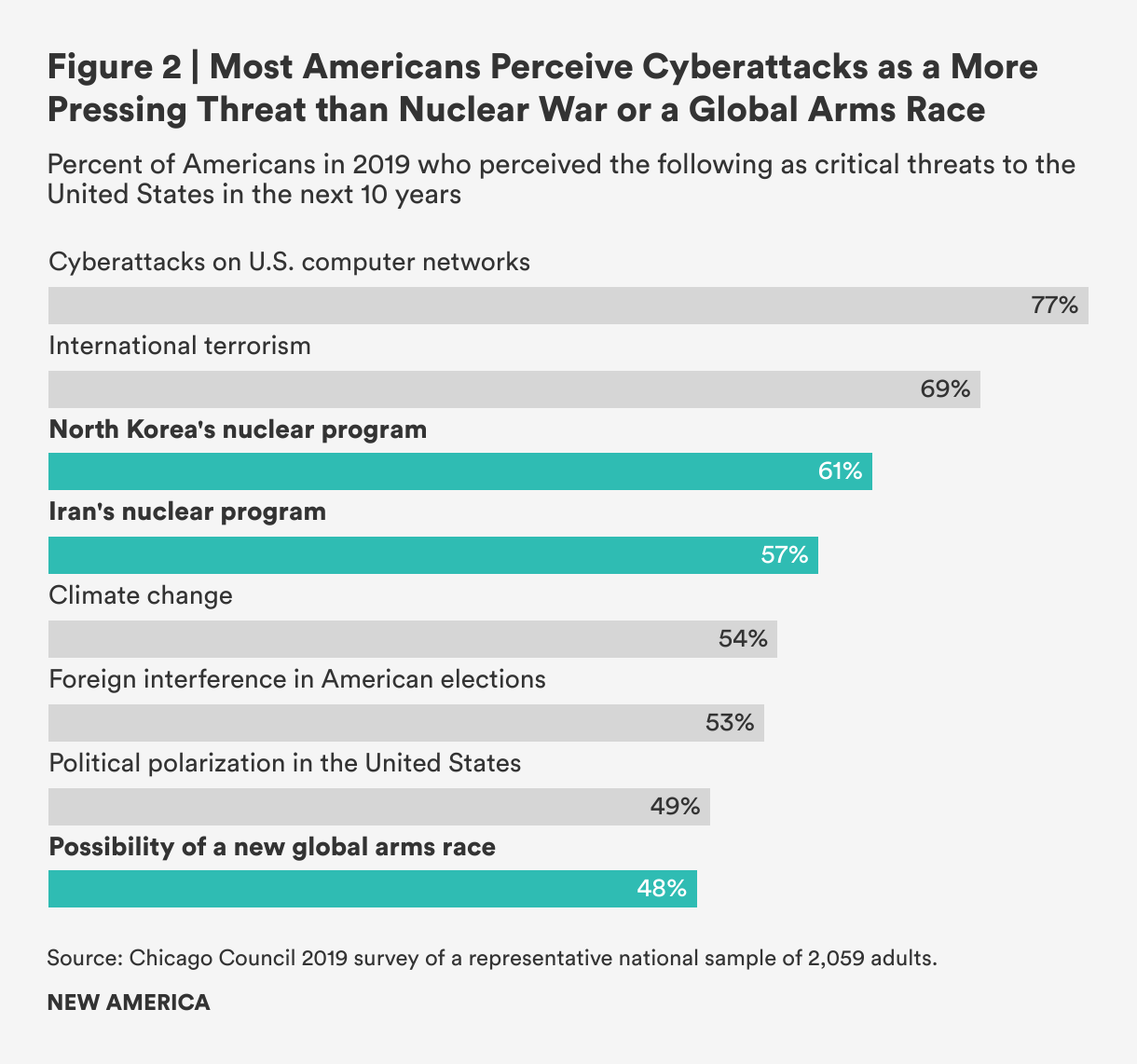
During the Cold War, anxiety drove broad mobilization—the 1980s nuclear freeze campaign drew support from roughly 70 percent of Americans. But by the 1990s, immediacy faded: Only about half of Americans still reported worrying about nuclear war.20 The pattern repeated after 9/11, when fears of nuclear terrorism briefly renewed attention, before subsiding again.21 By the late 2010s, the public’s threat hierarchy had reordered around more tangible risks: A 2019 Chicago Council survey showed that most Americans viewed cyberattacks, climate change, and terrorism as greater threats than a new arms race, which only 48 percent identified as a critical threat.
In a notable exception, their third-ranked concern was North Korea’s nuclear program—a reflection, not of broad anxiety about nuclear weapons, but of heightened media attention and the personalization of risk around a single adversary, which then faded.22
The onset of the COVID-19 pandemic followed a comparable dynamic. In a 2020 Pew Research Center polling, 79 percent of Americans identified the spread of infectious disease as a “major threat” to the United States, ranking above both terrorism and the spread of nuclear weapons (each 73 percent).23 Yet by February 2025, only about one in five Americans continued to view COVID-19 as a major threat—a decline of more than 45 percentage points since 2020.24 The arc of pandemic concern underscores how quickly salience decays once an emergency recedes from daily experience (although nuclear weapons have sustained a higher baseline concern than has COVID).
A 2020 Chicago Council survey found that when Americans were asked to identify the top critical threats to U.S. vital interests over the next decade, nuclear weapons did not appear among the seven leading concerns.25 Instead, respondents prioritized the COVID-19 pandemic, domestic violent extremism, and China’s rise as a global power. However, partisan divisions shaped nuclear attitudes: Republicans included Iran’s (54 percent) and North Korea’s (53 percent) nuclear programs among their top concerns, while Democrats omitted nuclear issues entirely, focusing instead on climate change, racial inequality, and election interference.
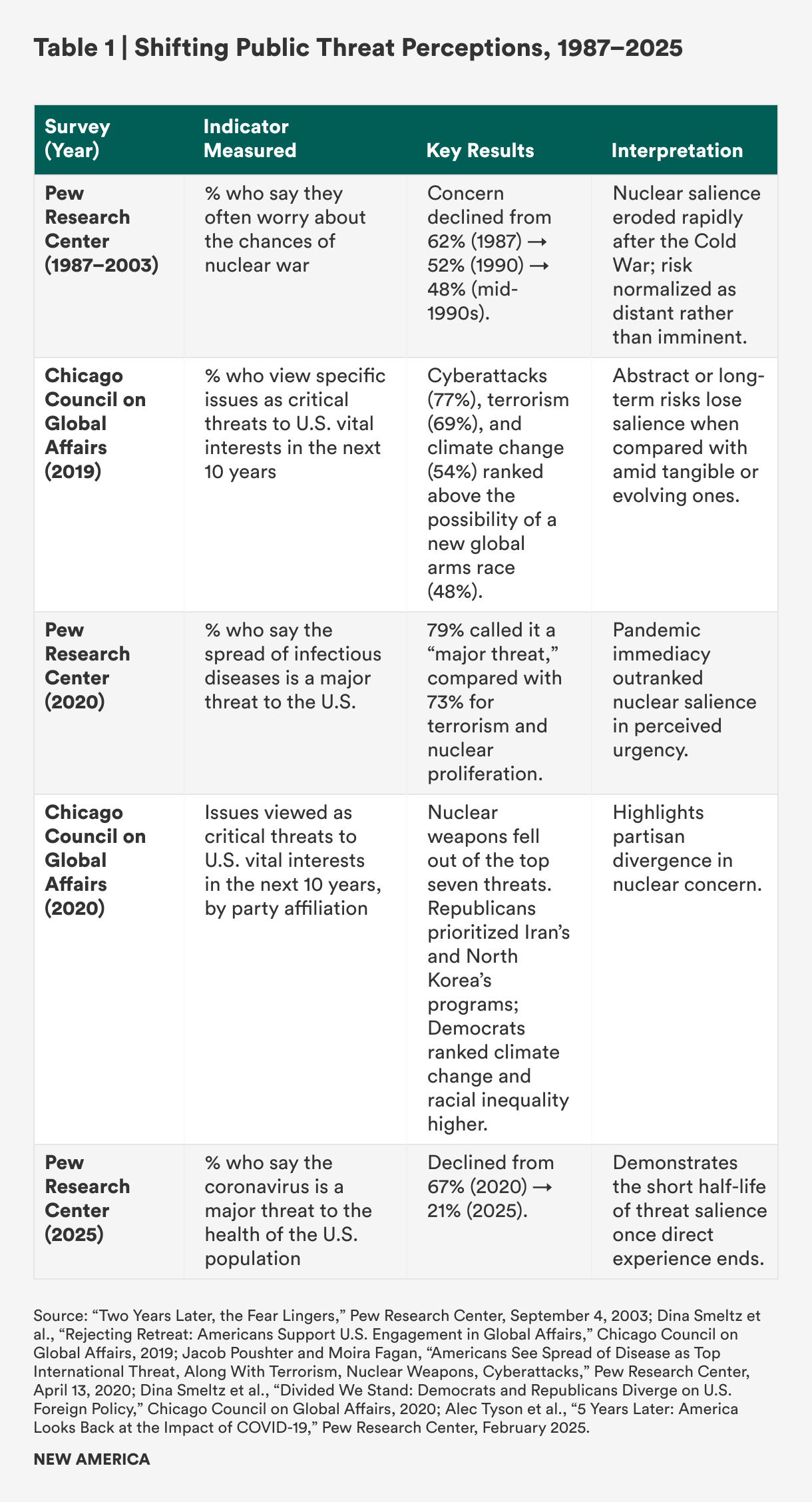
Interpreting public opinion on nuclear risk requires caution. Survey questions differ in what they measure—whether people fear nuclear war, view nuclear weapons as a major threat, or see them as important to U.S. national security. Still, taken together, these indicators trace a clear pattern: While Americans continue to recognize nuclear weapons as dangerous, their concern has become increasingly conditional, spiking around crises or specific adversaries, then fading as immediacy fades.
Across decades, several dynamics stand out:
- Immediacy and visibility govern attention. Threats that feel lived—pandemics, terrorism, natural disasters—dominate the public hierarchy of concern.
- Nuclear danger has become abstract. Without visible cues, Americans are less likely to perceive nuclear risk as urgent.
- Partisanship fragments perception. Republicans emphasize adversaries’ programs; Democrats emphasize systemic risks like climate change or inequality.26
Americans thus tend to locate danger in others’ arsenals while viewing their own as stabilizing—a reflection of deterrence framing and limited engagement with nuclear risks as a domestic concern. In addition, compared with other global threats, nuclear weapons are acknowledged but not activating. Issues such as climate change or pandemics offer visible cues, moral clarity, and tangible pathways for action; nuclear risks, by contrast, lack immediacy and accessible points of engagement. As a result, awareness seldom translates into agency. The central challenge for policymakers and advocates is therefore not recognition but relevance—making nuclear danger felt, not merely understood.
Strategic and Moral Ambivalence
While most Americans still endorse deterrence in principle, confidence in its necessity and moral legitimacy has eroded over time. Public opinion polling over several decades reveals a shift from conviction to conditional acceptance: Nuclear weapons are tolerated as legacy instruments of security rather than actively endorsed as policy tools.
In Rasmussen Reports surveys from 2012–2013, an overwhelming majority (80 percent) said that maintaining nuclear weapons was at least “somewhat important” to U.S. national security. However, the share describing them as “very important” declined from 57 percent in 2012 to 45 percent in 2013, suggesting an erosion of certainty about their strategic value.27
Similarly, YouGov (2024) and Pew Research Center (2025) polling data show that Americans now express widespread skepticism about whether having nuclear weapons make either the United States—or the world—safer.28 The table below summarizes key findings from major public opinion surveys on the perceived value, morality, and desirability of nuclear weapons.
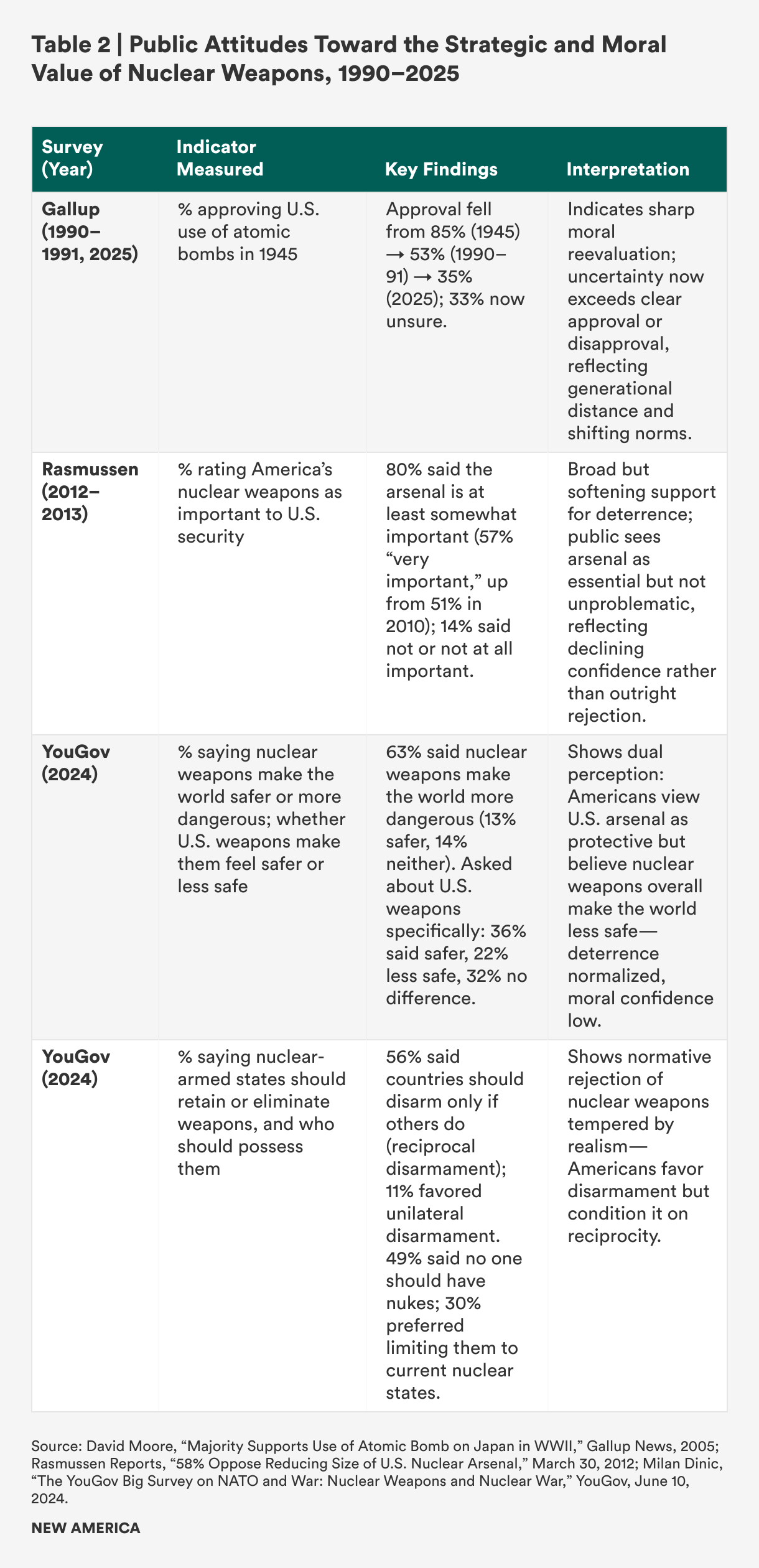
These data reveal three interrelated trends:
- Strategic uncertainty: Most Americans still see nuclear weapons as part of U.S. security, but confidence in their necessity and effectiveness has weakened.
- Moral ambivalence: Approval of nuclear use has declined sharply over time, with uncertainty replacing conviction.
- Reciprocal idealism: The public favors disarmament in principle but hesitates in practice unless all states participate—reflecting a preference for shared restraint rather than unilateral leadership.
Taken together, these findings reveal a public that recognizes the dangers of nuclear weapons but feels neither empowered nor morally compelled to act. Americans still acknowledge these weapons’ deterrent role but are less persuaded of their legitimacy or value as tools of security. Those who do perceive nuclear danger tend to externalize it—focusing on adversaries’ programs, such as those in North Korea or Iran, rather than on the risks of maintaining or modernizing the U.S. arsenal. The result is a form of psychological distance: Nuclear risk is understood, even feared, but rarely felt as proximate or actionable. Awareness has become acknowledgment without agency—a defining feature of contemporary nuclear politics and the central paradox this report seeks to explain.
Demographic Patterns in Nuclear Threat Perceptions
Public attitudes toward nuclear weapons are not uniform. Beneath aggregate polling averages lie deep variations by generation, gender, and political identity that reveal how experience, worldview, and socialization shape what kinds of danger people recognize—and whether they feel able to respond. These differences matter because they determine not only who worries about nuclear risk, but how that worry is interpreted: as moral outrage, strategic realism, or background noise. In this sense, demographic divides function as cognitive filters through which nuclear risk becomes meaningful—or fails to.
Generational Divides Remain Pronounced
Younger adults, distant from Cold War memory, are more likely to view nuclear weapons as stabilizing: In a 2024 YouGov survey, 17–18 percent of those aged 18 to 29 said nuclear weapons make the world safer, compared with about 10 percent of those over 40.29 Concern rises steeply with age: Nearly three-quarters (72 percent) of adults over 60 said nuclear weapons make the world more dangerous, compared with just over half of younger respondents. Older Americans, socialized through duck-and-cover drills and missile crises, perceive nuclear danger as real but managed; younger generations regard it as an abstraction outside lived experience.
Gender Differences Follow a Similar Pattern
Men are nearly twice as likely as women to view nuclear weapons as contributing to global safety, while women are slightly more likely to describe them as making the world more dangerous (64 percent vs. 61 percent).30 This aligns with longstanding research showing that women and caregivers express greater moral and humanitarian concern but lower perceived agency—interpreting nuclear risk through human impact rather than strategic stability.31
Partisan Divides Compound These Differences
In a 2025 Pew survey, majorities in both parties said nuclear weapons make the world less safe, but their reasoning diverges.32 Among Democrats, 56 percent said nuclear weapons make the United States less safe; among Republicans, only 37 percent agreed, and 38 percent said they make the country safer. Republicans thus frame deterrence as strength; Democrats see restraint as security. These partisan lenses reinforce interpretive gaps in what “safety” itself means.
Preparedness and Agency Vary
In the same YouGov survey, nearly half of Americans (47 percent) reported never having considered what they would do in a nuclear attack, with women (52 percent) and younger adults more likely to say so.33 Men and older adults—groups more exposed to historical crises—were significantly more likely to have thought through a response. This suggests that experience and identity shape not only perceptions of risk but also imagined capacity to act.
Together, these patterns underscore a central point: Awareness of nuclear danger is widespread but fragmented by social position. Younger Americans tend to view the threat as distant; older ones as familiar but normalized. Women register higher concern but less agency, while men and conservatives rationalize risk through deterrence. The barrier, then, is not ignorance but interpretation—people understand nuclear risk in fundamentally different ways. For advocates and policymakers, the task is no longer to amplify awareness, but to convert recognition into agency: designing messages and interventions that address the cognitive, moral, and social filters through which different publics perceive, prioritize, and act on nuclear danger.
How Americans View Issues of Nuclear Use and Taboo
Public attitudes toward nuclear use reveal the same pattern of conditional acceptance that characterizes broader views of deterrence and danger. Most Americans support the nuclear taboo—the powerful moral and norm against the use of nuclear weapons—but their support weakens when use is framed as defensive or necessary.
A 2024 YouGov survey found that 65 percent of Americans said it would be unacceptable for the United States to use nuclear weapons first.34 This rejection was particularly strong among older adults (over 75 percent among those aged 60+) and among Democrats (70 percent compared with 65 percent of Republicans). Yet when asked about retaliation, the picture changed: 61 percent said they would support U.S. use of nuclear weapons in response to a nuclear attack, rising to 74 percent among Republicans and 63 percent among Democrats. The moral duality—aversion to initiating nuclear use coupled with acceptance of retaliatory use—illustrates how Americans reconcile fear with faith in deterrence.
A 2024 University of Massachusetts Amherst poll comparing civilian and military attitudes highlights this divide further.35 When asked whether the United States should ever use nuclear weapons under “limited and extreme circumstances,” a slim majority of both groups agreed. Yet absolute rejection of nuclear use was far more common among civilians: One-third (33 percent) said the U.S. president should never authorize nuclear use, compared with 21 percent of military respondents. Professional proximity to nuclear planning appears to normalize conditional use, while distance from the operational domain reinforces moral absolutism among civilians.
Across both groups, humanitarian concerns, such as civilian harm and environmental devastation, were the strongest arguments against nuclear use, far outweighing legal and normative rationales. Both military and public respondents ranked “violating the norm of non-use” near the bottom of their reasoning hierarchies, underscoring how restraint is moral and emotional, not procedural.36
Demographic patterns mirror these divisions. The military sample was older, male, and Republican-leaning; the public was younger, more gender balanced, and leaning Democratic by 32 points. These differences echo broader trends: Men are more likely than women to view the Hiroshima and Nagasaki bombings as justified; older Americans more likely than younger; and Republicans more likely than Democrats. In short, attitudes towards nuclear use are shaped by social identity and political worldview—how people balance moral restraint against perceptions of national strength, as well as historical memory.
These attitudes show that awareness of nuclear danger coexists with rationalizations for its potential use. Americans broadly recognize the catastrophic consequences of nuclear weapons, but interpret them through identity, ideology, and emotion. Fear coexists with justification, and moral restraint with strategic rationalization. This fragmentation dilutes collective concern and weakens the shared sense of taboo that, during the Cold War, once drove engagement.
How Americans Think About Nonproliferation and Disarmament
Public opinion on disarmament reveals the same ambivalence that shapes broader attitudes towards nuclear weapons: moral support for abolition in principle, tempered by strategic caution in practice. Americans endorse a world without nuclear weapons but hesitate when elimination requires unilateral sacrifice or trust in rivals.
A 2024 YouGov survey found that nearly half of Americans (49 percent) believe no country should possess nuclear weapons, with women substantially more likely than men to hold this view.37 Partisan differences were also pronounced: 55 percent Democrats supported universal disarmament, compared with 40 percent of Republicans. Men and Republicans were more likely to favor maintaining the status quo—limiting nuclear possession to existing nuclear powers—while a small minority (12 percent said non-nuclear states should be allowed to develop nuclear weapons.
These results reflect a tension between moral aspiration and strategic objectives or reciprocity. While most Americans express ethical opposition to nuclear weapons, their willingness to eliminate them depends on mutual compliance (vs. unilateral action). This logic mirrors the structure of deterrence itself: Trust only works if symmetrical.
Support for complete abolition remains high in theory but collapses under conditions of asymmetry. Just 11 percent of respondents favored U.S. unilateral disarmament, and fewer than one in five (19 percent) said nuclear-armed countries should be required to give up their arsenals before others. In short, Americans imagine disarmament as an end state, not a process—desirable but distant, and contingent on others moving first.38
This “reciprocal idealism” helps explain why awareness seldom translates into advocacy. Disarmament is framed as a moral goal rather than a policy pathway—something to support, not to pursue. Public faith in deterrence as a guarantor of order, combined with uncertainty about alternatives, keeps nuclear policy insulated from mass mobilization. The result is moral agreement without political energy: a shared ideal stripped of agency.
Education, Geography, and Public Perceptions of Nuclear Authority
Americans’ understanding of nuclear risk is shaped not only by ideology and generation but also by education, geography, and trust in institutions—factors that together determine how people interpret information and whom they believe.
Education and Cognitive Confidence
Education exerts a paradoxical influence on nuclear perception. Less educated Americans tend to be more skeptical of existential risks, reflecting lower scientific literacy and weaker trust in expert authority.39 This is due to the so-called “science confidence gap”: the tendency for less educated individuals to possess lower scientific literacy and greater distrust of scientific authority.40 Conversely, higher education can foster overconfidence: Even trained national security professionals often display exaggerated certainty about probabilities and outcomes. A 2024 NATO study by Jeffrey Friedman found that senior military officers and policy officials routinely overestimated their accuracy when assessing nuclear and geopolitical threats.41 Such overconfidence can lead to threat inflation (exaggerating the likelihood of adverse events), but in the nuclear context, it may instead produce threat deflation (confidence in deterrence that downplays catastrophic risk and encourages maximalist policies without fully accounting for unintended consequences).42 In short, lower education produces complacency; higher education, overconfidence—each in its own way blunting adaptive awareness.
Regional Context and Proximity
Geography also shapes perceptions of risk. During the Cold War, city dwellers reported higher anxiety about nuclear attack than rural residents; today, nuclear awareness clusters sporadically around perceived “target” regions or moments of proximity.43 The 2018 Hawaii false missile alert briefly reignited local fear and revealed how little preparedness or understanding most citizens had of actual response protocols. Such moments show that distance from perceived targets dulls vigilance—where proximity, whether geographic or experiential—can still provoke acute but fleeting engagement.
Nuclear Literacy and Institutional Trust
Despite low baseline knowledge, curiosity remains high. Polling evidence suggests that most Americans have low levels of nuclear literacy. A 2019 University of Maryland study found that nearly half of respondents thought the U.S. nuclear arsenal was larger than it actually is, while only about one in eight thought it was smaller. Similarly, most Americans assumed that other countries’ nuclear stockpiles were greater than their actual size.44
A 2023 Chicago Council survey found that while most Americans said they understand the effects of nuclear weapons, far fewer reported familiarity with their potential targets (31 percent), U.S. nuclear policy (30 percent), or the costs of maintaining the arsenal (20 percent)—even though cost is the most tangible way for taxpayers to participate in nuclear decision-making.45 A 2023 Chicago Council poll likewise revealed that fewer than half of Americans expressed confidence in the government’s ability to manage nuclear weapons responsibly. In a University of Amherst study, when asked whom they trust, majorities (55 percent) cited the military and academics as reliable messengers, while fewer expressed confidence in journalists (43 percent), the president (43 percent), Congress (37 percent), or activist groups (22 percent). When asked where they would seek information about U.S. nuclear weapons policy, respondents most often cited television (24 percent), the government (21 percent), academics (16 percent), and social media (13 percent).46 Notably, the poll did not ask about NGOs. Television remains the most common source of information, but the other institutions Americans are likely to rely on—the military, academics, and government—are those whose legitimacy depends on deterrence, reinforcing the perception that nuclear stability is a technical matter best left to experts.
Despite this limited knowledge, public curiosity remains high: Six in 10 Americans said they would like to learn more about U.S. nuclear policy, and nearly a quarter (24 percent) admitted they wanted answers to “basic questions.” Interestingly, those who reported greater familiarity with U.S. nuclear policy were also more likely to believe that nuclear weapons make the country safer, suggesting a familiarity may reinforce rather than challenge existing deterrence assumptions.
Although polling data is often interpreted as evidence that the public does not care about nuclear risk, what emerges from cross-poll analysis is something more nuanced: Americans are broadly aware of nuclear danger but rarely translate that recognition into sustained concern or action. Most people acknowledge the catastrophic potential of nuclear weapons and support arms control in principle, yet they rank nuclear risk far below more visible or immediate threats. This reflects a familiar cognitive gap between awareness and engagement. Nuclear danger is recognized but not prioritized; it is concerning but not actionable.
Americans are not apathetic but deferential—curious about nuclear risk yet inclined to trust the authorities who sustain the deterrence status quo. The result is a public that acknowledges danger but rarely claims ownership over it.
This gap between curiosity and responsibility is intensified by another structural feature of the U.S. nuclear landscape: No institution is formally tasked with alerting the public to nuclear risk. Unlike public health, disaster preparedness, or climate science—domains with clearly designated communicators—nuclear warning has emerged piecemeal and organically, driven largely by NGOs, activist networks, and a handful of research organizations. In the United States, this role is diffuse across groups such as the Bulletin of the Atomic Scientists, Ploughshares, and the Nuclear Threat Initiative, among others. Internationally, the pattern is similar: In the U.K., organizations like the British American Security Information Council (BASIC) and the Campaign for Nuclear Disarmament (CND) often fill the gap. In Japan, hibakusha (survivors of the Hiroshima and Nagasaki bombings) networks, local peace museums, and civil society do much of the educational work. And in NATO states, warning typically comes from NGOs rather than government ministries. The absence of a dedicated, authoritative communicator means that nuclear risk enters public consciousness only when NGOs mobilize attention or when geopolitical crises erupt.
Bridging Awareness and Action: Fading Salience and Global Contrasts
Despite widespread unease about nuclear weapons, Americans remain largely unprepared to act—a reminder that awareness seldom translates into mobilization. Nuclear anxiety, once central to Cold War civic life, has receded amid more visible and proximate dangers. In an era of information saturation and renewed great-power competition, why does the world feel more dangerous even as nuclear concern fades? The answer lies partly in perception: Nuclear risk has become cognitively distant, politically normalized, and emotionally abstract.
Fading Salience
Americans respond most strongly to risks they can see or experience—such as pandemics, cyberattacks, climate disasters, and terrorism—while rare, catastrophic risks like nuclear war feel remote. This tendency reflects not simply a distraction by the news but a cognitive bias: People privilege immediacy over probability, salience over scale. As the next section explores, cognitive and behavioral biases, such as temporal discounting, ambiguity aversion, and scope neglect, make existential threats seem unmanageable or unreal.
Yet the picture is not one of indifference. Pew surveys from 2019 to 2020 found that 72 percent of both Republicans and Democrats viewed the spread of nuclear weapons as a “critical threat,” and concern about North Korea’s nuclear program was nearly identical across parties.47 This shows latent bipartisan concern even as salience declines. In contrast, climate change—often framed as an existential risk of similar magnitude—remains one of the most polarizing issues in U.S. politics. This shared baseline of unease represents a rare foundation for rebuilding civic attention, even if it has not yet translated into sustained engagement.
Global Contrasts
Globally, public opinion tells a strikingly different story: stronger awareness and greater moral opposition than in the United States, yet persistent strategic ambivalence. A 2023 Vienna Center for Disarmament and Non-Proliferation survey found that 68–85 percent of respondents across 24 countries supported their nation joining the Treaty on the Prohibition of Nuclear Weapons, with minimal differences between the Global North and South.48 Yet the same study showed that only 31 percent supported unilateral U.S. reductions, and in roughly one-third of countries, majorities favored acquiring or expanding national arsenals.
Similarly, the 2024 Elders Survey showed that 58 percent of respondents across five countries—the United States, South Africa, Brazil, India, and Indonesia—viewed nuclear weapons as a major threat—second only to climate change—a position particularly pronounced in countries without nuclear capabilities. Interestingly, nearly 70 percent of respondents supported total disarmament.49 In Europe, majorities in NATO host states such as Germany, Italy, and Belgium favored removing U.S. nuclear weapons from their soil.50
This contrast underscores the exceptionalism of U.S. nuclear psychology. Where other publics view nuclear weapons as a humanitarian emergency, Americans have learned to domesticate existential risk—treating it as a technical issue managed by experts. Understanding this normalization is essential before turning to the next question: why even credible warnings fail to motivate action. The following section explores how cognitive biases sustain inattention—and how attention itself can become a form of security.
Citations
- Pew Research Center, Two Years Later, the Fear Lingers (September 4, 2003), https://www.pewresearch.org/politics/2003/09/04/two-years-later-the-fear-lingers/.
- Steven Kull et al., The Foreign Policy Gap: How Policymakers Mis-Read the Public (Program on International Policy Attitudes, University of Maryland, 1997).
- Lawrence S. Wittner, “The Nuclear Freeze and its Impact,” Arms Control Today, October 2010, https://www.armscontrol.org/act/2010-12/nuclear-freeze-and-its-impact.
- Pew Research Center, Two Years Later, the Fear Lingers, https://www.pewresearch.org/politics/2003/09/04/two-years-later-the-fear-lingers/.
- According to the 2019 Chicago Council survey, the top threats to the vital interests of the United States in the next 10 years were: (1) cyberattacks on U.S. computer networks, (2) international terrorism, (3) North Korea’s nuclear program, (4) Iran’s nuclear program, (5) climate change, (6) foreign interference in the United States, (7) political polarization in the United States, and (8) the possibility of a new global arms race. See more here: Dina Smeltz et al., Rejecting Retreat: Americans Support U.S. Engagement in Global Affairs (Chicago Council on Global Affairs, 2019), https://globalaffairs.org/sites/default/files/2020-11/report_ccs19_rejecting-retreat_20190909.pdf.
- Jacob Poushter and Moira Fagan, Americans See Spread of Disease as Top International Threat, Along With Terrorism, Nuclear Weapons, Cyberattacks (Pew Research Center, April 13, 2020), https://www.pewresearch.org/global/2020/04/13/americans-see-spread-of-disease-as-top-international-threat-along-with-terrorism-nuclear-weapons-cyberattacks/.
- Alec Tyson et al., 5 Years Later: America Looks Back at the Impact of COVID-19 (Pew Research Center, February 2025), https://www.pewresearch.org/politics/2025/02/12/5-years-later-america-looks-back-at-the-impact-of-covid-19/.
- Dina Smeltz et al., Divided We Stand: Democrats and Republicans Diverge on U.S. Foreign Policy (Chicago Council on Global Affairs, 2020), https://globalaffairs.org/sites/default/files/2020-12/report_2020ccs_americadivided_0.pdf.
- Smeltz et al., Rejecting Retreat: Americans Support U.S. Engagement in Global Affairs, https://globalaffairs.org/sites/default/files/2020-11/report_ccs19_rejecting-retreat_20190909.pdf.
- Rasmussen Reports, “58% Oppose Reducing Size of U.S. Nuclear Arsenal,” March 30, 2012, https://www.rasmussenreports.com/public_content/politics/general_politics/march_2012/58_oppose_reducing_size_of_u_s_nuclear_arsenal.
- Milan Dinic, The YouGov Big Survey on NATO and War: Nuclear Weapons and Nuclear War (YouGov, June 10, 2024), https://today.yougov.com/politics/articles/49675-yougov-big-survey-nato-war-nuclear-weapons-nuclear-war; Emma Kikuchi, 80 Years Later, Americans Have Mixed Views on Whether Use of Atomic Bombs on Hiroshima, Nagasaki Was Justified (Pew Research Center, July 28, 2025), https://www.pewresearch.org/short-reads/2025/07/28/80-years-later-americans-have-mixed-views-on-whether-use-of-atomic-bombs-on-hiroshima-nagasaki-was-justified/.
- Dinic, The YouGov Big Survey on NATO and War, https://today.yougov.com/politics/articles/49675-yougov-big-survey-nato-war-nuclear-weapons-nuclear-war.
- Dinic, The YouGov Big Survey on NATO and War, https://today.yougov.com/politics/articles/49675-yougov-big-survey-nato-war-nuclear-weapons-nuclear-war.
- Pew Research Center, Two Years Later, the Fear Lingers, https://www.pewresearch.org/politics/2003/09/04/two-years-later-the-fear-lingers/; Misse Wester, Evelyn Salas Alfaro, and Phu Doma Lama, “Gender Differences in Risk Perception: A Review,” Oxford Research Encyclopedia of Natural Hazard Science, August 21, 2024, https://oxfordre.com/naturalhazardscience/display/10.1093/acrefore/9780199389407.001.0001/acrefore-9780199389407-e-525.
- Kikuchi, 80 Years Later, Americans Have Mixed Views on Whether Use of Atomic Bombs on Hiroshima, Nagasaki Was Justified, https://www.pewresearch.org/short-reads/2025/07/28/80-years-later-americans-have-mixed-views-on-whether-use-of-atomic-bombs-on-hiroshima-nagasaki-was-justified/.
- Dinic, The YouGov Big Survey on NATO and War, https://today.yougov.com/politics/articles/49675-yougov-big-survey-nato-war-nuclear-weapons-nuclear-war.
- Dinic, The YouGov Big Survey on NATO and War, https://today.yougov.com/politics/articles/49675-yougov-big-survey-nato-war-nuclear-weapons-nuclear-war.
- Human Security Lab, Military v. Civilian Attitudes Toward Nuclear Use and Legality (University of Massachussetts Amherst, conducted July 19–August 5, 2024), https://static1.squarespace.com/static/6036ca5c01be1f3ada2fcc09/t/671c07946bf199389f2ea207/1729890199125/Military-Civilian+Nuclear+Attitudes_Toplines_JulAug2024.pdf.
- Human Security Lab, Military v. Civilian Attitudes Toward Nuclear Use and Legality, https://static1.squarespace.com/static/6036ca5c01be1f3ada2fcc09/t/671c07946bf199389f2ea207/1729890199125/Military-Civilian+Nuclear+Attitudes_Toplines_JulAug2024.pdf.
- Dinic, The YouGov Big Survey on NATO and War, https://today.yougov.com/politics/articles/49675-yougov-big-survey-nato-war-nuclear-weapons-nuclear-war.
- Dinic, The YouGov Big Survey on NATO and War, https://today.yougov.com/politics/articles/49675-yougov-big-survey-nato-war-nuclear-weapons-nuclear-war.
- Anne G. Hoekstra et al., “The Educational Divide in Climate Change Attitudes: Understanding the Role of Scientific Knowledge and Subjective Social Status,” Global Environmental Change 86 (May 2024), https://www.sciencedirect.com/science/article/pii/S0959378024000554#b0005.
- Peter Achterberg, Willem de Koster, and Jeroen van der Waal, “A Science Confidence Gap: Education, Trust in Scientific Methods, and Trust in Scientific Institutions in the United States, 2014,” Public Understanding of Science 26, no. 6 (2017): 704–720, https://journals.sagepub.com/doi/10.1177/0963662515617367.
- Jeffrey Friedman, “The World is More Uncertain Than You Think: Assessing and Combating Overconfidence Among 2,000 National Security Officials,” Texas National Security Review 8 (Fall 2025): 34–48, https://tnsr.org/2025/09/the-world-is-more-uncertain-than-you-think-assessing-and-combating-overconfidence-among-2000-national-security-officials/.
- Friedman, “The World is More Uncertain Than You Think,” https://tnsr.org/2025/09/the-world-is-more-uncertain-than-you-think-assessing-and-combating-overconfidence-among-2000-national-security-officials/.
- Alyssa Davis, “Gallup Vault: Atomic Anxiety in 1951,” Gallup, January 19, 2018, https://news.gallup.com/vault/226046/gallup-vault-atomic-anxiety-1951.aspx.
- Steven Kull et al., Americans on Nuclear Weapons (Center for International and Security Studies: University of Maryland, May 2019), https://publicconsultation.org/wp-content/uploads/2019/05/Nuclear_Weapons_Report_0519.pdf.
- Dina Smeltz, Craig Kafura, and Sharon K. Weiner, Majority in U.S. Want to Learn More About Nuclear Policy (Chicago Council on Global Affairs, July 19, 2023), https://globalaffairs.org/research/public-opinion-survey/majority-us-want-learn-more-about-nuclear-policy.
- Human Security Lab, Military v. Civilian Attitudes Toward Nuclear Use and Legality, https://static1.squarespace.com/static/6036ca5c01be1f3ada2fcc09/t/671c07946bf199389f2ea207/1729890199125/Military-Civilian+Nuclear+Attitudes_Toplines_JulAug2024.pdf.
- Pew Research Center, Climate Change and Russia Are Partisan Flashpoints in Public’s Views of Global Threats (July 30, 2019), https://www.pewresearch.org/politics/2019/07/30/climate-change-and-russia-are-partisan-flashpoints-in-publics-views-of-global-threats/.
- “Global Public Views on Nuclear Deterrence and Nuclear Disarmament,” Vienna Center for Disarmament and Non-Proliferation, April 18, 2025, https://vcdnp.org/public-views-deterrence-disarmament/.
- The Elders, Existential Threats: Global Public Attitudes (September 20, 2024), https://theelders.org/news/existential-threats-global-public-attitudes.
- International Campaign to Abolish Nuclear Weapons, One Year On: European Attitudes Toward the Treaty on the Prohibition of Nuclear Weapons—A YouGov Poll of Four NATO States (2018), https://d3n8a8pro7vhmx.cloudfront.net/ican/pages/714/attachments/original/1575571450/YouGov_ICAN_EUNATOTPNW2018.pdf.
Decision-Theoretic Explanations for Inaction
The preceding sections have described how Americans perceive nuclear risk—what they fear, how those fears differ across groups, and how they compare internationally. Yet polling data alone cannot explain why awareness so rarely produces action in the U.S. To bridge that gap, this section draws on decision theory to identify the cognitive mechanisms that sustain complacency despite the recognition of danger.
Although most Americans support arms control in principle, they rank nuclear risks well below climate change, cyberattacks, or terrorism. This “recognition without mobilization” reflects not ignorance but predictable patterns of reasoning under uncertainty. Common explanations—that “the threat feels distant,” “deterrence works,” “there’s nothing I can do”—are surface expressions of deeper biases and decision-theoretic mechanisms, such as temporal discounting, ambiguity aversion, and normalcy bias. These mechanisms help people manage anxiety about low-probability, high-consequence risks by pushing them to the cognitive background.
Recognizing these patterns reframes the challenge. If engagement stems from the structure of human cognition rather than lack of information, then supplying more data or more vivid depictions will not restore salience. Effective communication must work with cognitive tendencies, not against them: pairing fear with clear agency to counter avoidance, using concrete analogies to reduce abstraction, and presenting uncertainty as manageable rather than paralyzing. This approach modernizes the traditional theory of change for nuclear policy: from simply increasing awareness to strategically activating engagement.
The same dynamics that dampen nuclear concern—temporal discounting, scope neglect, and habituation—also constrain action on other global catastrophic risks such as climate change, pandemics, and AI safety. Understanding these shared mechanisms enables a transferable toolkit for fostering preparedness across domains: one rooted in psychological realism rather than rhetorical intensity.
Ultimately, decision-theoretic analysis shifts focus from describing apathy to explaining and anticipating it. It clarifies why even credible warnings fail—and how they might succeed—by transforming attention itself into a form of prevention. This perspective is equally vital for futures work: how individuals and societies imagine nuclear danger in their future worlds shapes which risks they prioritize, which they ignore, and how preparedness is designed. Understanding these mental models is thus a precondition for making future threats actionable rather than abstract.
The 13 reasons for recognition without mobilization below represent the clearest, most empirically grounded pathways from decision science that explain why people fail to act on warnings of nuclear risk. Each meets three criteria: It is extensively documented in behavioral research; it directly shapes individual reasoning under uncertainty; and it has been demonstrated across other domains of existential or systemic risk. There are additional dynamics—such as identity-protective cognition, partisan cue-taking, misinformation saturation, narrative crowding, the absence of any institutional actor formally responsible for public nuclear-risk communication, temporal inversion problems, and media framing effects—that also shape engagement. We acknowledge these factors but do not include them as core reasons here for two considerations. First, several are context-dependent social phenomena, not stable cognitive processes, and therefore function as amplifiers rather than root causes of inaction. Second, including them would broaden the analytic frame beyond individual-level decision mechanisms into the adjacent domains of political psychology, media systems, and institutional design. These omitted dynamics matter—and they should be examined in follow-on work—but the present analysis focuses intentionally on the 13 foundational cognitive reasons that systematically drive recognition without action across individuals and over time.
Stability and Rarity Biases: Perceptions of Safety or Improbability
Reason 1: Deterrence as Proof of Safety (Status Quo Perception)
Many Americans reason that, because nuclear weapons haven’t been used since 1945, they likely won’t be—interpreting the absence of use since then as evidence that deterrence “works.” Variations of this logic abound: Nuclear weapons are “unpleasant but necessary,” “grim insurance,” or the system that has “kept the peace for 80 years.”51 Across these frames, the underlying inference is the same: non-use equals stability.52
This reflects a broader psychological tendency to treat the past as evidence of future safety.53 The long record of nuclear non-use creates the perception of stability and self-correction, even as underlying risks increase. Decision theory explains this through three mechanisms. Status quo bias leads people to favor existing arrangements because change appears costly or risky.54 Prospect theory explains this through loss aversion, whereby potential losses outweigh equivalent gains, and through uncertainty aversion, where calculating alternatives is implicitly avoided because it demands effort and introduces unknowns.55 Normalcy bias encourages the assumption that tomorrow will resemble yesterday.56 This shortcut reduces cognitive strain and preserves emotional comfort, since imagining catastrophic discontinuities (like nuclear war) is distressing. Cold War conditioning further strengthens these tendencies. Repeated standoffs that did not escalate were interpreted as evidence that deterrence is inherently stable and each “near miss” reinforced status quo and normalcy bias.57
These mechanisms form a self-reinforcing loop: Because deterrence has worked, people assume it will continue to work (status quo bias) and do not expect nuclear threats to escalate (normalcy bias). Over time, this produces a complacency trap: Nuclear weapons are viewed as stable background conditions, not urgent threats. The longer this period of nuclear non-use extends, the stronger these biases become—intensifying complacency even as objective nuclear risks grow, from modernization and proliferation to the integration of destabilizing technologies like AI and hypersonic weapons.
Polling data reflects this pattern: Americans acknowledge nuclear danger but rank it below climate change, terrorism, or cyber risks in urgency.58 Support for arms control remains broad but shallow, strongest among groups that trust deterrence or feel insulated from risk—older Americans, men, conservatives, high-income, and defense-affiliated populations.
This creates a cognitive anchor: As long as nuclear weapons remain unused, the system appears to function, dulling urgency for reform.59
Reason 2: “It Feels Unlikely” (Rarity and Imaginability)
After nearly 80 years without wartime use, many Americans treat nuclear war as implausible or obsolete, a Cold War relic rather than a live risk. The absence of lived experience makes the threat abstract and hard to picture, which makes it easy to discount. Even those who acknowledge the weapons often bracket their use as remote, not today’s problem, so attention drifts and urgency decays.60
Several mechanisms drive this perception. People tend to assess the likelihood of events by how easily relevant examples come to mind (reverse availability heuristic). In the absence of recent, vivid instances of nuclear use, the prospect feels inherently improbable.61 Individuals also exhibit probability neglect, which is difficulty with reasoning about low-probability, high-consequence events. When outcomes are both catastrophic and rare, attention gravitates towards their improbability rather than potential magnitude.62 A further distortion comes from optimism bias, the tendency to assume disasters are less likely to affect oneself. This comforting illusion reduces anxiety in the short term but suppresses the sense of urgency required for prudent policy and preparedness.63
The result is a belief that nuclear war is “too rare to worry about,” even as expert warnings intensify. Each additional year without a detonation reinforces this illusion of safety.
This dynamic mirrors other domains: Few anticipated COVID-19 despite warnings; climate and cyber risks seem distant until they erupt. Yet these threats, unlike nuclear war, still feel proximate because they manifest through visible, recurring events—wildfires, hacks, and outbreaks—that people have lived through or watched unfold in real time. The result is a hierarchy of imagination: Nuclear risk remains the most catastrophic, but also the least experienced, and therefore the easiest to discount.
This perception is most pronounced among:
- Younger Americans (18–34): lacking Cold War memories or vivid mental anchors.
- Less formally educated respondents: for whom nuclear risk is more abstract and easier to dismiss.
- Republicans: less likely than Democrats to view nuclear weapons as major threats.
When danger feels implausible, it fails to motivate action. If nuclear war seems unimaginable, it will not sustain attention, political pressure, or resources—no matter how often experts warn that the risk is rising.
Cognitive Load and Emotional Defenses
Reason 3: Overwhelming Complexity
Many Americans disengage from nuclear issues because the technical, probabilistic, and geopolitical dimensions are too dense to easily understand. Even well-informed citizens often find the language of nuclear policy opaque—terms like “counterforce,” “no first use,” or “escalation dominance” difficult to interpret.64 Compared with more tangible threats, nuclear risk feels abstract and elite-driven, making avoidance cognitively easier.
Cultural depictions such as Oppenheimer or Nuclear War: A Scenario tend to evoke brief alarm but rarely sustain engagement, mirroring a broader pattern of recognition without urgency. This reflects cognitive overload: When information exceeds processing capacity, people disengage. It is compounded by ambiguity aversion, the tendency to avoid choices when probabilities are unclear. In the nuclear domain, where both the likelihood and consequences are uncertain, these dynamics produce inaction rather than inquiry.65
Robert J. Lifton and Paul Slovic’s work on psychic numbing shows that as potential destruction grows, emotional engagement declines.66 People tune out what they cannot comprehend. Similar effects appear in climate modeling, artificial intelligence, and biosecurity—areas where technical opacity suppresses public urgency. When a threat feels too complex to grasp or influence, people default to disengagement, an informed but inert awareness of danger.
Reason 4: Overwhelming Fear
For many Americans, nuclear war is simply too frightening to contemplate. Faced with uncontrollable risks, people turn away. Surveys show that large majorities support arms control, yet “rarely or never” read about nuclear issues, signaling avoidance rather than ignorance. This is not apathy but self-protection against existential anxiety.
This avoidance reflects the ostrich effect: deliberate ignorance to preserve emotional comfort. Studies by Cass Sunstein and Paul Slovic show that when danger feels uncontrollable, people divert attention as a coping mechanism.67 Psychic numbing (diminished emotional engagement as potential destruction increases) and learned helplessness (belief that action cannot meaningfully alter the outcome) reinforce the pattern: If individual action seems futile, withdrawal feels safer.
Nuclear risk follows this pattern: When the threat feels both catastrophic and beyond control, avoidance provides relief but erodes pressure for change. The same logic appears elsewhere. Catastrophic climate messages often paralyze rather than mobilize audiences.68 In cybersecurity, warnings of “inevitable” breaches foster apathy, not vigilance.69
Avoidance transforms recognition into silence. The public knows the danger but sustains it through disengagement—a psychological defense that preserves comfort at the cost of action.
Reason 5: Desensitization
After eight decades without catastrophe, nuclear danger has faded into background noise. Each generation has heard warnings that never materialized. Over time, repetition without consequence dulls emotion and urgency. Chicago Council polling data show that while support for arms control remains high, intensity of concern has steadily declined since the 1980s.70
This is habituation, in which repeated warnings without outcomes reduce responsiveness. As Slovic notes, people treat unfulfilled predictions as evidence of safety.71 Each “near miss” or unfulfilled prediction (e.g., the Cuban Missile Crisis, Able Archer scare, or North Korean missile test) confirms that deterrence works. Psychic numbing and normalcy reinforcement deepen the effect, normalizing danger through repetition.
Cultural saturation amplifies this desensitization. Popular media—from Mission: Impossible: Fallout to the Fallout franchise—turn existential threat into spectacle. Simulated destruction replaces genuine imagination, turning peril into entertainment. Paradoxically, success breeds complacency.
Similar processes appear in climate change and public health: Endless “code red” or pandemic alerts have bred resignation. Warnings lose traction not because risk is small, but because audiences have grown numb. Older generations and high-information elites show this most strongly; younger Americans, lacking Cold War memory, often exhibit detached abstraction instead. Even recent crises like Russia’s nuclear threats in Ukraine produced brief spikes of concern but not sustained mobilization.
Reason 6: Warning Fatigue
While desensitization dulls emotional response, warning fatigue erodes credibility. After repeated alerts that fail to materialize, people start to doubt the messenger.72 If the world has been “on the brink” for 70 years yet endures, people conclude the risk must be overstated.
This is the cry wolf effect: Repeated alarms without visible outcomes are ignored, even when valid. Combined with probability neglect (discounting of low-probability, high-consequence events) and social proof dynamics (muted reactions from elites or peers reinforce perception that warnings are not urgent), these mechanisms transform credible alerts into background noise.73
The nuclear arena is particularly vulnerable to this effect today. Coverage of crises like North Korea (2017) or Ukraine (2022) generate brief media cycles but little urgency.74 The field then lacks reliable media events to fill gaps between the crises. The exception is the Doomsday Clock announcement, which remains the field’s most visible annual media event. However, more and varied moments of visibility are needed to get the message across.
Other domains echo this pattern. Public health officials documented “pandemic fatigue;”75 cybersecurity experts face “alert fatigue.” Warning fatigue is strongest among older adults, who have lived through decades of dire predictions without nuclear war, and frequent news consumers, who are exposed to constant crisis narratives. The result is cynicism toward new alerts and a loss of trust in expert signaling.
Repetition without consequences undermines both attention and credibility. To sustain salience, nuclear warnings require not louder alarms but clearer evidence, fresh framing, and visible policy response.
Competing Attention and Delegation: Structural or Social Drivers of Inaction
Reason 7: Attention Scarcity and the Salience Hierarchy
Even when people acknowledge nuclear danger, it competes with a crowded field of more visible and emotionally immediate threats.76 Human attention is finite; in an era defined by overlapping crises—climate change, pandemics, cyberattacks, inflation, and inequality—people prioritize dangers they can see, or control.77 Nuclear risk, abstract and largely confined to elite discourse, sinks down the mental agenda.78
This pattern reflects several well-documented cognitive mechanisms. Salience bias and the availability heuristic elevate risks with vivid cues or recent examples—those easier to imagine or recall.79 After eight decades without nuclear use, the threat feels implausible and therefore less urgent. Temporal discounting directs attention toward immediate crises rather than distant ones, while scope neglect makes vast but abstract harms feel less motivating than smaller, tangible ones. Finally, rational inattention channels focus toward actionable information, sidelining low-frequency, high-impact threats like nuclear war.
In today’s environment of constant crisis and limited bandwidth, nuclear risk suffers from relative invisibility, not irrelevance. Unless linked to daily experience and agency, even credible warnings will be drowned out by louder, more available threats.
Reason 8: Reliance on Elites
Americans broadly support arms control and risk reduction, yet rarely engage directly. A 2021 Chicago Council survey found that 82 percent of Americans favored extending New START and 87 percent supported nuclear limits, but grassroots activism was minimal.80 The prevailing assumption is that nuclear policy is managed by experts, diplomats, and institutions—treated as the “grown-ups in the room.” Concern becomes deference.
This reflects delegation bias and diffusion of responsibility: When people perceive risk as managed by others, they feel less obligated to act.81 The technical nature of nuclear issues reinforces this tendency. As fewer citizens feel competent to assess policy choices, responsibility drifts upward, insulating elite decision-making and weakening democratic oversight.
This dynamic recurs across domains: Citizens trust central banks to manage financial risk, governments to handle cybersecurity and to defend critical infrastructure and secure networks, and international bodies to address climate change, resulting in publics that are supportive but politically inert.82
Higher-income and more educated Americans, who are more trusting of institutions and technocratic expertise, exhibit the strongest reliance on elites. Likewise, older cohorts who grew up during the Cold War, urban professionals, and political moderates tend to see strategic issues as the rightful domain of experts and insulated from partisan politics. For these groups, deference to authority is reinforced by familiarity with institutional processes and a belief that individual action is unlikely to make a difference in such a complex policy area.
Meaning and Moral Rationalization
Reason 9: Abstractness of Consequences
For many, nuclear war is simply too vast to imagine—either incomprehensible or dismissed as “too big to think about.” The result is a gap between intellectual awareness (the understanding that nuclear war would be bad) and motivational urgency (the idea that we must act to prevent it).83
This reflects scope insensitivity (difficulty scaling concern to the magnitude of the harm), probability neglect (the tendency to underweight very low-probability events), temporal discounting (downgrading future risks), and optimism bias (assuming immunity). The larger and more abstract a catastrophe becomes, the weaker its psychological pull—another instance of psychic numbing.84
The same abstraction dulls engagement on climate change and pandemic preparedness: People recognize global threats but find them too remote to act upon. In each case, the enormity of the risk itself becomes a barrier to engagement.
In the nuclear context, abstraction creates psychological distance. Citizens may support arms control, but struggle to see what personal or civic action looks like. Without concrete anchors or accessible frames, existential risk becomes background noise.
This tendency is strongest among those with limited exposure to nuclear education or Cold War memory and among populations preoccupied with immediate economic or social concerns. As a result, the unimaginable becomes ignorable—recognized yet detached from behavior.
Reason 10: Cognitive Dissonance (Motivated Ambivalence)
Many Americans see nuclear weapons immoral but necessary. This contradiction produces cognitive dissonance—accepting a dangerous system while rationalizing its legitimacy. If deterrence is immoral yet indispensable, then worrying about nuclear weapons feels futile.
Survey data reveal this tension: Majorities call nuclear weapons immoral and dangerous, but still favor retaining them for deterrence.85 Additionally, support for disarmament collapses when framed as unilateral, illustrating how moral discomfort coexists with pragmatic acceptance. This reflects motivated reasoning and system justification—mechanisms that align personal beliefs with dominant narratives to preserve psychological stability. People defend the legitimacy of existing institutions, especially those perceived as foundational to national security. As Jost et al. and Kunda show, coherence outweighs accuracy.86 In the nuclear context, this means people rationalize deterrence as “working” because it preserves both peace and psychological equilibrium. Likewise, Tannenwald observes that public discourse surrounding deterrence remains “morally suspended,” acknowledging the horror of nuclear war while normalizing the weapons that could cause it—creating a “moral trap of deterrence” that explains why moral recognition rarely leads to political mobilization.87
Similar ambivalence shapes climate and AI debates, where people accept ethical urgency but rationalize inaction through necessity, inevitability, or scale. Fear coexists with faith in the system, sustaining inertia.
Tracking attitudes over time shows this paradox clearly: Fear of nuclear war has waned, but so has confidence in nuclear weapons. What remains is moral ambivalence—continued acceptance of deterrence as a necessity, coupled with growing unease about its morality and relevance. Cognitive dissonance thus functions as both a psychological defense and a political barrier: It allows citizens to acknowledge existential danger while avoiding the discomfort of confronting what meaningful action would require.
Meta-Dynamics of Attention and Trust
Reason 11: Diffusion of Futility (Collective Action Problem)
Even when people recognize nuclear danger, the scale and institutional complexity of the problem foster a sense of futility. The risk is seen as collective but the solutions as inaccessible—matters for governments, treaties, not individuals.88 Awareness thus coexists with detachment: Nuclear danger feels real but belongs to someone else’s jurisdiction.
This reflects collective action failure, diffusion of responsibility, and learned helplessness.89 When a problem is systemic and global, individuals expect others—governments, NGOs, or international institutions—to act. Each person’s incentive to contribute diminishes because the perceived impact of individual action is infinitesimal. Over time, this logic creates a feedback loop: The more people defer responsibility, the weaker collective pressure becomes, confirming the sense that individual efforts are meaningless.
Surveys show this dynamic clearly, revealing patterns of high endorsement and low engagement, illustrating the classic collective action problem: People approve of solutions in principle, but lack belief in their personal efficacy to achieve them.
Comparable patterns appear in other domains. In climate policy, economists call this diffusion of futility: When problems feel too vast, efforts seem pointless. In public health, free riding on others’ compliance to achieve herd immunity produces the same logic. In the nuclear context, it manifests as “deterrence by delegation”—the belief that experts are managing the problem adequately. Institutional opacity deepens this perception. Nuclear decisions occur in classified bureaucracies with few visible points of entry for public influence. Even motivated citizens lack a clear theory of impact.
Demographically, the sense of futility is strongest among younger Americans, who are more skeptical that the government listens to them on national security issues, and among those with lower political efficacy overall. Older and higher-information respondents—those with Cold War memory or policy literacy—express somewhat greater belief that civic pressure once mattered but concede that it no longer does.
The result is collective paralysis: a public that recognizes danger yet sees no viable role for itself in reducing it. The expected utility of individual effort approaches zero. Overcoming this barrier requires restoring credible pathways for participation that transform diffuse concern into collective efficacy.
Reason 12: Information Decay and Issue Attention Cycles
Nuclear danger follows the predictable issue-attention cycle identified by Anthony Downs: Crisis-driven spikes of anxiety give way to fatigue, normalization, and eventual forgetfulness.90 Public concern surges in response to discrete events—nuclear tests, geopolitical crises, or cultural moments like Oppenheimer—but fades as attention shifts to new or more immediate threats. In the absence of sustained reinforcement, even vivid warnings rapidly decay.
This pattern reflects recency bias, emotional decay, and habituation. Attention peaks during visible danger, then diminishes once the perceived immediacy of the danger passes. As Kahneman and Tversky observed, memory and attention are optimized for short-term adaptation, not long-horizon vigilance.91 Emotional arousal, which drives short-term concern, is not cognitively sustainable over long periods—especially for abstract risks.
Empirical evidence confirms this cycle. Pew surveys in 2022 showed that Americans’ concern about nuclear-related dangers increased sharply after Russia’s invasion of Ukraine, with majorities expressing worry about escalation and the possibility of a nuclear accident at Ukrainian power plants.92 Within a year, by 2023, that number had dropped significantly despite ongoing nuclear rhetoric.93 Chicago Council data from 2004–2021 show that nuclear risk consistently cycles between temporary spikes and long troughs of inattention, rather than maintaining steady salience.94
This decay is reinforced by the structure of modern media. Contemporary news and social platforms operate on an economy of novelty, privileging immediacy and emotional engagement over continuity. Catastrophic risks that unfold slowly—or persist without visible consequence—struggle to compete. Algorithms reward what is new, not what is enduring. As a result, even existential dangers are treated as “content cycles,” spiking briefly when nuclear fears or “WWIII” moments trend, then receding as soon as the next crisis captures attention. The pattern is one of oscillation rather than engagement—volatile surges of alarm without sustained public focus.
Demographically, issue-attention volatility is strongest among younger, high-information media consumers, whose exposure to rapid news cycles fosters short attention spans and emotional desensitization. Older cohorts, by contrast, display slower reactivity but also less sustained engagement—responding to crises with worry but returning quickly to normal routines. Across groups, the result is the same: Periodic awareness spikes, followed by collective forgetting.
In practice, information decay turns warnings into noise. Fear fades faster than policy moves. Without deliberate reinforcement through education, participation, or sustained storytelling, nuclear danger repeatedly slips from view
Reason 13: Trust Erosion and Epistemic Fatigue
Even accurate warnings lose force when trust collapses. Today, confidence in government, media, and expert institutions is near historic lows, eroding the credibility of nuclear risk communication.95 This reflects source discounting and epistemic skepticism: When messengers are seen as biased, self-interested, or unreliable, their information is systematically discounted regardless of its quality. Over time, repeated exposure to contradictory or alarmist narratives can lead to credibility fatigue, in which citizens begin to doubt all claims equally.96 Meanwhile, public trust in media—long the key conduit for communicating existential risk—has fallen to 43 percent, its lowest level since tracking began. These numbers show that the credibility problem is structural, not episodic.97
This distrust interacts with cognitive biases. The cry-wolf effect leads people to dismiss repeated doomsday predictions; confirmation bias polarizes interpretation along partisan lines. Conservatives distrust arms-control advocates; progressives distrust deterrence defenders. Information becomes filtered through identity, not evidence.
Comparable patterns appear across other existential risk domains. During the COVID-19 pandemic, declining trust in public health institutions led to resistance against even basic safety measures. In climate communication, skepticism toward international organizations and scientific elites has slowed policy momentum. In the AI domain, public doubt toward tech companies’ self-regulation reflects a different dynamic—not rejection of expertise per se, but a reasonable distrust of corporate self-interest in the absence of external oversight. Across all cases, eroded trust transforms uncertainty into apathy: when citizens no longer know whose claims to believe, they disengage rather than act.
The consequences for nuclear policy are severe. If the public doubts both the threat and the messenger, policy elites lose the democratic legitimacy needed to pursue reform. Even credible alerts now struggle to command attention. What once symbolized urgency risks becoming background noise, perceived as either politicized or performative.
Demographically, trust divides mirror broader partisan polarization. Republicans express higher confidence in the military but deep distrust of media and international institutions, while Democrats show the inverse pattern. Younger Americans, shaped by digital ecosystems rife with misinformation, report the lowest overall institutional trust of any age cohort. This generational skepticism means that even as younger voters express support for nuclear restraint in principle, they are less likely to believe official narratives about risk.
Trust is the infrastructure of mobilization. When it collapses, even truthful communication fails. Rebuilding it requires more than repetition—it demands participatory transparency and new intermediaries that connect citizens to expert knowledge without relying on distrusted institutions. Without such bridges, recognition remains decoupled from action.
The pathways identified in the below table synthesize insights from public opinion data, demographic trends, and 13 reasons for recognition without mobilization detailed earlier in this report. Those cognitive and behavioral biases—ranging from status quo and normalcy bias to warning fatigue, ambiguity aversion, rational inattention, cognitive overload, and diffusion of futility—operate in overlapping clusters rather than in isolation. Table 3 consolidates these dynamics into six composite cognitive patterns that consistently appear across age groups, partisan identities, and information environments. Polling shows that nuclear awareness persists but rarely translates into sustained engagement; decision theory explains why: People manage uncertainty by simplifying, deferring, or externalizing distant risks. Each cognitive pattern implies a distinct communication and policy strategy. This table translates those insights into practical interventions, aligning behavioral understanding with institutional design to rebuild durable attention, moral salience, and civic agency around nuclear risk.
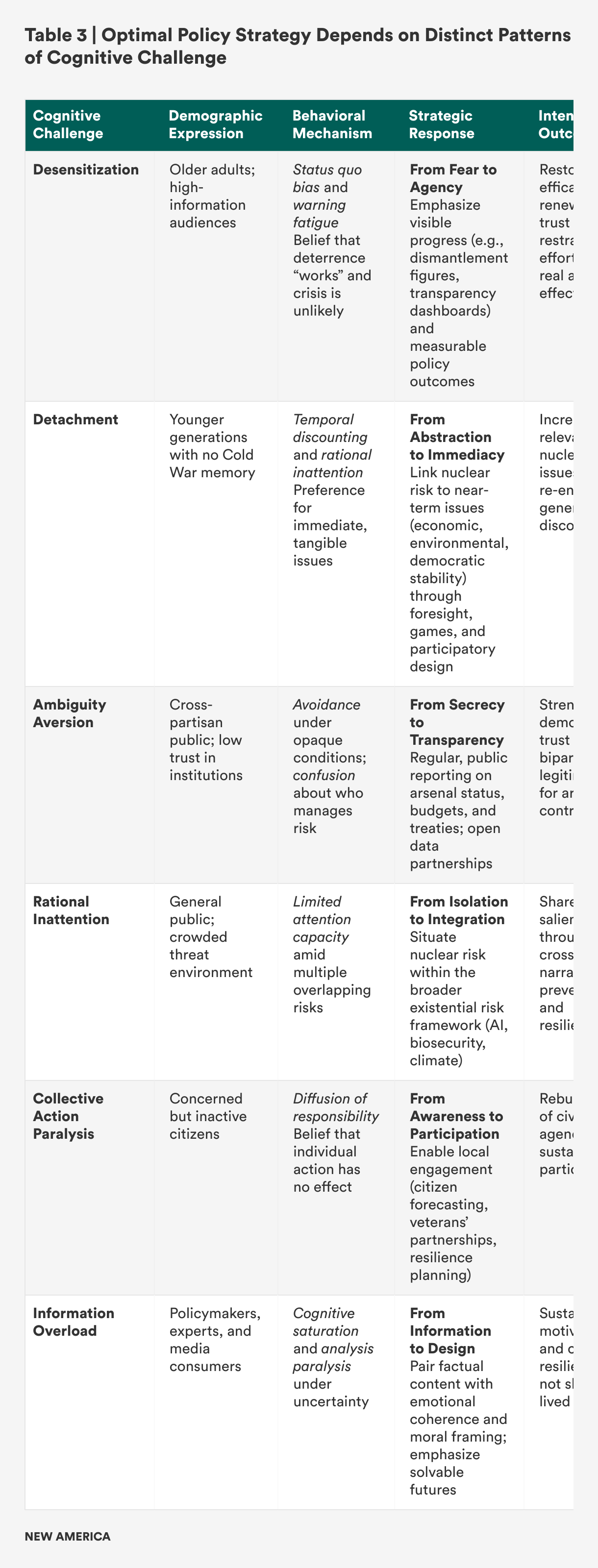
These pathways provide more than a communication roadmap—they create a behavioral foundation for action. By aligning narrative strategies, institutional design, and public participation with how different groups actually process uncertainty, institutions can shift nuclear risk from episodic awareness to sustained attention. The goal is not simply to inform the public, but to build durable civic agency and distributed ownership over nuclear restraint.
Implications Then and Now
Publicly driven arms control once succeeded because three reinforcing conditions—salience, trust, and simplicity—aligned to make nuclear risk both visible and actionable. During the 1960s through the 1980s, nuclear danger felt urgent and imaginable. The Cold War made threat perception visceral: duck-and-cover drills, televised missile crises, and cultural portrayals turned abstract danger into a shared civic experience. Fear was not hypothetical; it was lived. Because the threat felt proximate, engagement felt necessary—and because the media was less fragmented, the public experienced these moments through a common information environment, reinforcing a collective sense of urgency and shared responsibility.
Americans also trusted that their government could act effectively to reduce the danger. Arms control enjoyed broad—though never universal—bipartisan legitimacy, with leaders from Kennedy to Reagan framing it as pragmatic statecraft rather than ideology. While debates over verification, strength, and moral responsibility persisted, there remained a shared baseline of confidence that reducing nuclear risk was both possible and desirable. The Cold War’s binary structure simplified complexity: two superpowers, one existential risk, and one clear solution—limit weapons, avoid war. Public faith in science, diplomacy, and executive leadership reinforced a sense of efficacy: Citizens believed their voices could shape outcomes.
Equally important, movements could translate technical issues into simple, actionable demands. “Freeze the arms race now” and “ban atmospheric tests” converted anxiety into participation. The clarity of these messages, coupled with more active and organized civil society—churches, unions, women’s groups—lowered barriers to entry and created visible feedback loops between activism and policy. When Kennedy cited public support for the 1963 Limited Test Ban Treaty or Reagan echoed the Freeze-era sentiment that “a nuclear war cannot be won,” activism felt validated and influence tangible.
Today, those conditions have dissipated. Salience has faded: The threat feels distant, abstract, and cognitively discounted by habituation and warning fatigue. Trust has eroded: Citizens doubt the credibility of institutions and messengers, which is a form of source discounting amplified by polarization and media fragmentation. Simplicity has evaporated: Nuclear policy is now entangled in complex technical, legal, and geopolitical systems that defy concise framing.
A mix of rarity bias, competing attentional demands, fear-driven avoidance, and a sense of personal futility leads citizens to defer responsibility to institutions and to disengage emotionally from an overwhelming threat. The result is not apathy, but attenuated salience—an informed yet inert public that sees nuclear risk as real, but distant and beyond its influence.
In decision-theoretic terms, these shifts reflect well-documented cognitive mechanisms. The loss of salience follows habituation and attentional triage:repeated exposure to unrealized warnings dulls urgency and pushes nuclear danger to the cognitive margins. The loss of trust stems from credibility collapse and the diffusion of responsibility, as individuals assume that experts and institutions are managing risks that lie beyond their personal influence. The loss of simplicity stems from cognitive overload and ambiguity aversion, whereby the technical and probabilistic complexity of nuclear policy discourages engagement. Together, these forces produce what this paper terms “recognition without mobilization,” an informed but inert public that supports arms control in principle yet exerts little pressure in practice.
Modern information ecosystems deepen this problem. Rapid news cycles accelerate habituation; polarized media environments erode credibility; information saturation magnifies cognitive load. For the future of arms control and risk reduction, the implication is clear: Strategies that once relied on moral vividness, singular events, or mass mobilization cannot simply be revived. Instead, they must be redesigned to align with contemporary cognition: to restore salience without panic, rebuild trust through transparency and participation, and translate complexity into credible, actionable frameworks for engagement.
Citations
- Smeltz, Kafura, and Weiner, Majority in U.S. Want to Learn More about Nuclear Policy, https://www.globalaffairs.org/research/public-opinion-survey/majority-us-want-learn-more-about-nuclear-policy.
- Nina Tannenwald, The Nuclear Taboo: The United States and the Non-Use of Nuclear Weapons (Cambridge University Press, 2007), 22.
- Robert Jervis, Perception and Misperception in International Politics (Princeton University Press, 1976), 217–18.
- William Samuelson and Richard Zeckhauser, “Status Quo Bias in Decision Making,” Journal of Risk and Uncertainty 1, no. 1 (1988): 8–9.
- Daniel Kahneman and Amos Tversky, “Prospect Theory,” Econometrica (1979).
- Paul Slovic, “Perception of Risk,” Science 236, no. 4799 (1987): 280–285; Cass R. Sunstein, “Probability and Neglect,” Yale Law Journal 112, no. 1 (2002): 61–107.
- Tannenwald, The Nuclear Taboo.
- Smeltz et al., Divided We Stand: Democrats and Republicans Diverge on U.S. Foreign Policy, https://globalaffairs.org/sites/default/files/2020-12/report_2020ccs_americadivided_0.pdf.
- Jacques E. C. Hymans, The Psychology of Nuclear Proliferation: Identity, Emotions, and Foreign Policy (Cambridge University Press, 2006), 51–54.
- Marissa Fond et al., An Unthinkable Problem from a Bygone Era: How to Make Nuclear Risk and Disarmament a Salient Social Issue (FrameWorks Institute, August 2016), https://www.frameworksinstitute.org/app/uploads/2020/03/Ploughshares_Strategic_CM_Report_August2016.pdf; Paul Slovic, “The Perception of Risk,” in Scientists Making a Difference: One Hundred Eminent Behavioral and Brain Scientists Talk About Their Most Important Contributions, eds. Robert J. Sternberg, Susan T. Fiske, and Donald J. Foss (Cambridge University Press, 2016), https://www.cambridge.org/core/books/abs/scientists-making-a-difference/perception-of-risk/3027DAE5D15EA792AC4D600F50FE878D.
- Amos Tversky and Daniel Kahneman, “Availability: A Heuristic for Judging Frequency and Probability,” Cognitive Psychology 5, no. 2 (1973): 207–232.
- Cass R. Sunstein, “Probability Neglect: Emotions, Worst Cases, and Law,” Yale Law Journal 112 (October 2002): 61–107, https://www.jstor.org/stable/1562234.
- Tali Sharot, Christoph W. Korn, and Raymond J. Dolan, “How Unrealistic Optimism Is Maintained in the Face of Reality,” Nature Neuroscience 14 (October 2011): 1475–79, https://pmc.ncbi.nlm.nih.gov/articles/PMC3204264/.
- Carol Cohn, “Sex and Death in the Rational World of Defense Intellectuals,” Signs: Journal of Women in Culture and Society 12, no. 4 (1987): 687–718.
- Amy J. Nelson and Alexander H. Montgomery, “How Not to Estimate the Likelihood of Nuclear War,” Brookings Institution, October 19, 2022, https://www.brookings.edu/articles/how-not-to-estimate-the-likelihood-of-nuclear-war.
- Robert Jay Lifton, Death in Life: Survivors of Hiroshima (Random House, 1967); Paul Slovic, “If I Look at the Mass I Will Never Act: Psychic Numbing and Genocide,” Judgment and Decision Making 2 (April 2007): 79–95.
- Cass R. Sunstein, Risk and Reason: Safety, Law, and the Environment (Cambridge University Press, 2002); Paul Slovic, The Feeling of Risk: New Perspectives on Risk Perception (Earthscan/Routledge, 2010).
- Donna van Eerd, “Paralyzing Fear or False Sense of Hope: The Role of Emotions in Climate-Change Communication,” Utblick, March 17, 2024, https://www.utblick.org/2024/03/17/paralyzing-fear-or-false-sense-of-hope-the-role-of-emotions-in-climate-change-communication/; Susanne C. Moser, “Communicating Climate Change Adaptation and Resilience,” Oxford Research Encyclopedia of Climate Science, September 26, 2017, https://oxfordre.com/climatescience/display/10.1093/acrefore/9780190228620.001.0001/acrefore-9780190228620-e-436.
- Kristen Doerer, “Consumers Are Becoming Apathetic to Cyber Incidents, Research Finds,” Cybersecurity Dive, January 13, 2025, https://www.cybersecuritydive.com/news/consumer-trust-cyber-incident-data-breach/737145; Steve Schuchart, “We Are Becoming Numb to Cybersecurity Breaches,” Tech Monitor, July 1, 2025, https://www.techmonitor.ai/comment-2/we-are-becoming-numb-to-cybersecurity-breaches/.
- Smeltz, Kafura, and Weiner, Majority in U.S. Interested in Boosting Their Nuclear Knowledge, https://globalaffairs.org/sites/default/files/2023-07/Nuclear%20Survey%20Report%20PDF.pdf.
- Slovic, “The Perception of Risk,” https://www.cambridge.org/core/books/abs/scientists-making-a-difference/perception-of-risk/3027DAE5D15EA792AC4D600F50FE878D.
- Dennis Mileti and John Sorensen, Communication of Emergency Public Warnings: A Social Science Perspective and State-of-the-Art Assessment (Oak Ridge National Laboratory, January 1990, https://www.osti.gov/servlets/purl/6137387-tDRffv/.
- Mileti and Sorensen, Communication of Emergency Public Warnings, https://www.osti.gov/servlets/purl/6137387-tDRffv/.
- Kull et al., Americans on Nuclear Weapons, https://publicconsultation.org/wp-content/uploads/2019/05/Nuclear_Weapons_Report_0519.pdf.
- Regional Office for Europe, Pandemic Fatigue: Reinvigorating the Public to Prevent COVID-19—Policy Framework for Supporting Pandemic Prevention and Management (World Health Organization, December 2020), https://www.who.int/europe/publications/i/item/WHO-EURO-2020-1573-41324-56242.
- Cass R. Sunstein, Risk and Reason: Safety, Law, and the Environment (Cambridge University Press, 2002), 38–45.
- Daniel Kahnenman, Thinking, Fast and Slow (Farrar, Straus and Giroux, 2011).
- Michal Smetana et al., Atomic Responsiveness: How Public Opinion Shapes Elite Beliefs and Preferences on Nuclear Weapon Use (Social Science Research Network, April 30, 2025), https://papers.ssrn.com/sol3/papers.cfm?abstract_id=5241737; David C. Logan, “Elite–Public Gaps on Nuclear Weapons: The Roles of Salience and Knowledge,” International Organization 79 (Summer 2025), https://www.cambridge.org/core/journals/international-organization/article/elitepublic-gaps-on-nuclear-weapons-the-roles-of-salience-and-knowledge/BD1D6208E7E57E8FB2564302623BEC37.
- Amos Tversky and Daniel Kahneman, “Availability: A Heuristic for Judging Frequency and Probability,” Cognitive Psychology 5, no. 2 (1973): 207–232; Pedro Bordalo, Nicola Gennaioli, and Andrei Shleifer, “Salience and Consumer Choice,” Political Economy 121, no. 5 (2013): 803–843.
- Dina Smeltz et al., Despite Political Tension, Americans and Russians See Cooperation as Essential (Chicago Council on Global Affairs and Levada Analytical Center, March 2021), https://globalaffairs.org/sites/default/files/2021-03/US-Russia%20Brief%20FINAL.pdf.
- John M. Darley and Bibb Latané, “Bystander Intervention in Emergencies: Diffusion of Responsibility,” Personality and Social Psychology 8, no. 4, pt. 1 (1968): 377–383.
- European Central Bank, “Trust in ECB—Insights from the Consumer Expectations Survey,” Economic Bulletin, March 2024, https://www.ecb.europa.eu/press/economic-bulletin/articles/2024/html/ecb.ebart202403_01~05b13dbf02.en.html; MITRE-Harris Poll, Public Perceptions on Securing Critical Infrastructure (MITRE, 2025), https://www.mitre.org/focus-areas/cybersecurity/public-perceptions-securing-critical-infrastructure; “Climate Change Remains Top Global Threat Across 19-Country Survey,” Pew Research Center, August 31, 2022, https://www.pewresearch.org/global/2022/08/31/climate-change-remains-top-global-threat-across-19-country-survey.
- Thomas M. Skovholt, Richard C. Williams, and Cynthia Steffen, “Psychological Reactions to the Nuclear War Threat,” Medicine and War 4, no. 1 (1988): 3–16.
- Paul Slovic, The Feeling of Risk: New Perspectives on Risk Perception (Earthscan, 2010), 167–170.
- Dinic, The YouGov Big Survey on NATO and War, https://today.yougov.com/politics/articles/49675-yougov-big-survey-nato-war-nuclear-weapons-nuclear-war.
- John T. Jost, Mahzarin R. Banaji, and Brian A. Nosek, “A Decade of System Justification Theory: Accumulated Evidence of Conscious and Unconscious Bolstering of the Status Quo,” Political Psychology 25, no. 6 (2004): 881–919, https://psycnet.apa.org/record/2004-21198-003; Ziva Kunda, “The Case for Motivated Reasoning,” Psychological Bulletin 108, no. 3 (1990): 480–98, https://fbaum.unc.edu/teaching/articles/Psych-Bulletin-1990-Kunda.pdf.
- Nina Tannenwald, The Nuclear Taboo; Nina Tannenwald, 23 Years of Nonuse: Does the Nuclear Taboo Constrain India and Pakistan? (Stimson Center, February 22, 2021), https://www.stimson.org/2021/23-years-of-nonuse/.
- Mancur Olson, The Logic of Collective Action: Public Goods and the Theory of Groups (Harvard University Press, 1965), 2–6.
- Bibb Latane and John M. Darley, The Unresponsive Bystander: Why Doesn’t He Help? (Appleton-Century-Crofts, 1970).
- Anthony Downs, “Up and Down with Ecology—The ‘Issue-Attention Cycle,’” The Public Interest 28 (1972): 38–50, https://fbaum.unc.edu/teaching/articles/Downs_Public_Interest_1972.pdf.
- Daniel Kahneman and Amos Tversky, “Prospect Theory: An Analysis of Decision under Risk,” Econometrica 47, no. 2 (1979): 263–291, https://www.jstor.org/stable/1914185.
- Pew Research Center, Americans’ Concerns About War in Ukraine (Pew Research Center, May 10, 2022).
- Pew Research Center, One Year into the Russia–Ukraine War, Americans’ Concerns About the Conflict Have Eased (Pew Research Center, February 23, 2023).
- Smeltz et al., Rejecting Retreat: Americans Support U.S. Engagement in Global Affairs, https://globalaffairs.org/sites/default/files/2020-11/report_ccs19_rejecting-retreat_20190909.pdf; Smeltz et al., Divided We Stand: Democrats and Republicans Diverge on U.S. Foreign Policy, https://globalaffairs.org/sites/default/files/2020-12/report_2020ccs_americadivided_0.pdf.
- Edelman, 2024 Edelman Trust Barometer (Edelman, 2024), https://www.edelman.com/trustbarometer.
- Valentin Mang, Bob M. Fennis, and Kai Epstude, “Source Credibility Effects in Misinformation Research: A Review and Primer,” Advances in Psychology (2024), https://advances.in/psychology/10.56296/aip00028/.
- Smeltz, Kafura, and Weiner, Majority in U.S. Interested in Boosting Their Nuclear Knowledge, https://globalaffairs.org/sites/default/files/2023-07/Nuclear%20Survey%20Report%20PDF.pdf.
Toward Reframing and Reinvigoration
If the preceding analysis explains why warnings fail, the next step is understanding how they might succeed. Translating recognition into mobilization requires reframing nuclear risk to overcome habituation, restore trust, and reestablish a sense of agency. History and behavioral research show that successful “warning-to-action” transitions share several traits: they make abstract risks concrete, pair fear with efficacy, and link personal experience to collective outcomes.98
First, fear alone cannot sustain engagement; it must be coupled with credible pathways for action. Just as climate communication shifted from catastrophe framing to capability framing—emphasizing tangible solutions such as renewable energy and local adaptation—nuclear discourse must highlight verifiable arms control, risk reduction, and norms of restraint. Framing nuclear safety as a shared governance challenge—one that involves citizens, scientists, and policymakers alike—helps restore a sense of agency and counters the learned helplessness that fuels complacency.
Second, immediacy, moral salience, and reciprocity drive attention more effectively than abstract doom. Nuclear communication should link stability to near-term security and economic stakes, simplify deterrence through accessible visuals and analogies, and emphasize human stories—communities near test sites, veterans, or first responders—over apocalyptic scenarios. In recent years, advocacy around the Radiation Exposure Compensation Act and the experiences of impacted communities has begun to move in this direction, reframing nuclear risk through lived experience rather than distant abstraction. Building on these approaches can make nuclear danger emotionally legible without inducing paralysis.
A more evidence-based approach to nuclear communication also requires understanding which visual cues, metaphors, and narrative frames actually resonate with different audiences. We recommend dedicated polling and message-testing—especially focused on imagery and generationally tailored formats—to identify which messages make nuclear risk intelligible rather than abstract. Some foundational work exists. For example, NTI and Ploughshares’ Rewriting the Narrative on Nuclear Weapons, developed with ReThink Media, used media audits and focus groups to craft narrative frameworks.99 But the field still lacks large-scale, randomized polling and systematical visual-format testing. Filling this gap remains would sharpen communication strategies, strengthen shared mental models of nuclear danger, and provide an empirical foundation for future research.
Third, the nuclear policy field can build on its existing communication efforts by drawing selectively from approaches that have helped other domains bridge the awareness-action gap. Public health reframed vaccination as a civic responsibility; climate communication has shifted from abstract metrics (parts per million) to lived experiences (floods and fires); and AI governance increasingly links safety to societal well-being. These examples illustrate that moral urgency must be translated into relatable experience and agency-enhancing narratives. Nuclear communication has already begun similar work—through community-based storytelling, justice-focused advocacy, and narrative reframing—but additional tools remain underused.
Fourth, nuclear issues must be integrated into broader conversations about long-term security and systemic resilience, which some have already begun to explore.. Nuclear risk need not compete with other global challenges; rather, it can be woven into a shared language of prevention and preparedness. Framing nuclear risk as part of an interdependent risk ecosystem—alongside climate, AI, and biosecurity—situates nuclear policy within a forward-looking agenda of collective responsibility and helps people understand managing nuclear risk as part of a broader effort to manage systemic danger. Digital media can reinforce this integration: Short, emotionally resonant stories, visual simulations, and participatory foresight exercises can turn fleeting awareness into sustained, networked engagement. These approaches broaden the coalition of stakeholders while reinforcing that nuclear safety is inseparable from the wider project of building a secure and resilient future.
Fifth, rebuilding trust with the voting public requires complementing traditional communication with more participatory forms of engagement. Citizen assemblies, community dialogues, participatory foresight exercises, and partnerships between expert, educational, veterans and civic groups can translate abstract dangers into shared responsibility.100 The goal is not to revive Cold War fear, but to rebuild cognitive and emotional infrastructure for sustained attention—replacing apathy with efficacy and fear with stewardship.
Pathways to Implementation
Public disengagement from nuclear risk is not the result of ignorance but of patterned reasoning under uncertainty. It is, in many cases, a rational response to an environment where the threat is abstract, the probabilities unclear, and individual influence feels negligible. The analysis in this report shows that inattention stems from predictable cognitive dynamics—status quo bias, rational inattention, temporal discounting, and diffusion of futility—that shape how people perceive, prioritize, and act on existential threats. These biases are reinforced by generational experience, political identity, and the structure of modern media.
Polling data reveal corresponding demographic variations. Older Americans tend toward desensitization after decades of nuclear tension without war, expressing confidence in deterrence as proof of stability. Younger Americans exhibit detachment, prioritizing climate and technological risks that feel more immediate and actionable. High-information consumers and elites often display overconfidence bias—believing that existing institutions and deterrence mechanisms will self-correct—while women express greater concern but lower perceived efficacy.
Effective nuclear engagement must therefore begin from a behavioral foundation: It must be designed not just to inform, but to align with how people actually think, feel, and decide. The following pathways translate these insights into targeted strategies for restoring salience, agency, and collective attention.
1. From Fear to Agency: Countering Desensitization
Among older and high-information audiences, repetition without visible consequence has produced status quo bias and warning fatigue: a belief that deterrence “works” and that activism is unnecessary. Polling underscores this pattern, showing that broad support for arms control coexists with low engagement and declining trust in government efficacy.
Implementation: Reframe nuclear restraint around agency, not alarm. Replace catastrophic appeals with tangible indicators of progress, such as transparency dashboards showing annual warhead dismantlement or funding tradeoffs that illustrate opportunity costs. These cues of movement and accountability reestablish public efficacy and demonstrate that nuclear restraint is an ongoing process, not a lost cause.
2. From Abstraction to Immediacy: Engaging Younger Generations
For younger Americans, nuclear danger is distant, historical, and abstract. Surveys show that they rank nuclear risks far below climate change, AI, or pandemics. This reflects temporal discounting—a tendency to undervalue threats perceived as remote—and rational inattention to low-frequency dangers.
Implementation: Anchor nuclear risks in near-term, lived experience. Link them to economic stability, environmental safety, and the health of democracy. Use participatory foresight tools—scenario exercises, interactive media, and immersive simulations—to connect abstract nuclear issues to immediate social and moral concerns. Imagination, not alarm, will reintroduce the issue to a generation raised without Cold War memory.
3. From Secrecy to Transparency: Rebuilding Trust Across Partisan Lines
Polling consistently shows bipartisan support for arms control but low confidence in institutional follow-through. This pattern reflects ambiguity aversion. When information is opaque, citizens disengage.
Implementation: Adopt a culture of strategic transparency—treating openness not as a liability but as a source of legitimacy. Public reporting on arsenal size, dismantlement rates, and spending can restore credibility and strengthen democratic trust. Open data dashboards, unclassified briefings, and partnerships with universities can create transparency, turning distant processes into tangible progress.
4. From Isolation to Integration: Competing for Attention in a Crowded Risk Environment
By the late 2010s, polling showed that Americans ranked cyberattacks, climate change, and pandemics well above nuclear war as national security threats. This is a function of rational inattention: Finite attention is drawn to crises that feel more current, visible, or actionable.
Implementation: Integrate nuclear risk into the broader ecosystem of existential and systemic threats. Framing nuclear restraint as part of the same prevention agenda as AI safety, biosecurity, and climate adaptation fosters associative salience and cross-domain collaboration. Joint foresight networks and multi-risk scenario projects can make nuclear stability legible within a shared vocabulary of prevention and resilience.
5. From Awareness to Participation: Restoring Efficacy and Collective Action
Four in five Americans support arms control, yet fewer than one in five have ever taken related civic action. This reflects collective action paralysis—a belief that individual effort cannot meaningfully alter systemic risks.
Implementation: Translate concern into low-barrier participation. Partner with civic, educational, and veterans’ organizations to embed nuclear risk in community narratives of stewardship and preparedness. Activities such as citizen forecasting challenges, participatory wargames, or local resilience planning can transform passive awareness into active engagement. Visible, measurable participation reawakens the belief that individual and collective actions matter.
6. From Information to Design: Embedding Cognitive Insight in Communication
Traditional nuclear communication assumes that more information leads to better understanding. Decision theory demonstrates that this is rarely the case: When uncertainty is high, more data can paralyze rather than empower.
Implementation: Treat communication as cognitive design. Pair analytic content with emotional coherence and moral framing, emphasizing both why nuclear risks matter and how they can be reduced. Campaigns that couple facts with credible solutions activate both rational and affective (or emotional) reasoning—turning attention into sustained motivation rather than momentary alarm.
Integrating These Pathways
The goal is not a single campaign but a durable architecture of public cognition—an infrastructure of awareness and agency that persists beyond news cycles. Polling data and behavioral research together reveal where to begin: Older Americans need renewed efficacy; younger ones need immediacy and imagination; all citizens need visible proof that restraint works.
By aligning nuclear communication and policy outreach with how people actually reason under uncertainty, these pathways offer more than a messaging strategy—they outline a modern theory of change. Restoring nuclear salience will require designing institutions, narratives, and participatory experiences that transform recognition into responsibility and awareness into sustained action.
Reframing nuclear risk requires more than new narratives; it demands institutional transparency, narrative innovation, digital adaptability, and cross-domain integration. These shifts call for a reimagining of how governments, civil society, and funders sustain public understanding and trust over time.
At the institutional level, governments should move from a culture of secrecy to one of strategic transparency—treating communication not as a vulnerability but as a tool of deterrence and legitimacy. The Nuclear Risk Reduction Center, created as a crisis “firebreak” between Washington and Moscow, could evolve into a dual-purpose institution: continuing its operational role while providing public transparency about treaty compliance and communication activities.101 Regular, unclassified briefings, open data dashboards, and plain-language reports would make the machinery of restraint visible, showing that nuclear stability is actively maintained even amid tension.
Additional measures could deepen this transparency ecosystem. The United States could resume the practice, common in the early 1990s, of publishing annual data on warhead dismantlement and the transfer of weapons from the “active” to the “inactive” stockpile—creating a visible “thermometer” of disarmament progress. The Department of Energy and the Pentagon could jointly review classified holdings, especially Unclassified Controlled Nuclear Information, to identify material that could be safely declassified and used to improve public understanding. Finally, routine publication of nuclear spending and modernization budgets, coupled with clear trade-offs among other national priorities, could help reintroduce a sense of civic agency into nuclear decision-making. Transparency in this sense becomes participatory: a means of not only verification but of public inclusion in governance.
Civil society and advocacy organizations play a parallel role in sustaining salience through narrative design rather than episodic campaigns. As a 2023 report from Ploughshares and the Nuclear Threat Initiative shows, traditional fear-based communication has diminishing returns.102 Audiences today respond not to abstract warnings but to narratives that connect nuclear risk to values they already hold—safety, community, and justice. To maintain durable awareness, advocates must alternate between moments of urgency and reflection, link global risks to local experience—such as environmental cleanup or community preparedness—and elevate diverse voices that humanize the issue. Storytelling in this context becomes strategic infrastructure: Creative media, immersive exhibits, and participatory projects can make nuclear danger emotionally legible without relying on fear. Public briefings, partnerships with universities, and simulation-based outreach could further strengthen democratic trust, modeling transparency as strength and setting a new global norm of reciprocal accountability.
Digital ecosystems are equally critical for sustaining engagement and countering information decay. Instead of relying on crisis-driven spikes, institutions and advocates can use serial storytelling—short, episodic updates that maintain continuity of attention between crises. Partnering with trusted intermediaries, such as scientists, journalists, or veterans, can broaden credibility and reduce polarization. During periods of heightened tension, coordination with major platforms could ensure that verified nuclear content—such as treaty updates or de-escalation statements—is prioritized in search and recommendation systems. Properly designed, digital communication becomes a form of cognitive resilience: It extends the life of public attention, resists manipulation, and fosters adaptive, two-way dialogue.
Some in the field are already pioneering this communication shift. Kate Kohn’s work at the Federation of American Scientists offers a distinctive model: platform-native, visually playful, and intentionally steeped in pop-culture idioms that resonate with younger audiences. Her irreverent, sometimes delightfully unhinged communication style cuts through the polished formality that often alienates Gen Z and Millennials, reframing nuclear risk in a voice that feels familiar, accessible, and culturally fluent. This kind of creative narrative strategy illustrates how digital-first communication can make nuclear issues legible in a crowded information environment while capturing attention that traditional formats cannot.
Finally, nuclear risk should be integrated into the broader futures and existential-risk agenda. Issues such as climate change and artificial intelligence face many of the same “fear-paralysis” traps that nuclear policy has long encountered—where the scale of the threat overwhelms action rather than motivating it. Framing nuclear restraint as a pillar of collective resilience situates it alongside climate adaptation, AI governance, and biosecurity, not as a competing cause but as a complementary one. Governments, researchers, and funders can build cross-domain foresight networks that use scenario planning, horizon scanning, and public forecasting to anticipate rather than react to threats.
Philanthropic initiatives such as the newly launched Humanity AI collaborative demonstrate how coordinated, field-wide approaches can bridge technology governance, security, and ethics. The Future Security Scenarios Lab at New America (FSSL) aims to advance this kind of integrated foresight, connecting nuclear, AI, and climate communities through scenario design, behavioral research, and policy innovation. There is a growing need for organizations capable of sustaining this cross-domain capacity. By embedding nuclear issues within a shared, future-oriented framework for managing systemic danger, FSSL seeks to help shape a new generation of anticipatory, interdisciplinary security thinking.
These approaches redefine nuclear communication as a system of cognitive stewardship—making deterrence legible, engagement durable, and prevention actionable.
Citations
- Jessica G. Myrick and Robin L. Nabi, “Fear Arousal and Health and Risk Messaging,” Oxford Research Encyclopedia of Communication, 2017, https://oxfordre.com/communication/display/10.1093/acrefore/9780190228613.001.0001/acrefore-9780190228613-e-266; Laura Fischer et al., “You Have to Send the Right Message: Examining the Influence of Protective Action Guidance on Message Perception Outcomes Across Prior Hazard Warning Experience to Three Hazards,” Weather, Climate, and Society 15, no. 2 (2023): 307–26, https://doi.org/10.1175/WCAS-D-22-0092.1.
- Ploughshares Fund and Nuclear Threat Initiative (NTI), Rewriting the Narrative on Nuclear Weapons: A Research-Based Guide to Building a Safer Future (Ploughshares Fund and NTI, March 2025), https://www.nti.org/analysis/articles/rewriting-the-narrative-on-nuclear-weapons-a-research-based-guide-to-building-a-safer-future/.
- Citizen assemblies are groups of randomly selected, demographically representative citizens who come together to study an issue, hear from experts, deliberate with one another, and recommend policy options that are reflective of the population as a whole. They are not activists, professionals, or interest groups. The goal of the assemblies is to give policymakers guidance grounded in informed public judgment.
- National and Nuclear Risk Reduction Center, History of the National and Nuclear Risk Reduction Center (U.S. Department of State, accessed October 2025), https://www.state.gov/history-of-the-national-and-nuclear-risk-reduction-center.
- Ploughshares Fund and Nuclear Threat Initiative, Rewriting the Narrative on Nuclear Weapons, https://www.nti.org/analysis/articles/rewriting-the-narrative-on-nuclear-weapons-a-research-based-guide-to-building-a-safer-future/.
Conclusion
Nuclear complacency is not evidence of safety—it is the symptom of a changing cognitive and cultural landscape. Today’s inaction reflects not ignorance but adaptation: Citizens have learned to live with existential danger by normalizing it. Traditional warning mechanisms—alarmist narratives, iconic symbols, or cultural flashpoints —no longer penetrate the noise of modern risk perception. Nuclear fear, once proximate and politically mobilizing, has become ambient background risk.
Generational, demographic, and informational patterns reveal how this shift has unfolded. Older Americans, shaped by Cold War experiences and repeated misses, exhibit desensitization—having lived through repeated nuclear crises that ended without war, they interpret the absence of catastrophe as evidence of deterrence “working.” Among younger Americans, the issue suffers from detachment: a lack of lived experience turns nuclear risk into abstraction. High-information consumers and elites—those most exposed to nuclear narratives—show signs of warning fatigue, while women tend to express greater concern but less perceived agency. These differences map cleanly onto decision-theoretic mechanisms: status quo bias and probability neglect among older cohorts, rational inattention and cognitive distancing among younger ones, and the diffusion of futility among those who care most but feel least empowered. Together, they produce recognition without mobilization: a public that acknowledges nuclear danger yet exerts little sustained pressure for change.
Understanding these dynamics clarifies what must come next. Restoring nuclear salience requires working with, not against, contemporary cognitive dynamics. For younger generations, engagement must begin with imagination—immersive, participatory foresight and narratives that make risk concrete without relying on fear. For older cohorts, the task is to pair familiarity with renewed agency, showing restraint is not static, but actively maintained. For women and civic leaders, linking nuclear safety to justice, community resilience, and intergenerational stewardship can rebuild moral relevance. Across these groups, the task is to translate recognition into responsibility.
Public opinion offers a rare asset: broad, bipartisan support for arms control and risk reduction. The challenge is sustaining that support across time and attention cycles. Doing so will require new forms of communication and institutional design—transparency practices that make restraint visible, narrative strategies that connect nuclear issues to lived experience, and digital storytelling that maintains continuity during long periods without crisis.
Whereas polling data reveal what Americans believe about nuclear danger, decision theory explains why they believe it. This synthesis clarifies that nuclear inattention is not apathy but a coping strategy—a way of reconciling uncertainty with normal life. Citizens manage existential risk through normalization, not denial, and this adaptation (while psychologically protective) has eroded vigilance and civic engagement. Ultimately, restoring nuclear salience will depend less on amplifying fear than on cultivating agency. The goal is to rebuild connections between awareness and action—to show that nuclear risk is not an immutable fact of international life, but a domain where citizens, institutions, and governments can shape outcomes. By articulating credible pathways for restraint, transparency norms, and long-term risk governance, we can work to transform resignation into purpose and extend the moral horizon of security itself. The task ahead is not simply to warn, but to ensure that public recognition of nuclear danger produces the collective will to reduce it—and to imagine a future in which nuclear weapons no longer define what it means to feel secure, where deterrence is understood as a temporary bridge, not a permanent foundation.
This report offers more than a descriptive account of disengagement—it aims to provide a roadmap for renewal. Polling data reveal that public concern about nuclear weapons, while diffuse, remains bipartisan—a rare foundation for rebuilding political legitimacy around arms control and risk reduction. The challenge is not to create awareness but to sustain it: to transform fleeting salience into lasting cognitive infrastructure. Doing so will require narrative innovation, educational design, and digital engagement strategies that make restraint visible, relatable, and continuous rather than episodic.
More About the Author

Amy J. Nelson
Director, Future Security Scenarios Lab, New America; Senior Fellow, Future Security Program, New America
Issues
Programs/Projects/Initiatives
Topics
Related

Beyond Bilateral: What Trump’s Multilateral Gambit Can and Cannot Fix Review


How Russia’s Undersea Nuclear Buildup Is Reshaping the Arctic