Conversations in California on District Budget Transparency

In California, Governor Arnold Schwarzenegger’s Committee on Education Excellence released its long-overdue final report last week with recommendations for reforming the state’s K-12 education system in four areas: governance, finance, teacher recruitment and retention, and administrator preparation and retention. The finance section, titled “Ensure Fair Funding that Rewards Results,” offers a number of good, detailed ideas for making state funding more flexible and student-centered, and better tied to incentives to improve learning.
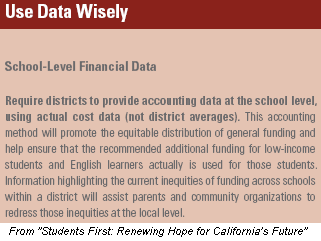 One specific proposal in the report caught Ed Money Watch’s eye: Recommendation 2.1.8—make school budgets more understandable. We believe that changing school district budgeting practices is a key first step in school finance reform. Education advocacy groups in California have been talking about this for a long time, and it’s encouraging to see a state committee acknowledge the need for change. We hope that other states will take note.
Specifically, school districts need to report how funding is allocated—using the actual cost of resources—across all of their schools. Currently, districts do not report school-level funding figures, instead using district averages to calculate budgets. As the California report recommends, districts should “clearly delineat[e] the total resources (i.e., the financial value of the personnel, supplies, and services) that reach each school.”
Why is this important? Many school districts—specifically, large, diverse districts, which are common in California—systematically spend less on their poorest schools than they do on more affluent schools. Policymakers, parents, and the public are largely unaware of these disparities, because school districts are not required to report them, and district budgeting practices mask their existence.
If the state is going to invest its money in a funding formula that gives additional money to districts based on student needs (as the Governor’s Committee recommended), it must ensure that the additional resources actually reach the students who need them. Without more transparent budgeting practices at the district level, the state, parents, and other stakeholders will never know.
More About the Author
Issues
Related

Tracking the AI Economy: Seven Charts Every Presidential Candidate Should Study

Five Places to Watch: Where Kindergarten Is Being Rediscovered

How Colleges Can Use Workforce Pell to Level Up