Comparing the House and Senate Stimulus Bills

On Wednesday the House passed its version of the stimulus bill and the Senate reported from committee the text of its version. Both bills dedicate more than $140 billion to education programming including Title I, IDEA, and school construction. While each version provides similar funding for most programs, the House passed version includes funding for a number of smaller initiatives that the Senate bill does not.
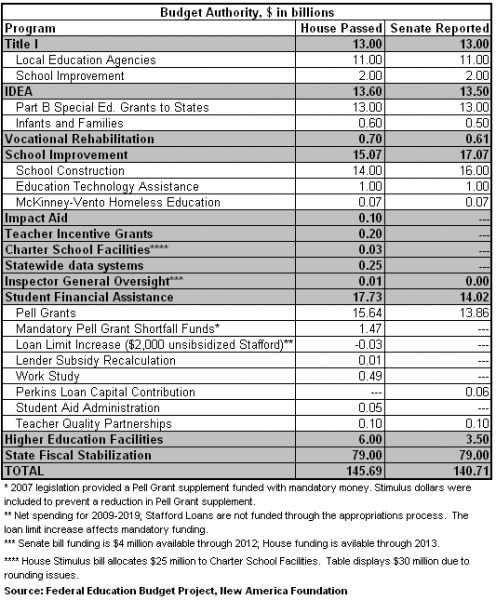
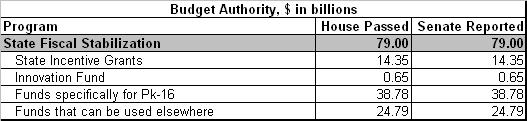
The House and the Senate fund Title I and IDEA at similar amounts. They also allocate the same amount for the State Fiscal Stabilization fund which includes the State Incentive Grants and the Innovation Fund.
Fifteen of the $79 billion for State Fiscal Stabilization are dedicated to the State Incentive Grants and Innovation Fund. The legislation specifies that states must use 61 percent of the remaining $64 billion toward elementary, secondary, postsecondary education, and early childhood education programs and services. The balance can be used toward education or other programs like public safety and government services. The State Incentive Grants are for schools and school districts that have made strides in meeting education objectives like Adequate Yearly Progress. Innovation Fund dollars are for schools, school districts, or partnerships that have succeeded in closing the achievement gap.
The House bill provides stimulus funds to a number of smaller programs including Teacher Incentive Grants, Charter School Facilities, and Statewide Data Systems. These programs are viewed by some as slightly more “reform-minded” because they aim to alter the way federal dollars affect schools. Their exclusion from the Senate bill has led some to claim that the Senate is supporting the “status quo” in education.
Teacher Incentive Grants provide funds to states and school districts to create new and innovative teacher pay or incentive programs. These grants aim to attract more highly qualified teachers into hard-to-staff subjects and schools or bring second career teachers into education. Charter School Facilities funds would put more federal dollars into the physical capital available to charter schools, freeing up funds for other uses. Statewide Data Systems would provide funds for the creation of longitudinal student-level data systems to track students from pre-K through college and beyond.
The House and Senate bills require different methods of allocation for school construction funds. While the house bill funds construction more widely to all local education agencies (based on their share of Title I allocation), the Senate version allocates money to the 100 largest local education agencies and then distributes remaining funding through a statewide competitive grant program. The House version would disperse small amounts of funding widely while the Senate version would concentrate funding, likely allowing for more major construction projects.
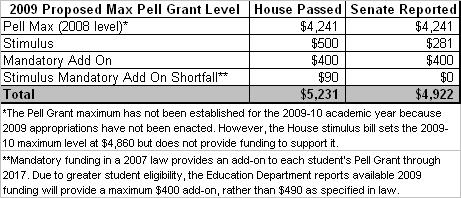
The House and Senate bills differ somewhat in their allocation of funds for student financial assistance. Both include sizeable funding for Pell Grants ($15.6 billion for the House and $13.9 billion for the Senate), but the House bill also directs funding toward Work Study and increases the unsubsidized Stafford loan limit by $2,000. The Senate bill includes neither, but provides a capital contribution for Perkins Loan revolving funds at colleges and universities. Teacher Quality Partnership grants receive $100 million in both bills.
In the end, the Senate and the House education stimulus amounts differ by a little more than $5 billion. The differences are relatively insignificant beyond a few favored programs in each bill. We look forward to seeing how it all shakes out in the conference committee bill.
More About the Author
Issues
Related

The 25-Year Detour

The Education Department Gave Us the List of 2026 CCAMPIS Grantees

How Americans View a Changing Higher Ed Landscape