Comparing Education Jobs Fund and Race to the Top Allocations

Yesterday, Ed Week’s Michele McNeil published an interesting analysis comparing states’ potential allocations under the Education Jobs Fund to their potential maximum winnings under Race to the Top. The Education Jobs Fund is a $10 billion program pending in Congress to help states avoid K-12 teacher layoffs, while Race to the Top is a $4.4 billion competitive grant program enacted in 2009 to support states implementing reform initiatives. A bill that passed the U.S. House of Representatives last week and now awaits Senate consideration cuts $500 million from the remaining $3.4 billion for Race to the Top to help offset the costs of the Education Jobs Fund. However, several Senators and the President have both expressed disapproval of any bill that would take money away from Race to the Top.
In her analysis, McNeil suggests that for some states, like those who decided not to apply for Race to the Top or who have little chance of winning any of the money (Race to the Top is a competitive grant program), the House-passed Education Jobs Fund is more attractive. As a result, these states should be in favor of the proposed cuts to Race to the Top and passing the Education Jobs Fund. At the same time, for states that are highly likely to win Race to the Top funds, any cut to the program is unlikely to affect them because, even with the cuts, they will receive funds from both programs.
As a result, the tradeoff between the Education Jobs Fund and Race to the Top only truly matters for states at the margin of winning Race to the Top. In other words, there are likely two or three states that will win a Race to the Top grant if Congress doesn’t approve the $500 million cut from the program, but will not win a Race to the Top grant if Congress does decide to make the cut. For all states but California and Illinois, their potential winnings under Race to the Top are larger than any allocation they would receive under the Education Jobs Fund.
To get a sense of which states might be most affected by this tradeoff, Ed Money Watch has extended McNeil’s analysis to include all 50 states, Puerto Rico, and the District of Columbia. The table below shows each state’s potential allocation under the House-passed Education Jobs Fund, and maximum potential winnings under Race to the Top if they applied in round two. Additionally we have included each state’s previous ranking under round one of the Race to the Top competition and a marker of whether the state is considered a wild card under round two of Race to the Top.
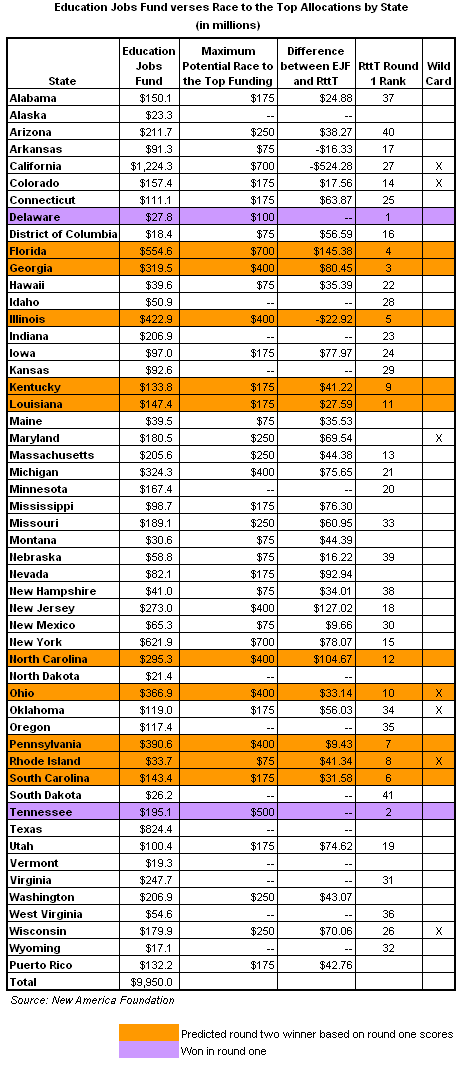
Using this data, we estimated which states are most likely to win funds during round two of Race to the Top using both their previous rankings and incorporating some of the potential wild cards into the theoretical winners circle. These wild card states, which have received media attention for their dramatically altered round two Race to the Top applications, include California, Colorado, Maryland, Ohio, Oklahoma, Rhode Island, and Wisconsin. It is important to note, however, that these estimates are purely conjecture based on the available information.
If the outcome of round two of Race to the Top is identical to round one and Race to the Top funds are not cut, we estimate that 10 states will win awards totaling $3.3 billion (those states that ranked 3rd through 12th in round one). These states are Georgia, Florida, Illinois, South Carolina, Pennsylvania, Rhode Island, Kentucky, Ohio, Louisiana, and North Carolina. However, if Congress passes and the President signs the Education Jobs bill, only $2.9 billion would be available under Race to the Top. In this situation North Carolina, which is ranked lowest, would not receive a $400 million Race to the Top grant. While North Carolina would receive $295.3 million under the Education Jobs Fund, it would lose a net $104.7 million.
If some of the wild card states that have dramatically improved their Race to the Top applications do win awards in round two, the lineup of winners will be somewhat different. Under this situation, we estimated two potential scenarios – one in which California does win a $700 million grant and one in which it does not win such a grant. Under the first scenario with $3.3 billion in total winnings, the potential winners are Georgia, Florida, Illinois, South Carolina, Rhode Island, Wisconsin, California, Colorado, Oklahoma, and Maryland. Should the total Race to the Top pot be limited to $2.9 billion, two or three of those wild card states like Wisconsin, Colorado, Oklahoma, and Maryland could be on the chopping block. For these states, Race to the Top would also provide greater funding than the Education Jobs Fund.
If California does not win in round two of Race to the Top, we estimate that the potential winners totaling $3.4 billion in winnings could include Georgia, Florida, Illinois, South Carolina, Rhode Island, Ohio, Pennsylvania, Wisconsin, Colorado, Oklahoma, and Maryland. Under the $2.9 billion Race to the Top scenario, the wild card states would again be threatened with no Race to the Top winnings.
In the end, and in purely monetary terms, it seems that the trade off between the Education Jobs Fund and the proposed Race to the Top cut only affects a few states – those at the margin of winning Race to the Top like North Carolina, Wisconsin, Colorado, Oklahoma, California, and Maryland. For states like Florida, Georgia, Louisiana, and South Carolina, Race to the Top seems to be in the bag and any cuts to the program will not affect them. In fact, they will come out ahead with hundreds of millions of dollars from both the Education Jobs Fund and Race to the Top. Similarly, for states that have chosen not the participate in Race to the Top at all, like Texas, Alaska, and Minnesota, the Education Jobs Fund makes financial sense because they are guaranteed an allocation.
It should also be said that a $400 million Race to the Top grant comes with a different set of requirements and restrictions than a $400 million Education Jobs Fund allocation. Race to the Top winnings must be used to implement highly structured reform activities outlined in a state’s application. In contrast, the Education Jobs Fund monies must be used to support local salary and benefits expenses to keep teachers and other school personnel in their jobs. Thus, Race to the Top does not mean simple, fungible dollars in the state’s budget in the same way that the Education Jobs Fund would.
This discussion also ignores the political implications of the pending Education Jobs Fund and Race to the Top. Many legislators and policymakers view the House-passed Education Jobs Fund unfavorably because they consider it wasteful spending that allows schools to maintain the status quo. For these stakeholders, the Education Jobs Fund is a no-go even if it means great financial gain for their state. At the same time, some legislators and policymakers have soured on Race to the Top because they believe it is supporting the wrong types of reform initiatives and giving too much power to the Obama Administration. These critics favor cuts to the program even if it could potential hurt their states.
And in many cases, legislators subscribe to both schools of thought and would like to see an end to the Education Jobs Fund and Race to the Top. As a result, the discussion in Congress and elsewhere over these two programs has little to do with potential financial gain for states – even in those that need it most – and more to do with politics.
To download a PDF of these data, click here
More About the Author
Issues
Related

Current Head Start Program Performance Standards Protect Children with Disabilities

New Report Offers Bipartisan Solutions to State Child Care Woes

Tracking the AI Economy: Seven Charts Every Presidential Candidate Should Study